
Summer Solstice Farming
「夏至不锄根边草,如同养下毒蛇咬。」
During 夏至 (Xiàzhì, Summer Solstice), the Northern Hemisphere experiences its longest days and greatest duration of sunlight, while most of China enters the height of summer. On the North China Plain, the winter-wheat harvest is largely complete, summer maize and summer soybean sowing is fully finished, and farmland shifts into summer management; across the Yangtze River basin, the 梅雨 (*plum-rain season*) enters its peak, while early rice moves from heading and flowering into grain filling; in South China, early rice enters grain filling, the “龙舟水” (*Dragon Boat rains*) continue, and flood-control pressure remains high. In Northeast China, maize and soybeans enter vigorous growth and full-scale field management begins; in Northwest China, spring wheat enters heading and flowering while cotton enters budding. In the temperate Southern Hemisphere, the Winter Solstice arrives with the shortest daylight of the year, and autumn-sown crops in southeastern Australia and Argentina remain in overwintering dormancy. Across the tropical Northern Hemisphere, the rainy season continues and rice enters tillering-to-jointing management; in the tropical Southern Hemisphere, the dry season deepens and dry-season crops remain in active growth.
Global Agriculture
Temperate Regions of the Northern Hemisphere
Phenological Signs
Most of China enters the height of summer and temperatures rise markedly. Across the North China Plain, fields lie exposed after the wheat harvest, awaiting the next crop. In the Yangtze River basin, the plum-rain season enters its peak, with prolonged cloudy and rainy weather and atmospheric humidity reaching its annual maximum, while rice fields turn a deep green. The rainy season continues across Japan’s Kantō region, while South Korea enters the peak of its rainy season. Cicadas begin to call, and deer begin shedding their antlers.
Farming Activities
The winter-wheat harvest on the North China Plain is largely complete, with grain safely stored and summer maize and summer soybean sowing fully finished, shifting farmland into summer management that includes stand inspection and gap filling, thinning and final stand establishment, intertillage and weed control, fertilization, and pest and disease management. Summer maize enters a critical seedling-management stage and requires timely thinning and stand establishment, completed at the 3–4 leaf stage, application of seedling fertilizer, and control of early-season pests. Across the Yangtze River basin, early rice moves from heading and flowering into grain filling and requires stronger water and nutrient management, including maintenance of a shallow water layer and application of 穗肥 (*panicle fertilizer*); during the peak plum-rain period, farmers must guard against waterlogging as well as rice blast, sheath blight, planthoppers, and other pests and diseases. In South China, early rice enters grain filling and requires a secure water supply, with fields kept moist and never allowed to dry out, while farmers guard against flooding caused by “龙舟水” and against heat-forced maturity. Northern orchards enter fruit enlargement and growers strengthen water and nutrient management through 膨果肥 (*fruit-enlargement fertilizer*), mainly potash, together with pest and disease control. Maize and soybeans in Northeast China enter vigorous growth, with full-scale management of maize at jointing and soybean at flowering. In Northwest China, spring wheat enters heading and flowering and requires secure water supply and pest and disease control, while cotton enters budding and needs stronger water and nutrient management.
Phenological Signs
Temperatures across Western Europe rise to 25–30°C and winter wheat enters large-scale harvest, turning the countryside golden. Summer vegetation in France and Germany reaches its peak growth and lavender enters flowering. In Central Europe, temperatures rise to around 25°C, forests remain densely closed, and the character of summer becomes pronounced.
Farming Activities
Winter wheat in France and Germany enters large-scale harvest, with combines working day and night as farmers seize clear weather for cutting, drying, and storage. Across Ukraine’s chernozem belt, winter wheat also enters large-scale harvest and the region’s harvest season unfolds fully. In Bordeaux, Rheinhessen, and other wine-producing regions, grapes move from the young-fruit stage into early enlargement; summer pruning, including lateral-shoot removal, fruit thinning, and tying, proceeds alongside pest and disease control, with downy mildew and powdery mildew entering key treatment windows. In Northern Europe, spring wheat enters heading and flowering and summer field management advances fully.
Phenological Signs
Across the winter-wheat belt of Kansas and Nebraska, temperatures rise to around 30°C and wheat fields enter large-scale harvest. Orchards in California’s Central Valley enter fruit enlargement and young fruit develops rapidly. In the U.S. Midwest, spring maize moves from jointing toward tasseling and fields become a deep green. In Ontario, Canada, crops enter rapid growth.
Farming Activities
Winter wheat in Kansas, Nebraska, and other producing areas enters large-scale harvest, with combines operating day and night as farmers seize clear weather for cutting, drying, and storage. Orchards in California’s Central Valley enter fruit enlargement and growers strengthen water and nutrient management through 膨果肥, mainly potash, together with pest and disease control. Spring maize in the U.S. Midwest moves from jointing into tasseling and requires stronger water and nutrient management, including 拔节肥 (*jointing fertilizer*) at 8–10 kilograms of urea per *mu* and adequate water supply, together with control of corn borer, aphids, leaf spot, and other pests and diseases. Cotton in the southeastern United States enters budding, while peanuts enter flowering and pegging. Across Canada’s Prairie Provinces, spring wheat enters heading and flowering and summer field management expands fully.
Phenological Signs
Winter wheat on Turkey’s Anatolian Plateau enters harvest and the fields turn golden. Along Iran’s Caspian coast, fruit trees enter fruit enlargement. In Morocco and Algeria, the winter-wheat harvest approaches its end.
Farming Activities
Winter wheat in Turkey, Iran, and other parts of the Middle East enters harvest, and farmers seize clear weather for cutting, drying, and storage. Along the Mediterranean coasts of Israel, Morocco, and other parts of North Africa, the winter-wheat harvest approaches completion and summer management proceeds fully. Vineyard winter dormancy continues in South Africa’s Cape region.
Temperate Regions of the Southern Hemisphere
Phenological Signs
It is the Winter Solstice, with the shortest daylight of the year. Temperatures fall to 2–6°C and the weather is cold. Pastures are yellow and autumn-sown crops remain in overwintering dormancy. Frosts are frequent, snowfall increases at higher elevations, and the winter landscape becomes pronounced.
Farming Activities
Autumn-sown crops—winter wheat, barley, and rapeseed—remain in overwintering dormancy and growth stops completely. Farmers use the winter period to service agricultural machinery, purchase production inputs, and prepare planting plans for the following year. Vineyards remain in winter dormancy. Winter pasture management continues, with livestock housed and supplementary feeding fully underway to ensure safe overwintering.
Phenological Signs
The Winter Solstice arrives with the shortest daylight of the year. Temperatures fall to 2–6°C and the weather is cold. Grasslands are yellow, fields are open and bare, and frosts are frequent.
Farming Activities
Autumn-sown crops—winter wheat, barley, and rapeseed—remain in overwintering dormancy. Storage and sales of summer crops are fully complete. Machinery maintenance, purchase of agricultural inputs, and preparation of planting plans continue. Orchards remain in winter dormancy.
Phenological Signs
The Winter Solstice arrives with the shortest daylight of the year. Temperatures fall to 1–5°C and the weather is cold. Pasture growth stops, grass turns yellow, and deciduous fruit trees enter full dormancy. Frosts are frequent and snowfall increases.
Farming Activities
Winter pasture management continues, with livestock housed and supplementary feeding fully underway. Kiwifruit orchards remain in winter dormancy. The peak export season continues and demand from Northern Hemisphere markets remains strong.
Tropical and Subtropical Regions
Phenological Signs
The rainy season continues, rainfall remains abundant, and humidity is high. Rice in Thailand, Myanmar, Laos, and neighboring regions enters vigorous growth and the landscape turns deep green. India’s Southwest Monsoon is fully established and rainfall increases markedly. In southernmost China, early rice enters grain filling and fields remain lush green.
Farming Activities
Rice moves from tillering into jointing. Across Southeast Asia, farmers strengthen water and nutrient management by applying 拔节肥 (*jointing fertilizer*) and maintaining a shallow water layer, while controlling pests and diseases such as rice blast, sheath blight, and planthoppers as they enter key treatment windows. Vietnam’s Mekong Delta, Thailand’s central plain, and Cambodia’s Tonlé Sap Plain enter a busy period of rice management. As India’s Southwest Monsoon develops fully, rice management expands on a broad scale. In southernmost China, early rice enters grain filling and requires secure water supply, with fields kept moist and never allowed to dry, while growers guard against heat-forced maturity and flooding.
Phenological Signs
The dry season deepens and clear, dry weather continues. The dry-season landscape becomes pronounced in central-western Brazil, while fields across southern Africa remain open and bare. The air is dry and the difference between daytime and nighttime temperatures is marked.
Farming Activities
Dry-season crops enter active growth management. In irrigated areas, wheat, barley, rapeseed, and other dry-season crops move from heading into flowering and require full use of irrigation resources, stronger water and nutrient management through 穗肥, reliable water supply, and pest and disease control. In central Brazil, second-season maize advances from grain filling into maturity and needs secure water supply, while growers guard against incomplete grain filling caused by dry-season heat. The dry season is also the best period for servicing agricultural machinery and maintaining farmland water-conservancy facilities.
China’s Six Major Agricultural Regions
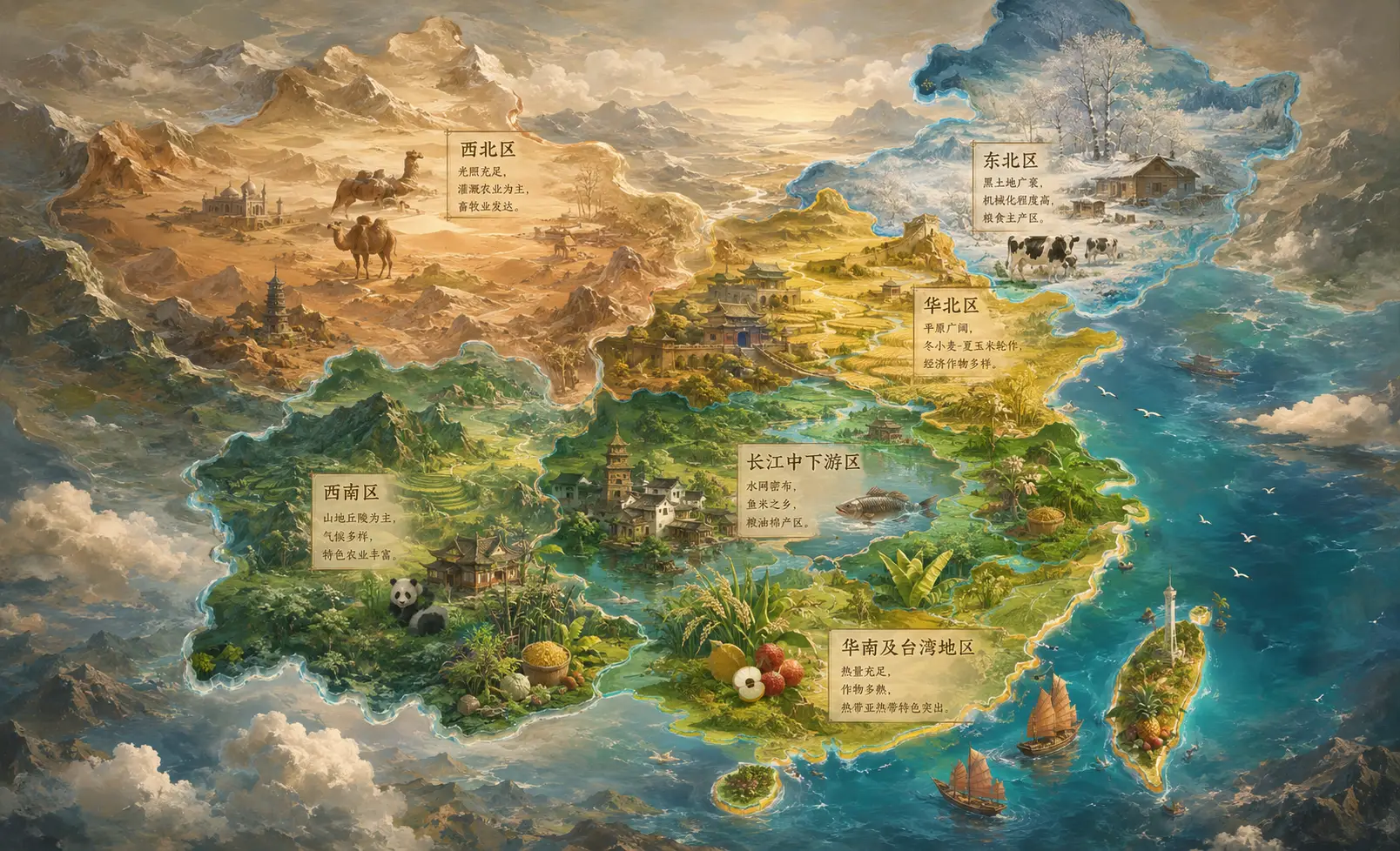
| Agricultural Region | Major Provinces | Keywords |
|---|---|---|
| Northeast | Heilongjiang, Jilin, Liaoning, eastern Inner Mongolia | Maize jointing, soybean flowering, field management, pest and disease control |
| Northwest | Xinjiang, Gansu, Ningxia, western Inner Mongolia, Qinghai | Spring-wheat heading, cotton budding, winter-wheat harvest, orchard management |
| North China | Hebei, Shanxi, Beijing, Tianjin, Shandong, northern Henan | End of wheat harvest, summer-maize seedlings, summer-soybean seedlings, field management |
| Middle and Lower Yangtze | Hubei, Hunan, Jiangxi, Anhui, Jiangsu, northern Zhejiang, Shanghai | Early-rice heading, plum-rain flood control, pest and disease control, ditch clearing and waterlogging prevention |
| Southwest | Sichuan, Chongqing, Guizhou, Yunnan, southeastern Tibet | Winter-wheat harvest, potato management, end of spring tea, orchard management |
| South China and Taiwan | Guangdong, Guangxi, Hainan, southern Fujian, Taiwan Province | Early-rice grain filling, Dragon Boat rain flood control, lychee harvest, peanut and maize management |
Heilongjiang, Jilin, Liaoning, eastern Inner Mongolia
Around the Summer Solstice, maize and soybeans across Northeast China enter vigorous growth, full-scale field management unfolds, and crops enter a period of rapid development.
Maize management during jointing. Spring maize in Northeast China enters jointing around the Summer Solstice, with stem internodes beginning to elongate rapidly and young ears differentiating and developing inside the stalk. Jointing is a key stage for determining both ear number and kernels per ear. Management centers on applying 拔节肥 at 8–10 kilograms of urea per *mu* to promote stem elongation and young-ear development; intertilling and earthing up in combination with fertilization to encourage root growth and lodging resistance; and controlling pests and diseases, with corn borer entering a key treatment window and treated with phoxim or Bt preparations, while aphids, leaf spot, and other problems require simultaneous monitoring. Management during jointing directly affects ear number and final yield.
Soybean management during flowering. Soybeans in Northeast China enter flowering around the Summer Solstice, with blossoms opening and pod formation beginning. Flowering is a crucial stage for determining pod number and seed number. Management centers on applying 花荚肥 (*flower-and-pod fertilizer*) at 5–8 kilograms of compound fertilizer per *mu* to promote flowering and pod setting; intertilling and soil loosening in combination with fertilization; and controlling pests and diseases such as soybean pod borer, aphids, and leaf spot as they enter treatment windows. Management during flowering directly affects pod number and final yield.
Rice management from peak tillering to early jointing. Rice in Northeast China moves from peak tillering into early jointing around the Summer Solstice, with effective tillers largely established and plants beginning to transition into elongation growth. Management includes 晒田控苗 once the target tiller number has been reached, draining and drying fields for 7–10 days to suppress unproductive tillers and encourage deeper rooting; applying 拔节肥 after re-flooding, mainly potash, at 5–8 kilograms of potassium chloride per *mu*; and controlling rice blast, sheath blight, and other pests and diseases as they enter treatment windows.
Pasture management. Pastures in eastern Inner Mongolia remain in vigorous growth and livestock grazing continues. Herders implement rotational grazing systems to make rational use of grassland resources.
Xinjiang, Gansu, Ningxia, western Inner Mongolia, Qinghai
Around the Summer Solstice, Northwest China enters a crucial stage of summer management: spring wheat moves into heading and flowering, cotton enters budding, and the winter-wheat harvest in southern Xinjiang expands fully.
Spring-wheat management during heading and flowering. In the Hexi Corridor of Gansu and the Yellow River irrigation districts of Ningxia, spring wheat enters heading and flowering around the Summer Solstice, with young ears emerging and flowering and pollination beginning. This is a crucial stage for determining kernel number per ear. Management centers on securing water supply because demand is high during heading and flowering, with timely irrigation where soil moisture is insufficient, generally 40–50 cubic meters per *mu*; controlling wheat rust, aphids, wheat midges, and other pests and diseases as they enter critical treatment periods, particularly wheat midge adults laying eggs on the ears and larvae feeding on the juice of developing kernels, which requires spraying at heading; and guarding against 干热风 through foliar fertilizer applications that improve stress resistance. Management during heading and flowering directly affects kernel number and final yield.
Cotton management during budding. Cotton across Xinjiang enters budding around the Summer Solstice as flower buds begin to form and develop, making this a key stage in determining boll number and yield. Management centers on applying 蕾肥 (*bud fertilizer*) at 10–15 kilograms of compound fertilizer per *mu* to promote bud development and plant growth; timely pruning and topping, including removal of side growing points, to control vegetative growth and promote reproductive growth; and controlling cotton bollworm, aphids, cotton spider mites, and other pests as they enter key treatment windows. Management during budding directly affects boll number and final yield.
Large-scale winter-wheat harvest in southern Xinjiang. Winter wheat in the Tarim Basin enters large-scale harvest around the Summer Solstice, with ears turning fully yellow, kernels becoming plump and hard, and the crop reaching physiological maturity. Farmers seize clear weather for harvesting, with combines operating day and night and completing harvesting, threshing, and cleaning in a single operation. Grain is promptly dried and stored after harvest, and fields are immediately plowed.
Orchard management. Apples, fragrant pears, grapes, and other fruit crops in southern Xinjiang enter fruit enlargement. Growers strengthen water and nutrient management through 膨果肥, mainly potash, and control pear psylla, aphids, spider mites, codling moth, and other pests. Grapes enter the young-fruit stage and require fruit thinning and summer pruning.
Specialty crops. Potatoes around Dingxi, Gansu, move from flowering into tuber formation and require stronger water and nutrient management through 结薯肥, mainly potash, together with late-blight control. Goji in Ningxia moves from fruit development into maturity and harvest, with farmers seizing clear weather to pick and dry the crop. Processing tomatoes in Xinjiang move from flowering into fruit set and require stronger water and nutrient management.
Hebei, Shanxi, Beijing, Tianjin, Shandong, northern Henan
Around the Summer Solstice, the winter-wheat harvest across North China is largely complete, summer maize and summer soybean sowing is fully finished, and farmland shifts into summer management as the agricultural rhythm moves from “harvesting and sowing together” toward “field management.”
Winter-wheat harvest largely complete. By the Summer Solstice, the winter-wheat harvest across the North China Plain is largely finished and grain has been brought safely into storage, while wheat-straw handling is completed at the same time through straw incorporation or baling and removal from fields. After wheat harvest, land is immediately plowed or directly seeded without tillage in preparation for summer crops. Wheat harvesting is generally completed between Grain in Ear and the Summer Solstice, and its conclusion marks the end of the first stage of the “三夏” rush.
Summer-maize seedling management. Summer maize enters a critical seedling-management stage around the Summer Solstice as plants move into rapid growth after emergence. Management includes inspecting stands and filling gaps by transplanting where plants are missing; thinning and final stand establishment at the 3–4 leaf stage, leaving 1–2 strong plants per hill and removing weak or diseased seedlings; applying 苗肥 at 5–8 kilograms of urea per *mu*; intertilling and weed control at a depth of 5–8 centimeters in combination with fertilization; and controlling seedling-stage pests such as cutworms, mole crickets, aphids, and corn borer. Growth during the seedling stage directly affects ear number and final yield.
Summer-soybean seedling management. Summer soybeans enter a crucial seedling-management stage around the Summer Solstice, including stand inspection and gap filling, thinning and final stand establishment with 2–3 strong plants per hill, intertillage and weed control, application of 苗肥 at 3–5 kilograms of urea per *mu*, and control of seedling-stage pests and diseases such as aphids and cutworms.
Orchard management during peak fruit enlargement. Apple-, pear-, and peach-growing areas across North China enter peak fruit enlargement, with young fruit developing rapidly in a crucial stage of quality formation. Growers apply 膨果肥, mainly potash, at 10–15 kilograms of potassium sulfate per *mu* to promote fruit development and quality; carry out summer pruning by removing vigorous upright shoots and overly dense branches to improve ventilation and light penetration and promote flower-bud differentiation; and strengthen control of apple ring rot, pear scab, peach aphids, oriental fruit moth, spider mites, and other pests and diseases as they enter key treatment windows.
Vegetable management. Open-field vegetables across North China enter rapid growth and peak harvest, with cucumbers, beans, eggplants, peppers, tomatoes, and other summer vegetables reaching the market in large quantities. Water and nutrient management and pest and disease control need to be strengthened, while after the Summer Solstice, rising temperatures make protection against heat and drought increasingly important.
Hubei, Hunan, Jiangxi, Anhui, Jiangsu, northern Zhejiang, Shanghai
Around the Summer Solstice, the plum-rain season reaches its peak across the middle and lower Yangtze, bringing prolonged rain, high humidity, and limited sunshine. Early rice moves from heading and flowering into grain filling, making flood control and rice management equally important.
Flood control during the peak plum-rain period. Around the Summer Solstice, the plum-rain season reaches its peak across the middle and lower Yangtze, with large rainfall totals and long-lasting precipitation making this the most concentrated period of annual rainfall. Farmers need to inspect drainage systems continuously and ensure that the “三沟” remain unobstructed to prevent standing water and waterlogging. Low-lying fields are particularly vulnerable and require drainage plans in advance. This is also a critical flood-control period for reservoirs and embankments, and water-level changes need to be monitored closely.
Early-rice management from heading and flowering into grain filling. Early rice across the Yangtze River basin moves from heading and flowering into grain filling around the Summer Solstice, with young panicles emerging, flowering and pollinating before the crop enters grain filling. Management centers on maintaining a shallow water layer of 3–5 centimeters without allowing fields to dry, applying 穗肥, primarily potash, at 3–5 kilograms of potassium chloride per *mu*, and monitoring weather closely. Persistent cloudy and rainy conditions during the plum rains can impair pollination and seed set, increasing the number of unfilled grains, while temperatures of 35°C or above can render pollen inactive. Pest and disease management must also be strengthened because rice blast, sheath blight, planthoppers, and other problems enter a high-incidence period under the hot and humid conditions of the plum rains. Management during grain filling directly affects seed-setting rate and thousand-kernel weight.
Pest and disease control. High temperatures and humidity during the plum rains bring rice pests and diseases into a high-incidence period. Key targets include rice blast—leaf blast and panicle-neck blast—treated with tricyclazole or isoprothiolane; sheath blight, treated with validamycin or difenoconazole + propiconazole; rice planthoppers, treated with imidacloprid or buprofezin; and stem borers, treated with dimehypo or Bt preparations. Farmers need to strengthen field inspections and intervene promptly when pests or diseases are detected.
Vegetables and aquaculture. During the plum-rain season, open-field vegetables across the Yangtze basin grow more slowly and pests and diseases occur readily, making drainage and disease control especially important. Greenhouse vegetables require stronger ventilation and humidity reduction. In aquaculture, low atmospheric pressure and high humidity during the plum rains increase the risk of oxygen depletion and pond overturning, so farmers need to strengthen aeration and water-quality management.
Sichuan, Chongqing, Guizhou, Yunnan, southeastern Tibet
Around the Summer Solstice, agricultural activity across Southwest China enters summer management: the winter-wheat harvest is largely complete, potatoes remain in tuber enlargement, and spring-tea picking is fully finished.
Winter-wheat harvest largely complete. By the Summer Solstice, winter-wheat harvesting in the Sichuan Basin is largely finished, with grain safely stored and fields plowed in preparation for middle-season rice or other summer crops.
Potato management during peak tuber enlargement. Spring potatoes in the main producing areas of Yunnan, Guizhou, and Sichuan enter peak tuber enlargement around the Summer Solstice, with underground tubers expanding rapidly in a crucial stage for both yield and marketable quality. Management centers on applying 结薯肥, primarily potash, at 8–10 kilograms of potassium sulfate per *mu*; controlling late blight, the crop’s most important disease, using mancozeb or metalaxyl every 7–10 days for 2–3 consecutive applications; irrigating at the proper time to secure adequate moisture without allowing waterlogging; and intertilling and earthing up to prevent tubers from being exposed to light and turning green.
Spring-tea picking fully complete; summer garden management advances comprehensively. Spring-tea harvesting is completely finished across Sichuan, Guizhou, and Yunnan, and growers move fully into summer garden management through immediate pruning after spring harvest to encourage summer and autumn shoots, application of summer fertilizer mainly based on nitrogen, and control of tea green leafhoppers, tea geometrid moths, tea blister blight, and other pests and diseases as they enter critical treatment windows.
Orchard management. Citrus-growing areas across Southwest China enter fruit enlargement and require stronger water and nutrient management through 膨果肥, mainly potash, together with control of citrus red mites, leaf miners, citrus canker, anthracnose, and other problems. Loquat harvesting is largely complete and orchards move into postharvest management through pruning and fertilization.
Guangdong, Guangxi, Hainan, southern Fujian, Taiwan Province
#### (1) Mainland South China
Early-rice grain filling and flood control during “龙舟水.” Early rice in South China enters grain filling around the Summer Solstice, with kernels becoming increasingly full in a crucial stage for determining thousand-kernel weight. Management centers on keeping fields moist through shallow-water or moist irrigation without allowing them to dry; applying 粒肥 (*grain-filling fertilizer*), mainly potash, at 3–5 kilograms of potassium chloride per *mu* to promote full kernels; preventing heat-forced maturity by applying deeper water when temperatures reach 35°C or above, generally 5–10 centimeters, to lower field temperature; and guarding against “龙舟水”, which continues around the Summer Solstice with frequent heavy rainfall, requiring farmers to keep drainage systems unobstructed and prevent flooding.
Spring-peanut and spring-maize management. Spring peanuts move from peak pod setting into early maturity, with pods enlarging rapidly and some early cultivars beginning to ripen. Management focuses on controlling peanut leaf spot, aphids, cotton bollworm, and other pests and diseases and harvesting early cultivars at the proper time. Spring maize moves from grain filling into maturity, with kernels becoming full; water supply must be secured because drought can reduce thousand-kernel weight, while corn borer, aphids, leaf spot, and other pests and diseases require control.
Tropical-fruit management. Early lychee cultivars such as “三月红” and “白糖罂” enter peak maturity and harvest, while middle- and late-season cultivars including “妃子笑”, “桂味”, and “糯米糍” move from fruit enlargement toward early maturity and require stronger water and nutrient management. Mangoes enter maturity and harvest, with farmers seizing clear weather to pick, grade, pack, and market the fruit. Citrus enters fruit enlargement and requires control of excessive summer-shoot growth together with citrus red mites, leaf miners, canker, and other problems.
Vegetables and aquaculture. Open-field vegetables across South China enter rapid growth and peak harvest. Rising temperatures bring pests and diseases into a high-incidence period and require stronger prevention and control. In aquaculture, “龙舟水” brings continuing flood risk, requiring more frequent pond inspections, stronger water-quality management, and prevention of oxygen depletion and pond overturning.
#### (2) Taiwan
Rice: The first rice crop in central Taiwan—including Changhua, Yunlin, and the Chianan Plain—enters peak harvest around the Summer Solstice, with panicles fully yellow and kernels plump as farmers seize clear weather for cutting. In southern Taiwan, particularly the Kaohsiung–Pingtung region, the rice harvest enters its final stage. In northern Taiwan, including Taoyuan and Hsinchu, rice moves from heading into grain filling.
Vegetables: Around the Summer Solstice, summer vegetables across Taiwan enter peak harvest, with cucurbits such as watermelon, cucumber, and muskmelon, along with beans and fruiting vegetables, reaching the market in large quantities.
Fruit trees: Mangoes in southern Taiwan enter peak maturity and harvest, with cultivars such as Irwin and Jinhuang harvested intensively. Lychees likewise enter peak maturity and harvest, including concentrated harvesting of cultivars such as Yu Her Pau. Citrus enters fruit enlargement.
Tea: Summer management advances fully across tea gardens in central and southern areas such as Nantou and Chiayi, including pruning, fertilization, and pest and disease control. Tea gardens in northern districts such as Wenshan and Sanxia likewise enter full summer management.
Fisheries: Catches in waters around Taiwan continue to increase during the Summer Solstice. Coastal fishing vessels go to sea frequently and catch quality remains good.
Farmer’s proverbs and folk customs: Taiwanese folk tradition preserves the saying “夏至,風颱(台风)就欲到”—after the Summer Solstice, typhoon season is about to arrive, and coastal areas need to prepare accordingly. Another saying, “夏至吃荔枝,冬至吃汤圆”, links lychees with the Summer Solstice and tangyuan with the Winter Solstice, reflecting the seasonal food culture associated with the solar terms.
Global Extreme Weather · Risks & Responses
Temperate Northern Hemisphere: Heavy Rain and Flooding—the Greatest Threat of the Summer Solstice
Around the Summer Solstice, precipitation increases across the temperate Northern Hemisphere. The Yangtze River basin in China enters the peak plum-rain period, while the “龙舟水” continues across South China and heavy rainfall occurs frequently. Persistent downpours may cause standing water and waterlogging in fields, submerging rice and rotting the roots of dryland crops; rising river levels may trigger floods; and mountainous areas may face landslides and debris flows. Farmers need to inspect drainage systems continuously, keep ditches and channels unobstructed, and closely follow weather forecasts and flood-control warnings.
Temperate Northern Hemisphere: Heat Damage and “High-Temperature Forced Maturity”
Temperatures continue to rise around the Summer Solstice and some regions may experience heat of 35°C or above. When early rice encounters such heat during grain filling, “高温逼熟” may occur, with insufficient grain filling, reduced thousand-kernel weight, and an increase in unfilled grains. Before high temperatures arrive, farmers need to irrigate with deeper water, generally 5–10 centimeters, to lower field temperature and spray foliar fertilizer such as monopotassium phosphate to strengthen stress resistance.
Temperate Northern Hemisphere: Severe Convective Weather—Hail and Strong Winds
Severe convective weather occurs frequently around the Summer Solstice, including thunderstorms, hail, short-duration heavy rain, and strong winds. Hail can damage fruit, branches and leaves, and greenhouse structures; strong winds can lodge summer maize; and heavy rainfall may cause standing water in fields. Farmers need to follow forecasts closely and prepare protective measures in advance.
Temperate Southern Hemisphere: Winter Cold and Overwintering Management
During the Southern Hemisphere Winter Solstice in mid- to late June, daylight is shortest and the weather is coldest. Autumn-sown crops remain in overwintering dormancy and weak plants may die from frost injury. Livestock need to move into housed systems, supplementary feeding becomes fully established, and protection against cold is the primary task in pastoral regions. Farmers need to complete stand inspection and gap filling, irrigation to strengthen seedlings, and pest and disease control before winter fully arrives so that strong plants are established before overwintering.
Tropical Regions: Alternating Flood and Drought and Pest-and-Disease Risks
Across the tropical Northern Hemisphere—including Southeast Asia and India—the rainy season continues, but uneven rainfall distribution can cause localized flooding or drought. Under hot and humid conditions, rice pests and diseases such as rice blast, sheath blight, and planthoppers can erupt readily, requiring stronger monitoring and control. In the tropical Southern Hemisphere—including Brazil and Africa—the dry season is underway, and dry-season crops need to make full use of irrigation resources while guarding against the effects of high temperatures and drought.
---
Readers’ Comments
Calendar and traditional culture enthusiasts from around the world, sharing the same moon.
Sign in or register to join the conversation. Your comment account is created automatically the first time you use a connected account.
No comments yet
Share your thoughts with readers around the world.