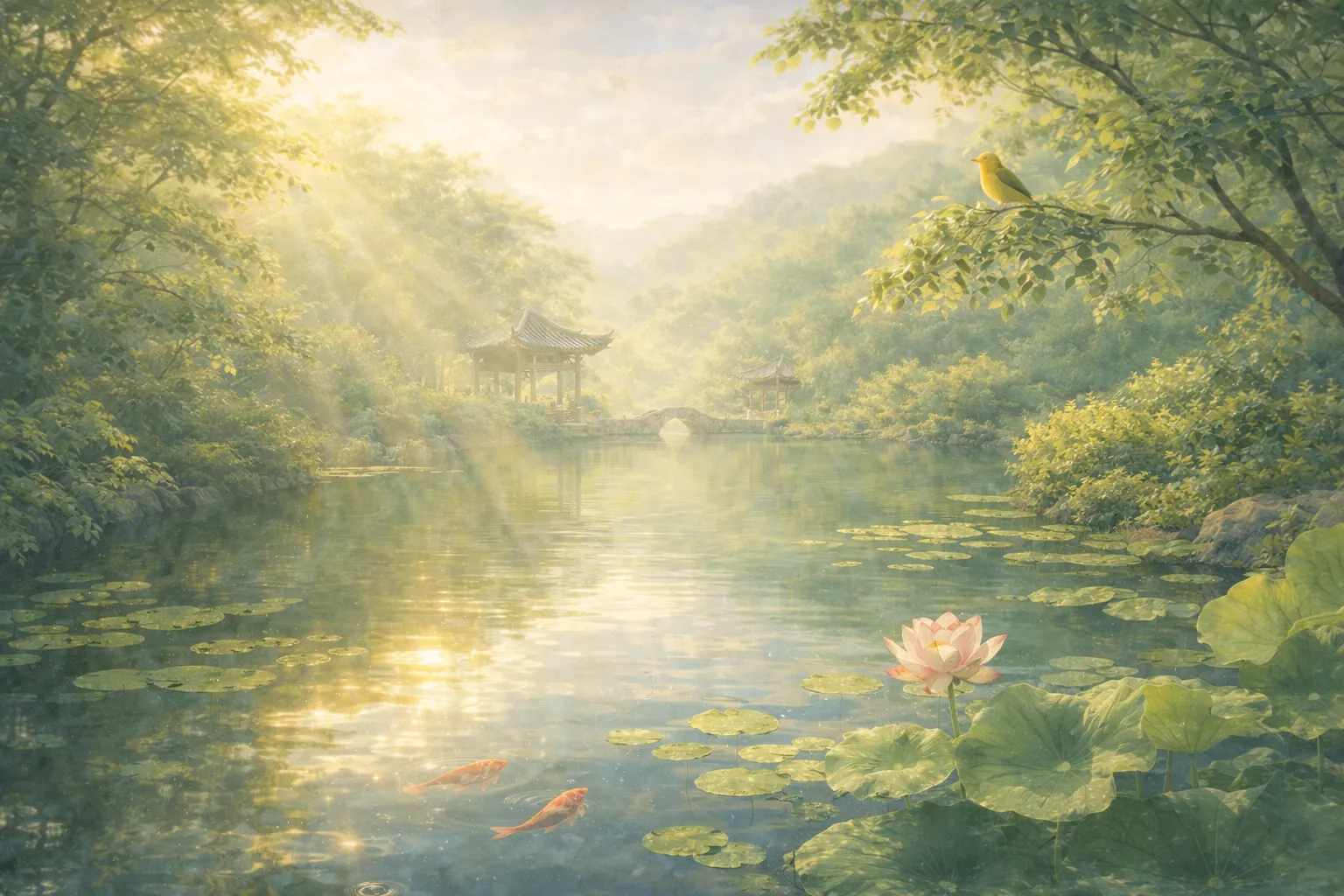
Summer Solstice Customs
「夏至有雨三伏热,重阳无雨一冬晴」
The customs of the Summer Solstice can be summarized through five ideas: 祭、面、扇、冰、假 — sacrifice, noodles, fans, ice, and rest. Sacrifice refers to worshipping deities, honoring ancestors, and offering rites to the Earth. By the Zhou dynasty, there was already a formal institution of summer-solstice Earth worship, and emperors later performed grand state sacrifices at the Altar of Earth. Noodles refer to the traditional Summer-Solstice noodles eaten when the new wheat crop first comes to market, combining the tasting of newly harvested grain with celebration of the harvest. A folk saying observes: “吃过夏至面,一天短一线” — after eating Summer-Solstice noodles, each day grows shorter by a thread. Fans refer to the custom of exchanging folding fans and cosmetic powders among women as a way of coping with the summer heat; because the Chinese word for “fan,” *shan*, is homophonically associated with “善,” goodness, the gift also carries wishes of friendship and goodwill. Ice refers to the ancient practice of storing winter ice for summer use, a royal cooling system already institutionalized in the Zhou dynasty. Rest, finally, refers to seasonal leave: during the Song dynasty, officials were granted three days off for the Summer Solstice, while ordinary people likewise treated the date as an occasion for celebration and exchange of good wishes.
Among these five groups of customs, worship of deities, ancestors, and the Earth focuses on state ritual and family ethics; Summer-Solstice noodles center on seasonal flavor and celebration of the new harvest; while fans and stored ice embody practical wisdom for surviving the hottest part of the year. Together they form a complete cultural landscape stretching from imperial court to countryside, from ceremony to everyday life, and from gratitude to the art of keeping cool. Three cultural ideas run through them. The first is reverence for Heaven and Earth: sacrifices to the Earth and ancestors express gratitude toward nature and lineage. The second is following the proper time of nature: the saying “吃过夏至面,一天短一线” reveals a keen awareness of the gradual shortening of daylight after the solstice. The third is summer health and heat avoidance: giving fans, storing ice, and eating chilled noodles are all ingenious responses to intense summer heat. The Summer Solstice can therefore be considered one of the solar terms richest in both ritual dignity and the texture of everyday life. On the longest day of the year, people thank Heaven and Earth through solemn sacrifice, celebrate the harvest with the humblest bowl of noodles, and send cooling breezes through finely made fans—turning the longest day into one of the most flavorful days of the calendar.
Regional Customs of This Solar Term
| Region | Signature Customs | Notable Features |
|---|---|---|
| Beijing, Altar of Earth | Grand sacrifice to the Earth | Ming and Qing emperors personally visited the Altar of Earth at the Summer Solstice; the full ceremony lasted about two hours and required more than seventy kneelings and over two hundred kowtows |
| Nationwide | Worshipping deities and ancestors | The Summer Solstice coincides with the wheat harvest, and from ancient times people celebrated the new crop and honored their ancestors |
| Beijing | Eating cold-tao noodles, or noodles rinsed in water | Old Beijing households traditionally ate chilled noodles at the Summer Solstice, once regarded as a delicacy of the capital |
| Jiangnan, including Suzhou, Wuxi, and Shaoxing | Summer-Solstice noodles, wheat dumplings, and Summer-Solstice cakes | Varieties include plain spring noodles, bridge noodles, cold dressed noodles, and wheat dumplings exchanged as gifts |
| Nationwide | Giving fans and cosmetic powders | Women exchanged folding fans, cosmetic powders, and sachets to cool the body and endure the hottest days; “fan” was also associated with “goodness” through sound |
| Imperial court | Storing and using ice | From the Zhou dynasty onward, winter ice was stored for summer use and gradually became an established royal system |
| Shaoxing, Zhejiang | Summer-Solstice dragon-boat racing | Dragon-boat races have been held around the Summer Solstice since the Ming and Qing periods, drawing dense crowds of spectators |
| Central and southern Shandong | Guo Xiamai, celebrating the summer wheat | Dumplings made from new flour are offered to Heaven, Earth, and the ancestors in celebration of the wheat harvest |
| Southern China | Weighing people | People weigh themselves at the Summer Solstice to observe changes in body weight and guard against summer weight loss |
Summer Solstice Customs
Releasing Lotus Lamps
Popular Regions:
Activities:
Releasing lotus lamps, also called river lamps, is a traditional Han folk sacrificial and religious activity and one of the folk customs associated with the Summer Solstice. The practice expresses remembrance of deceased loved ones while conveying blessings for those still living. In earlier times, thousands of lamps were released onto rivers on the night of the Summer Solstice. Their flickering lights drifted over the water like stars scattered across the human world, creating a deeply moving scene.
Lotus lamps were not released only at the Summer Solstice. They were also commonly set afloat on the first and fifteenth days of each lunar month and on anniversaries of a person’s death. Carried by the current, the lamps became vessels for longing toward the departed and wishes for the living.
Historical Origins:
The custom has a long history and forms an important part of traditional water-town culture. The Summer Solstice coincides with the first flowering of lotuses, and people used lotus-shaped lamps to send memories and blessings out upon the water. The practice brings together seasonal timing, the scenery of southern waterways, and human emotion, embodying the Chinese tradition of entrusting feeling to objects.
In the water towns of southern China, releasing river lamps around the Summer Solstice continues in some places as an important folk activity of remembrance and blessing.
How to Take Part:
On the evening of the Summer Solstice, visitors can observe lotus-lamp ceremonies in some southern water towns. Certain folk attractions organize lamp-making and lamp-releasing activities, allowing visitors to make a lamp by hand and place it on the water as a symbolic blessing.
Recommended Places:

Sacrificing to the Earth
Popular Regions:
Activities:
The Summer-Solstice sacrifice to the Earth was one of the highest-ranking state rituals of ancient China. Traditional ritual distinguished between sacrificing to Heaven at the Winter Solstice and to the Earth at the Summer Solstice. The magnificence of the Earth-sacrifice ceremony is difficult to imagine today. During the Ming and Qing periods, the emperor personally visited the Altar of Earth on the Summer Solstice to preside over the grand rite.
The entire ceremony lasted about two hours. Dressed in full ceremonial attire, the emperor had to kneel more than seventy times and perform over two hundred kowtows. From welcoming the spirits to seeing them off, he repeatedly performed the rite of three kneelings and nine kowtows toward the principal altar and its subsidiary positions.
The Zhou system for Summer-Solstice Earth worship was likewise highly elaborate. The *Rites of Zhou · Offices of Spring* records: “以夏日至,致地方物魈”. Under the Qing, square pools were excavated in the northern suburbs of Beijing for the great Summer-Solstice rites. By contrast, at the Winter Solstice, Heaven was worshipped at the circular altar. The pairing of square and round expressed the ancient cosmological idea that Heaven is round and Earth is square. The Summer Solstice marks the arrival of the hottest part of the year and the peak of heat, but it also signifies that yin energy will thereafter begin gradually to rise. The imperial sacrifice to the Earth was therefore performed in hopes of securing a prosperous agricultural year.
Historical Origins:
Sacrificial rites at the Summer Solstice can be traced back to the Zhou dynasty. The *Rites of Zhou · Offices of Spring* records: “以夏日至,致地方物魈”. In Zhou ritual thought, sacrifice at the Summer Solstice was intended to avert famine and misfortune. Sima Qian’s *Records of the Grand Historian · Treatise on the Feng and Shan Sacrifices* likewise states: “夏至日,祭地祇,皆用乐舞” — on the day of the Summer Solstice, sacrifices were offered to the spirits of the Earth, accompanied by music and dance.
The tradition continued from the Zhou through the Qing and became one of the central components of the state sacrificial system. In the early Western Zhou, the Duke of Zhou established Luoyi at Luoyang and performed sacrifices to the Earth on the Summer Solstice. During the Ming and Qing dynasties, Beijing’s Altar of Earth became the dedicated site for these ceremonies. The rite was not a brief half-hour performance like those sometimes seen at temple fairs today, but an elaborate ceremony lasting a full two hours. Although the imperial rite itself has disappeared, reconstructed performances are still organized around the Summer Solstice at the Altar of Earth in Beijing.
How to Take Part:
During the Summer Solstice, visitors can travel to Beijing’s Altar of Earth Park to watch reconstructed Earth-sacrifice ceremonies. Historical reenactments featuring an “emperor” performing the rites are sometimes staged during cultural events, with spectators observing from designated areas. Specific schedules should be checked in advance through the park or Beijing cultural and tourism authorities.
Recommended Places:
Summer-Solstice Noodles
Popular Regions:
Activities:
The saying “冬至饺子夏至面” — dumplings at the Winter Solstice, noodles at the Summer Solstice — reflects one of the most widespread food traditions associated with this date. By the Summer Solstice, the new wheat crop has reached the market, so eating noodles also carries the meaning of tasting the new harvest. The variety of noodle dishes is enormous. In the south, one finds plain spring noodles, dry-soup noodles, shredded-pork noodles, three-delicacy noodles, crossing-the-bridge noodles, and sesame-oil cold noodles; in the north, common choices include gravy noodles and zhajiang noodles. In the Yellow River basin, where the solar-term system first took shape, the custom has an especially long history.
Local forms vary widely. In Beijing, people traditionally eat “cold-tao noodles,” also known as noodles rinsed in water: freshly cooked noodles are first plunged into cool water before serving. The Qing-dynasty *Dijing Sui Shi Ji Sheng* records: “京师于是日家家俱食冷淘面,即俗说过水面是也,乃都门之美品” — every household in the capital eats cold-rinsed noodles on this day, the delicacy popularly known as *guoshui mian*. Even today, zhajiang noodles rinsed in cold water remain a favorite summer food.
In Jiangnan, people eat wheat dumplings, which are not only consumed at home but also exchanged as gifts. Farming households also roll dough into thin cakes, bake them, and fill them with greens, bean pods, tofu, cured meat, and other ingredients. These are called Summer-Solstice cakes and are eaten or distributed among relatives and friends after ancestral offerings. In Wuxi, people eat wheat porridge in the morning and wontons at noon, taking the sound and symbolism of “hundun hehe” to suggest harmony and union. In Shaoxing, besides noodles, people prepare maihushao, a thin pancake made by spreading a flour batter over a hot pan.
Historical Origins:
There are roughly three traditional explanations for the origin of Summer-Solstice noodles.
The first is sacrifice to the gods. Summer-Solstice worship can be traced to the pre-Qin period, and in the north the date coincided with the wheat harvest. People thanked Heaven and Earth by presenting new wheat as an offering. At first, whole grains were offered before images of heavenly and earthly deities; later, noodles gradually replaced the grains, with their length symbolizing long-lasting fortune and smooth progress. By the Ming dynasty, eating noodles had developed into a household custom.
The second explanation is celebration of the harvest. In the Central Plains, new wheat was ground into flour and made into noodles as a direct expression of joy at the harvest.
The third is health and longevity. The ancients believed that temperatures and illness increased after the Summer Solstice, and that noodles rinsed in cold water could reduce internal heat, stimulate the appetite, and help prevent illness. Historical records indicate that China already observed the Summer-Solstice festival in the Han dynasty. Folk tradition also preserves the saying “吃过夏至面,一天短一线” — after Summer-Solstice noodles are eaten, each day becomes shorter by a thread — because the Summer Solstice is the longest day of the year and daylight gradually decreases thereafter.
How to Take Part:
On the Summer Solstice, seasonal noodles can be enjoyed at noodle shops across China. Beijing’s traditional zhajiang noodles and gravy noodles are classic choices, while southern regions offer dishes such as plain spring noodles and three-delicacy noodles. At home, chilled noodles or noodles rinsed in cool water provide an easy way to experience the old saying about daylight shortening after the solstice.
Recommended Places:
Giving Fans
Popular Regions:
Activities:
In ancient times, the Summer Solstice was itself regarded as a festival for escaping the heat, known as the Summer-Solstice Festival. On this day, women exchanged folding fans, face powders, and related items. The fan generated cooling air, while cosmetics and fragrant powders were applied to the body to counter unpleasant odors caused by summer heat and help prevent heat rash.
The *History of Liao · Treatise on Ritual* records: “夏至日谓之‘朝节’,妇女进彩扇,以粉脂囊相赠遗” — on the Summer Solstice, known as the *Chao Festival*, women presented colored fans and exchanged pouches of cosmetics. The *Youyang Zazu · Ritual Differences* likewise states: “夏至日,进扇及粉脂囊,皆有辞” — on the Summer Solstice, fans and cosmetic pouches were presented together with words of blessing.
The sound of the Chinese word for fan, 扇 (*shan*), is also associated with 善 (*shan*), goodness, giving the gift an added meaning of goodwill, friendliness, and benevolent connection. The custom was not limited to women. During the Tang and Song dynasties, male friends also exchanged folding fans at the Summer Solstice. By the Ming and Qing periods, gifts of fans and cosmetic pouches had become even more widespread. In old Chengdu, women gave one another rouge and bamboo fans on this day, and shops selling cosmetics in busy districts such as Yanshikou and Dongdajie did flourishing business. The custom thus combined the practical cooling function of the fan with the auspicious implication of goodness.
Historical Origins:
The exchange of fans is frequently recorded in classical sources. Both the *History of Liao · Treatise on Ritual* and the *Youyang Zazu · Ritual Differences* describe the giving of fans and cosmetic pouches at the Summer Solstice. The custom was already established by the Liao dynasty and became still more widespread in the Ming and Qing periods, extending from court and aristocratic society into ordinary life.
Although the old practice of exchanging fans and powders has gradually faded, its cultural core—finding ways to cope with the hottest days of summer—continues in modern forms. Air conditioning, electric fans, and chilled drinks serve a different technology but carry forward the same seasonal impulse.
How to Take Part:
On the Summer Solstice, a folding fan can be chosen as a gift for relatives or friends and accompanied by a short blessing. Handmade fragrant sachets are another option. Many cultural institutions also organize seasonal fan-making workshops.
Recommended Places:
Storing and Using Ice
Popular Regions:
Activities:
After the Summer Solstice, the weather enters its hottest period. In the imperial court, ice stored during winter was brought out in summer to help people escape the heat, and from the Zhou dynasty onward this practice gradually became an established institution maintained by successive dynasties.
As early as the pre-Qin period, people stored blocks of winter ice in underground cellars for summer use. This system of storing in winter and using in summer remained in place through the late Qing. When summer arrived, members of the imperial and aristocratic households took out the ice to cool their surroundings.
Managing ice was an enormous undertaking. Successive dynasties maintained specialized offices and officials responsible for the ice system. Remains of Qing-dynasty ice cellars can still be found around Shichahai in Beijing. Ice was used not only to cool rooms but also to chill foods and drinks. During the reign of Emperor Xuanzong of Tang, when Yang Guifei enjoyed imperial favor, members of the Yang family were said to have “每至伏中,取大冰,使匠琢为山,周围于席间” — during the hottest days, they brought out great blocks of ice and had craftsmen carve them into mountain forms around their seating area.
The Tang dynasty also produced sushan, a snow-mountain-shaped frozen delicacy made from dairy cream mixed with honey or sugarcane juice, something that might be regarded as an elite ancient precursor to ice cream.
Historical Origins:
China’s system of storing and using ice has an extremely long history. The *Rites of Zhou · Offices of Heaven · Lingren* records the official Lingren, whose responsibilities included the management of ice: “掌冰,正岁十有二月,令斩冰,三其凌” — in the twelfth month, ice was cut and stored in cellars in quantities sufficient for later use.
The system continued from the Zhou through the Qing, lasting for more than two thousand years. Bringing out stored ice after the Summer Solstice became a regular feature of imperial life. Although access to ice was also a privilege of elites, the practice demonstrates the ingenuity with which ancient people used natural resources to respond to severe summer heat.
How to Take Part:
During the Summer Solstice, visitors can explore the history of ancient ice storage at sites such as the ice-cellar remains around Beijing’s Shichahai or Bingjiao Lane in Xi’an. Some museums also organize seasonal exhibitions devoted to traditional summer-cooling culture.
Recommended Places:
Worshipping Deities and Ancestors
Popular Regions:
Activities:
The Summer Solstice coincides with the wheat harvest, and from ancient times people celebrated the harvest and worshipped their ancestors in hopes of avoiding disaster and securing a prosperous year. The Summer Solstice therefore became incorporated into the ancient ritual system of worshipping deities. The *Rites of Zhou · Offices of Spring* records: “以夏日至,致地方物魈”. In Zhou ritual thought, Summer-Solstice sacrifice was associated with averting famine, hunger, and death.
The ancients held that “天地者,生之本也;先祖者,类之本也” — Heaven and Earth are the roots of life, while the ancestors are the roots of human lineage. Objects of worship therefore included not only ancestors but also deities of the land, water, and other natural forces. In earlier times, families often placed their hopes for disaster prevention and abundant grain in sacrifices performed at the Summer Solstice.
The tradition survives in some regions today. In central and southern Shandong, people make dumplings from newly milled flour, offer them to Heaven, Earth, and the ancestors, and celebrate the wheat harvest in a custom known locally as “Guo Xiamai.” In several places, elaborate celebrations of the new summer wheat are still held around the Summer Solstice and are regarded as survivals of ancient summer sacrifices. In the past, rich and poor alike performed ancestral rites on the day, commonly described as “doing the Summer Solstice.”
Historical Origins:
The custom of worshipping deities and ancestors at the Summer Solstice originated in the Zhou period. The *Rites of Zhou · Offices of Spring* clearly records: “以夏日至,致地方物魈”. Sima Qian’s *Records of the Grand Historian · Treatise on the Feng and Shan Sacrifices* likewise states: “夏至日,祭地祇,皆用乐舞”.
By the late Western Han, the court had established an altar to the Earth deity in the northern suburbs of Chang’an according to cosmological directions of yin and yang. Although ritual systems changed across dynasties, Summer-Solstice Earth worship continued without interruption. This sacrificial tradition, extending across some three thousand years, tightly connected seasonal order with worship of Heaven, Earth, and ancestry and reflects the deep cultural principle of revering Heaven and honoring the ancestors.
How to Take Part:
During the Summer Solstice, local announcements may provide information on ancestral and deity-worship ceremonies. Central and southern Shandong retain the Guo Xiamai tradition, while many cultural institutions organize seasonal programs related to traditional sacrificial culture.
Recommended Places:
Summer-Solstice Dragon-Boat Racing
Popular Regions:
Activities:
Dragon-boat racing at the Summer Solstice is a distinctive custom preserved for centuries in Shaoxing and neighboring parts of Zhejiang. The Shaoxing *Wanli Prefectural Gazetteer* records: “山、会农人作竞渡会,衣小儿衣,歌农歌,率数十人共一舟,以先后相驰逐,观者如堵”. Farmers from Shanyin and Kuaiji organized races, dressed in children’s garments, sang agricultural songs, and raced in boats carrying dozens of people, while spectators crowded the banks.
Shaoxing therefore held dragon-boat contests not only at the Dragon Boat Festival but, from the Ming and Qing periods onward, also around the Summer Solstice.
Around Taoyan in Zhejiang, the tradition is said to have continued for more than five hundred years. According to stories passed down by local elders, the races commemorate a benevolent General Xingshan, remembered for helping the weak and those in hardship. Because the villagers had received his great kindness, they rowed dragon boats every Summer Solstice in his memory. Over time, the custom became not only a form of communal exercise but also a vessel for wishes for favorable weather, abundant harvests, national peace, and public well-being.
Historical Origins:
According to Sima Biao’s *Book of the Later Han · Treatise on Ritual*, dragon-boat racing during the Xia, Shang, and Zhou periods was associated with the Summer Solstice. After the practice became connected with the commemoration of Qu Yuan, it was increasingly concentrated around the Dragon Boat Festival, although the two dates are seasonally close.
Clear records of Summer-Solstice dragon-boat races appear in Shaoxing gazetteers from the Ming and Qing periods. The custom joins the solar-term calendar with the competitive water culture of Jiangnan and represents a distinctive form of regional seasonal expression.
How to Take Part:
During the Summer Solstice, dragon-boat races may be held around East Jianhu Lake and other waterways in Shaoxing. These events traditionally attract large crowds, and visitors can observe from designated safe areas. Specific dates should be checked through Shaoxing cultural and tourism authorities.
Recommended Places:
Summer Rest
Popular Regions:
Activities:
The Summer Solstice was an important festival in ancient China, known as the Summer Festival or Summer-Solstice Festival. Records state that before the Qing dynasty, a one-day holiday was observed nationally, while during the Song dynasty officials were granted three days of leave.
People gathered with relatives, drank together, and celebrated the occasion, reflecting the importance attached to the Summer Solstice in earlier times. Folk speech also preserved the idea of “resting for summer.”
Historical Origins:
The institution of Summer-Solstice leave has a long history. Pang Yuanying’s Song-dynasty *Wenchang Zalu* records: “夏至之日始,百官放假三天” — beginning on the day of the Summer Solstice, officials were granted three days of leave.
A one-day national holiday for the Summer Solstice is also said to have continued for centuries before the Qing. Later, as the Dragon Boat Festival grew in importance, many customs that had once belonged to the Summer Solstice shifted toward that festival, and the holiday tradition gradually faded.
How to Take Part:
The Summer Solstice is no longer a statutory holiday, but many workplaces, schools, and cultural institutions organize solar-term activities around the date. Individuals can also mark the day by taking time to relax and gathering with relatives or friends in the spirit of the older custom of summer rest.
Recommended Places:
Summer-Solstice Foods
Popular Regions:
Activities:
Beyond noodles, the Summer Solstice has a rich variety of regional food customs. In Wuxi, people eat wheat porridge in the morning and wontons at noon, interpreting “hundun hehe” as a symbol of harmony and unity. A saying goes: “夏至馄饨冬至团,四季安康人团圆” — wontons at the Summer Solstice, rice dumplings at the Winter Solstice; may all four seasons bring health and family reunion.
In Jiangnan, people eat wheat dumplings, both for themselves and as gifts exchanged between households. Rural families roll dough into thin cakes, bake them, fill them with greens, bean pods, tofu, cured meat, and other foods, and call them Summer-Solstice cakes. After the solstice, cooling foods and drinks such as qingbuliang soup, herbal tea, and sour-plum drink become common.
The ancients regarded the fifth lunar month as an “inauspicious month” and believed that eating hot noodles could drive away harmful influences, while sweating moderately could help expel accumulated dampness and summer heat from the body.
Historical Origins:
The varied food traditions of the Summer Solstice embody both the dietary principle of “不时不食” — eating according to the season — and the regional principle of adapting food to local conditions. An older saying, “夏至尝黍,端午食粽”, describes tasting millet at the Summer Solstice and eating wrapped dumplings at the Dragon Boat Festival.
The *Lüshi Chunqiu* records that when early millet became available in the fifth lunar month, the Son of Heaven performed a millet-tasting rite at the Summer Solstice. The *Book of Songs* also contains the phrase “年丰多黍”, linking plentiful millet with a prosperous year. These customs connect the seasonal calendar with local produce and health-preserving knowledge and form an important part of Chinese food culture.
How to Take Part:
During the Summer Solstice, regional foods can be sampled throughout China. In the north, zhajiang noodles and gravy noodles are common choices; in Jiangnan, wheat porridge, wontons, and wheat dumplings are traditional; while cooling drinks such as sour-plum drink and qingbuliang soup are enjoyed in many regions.
Recommended Places:
Closing Note
The customs of the Summer Solstice emerged from the ancient Chinese response to a profound cosmological turning point: “at the extreme of yang, yin begins to arise.” The Summer Solstice was among the earliest of the Twenty-Four Solar Terms to be identified. As early as the seventh century BCE, people used the *tugui*, a gnomon for measuring the Sun’s shadow, to determine the solstice. On this day the noon shadow is at its shortest and daylight at its longest, marking the Sun’s extreme northern position over the Tropic of Cancer. Yet tradition also says “夏至一阴生” — at the Summer Solstice, the first yin is born. Behind the apparent culmination lies the quiet reversal of the forces of Heaven and Earth. This reflection on how extreme flourishing inevitably begins to turn toward decline gave Summer-Solstice customs an enduring undertone of caution.
Across the centuries, the Summer Solstice had already become part of the state sacrificial system by the Zhou dynasty, while among ordinary people its customs interacted increasingly with those of the Dragon Boat Festival, together shaping a broad set of strategies for escaping the heat, warding off illness, and caring for the body. Before the Qing, the Summer Solstice was observed as a national holiday and stood alongside the Winter Solstice in importance. Summer-Solstice noodles, eggs, and seasonal soups all reveal an older health-preserving wisdom in which food was used to regulate the balance of yin and yang.
When the noon shadow contracts to its shortest point on the day of the Summer Solstice, and a bowl of chilled noodles rinsed in cool water is placed upon the table, the customs of the season become more than a measure of time. They express an ancient Chinese philosophy of remaining mindful of danger in times of security and knowing when to turn back at the height of prosperity. No matter how long the daylight becomes, it must eventually shorten; no matter how powerful yang grows, yin will inevitably begin to rise.
—-
Readers’ Comments
Calendar and traditional culture enthusiasts from around the world, sharing the same moon.
Sign in or register to join the conversation. Your comment account is created automatically the first time you use a connected account.
No comments yet
Share your thoughts with readers around the world.