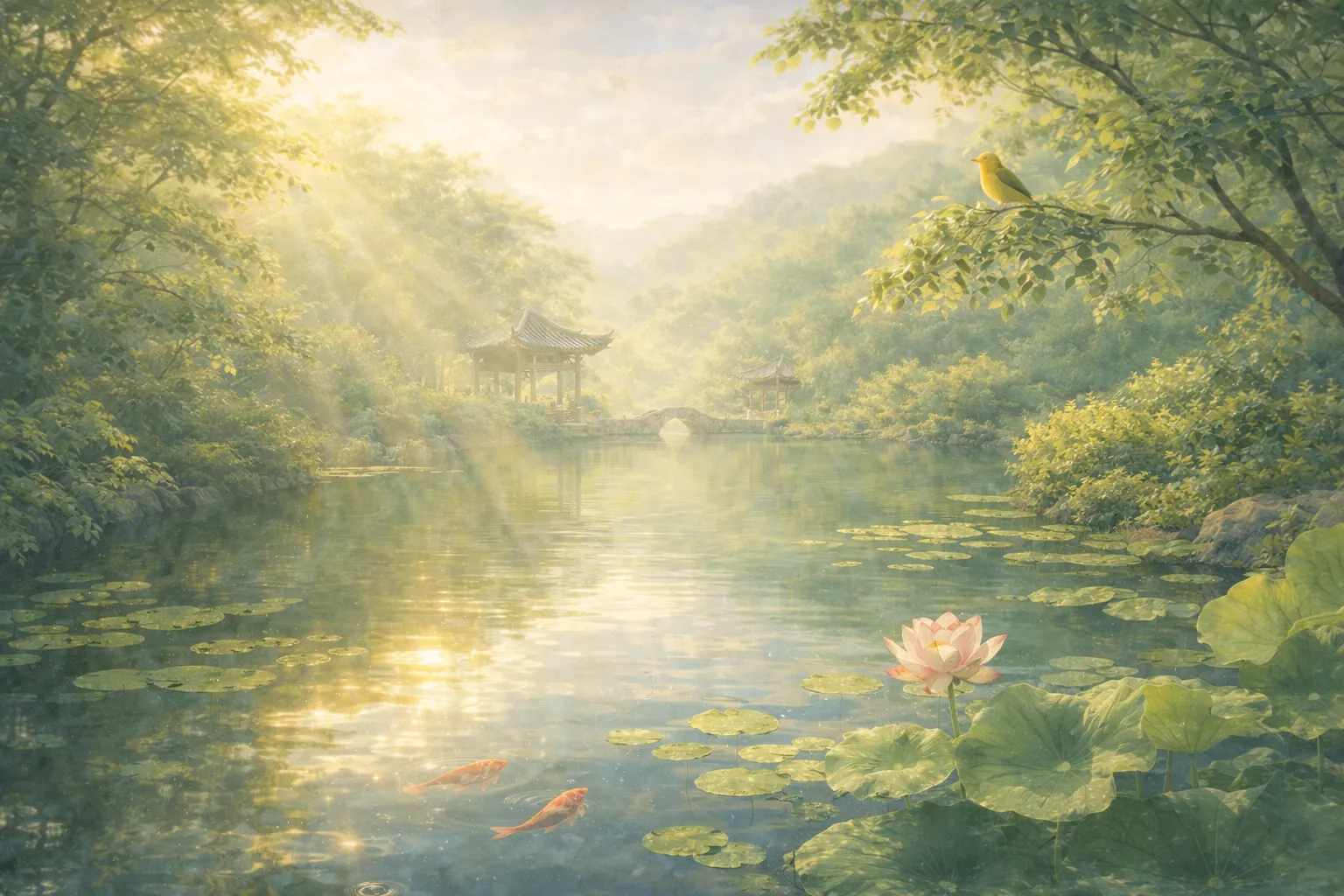
Summer Solstice Poetry
「昼晷已云极,宵漏自此长。」
Poetry of the Summer Solstice often writes of the heavenly rhythm in which yang reaches its height and yin begins to rise, and day and night begin their reversal. Wei Yingwu’s “昼晷已云极,宵漏自此长” records the point at which daylight reaches its maximum; Fan Chengda’s “李核垂腰祝饐,粽子系臂扶羸” describes customs associated with the Summer Solstice. In the poets’ writing are cicadas calling from tall trees, lotus blossoms shining in the sun, and new bamboo shoots lengthening, as well as the philosophical reflection “夏至一阴生”—at the Summer Solstice, the first yin is born. Within the longest day of the year, poets use brush and ink to capture the movement of light and shadow: when the day reaches its greatest length, yin has already begun to emerge, and the rhythm of nature never fails to arrive on time.
Summer Solstice Poetry
夏至日作
Original Verse:
璿枢无停运,四序相错行。
寄言赫曦景,今日一阴生。
Modern Translation:
The celestial pivot of the Northern Dipper never ceases its motion, and the four seasons follow one another in turn. I would speak to this blazing summer sunlight: from today, the Summer Solstice, yin quietly begins to arise.
Commentary:
This five-character quatrain brings astronomy and philosophy into poetry with remarkable concision. “璿枢无停运” writes of the ceaseless motion of the Northern Dipper, implying the unalterable laws governing the heavens. “四序相错行” describes the four seasons alternating in ordered succession. The first two lines begin from the broad laws of the cosmos; the final two narrow their focus to the special moment of the Summer Solstice. “寄言赫曦景” personifies the summer sun, as though the poet were speaking directly to it; “今日一阴生” points to the central astronomical and philosophical meaning of the Summer Solstice: it is the day when yang reaches its height, yet also the moment when yin first begins to emerge—the idea expressed in “夏至一阴生.” Though the poem contains only twenty characters, it encompasses astronomy, seasonal phenomena, and philosophy, embodying the Tang poetic wisdom of seeing the great through the small.
夏至雨霁与陈履常暮行溪上 · 其一
Original Verse:
西山已暗隔金钲,犹照东山一抹明。
片子时间弄山色,乍黄乍紫忽全青。
Modern Translation:
The western hills have already darkened, blocking the setting sun like a golden gong; yet its light still reaches the eastern hills, leaving behind a narrow band of brightness. In the space of only a moment, the sunset plays across the mountains, turning them now golden, now purple-red, then suddenly entirely blue-green.
Commentary:
This poem describes a wondrous evening scene after rain on the Summer Solstice, seen while the poet walks beside a stream. “西山已暗隔金钲” shows the sun sinking and its golden-red disk hidden behind the western hills; “金钲”, an ancient percussion instrument shaped like a gong, vividly serves as a metaphor for the setting sun. “犹照东山一抹明” shows the last light still illuminating a strip of the eastern hills. One side is dark, the other bright, creating a sharp contrast. The final two lines, “片子时间弄山色,乍黄乍紫忽全青”, use a rapid rhythm to describe the instant transformations of mountain color at dusk. “片子时间” means within a brief moment, while “乍黄乍紫忽全青” strings together three color changes to capture the shifting interplay between the remaining sunlight and the mountains. The Summer Solstice is the longest day of the year, when sunset is especially late and lingering; what the poet captures is precisely the changing light and color of this distinctive moment.
夏至
Original Verse:
日永星火,以正仲夏。
火流暑退,金气始下。
井梧叶绿,砌槿花赭。
忽忽时变,感物伤化。
Modern Translation:
The daylight grows long, and the Great Fire star, Antares, appears due south at dusk, marking the height of midsummer. As the Fire star begins to shift, the heat gradually recedes and the first breath of autumn quietly descends. The parasol-tree leaves beside the well remain green, while the hibiscus before the steps blooms in deep reddish flowers. Time changes all too swiftly; moved by the transformations of things, one cannot help but feel sorrow at change.
Commentary:
This is an ancient-style four-character poem, austere and solemn in tone, with something of the lingering spirit of the *Book of Songs*. The opening “日永星火” draws on the *Yao Dian* of the *Book of Documents*, using celestial phenomena to locate the Summer Solstice: “日永” refers to the longest day, while “星火” refers to the Great Fire star, Antares, appearing due south at dusk around this season. This method of determining the season through astronomical signs continues a tradition reaching back to pre-Qin antiquity. “火流暑退,金气始下” writes the Summer Solstice principle that yin begins to arise even as summer heat remains strong; “金气” refers to the western phase of metal, corresponding to autumn. The final four lines move from the still green leaves of the parasol tree by the well to the reddish hibiscus flowers beside the steps, then close with “忽忽时变,感物伤化.” The poem thus merges the Summer Solstice with reflections on the transformations of life and the passing of time, carrying a melancholy beauty akin to being moved by the season through the sight of flowers.
夏至
Original Verse:
朝雨晚晴夏至天,绿阴幽草胜花时。
一觞一咏聊自适,莫问人间荣与衰。
Modern Translation:
On this Summer Solstice day, rain falls in the morning and the sky clears by evening; deep green shade and secluded grasses seem lovelier than the season of blossoms. With a cup of wine and a poem, I simply seek my own ease; there is no need to ask about honor or decline in the human world.
Commentary:
Sima Guang takes the changing weather of the Summer Solstice as the background for a feeling of detachment from worldly concerns. “朝雨晚晴夏至天” describes the day’s shifting weather—rain in the morning and clearing skies by evening, a pattern associated with the convective rains of this season. “绿阴幽草胜花时” sets green shade and quiet grasses against the flowers of spring, expressing the Song aesthetic preference for restrained simplicity over luxuriant brilliance: the deep shade and secluded grasses of midsummer possess a vitality greater than spring flowers. The final two lines, “一觞一咏聊自适,莫问人间荣与衰”, directly express the poet’s heart. He finds contentment in drinking and verse, refusing to concern himself with worldly rise and decline. In four concise lines, weather, seasonal phenomena, and state of mind are brought together with simplicity and force.
夏至
Original Verse:
老去人间百事慵,夏来长日睡方浓。
绿阴满地蝉声静,惟有幽禽自往还。
Modern Translation:
With age, everything in the human world leaves me languid and disinclined. Summer arrives, the days grow long, and sleep becomes deep. Green shade covers the ground, and even the cicadas seem absorbed into the stillness; only secluded birds come and go freely.
Commentary:
Zhao Fan sets this poem against the long daylight of the Summer Solstice, writing the particular languor and ease of old age. “老去人间百事慵” immediately establishes the poet’s later-life state of mind: he can no longer summon enthusiasm for worldly affairs. “夏来长日睡方浓” writes of the longest days of summer and the depth and sweetness of sleep. “绿阴满地蝉声静” uses the green shade covering the ground to suggest summer’s density and coolness. The phrase “蝉声静” is especially subtle—not because there are no cicadas, but because their sound has merged into the stillness, making the surroundings seem even more secluded. The final “惟有幽禽自往还” closes with birds freely coming and going. Their freedom contrasts with the poet’s indolence, yet this indolence is not decadence; it is a calmness settled through the passing of years. The poem’s language is light but resonant, offering a truthful portrait of an elderly state of mind in the Summer Solstice season.
夏至
Original Verse:
不是清凉罢挥扇,自缘手倦歇些时。
登台长早下台迟,移遍胡床无处移。
Modern Translation:
It is not because the air has grown cool that I stop waving the fan; my arm is simply tired, so I rest for a moment. I climb the high terrace early and come down late, moving my folding seat again and again, yet nowhere can I find a truly cool place.
Commentary:
This quatrain writes of the oppressive heat after the Summer Solstice in a humorous tone. “登台长早下台迟” describes the poet lingering on the high terrace, perhaps because it catches more breeze than the ground below; “移遍胡床无处移” shows him repeatedly shifting his seat in search of a cooler spot, without success. The first two lines are even more amusing. “不是清凉罢挥扇” first denies the obvious explanation—it is not because the weather has cooled that he has stopped fanning himself; “自缘手倦歇些时” then gives the real reason—his arm is simply sore, so he must rest. This pattern of denial followed by explanation uses self-mockery to convey the intensity of the summer heat and invites a smile from the reader. Yang Wanli’s Chengzhai style, known for capturing details of everyday life and treating ordinary sensations with humor, is fully evident here.
Closing Note
Poetry of the Summer Solstice begins with the idea of long daylight. Wei Yingwu writes in *夏至避暑北池*, “昼晷已云极,宵漏自此长”—the longest day of the year has arrived, and from this point onward the nights will grow longer day by day. This is not the end of a season, but a turning point between yin and yang. The Tang poet Han Wo writes “长夏于今逢至日,长年何计得闲身”: summer is long, yet human life is brief. Yuan Zhen, in *咏廿四气诗·夏至五月中*, writes: “处处闻蝉响,须知五月中。龙潜渌水坑,火助太阳宫.” What he captures is the height of yang energy in the fifth lunar month—cicadas sounding everywhere, the sun blazing like fire. The final two lines, “寄言赫曦景,今日一阴生”, perceive the first stirring of yin within intense heat and sense the turning already present within the extreme.
Song poets often write the Summer Solstice with a sense of leisure. Fan Chengda writes “李核垂腰祝饐,粽丝系臂扶羸。节物竞随乡俗,老翁闲伴儿嬉”: the zongzi of the Summer Solstice were not merely eaten or commemorative, but were also worn or used in customs of blessing and longevity. Another poet writes “忆在苏州日,常谙夏至筵。粽香筒竹嫩,炙脆子鹅鲜”, recalling the fragrance of zongzi and the tenderness of young goose at a Summer Solstice banquet in Suzhou. Most moving of all is Su Shi’s line written at the Summer Solstice: “处之泰然,夫复何忧”—however long the day or heavy the heat, meeting it with composure is the best way to pass through it.
The Summer Solstice is one of the earliest of the twenty-four solar terms to have been determined. As early as the seventh century BCE, the ancients used a gnomon to measure the sun’s shadow and identify the solstice. What they saw was “the extreme of long daylight”; what they understood was “when yang reaches its extreme, yin begins to arise.” From Wei Yingwu’s “昼晷已云极” to Yuan Zhen’s “今日一阴生”, from Fan Chengda’s “老翁闲伴儿嬉” to Su Shi’s “处之泰然”—the poetry of the Summer Solstice tells us that the longest day will eventually pass, and that after yang reaches its fullest, yin must begin. Yet however the climate of the world may turn, the climate within the heart can remain steady. The Summer Solstice has arrived: the day is long, and the heart may rest at ease.
—
Readers’ Comments
Calendar and traditional culture enthusiasts from around the world, sharing the same moon.
Sign in or register to join the conversation. Your comment account is created automatically the first time you use a connected account.
No comments yet
Share your thoughts with readers around the world.