
Qingtuan (青团)
Pastries & SnacksBasic Information
- Category: Grain-based pastry
- Popular Regions: Jiangnan region, including Shanghai, Jiangsu, Zhejiang, Anhui, and surrounding areas
- Main Ingredients: Glutinous-rice flour, mugwort juice (or jiangmaicao juice / green plant juice), fillings such as red bean paste, sesame, salted egg yolk and pork floss
- Alternative Names: Qingming tuanzi (清明团子), mugwort dumplings, Qingming guo (清明果), qing yuanzi (青圆子)
Historical Origins
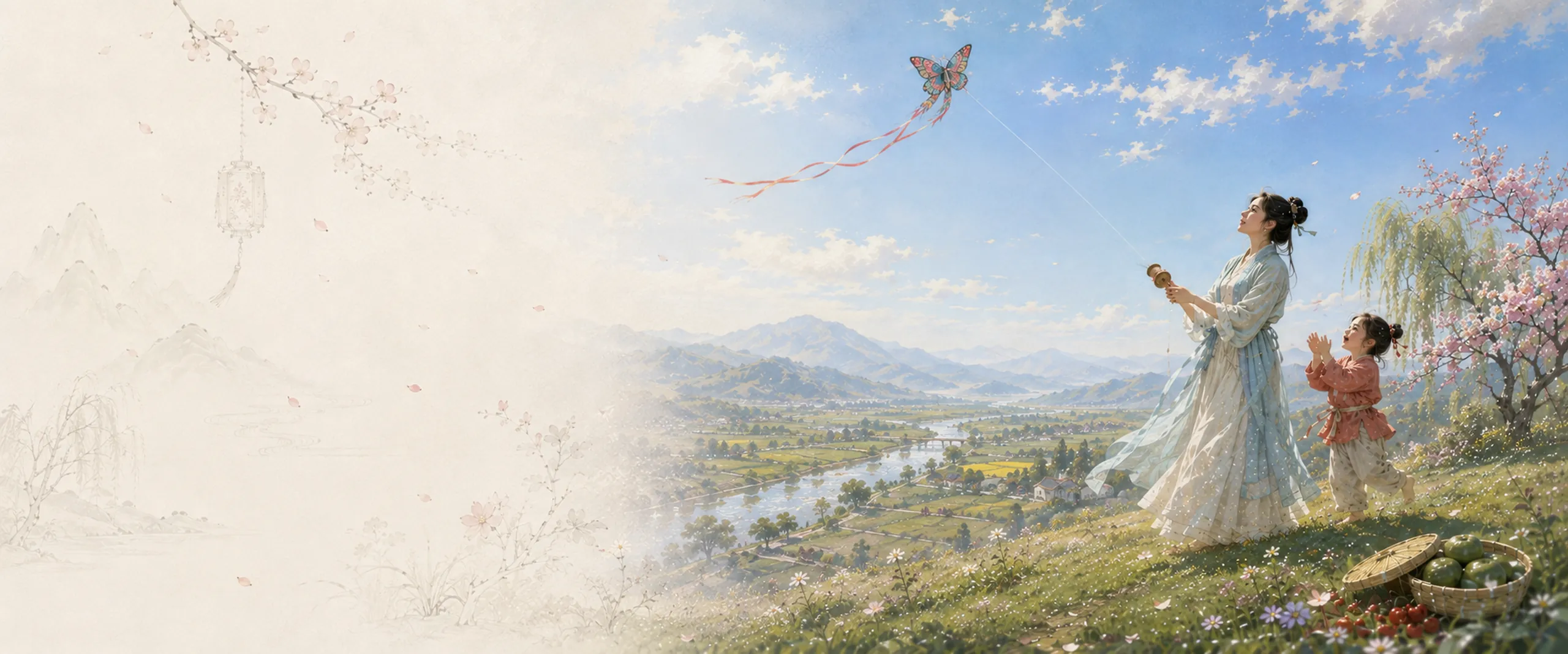
Qingtuan are the most representative seasonal food of the Qingming Festival and one of the relatively few Chinese festival foods named after a color. The word qing (青) refers here to green, drawn from the fresh new growth of spring.
The origins of qingtuan are closely connected with the Cold Food Festival. Hanshi falls on the 105th day after the winter solstice, usually one or two days before Qingming. During the festival, fire was prohibited for three days and people could eat only cold foods prepared beforehand; qingtuan emerged within precisely this setting. According to Gao Cheng’s Song-dynasty Shiwu Jiyuan (《事物纪原》), citing the Zhou Li (《周礼》), the prohibition on fire during Hanshi began in the Zhou dynasty. As one form of cold food eaten during the festival, qingtuan can therefore be traced at least to the period before the Song dynasty.
Cultural Meaning
By the Tang and Song dynasties, the seasonal foods of the Cold Food Festival had already become highly diverse. Tang-dynasty Hanshi foods included wheat-based items such as “Cold Food Cakes” and “Zhitui Cakes.” A line attributed here to Bai Juyi—“At the Cold Food qingtuan shop, spring lowers the willow branches”—directly connects qingtuan with the Cold Food Festival. The Song-dynasty Mengliang Lu (《梦粱录》) already records foods such as qingjing rice (青精饭) and qingtuan. Qingjing rice was rice darkened with the juice of Nanzhu leaves, following essentially the same principle of plant-based coloring later seen in qingtuan.
Lang Ying’s Ming-dynasty Qixiu Leigao (《七修类稿》) records: “In ancient times, during Cold Food, people gathered leaves of tong and poplar, dyed rice green for sacrifice, and thereby nourished yang qi. Today this has changed into green-and-white dumplings.” This constitutes a relatively explicit documentary account of qingtuan. Lang Ying not only recorded the food but also explained its cultural meaning—“to nourish yang qi.” Eating green food was understood as supporting the emergence and growth of springtime yang energy. Li Shizhen’s Ming-dynasty Bencao Gangmu (《本草纲目》) likewise records methods of using mugwort in food preparation.
By the Qing dynasty, qingtuan had become an indispensable seasonal Qingming food throughout Jiangnan. Yuan Mei’s Suiyuan Shidan (《随园食单》) records a concise method: “Pound green herbs for their juice, mix with flour to make dumplings, their color like green jade.” In only a few words, the passage precisely captures the essential technique: extracting juice from green plants, combining it with glutinous-rice flour, and forming jade-green dumplings. The Qing-dynasty Qingjia Lu (《清嘉录》) also explicitly records eating qingtuan at Qingming, indicating that by this time they had already become an emblematic Qingming food of Jiangnan.
After the 1990s, qingtuan expanded from a regional Jiangnan seasonal food into a nationally recognized delicacy. After 2010, amid renewed interest in traditional culture and the growth of online media, qingtuan became a widely discussed “internet-famous food.” Salted egg yolk and pork floss qingtuan introduced by major heritage food brands became a phenomenon, and scenes of customers waiting in line for hours to purchase them have recurred year after year. Qingtuan have thus shifted from the “taste of grandmothers” to the “taste of young people,” and from a “Qingming-only” delicacy to a broader “springtime limited edition.” Their cultural influence has greatly surpassed their original regional boundaries.
A folk legend in Jiangnan links the origins of qingtuan to the Taiping Heavenly Kingdom. According to the story, during that period a farmer attempting to deliver food to the besieged Li Xiucheng (李秀成) mixed mugwort juice into glutinous-rice flour to create green dumplings, concealed them among fresh grass, passed Qing military inspections, and successfully delivered them to Li Xiucheng. From then on, Li Xiucheng supposedly had his subordinates learn to make qingtuan every Qingming. Although this legend may not necessarily accord with historical fact, it has added associations of resourcefulness and loyalty to the cultural image of qingtuan.
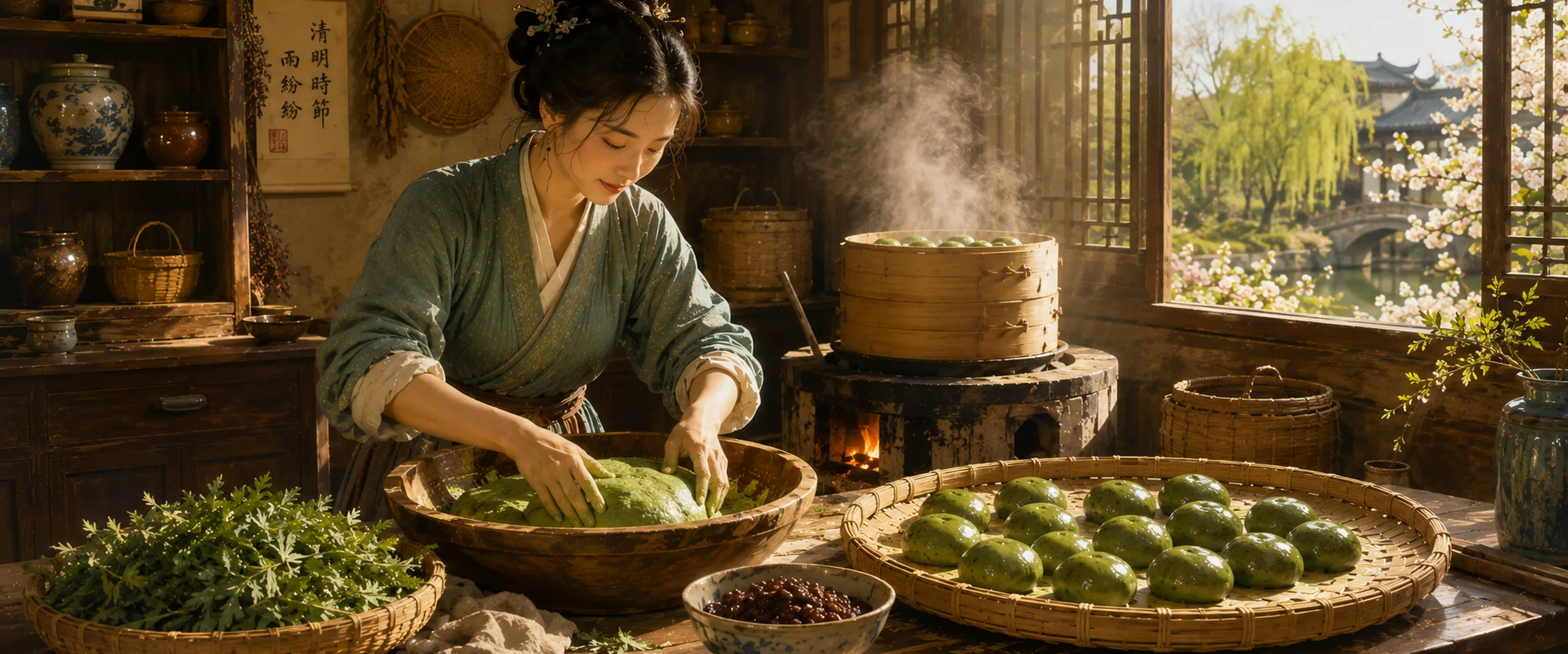
Qingtuan carry several layers of cultural symbolism. First, “green as jade.” Their green color comes from newly sprouted spring mugwort, effectively bringing the color of spring into food. To the ancients, qing represented spring and life, and eating green foods could “support yang qi” and encourage growth. Second, “honoring ancestors and respecting those who came before.” Qingtuan originally served as ancestral offerings at Qingming, using freshly grown mugwort to prepare food for the ancestors and embodying the traditional principle of “serving the dead as one serves the living.” Third, “the legacy of Cold Food.” Qingtuan preserve the tradition of cold foods from the Hanshi Festival and function as a sensory memory of an ancient ritual system. Fourth, “the symbolism of reunion.” Their round or clustered form also carries associations with family reunion; relatives gathering to make qingtuan together became a Qingming family ritual. Fifth, “the taste of spring.” To bite into qingtuan is, figuratively, to “eat spring in a single mouthful.” Their season is extremely short: after Qingming, mugwort gradually grows older and qingtuan disappear from the market. This “miss it and wait another year” seasonality gives qingtuan their distinctive appeal as a springtime limited delicacy.
Regional Evolution
Across Jiangnan, qingtuan display a rich range of forms and flavors:
- Shanghai: Red bean paste is the classic filling, while salted egg yolk and pork floss qingtuan have become increasingly popular in recent years. Shanghai diners place particular emphasis on both color and taste: qingtuan should be bright, translucent green and sweet without being cloying. Long-established Shanghai brands such as Xinghualou (杏花楼), Shen Dacheng (沈大成), and Wangjiasha (王家沙) are representative producers.
- Suzhou: Suzhou qingtuan are distinguished by the use of jiangmaicao for coloring, producing an especially vivid emerald green. They have been praised as the “finest among qingtuan.” Suzhou tradition places particular emphasis on fragrance, combining the fresh aroma of jiangmaicao with the gentle sweetness of glutinous rice.
- Hangzhou: Hangzhou qingtuan are made with mugwort, resulting in a deeper green color and a stronger herbal fragrance. They are commonly used as ancestral offerings and remain important foods for Qingming tomb sweeping.
- Ningbo: Ningbo qingtuan are also known as aiqing tuan (艾青团) and are made with mugwort juice and glutinous-rice flour. Fillings usually include red bean paste or sesame; pine pollen may sometimes be added for a distinctive flavor.
- Southern Anhui: Local Qingming guo are commonly savory, filled with spring bamboo shoots, pressed tofu, minced meat, and other ingredients. They may be shaped like dumplings or flat round cakes and are steamed before eating.
- Jiangxi: Jiangxi aimiguo (艾米果) are made from mugwort juice and glutinous-rice flour, usually in a dumpling shape. Both sweet and savory fillings are used, and they are an important Qingming food in southern Jiangxi.
Simple Preparation
- Ingredients: 300 g glutinous-rice flour, 200 g mugwort (or cudweed), 50 g regular rice flour, 30 g white sugar, 200 g red bean paste, cooking oil as needed
- Steps:
- Gather the greens: Pick fresh tender mugwort tips and wash thoroughly. Blanch in boiling water, remove, and rinse in cold water; a small amount of baking soda may be added to help preserve the vivid green color.
- Make the juice: Blend the blanched mugwort with a small quantity of water into a purée and strain for the juice. The pulp may also be retained for a deeper green color.
- Prepare the dough: Combine glutinous-rice flour and regular rice flour, add mugwort juice and white sugar, and knead into a smooth, non-sticky dough.
- Fill: Take a small piece of dough, roll it into a ball and flatten it, place red bean paste in the center, seal, and roll round again.
- Steam: Line a steamer with bamboo leaves or parchment paper, place the qingtuan inside, and steam over high heat for 10–15 minutes.
- Brush with oil: While still hot, brush the surface with a thin layer of cooking oil to preserve gloss and prevent cracking.
Tip: Adding a little baking soda while blanching mugwort helps retain its bright green color. Do not steam for too long, or the qingtuan may collapse and lose their shape. Brushing them with oil is a key step in achieving their characteristic “jade-green” appearance.
Readers’ Comments
Calendar and traditional culture enthusiasts from around the world, sharing the same moon.
Sign in or register to join the conversation. Your comment account is created automatically the first time you use a connected account.
No comments yet
Share your thoughts with readers around the world.