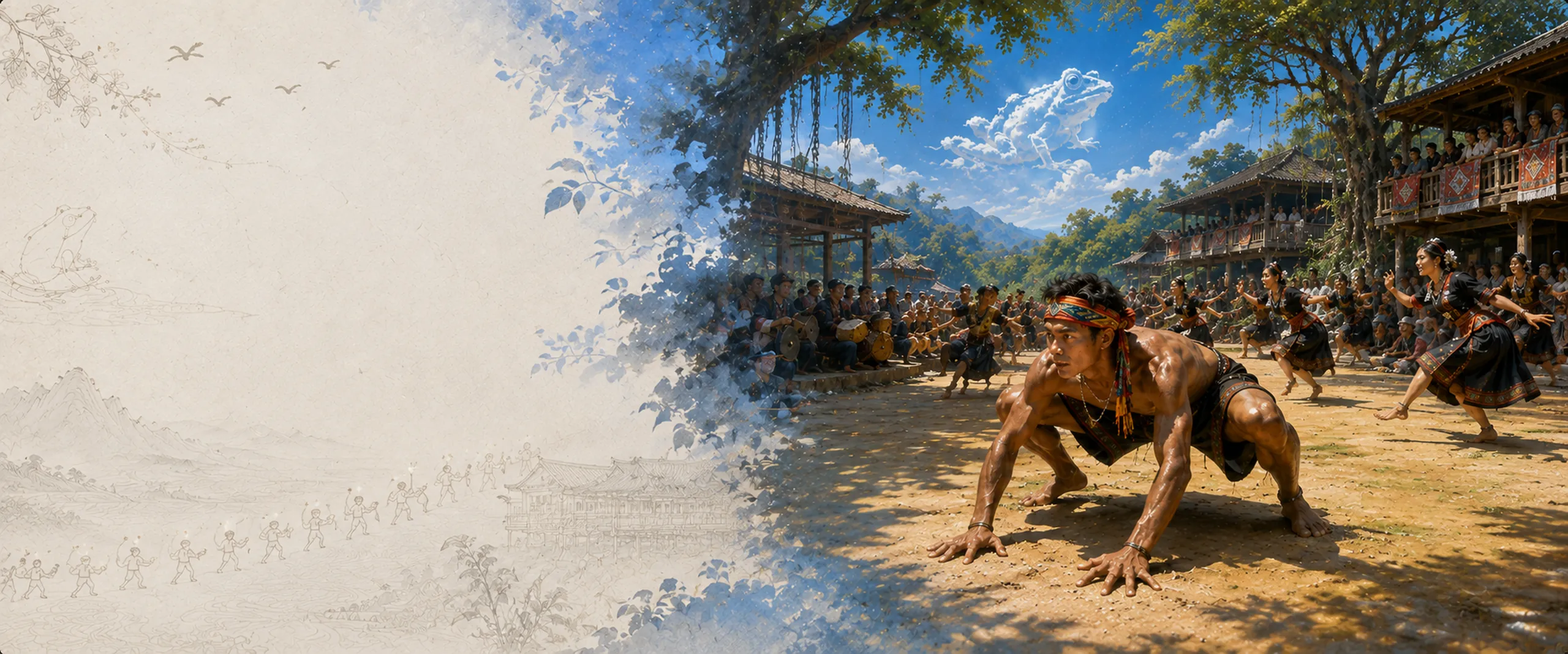

The Maguai Festival is a unique traditional festival of the Zhuang people, celebrated in the Hongshui River basin of Guangxi Zhuang Autonomous Region. “Maguai” is the Zhuang term for frog. The Zhuang ancestors believed that frogs were the sons of the Thunder God, capable of summoning rain and bringing harvests, thus giving rise to a distinctive frog worship. The festival is generally held between the first and second months of the lunar calendar, consisting of a complete ritual sequence: people first search the fields for frogs emerging from hibernation and bring them back to the village; then they hold a solemn ceremony, singing Maguai songs and dancing Maguai dances, praying for favourable weather and abundant harvests; finally, on an auspicious day, they “bury” the frog, symbolising the farewell to the old year and the welcome of the new. At the heart of the festival lies reverence for nature — the Zhuang people believe that by treating frogs well, they will receive the favour of the Thunder God and secure a good harvest for the year. In 2006, the Zhuang Maguai Festival was inscribed on China’s first list of National Intangible Cultural Heritage.
Festival Journey
Origins & Legends
History · Evolution · Legend
Tracing the Source · Historical Development
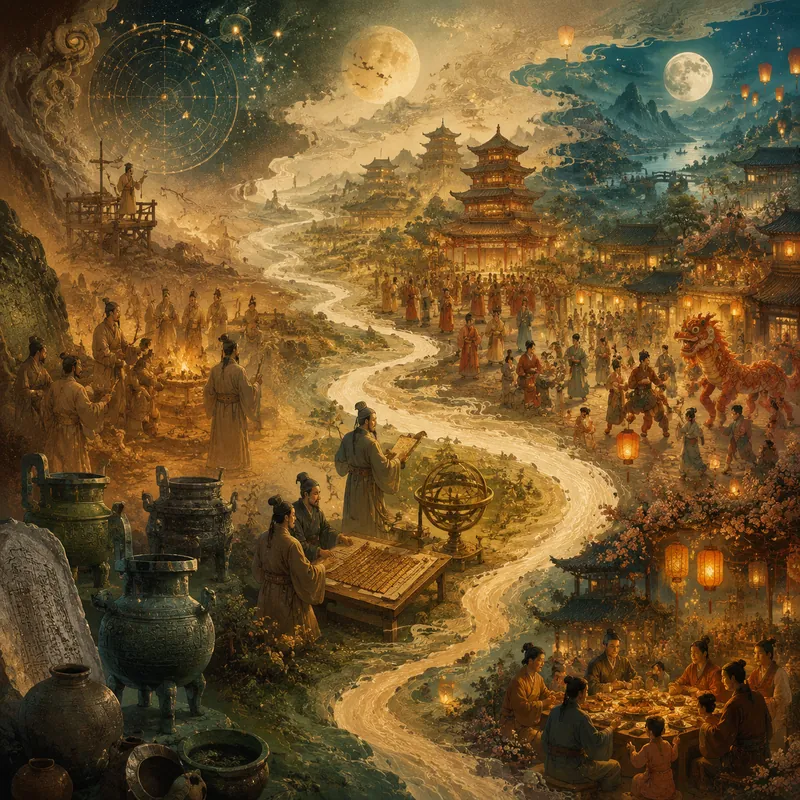
- From the Pre-Qin Period to the Tang and Song Dynasties The origins of the Maguai Festival can be traced to the period of frog-totem worship among the ancestors of the Zhuang people
- The Ming and Qing Dynasties The Ming and Qing periods were an important stage in which the Maguai Festival became more firmly established and widely practised throughout the Hongshui River basin
- The Modern Period During the Republican period, the introduction of Western culture and the development of modern education brought profound changes to traditional Zhuang society
- The Contemporary Era In 2006, the Zhuang Maguai Festival was inscribed on the first national list of representative items of China’s Intangible Cultural Heritage (第一批国家级非物质文化遗产代表性项目名录)
Festival Customs
Customs · Local Traditions · Everyday Life
Festival Foods
Food Traditions · Local Flavors · Taste
Seasonal Flavours · Seasonal Menu
Folk Arts
Song & Dance · Living Tradition · Heritage

Living Folk Arts · Of Song and Dance
Through Song and Dance · A Living Tradition
Opening Verse: 铜鼓声声唤蛙神,蚂拐舞中祈丰年。 Introduction: The poetry of the Maguai Festival centers on the worship of the Frog Deity and on Maguai songs and dances. “铜鼓声声唤蛙神” depicts the solemn ritual of invoking and worshipping the Frog Deity through the resounding beat of bronze drums, while “蚂拐舞中祈丰年” describes people imitating the movements of frogs in dance as they pray for an abundant harvest. The poetry frequently records the complete ritual sequence of finding the Maguai, worshipping the Maguai, observing mourning and filial rites for the Maguai, and finally burying the Maguai. The Maguai Festival is a Zhuang festival centered on frog worship, and the line “铜鼓声声唤蛙神,蚂拐舞中祈丰年” summarizes its core meaning. Zhuang ancestors believed that the frog was the son of the Thunder God and a rain-bringing deity who governed wind and rainfall. The poetry and songs of the Maguai Festival preserve the complete ritual sequence: people search the fields for frogs newly awakened from hibernation (“找蚂拐”), conduct sacrificial rites (“祭蚂拐”), sing Maguai songs and perform the Maguai Dance (“孝蚂拐”), and finally bury the frog (“葬蚂拐”). The movements of the Maguai Dance largely imitate those of frogs, and festival poetry frequently describes both the sound of bronze drums and the movements of the frog dance. The poetry of the Maguai Festival carries forward a thousand-year Zhuang belief in the frog as a sacred spirit and in dance as a means of praying for a good harvest.
Global Features
Overseas · Chinese Communities · Celebrations

Overseas Celebrations · Lights of Chinese Communities
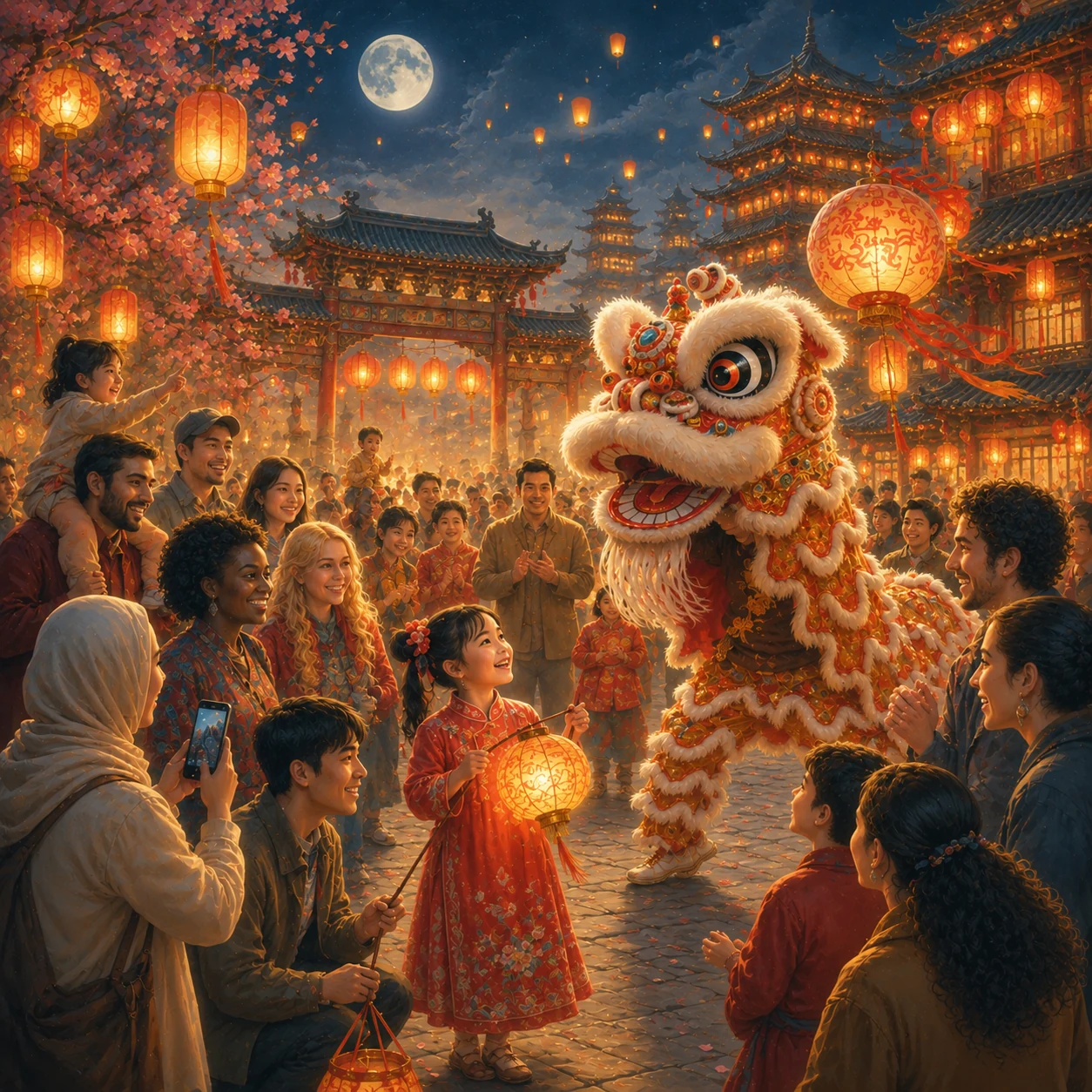
Asia is the most active region in the international dissemination of the Maguai Festival. Southeast Asian countries such as Thailand, Laos, and Cambodia are connected with Guangxi through geography and cultural affinities, and the Maguai Festival has generated strong cultural resonance among visitors from Southeast Asia. Thailand: linguistic affinity, cultural closeness Thailand provides one of the most striking examples of the Maguai Festival’s international reach. On the second day of the second lunar month in 2025, more than ten thousand people gathered to celebrate in Baying Village, Bachou Township, Donglan County, Hechi City, Guangxi—the birthplace of Zhuang Maguai Festival culture. At the venue, hundreds of bronze drums were arranged along the riverside walkway of the Baying River to welcome guests, their thunderous sound resounding into the sky. Thai visitor Nacha made a special journey to Baying Village to experience the Maguai Festival. She deliberately dressed in Zhuang attire and tried both weaving Zhuang brocade and playing the bronze drum. “This is my first time in Guangxi. Seeing people in the Zhuang village worship the maguai and perform the ‘Maguai Dance’ left a deep impression on me and gave me a deeper understanding of Chinese culture,” Nacha said. She found Zhuang clothing exquisite and the folk culture of the Zhuang region novel and interesting, and hoped to return to Guangxi again. Another Thai visitor, Sun Jiayan, found a sense of familiarity in the similarities of language and culture: “The Zhuang language, a Guangxi dialect, is very similar to Thai. Traveling in a Zhuang village makes me feel especially at home even though I am in a foreign country. People in northern Thailand also have a tradition of playing bronze drums. Thailand and China share affinities in language and ethnic culture, bringing us closer together.” This Southeast Asian cultural resonance is not accidental. The Zhuang, Thai, Lao, and related peoples all belong to the Tai-Kadai language family and share deep historical connections in language, agricultural culture, and bronze-drum traditions. The frog worship and rice-farming culture embodied in the Maguai Festival possess an intrinsic affinity with the belief traditions of many Southeast Asian peoples. Ming Meiying, a retired teacher from Bangkok, Thailand, was likewise drawn to the mysterious culture of the maguai: “The Zhuang customs here are very appealing to me, and the Zhuang Maguai Festival is also highly distinctive. Baying Zhuang Village has fresh air and is beautiful and pleasant to live in. It is wonderful to see how happy the elderly and children are here.” Participation by Southeast Asian international students The Maguai Festival has attracted not only Thai visitors who make special trips for the occasion, but also Southeast Asian students studying in China. International students from the United States, Thailand, Indonesia, and other countries have attended Maguai Festival activities after hearing of its reputation. At the venue, they performed with an auspicious dragon and offered blessings to local residents and visitors. Their participation has helped extend the influence of the Maguai Festival into Southeast Asian countries through the social networks of international students. Reflections of a Pakistani international student After experiencing the Maguai Festival, Niz, an international student from Pakistan, remarked: “It is truly very lively. The Zhuang clothing is beautiful and the singing is extremely pleasant. Although I do not understand what they are singing, what belongs to an ethnic people belongs to the world. I have gained a deeper understanding of Chinese culture.” Cultural connections with Cambodia The Maguai Festival has also attracted attention in Cambodia. The Zhuang Maguai Festival and Cambodia’s traditional agricultural culture share similarities at the level of their spiritual core—both are rooted in rice-growing civilizations and both contain prayers for rainfall and abundant harvests. The ecological wisdom of “harmonious coexistence between humanity and nature” carried by the Maguai Festival likewise finds cultural resonance in Cambodia.
The influence of the Maguai Festival has crossed the Pacific and reached the American continent. Visits by scholars and online personalities from multiple countries During the 2023 Maguai Festival, folk performances in Donglan County attracted international visitors from countries including the United States, Iran, Bangladesh, and South Africa. Scholars and online personalities from different countries celebrated the Zhuang Maguai Festival together with the warmly welcoming local Zhuang people, personally experiencing the distinctive appeal of this ancient ritual tradition along the Hongshui River. Participation by American visitors The Maguai Festival has attracted not only scholars but also ordinary American visitors. At the festival venue in Baying Village, visitors from the United States joined Zhuang residents in performing bamboo-pole dances, playing bronze drums, and experiencing the appeal of intangible cultural heritage. For American visitors, the ancient Zhuang tradition of revering frogs and praying for blessings—a belief system deeply bound to nature—offers a worldview markedly different from that of Western culture. International online communication breaks beyond its circle In February 2023, Donglan County organized and planned coordinated external communication, strengthening international online dissemination and helping publicity for the “Donglan Zhuang Maguai Festival” become widely popular online. Scholars and online personalities from Iran, the United States, the United Kingdom, South Africa, Nigeria, Bangladesh, Cambodia, Kazakhstan, and other countries participated and reported on the festival. Through their own social media accounts and media coverage, these participants and reporters carried the spectacle of the Maguai Festival back to their respective countries. Coverage by Bangladesh National Television An important milestone in the international online dissemination of the Maguai Festival was its first appearance on Bangladesh National Television. This marked the first time the festival entered mainstream television media in a South Asian country. Coverage by Bangladesh National Television brought the Maguai Festival broad public attention in Bangladesh.
The Maguai Festival has spread in Europe primarily through two channels: visits by scholars and media reporting. Participation by British scholars During the 2023 Maguai Festival, scholars from the United Kingdom traveled deep into Baying Village in Donglan County to explore its folk performances. Together with local Zhuang residents, they took part in ritual activities, watched Maguai Dance performances, and listened to the thunderous sound of bronze drums. For these European scholars, the Maguai Festival provided a distinctive window onto Zhuang agricultural civilization and folk beliefs. Attention from mainstream European media A number of mainstream media outlets in China and abroad republished scenes from the Baying Maguai Festival in different languages. The reputation of the Baying Maguai Festival in Bachou Township, Donglan, consequently spread further. European media coverage brought this ethnic festival from southwestern China into the public view of European audiences.
The influence of the Maguai Festival has also extended to Oceania. During the 2023 Maguai Festival, international visitors from countries including South Africa traveled to explore and experience the celebrations. Although the festival’s dissemination in Oceania is still at an early stage, personal experiences by international visitors and the spread of content through social media are allowing more and more people in Oceania to learn about the Maguai Festival. As cultural exchange between Guangxi and Oceanian countries such as Australia and New Zealand grows increasingly close, the Maguai Festival is expected to gain wider visibility in Oceania through cultural exhibitions, tourism promotion, and other channels.
Visitor Guide
Preparation · Etiquette · Take Part with Confidence
Readers’ Comments
Calendar and traditional culture enthusiasts from around the world, sharing the same moon.
Sign in or register to join the conversation. Your comment account is created automatically the first time you use a connected account.
No comments yet
Share your thoughts with readers around the world.