Dragon Boat Festival

Dragon Boat Festival

「 节分端午自谁言,万古传闻为屈原。 」

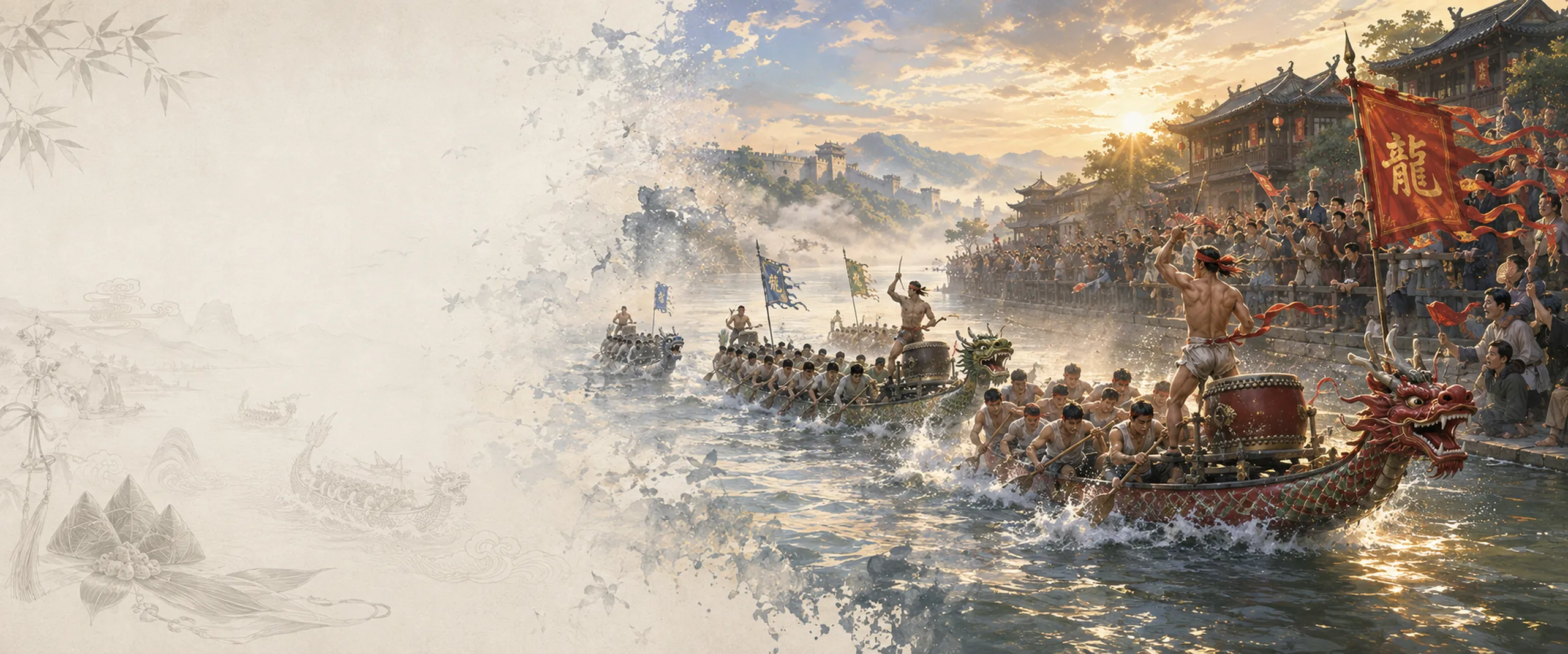
The Dragon Boat Festival, also known as Duanwu, carries millennia of remembrance for Qu Yuan, the patriotic poet of ancient Chu. Its customs—dragon boat racing, eating zongzi (sticky rice dumplings), hanging mugwort, and drinking realgar wine—are…
Dragon Boat Festival

The Dragon Boat Festival originated from dragon totem sacrifices in the pre‑Qin period. Later, because Qu Yuan drowned himself in the Miluo River on the fifth day of the fifth lunar month, the day became a festival commemorating this patriotic poet. The Tang‑dynasty poet Wen Xiu, in his poem “Duanwu” (《端午》), writes: “节分端午自谁言,万古传闻为屈原。” (*The Dragon Boat Festival—who first gave it that name? Through the ages, the tale has been told of Qu Yuan.*) This verse clearly links the festival to Qu Yuan. The customs are rich and varied: dragon boat racing derives from the legend that local people rowed out to search for Qu Yuan; eating zongzi commemorates the poet—people wrapped sticky rice in reed leaves and threw them into the river to keep fish and shrimp from consuming his body; hanging mugwort and drinking realgar wine were meant to expel the “five poisons” (五毒: scorpions, centipedes, snakes, toads, and geckos) and drive away pestilence. As Mei Yaochen of the Song dynasty wrote in his poem “The Fifth Day of the Fifth Month” (《五月五日》): “屈氏已沉死,楚人哀不容。” (*Qu Yuan had sunk to his death; the people of Chu grieved for his unjust fate.*) After a thousand years, the fragrance of zongzi and the drumbeats of dragon boats remain the deepest tribute to this great poet.

Next Dragon Boat Festival in 229 days
Lunar Date
5th day of the 5th lunar month
Origin Dynasty
Warring States period
Popular Regions
Throughout China
Cultural Heritage
UNESCO Intangible Cultural Heritage

Festival Journey

  1. Pre‑Festival Preparations

    Preparations for the Dragon Boat Festival begin gradually from the end of th…

  2. The Day of the Dragon Boat Festival

    The Dragon Boat Festival falls on the fifth day of the fifth lunar month. To…

  3. After the Festival

    The Dragon Boat Festival holiday runs from Friday, 19 June, to Sunday, 21 Ju…

Origins & Legends

History · Evolution · Legend

Dragon Boat Festival · Origins & Legends

Tracing the Source · Historical Evolution

  • Han Dynasty The Dragon Boat Festival sprouted in the pre‑Qin period and was formally established as a festival during the Han dynasty
  • Wei‑Jin and Northern and Southern Dynasties During the Wei‑Jin and Northern and Southern Dynasties period, the customs of the Dragon Boat Festival became more diverse and displayed distinctive regional characteristics
  • Sui and Tang Dynasties During the Sui and Tang dynasties, the Dragon Boat Festival inherited the customs of the previous dynasties in form
  • Song Dynasty and Later By the Song dynasty, the court posthumously honoured Qu Yuan as Duke Loyal and Martyr, and issued an edict designating the fifth day of the fifth month as “Duanwu Festival,” ordering local governments to organise activities such as dragon boat races to commemorate Qu Yuan

Festival Customs

Customs · Local Traditions · Everyday Life
Festival Foods

Food Traditions · Local Flavors · Taste
Poetry & Verse

Classics · Imagery · Legacy

Dragon Boat Festival · Poetry & Verse

Representative Poems · Classic Selections

「Dragon Boat Festival」

节分端午自谁言,万古传闻为屈原。
堪笑楚江空渺渺,不能洗得直臣冤。

Historical Development Core Imagery Thematic Categories Dragon Boat Festival Folk Songs Closing Reflections

Global Features

Overseas · Chinese Communities · Celebrations

Dragon Boat Festival · Global Features

Overseas Celebrations · Lights of Chinese Communities

01
Festival Scenes Abroad United States

The United States is one of the countries where dragon boat sport is most active worldwide. Dragon Boat Festival celebrations extend from the East Coast to the West Coast, shaped both by the spontaneous initiatives of Chinese communities and by deep participation from mainstream society. Washington, D.C.: Dragon boat clubs train through the night. In the U.S. capital, dragon boat clubs practice through the night in preparation for Dragon Boat Festival races. Francis Lira, who began dragon boating in 2006, said: “It takes 20 people to move a dragon boat. You cannot do it alone. There is no individual in this sport; everyone has to work together.” Local media commented that “this growing sport is paying tribute to Chinese history.” Washington’s dragon boat races have become one of the city’s most influential multicultural events. California: A Dragon Boat Festival celebration for a multicultural community. In California, the 2025 Annual Dragon Boat Festival, organized by the Asian American Community Involvement Association, was held on May 31 at West Valley College in Saratoga, attracting hundreds of enthusiastic participants. The event not only showcased the appeal of diverse Asian cultures, but also demonstrated strong community cohesion and a spirit of exchange across ethnic groups. On the day of the Dragon Boat Festival, the third Dragon Boat Folk Culture Festival was held at Qiyang Cultural Center. Activities included hands-on zongzi making; tasting mugwort cakes, foods made with ai (艾), or Chinese mugwort, a plant closely associated with traditional Dragon Boat Festival customs; weaving five-colored cords (五彩绳), colored threads traditionally worn during the festival; calligraphy; papercutting; and “shooting the five poisons” (射五毒), an interactive folk game associated with the traditional wudu (五毒), or “five poisons.” The program also included traditional Chinese face painting and assessments of individual traditional Chinese medicine body constitutions (体质). Gao Huiling of Los Angeles said that the Dragon Boat Festival is an important traditional festival for Chinese people, carrying profound cultural and historical significance; through storytelling, music and dance, food stalls, and other activities, people of different generations and ethnic backgrounds are invited to experience the beauty of Chinese culture together. Seattle: A Chinese school’s cultural return. Located south of Seattle, Nanpu Xiaxida Chinese School returned after a six-year absence to participate in the 17th Kent International Festival, organized by the Kent Chamber of Commerce on May 31, 2025, presenting Dragon Boat Festival culture to local residents. Michigan: A Dragon Boat Festival celebration in the library. On April 26, the Michigan Lion Dance Team held a “Taiwanese American Dragon Boat Festival” cultural event in Adam Strohm Hall at the Detroit Public Library. Holding the event in this historic hall—renowned for its soaring vaulted ceiling, ornate decoration, and murals by American artist Gari Melchers—gave the occasion particular significance; within a space where knowledge and history intertwine, the Dragon Boat Festival celebration took on an added depth while opening a new chapter for different communities. Corporate cultural transmission. Huamao Logistics also organized Dragon Boat Festival celebrations across several of its U.S. offices. The Miami and Los Angeles offices strengthened awareness of tradition through dragon boat race videos and cultural introductions; the Chicago office created a rich festive atmosphere with themed backdrops, while its e-commerce team brought colleagues closer through food, games, and cultural learning, with touhu (投壶), the traditional Chinese game of tossing arrows into a narrow vessel, generating particularly lively interaction; the New York office introduced employees to traditional Chinese culture, and everyone tasted traditional zongzi.

02
Festival Scenes Abroad Canada

Dragon Boat Festival celebrations are equally vibrant in Canada. Even before the festival arrives, many supermarkets and stores begin offering an array of zongzi; the fragrance of zongzi leaves spreads through the early-summer air, while dragon boat racing has become one of the favorite sports of people in Canada’s mainstream communities. During the festival period, Vancouver and other places in Canada hold dragon boat races and related activities, drawing large crowds of spectators and creating a lively atmosphere. Huamao Logistics Canada organized employees in Toronto to taste traditional zongzi and exchange cultural stories, strengthening employees’ sense of belonging through the principle of “people first, cultural integration.” Weng Guoning, chairman of the Federation of Chinese Associations in Toronto, said that the Dragon Boat Festival has long since become more than merely a traditional Chinese festival; it has become a vibrant calling card for Chinese culture as it reaches the world.

03
Festival Scenes Abroad Argentina

The 2025 Argentina Dragon Boat Competition was held on May 24 at the dragon boat base in Escobar, Buenos Aires Province, attracting more than 100 competitors. The scale of the event reached a new record, and a 2,000-meter long-distance race was introduced for the first time. Liu Jingang, chairman of the Argentine Dragon Boat Association, said that dragon boat sport not only embodies the spirit of unity, cooperation, and striving forward, but has also become an important bond connecting the peoples of China and Argentina. Nicolás Ceruya, director of Escobar’s municipal sports bureau, said that dragon boat sport has become an effective platform connecting different cultural groups: “This is a sport worth promoting, not only because it is highly competitive and exciting to watch, but also because it is a symbol of tradition and unity.” Since its establishment in 2019, the Argentine Dragon Boat Association has actively promoted the sport and gradually built a training and competition system covering several provinces across Argentina.

04
Festival Scenes Abroad Ecuador

On May 10, 2025, Consul General Gao Zhenting in Guayaquil attended a Dragon Boat Festival celebration jointly organized by Guayaquil’s Chinese community and the municipal government. Consul General Gao said that the traditional Chinese Dragon Boat Festival had been inscribed by UNESCO on the Representative List of the Intangible Cultural Heritage of Humanity; the joint organization of Dragon Boat Festival activities by the Chinese community of Guayaquil and the municipal government had created a platform for exchange and mutual learning between Chinese and Ecuadorian civilizations.

Visitor Guide

Preparation · Etiquette · Take Part with Confidence
Dragon Boat Festival · Visitor Guide

Start with Understanding, Step into the Festival with Confidence

01 Before You Join Event Schedule and Venues ### Core Dragon Boat Festival Dates The Dragon Boat Festival falls on the fifth day of the fifth lunar month each year, generally corresponding to late May through late June in the Gregorian calendar. Dragon boat races and folk activities usually begin about one week before the festival and reach their peak on the official festival day. The core schedule is as follows: Time Activity Description 1–2 weeks before the festival Dragon boat race warm-ups and intangible cultural heritage activities begin Miluo Dragon Boat Super League finals and Tianjin Baodi demonstration activities open successively Fifth day of the fifth lunar month Dragon Boat Festival Day Qu Yuan Hometown Dragon Boat Culture Festival opens and national dragon boat events move into full swing Before and after the festival Peak dragon boat racing period Dragon boat races are concentrated across the country ### Traditional Dragon Boat Festival Customs Dragon Boat Festival customs are rich and diverse, and can broadly be divided into two themes: warding off harmful influences and disaster, and commemoration and blessing. Custom Description Dragon Boat Racing The festival’s grandest activity. Traditionally associated with people rowing out to search for Qu Yuan’s body, it later evolved into competitive dragon boat racing. Events range in scale from dozens to more than one hundred participating teams Eating Zongzi The festival’s most representative food custom. Glutinous rice, red dates, meat, and other fillings are wrapped in reed leaves and steamed or boiled. Along the Miluo River, alkaline-water horn-shaped zongzi are a local specialty Hanging Mugwort and Calamus “Willow at Qingming, mugwort at Duanwu.” Mugwort and calamus are believed to repel insects and ward off evil, and are traditionally hung outside household doors Wearing Scented Sachets Sachets filled with fragrances and Chinese medicinal herbs are worn to repel mosquitoes and help prevent illness Wearing Five-Colored Threads Five colors of silk thread are woven into bracelets and tied around children’s wrists as prayers for blessing and good fortune Applying Realgar Realgar wine is used to draw the character 王 on children’s foreheads, symbolizing the warding off of evil and poison Shooting the Five Poisons Participants use bows and arrows to shoot images of the Five Poisons—snake, scorpion, centipede, gecko, and toad—symbolically driving away disease and harm Bathing in Herbal Water Herbal decoctions are used for bathing to dispel harmful influences and help avoid illness ### Recommended Activities by Region Miluo, Hunan — “Source of Duanwu · Home of Dragon Boats”: Miluo is the place where Qu Yuan drowned himself and is known as the “source of the Dragon Boat Festival and the home of dragon boats.” Every year during the festival, the final round of the Hunan Dragon Boat Super League opens at the Miluo River International Dragon Boat Racing Center. Dozens of top dragon boat teams from all 14 prefecture-level cities and autonomous prefectures across Hunan gather in Miluo. A themed cultural program under “Our Festival · Dragon Boat Festival” is held at the same time, and zongzi-making experiences take place in Quzi Cultural Park on festival day. Zigui, Yichang, Hubei — Qu Yuan Hometown Dragon Boat Culture Festival: Zigui is the hometown of the poet Qu Yuan and an important birthplace of Dragon Boat Festival culture. Dragon boats here retain the traditional wooden dragon boat form. The annual Qu Yuan Hometown Dragon Boat Culture Festival includes an opening ceremony and National Dragon Boat Linkage event at the Yichang venue, traditional wooden dragon boat races recreating ancient rites such as dotting the dragon’s eyes and sailing the river to summon the spirit, the Saotan Poetry Gathering, youth poetry competitions, the “Twelve Hours of Duanwu” immersive regional experience, and cross-Strait Qu Yuan cultural exchange activities. Chengdu, Sichuan — Tianfu Dragon Boat Festival: The Chengdu region hosts a rich range of dragon boat activities, with several competitions held simultaneously. * National Dragon Boat Linkage · Sichuan–Chongqing Tianfu Dragon Boat Festival: held along the Nanhe River in the urban section of Xinjin, with more than 50 teams from across the country * Xinglong Lake Dragon Boat Invitational: in addition to dragon boat racing, includes three water-based fun competitions and four folk-cultural activities * Huanglongxi Dragon Boat Competition and Dragon Boat Gathering: held in Huanglongxi Ancient Town * Qingshen County, Meishan, Sichuan: “Hundred Boats Racing to Welcome Duanwu” dragon boat race and traditional duck-catching activities Suzhou, Jiangsu — Jinji Lake Dragon Boat Race: Held every year during the Dragon Boat Festival at Moon Harbor on Jinji Lake in Suzhou, the event attracts dozens of teams and more than a thousand participants. Suzhou’s classical gardens and ancient towns simultaneously launch Dragon Boat Festival themed cultural programs. Guangdong — Province-Wide Dragon Boat Linkage: During the Dragon Boat Festival, Guangdong Province organizes hundreds of dragon boat activities and hundreds of competitions in a province-wide coordinated program. Traditional dragon boat races, five-person dragon boat races, women’s phoenix boat competitions, and other events offer a rich variety of Lingnan-style Dragon Boat Festival experiences. Baodi, Tianjin — National “Our Festival · Dragon Boat Festival” Cultural Demonstration Event: Held annually at the Chaobai River National Wetland Park in Baodi, Tianjin. The “Chaobai Duanwu Guochao Cultural Grand Garden” showcases hands-on intangible cultural heritage such as metal-and-stone paper tearing and temari ball making. Traditional games include pitch-pot rituals, land dragon boats, and ring-toss for lucky zongzi, while the “Book-Fragrant Duanwu · Children Chanting Family and Nation” series runs alongside the main program. Shangrao, Jiangxi — Ancient-Style Dragon Boat Festival at Gexian Village: Gexian Village Resort in Shangrao is a popular destination for an old-style Dragon Boat Festival experience. Visitors can try ancient customs such as shooting the Five Poisons and bathing in herbal water, alongside land dragon boat activities and nighttime fish-lantern tours. Yixian, Anhui — Hongcun Lantern Parade: Hongcun offers intangible cultural heritage study programs including lantern painting, traditional rubbing techniques, and lacquer-fan making. Lantern parades, Huizhou opera performances, and live bamboo-raft shows provide activities throughout both day and night. Other Recommended Destinations: * Changsha, Hunan: “Tour the Homeland of Qu and Jia · Experience Duanwu Intangible Heritage” — traditional activities including applying realgar to the forehead, cleansing hands with mugwort water, and interacting with “Qu Yuan” over *Chu Ci* * Shanghai: more than ten local intangible cultural heritage traditions appear together, including Sanlin embroidery, Shanghai-style paper cutting, Luodian lanterns, and Wusong dough modeling 02 Before You Join Pre-Trip Preparation: ### Visas and Entry Dragon Boat Festival destinations across China are subject to the country’s unified visa policies: * 240-hour visa-free transit for citizens of 54 countries: Travelers may enjoy visa-free transit for up to 240 hours, with permitted stay areas covering most administrative regions of China. * Tour groups from ASEAN countries: Organized groups may enter visa-free through designated ports. * Other nationalities: Apply in advance for a tourist visa, or L visa, through the relevant Chinese embassy or consulate and ensure that the passport remains valid for more than six months. * Latest policies: Before departure, consult the official website of China’s National Immigration Administration or the relevant Chinese embassy or consulate. ### Adapting to the Climate The Dragon Boat Festival falls on the fifth day of the fifth lunar month, corresponding to late May through late June. By this time, most of China has entered summer, with the following regional climate patterns: Region Temperature Range Climate Characteristics Clothing Recommendations North China (Beijing, Tianjin) 22°C–32°C Hot and dry, with strong sunlight Short-sleeved T-shirt, sun-protective clothing, sun hat, sunscreen East China (Shanghai, Hangzhou, Suzhou) 24°C–34°C Hot and humid, during the plum-rain season Short sleeves, quick-drying clothing, rain gear essential South China (Guangzhou, Shenzhen, Foshan) 26°C–35°C Hot and humid, with frequent showers Short sleeves, quick-drying clothing, sun protection, rain gear Central China (Wuhan, Changsha, Yueyang) 24°C–33°C Hot, with relatively high humidity Short sleeves, lightweight clothing, sun protection Southwest China (Chengdu, Chongqing) 22°C–30°C Warm and humid, with occasional rain Short sleeves, light jacket, rain gear Northeast China (Harbin) 18°C–28°C Warm and comfortable, with larger day-night temperature differences Short sleeves, light jacket General Advice: By June, most of China is already in summer, so sun protection and hydration are daily essentials. East China is in the plum-rain season, making rain gear indispensable. Dragon boat races are usually watched outdoors by the water, so quick-drying fabrics, sun hats, and sunglasses are recommended. ### Travel Insurance It is strongly recommended to purchase travel insurance covering: * Accidental injury and medical treatment for acute illness, including outpatient care * Loss of or damage to personal belongings * Travel delays or cancellations, as summer weather can be changeable and flights may be delayed ### Currency and Payment * Currency: Renminbi (CNY). * Cash: Cash can be more reliable at folk markets and intangible cultural heritage workshops. Carrying RMB 200–400 is recommended. * Cards: Visa and MasterCard are accepted at major hotels and shopping centers. * Mobile Payment: Alipay and WeChat Pay are widely used throughout China. ### Communications and Internet * Important: During the Dragon Boat Festival holiday, travel volume is highly concentrated, and 4G/5G networks may become congested at popular scenic areas and dragon boat venues. It is strongly recommended to download offline maps in advance. Baidu Maps and AutoNavi are recommended; download maps for your destination cities while connected to Wi-Fi. 03 Before You Join How to Get There: ### Major Event Destinations The Dragon Boat Festival is celebrated nationwide, and dragon boat races and folk activities vary by region. Key recommended destinations include: Destination Featured Activities Transportation Miluo, Yueyang, Hunan Source of Duanwu · Home of Dragon Boats — Dragon Boat Super League Fly to Changsha Huanghua Airport, then take high-speed rail to Miluo East Station Zigui, Yichang, Hubei Qu Yuan Hometown Dragon Boat Culture Festival — traditional wooden dragon boat races Fly to Yichang Sanxia Airport, then transfer by road to Zigui Chengdu, Sichuan Tianfu Dragon Boat Festival, Xinglong Lake Dragon Boat Invitational Chengdu Shuangliu / Tianfu airports; Chengdu East Railway Station Suzhou, Jiangsu Jinji Lake Dragon Boat Race Shanghai Hongqiao / Pudong airports; Suzhou / Suzhou North railway stations Guangdong Province-wide coordinated dragon boat activities Guangzhou Baiyun Airport; Shenzhen Bao’an Airport Tianjin National “Our Festival · Dragon Boat Festival” cultural demonstration event Tianjin Binhai Airport; Tianjin Railway Station Shangrao, Jiangxi Ancient-style Dragon Boat Festival at Gexian Village Shangrao Sanqingshan Airport; Shangrao Railway Station Yixian, Anhui Hongcun lantern parade and Huizhou opera Fly to Huangshan Airport, then transfer by road to Yixian ### Special Transportation Reminders The Dragon Boat Festival is a national statutory holiday and generally includes a three-day break, including the weekend. Exact dates are subject to the State Council’s official announcement for the year. Flights / High-Speed Rail: * The afternoon before the holiday and the morning of the first holiday day are the peak outbound travel periods, while the final holiday day is the peak return period. * Book flights and train tickets about one month in advance. * Tickets to popular destinations such as Miluo, Zigui, Suzhou, and Chengdu can sell quickly. Purchase in advance through the Railway 12306 App. Driving: * Important: Expressways are not toll-free during the Dragon Boat Festival. Toll-free expressway travel applies only during the four national statutory holidays of the Spring Festival, Qingming Festival, Labor Day, and National Day. * Roads leading to dragon boat race venues and ancient towns may be congested, so depart early. Urban Transportation Tips: * During the Dragon Boat Festival, traffic controls are implemented around dragon boat race venues. Public transportation is recommended. * Traffic around major ancient towns and scenic areas can be heavy, so depart early. 04 Before You Join Accommodation Reservations: Key Point Recommendation When to book The Dragon Boat Festival is a three-day holiday and accommodation is in high demand in popular destinations. Book about one month in advance Miluo recommended areas Central Miluo and areas around the Miluo River International Dragon Boat Racing Center Zigui recommended areas Central Zigui and areas around the Qu Yuan Hometown Cultural Tourism Area Suzhou recommended areas Around Jinji Lake or in Suzhou Old Town near Guanqian Street and Pingjiang Road Chengdu recommended areas Xinjin District for the main festival venue, around Huanglongxi Ancient Town, or near Xinglong Lake Shangrao recommended areas Inside Gexian Village Resort for an immersive old-style experience, or central Shangrao Price Reference Rates generally rise during the holiday: budget RMB 200–500 per night, mid-range RMB 500–1,000, high-end above RMB 1,000 Booking Platforms Major platforms such as Ctrip, Qunar, and Meituan; rooms with free cancellation are preferable Distinctive Experience Choose waterside inns in ancient towns such as Zhouzhuang, Wuzhen, or Huanglongxi, where you can open the window to water views and step outside to watch the boats

Readers’ Comments

Calendar and traditional culture enthusiasts from around the world, sharing the same moon.

Sign in or register to join the conversation. Your comment account is created automatically the first time you use a connected account.