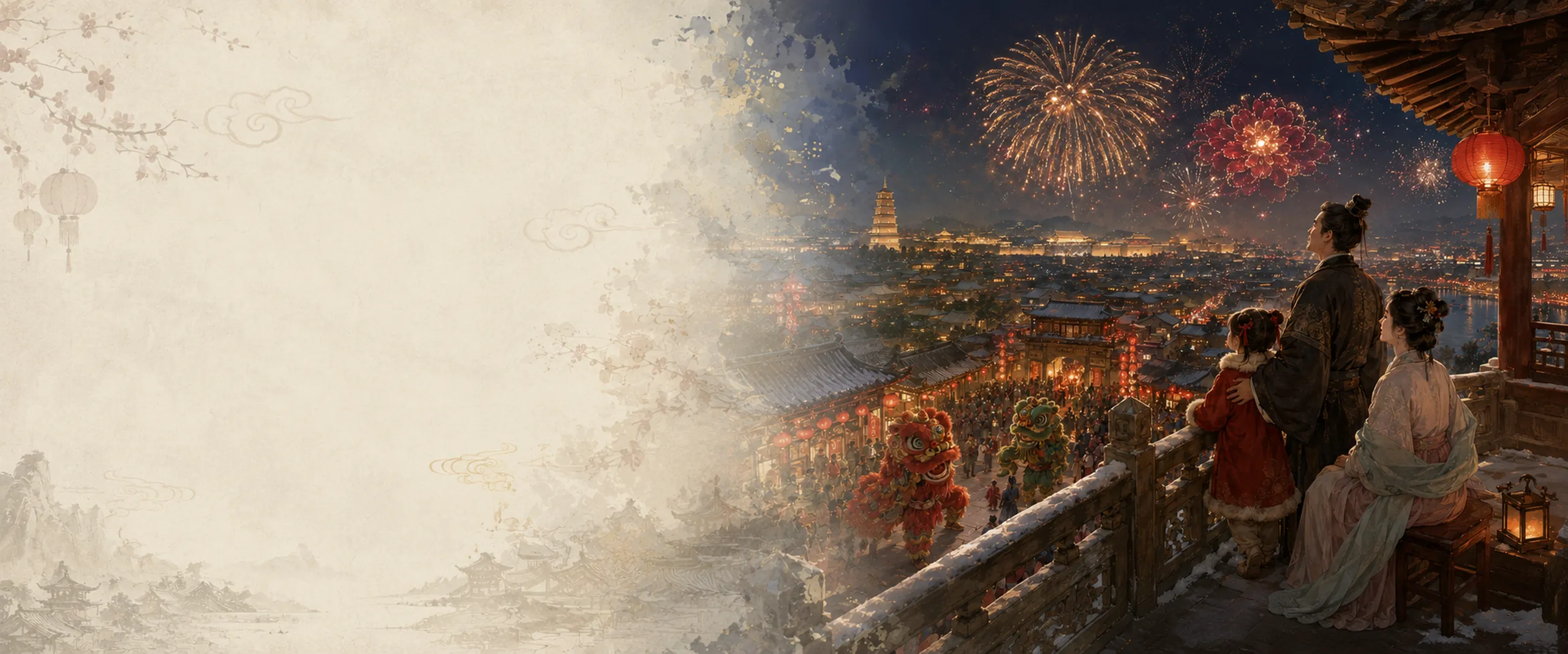

Spring Festival customs are rich and varied: on the twenty-third day of the twelfth lunar month, people worship the Kitchen God; before New Year’s Eve, they sweep away dust, and because “dust” (尘, chén) and “old” (陈, chén) are homophones in Chinese, the custom carries the meaning of “clearing away the old and making way for the new”; on New Year’s Eve, the entire family gathers for the reunion dinner and stays up to welcome the New Year, while at midnight the sound of firecrackers bids farewell to the old year and ushers in the new; on the first day of the first lunar month, people put on new clothes, exchange New Year greetings, and give lucky money.
Festival Journey
Origins & Legends
History · Evolution · Legend
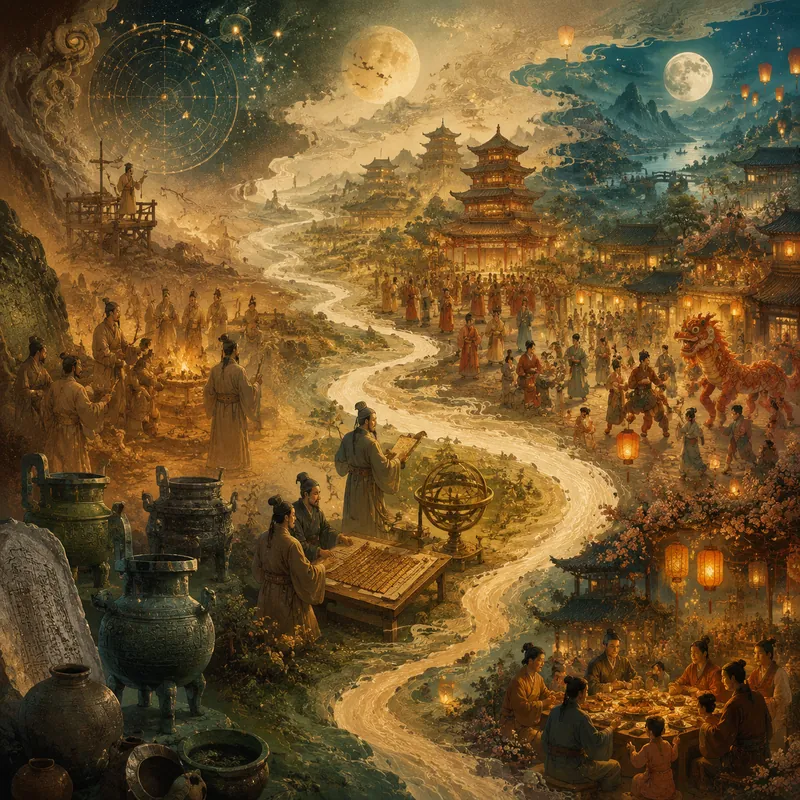
Tracing the Source · Historical Evolution
- Pre‑Qin Period The seeds of the Spring Festival can be traced back to the pre‑Qin period
- Han Dynasty The Han dynasty was the crucial period when the Spring Festival truly took shape
- Wei‑Jin and Southern‑Northern Dynasties During the Wei‑Jin period, Spring Festival customs became richer
- Sui and Tang Dynasties By the Tang and Song dynasties, the Spring Festival entered its “Golden Age,” much like today’s “Golden Week.” The Tang court designated the New Year as a statutory holiday
- Song, Yuan, Ming, and Qing Dynasties The Spring Festival in the Song dynasty was even more lively. In addition to continuing Tang customs, new rituals such as “offering farewell to the year,” “bidding farewell to the year,” and “staying up” appeared. Su Shi wrote in his poem “Staying Up on New Year’s Eve” (《守岁》): “明年岂无年,心事恐蹉跎。努力尽今夕,少年犹可夸。” (*Will there be no next year
- Modern and Contemporary Period After the 1911 Revolution, 1 January in the Gregorian calendar was designated as Yuandan (元旦), and the first day of the first lunar month was officially called Spring Festival (春节)
Festival Customs
Customs · Local Traditions · Everyday Life
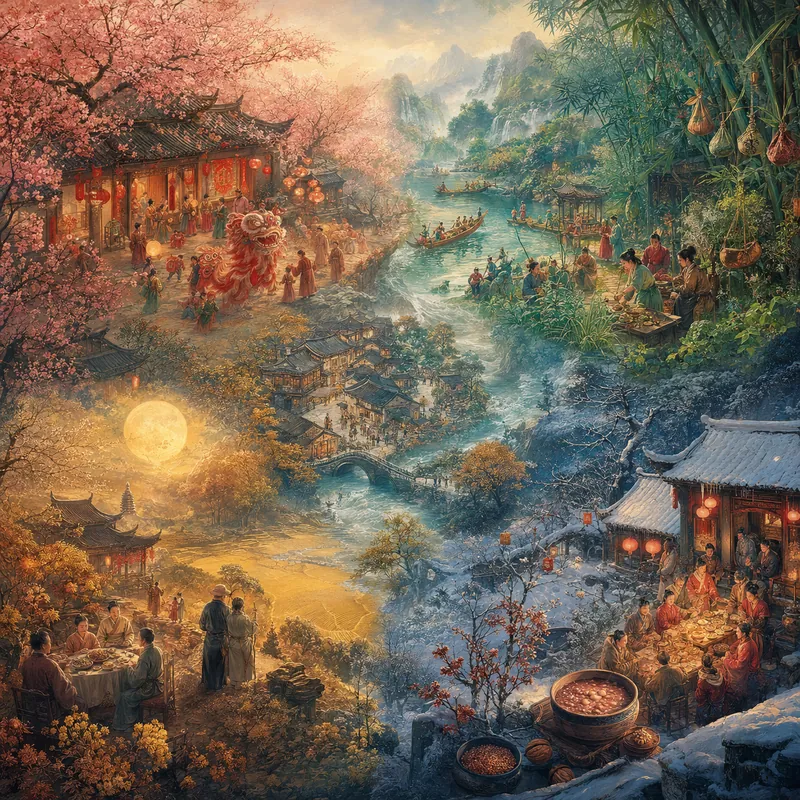
Seasonal Snapshots · Customs & Local Life
Festival Foods
Food Traditions · Local Flavors · Taste
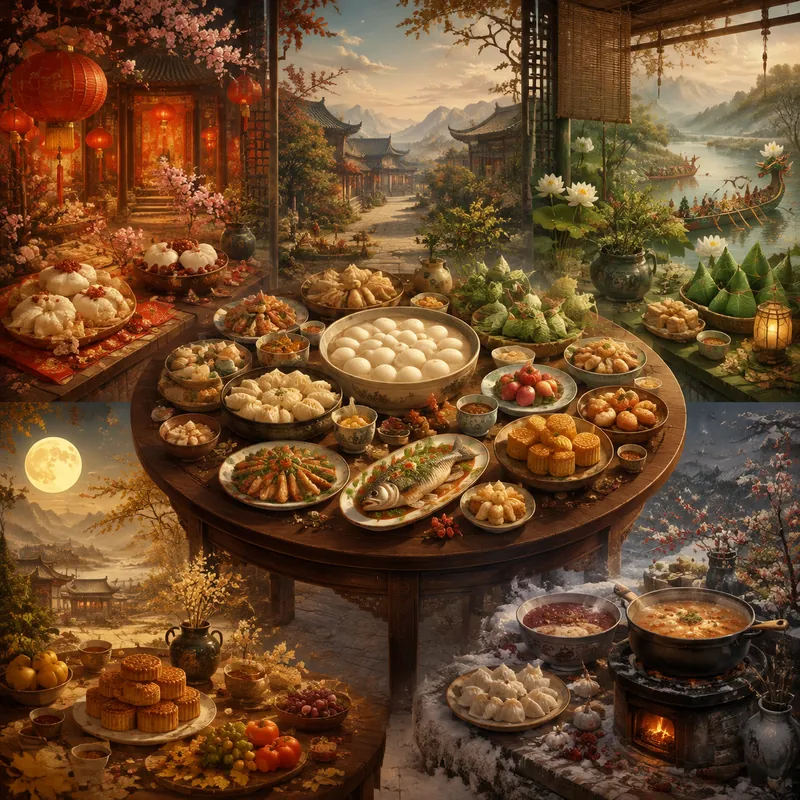
Seasonal Flavours · Seasonal Menu
Poetry & Verse
Classics · Imagery · Legacy
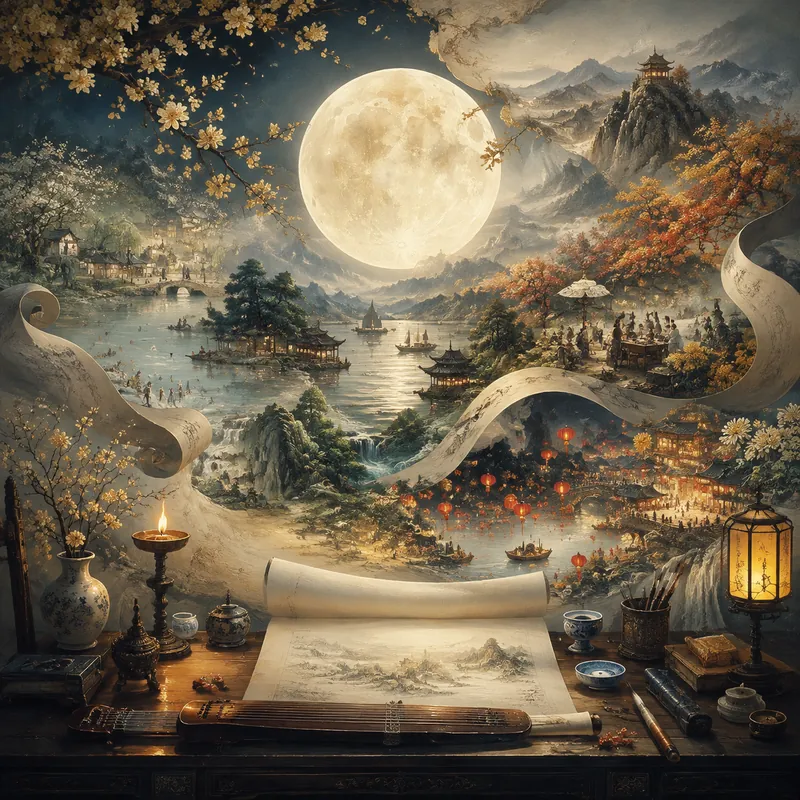
Representative Poems · Classic Selections
「元日」
爆竹声中一岁除,春风送暖入屠苏。
千门万户曈曈日,总把新桃换旧符。
Global Features
Overseas · Chinese Communities · Celebrations
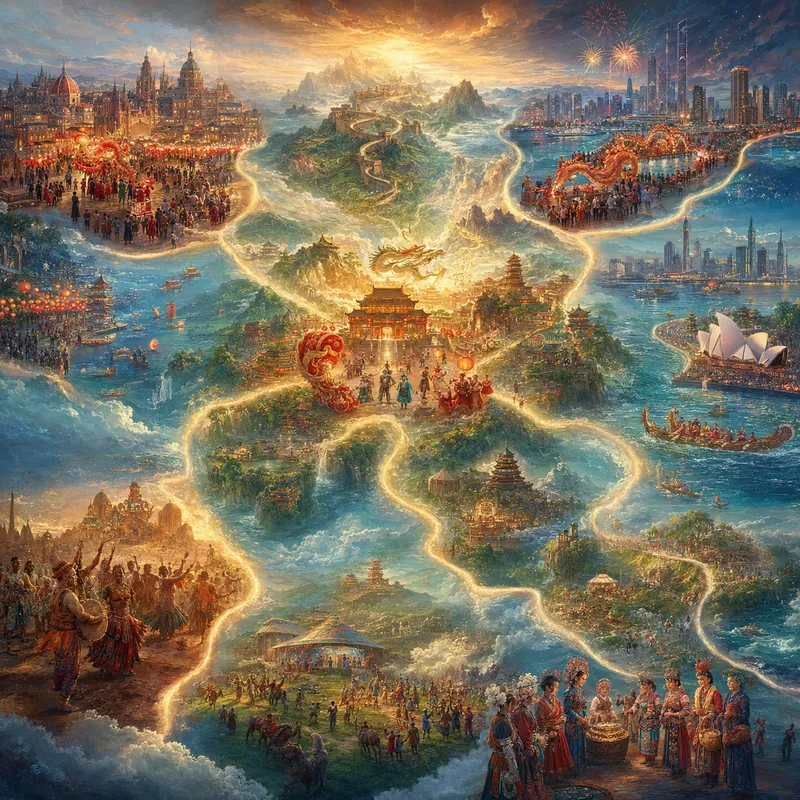
Overseas Celebrations · Lights of Chinese Communities
The United States is one of the countries where Spring Festival celebrations are most active and visible. During the 2026 Year of the Horse, festivities unfolded on a broad scale from the East Coast to the West Coast. New York: From the Firecracker Cultural Fair to the Lunar New Year Parade. On February 17, Chinatown hosted a “Lunar New Year Firecracker Cultural Fair.” Dragon and lion dances, firecrackers, and a wide range of live activities drew thousands of visitors into the distinctive atmosphere of the Chinese New Year. On February 21, Flushing held the “2026 Lunar New Year Parade.” Elaborately decorated floats rolled through the streets to the thunder of gongs and drums as golden dragons twisted overhead and lions danced through the crowds, opening a wider series of Lunar New Year celebrations across the greater New York area. Over time, the parade has become part of the United States’ multicultural immigrant landscape, with growing participation from organizations and groups representing different ethnic communities. On March 1, the 28th New York Lunar New Year Charity Parade was held in Chinatown. New York Governor Kathy Hochul, New York City Mayor Zohran Mamdani, and representatives from different sectors attended. Dozens of floats and more than one hundred marching contingents moved through Chinatown, accompanied by dragon and lion dances, Chinese song and dance performances, and other festive displays that drew large crowds along the streets. Los Angeles: A Century-Old Golden Dragon Parade. On February 21, Los Angeles staged the 127th Golden Dragon Parade, watched by large crowds lining the route. With more than a century of history, it is one of the city’s longest-running festival traditions, and more than one hundred groups registered to participate that year. Alongside Chinese community organizations, local political and business representatives, civic groups, and cultural organizations joined the procession. Groups from South Korea, Thailand, Japan, South America, and different communities within the United States were also specially invited. Zhuang Peiyuan, president of the Chinese Chamber of Commerce of Los Angeles, remarked: “The Spring Festival is not only a traditional festival of the Chinese community; it is also an annual celebration for the local community.” Landmark Illuminations and the Arrival of New Technology. On the evening of February 16, the Empire State Building was illuminated with Spring Festival-themed lights. Chinese-made intelligent robots also made their first appearance in New York’s Lunar New Year festivities, turning, waving, and interacting with spectators during the parade, drawing crowds of residents and tourists who stopped to watch and take photographs. Washington and California: Spring Festival in Multicultural Communities. Washington, D.C.’s largest Lunar New Year celebration has a history of more than sixty years. Dragon and lion dancers, middle-school marching bands, Scouts, and other parade groups fill the streets and lanes of Chinatown. Across California, Chinese communities organize activities such as zongzi-making, calligraphy, and paper-cutting workshops, inviting people of different generations and ethnic backgrounds to experience the beauty of Chinese culture together.
Spring Festival celebrations in Canada are equally vibrant. In Vancouver, the Chinese community prepared a full program of events for the 2026 Year of the Horse. The Chinatown Storytelling Centre hosted special Lunar New Year painting sessions, introductions to the art of Spring Festival couplets, red-envelope making, candy tasting, and other cultural experiences. On February 19, the third day of the Lunar New Year, the Joint Council of Chinese Associations in Canada held the 2026 Bingwu Year of the Horse Spring Festival Temple Fair at the Greater Vancouver Chinese Cultural Centre. The annual Lunar New Year parade was staged in grand fashion at the iconic Millennium Gate, drawing tens of thousands of local residents and visitors. The 52nd Vancouver Chinatown Spring Festival Parade followed on February 22. In Toronto, the landmark CN Tower was illuminated in red to welcome the Lunar Year of the Horse. During the festival period, Chinatowns in Toronto and other cities were dressed in lanterns and festive decorations, while dragon and lion dances drew residents and tourists alike to stop and watch.
During the 2026 Year of the Horse, Brazil’s Carnival and the Chinese Spring Festival happened to coincide. At a grand Carnival parade staged in the historic old quarter of Recife, capital of Pernambuco in northeastern Brazil, performers dressed in brilliant gold as a “golden dragon” surged and twisted above the crowd, weaving unmistakable Chinese imagery into the spectacle. Spectator Maria Oliveira said: “The Chinese New Year and Carnival work beautifully together. I believe this kind of interaction is deeply meaningful for cultural exchange and connection between the two countries.” Lu Gongrong, president of the Recife Association of Overseas Chinese and Chinese Residents, noted that the year marked the “China-Brazil Year of Culture,” and that the encounter between the Chinese Spring Festival and Brazilian Carnival gave more Brazilians an opportunity to experience the appeal of Chinese culture. On February 28, the Chinese Association of Brazil and 16 Zhejiang-origin Chinese associations jointly organized a Lantern Festival garden gathering in São Paulo, attracting tens of thousands of people to taste food and watch performances. Yu Peng, Consul General of China in São Paulo, said in his opening remarks: “This year, the Chinese Spring Festival and Brazilian Carnival happened to coincide. The most important festivals in the two cultures met in the same time and space.”
In Buenos Aires, the landmark Women’s Bridge was illuminated in “Chinese red” to celebrate the Year of the Horse.
Visitor Guide
Preparation · Etiquette · Take Part with Confidence
Readers’ Comments
Calendar and traditional culture enthusiasts from around the world, sharing the same moon.
Sign in or register to join the conversation. Your comment account is created automatically the first time you use a connected account.
No comments yet
Share your thoughts with readers around the world.