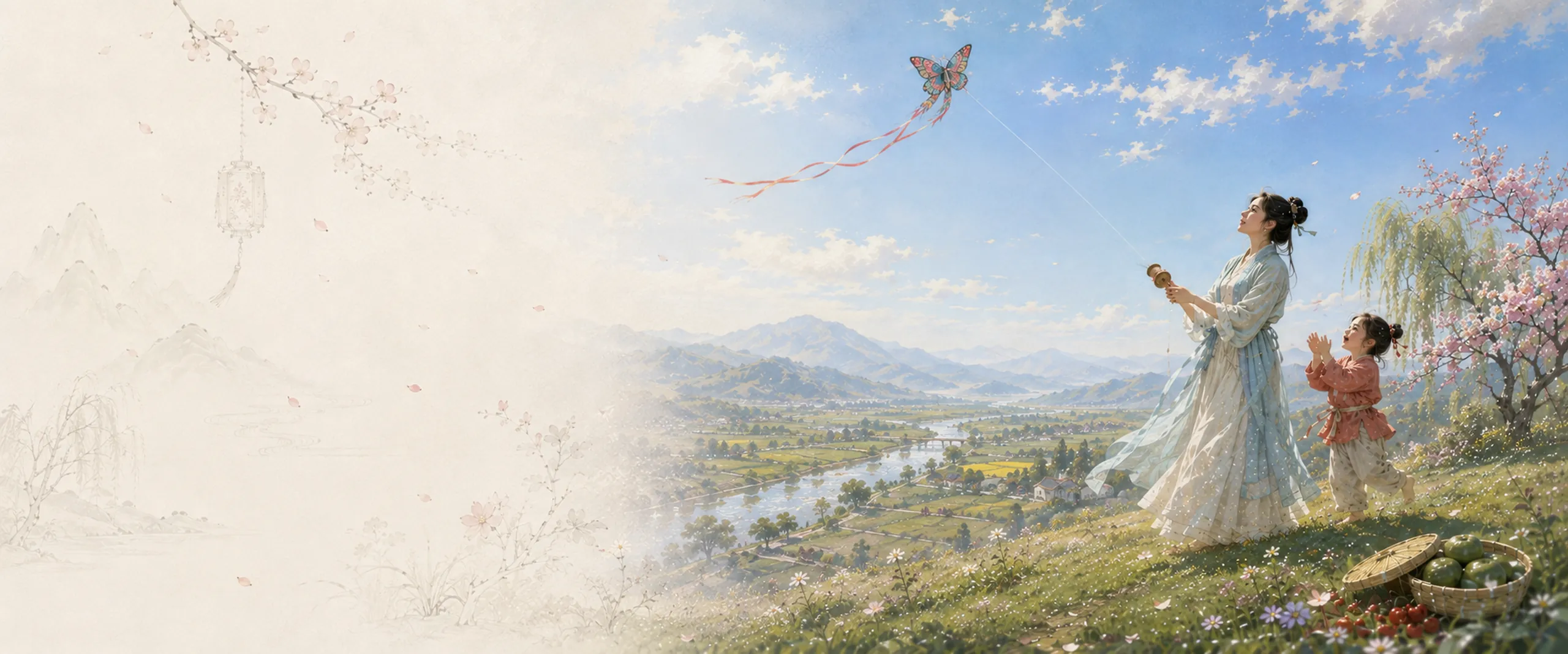
Tomb sweeping and ancestor worship are the most important customs of Qingming. People visit ancestral graves, clear weeds, add fresh soil, clean the gravestones, arrange offerings such as cakes, fruit, and wine, burn incense, and bow or kneel in reverence. Qingming is also an ideal season for spring outings. Taking advantage of the bright spring weather and trips to family graves, people traditionally went into the countryside, giving rise to activities such as cuju, swinging, and kite flying. Inserting willow branches is another important custom: after returning from a spring outing, people place willow twigs by the doorway to ward off insects and disease, while children weave willow branches into rings and wear them on their heads.
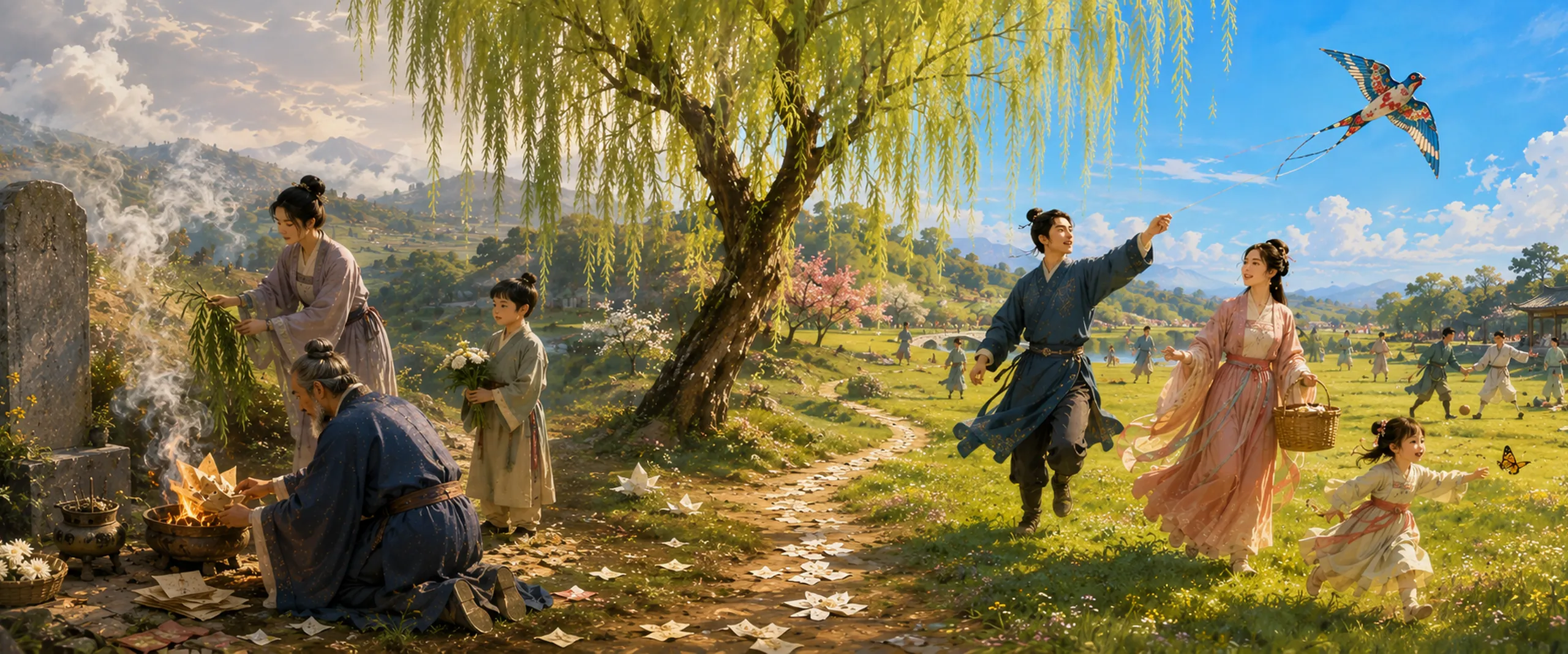
Main Customs
Tomb Sweeping and Ancestor Worship
Historical Origins
The custom of visiting and tending graves has very ancient roots. Archaeological excavations at the Qingtang site in Yingde, Guangdong, uncovered burials dating back around 10,000 years. The story of “begging food among the graves” (墦间乞食) in Mencius: Li Lou II (《孟子·离娄下》) suggests that grave-side rites were already widespread during the Warring States period. During the Qin and Han dynasties, filial piety was strongly promoted, and sweeping ancestral graves gradually became an established custom.
Originally, the Cold Food Festival (寒食节) and Qingming were separate observances. By the Tang dynasty, however, the court designated the Cold Food period as the time for grave worship. In the twentieth year of the Kaiyuan reign of Emperor Xuanzong (732), an imperial decree stated: “Visiting graves at Cold Food should be incorporated into the Five Rites and made a permanent institution” (寒食上墓,宜编入五礼,永为恒式). Grave sacrifices at Cold Food were thus formally established within state ritual practice.
During the Song and Yuan periods, Qingming gradually replaced the Cold Food Festival and developed into a traditional festival centered on ancestor worship and grave sweeping. Meng Yuanlao’s The Eastern Capital: A Dream of Splendor (《东京梦华录》) records: “The third day after Cold Food is Qingming. All new graves are visited and swept on this day; people of the capital go out to the suburbs… the countryside is like a marketplace. Beneath flowering trees and in gardens, cups and dishes are set out and people urge one another to drink.” By the Song dynasty, Qingming grave visiting had clearly become a society-wide activity.
Activities
Tomb sweeping and ancestor worship are the most central and important customs of Qingming, expressing what Chinese tradition calls “reverence when remembering the departed” (思时之敬). People bring wine, food, fruit, paper money, and other offerings to ancestral graves, where they repair the burial mound, present sacrifices, burn paper offerings, and bow or kneel in respect.
The procedures are solemn and orderly. People first clear weeds from around the grave, add fresh soil, and repair the burial mound—sometimes described as “repairing the ancestor’s house” so that it will not leak during the summer rains. They then arrange offerings and burn paper money. Finally, more earth is added and paper money may be pressed onto the grave. The Ming work Scenes and Objects of the Imperial Capital (《帝京景物略》) records that on Qingming, men and women carried wine vessels and offerings to the graves; the roads glittered with paper ingots hanging behind sedan chairs and horses, while people bowed, poured libations, wept, weeded and added earth to graves, burned paper ingots, and placed paper money on the mound.
Offerings are prepared with considerable care. Traditional sacrifices include wine, meat, rice, fruit, and cakes. Southern China commonly uses seasonal foods such as qingtuan and aiban, while northern regions more often offer steamed buns and pastries. Some places have highly distinctive offerings, such as roast suckling pig in Guangdong or runbing in Fujian. Paper offerings also take many forms, including gold-and-silver paper, spirit money, and paper ingots. In recent years, many places have promoted environmentally responsible memorial practices, replacing paper burning with flowers; some urban cemeteries even offer services exchanging paper money for fresh flowers.
Public memorial ceremonies supplement family tomb sweeping. During Qingming, ceremonies are held throughout China, including national-level rites at the Mausoleum of the Yellow Emperor and the Mausoleum of the Yan Emperor, as well as commemorations at martyrs’ cemeteries. These have become important parts of the modern festival.
Cultural Meaning
Tomb sweeping and ancestor worship embody the traditional virtues of honoring the dead, remembering distant ancestors, strengthening kinship, and maintaining clan solidarity. In traditional belief, although ancestors have died, their spirits continue to protect their descendants. Through grave rites, later generations express gratitude and remembrance while also praying for ancestral blessing. The custom reinforces family cohesion and allows collective memory and moral values to be transmitted from generation to generation.
How to Participate
Cemeteries across China are generally open for memorial visits during Qingming. Visitors may prepare flowers, fruit, cakes, and other offerings, tidy ancestral graves, present food, burn incense where permitted, and bow in remembrance. Many cities encourage flower offerings instead of burning paper. Those unable to visit in person may use online memorial platforms. Foreign visitors interested in learning about the tradition can observe ceremonies at large cemeteries or join public memorial events organized by cultural institutions. These public ceremonies are usually held on the morning of Qingming Day and are solemn in tone.
Spring Outings
Historical Origins
The origins of spring outings (踏青) can be traced to the Shangsi Festival (上巳节) purification rites of the Zhou period. In the third lunar month, people went to rivers to bathe and worship deities, hoping to wash away the impurities of winter and pray for flourishing descendants. In the Analects: Xianjin (《论语·先进》), Confucius asks his disciples about their aspirations. Zeng Xi replies that he wishes to “bathe in the Yi River, enjoy the breeze at the Rain Altar, and return home singing” (浴乎沂,风乎舞雩,咏而归)—a classic image of springtime enjoyment in ancient China.
After the Wei and Jin periods, Shangsi became fixed on the third day of the third lunar month. Its magical purification character gradually faded, and the festival evolved into waterside banquets and excursions into the countryside. From roughly the Tang dynasty onward, because Qingming grave visits required people to travel outside the city, many combined mourning for ancestors with enjoying the bright spring landscape. Spring outings thus merged with Qingming. The custom was especially popular in the Song dynasty. The Ming work Scenes and Objects of the Imperial Capital records the Qingming scene of “wearing willow on this day and visiting Gaoliang Bridge.”
Activities
Spring outing, also called “stepping into spring” (踏春), “seeking spring” (探春), or “looking for spring” (寻春), is an indispensable Qingming custom. Around Qingming, the earth warms, plants revive, and the natural world becomes vibrant again, making it an ideal season for excursions. People leave home with family and friends to admire flowers, walk in the countryside, and experience the atmosphere of spring.
Descriptions of ancient spring outings are particularly vivid. Women in Tang Chang’an went to the countryside for spring excursions; when they encountered beautiful flowers, they set up seats on the grass and hung red skirts from tree branches to create makeshift picnic screens. After weeping and performing rites at graves, people sometimes “did not return home, but went toward flowering trees and gardens, sat together, and drank to their fill.” This captures Qingming’s distinctive coexistence of mourning and joy. Today, many parks, museums, and cultural sites organize flower festivals, folk exhibitions, and other Qingming-related activities. For this reason, Qingming is also known as the “Spring Outing Festival.”
People also gather wild seasonal foods while on spring outings. Qingming is the season for shepherd’s purse, Indian aster greens, spring bamboo shoots, and other wild vegetables. A folk saying goes, “Qingming snails are worth a goose” (清明螺,抵只鹅), praising the rich flavor of river snails at this time of year.
Cultural Meaning
Qingming spring outings embody the Chinese ideal of “the unity of heaven and humanity” (天人合一). After honoring the ancestors, people enter the natural world and experience spring. This is both a celebration of life and a form of consolation for the dead: the living continue to live well, which itself becomes a tribute to those who came before. Qingming’s fusion of sorrow and joy makes it at once solemn and full of vitality.
How to Participate
Parks and scenic areas across China are ideal for spring outings during Qingming. Local tourism departments often announce flower festivals and seasonal activities; some scenic areas organize Hanfu garden walks, poetry gatherings, and other cultural programs. Qingming also coincides with the blooming of cherry, peach, apricot, crabapple, and other spring flowers. Comfortable, breathable clothing and walking shoes are recommended.
Inserting and Wearing Willow
Historical Origins
There are three major explanations for the origin of Qingming willow customs. One associates them with Shennong (神农), the culture hero who taught agriculture: willow buds with the arrival of spring, signaling that sowing and cultivation can begin. A second explanation links the custom to Jie Zitui. According to tradition, when Duke Wen of Jin returned the following year in plain clothes to mourn him, he found that a willow burned in the fire had come back to life; he broke off a branch and wore it on his head in remembrance. A third explanation derives from the belief that willow has the power to repel evil. Qingming was sometimes regarded as a time when wandering spirits appeared, so people inserted willow at the door and wore it on the head to prevent ghosts from causing harm.
By the Northern and Southern Dynasties, people inserted willow branches at New Year in the belief that they could ward off ghosts; later the practice shifted to the Cold Food or Qingming period. After the Tang dynasty, inserting and wearing willow gradually became an important Qingming symbol. Ming and Qing local gazetteers record the custom frequently. Scenes and Objects of the Imperial Capital states: “On Qingming in the third month, men and women wear willow in their hair and insert willow branches in the lintel.” The Qing work Qing Jia Lu (《清嘉录》) likewise records that willow was sold throughout the streets on Qingming and households bought branches to place at their doors.
Activities
Inserting and wearing willow are important Qingming customs. People place willow branches in the lintel or beneath the eaves, or weave willow twigs into rings to wear on the head or body. A proverb says, “If you do not wear willow at Qingming, a youthful face will turn white-haired.” In Jiexiu, Shanxi, every household inserts willow beneath the eaves; Jing County, Anhui, even calls Qingming the “Willow-Inserting Festival.” Women and children were the most common wearers. The Yanjing Suishiji (《燕京岁时记》) explains the custom by recalling that Emperor Gaozong of Tang once carried out purification rites at Weiyang on the third day of the third month and gave each minister a willow ring, saying that wearing it could protect against poisonous creatures.
The specific form differs by region. Some places insert willow above the lintel, some beneath the eaves, and some place one branch on each side of the doorway. Wearing willow may involve either a ring woven from twigs or individual leaves tucked into the hair. Folk belief holds that willow branches drive away evil spirits, so inserting them at the door and wearing them on the head protects the household from supernatural disturbance.
Cultural Meaning
Willow carries several layers of symbolism in Chinese culture. It is highly resilient and can take root even from a cut branch planted in the soil, making it a symbol of the continuation and flourishing of life. Inserting and wearing willow therefore expresses not only protection against evil but also hopes for prosperous descendants. In addition, liu (柳, willow) sounds like liu (留, to retain), so willow can also suggest holding on to spring and preserving what is beautiful.
How to Participate
During Qingming, willow branches may be collected in the countryside and placed above a doorway or woven into a ring, provided public landscaping is not damaged. Many folk-culture villages organize collective willow activities. In cities, willow branches can be purchased instead. Do not break branches from ornamental trees in parks or along roads.
Kite Flying
Historical Origins
Kites have an extremely long history. According to tradition, the wooden bird made by Mozi or the bamboo bird devised by Lu Ban during the Spring and Autumn and Warring States periods were early prototypes. The term fengzheng (风筝, kite) is generally believed to have arisen during the Five Dynasties period. Li Ye is said to have made paper birds in the palace and flown them by wind; later a bamboo flute was fixed to the bird’s head, producing a sound like a zheng zither when the wind entered it, hence the name fengzheng.
Kite flying became deeply associated with Qingming by the Song dynasty and grew increasingly popular thereafter. The Qing text Qing Jia Lu records: “The spring wind rises from below, and paper kites rise with it; hence the saying ‘at Qingming, release the kite by cutting the string.’” In the past, people wrote their names and troubles on kites; once the kite had flown high, they cut the line and let it drift away, symbolizing the release of bad luck and the roots of illness. In 2006, Weifang kite-making craftsmanship was inscribed on China’s national intangible cultural heritage list.
Activities
Kite flying is one of the most popular Qingming activities. Kites were formerly called zhiyuan (纸鸢) or zhiyao (纸鹞) and were commonly made from silk or paper. People flew them not only by day but also at night: strings of small colored lanterns were attached below the kite or along the line, shining like stars and known as “divine lamps” (神灯). Ancient belief held that the Qingming wind could carry away impurity. People wrote their worries on the kite, and when the string snapped or was cut, their troubles were believed to drift away with it.
Kite forms are extraordinarily varied. Common examples include butterflies, swallows, and centipedes, alongside giant human figures and animals. Beijing is famous for the shayan (沙燕) swallow kite, Tianjin for the craftsmanship known as “Kite Wei” (风筝魏), and Weifang in Shandong is widely known as the World Kite Capital.
Cultural Meaning
Kite flying has rich folk significance. First, it can express remembrance of deceased relatives and friends, with affection for the departed entrusted to the kite. Second, it is associated with dispelling misfortune while also providing healthy exercise. When a kite breaks free and flies away, people traditionally do not chase it, believing instead that the year’s bad luck has successfully been released.
How to Participate
During Qingming, kites can be seen in parks and public squares across China. Visitors may buy one locally and join in. Many cities organize large public kite-flying events. Families can participate together and experience the symbolic idea of “releasing bad luck.” Those wishing to recreate the old custom of “cutting loose the kite” may write a wish on the kite and release it once it has risen high—though modern environmental and safety rules should always be observed.
Swinging
Historical Origins
The swing was known in antiquity as qianqiu (千秋) and also as “rope play” (绳戏). Tradition attributes its invention to the Shanrong, a northern ethnic group, from whom it entered the Central Plains during the Spring and Autumn period. The Ancient and Modern Illustrations of Arts states that swinging was a northern Shanrong game used to practice light-footed movement. Zong Lin of the Liang dynasty records in the Jingchu Suishiji: “In spring, long ropes are hung from tall trees; men and women in colored clothing sit or stand upon them and push back and forth, which is called swinging.”
By the Tang dynasty, swinging around the Cold Food and Qingming period had become even more popular. Palace swings were erected for imperial consorts during the Cold Food Festival; their graceful movement through the air reportedly led Emperor Xuanzong to call swinging “the game of half-immortals” (半仙之戏). During the Tang and Song periods, swinging was widespread both in court and among ordinary people, and it became an important Qingming custom. By the Song dynasty, it was also practiced competitively.
Activities
Swinging was an important ancient Qingming activity. Early swings were made by using forked tree branches as frames and tying colorful ribbons or ropes to them; later they developed into the familiar form of two ropes and a seat board. Qing painter Chen Mei depicted imperial consorts swinging in the palace garden in his painting Swinging among Willows (《杨柳荡千》).
There are many ways to swing: alone, in pairs, face-to-face, or in relay forms. One person may sit on the board while another pushes from behind, or the rider may generate momentum independently. Swinging higher is traditionally associated with greater courage and skill.
Cultural Meaning
Folk belief holds that swinging can help dispel illness by “swinging disease away.” The higher one swings, the better life is symbolically expected to become. In some places swinging also carried a divinatory meaning: if a shoe fell off while swinging, it could be taken as a sign of good luck that year. Adults sometimes sang swing songs to children, such as, “Swing high, swing low; swing up high and fortune will come.”
How to Participate
Many parks have swings that can be used during Qingming, and some folk-culture villages erect traditional wooden-frame swings. Safety should come first: children should be supervised, ropes should be checked before use, and riders should avoid swinging excessively high.
Cuju
Historical Origins
Cuju (蹴鞠) originated in Linzi, the ancient capital of the state of Qi during the Spring and Autumn and Warring States periods. The ball, or ju (鞠), was made of leather and stuffed with hair. Legend attributes its invention to the Yellow Emperor as a method of military training. Historical records show that recreational cuju was already popular among ordinary people in the Warring States period. From the Han dynasty onward it was also used in military training; the Song dynasty saw the emergence of specialized cuju organizations and professional players, while the Qing dynasty developed forms of cuju played on ice.
Cuju flourished most strongly during the Tang and Song dynasties, when descriptions speak of the ball “never dropping all day” and of players keeping it continuously at their feet while huge crowds watched. In 1982, FIFA recognized China as the birthplace of football; in 2004, FIFA and the Asian Football Confederation publicly affirmed China as the birthplace of the game. In 2006, cuju was inscribed on China’s national intangible cultural heritage list.
Activities
Cuju literally means kicking a ball with the foot and was a favorite Qingming recreation in ancient China. The ball was made of leather and densely stuffed with hair. One traditional explanation holds that because the Cold Food period prohibited fire and people ate cold food, physical activities such as cuju helped maintain health.
Cuju included two broad styles: baida (白打) and zhuqiu (筑球). Baida involved no goal and emphasized individual control, posture, and technical tricks. Zhuqiu used goals and involved competition between teams, with victory determined by scoring. By the Song dynasty, cuju had developed complete rules and specialized organizations known as the Qiyun Society (齐云社) or Yuan Society (圆社).
Cultural Meaning
Cuju was more than a sport; it formed part of the cultural life of ancient Chinese society. During Qingming—a festival combining grief with renewed vitality—cuju reflects the traditional ideal of “mourning without being overwhelmed by sorrow” (哀而不伤). After honoring ancestors, people stretched their bodies through sport and welcomed the arrival of spring.
How to Participate
Some folk-culture villages and traditional-sport organizations offer cuju experiences during Qingming. Friends can also simply play football on grass and enjoy the spirit of springtime exercise. Those interested in historical cuju can visit the Cuju Museum in Linzi District, Zibo, Shandong, which offers extensive displays and interactive experiences.
Other Folk Activities
Tug of War
Tug of war was originally called qiangou (牵钩) or gouqiang (钩强) and came to be known as bahe (拔河) in the Tang dynasty. It is said to have been invented in the late Spring and Autumn period, first becoming popular in the military and later spreading among ordinary people. Emperor Xuanzong of Tang once organized a large-scale tug-of-war competition at Qingming, after which the activity became associated with the festival.
Tree Planting
Around Qingming, spring sunshine and rainfall create ideal conditions for young trees to take root and grow quickly. China has therefore had a long tradition of planting trees during this season. The custom has continued into modern times; in 1979, the Standing Committee of the National People’s Congress designated March 12 as China’s Arbor Day.
Willow Shooting
In willow shooting (射柳), a pigeon was placed inside a gourd and hung high from a willow tree. Archers shot the gourd, releasing the bird, and the height of its flight helped determine the winner. The practice originated in the mounted-archery traditions of the Liao and Jin periods, where it functioned as military training among northern peoples, and later evolved into a Qingming folk game. It was especially popular in the Ming dynasty.
Polo
Polo was another Qingming sport. Known in Chinese as jiqiu (击鞠) or daqiu (打球), it involved riders striking a ball with mallets toward a goal. Polo was extremely popular at the Tang court in Chang’an, where matches were often held around Qingming.
Cockfighting
Cockfighting traditionally began around Qingming and continued until the summer solstice. China’s earliest written record of cockfighting appears in the Zuo Commentary (《左传》). The activity was especially popular during the Tang dynasty, among both ordinary people and the imperial court; Emperor Xuanzong was particularly fond of it.
Regional Variations
Shandong
In Zhaoyuan, Jimo, Linqu, Linqing, and other places, new soil is added to graves during tomb sweeping. In Weihai, Qixia, Huangxian, and elsewhere, clans conduct collective ancestral rites and then share the offerings in a communal meal known as fangshi (房食) or fangshe (祊社). Northern Shandong preserves the custom of “egg fighting” (斗鸡子), in which children knock boiled eggs against one another. In Qishan, Boshan, and other areas, millet rice is cooked and fed to cattle in a practice called “feeding the ox” (饭牛). Jimo eats eggs and cold steamed bread; Laiyang, Zhaoyuan, and Changdao eat eggs and cold sorghum rice.
Shanxi
In Hequ County, millet flour is used to make cakes called tanhuang’er (摊黄儿). In Shouyang County, women and children cut colored paper into strings and wear them on their heads, a survival of the ancient caisheng (彩胜) custom. In Yicheng County, black-flour jelly is cooked in advance, chilled, sliced thin, and eaten. In Xiezhou, all women’s needlework traditionally stops for Qingming. In Pinglu County, children tie wheat to their hair to pray for longevity. In southern Shanxi, families steam zifu (子福).
Shaanxi
In Xingping, relatives by marriage exchange paper money and visit one another’s ancestral graves. In Fuping, spring water from famous mountains is brought back for sacrificial use to pray for a good harvest, a practice called “you shui” (游水). In Tongzhou, willow branches are broken after tomb sweeping and inserted by the door, while paper money is pasted to tree trunks to prevent insects and ants. In Luochuan, steamed buns decorated with birds and snakes are made in memory of Jie Zitui (介子推). Fugu County eats huang’er millet cakes and pancakes. In northern Shaanxi villages, decorative flour figures are made, known as “pinching swallows” (捏燕燕) or “steaming Zitui” (蒸子推). Sijia Village in Huayin holds an ancient Qingming Swing Fair, and Luochuan in Yan’an steams Qingming jar-shaped buns for ancestor worship.
Henan
In Gong County, sons-in-law worship at the ancestral graves of their wives’ families, and people also sacrifice to the spirits of green crops and the Ox King. In Mengjin County, green shoots are inserted into wheat fields during Qingming.
Jiangsu
Farmers in Taizhou hold boat races called “hui chuan” (会船). In Zhenjiang, seven willow leaves are steeped as tea to brighten the eyes. Dantu County preserves the old Cold Food Festival custom of “wang mian” (望绵). The Maoshan area of Xinghua City has the Maoshan Boat Festival, with collective boat-based rites. Nanjing and other places fly kites during Qingming. Suzhou places willow branches by the door, while Yancheng inserts willow twigs beneath the eaves to avert disaster.
Zhejiang
In Jiaxing County, people eat green snails on Qingming night, a custom called “tiao qing” (挑青). Haiyan County has dragon-boat entertainments. In the former Taizhou Prefecture, people wore willow in the hair in a rite called “driving away Xiang Jiuniang” (驱香九娘). In Shaoxing, sweets and biscuits are prepared at graves and distributed to nearby children, called “grave-visiting fruit” (上坟果). Huzhou families wrap zongzi; Wenzhou preserves customs such as inserting and wearing willow and welcoming the City God. Jinhua, Lishui, Yueqing, and other places eat Qingming cakes (清明粿 / 青团). Silk-producing districts preserve sericulture customs such as “ya canhua” (轧蚕花).
Anhui
Huizhou Prefecture traditionally drew fresh spring water at Qingming to brew wine. In Guichi County, women made rice cocoons as offerings to the Silkworm Maiden to pray for prosperous sericulture. Jing County called Qingming the “Willow-Inserting Festival” (插柳节). In Shouchun, every household inserted willow and hung paper money on trees by ancestral graves.
Fujian
Fuzhou makes bobo guo (菠菠粿), a Qingming cake colored with cudweed, and uses guangbing (光饼) as ancestral offerings. Tomb sweeping in Fuzhou is called “pressing paper” (压纸) because paper money is weighted on top of the grave. Xiamen eats thin pancakes or spring pancakes, inheriting Cold Food Festival traditions. In southern Fujian, tomb sweeping is called “hanging paper” (挂纸). Hui’an flies kites while visiting graves. Some people in Zhangzhou sweep graves near the Shangsi Festival on the third day of the third lunar month. Hakka areas make grass cakes (草粿) or qingban (青粄).
Guangdong
Cantonese communities call tomb sweeping “xing qing” (行清) or “worshipping the mountain” (拜山). In Guangzhou, people stir-fry pork with Qingming buckwheat greens after grave rites, and also eat buckwheat-green spring rolls. Dongguan eats aiban (艾粄) and buys oiled-paper “Qingming fans” (清明扇) to sweep away impurity. Huizhou preserves customs of carrying aromatic herbs, making aiban, and inserting willow. Chaoshan traditions include guozhi (过纸, tomb sweeping), steaming puziguo (朴籽粿), and eating thin pancakes and runbing. In Zhaoqing, sugarcane is eaten from one end to the other to symbolize a complete beginning and ending. In Ruyuan County, Shaoguan, the ten days before Qingming are called “forbidden wind” (禁风) and people wear peach leaves. Western Guangdong has a custom of carrying torches to graves and bringing them home afterward, symbolizing “the transmission of the flame” (薪火相传). Hakka communities call tomb sweeping “hanging paper” or “hanging spring paper” (挂春纸). A whole roast pig is a key element in many Guangdong Qingming ancestral rites.
Beijing
Old Beijing customs include ancestor worship, tomb sweeping, spring outings, and inserting willow. A saying goes, “If you do not wear willow at Qingming, a youthful face will turn white-haired” (清明不戴柳,红颜成皓首). Traditional Cold Food snacks include sanzi twists, ginger-thread crisps, lüdagunr, and aiwowo. Historical Qingming entertainments included willow shooting and pitch-pot, while kite flying was believed to dispel bad luck.
Shanghai
People eat qingtuan (青团) made from brome-grass juice and glutinous rice. Older customs included peach-blossom porridge, purple-bamboo-shoot tea, rites at platforms for neglected spirits, and processions welcoming the City God.
Hebei
In Dong’an County, people inserted willow and viewed flowers. In Yongping Prefecture, men and women went outside the city for spring outings, flower viewing, gathering vegetables, and wearing willow. Yuanshi County called Qingming the “Flower Festival”, buying flowers and serving wine to guests.
Hubei
Jingzhou calls its tomb-sweeping custom “inserting green” (插青), using colored paper cut into Qingming streamers and placed on graves. Wuhan has the “hanging paper” custom, Enshi the custom of “marking the grave” (标墓). In Xuanhuadian Town, Dawu County, people traditionally do not eat breakfast before grave visiting. Hefeng County makes Qingming baba, and Huanggang makes soft cudweed cakes known as zhuanba.
Hunan
Changsha Prefecture inserted willow at Qingming in a practice called “remembering the passing years” (记年华). Yongzhou Prefecture drew water before dawn on Qingming; it was said to keep its taste and color for months and to be especially suitable for brewing wine. Xintian County has the agricultural saying, “If Qingming is clear, all things will flourish” (清明晴,万物成).
Sichuan
Dujiangyan holds the Water-Releasing Festival, worshipping the water deity, cutting the macha diversion structures, and competing for the first flow of irrigation water. Yuantong in Chongzhou holds the Qingming Chuntai Fair, with a history of more than 300 years. Chengdu and surrounding areas preserve tomb sweeping, ancestor worship, and spring outings.
Northeast China
During Manchu Qingming rites, people insert fotuo (佛托)—ritual objects made of willow branches and five-colored paper—at ancestral graves. Manchu communities also preserve an “egg-burying” custom: before spring plowing, eggs are roasted by a field-side fire and then buried in the soil to symbolize a good harvest. Qingming is also popularly called the “Willow-Inserting Festival.” People eat small wild-onion pancakes. Mongol communities may light a strong fire before ancestral graves and cast offerings such as roasted rice and fried pastries into the flames.
Closing Note
The folk customs of Qingming form a long cultural scroll about “life” and “death.” From the solemnity of tomb sweeping and ancestor worship to the vitality of spring outings; from inserting and wearing willow to ward off evil and seek blessing, to the springtime pleasures of kite flying, swinging, and cuju—Qingming customs bring together grief and joy, remembrance and hope, solemnity and liveliness.
Qingming is a festival in which sorrow and joy coexist. On this day, people shed tears for the dead yet also smile and embrace spring, arriving through this intertwining of grief and happiness at a fuller understanding of life. Tomb sweeping is a tribute to the past—remembering ancestors and giving thanks to those who came before. Spring outings are an embrace of the future—drawing close to nature and welcoming new life. This cultural quality of “grieving without being broken by grief, rejoicing without excess” (哀而不伤、乐而不淫) is one of the reasons Qingming has remained vibrant for more than a thousand years. In 2006, Qingming was included in China’s first national list of intangible cultural heritage; in 2008, it officially became a national public holiday. Its customs embody both the Chinese tradition of “honoring the dead and remembering distant ancestors” (慎终追远) and the philosophy of “the unity of heaven and humanity” (天人合一) in everyday life. Between remembrance and renewal, Qingming continues to stage a profound dialogue about life itself.
—
Readers’ Comments
Calendar and traditional culture enthusiasts from around the world, sharing the same moon.
Sign in or register to join the conversation. Your comment account is created automatically the first time you use a connected account.
No comments yet
Share your thoughts with readers around the world.