Qingming Festival

Qingming FestivalQingming Festival Cuisine

「 相传百五禁烟厨,红藕青团各祭先。 」

Qingming Festival has a history of over 2,500 years. Du Mu, in his poem “Qingming” (《清明》), wrote: “清明时节雨纷纷,路上行人欲断魂。” (*A drizzling rain falls during Qingming; travelers on the road are overcome with grief.*) The fine rain sets a…

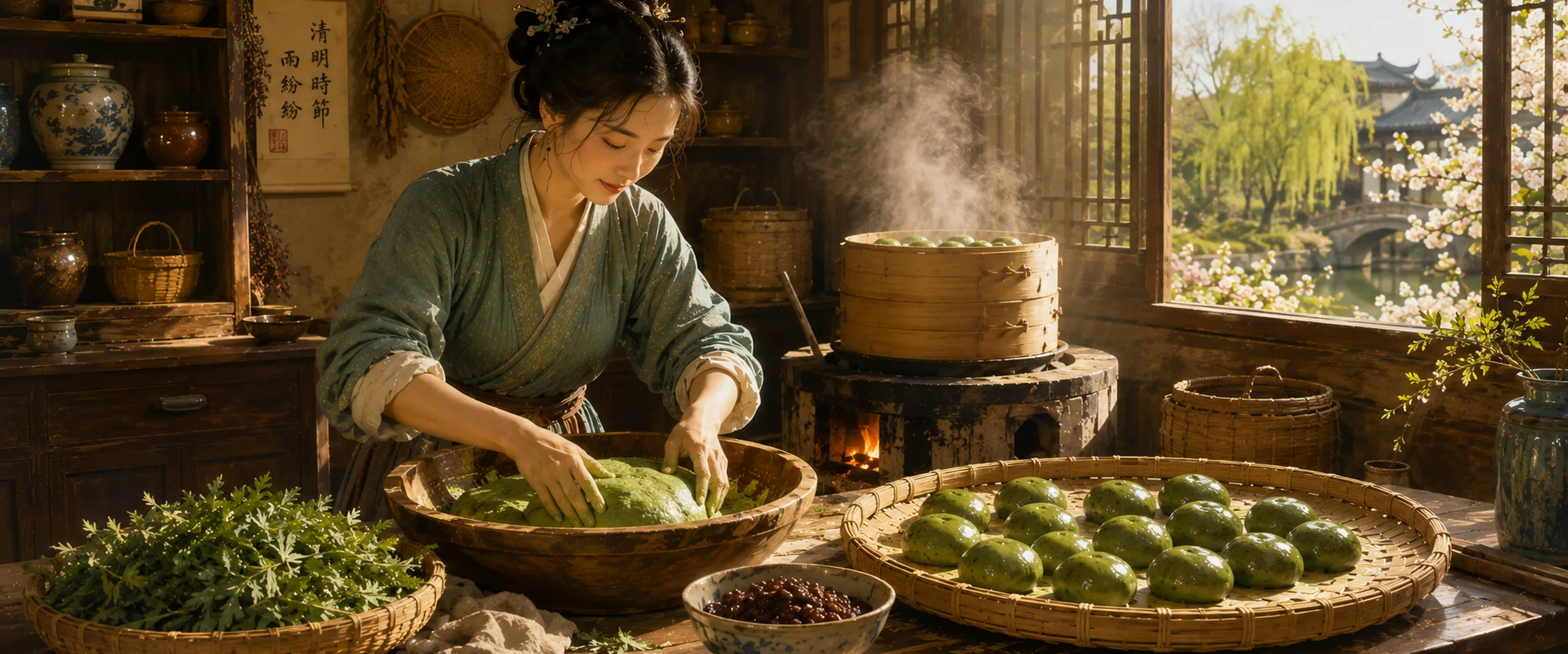
Qingtuan (青团) are the most representative traditional Qingming delicacy of the Jiangnan region, with a history extending back to the Cold Food Festival (寒食节, Hanshi Festival) and the Qingming Festival. Their characteristic green color comes from wild plants. In Jiangnan, people commonly pound jiangmaicao (浆麦草) or mugwort to extract the juice, while in Anhui, Jiangxi, and other regions, tender cudweed is washed, crushed for its juice, and kneaded into glutinous-rice flour. Qingtuan may be sweet or savory: sweet versions are commonly filled with red bean paste, while savory versions often contain five-spice dried tofu, dried bamboo shoots, and other ingredients. In northern China, meanwhile, foods such as sanzi (馓子) and eggs are widely eaten during Qingming. Qingming guo and qingtuan are essentially closely related foods known by different regional names. Their original purpose was described as “counteracting seasonal influences,” helping migrants cope with unfamiliar local climates and environments. Qingming foods thus carry both the solemn remembrance of ancestors and the fresh vitality of welcoming spring.

Qingming Festival / Qingming Festival Cuisine

Festival Food Gallery

Seasonal Menu

Food in Detail

Seeking the True Flavor

Qingtuan (青团)

Pastries & Snacks

Basic Information

  • Category: Grain-based pastry
  • Popular Regions: Jiangnan region, including Shanghai, Jiangsu, Zhejiang, Anhui, and surrounding areas
  • Main Ingredients: Glutinous-rice flour, mugwort juice (or jiangmaicao juice / green plant juice), fillings such as red bean paste, sesame, salted egg yolk and pork floss
  • Alternative Names: Qingming tuanzi (清明团子), mugwort dumplings, Qingming guo (清明果), qing yuanzi (青圆子)

Historical Origins

Qingtuan are the most representative seasonal food of the Qingming Festival and one of the relatively few Chinese festival foods named after a color. The word qing (青) refers here to green, drawn from the fresh new growth of spring.

The origins of qingtuan are closely connected with the Cold Food Festival. Hanshi falls on the 105th day after the winter solstice, usually one or two days before Qingming. During the festival, fire was prohibited for three days and people could eat only cold foods prepared beforehand; qingtuan emerged within precisely this setting. According to Gao Cheng’s Song-dynasty Shiwu Jiyuan (《事物纪原》), citing the Zhou Li (《周礼》), the prohibition on fire during Hanshi began in the Zhou dynasty. As one form of cold food eaten during the festival, qingtuan can therefore be traced at least to the period before the Song dynasty.

Cultural Meaning

By the Tang and Song dynasties, the seasonal foods of the Cold Food Festival had already become highly diverse. Tang-dynasty Hanshi foods included wheat-based items such as “Cold Food Cakes” and “Zhitui Cakes.” A line attributed here to Bai Juyi—“At the Cold Food qingtuan shop, spring lowers the willow branches”—directly connects qingtuan with the Cold Food Festival. The Song-dynasty Mengliang Lu (《梦粱录》) already records foods such as qingjing rice (青精饭) and qingtuan. Qingjing rice was rice darkened with the juice of Nanzhu leaves, following essentially the same principle of plant-based coloring later seen in qingtuan.

Lang Ying’s Ming-dynasty Qixiu Leigao (《七修类稿》) records: “In ancient times, during Cold Food, people gathered leaves of tong and poplar, dyed rice green for sacrifice, and thereby nourished yang qi. Today this has changed into green-and-white dumplings.” This constitutes a relatively explicit documentary account of qingtuan. Lang Ying not only recorded the food but also explained its cultural meaning—“to nourish yang qi.” Eating green food was understood as supporting the emergence and growth of springtime yang energy. Li Shizhen’s Ming-dynasty Bencao Gangmu (《本草纲目》) likewise records methods of using mugwort in food preparation.

By the Qing dynasty, qingtuan had become an indispensable seasonal Qingming food throughout Jiangnan. Yuan Mei’s Suiyuan Shidan (《随园食单》) records a concise method: “Pound green herbs for their juice, mix with flour to make dumplings, their color like green jade.” In only a few words, the passage precisely captures the essential technique: extracting juice from green plants, combining it with glutinous-rice flour, and forming jade-green dumplings. The Qing-dynasty Qingjia Lu (《清嘉录》) also explicitly records eating qingtuan at Qingming, indicating that by this time they had already become an emblematic Qingming food of Jiangnan.

After the 1990s, qingtuan expanded from a regional Jiangnan seasonal food into a nationally recognized delicacy. After 2010, amid renewed interest in traditional culture and the growth of online media, qingtuan became a widely discussed “internet-famous food.” Salted egg yolk and pork floss qingtuan introduced by major heritage food brands became a phenomenon, and scenes of customers waiting in line for hours to purchase them have recurred year after year. Qingtuan have thus shifted from the “taste of grandmothers” to the “taste of young people,” and from a “Qingming-only” delicacy to a broader “springtime limited edition.” Their cultural influence has greatly surpassed their original regional boundaries.

A folk legend in Jiangnan links the origins of qingtuan to the Taiping Heavenly Kingdom. According to the story, during that period a farmer attempting to deliver food to the besieged Li Xiucheng (李秀成) mixed mugwort juice into glutinous-rice flour to create green dumplings, concealed them among fresh grass, passed Qing military inspections, and successfully delivered them to Li Xiucheng. From then on, Li Xiucheng supposedly had his subordinates learn to make qingtuan every Qingming. Although this legend may not necessarily accord with historical fact, it has added associations of resourcefulness and loyalty to the cultural image of qingtuan.

Qingtuan carry several layers of cultural symbolism. First, “green as jade.” Their green color comes from newly sprouted spring mugwort, effectively bringing the color of spring into food. To the ancients, qing represented spring and life, and eating green foods could “support yang qi” and encourage growth. Second, “honoring ancestors and respecting those who came before.” Qingtuan originally served as ancestral offerings at Qingming, using freshly grown mugwort to prepare food for the ancestors and embodying the traditional principle of “serving the dead as one serves the living.” Third, “the legacy of Cold Food.” Qingtuan preserve the tradition of cold foods from the Hanshi Festival and function as a sensory memory of an ancient ritual system. Fourth, “the symbolism of reunion.” Their round or clustered form also carries associations with family reunion; relatives gathering to make qingtuan together became a Qingming family ritual. Fifth, “the taste of spring.” To bite into qingtuan is, figuratively, to “eat spring in a single mouthful.” Their season is extremely short: after Qingming, mugwort gradually grows older and qingtuan disappear from the market. This “miss it and wait another year” seasonality gives qingtuan their distinctive appeal as a springtime limited delicacy.

Regional Evolution

Across Jiangnan, qingtuan display a rich range of forms and flavors:

  • Shanghai: Red bean paste is the classic filling, while salted egg yolk and pork floss qingtuan have become increasingly popular in recent years. Shanghai diners place particular emphasis on both color and taste: qingtuan should be bright, translucent green and sweet without being cloying. Long-established Shanghai brands such as Xinghualou (杏花楼), Shen Dacheng (沈大成), and Wangjiasha (王家沙) are representative producers.
  • Suzhou: Suzhou qingtuan are distinguished by the use of jiangmaicao for coloring, producing an especially vivid emerald green. They have been praised as the “finest among qingtuan.” Suzhou tradition places particular emphasis on fragrance, combining the fresh aroma of jiangmaicao with the gentle sweetness of glutinous rice.
  • Hangzhou: Hangzhou qingtuan are made with mugwort, resulting in a deeper green color and a stronger herbal fragrance. They are commonly used as ancestral offerings and remain important foods for Qingming tomb sweeping.
  • Ningbo: Ningbo qingtuan are also known as aiqing tuan (艾青团) and are made with mugwort juice and glutinous-rice flour. Fillings usually include red bean paste or sesame; pine pollen may sometimes be added for a distinctive flavor.
  • Southern Anhui: Local Qingming guo are commonly savory, filled with spring bamboo shoots, pressed tofu, minced meat, and other ingredients. They may be shaped like dumplings or flat round cakes and are steamed before eating.
  • Jiangxi: Jiangxi aimiguo (艾米果) are made from mugwort juice and glutinous-rice flour, usually in a dumpling shape. Both sweet and savory fillings are used, and they are an important Qingming food in southern Jiangxi.

Simple Preparation

  • Ingredients: 300 g glutinous-rice flour, 200 g mugwort (or cudweed), 50 g regular rice flour, 30 g white sugar, 200 g red bean paste, cooking oil as needed
  • Steps:
  1. Gather the greens: Pick fresh tender mugwort tips and wash thoroughly. Blanch in boiling water, remove, and rinse in cold water; a small amount of baking soda may be added to help preserve the vivid green color.
  2. Make the juice: Blend the blanched mugwort with a small quantity of water into a purée and strain for the juice. The pulp may also be retained for a deeper green color.
  3. Prepare the dough: Combine glutinous-rice flour and regular rice flour, add mugwort juice and white sugar, and knead into a smooth, non-sticky dough.
  4. Fill: Take a small piece of dough, roll it into a ball and flatten it, place red bean paste in the center, seal, and roll round again.
  5. Steam: Line a steamer with bamboo leaves or parchment paper, place the qingtuan inside, and steam over high heat for 10–15 minutes.
  6. Brush with oil: While still hot, brush the surface with a thin layer of cooking oil to preserve gloss and prevent cracking.

Tip: Adding a little baking soda while blanching mugwort helps retain its bright green color. Do not steam for too long, or the qingtuan may collapse and lose their shape. Brushing them with oil is a key step in achieving their characteristic “jade-green” appearance.

Qingming Guo (清明果)

Pastries & Snacks

Basic Information

  • Category: Grain-based pastry
  • Popular Regions: Zhejiang, Fujian, Jiangxi, Anhui, and surrounding areas
  • Main Ingredients: Glutinous-rice flour, cudweed (or mugwort), sweet or savory fillings
  • Alternative Names: Qingming tuan (清明团), Qingming ba (清明粑), aiban (艾粄)

Historical Origins

Qingming guo are close relatives of qingtuan and are especially widespread in Zhejiang, Fujian, Jiangxi, and Anhui. Their most obvious distinction from qingtuan lies in shape: Qingming guo are commonly crescent-shaped like dumplings or flattened and round, while qingtuan are generally spherical. Their fillings are also more varied, ranging from savory to sweet.

The history of Qingming guo can be traced to the Ming dynasty. Li Shizhen’s Bencao Gangmu records a method of making food with cudweed: “Take the juice of cudweed, mix it with rice flour, and make rice cakes to eat.” This indicates that foods of the Qingming-guo type prepared with cudweed were already relatively common during the Ming period. After the Qing dynasty, Qingming guo spread widely throughout southern China, developing distinct regional forms.

Cultural Meaning

Like qingtuan, Qingming guo carry the cultural meanings of “welcoming spring through green” and “honoring ancestors.” Their crescent or dumpling-like shape symbolizes reunion and completeness in traditional Chinese culture. Made from cudweed or mugwort, they likewise incorporate the color of spring directly into food.

Regional Evolution

  • Lishui, Zhejiang: Qingming guo are mainly savory. Fillings of spring bamboo shoots, pressed tofu, minced meat, dried shrimp, and other ingredients are stir-fried, wrapped in half-moon shapes, and steamed.
  • Fuzhou, Fujian: Qingming guo are locally called bobo guo (波波粿), made with cudweed juice and glutinous-rice flour, usually filled with red bean paste and characterized by a deep green color.
  • Ganzhou, Jiangxi: Hakka communities in southern Jiangxi call them aimiguo (艾米果). They are made with mugwort juice and glutinous-rice flour, generally shaped like dumplings and prepared with both savory and sweet fillings.
  • Huizhou, Anhui: Huizhou Qingming guo use cudweed and commonly contain savory fillings such as spring bamboo shoots, ham, and pressed tofu.

Simple Preparation

  • Ingredients: 250 g glutinous-rice flour, 100 g regular rice flour, 200 g cudweed (or mugwort), filling of choice—savory: diced spring bamboo shoots, minced meat, pressed tofu; sweet: red bean paste
  • Steps:
  1. Wash and blanch the cudweed, then blend it into juice.
  2. Mix glutinous-rice flour with regular rice flour, add the green juice, and knead into a smooth dough.
  3. Take a portion of dough, roll into a ball and flatten it, add filling, fold in half, seal the edges, and pinch a decorative crimped border to form a dumpling shape.
  4. Once the steamer is producing steam, steam for 10–12 minutes.

Tip: Cudweed produces a lighter color and milder fragrance than mugwort, making it suitable for those who do not enjoy the stronger aroma of mugwort. The crimped edge is a distinctive feature of Qingming guo and traditionally demonstrates the maker’s skill.

Sanzi (馓子)

Pastries & Snacks

Basic Information

  • Category: Fried wheat pastry
  • Popular Regions: Northern China, especially Shandong, Shanxi, and Shaanxi
  • Main Ingredients: Wheat flour, egg, salt, cooking oil
  • Alternative Names: Hanju (寒具), sanzi (馓子), huanbing (环饼), niantou (捻头)

Historical Origins

Sanzi are among the most representative wheat-based foods of Qingming and among the oldest seasonal foods of the Cold Food Festival. Their history can be traced to the Spring and Autumn and Warring States periods, when they were originally one of the cold foods eaten during the festival’s prohibition on fire.

Hanju (寒具) is the oldest recorded name for sanzi. Hanju were foods specifically associated with the ancient Cold Food Festival and referred particularly to fried flour preparations eaten while fire was prohibited. By the Wei, Jin, and Northern and Southern Dynasties, hanju—later known as sanzi—had become one of the most representative foods of Hanshi. The Western Jin writer Shu Xi (束皙) described their preparation in his Bing Fu (《饼赋》), while Jia Sixie (贾思勰) of the Northern Wei recorded methods for making huanbing and “fine ring cakes” in the Qimin Yaoshu (《齐民要术》).

During the Tang and Song dynasties, sanzi became more refined and diversified. During the Tang Cold Food Festival, pastry shops in Chang’an produced them in large quantities for sale. The Song-dynasty Dongjing Menghua Lu (《东京梦华录》) records their brisk sales during Hanshi. Su Shi wrote, “Scattered into a hundred Dongpos, in an instant they are here again.” Although the verse describes the image of the monk Foyin, it also indirectly reflects the familiarity of sanzi, then written as “散子,” as a common food of the period.

Li Shizhen gave a detailed description of sanzi in the Ming-dynasty Bencao Gangmu: “Mix glutinous flour into dough, add a little salt, pull it into cords and twist them into bracelet-shaped rings, then fry in oil and eat.” Li not only documented the preparation but also noted the alternative name: “Hanju are what are now called sanzi.” This indicates that by the Ming dynasty, “sanzi” had already become the common name for the older hanju.

Cultural Meaning

The central symbolism of sanzi is the “legacy of Cold Food.” Although the Hanshi Festival was eventually absorbed into Qingming, sanzi continued to be widely eaten as an edible memory of that older observance. The sound of san (馓) is also associated with san (散, “to disperse”), giving rise to auspicious interpretations such as “dispersing worries” and “driving away illness.” Their long, intertwined form symbolizes longevity and continuity without end. Fried wheat foods such as youtiao and twisted dough fritters can also trace part of their culinary ancestry back to sanzi.

Regional Evolution

Sanzi take on different forms and flavors around China:

  • Shandong: Sanzi from Linyi and Jining are especially famous. Fine as strands of hair, golden and crisp, they are an important Qingming food.
  • Shanxi: Sanzi are especially common around Jinzhong, where they tend to be thicker and more substantial in texture.
  • Shaanxi: Sanzi are widespread around Xi’an and Xianyang and are often served with either sweet or savory soup.
  • Xuzhou: Xuzhou sanzi are noted for being especially fine and crisp and remain a traditional local Qingming delicacy.
  • Hui Muslim communities: Hui-style sanzi are fried in sesame oil, giving them a rich fragrance and golden color. They are important foods during Eid al-Fitr and Eid al-Adha.

Simple Preparation

  • Ingredients: 300 g wheat flour, 1 egg, 5 g salt, about 120 g warm water, cooking oil as needed
  • Steps:
  1. Combine the flour, salt, egg, and warm water and knead into a smooth dough. Let rest for 30 minutes.
  2. Roll the dough thin, cut into long narrow strips, and roll them into even finer strands.
  3. Coil the strands into spirals or fold and twist them into rope-like forms.
  4. Heat the oil to a moderate temperature and fry slowly over low heat until golden and crisp.
  5. Remove, drain, cool, and eat. They become even crisper when eaten cold.

Tip: Lightly oil the work surface when rolling the strands to prevent sticking. Fry over gentle heat so that the sanzi cook completely and become crisp throughout. Their particularly crisp texture when eaten cold makes them a classic example of Cold Food Festival cuisine.

Zhitui Swallows (子推燕)

Grains & Staples

Basic Information

  • Category: Wheat-based food
  • Popular Regions: Jiexiu, Shanxi, and surrounding areas
  • Main Ingredients: Wheat flour, red dates
  • Alternative Names: Jie Zitui Swallows, Cold Swallows, Flour Swallows

Historical Origins

Zhitui Swallows (子推燕) are a distinctive Cold Food Festival food from the Jiexiu area of Shanxi, traditionally regarded as the birthplace of the Hanshi Festival. Flour dough is shaped into swallows and steamed. Their lifelike forms embody remembrance of the loyal minister Jie Zitui (介子推). According to folk tradition, Duke Wen of Jin ordered a prohibition on lighting fires during Hanshi in memory of Jie Zitui, with cold foods used in commemoration. Zhitui Swallows are understood as a distinctive food arising from this tradition. According to the Gazetteer of the Jinzhong Region (《晋中地区志》), people around Jiexiu traditionally shaped white-flour dough into swallows each Cold Food Festival, steamed them, and hung them from door lintels in memory of Jie Zitui.

The Song-dynasty Dongjing Menghua Lu also records the making of flour swallows during the Cold Food Festival. To this day, Zhitui Swallows remain an important food in the Jiexiu area during both Qingming and Hanshi.

Cultural Meaning

The central meaning of Zhitui Swallows is “remembering the worthy figures of the past.” In traditional Chinese culture, swallows symbolize spring and good fortune. By shaping flour into swallows, the people of Jiexiu commemorate Jie Zitui while also welcoming the arrival of spring. Hanging Zhitui Swallows from the door lintel conveys the auspicious wish to “welcome spring and receive blessings.”

Simple Preparation

  • Ingredients: 300 g wheat flour, 3 g yeast, about 150 g warm water, several red dates
  • Steps:
  1. Mix the flour with yeast and warm water, knead into a smooth dough, and allow it to rise until doubled in size.
  2. Roll a piece of dough into a long strip and coil it into a spiral for the swallow’s body. Shape smaller pieces into the head, tail, and wings, and use red dates to decorate the eyes.
  3. Once steam has built up in the steamer, steam for 15–20 minutes.

Tip: Scissors may be used to cut feather-like textures into the dough for a more lifelike effect. Red dates used for the eyes carry associations of prosperity and good fortune. After steaming and cooling, the swallows may be hung from the door lintel as decorations.

Qingming Snails (清明螺)

Meat & Seafood

Basic Information

  • Category: Freshwater food
  • Popular Regions: Jiangnan water towns
  • Main Ingredient: Freshwater snails
  • Alternative Names: Qingming snails, luosi (螺蛳)

Historical Origins

“Qingming snails are better than goose.” This folk saying has circulated in Jiangnan for generations. Around Qingming, freshwater snails emerge from a winter of dormancy and their flesh reaches its plumpest and most flavorful stage. Folk tradition holds that snails before Qingming are especially clean and delicious, and eating them at this time has therefore become an important culinary custom throughout the Jiangnan water towns.

Jiangnan is crisscrossed by waterways, and freshwater snails are a common aquatic food. By the Song dynasty, they were already part of the everyday diet of Jiangnan residents. The Ming-dynasty Bencao Gangmu records both their medicinal value and methods of consumption, while the Qing-dynasty Qingjia Lu documents the Qingming custom of eating snails in Jiangnan. Snails arrive on the market in abundance around Qingming not only because they are flavorful, but also because before spawning their flesh is at its fullest.

Cultural Meaning

Qingming snails carry the dual meanings of “eating what is fresh and seasonal” and “nourishing health.” The saying “Qingming snails are better than goose” compares their seasonal excellence with prized poultry and represents the highest praise for a fresh seasonal ingredient. Eating snails is also traditionally associated with improving eyesight and clearing internal heat, in keeping with springtime health practices.

Simple Preparation

  • Ingredients: 500 g freshwater snails, sliced ginger, minced garlic, dried chili, cooking wine, light soy sauce, salt, white sugar, cooking oil
  • Steps:
  1. Soak the snails in clean water, add a few drops of sesame oil, and leave for 2 hours so they expel sand and impurities.
  2. Cut off the tail ends, wash thoroughly, and drain.
  3. Heat oil in a wok and stir-fry the ginger, garlic, and dried chili until fragrant.
  4. Add the snails and stir-fry over high heat, adding cooking wine to reduce any strong odor.
  5. Season with light soy sauce, salt, and white sugar, add a small quantity of water, and cover to simmer for 3–5 minutes.
  6. Reduce the liquid, sprinkle with chopped scallions, and serve.

Tip: Snails must be allowed sufficient time to expel sand, otherwise the texture will be affected. Stir-fry them over high heat to preserve tenderness. Removing the tail makes seasoning easier to absorb and also makes the meat easier to draw from the shell.

Shepherd’s Purse (荠菜)

Seasonal Vegetables

Basic Information

  • Category: Wild vegetable
  • Popular Regions: Nationwide
  • Main Ingredient: Shepherd’s purse
  • Alternative Names: Hushengcao (护生草), dicai (地菜)

Historical Origins

Shepherd’s purse is one of China’s oldest wild vegetables, and the period around Qingming is when it is at its most tender. A folk saying goes: “On the third day of the third month, shepherd’s purse is as good as an elixir.” People traditionally believed that eating it around Qingming could benefit eyesight, clear internal heat, and detoxify. Its use as a spring food can be traced to the pre-Qin period. The Book of Songs, in “Gufeng” from the “Bei Odes” (《诗经·邶风·谷风》), contains the line: “Who says the sowthistle is bitter? It is sweet as shepherd’s purse.” Song-dynasty writers such as Su Shi and Lu You also praised its flavor. Su Dongpo described shepherd’s purse as “not sweet among the five flavors, yet possessing a beauty beyond flavor,” while Lu You wrote: “The last snow has just melted and shepherd’s purse fills the garden; its thick soup is more delicious than lamb or suckling pig.”

Cultural Meaning

Shepherd’s purse is closely associated with the custom of “going outdoors in spring and gathering spring itself.” Picking the plant during Qingming outings is one of the season’s characteristic outdoor activities. As one of the earliest wild vegetables to turn green again, shepherd’s purse is regarded as a messenger of spring. Eating it means tasting the first fresh flavor of the season. Folk tradition also holds that eating shepherd’s purse at Qingming can benefit eyesight and clear internal heat.

Simple Preparation

  • Ingredients: 300 g shepherd’s purse, 2 eggs, salt, cooking oil
  • Steps:
  1. Wash the shepherd’s purse, blanch briefly, squeeze dry, and chop finely.
  2. Beat the eggs, add the chopped shepherd’s purse and salt, and mix well.
  3. Heat oil in a pan, pour in the egg mixture, and cook until golden on both sides.

Tip: Do not blanch shepherd’s purse for too long, as this helps preserve both its green color and nutrients. It may also be used as a filling for dumplings and wontons or cooked in soup.

Malantou (马兰头)

Seasonal Vegetables

Basic Information

  • Category: Wild vegetable
  • Popular Regions: Jiangnan region
  • Main Ingredient: Malantou
  • Alternative Names: Malan (马兰), roadside chrysanthemum

Historical Origins

Malantou is one of the most common wild spring vegetables in Jiangnan around Qingming. At this time, its tender young shoots have only recently emerged and are at their freshest and most flavorful. Malantou mixed with pressed tofu is a classic Jiangnan cold dish of the Qingming season.

Cultural Meaning

Malantou is a representative ingredient of the tradition of “eating wild spring vegetables.” Gathering it during Qingming outings is a distinctive Jiangnan way of welcoming spring. Traditionally described as cooling in nature and pungent in flavor, malantou is associated with clearing heat and detoxifying and is therefore regarded as a seasonal ingredient for “clearing internal heat” around Qingming.

Simple Preparation

  • Ingredients: 300 g malantou, 100 g pressed tofu, salt, sesame oil, white sugar
  • Steps:
  1. Wash the malantou, blanch briefly, rinse in cold water, squeeze dry, and chop finely.
  2. Dice the pressed tofu, blanch quickly in boiling water, and remove.
  3. Combine the chopped malantou and diced tofu, season with salt, white sugar, and sesame oil, and mix well.

Tip: Blanch malantou only briefly; rinsing it in cold water helps preserve its bright green color. Pressed tofu adds textural contrast and is the classic pairing for this vegetable.

Spring Bamboo Shoots (春笋)

Seasonal Vegetables

Basic Information

  • Category: Vegetable
  • Popular Regions: Southern China, especially Zhejiang, Fujian, and Jiangxi
  • Main Ingredient: Spring bamboo shoots
  • Alternative Names: Bamboo shoots, shoots

Historical Origins

The period around Qingming is when spring bamboo shoots enter the market in abundance. Their tender, crisp texture makes them a prized seasonal dish during the festival. Bamboo shoots have a long history in Chinese food culture. The Book of Songs already contains the line “What are the vegetables? Bamboo shoots and cattails,” indicating that bamboo shoots were served at elite banquets in the pre-Qin period. In his Tang-dynasty poem Eating Bamboo Shoots (《食笋》), Bai Juyi wrote: “Place them in the steaming vessel, and they cook alongside the rice. Their purple sheaths split like old brocade; their pale flesh parts like fresh jade,” praising the beauty of spring shoots. In the Song dynasty, the monk Zanning (赞宁) compiled the Sun Pu (《笋谱》), devoted specifically to the characteristics and culinary uses of nearly one hundred kinds of bamboo shoots.

Cultural Meaning

Spring bamboo shoots are a classic embodiment of the principle “do not eat what is out of season.” They appear only during a brief period, reaching their greatest tenderness around Qingming; once the season passes, one must wait another year. Their emergence from the soil symbolizes the vitality and hope of spring.

Simple Preparation

  • Ingredients: 300 g spring bamboo shoots, soy sauce, white sugar, cooking oil
  • Steps:
  1. Peel the bamboo shoots, cut into pieces, and blanch to remove bitterness.
  2. Heat oil in a wok and stir-fry the shoots.
  3. Add soy sauce and white sugar, season, and braise until the flavors are absorbed.

Tip: Blanching spring bamboo shoots helps remove both bitterness and oxalic acid. Oil-braised bamboo shoots are among the most common preparations, though the shoots may also be stewed with cured pork or fresh pork.

Qingming Luosifen (清明螺蛳粉)

Grains & Staples

Basic Information

  • Category: Rice-noodle staple
  • Popular Regions: Liuzhou, Guangxi, and surrounding areas
  • Main Ingredients: Freshwater snails, rice noodles, pickled bamboo shoots, chili, and other ingredients
  • Alternative Name: Luosifen (螺蛳粉)

Historical Origins

Although luosifen is not directly associated with the Qingming Festival, the folk saying “Qingming snails are better than goose” has made freshwater snails a symbolic seasonal ingredient at this time of year. Liuzhou luosifen takes its name from the snail broth used as its soup base. Rich, spicy, and deeply savory, the broth corresponds well with the seasonal characteristic of freshwater snails being at their plumpest around Qingming. As luosifen has become popular throughout China, eating a bowl during Qingming has also emerged as a new form of seasonal food fashion.

Cultural Meaning

Luosifen carries the seasonal wisdom expressed in the phrase “Qingming snails are better than goose.” A bowl of rice noodles served in broth made from plump seasonal snails offers a direct interpretation of the freshwater flavors of Qingming. Its sour and spicy character is also described as appetite-stimulating and is presented as consistent with the springtime health principle of “reducing sour flavors and increasing sweetness.”

Because the preparation of luosifen is complex, it is recommended to cook commercially packaged luosifen according to the instructions or enjoy it at a Guangxi-style restaurant.

Thirteen Delicacies of the Cold Food Festival (寒食十三绝)

Grains & Staples

Basic Information

  • Category: Assorted wheat-based pastries
  • Popular Regions: Beijing and northern China
  • Main Ingredients: Wheat flour, sugar, sesame, various fillings
  • Alternative Name: Cold Food pastries

Historical Origins

The Thirteen Delicacies of the Cold Food Festival is a collective name for thirteen traditional pastries once widely eaten in old Beijing during Hanshi. Because fire was prohibited for three days, people could eat only foods prepared in advance, and Beijing residents consequently developed a highly varied system of cold pastries.

The Thirteen Delicacies include lüdagun (驴打滚), aiwowo (艾窝窝), wandouhuang (豌豆黄), tang erduo (糖耳朵), tang huoshao (糖火烧), jiangsi paicha (姜丝排叉), jiaoquan (焦圈), sanzi (馓子), mahua (麻花), fried cakes, tang juanguo (糖卷果), luosizhuan (螺丝转), and douzhi’er (豆汁儿). These pastries span a wide variety of forms and both sweet and savory flavors, and were indispensable seasonal foods in old Beijing during the Cold Food Festival. During the Ming and Qing dynasties, pastry shops throughout the capital concentrated their production and sales of these thirteen items during the Hanshi season.

Cultural Meaning

The Thirteen Delicacies are among the most vivid expressions of the “legacy of Cold Food.” Their wide variety and different flavors reflect the depth of Beijing’s culinary culture as an ancient capital. The character jue (绝) in the name refers both to the richness of the assortment and to the exceptional skill required to make them.

Because the Thirteen Delicacies involve complex preparation techniques, it is recommended to sample them at established traditional pastry shops.

Food Culture

Foodways

Viewed as a whole, the food traditions of the Qingming Festival reveal several cultural principles that run through them from beginning to end:

1. Green as the defining color. Representative Qingming foods such as qingtuan, Qingming guo, and aimiguo (艾米果) are almost invariably bright green. This color comes from natural plant ingredients such as mugwort, cudweed, jiangmaicao, and other green juices, effectively kneading the color of spring directly into food. In traditional Chinese culture, qing (青) is associated with the east, spring, and life itself. Eating green foods at Qingming therefore means taking the vitality and hope of spring into the body, reflecting a simple traditional belief in “supplementing form through form.”

2. Cold food as the historical source. Another important source of Qingming food customs is the Cold Food Festival. During the three-day prohibition on fire, people could eat only foods prepared in advance and served cold. Qingtuan, sanzi, cold cakes, and similar foods developed within this context. Although the Cold Food Festival gradually merged into Qingming after the Song dynasty, its tradition of eating cold foods survived within Qingming cuisine. Eating cold food at Qingming is therefore both a sensory memory of ancient ritual institutions and a silent tribute to history.

3. Sacrifice as a ritual function. Qingming is a time for ancestral worship and tomb sweeping, and foods such as qingtuan, sanzi, and Qingming snails originally served as offerings to ancestors. People transformed newly available spring ingredients into carefully prepared foods, presenting them first to their ancestors and only afterward eating them themselves. This practice reflects the traditional ethical principle of “serving the dead as one serves the living.” Foods offered to ancestors were subsequently shared among family members and also became convenient provisions for spring outings and excursions.

4. Freshness as the ideal. Around Qingming, the natural world begins to flourish. Mugwort, spring bamboo shoots, shepherd’s purse, malantou (马兰头), freshwater snails, and other seasonal ingredients all come into their prime. Each ingredient used in Qingming cuisine is gathered at its optimal seasonal moment: mugwort before Qingming is at its most tender, snails before Qingming at their plumpest, and spring bamboo shoots before Qingming at their crispest. The Chinese dietary philosophy of “do not eat what is out of season” finds one of its fullest expressions in Qingming food culture.

Regional Distribution

Foodways
Region Distinctive Qingming Foods
Shanghai Qingtuan (red bean paste filling, salted egg yolk and pork floss filling, malantou and pressed tofu filling)
Jiangsu Qingtuan colored with jiangmaicao, filled with sweet red bean paste and sugared lard; Nanjing qingtuan, often purchased from long-established shops after long queues; Suzhou qingtuanzi
Zhejiang Jinhua Qingming guo, predominantly green; Ningbo green ma ci; Wenzhou Qingming cakes; Huzhou zongzi in some localities; mustard-green rice, traditionally said to benefit eyesight
Anhui Qingming guo with a glutinous-rice wrapper colored by mugwort juice and savory fillings such as diced bamboo shoots, pickled mustard greens, and minced pork; Huizhou “Qingming Turtles”
Jiangxi Qingming guo / aimiguo made with cudweed, with savory fillings such as mustard greens and tofu or pickled vegetables and shredded pork, and sweet fillings such as red bean paste with rock sugar or sesame with brown sugar; southern Jiangxi aimiguo filled with diced bamboo shoots and pickled vegetables
Fujian Fuzhou bobo guo made by mixing vegetable juice into rice batter and filled with date paste, shredded radish, and other fillings; southern Fujian spring pancakes / runbing filled with crushed peanuts, vegetables, and shredded meat; Xiapu cudweed cakes stamped with the character fu (福, “good fortune”); Puxian “Qingming Turtles” shaped like turtles; Wuyishan cudweed guo with mushroom filling; Zhangzhou mugwort guo
Guangdong Chaoshan puzi guo, made by pounding leaves of the puzi tree and steaming the juice with rice, traditionally associated with relieving phlegm, regulating qi, and clearing accumulated heat; Chaoshan sugar-scallion pancakes; runbing / thin pancakes filled with crushed peanuts, vegetables, shredded meat, and other ingredients; roast pig and whole chickens and ducks as important ancestral offerings
Guangxi Five-colored glutinous rice naturally dyed with purple sweet potato, yellow flowers, red-blue herb, and other plants, symbolizing abundant harvests; mugwort cakes
Guizhou Qingming cakes filled with white sugar or fermented-chili minced pork; five-colored glutinous rice; ciba
Yunnan Pine-pollen cake with three layers of pine pollen and red bean paste, set on a banana leaf
Sichuan Chengdu mugwort steamed buns, with flour wrapped around mugwort; Chengdu huanxituan, balls made from toasted rice and decorated in different colors; fragrant mugwort buns / ye’erba, made by blending mugwort juice into dough and filling it with fried minced pork
Chongqing Mugwort steamed buns, similar to those of Sichuan
Beijing The Thirteen Delicacies of the Cold Food Festival, including aiwowo, pea-flour cake, lüdagun, and sanzi twists; fried sanzi
Tianjin Sanzi, date cake
Hebei Date cake / Zhitui cake, made from lees-fermented dough with dates and steamed for cold consumption; Qingming bobo
Shanxi Jiexiu Zhitui steamed buns / Zhitui swallows, decorative flour buns filled with walnuts, red dates, and peanuts, commemorating Jie Zitui and transmitted for more than two thousand years; southern Shanxi zifu, a large white-flour bun coiled into a dragon shape with an egg fixed in the center; date cake / Zhitui cake
Shaanxi Zhitui buns shaped like a military helmet, enclosing eggs or red dates and decorated with dough flowers; sanzi fried in sesame oil and especially crisp
Shandong Jimo eggs with cold bobo; Laiyang, Zhaoyuan, and Changdao eggs with cold sorghum rice; Tai’an cold pancakes rolled around raw bitter greens; Jiaodong “steamed little swallows,” flour sculptures shaped like birds and symbolizing the return of swallows and the arrival of spring; southern Shandong single-layer pancakes rolled with eggs; scallion-and-egg pancakes symbolizing intelligence and cleverness
Henan Sanzi, date cake; cold-food traditions inherited from the Cold Food Festival
Gansu Sanzi; the large difference between daytime and nighttime temperatures produces wheat with strong gluten, making the fried sanzi especially crisp
Northeast China (Heilongjiang, Jilin, Liaoning) Spring pancakes, hand-rolled thin pancakes wrapped around vegetables

Supplementary Notes: * Qingming incorporates customs from both the Cold Food Festival, with its prohibition on fire and emphasis on cold foods, and the Shangsi Festival (上巳节). Many traditional Qingming foods are therefore cold foods, including sanzi, date cakes, and Zhitui buns. * Qingtuan-type foods are the most representative Qingming foods of southern China, although their names and preparation vary by region: Shanghai qingtuan, Zhejiang Qingming guo / green ma ci, Fujian bobo guo / cudweed cakes, Jiangxi aimiguo, Anhui Qingming guo, Guangdong puzi guo, and others. Even the source of their green coloring differs, including mugwort, jiangmaicao, cudweed, bobo greens, and puzi leaves. * Northern China is dominated by wheat-based foods, including Shanxi Zhitui buns commemorating Jie Zitui, Shandong decorative flour sculptures and “steamed little swallows,” and Beijing’s Thirteen Delicacies of the Cold Food Festival. * Southwestern China has particularly distinctive traditions, including five-colored glutinous rice in Guangxi and Guizhou, Sichuan huanxituan and mugwort steamed buns, and Guizhou Qingming cakes.

Closing Reflections

Foodways

Jade-green qingtuan and golden sanzi give Qingming cuisine a palette of quiet, restrained colors that echoes the clarity of the earth returning to spring. The Qingming Festival combines the ancient Cold Food custom of prohibiting fire and eating prepared cold foods with the refined pleasures of spring outings inherited from the Shangsi Festival. Its culinary traditions therefore reveal two distinct yet complementary dimensions: solemn remembrance of those who came before and joyful acceptance of spring’s renewal. In southern households, mugwort, jiangmaicao, or cudweed is gathered, pounded for its juice, and kneaded into flour; fillings such as red bean paste, diced bamboo shoots, or cured pork are enclosed within, and baskets of glossy green qingtuan, Qingming guo, and bobo guo emerge from the steamer. That single shade of green represents Jiangnan’s keenest perception of spring and, for those who have left home, an enduring taste of nostalgia. Ningbo’s green ma ci are soft, glutinous, and gently sweet; Wenzhou’s Qingming cakes carry the fragrance of grasses and plants; Jinhua Qingming guo favor savory fillings. The same green hue takes on different flavors under different soils and waters.

The tradition of cold foods gives the Qingming table still greater depth. Beijing’s Thirteen Delicacies of the Cold Food Festival—such as lüdagun, aiwowo, pea-flour cake, and sanzi twists—once formed the classic repertoire of cold Qingming foods in the capital. Although the full set is now rarely seen, the memory continues on seasonal counters at long-established shops such as Daoxiangcun (稻香村). In Jiexiu, Shanxi, Zhitui buns are shaped from white flour into swallows and filled with walnuts and red dates; transmitted for more than two thousand years, they commemorate the loyalty of the faithful minister Jie Zitui. In Jiaodong, Shandong, “steamed little swallows” are shaped into birds from dough, symbolizing the return of swallows and the arrival of spring. Southern sanzi are fine as golden threads and delicately crisp, echoing the ancient Hanshi technique of frying strands of dough prepared with maltose syrup. From the Yellow River to the Pearl River, Qingming cuisine weaves together cold foods, wheat foods, and rice foods, sustaining a cultural logic in which the Chinese ideals of “carefully attending to the rites of death and remembering distant ancestors” and unceasing renewal of life exist side by side.

Qingming food is, ultimately, a dialogue between humanity and nature. It is both a gentle consolation offered to the departed and a profound recognition of the ceaseless succession of life. When the spring wind once again turns the fields green and the fragrance of qingtuan rises from an old kitchen stove, what we taste is not merely the flavor of the season, but a sense of home and country that has remained warm across a thousand years. The delicate sweetness of each qingtuan, the crispness of every strand of sanzi, and the wheaten fragrance of every Zhitui bun transform Qingming from a passing seasonal marker into a living emotion. Spring on the tongue meets, in this moment, those remembered from the past.

—

[Language: es]

Continue exploring Qingming Festival culture

Readers’ Comments

Calendar and traditional culture enthusiasts from around the world, sharing the same moon.

Sign in or register to join the conversation. Your comment account is created automatically the first time you use a connected account.