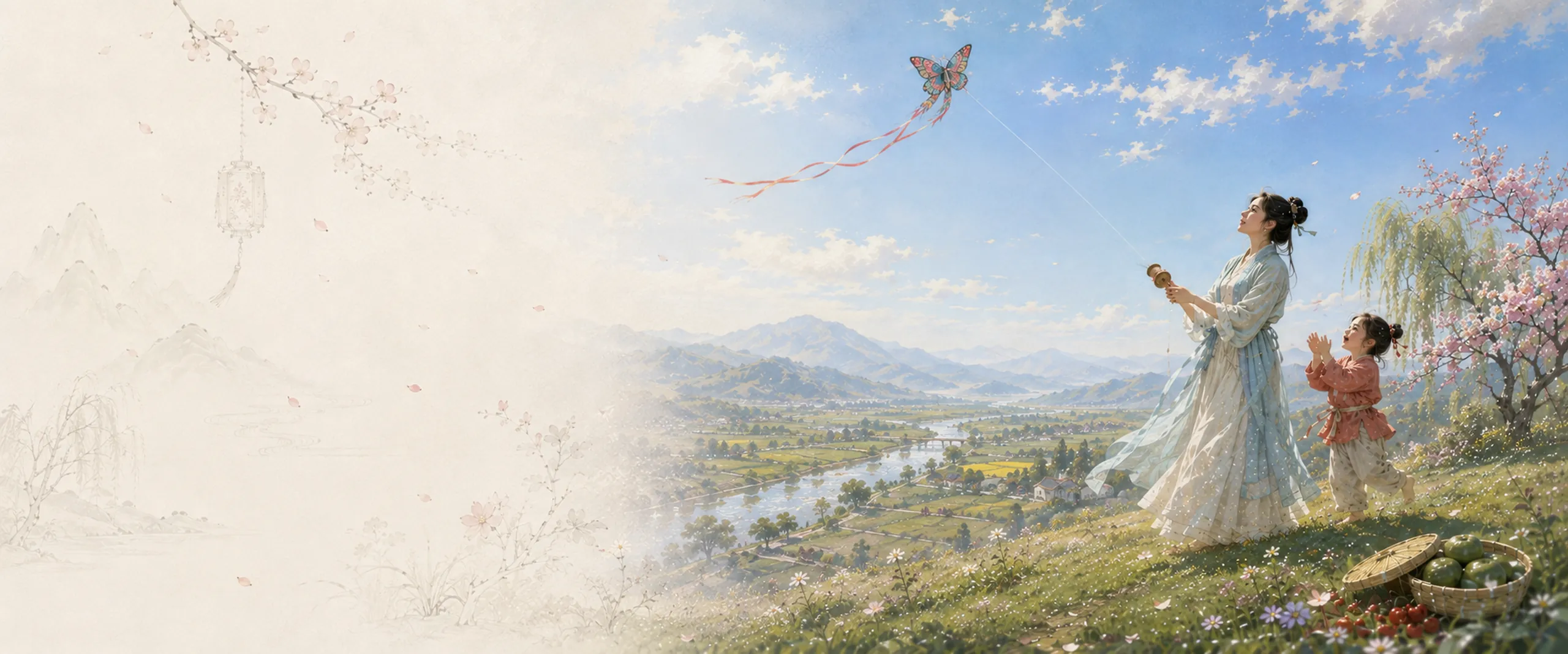
The Qingming Festival, also known as the Spring Outing Festival or the Third-Month Festival, is one of China’s four major traditional festivals. Falling at the transition between mid-spring and late spring, it is both a solemn day for honoring ancestors and remembering the departed and a joyful season for drawing close to nature, going on spring excursions, and enjoying the pleasures of the season. Grave sweeping and ancestral worship and spring outings form the festival’s two principal ritual themes. Other traditional customs include refraining from fire and eating cold foods, placing and wearing willow branches, and flying kites. In 2006, Qingming Festival was included in the first batch of China’s national intangible cultural heritage list. As Chinese culture has spread across the world, Qingming has become a cultural festival upheld by Chinese communities in many countries—from the waves of grave sweeping at the Kwong Tong Cemetery in Kuala Lumpur, Malaysia, to Minnan ancestral rites organized by the Hokkien Association in Cambodia; from large-scale Buddhist blessing ceremonies in Ho Chi Minh City, Vietnam, to Sino-Brazilian cultural celebrations in São Paulo; from transoceanic ancestral memorial rites in the San Francisco Bay Area to Qingming poetry recitals and spring outings in Canada. Around the world, communities commemorate their ancestors in ways both solemn and diverse.
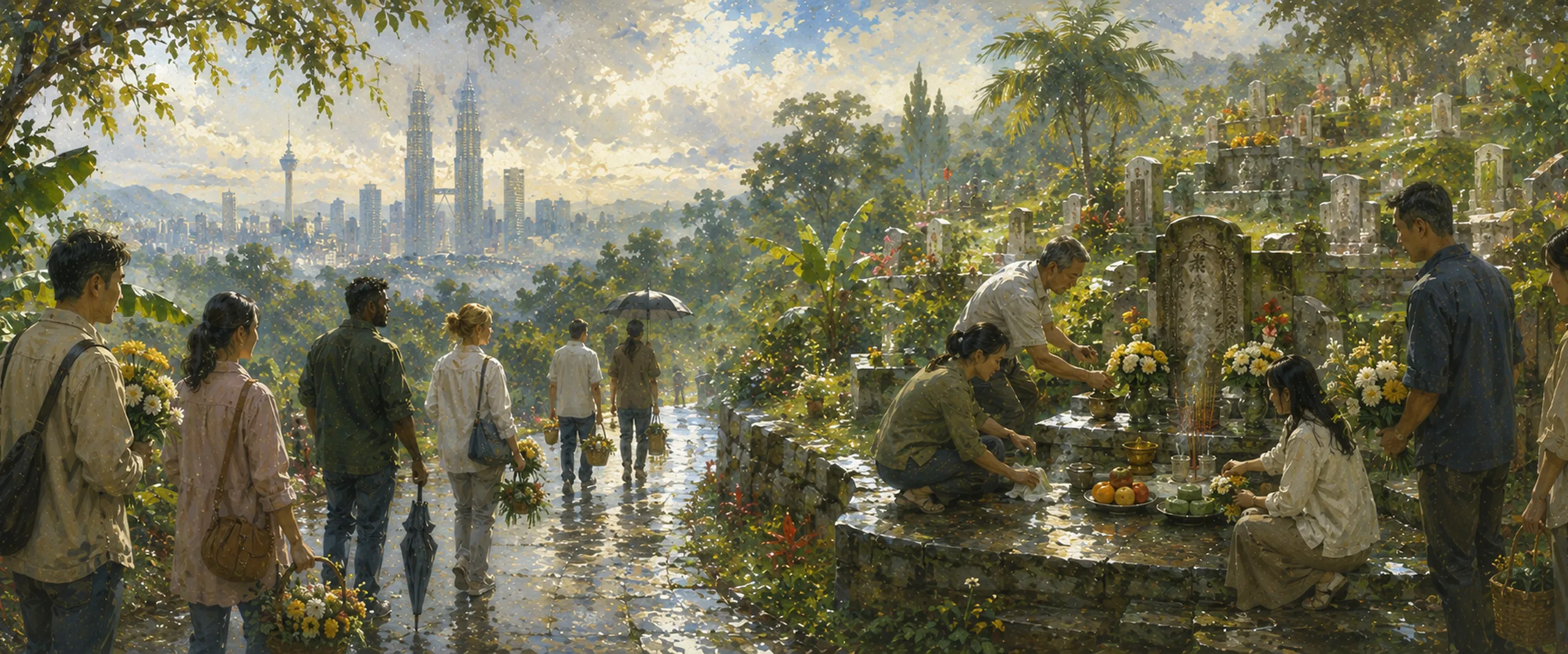
Event Schedule and Venues:
### Core Qingming Dates
Qingming Festival generally falls between April 4 and 6 in the Gregorian calendar, with the exact date determined by the solar term in that year. The Qingming holiday is usually three days long, including weekend adjustments. The period from one week before to one week after the festival is the peak season for memorial visits, with the heaviest grave-sweeping traffic occurring around April 4. The core schedule is as follows:
| Time | Activity | Description |
|---|---|---|
| Late March to early April | Memorial services begin across the country | Cemeteries and martyrs’ memorial parks begin receiving peak visitor flows |
| April 4–6 | Statutory holiday | Three-day holiday, subject to the State Council’s official announcement for the year |
| Around April 4 | Qingming Day | Grave sweeping and ancestral worship, the peak memorial period |
| Throughout April | Cold Food and Qingming themed cultural activities in Jiexiu, Shanxi | The 19th edition continues throughout the month |
### Traditional Qingming Customs
Qingming combines both natural and humanistic meanings. Its principal customs include:
| Custom | Description |
|---|---|
| Grave Sweeping and Ancestral Worship | The most important Qingming activity. People visit ancestral graves to remove weeds, add fresh soil, offer flowers, and burn incense, expressing remembrance and respect |
| Spring Outings | As spring returns, people leave their homes to enjoy the beauty of the season |
| Flying Kites | One of the most beloved Qingming activities, symbolizing the release of misfortune, worries, and illness |
| No Fire and Cold Food | Originating in the Cold Food Festival tradition, people refrained from fire and ate cold foods around Qingming |
| Placing and Wearing Willow Branches | Willow branches are placed over doors or worn as rings on the head to pray for blessings and ward off evil |
| Eating Qingtuan | A seasonal food made by kneading glutinous rice with mugwort juice. Green, soft, glutinous, and fragrant, it is among the most representative Qingming foods |
### Major Recommended Activities by Region
Jiexiu, Shanxi — Cold Food and Qingming Themed Cultural Activities, Throughout April:
Mianshan in Jiexiu, Shanxi, is an important place of origin for Qingming and Cold Food culture and possesses a deep cultural heritage. In 2011, the Qingming Festival — Jiexiu Cold Food and Qingming Customs was included in the third batch of China’s national intangible cultural heritage list. Each year, activities are organized around the theme “Continuing the Cultural Lineage of Cold Food, Deepening the Values of Loyalty and Filial Piety,” with five major series and 12 individual events:
* “Taste of Jiexiu” Civic Practice Intangible Cultural Heritage Market: Live demonstrations of national- and provincial-level heritage traditions such as colored-glaze firing techniques, Hongshan incense making, and Jiexiu huamo.
* “Skilled Hands Shape Spring and Autumn” Huamo and Dough Modeling Workshop: Participants follow inheritors in making Qingming seasonal dough figures.
* “Ancient Flavors of Cold Food” Cooking Workshop: Learn to prepare traditional cold foods such as Cold Food porridge and Cold Food noodles.
* Walking Historic Sites, Hearing Traditional Stories, Making Handicrafts: Folklore specialists recount stories of loyalty and righteousness in historical settings such as the Temple of Jie.
* Spring outings, red tourism, Qingming poetry gatherings, and other cultural and sporting activities.
Cuiheng Village, Zhongshan, Guangdong — “Our Festival · Qingming” Series:
Cuiheng Village is the hometown of Dr. Sun Yat-sen. During Qingming, a series of events is held under the theme “Fine Rain Nourishes Fragrant Grass, Sorrowful Thoughts Honor Loyal Souls”:
* “Talking About Customs, Rediscovering the Pleasures of Qingming”: Interactive Qingming customs quiz in the Cuiheng traditional residence exhibition area.
* Flower Tributes at Former Residences of Notable Figures: Yellow and white chrysanthemums are placed at six former residences, including those of Sun Yat-sen and Yang Yin, for visitors to offer.
* “Thoughts of Qingming, Words from the Heart”: Message activity honoring predecessors and martyrs.
* “Strolling Through Cuiheng, Qingming in Painting”: Qingming landscape painting activity.
Changzhou, Jiangsu — “Our Festival · Qingming” Themed Activities:
* Feihualing Poetry Challenge: Interactive traditional poetry activity.
* Qingtuan Making: Pastry chefs guide participants in preparing this traditional Qingming food.
* Spring Cycling: A spring ride for cycling enthusiasts.
* “Remembering the Martyrs, Recalling Our Original Aspirations” and other civic practice activities.
Other Activities Across the Country:
* Red Memorial Visits: Martyrs’ cemeteries around the country organize themed memorial activities under the banner “Tracing Memory · Honoring the Heroes at Qingming.”
* Civic Markets: Public-service booths provide road-safety advice, free health consultations, anti-fraud information, and other services.
* Qingming Poetry Gatherings: Poetry recitations and readings of classical works are organized in many regions.
Pre-Trip Preparation:
### Visas and Entry
Qingming destinations throughout China are subject to the country’s unified visa policies:
* 240-hour visa-free transit for citizens of 54 countries: Travelers may enjoy visa-free transit for up to 240 hours, with permitted stay areas covering most administrative regions of China.
* Tour groups from ASEAN countries: Organized groups may enter visa-free through designated ports.
* Other nationalities: Apply in advance for a tourist visa, or L visa, through the relevant Chinese embassy or consulate and ensure that the passport remains valid for more than six months.
* Latest policies: Before departure, consult the official website of China’s National Immigration Administration or the relevant Chinese embassy or consulate.
### Adapting to the Climate
Qingming falls in early April each year. Climate conditions across China at this time are as follows:
| Region | Temperature Range | Climate Characteristics | Clothing Recommendations |
|---|---|---|---|
| North China (Beijing, Shanxi) | 5°C–18°C | Temperatures rise, but mornings and evenings remain cool; frequent wind and dust | Long-sleeved T-shirt, light jacket / trench coat, windproof outerwear |
| East China (Shanghai, Hangzhou, Changzhou) | 10°C–20°C | Warm and humid, with persistent spring rain | Long-sleeved T-shirt, light jacket, folding umbrella |
| South China (Guangzhou, Shenzhen) | 18°C–25°C | Warm, with occasional rain | Short-sleeved T-shirt, light jacket, rain gear |
| Southwest China (Chengdu, Chongqing) | 12°C–22°C | Frequent rain and fog, humid air | Long-sleeved T-shirt, light jacket, rain gear |
| Central China (Wuhan, Changsha) | 10°C–22°C | Temperatures fluctuate considerably | Layered clothing and a light jacket |
General Advice: Qingming is famously associated with spring rain, and precipitation is relatively common across much of China, so rain gear is essential. Morning and evening temperatures can differ noticeably, making layered clothing the most practical choice.
### Travel Insurance
It is strongly recommended to purchase travel insurance covering the following:
* Accidental injury and medical treatment for acute illness, including outpatient care
* Loss of or damage to personal belongings
* Travel delays or cancellations, as spring weather is changeable and flights may be delayed
### Currency and Payment
* Currency: Renminbi (CNY).
* Cash: Memorial supplies such as flowers and fruit are often sold at roadside stalls. Carrying RMB 200–300 in cash is recommended.
* Cards: Visa and MasterCard are accepted at major hotels and shopping centers.
* Mobile payment: Alipay and WeChat Pay are widely used throughout China.
### Communications and Internet
* Important: During the three-day Qingming holiday, travel volume is concentrated, and 4G/5G networks may become congested at popular scenic areas and transport hubs. It is strongly recommended to download offline maps in advance. Baidu Maps and AutoNavi are recommended; download maps for destination cities to your phone while connected to Wi-Fi.
How to Get There:
### Major Event Destinations
Qingming is a nationwide festival, and events in different regions have their own distinctive features. Key recommended destinations include:
| Destination | Featured Activities | Transportation |
|---|---|---|
| Jiexiu, Shanxi | Cold Food and Qingming themed cultural activities throughout April | Fly to Taiyuan Wusu Airport or take high-speed rail to Jiexiu East Station |
| Zhongshan, Guangdong | Cuiheng Village “Our Festival · Qingming” series | Fly to Guangzhou / Zhuhai, then transfer by high-speed rail or road to Zhongshan |
| Changzhou, Jiangsu | “Our Festival · Qingming” themed activities | Changzhou Benniu Airport or Changzhou North Railway Station |
| Beijing | Spring outings in parks and memorial activities at revolutionary heritage sites | Capital / Daxing airports and major Beijing railway stations |
| Zhejiang | Red heritage study programs and Qingming spring outings across the province | Hangzhou Xiaoshan Airport and regional high-speed rail stations |
### Special Transportation Reminders
Qingming is a national statutory holiday, usually with a three-day break including weekend adjustments. Exact dates are subject to the State Council’s official announcement for the year.
Flights / High-Speed Rail:
* The afternoon before the holiday and the morning of the first holiday day are peak departure periods, while the final holiday day is the peak return period.
* Book flights and train tickets about one month in advance.
* Long-distance buses can be considered for short journeys, as ticket availability is generally better.
Driving:
* During Qingming, toll roads are free for passenger vehicles with seven seats or fewer.
* During the toll-free period, expressways and roads leading to cemeteries and scenic areas can be severely congested, so travel outside peak hours is recommended.
* Check real-time traffic conditions in advance and avoid congested routes.
Urban Transportation Tips:
* During Qingming, roads around cemeteries are subject to traffic controls, and public transportation is recommended.
* Major parks and scenic areas also experience heavy traffic, so depart early.
Accommodation Reservations:
| Key Point | Recommendation |
|---|---|
| When to book | Qingming is a three-day holiday with concentrated travel demand. Book hotels about one month in advance |
| Recommended areas | Near major event venues in each city, such as central Jiexiu in Shanxi, around Cuiheng Village in Zhongshan, or central Changzhou |
| Accommodation types | Luxury hotels for full-service comfort, budget chain hotels for value, and distinctive guesthouses for cultural experiences |
| Price reference | Rates generally rise during the holiday: budget hotels around RMB 200–400 per night, mid-range around RMB 400–800, and high-end above RMB 800 |
| Booking platforms | Major platforms such as Ctrip, Qunar, and Meituan; rooms with free cancellation are preferable |
| Special note | Visitors traveling to Jiexiu, Shanxi, for Cold Food and Qingming cultural activities should book early, as the program continues throughout April |
Pre-Trip Packing Checklist:
| Category | Essential Items | Special Notes |
|---|---|---|
| Upper-body clothing | Long-sleeved T-shirt, light jacket / trench coat / outdoor shell | Early April has large morning-evening temperature differences; northern regions can be windy and dusty |
| Lower-body clothing | Long pants | Prioritize comfort for outdoor activities |
| Shoes | Comfortable, non-slip athletic / hiking shoes | Cemetery and countryside paths may be muddy |
| Rain Gear | Folding umbrella or lightweight raincoat — essential | “清明时节雨纷纷” — rain is common across much of China |
| Sun Protection | SPF30+ sunscreen, sun hat | Ultraviolet exposure can still be strong on sunny days |
| Medication | Cold medicine, gastrointestinal medicine, adhesive bandages, allergy medicine | Spring pollen allergies are common |
| Electronics | Power bank, phone, camera | Outdoor activities may last for long periods |
| Storage | Small bag / waist pouch for documents and cash | Keep personal belongings secure in crowded places |
| Other | Tissues / wet wipes, thermos | Useful for long outdoor activities |
Participation Rules:
### Grave Sweeping and Ancestral Worship Etiquette
The heart of Qingming lies in honoring the departed and remembering one’s ancestors with reverence. If visiting a cemetery or participating in memorial rites, observe the following:
* Dress appropriately: Plain, dignified clothing is recommended. Avoid overly bright or revealing attire.
* Maintain solemnity: Cemeteries are solemn places. Remain quiet and respectful; laughter and noisy behavior are inappropriate.
* Flower offerings: Chrysanthemums, especially yellow and white varieties, are traditional Qingming memorial flowers and symbolize remembrance. Place them gently and bow deeply.
* Photography restrictions: Photography is generally not recommended during memorial rites, out of respect for the deceased and their families.
* Fire safety: Burn incense and joss paper only in designated areas, and ensure flames are completely extinguished before leaving. Authorities encourage greener and safer forms of remembrance, including flower offerings, memorial tree planting, family remembrance, and online memorials.
* Responsible memorial practice: Many regions promote activities such as “flowers in exchange for joss paper” as part of efforts to encourage more environmentally responsible customs. Visitors are encouraged to cooperate.
### Etiquette for Spring Outings and Outdoor Activities
* Protect the environment: Take care of flowers, plants, and trees. Do not pick them or damage vegetation.
* Waste management: Carry a rubbish bag and take all waste away from natural scenic areas.
* Kite-flying safety: Choose open spaces and stay away from high-voltage lines and roads.
### Etiquette for Cultural Experience Activities
* Intangible cultural heritage workshops: When joining huamo dough-modeling or Cold Food cooking workshops in places such as Jiexiu, follow the guidance of tradition bearers and respect the techniques being taught.
* Qingming poetry gatherings: Remain quiet while watching or participating and do not disturb performances.
* Visits to revolutionary heritage sites: Maintain a solemn atmosphere in memorial halls and revolutionary sites and avoid loud behavior.
### Photography Etiquette
* Ask permission: Before photographing local people in traditional clothing, intangible cultural heritage practitioners, elderly people, or children, smile and ask first.
* Respect portrait rights: Do not use photographs of others for commercial purposes without consent.
* Drone regulations: Flying drones over cemeteries, memorial halls, and crowded areas requires advance notification to local public security authorities.
Practical Emergency Information:
| Item | Contact / Notes |
|---|---|
| Emergency Numbers | Police 110, Fire 119, Ambulance 120 |
| Major Hospitals | Municipal and People’s Hospitals in major cities; emergency departments remain open 24 hours during Qingming |
| Tourist Police / Lost Property | Scenic areas generally have permanent police posts. If valuables are lost, report immediately to the nearest police office |
| Tourist Information | Official platforms of local culture and tourism authorities |
| Time Zone | UTC+8, China Standard Time |
| Voltage / Plugs | 220V; plug types A / C / I |
Special Reminders:
* Holiday arrangements: Qingming is a national statutory holiday and usually involves a three-day break. Exact arrangements are subject to the State Council’s official announcement for the year.
* Peak memorial period: Qingming Day itself is the busiest period for grave sweeping. Roads around cemeteries can be heavily congested and crowded, so off-peak memorial visits or greener alternatives such as online remembrance are recommended.
* Free expressway travel: Passenger vehicles with seven seats or fewer enjoy toll-free expressway travel during Qingming, but severe congestion is common, so plan ahead.
* Changeable weather: Much of China is rainy in early April, so rain gear is essential. Northern China can also be windy and dusty, and a face mask is recommended.
* Special recommendation — Jiexiu, Shanxi: Mianshan in Jiexiu is an important place of origin for Qingming and Cold Food culture, and themed cultural activities continue throughout April. Visitors with sufficient time can explore this national intangible cultural heritage tradition in greater depth.
* Spring allergies: Pollen allergies are common in spring. Travelers prone to allergies should carry antihistamines and a face mask.
* Fire safety: Qingming grave sweeping is a high-risk period for fires. Strictly follow local fire regulations and never use open flames in prohibited areas.
* Tasting qingtuan: Qingtuan are the most representative seasonal Qingming delicacy. They can be tasted at local pastry shops or intangible cultural heritage workshops, and in some places visitors can make them by hand.
*May you experience the distinctive charm of Chinese culture amid the gentle spring rain and the clear brightness of Qingming, and discover, between reverent remembrance and the renewal of spring, a deeper understanding of life, memory, and continuity.*
—–
Cultural Background:
Qingming Festival originated in China and has a history of more than 2,500 years. As one of the Twenty-Four Solar Terms, Qingming is both a seasonal marker in the natural calendar and a traditional festival. Its customs incorporated elements of the Cold Food Festival and the Shangsi Festival, gradually forming the two major ritual themes of grave sweeping and ancestral worship, and spring outings in the countryside.
Qingming customs are rich and varied:
* Grave Sweeping and Ancestral Worship: The most important Qingming activity. People visit ancestral graves to remove weeds, add fresh soil, offer flowers, burn incense, and express remembrance and respect for their forebears.
* Spring Outings: As spring returns to the earth, people leave their homes to enjoy the beauty of the season.
* No Fire and Cold Food: Originating in the Cold Food Festival tradition, people refrained from lighting fires and ate cold foods around Qingming.
* Placing and Wearing Willow Branches: Willow branches are placed over doors or woven into rings and worn on the head as prayers for blessing and protection from evil.
* Flying Kites: One of the most popular Qingming activities, symbolizing the release of misfortune.
* Eating Qingtuan (青团): A seasonal delicacy made by kneading glutinous rice with mugwort juice. Green in color, soft and glutinous in texture, and delicately fragrant, qingtuan are among the most representative foods of Qingming.
As Chinese communities spread around the world, Qingming culture traveled with them. Today, Qingming Festival has become an important part of multicultural life in many countries:
* Asia: Chinese communities in Malaysia, Singapore, Cambodia, Vietnam, and elsewhere retain complete traditions of ancestral worship, and Qingming grave sweeping is one of the most important traditional activities in overseas Chinese communities.
* North America: Chinese associations in major cities across the United States and Canada organize ancestral memorial ceremonies, poetry recitals, spring outings, and related activities.
* Europe: Chinese embassies abroad hold memorial rites for martyrs and national heroes buried overseas.
* South America: São Paulo, Brazil, holds cultural celebrations blending Qingming and Easter in the context of the “China–Brazil Cultural Year.”
* Oceania: Chinese communities in Australia, New Zealand, and elsewhere organize public Qingming memorial ceremonies.
The year 2026 is the lunar Bingwu Year of the Horse (丙午马年).
Major Celebration Cities
| Continent | Country / Region | Core City | Featured Activities |
|---|---|---|---|
| Asia | Malaysia | Kuala Lumpur | Qingming grave sweeping at the Kwong Tong, Hokkien, and Kwangsi cemeteries, March 21–April 19, with an estimated 11 peak days |
| Malaysia | Penang | Qingming grave sweeping, with expected peaks on March 28–29, April 5, and April 11–12 | |
| Singapore | Singapore | Qingming ancestral worship and large-scale Buddhist blessing ceremony on April 5 at Marina Bay Sands Expo | |
| Cambodia | Phnom Penh | Qingming ancestral worship organized by the Hokkien Association at the Hokkien Cemetery on April 5 | |
| Vietnam | Ho Chi Minh City | Large-scale Buddhist memorial and blessing ceremony at Binh Duong Cemetery, attended by more than 3,000 people | |
| Timor-Leste | Dili | Qingming memorial rites at the Chinese cemetery organized by the Timor-Leste Chinese Chamber of Commerce | |
| North America | United States | San Francisco | Third Bay Area Chinese Qingming Ancestral Memorial Ceremony, April 12, at Golden Gate Cemetery |
| United States | New York / New Jersey | Wenzhou Association ancestral memorial rites and commemoration of the earliest Chinese laborers on the U.S. East Coast | |
| United States | Washington, D.C. | Qingming ancestral rites at four cemeteries organized by the Chinese Consolidated Benevolent Association of Washington, March 28 | |
| United States | Chicago | Qingming ancestral rites at the Chinese cemetery organized by the Chinese Consolidated Benevolent Association, March 23 | |
| United States | Portland | Fifth annual Qingming event, April 4, at Lone Fir Cemetery | |
| Canada | Toronto | Qingming commemorative event combining spring outing, poetry recitation, and qingtuan tasting on April 5 | |
| Europe | Serbia | Belgrade | Memorial ceremony for three martyrs at the former site of the bombed Chinese Embassy in the Federal Republic of Yugoslavia |
| United Kingdom | London | Memorial activities organized by the Chinese Embassy and related institutions | |
| Africa | Tanzania | Dar es Salaam | Memorial rites at the Chinese Experts Cemetery for those who died during construction of the Tanzania–Zambia Railway |
| Ethiopia | Addis Ababa | Memorial ceremony for pioneers of the Chinese medical team | |
| Zambia | Lusaka | Memorial rites at the TAZARA Memorial Park | |
| South America | Brazil | São Paulo | Joint Qingming and Easter celebration at the Chinese Catholic Church on April 5 |
| Oceania | Australia | Perth | Public Qingming memorial at Karrakatta Chinese Cemetery on April 3 |
| Samoa | Apia | Qingming grave-sweeping activity at the Chinese cemetery on April 4 | |
| Nauru | Nauru | Qingming memorial at the overseas Chinese cemetery on April 5 |
Recommended Activities by Destination
### 3.1 Kuala Lumpur, Malaysia — Qingming Grave Sweeping
Malaysia has a large Chinese community, and Qingming is one of the most important traditional festivals for overseas Chinese society. In 2026, Qingming grave-sweeping access runs from March 21 to April 19, daily from 6:00 a.m. to 4:00 p.m. Organizers expect a total of 11 peak days: March 21, 22, 23, 28, and 29, and April 4, 5, 11, 12, 18, and 19.
The Kwong Tong Cemetery, Hokkien Cemetery, and Kwangsi Cemetery in Kuala Lumpur jointly issue notices urging the public to plan ancestral memorial visits in advance. Qingming in 2026 coincides with the Hari Raya holiday period, and cemetery administrators call on visitors to observe traffic regulations. The Kwong Tong Cemetery also introduces a new measure: incense sticks and candles are prohibited inside the columbarium tower.
In Penang, March 28–29 and April 5, 11, and 12 are expected to be peak grave-sweeping days, and authorities urge visitors to travel outside the busiest periods.
Transport Tip: Kuala Lumpur’s Kwong Tong Cemetery is located within the city. Public transportation or carpooling is recommended, and the peak period from 9:00 a.m. to noon should be avoided where possible.
### 3.2 Singapore — Qingming Ancestral Worship and Buddhist Blessing Ceremony
Qingming is an important nationwide observance in Singapore. In 2026, Qingming falls on Sunday, April 5, and ancestral memorial activities are expected to concentrate between March 21 and April 19. Authorities identify 11 peak days, including April 3, Good Friday, April 4, April 5, Qingming Day, April 11–12, and April 18–19.
The Qingming Ancestral Worship and Grand Buddhist Blessing Ceremony is held on April 5 at the Marina Bay Sands Expo and Convention Centre. Visitors traveling to memorial grounds such as Kranji War Memorial are expected to maintain quiet and orderly conduct. Free shuttle buses are provided, and parking reservations are required on peak grave-sweeping days.
Transport Tip: Marina Bay Sands Expo and Convention Centre is located in central Singapore and is directly accessible from Bayfront MRT Station on the Downtown and Circle lines.
### 3.3 Phnom Penh, Cambodia — Qingming Ancestral Worship of the Hokkien Association
The Cambodia Hokkien Association holds its Qingming grave-sweeping and ancestral memorial ceremony on April 5 at the Hokkien Cemetery. In keeping with long-standing practice, the association issues an announcement before the festival calling on both long-established and newly arrived members of the Fujian community in Cambodia to gather at the cemetery.
Led by association president Ms. Huang Meifen, members of the council and Fujianese community follow traditional rites, successively paying homage to Ksitigarbha Bodhisattva, Tudigong, and Dazhongye. Families place offerings before ancestral graves, including roast pig, chicken and duck, fruit, pastries, tea and wine, and joss paper, together with distinctive traditional foods from southern Fujian. After the rites, community members gather in the cemetery pavilion for a shared meal, exchanging food, tea, and conversation. This post-memorial gathering has become a distinctive cultural feature of Qingming among the Minnan Chinese community in Cambodia.
Transport Tip: The Hokkien Cemetery is located in the suburbs of Phnom Penh. Contacting the association in advance for exact location and transport arrangements is recommended.
### 3.4 Ho Chi Minh City, Vietnam — Grand Buddhist Memorial and Blessing Ceremony
During Qingming Festival in 2026, the Executive Council of the Vietnam Buddhist Sangha in Ho Chi Minh City works with Binh Duong Cemetery to hold a Grand Buddhist Memorial and Blessing Ceremony, attracting more than 3,000 participants.
The ceremony is held at Binh Duong Cemetery, where large numbers of worshippers gather to pray for and dedicate merit to their ancestors in a solemn and reverent atmosphere.
Transport Tip: Binh Duong Cemetery is located outside central Ho Chi Minh City and can be reached by bus or taxi.
### 3.5 United States — Qingming Ancestral Memorial Activities in Multiple Cities
San Francisco — Third Bay Area Chinese Qingming Ancestral Memorial Ceremony, April 12:
The Third Overseas San Francisco “Tracing Roots, Honoring Ancestors, Blessing Future Generations” Bay Area Chinese Memorial Ceremony is held on the afternoon of April 12 at Golden Gate Cemetery. It is jointly organized by the San Francisco International Ladies Charity Alliance of North America and the San Mateo Metropolitan Lions Club.
The program includes transoceanic memorial offerings with incense and candles, a collective Daoist blessing and ancestral memorial ritual, presentations on traditional Chinese culture, and a unified incense-offering ceremony by guests. The event opens with a lyrical violin and piano duet, while several guests share reflections on remembrance of life and cultural inheritance.
Washington, D.C. — Ancestral Worship at Four Cemeteries, March 28:
Following tradition, the Chinese Consolidated Benevolent Association of Washington visits four affiliated cemeteries on March 28—Cedar Hill Cemetery, Washington National Cemetery, Fort Lincoln Cemetery, and George Washington Cemetery—to conduct Qingming ancestral rites. The memorial team follows traditional Chinese ritual practice, placing fresh flowers, vegetarian fruit offerings, and clear wine before the graves and burning incense and joss paper.
Since the earliest Chinese migrants crossed the ocean to make a living in the United States, the association has assisted unclaimed Chinese migrants by purchasing burial land and establishing Chinese charitable burial grounds. It has returned every Qingming season to pay respects without interruption.
New York / New Jersey — Memorial for the Earliest Chinese Laborers on the East Coast and Wenzhou Association Ancestral Rites:
* April 11: The New Jersey Chinese United Association organizes the annual memorial ceremony for the earliest Chinese laborers on the U.S. East Coast at the cemetery of the Dutch Reformed Church in Belleville, New Jersey.
* During Qingming: Wang Chongzhang, president of the New York Wenzhou Association, leads members to two cemeteries affiliated with the New Jersey Wenzhou Association to honor their ancestors.
Chicago — Chinese Consolidated Benevolent Association Qingming Ancestral Rites, March 23:
On March 23, the Chicago Chinese Consolidated Benevolent Association travels to the Chinese cemetery outside Chicago to hold Qingming ancestral rites. Members of the overseas Chinese community gather to remember earlier generations, embodying the traditional values of honoring one’s forebears and remembering the source from which one came.
Portland — Fifth Annual Qingming Event, April 4:
The fifth annual Qingming event is held at 11:00 a.m. on April 4 at Lone Fir Cemetery in southeast Portland. Activities include celebrating the dedication of a new memorial in the cemetery’s historic Chinese section. On the same day, Salem Pioneer Cemetery hosts its eighth Qingming celebration, including a mayoral proclamation and performances of traditional Chinese music and poetry.
In addition, the Chinese Catholic community in Seattle holds a Qingming memorial Mass on March 28 at Holyrood Cemetery; Hsi Lai Temple in Los Angeles holds its annual Qingming memorial chanting ceremony on April 12; and the Chung Shan Lung Doo Benevolent Association in San Francisco holds its annual Qingming grave-sweeping day on April 5.
### 3.6 Canada — Qingming Poetry Recital and Spring Outing, April 5
The Canadian Recitation Arts Troupe holds a Qingming commemorative event on the afternoon of April 5, centered on Qingming culture and combining a spring outing in the park, qingtuan tasting, and poetry recitation. The event attracts many Chinese families and cultural enthusiasts.
* Seeking Spring on a Qingming Outing: Members first stroll through Simonston Park, experiencing the philosophy of life embodied in the Qingming seasonal transition.
* Tasting Qingtuan: Two flavors are specially prepared—red bean paste and salted egg yolk with pork floss—and offered free to participants.
* Qingming Poetry Gathering: At Hongyi Private Academy in Markham, the “What Is Qingming? — 2026 Qingming Poetry Gathering” unfolds in four chapters: “Where We Come From,” “Giving Voice Through Poetry,” “Sending Thoughts on the Clear Wind,” and “Clarifying the Heart, Looking to the Distance.”
During the gathering, participants recite *Qingming Fu* with emotion and sing *Qingming Rain*, while a ten-year-old child recites *Chu Shi Biao*, interpreting the cultural meanings of Qingming from different perspectives.
Transport Tip: Simonston Park is located north of Toronto. Hongyi Private Academy in Markham can be reached by car or York Region Transit.
### 3.7 São Paulo, Brazil — Joint Qingming and Easter Celebration, April 5
The year 2026 coincides with the “China–Brazil Cultural Year.” Around Easter and Qingming, the Chinese Catholic Church in São Paulo organizes a celebration filled with gratitude, joy, and warmth.
On the day of the event, overseas Chinese families and Brazilian residents enjoy a program showcasing Sino-Brazilian cultural exchange—including a fan dance by the Beijing Cultural Exchange Association, the classical dance *Rain Butterfly* performed by overseas Chinese participants, the street dance *Havoc in Heaven*, magic performances, Brazilian children’s dances, and a large chorus. A generous selection of festive foods is also prepared, including barbecue, fruit, and snacks with both Chinese and Brazilian characteristics.
The event is attended by the head of São Paulo’s civil affairs bureau and representatives of several overseas Chinese associations. Father Xiao Shihui of the Chinese Catholic Church in São Paulo remarks that Easter and Qingming are both important festivals in China and Brazil, and that, with 2026 also being the “China–Brazil Cultural Year,” the event is intended to let guests experience the unique charm of two cultures appreciating one another through exchange.
Transport Tip: The Chinese Catholic Church in São Paulo is located within the city and can be reached by metro or bus.
### 3.8 Chinese Embassies Abroad — Qingming Memorials for Martyrs
During Qingming, Chinese embassies in a number of countries hold memorial activities honoring martyrs and national heroes buried overseas:
* Serbia: The Chinese Embassy in Serbia visits the former site of the bombed Chinese Embassy in the Federal Republic of Yugoslavia to commemorate the three martyrs who died in the 1999 bombing.
* Tanzania: The Chinese Embassy in Tanzania holds a flower-laying ceremony at the Chinese Experts Cemetery, commemorating engineers who died during construction of the Tanzania–Zambia Railway in the 1970s.
* Ethiopia: The Chinese Embassy in Ethiopia commemorates Mei Gengnian, leader of the first Chinese medical team sent to Ethiopia in 1974.
* Cambodia: Chinese Ambassador to Cambodia Wang Wenbin travels to Kampong Cham Province to pay respects to two fallen peacekeepers.
* Vietnam: Chinese Ambassador to Vietnam He Wei visits the Taomei Martyrs Cemetery in Bac Ninh Province.
* Papua New Guinea: The Chinese Embassy visits the cemetery in Rabaul dedicated to Chinese soldiers of the War of Resistance and civilians who lost their lives.
* South Sudan: The 12th Chinese peacekeeping infantry battalion deployed to South Sudan, Juba, holds a Qingming memorial for fallen heroes.
Pre-Trip Packing Checklist
| Category | Recommended Items | Notes |
|---|---|---|
| Clothing | Dress for the local climate — April in the Northern Hemisphere is increasingly springlike but mornings and evenings can be cool, so bring a light jacket; the Southern Hemisphere is in early autumn and also calls for outerwear | Outdoor activities may last for long periods |
| Shoes | Comfortable, non-slip athletic shoes | Cemeteries, parks, and similar areas require extensive walking |
| Rain Gear | Folding umbrella or lightweight raincoat | “清明时节雨纷纷” — spring rain is common in the Northern Hemisphere |
| Camera / Phone | For photographing spring outings, poetry gatherings, and cultural celebrations | Spring scenery can be especially beautiful |
| Cash | Small amounts in local currency | Memorial supplies and some temple-fair stalls may require cash |
| Power Bank | Portable charger | Outdoor activities may last for long periods |
| Translation App | Google Translate and similar apps | Useful for communicating with local Chinese residents or stallholders |
Participation Etiquette:
### 5.1 General Qingming Etiquette
* Festival greetings: When meeting others, you may say “清明安康” or “清明节快乐”.
* Grave-sweeping etiquette: If visiting a cemetery or participating in memorial rites, maintain silence and solemnity. Laughter and loud behavior are inappropriate.
* Dress appropriately: Plain, dignified clothing is recommended; avoid overly bright or revealing attire.
* Flower offerings: Chrysanthemums are traditional Qingming memorial flowers and symbolize remembrance. They may be placed gently before the grave, followed by a deep bow.
* Photography restrictions: Photography is generally not recommended during memorial rites, out of respect for the deceased and their families.
* Tasting qingtuan: Qingtuan are among the most representative Qingming foods and may be freely enjoyed.
### 5.2 Etiquette for Spring Outings and Outdoor Activities
* Protect the environment: Take care of flowers, trees, and vegetation during spring outings. Do not pick plants or damage natural surroundings.
* Waste management: Carry a rubbish bag and take waste away from parks and natural scenic areas.
* Kite-flying safety: Choose open spaces and stay away from high-voltage power lines and roads.
### 5.3 Temple and Buddhist Ceremony Etiquette
* Dress appropriately: When entering temples, cemeteries, or participating in Buddhist ceremonies, wear dignified and suitable clothing.
* Maintain solemnity: Buddhist ceremonies and memorial sites are solemn spaces. Remain quiet and respectful.
* Photography restrictions: Photography is often prohibited during Buddhist rites and memorial ceremonies. Confirm with on-site staff in advance.
* Do not touch: Do not touch Buddha statues, scriptures, memorial tablets, or religious objects.
### 5.4 Photography Etiquette
* Ask permission: Before photographing Chinese participants in traditional dress, intangible cultural heritage practitioners, elderly people, or children, smile and ask first.
* Respect portrait rights: Do not use photographs of others for commercial purposes without consent.
* Drone regulations: Flying drones over cemeteries, temples, and crowded areas requires advance notification to local public security authorities.
### 5.5 General Responsible Participation
* Protect the environment: Do not litter; keep cemeteries, parks, and event venues clean.
* Maintain order: Queue patiently, do not cut in line, and avoid crowding.
* Fire safety: When burning incense or joss paper during cemetery rites, use only designated areas and ensure all flames are completely extinguished.
Travel Tips:
| Item | Notes |
|---|---|
| Best time to participate | The peak period generally falls one to two weeks before and after Qingming Day, April 5 |
| Plan ahead | Grave-sweeping peak days in Malaysia, Singapore, and elsewhere attract very large crowds; traveling outside peak periods is recommended |
| Transport | Roads around cemeteries and burial grounds are often heavily congested. Depart early or use public transportation |
| Weather | April in the Northern Hemisphere is increasingly springlike but often rainy; the Southern Hemisphere is in early autumn. Check local weather before travel |
| Local culture | Qingming observances vary by country—Brazil incorporates Easter traditions, Canada combines poetry recitation and spring outings, while Malaysia preserves Minnan ancestral customs |
Special Reminders:
* Qingming is a global festival: There is no need to travel to China to experience its cultural atmosphere. Malaysia, Singapore, the United States, Canada, Brazil, Australia, and many other places hold solemn commemorative activities.
* 2026 is the Year of the Horse: Public memorial ceremonies for the Yellow Emperor and other Qingming activities in some areas incorporate Year of the Horse elements.
* Peak grave-sweeping periods: In Malaysia, Singapore, and elsewhere, the busiest periods fall on weekends from late March through mid-April. If visiting a cemetery, avoid peak hours where possible, especially from 9:00 a.m. to noon.
* Special “China–Brazil Cultural Year” experience: In 2026, the joint Qingming and Easter celebration in São Paulo brings together Chinese and Brazilian cultural elements, offering a distinctive cross-cultural experience.
* Cultural diversity: Qingming celebrations vary widely around the world—Malaysia preserves complete Minnan ancestral rites, Canada commemorates the festival through poetry and spring outings, and many U.S. cities hold transoceanic ancestral memorial ceremonies.
* Public memorials by Chinese embassies: Chinese embassies in Serbia, Tanzania, Ethiopia, Cambodia, and other countries hold Qingming memorial rites for martyrs buried overseas. Some sites, such as the former Chinese Embassy site in Belgrade, are open to the public.
* Hong Kong is a public holiday: Qingming is a statutory public holiday in Hong Kong. Visitors can experience local ancestral rites and spring-outing customs.
*May you experience the distinctive spirit of Qingming in different corners of the world, and discover a profound cultural encounter in both the solemn remembrance of one’s forebears and the joy of stepping into the spring landscape.*
Readers’ Comments
Calendar and traditional culture enthusiasts from around the world, sharing the same moon.
Sign in or register to join the conversation. Your comment account is created automatically the first time you use a connected account.
No comments yet
Share your thoughts with readers around the world.