The formation of Qingming did not originate from a single tradition but resulted from the gradual fusion of three sources over a long historical period. These three sources are: “Qingming” as an agricultural solar term; the Cold Food Festival (Hanshi), centred on fire‑abstinence, cold food, tomb‑sweeping, and ancestor worship; and the Shangsi Festival (the Third Day of the Third Month), centred on purification rituals, blessings, and spring outings. Converging from different directions, they completed their final fusion in the Tang dynasty, forming the basis of Qingming.
The Qingming Solar Term
Qingming is first and foremost a solar term. The term “Qingming” first appeared in close connection with ancient astronomical observations; as early as the Zhou dynasty, people already had the concept of “Qingming” in the sense of a solar term. The 24 solar terms are climatic patterns summarised by ancient Chinese astronomers and common people through life and agricultural practice, reasonably reflecting changes in temperature, phenology, and rainfall across the four seasons. Although the 24‑solar‑term system was finalised in the Western Han dynasty’s “Huainanzi,” the division and establishment of the solar terms underwent a long process, largely completed by the Warring States period.
The Western Han dynasty’s “Huainanzi · Treatise on Astronomy” records: “Fifteen days after the Spring Equinox, when the Dipper points to Yi, the Qingming wind arrives.” The so‑called “Qingming wind” refers to a refreshing and bright wind. This is the first formal appearance of “Qingming” as a solar term name in historical texts. The “Sui Shi Bai Wen” further explains: “All things grow at this time, both clean and bright, hence the name Qingming.” Sima Qian also wrote in his “Almanac”: “Fifteen days after the Spring Equinox, when the Dipper points to Ding, it is Qingming. At this time, all things are neat and bright; when the air is clear and the scene is bright, all things appear, hence the name.” From these records, the origin of the name “Qingming” is closely related to the climatic and phenological characteristics of this period — at the turn of mid‑spring and late spring, the sky is clear, plants sprout, and all things present a clean and bright scene.
The “Yi Zhou Shu · Seasonal Instructions” also records: “On the day of Qingming, the tung tree begins to flower.” At this time, tung trees begin to bloom, marking a key moment of phenological change. Through long‑term observation of natural phenomena, the ancients named the period when temperatures rise, rainfall increases, and conditions become suitable for spring ploughing and sowing “Qingming,” endowing this solar term with distinct agricultural guidance.
By the Eastern Han dynasty, Qingming as a solar term already had clear agricultural connotations. Cui Shi’s “Monthly Instructions for the Four Classes of People” records: “On Qingming, order the silkworm maids to prepare the silkworm chambers…” This meant that at Qingming, silkworm workers were to be directed to organise the silkworm chambers and prepare for sericulture. The same book also records: “On Qingming, order the silkworm women to prepare silkworm food, seal crevices, and repair silkworm tools and food containers.” Thus, in the Han dynasty, “Qingming” was still a purely agricultural seasonal marker, with people arranging sericulture, spring ploughing, and other production activities according to this time point. The “Monthly Instructions” also contains this record: “On Qingming, order the silkworm maids to prepare the silkworm chambers, seal crevices, and prepare hammers, stands, trays, and baskets.” This too is agricultural guidance. At this time, “Qingming” was merely a solar term, its main function being to remind farmers when to sow and when to raise silkworms. In the Eastern Han period, although Qingming already had the designation of a “festival,” the custom system centred on ancestor worship, tomb‑sweeping, and spring outings had not yet developed.
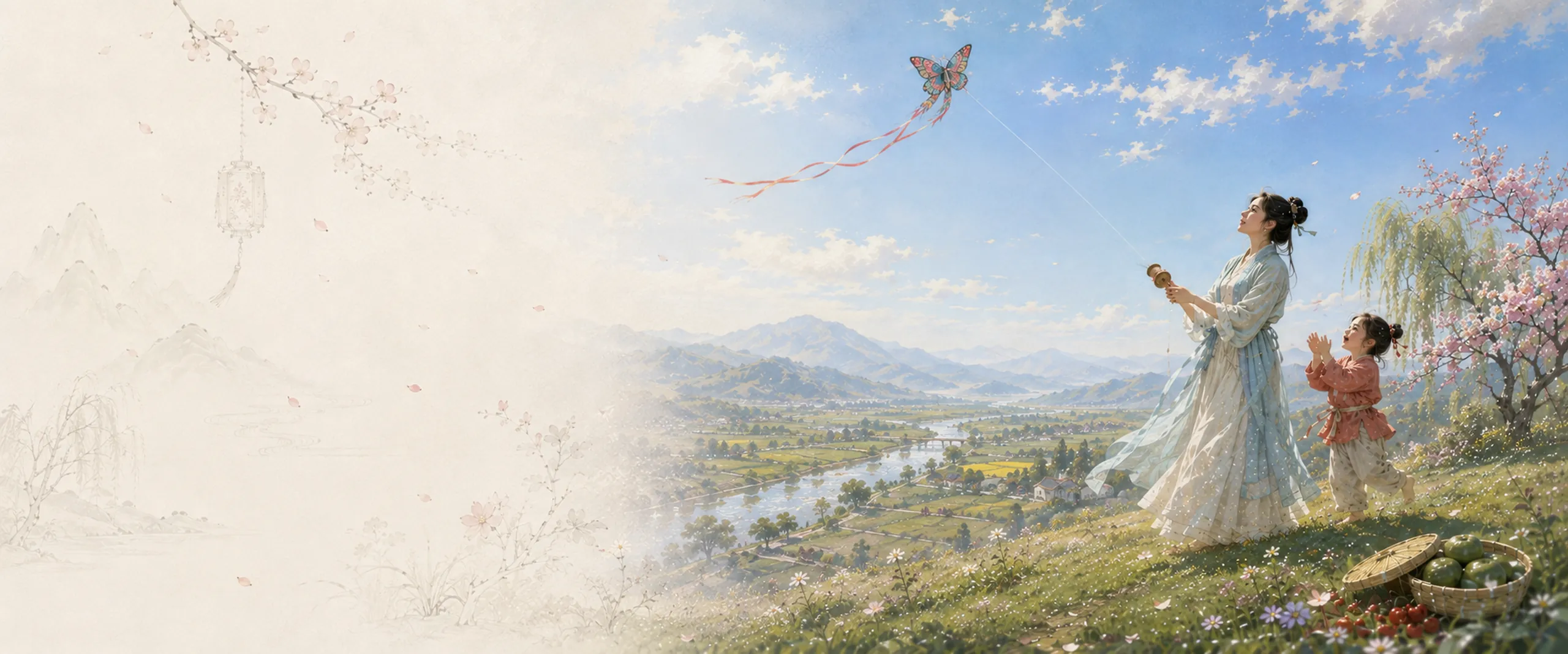
Farming proverbs such as “Around Qingming, plant melons and beans” and “Do not pass Qingming for afforestation” vividly reflect the importance of the Qingming solar term to ancient agricultural production. When Qingming arrives, temperatures rise and rainfall increases, making it an ideal time for spring ploughing and sowing. Precisely because the Qingming solar term falls at a time when all things revive and life flourishes, it later became an excellent occasion for people to go out and enjoy spring excursions.
The Cold Food Festival (Hanshi)
The Cold Food Festival is one of the most important sources of Qingming. It was once an independent and grand festival, contributing two core elements — fire‑abstinence with cold food, and tomb‑sweeping and ancestor worship — to the formation of Qingming. The Cold Food Festival falls in the third lunar month, one or two days before Qingming. From the pre‑Qin to the Northern and Southern dynasties, the Cold Food Festival was regarded as a major festival. In the Tang dynasty it was still a relatively important festival, but had begun to decline, gradually being absorbed by Qingming.
There have long been two main explanations for the origin of the Cold Food Festival: one is the ancient custom of “changing fire”; the other is the folk legend commemorating Jie Zitui, a loyal minister of the Jin state in the Spring and Autumn period. These two accounts are not mutually exclusive — the former reveals the ancient ritual roots of the festival, while the latter infuses it with profound humanistic meaning. As folklorists have noted: the Cold Food Festival “originated from ancient rituals of fire use and management; the story of Jie Zitui during the Spring and Autumn and Warring States periods added further cultural layers to it.”
#### The “Changing Fire” Custom
The oldest origin of the Cold Food Festival can be traced back to ancient people’s understanding and management of fire. In primitive society, people already recognised the importance of fire, but also noticed that fire burning for a long time could bring certain ominous effects. Thus, they developed the regular practice of “changing fire” — extinguishing the old fire and re‑drilling wood to obtain new fire, in order to remove inauspicious influences and avoid illness. This custom of changing fire existed among many peoples around the world, reflecting early humanity’s mysterious worship of fire and simple hygienic concepts.
By the Zhou dynasty, changing fire had developed into a strict ritual system. The “Rites of Zhou · Office of Summer · Fire Officer” records: “The Fire Officer has charge of the government orders concerning the use of fire, changing the state fire according to the four seasons to counter seasonal illnesses.” This means that the official in charge of fire was to change the state fire according to the four seasons in order to address seasonal diseases. When changing fire in spring, he was to patrol the capital with a wooden bell to proclaim the prohibition. The “Rites of Zhou” states: “In mid‑spring, with a wooden bell, proclaim the fire prohibition in the capital” — a record of this institution.
Why was fire prohibited in mid‑spring? This was closely related to the climatic characteristics of the north. Spring is dry, and fires were frequent. At the same time, influenced by astrological superstition and sympathetic magic, the ancients believed that in spring the Dragon Star appeared in the east, which could easily provoke great fires. Therefore, when the Dragon Star first appeared in the third month, fire should be prohibited. The prohibition of fire already existed in the Zhou dynasty. During the prohibition, people could not cook with fire and could only eat food prepared in advance — hence the name “Cold Food.” The interval between prohibition and changing fire was about three to seven days. From the Spring Equinox to Qingming was precisely the period of “Cold Food” fire prohibition.
Before the Han dynasty, the Cold Food Festival’s fire prohibition lasted a long time, up to a month. According to the “Book of the Later Han · Biography of Zhou Ju,” in the Han dynasty, the Shanxi region observed a month of cold food in spring to commemorate Jie Zitui. The Han dynasty set the Cold Food Festival three days before Qingming. The Southern dynasty “Jingchu Suishiji” records: “One hundred and five days after the Winter Solstice, there will be strong winds and heavy rain, called Cold Food; fire is prohibited for three days.” In the Tang and Song dynasties, it was reduced to the day before Qingming. As the prohibition shortened, the Cold Food Festival gradually evolved from a month‑long fast to a festival lasting only a few days.
#### The Legend of Jie Zitui
The most widely circulated legend about the Cold Food Festival concerns Jie Zitui, a loyal minister of the Jin state in the Spring and Autumn period. This legend infused the festival with cultural values of loyalty, integrity, and gratitude, elevating it from a simple fire‑prohibition custom to a festival full of humanistic spirit.
The story begins with the internal strife of the Jin state during the Spring and Autumn period. Duke Xian of Jin, in his later years, favoured Li Ji, who schemed to have her own son Xi Qi inherit the throne by framing the crown prince, Shensheng, who was forced to take his own life. Prince Chong’er (later Duke Wen of Jin) went into exile to escape persecution. During nineteen years of wandering, Chong’er endured countless hardships. On one occasion, when Chong’er’s party was trapped in a desolate place, exhausted and starving, they could no longer go on. His attendants searched everywhere but found nothing to eat. In desperation, his attendant Jie Zitui withdrew to a secluded spot, cut a piece of flesh from his own thigh, and cooked a bowl of broth for the prince. After drinking it, Chong’er gradually recovered his strength. When he learned that the meat had come from Jie Zitui’s own thigh, he wept with emotion.
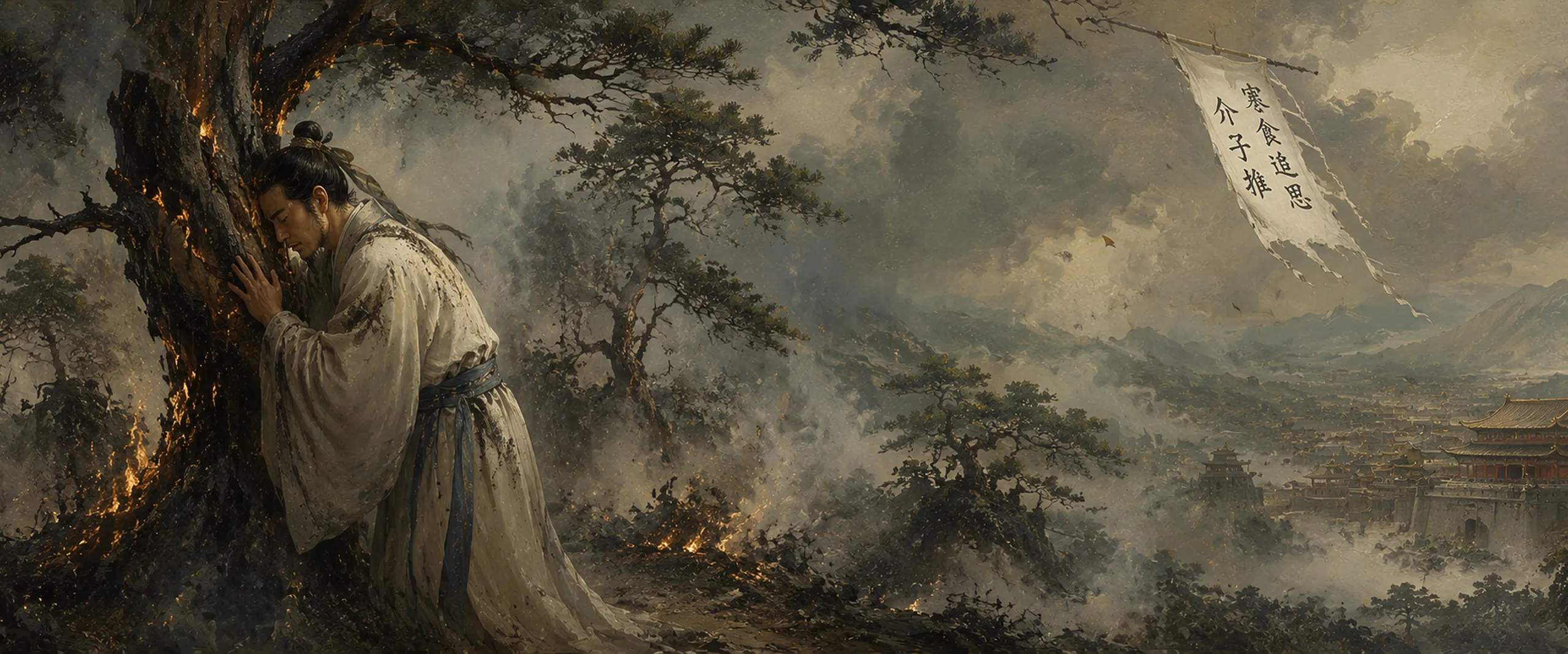
Nineteen years later, Chong’er finally returned to Jin and ascended the throne, becoming the renowned Duke Wen of Jin. After his accession, Duke Wen lavishly rewarded the ministers who had accompanied him in exile, but by mistake forgot Jie Zitui. Many urged Jie Zitui to petition the duke for rewards, but he despised those who clamoured for recognition. Unwilling to follow the vulgar crowd, Jie Zitui packed his belongings and quietly retreated to Mount Mian with his elderly mother. When Duke Wen heard of this, he was filled with shame and personally led a party to invite Jie Zitui back. But Jie Zitui had already gone into seclusion on Mount Mian, which was high, steep, and densely forested. Finding two people there was no easy task. Someone suggested setting fire to Mount Mian from three sides to force Jie Zitui out. The fire swept across the mountain, but Jie Zitui was nowhere to be found. When the flames died down, people discovered that Jie Zitui, carrying his mother on his back, had died sitting beneath an old willow tree.
When Duke Wen saw this, he wept bitterly. During the preparation for burial, they found a piece of cloth in a tree hollow with an inscription: “I cut my flesh to serve my lord with utmost devotion; may my lord always be clear and bright.” To commemorate Jie Zitui, Duke Wen decreed that this day be designated the Cold Food Festival, and that no fire be lit for cooking on that day—only cold food could be eaten. The following year, Duke Wen led his ministers to the mountain to pay homage, and found that the old willow tree had come back to life. He named it “Qingming Willow” and proclaimed that the day after the Cold Food Festival be designated Qingming.
Although this story is widely told, it should be noted that the earliest records of Jie Zitui’s death by fire appear in texts from the Qin‑Han transition, such as “Zhuangzi,” “Han Shi Wai Zhuan,” and “Xin Xu.” The “Zuo Zhuan” and “Records of the Grand Historian” contain no account of Jie Zitui being burned. That is, the legend of Jie Zitui may not have been fully formed in the Spring and Autumn period, but was gradually attached to the origin of the Cold Food Festival in later times. Nonetheless, this does not diminish the legend’s importance in later cultural construction — it provided the most moving cultural narrative for the Cold Food Festival, giving an ancient fire‑prohibition ritual enduring vitality. The Tang poet Lu Xiang wrote in his poem “Cold Food”: “Zitui spoke of withdrawing from the world; the mountain fire consumed him. All under heaven observe Cold Food, for a thousand autumns it has been so.” By the Tang dynasty, the legend of Jie Zitui had become the most widely accepted explanation for the Cold Food Festival.
#### The Evolution of Cold Food Festival Customs
The original custom of the Cold Food Festival was to prohibit fire and eat only cold food. In later development, it gradually incorporated activities such as tomb‑sweeping, swinging, cuju (ancient football), tug‑of‑war, and cockfighting.
The Cold Food Festival was called the “Fire‑Prohibition Festival” in the Han dynasty. According to the “Book of the Later Han,” the earliest Cold Food Festival lasted a long time — the longest being 105 days, the shortest nearly a month. During the Three Kingdoms period, Emperor Wu of Wei, Cao Cao, issued an order abolishing this custom. His “Penalty Decree” reads: “I have heard that in Taiyuan, Shangdang, and Yanmen, people extinguish fire and eat cold food for 105 days after the Winter Solstice, saying it is for Zitui… When this decree arrives, people shall not eat cold food. Offenders…” This shows that the Cold Food custom was already so prevalent in the Shanxi region that the court had to intervene.
By the Tang dynasty, the Cold Food Festival had become three days, known respectively as “Great Cold Food,” “Official Cold Food,” and “Small Cold Food.” Emperor Xuanzong of Tang formally included it in the national statutory holidays, explaining in an edict: “The ‘Rites’ mark the prohibition of fire, and the ‘Sayings’ mention drilling fire — these are to regulate cold and heat and harmonise the seasons.” The Tang rulers valued the Cold Food Festival, adding a royal dimension. The court stipulated a three‑day fire prohibition and set a holiday, initially four days; later, because it linked with Qingming, the two festivals were combined into a seven‑day holiday. In addition to the holiday, the court also held Cold Food banquets.
Another important custom — tomb‑sweeping — is said to have originated from the “tomb sacrifices” of ancient emperors and princes, later imitated by the common people. After the Song dynasty, the custom of tomb‑sweeping gradually shifted from the Cold Food Festival to Qingming.
The Shangsi Festival
The Shangsi Festival is another important source of Qingming. If the Cold Food Festival contributed fire‑prohibition and tomb‑sweeping, then the Shangsi Festival contributed spring outings. The Shangsi Festival, commonly known as the Third Day of the Third Month, was an important festival for ancient “purification and riverside bathing” activities. On this day, people gathered in groups to bathe by the water, called “fuxi.” Later, banquets, “winding stream” poetry gatherings, and spring excursions were added. The Shangsi Festival “originated from ancient belief practices but was enriched into entertainment practices through evolution.”
#### Ancient Origins
The Shangsi Festival is quite ancient, having existed at least since the Zhou dynasty. It was originally set on the first si day of the third lunar month, only later becoming fixed on the third day of the third month. From the pre‑Qin to the Han dynasty, the festival’s activities mainly consisted of three types: fuxi (purification), recalling and nourishing souls, and meeting of young men and women.
Fuxi was the most central ritual of the Shangsi Festival. “Fu” meant to remove disease and misfortune, and “xi” meant to cleanse and purify. Fuxi was a ritual held by the water, including bathing, to wash away the impurities of the past year. People believed that water could wash away dirt and dispel inauspicious influences. This bathing was not merely physical but closer to a religious or magical ritual. In addition, fuxi also included prayers for offspring, later combined with the worship of Gaomei (the fertility goddess).
Recalling and nourishing souls was performed in the wild or by the water to summon the souls of deceased loved ones, and also to awaken one’s own soul. Ancestors believed that the soul, like all things, underwent cycles of sprouting, growing, and withering with the seasons. This custom reflects the ancient understanding of the cycle of life and the remembrance of the departed.
Meeting of young men and women was another important activity of the Shangsi Festival. In its earliest form, the festival included courtship and matchmaking, and even some “field mating” practices in the most ancient periods. For this reason, some consider the Shangsi Festival an ancient Chinese Valentine’s Day. This custom was related to the ancient ritual of “in the mid‑spring month, ordering young men and women to meet,” reflecting the importance placed on population growth in early times.
#### Evolution and Refinement
From the Han through the Wei‑Jin and Northern and Southern dynasties, the magical dimension of the Shangsi Festival gradually faded. Customs such as fuxi, prayers for offspring, and soul‑recalling were still common in the Western Han but gradually disappeared by the Wei‑Jin period. Riverside fuxi became riverside banquets, and courtship evolved into spring outings.
The refined style of the Wei‑Jin literati infused the Shangsi Festival with new cultural meaning. Riverside drinking and “winding stream” poetry gatherings became a new trend. The most famous example is Wang Xizhi’s “Preface to the Orchid Pavilion Collection” — on the third day of the third month in the ninth year of the Yonghe era (353 CE), Wang Xizhi, Xie An, Sun Chuo, and more than forty other literati held a purification ceremony at the Orchid Pavilion in Shanyin, Kuaiji, composing poems by the winding stream. Wang Xizhi wrote the preface, which has been acclaimed as the “best running‑script calligraphy under heaven.” The “Orchid Pavilion Preface” is in fact a record of a Shangsi Festival gathering.
As the Shangsi Festival’s customs gradually dwindled to spring outings alone, its necessity as a fixed festival diminished. By the Tang and Song dynasties, it was gradually absorbed into Qingming. The Qingming custom of spring outings, including excursions and various outdoor activities, largely inherited from the Shangsi Festival.
The term “Shangsi” first appeared in the Han dynasty text “Rites of Zhou.” By the Song dynasty, the Shangsi Festival had gradually disappeared from documentary records. Its customs were absorbed into Qingming, becoming the direct source of Qingming’s “spring outing and excursion” tradition.
Readers’ Comments
Calendar and traditional culture enthusiasts from around the world, sharing the same moon.
Sign in or register to join the conversation. Your comment account is created automatically the first time you use a connected account.
No comments yet
Share your thoughts with readers around the world.