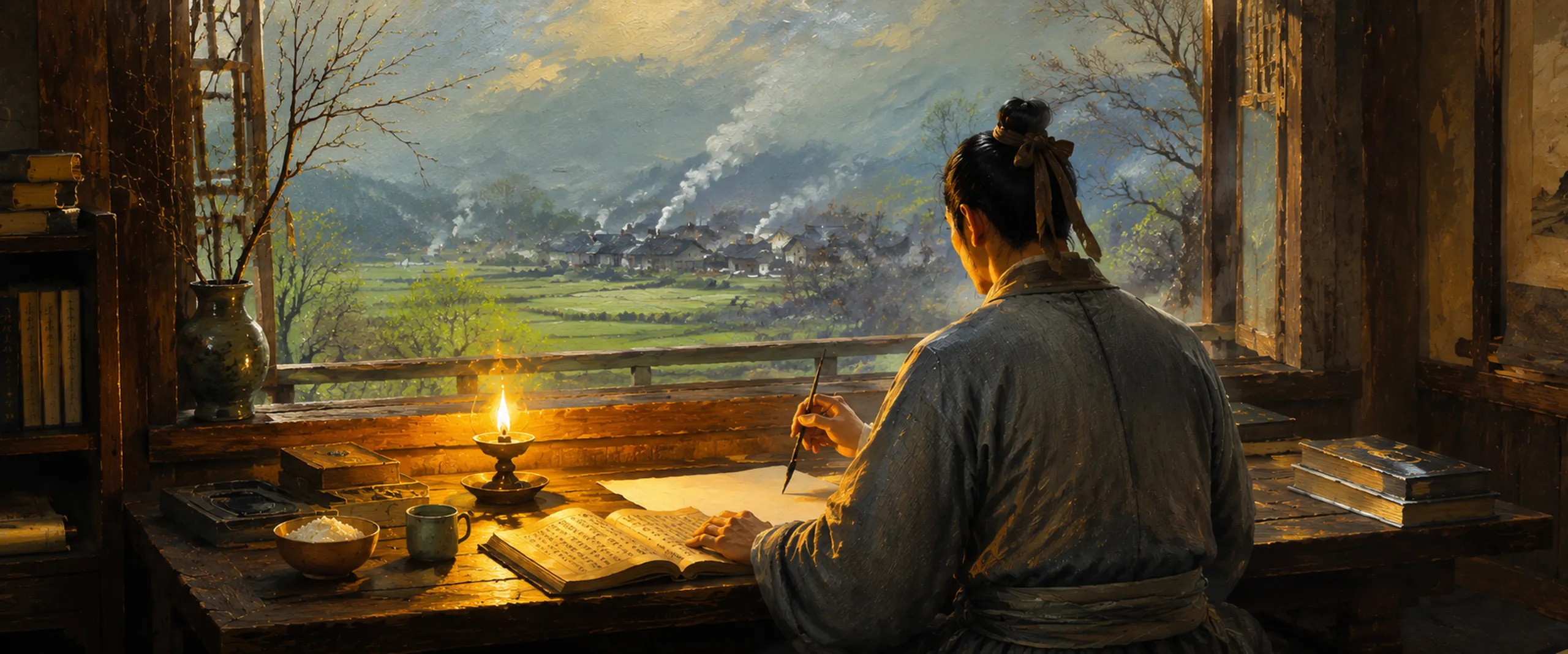
The opening immediately establishes both season and weather. “清明时节” gives the time; “雨纷纷” gives the weather. The word “纷纷” is especially subtle: it describes the dense, continuous spring rain while also suggesting the traveler’s disturbed and tangled state of mind. Qingming is already a season of grave-sweeping; the fine rain adds another layer of melancholy. This single reduplicated expression fuses the outward rain with inward feeling. In Jiangnan, Qingming weather is often overcast and filled with fine rain, troubling both travelers and those on their way to sweep graves. “纷纷” not only captures the character of “泼火雨” — rain falling around the Cold Food Festival, when the old custom required three days without fire — but also mirrors the mood of the person walking through it.
Du Mu’s Qingming (《清明》) is the most iconic of all Qingming poems: “清明时节雨纷纷,路上行人欲断魂。借问酒家何处有?牧童遥指杏花村。” What falls in ceaseless strands is not merely rain, but the traveler’s own drifting sorrow. Huang Tingjian’s Qingming (《清明》), “佳节清明桃李笑,野田荒冢只生愁。雷惊天地龙蛇蛰,雨足郊原草木柔,” contrasts blossoming peach and plum trees with desolate fields and abandoned graves, revealing the brevity and impermanence of life. Wu Weixin’s “梨花风起正清明,游子寻春半出城” captures the cheerful spirit of spring excursions at Qingming, while Jia Dao’s “晴风吹柳絮,新火起厨烟” reveals a more leisurely side of the season. Between sorrow and joy, Qingming poetry gives poetic expression to life and death.
Historical Development
From the Pre-Qin Era to the Northern and Southern Dynasties
The appearance of the term “Qingming” in poetry can be traced back to the Pre-Qin period. The Book of Songs · Daya · Daming (《诗经·大雅·大明》) already contains the line “肆伐大商,会朝清明,” though here “清明” refers to political order and clarity rather than to the solar term. In the Han dynasty, Wang Yi wrote in Jiusi · Shangshi (《九思·伤时》): “惟昊天兮昭灵,阳气发兮清明。风习习兮和煖,百草萌兮华荣。” Here “清明” has already become a description of climate—the rise of yang energy, clear weather, and the stirring of all living things. Xie Lingyun likewise wrote of the Qingming season in Poem on Entering the Eastern Road (《入东道路诗》): “属值清明节,荣华感和韶。陵隰繁绿杞,墟囿粲红桃。” It is Qingming: flowers and grasses flourish, and spring unfolds in radiant beauty.
By the Northern and Southern Dynasties, Qingming had become fixed in the calendrical system as a solar term. Yizhoushu · Zhouyue (《逸周书·周月》) records: “春三月中气:惊蛰,春分,清明。” At this stage, however, Qingming remained primarily a solar term and had not yet developed a complete system of festival customs. In poetry of the period, it more often appears simply as a marker of time.
The Tang Dynasty
The Tang dynasty was a crucial stage in the development of Qingming culture and also the great flourishing of Qingming poetry. By then, the Cold Food Festival and Qingming had become deeply intertwined. The imperial court designated Cold Food as an official holiday with seven days of leave. From palace to countryside, ancestral rites and spring outings became common practice. Blossoms drifting through imperial willows in Chang’an, paper money scattered among lonely graves in the countryside, and travelers journeying far from home all became subjects for poets.
Tang poets approached Qingming from many directions: some wrote the grandeur and prosperity of the capital, others the delicate emotions of travelers far from home. Han Hong’s Cold Food (《寒食》) depicts the springtime magnificence of Chang’an, and “春城无处不飞花” became an immortal line. Bai Juyi’s Cold Food: A Song While Looking Across the Fields (《寒食野望吟》) records, in a realistic mode, the grief of grave-sweeping and transmits with remarkable immediacy the Qingming emotions of ordinary people from a thousand years ago. Du Fu’s late Two Qingming Poems (《清明二首》) writes the pain of displacement amid Qingming spring scenery, merging personal fate with the turbulence of the age. Du Mu’s Qingming uses plain, unadorned description to sketch a rain-veiled Qingming and became the poem that has perhaps inspired the widest emotional recognition for centuries.
Tang Qingming poetry is as open and full-bodied as the larger spirit of the Tang itself. Whether writing spring in the capital, popular grave-sweeping, the sorrow of travel, or thoughts of family and country, the emotions arise directly from the heart. By using Qingming as a vessel for what they saw, heard, and genuinely felt, Tang poets gave Qingming verse from its very beginnings both the beauty of seasonal scenery and the depth of human feeling.
The Two Song Dynasties
After the beginning of the Song, the cultural preference for letters over martial pursuits fostered increasingly subtle emotional expression among literati, while the broader spread of culture carried Qingming customs deep into popular life. Grave-sweeping, spring outings, willow-wearing, and banqueting became activities shared across society. Compared with the broad and vigorous spirit of Tang poetry, Song writing on Qingming lost some of the majesty of a flourishing age and gained a clearer, gentler refinement. Qingming also became a vehicle through which poets contemplated life and death, voiced inward emotion, and described popular customs.
Song poets and lyricists blended mourning, reflections on life, and the warmth of everyday custom into their writing, moving Qingming poetry from “describing scenery and expressing emotion” toward “contemplating life,” and giving it a deeper spiritual core. Huang Tingjian’s Qingming uses contrast to set festival against abandoned grave, peach and plum blossoms against barren fields, placing the joy of life beside the weight of death and expressing a lament over human impermanence. Gao Zhu’s Drinking Wine on Qingming Day (《清明日对酒》), with the imagery “纸灰飞作白蝴蝶,泪血染成红杜鹃,” renders the grief of grave-sweeping with piercing vividness. Ouyang Xiu’s Caisangzi · West Lake Is Beautiful at Qingming and Shangsi (《采桑子·清明上巳西湖好》), by contrast, uses a lucid and graceful lyrical style to portray the bustling spring outings of West Lake during Qingming, revealing the festival’s joyful side.
Yuan, Ming, and Qing
By the Yuan, Ming, and Qing dynasties, Qingming customs had largely taken their enduring form: sweeping ancestral graves, honoring forebears, taking spring outings, wearing willow branches, and flying kites became established traditions. Although Qingming poetry no longer reached the dazzling heights of the Tang and Song, its creative lineage never ceased. Reflections born of dynastic change and the rich diversity of regional customs both left their marks on the Qingming verse of this period. Ming writer Wang Pan, in An Outing on Qingming Day (《清明日出游》), describes a colorful range of popular customs—spring excursions, swinging, cuju, polo, willow-wearing, and more. Qing Qingming poetry, while inheriting earlier traditions, placed greater emphasis on personal feeling and distinctive regional character.
Core Imagery
Recurring images in Qingming poetry form a distinctive “Qingming image system.” They are both literary expressions of Qingming customs and vessels for poetic emotion.
Spring Rain
Spring rain is the central natural image of Qingming poetry. The line “清明时节雨纷纷” has almost permanently defined the festival’s weather in the cultural imagination. Qingming rain is both a realistic portrayal of Jiangnan’s seasonal climate and a symbol of poetic sorrow. Du Mu uses “雨纷纷” to write Qingming’s misty melancholy; Bai Juyi uses “萧萧暮雨” to evoke the bleakness of the journey home after grave-sweeping; Huang Tingjian uses “雨足郊原草木柔” to write the life-giving energy of spring rain nourishing all things. The word “纷纷” in “雨纷纷” describes both the fine continuity of the rain and the traveler’s unsettled emotions. Rain has become almost a standard accompaniment to Qingming: it falls upon the graves, and it falls upon the heart.
Flying Blossoms
“春城无处不飞花” — through this line of Han Hong’s, “flying blossoms” became one of the most brilliant images in Qingming poetry. Drifting flowers mark late spring: peach and plum blossoms in bloom, pear petals falling, willow catkins floating through the air, together forming Qingming’s rich seasonal palette. Huang Tingjian’s “佳节清明桃李笑” personifies the vitality of spring through laughing peach and plum blossoms. Flying petals are both praise of spring and farewell to it—at the moment of fullest bloom, flowers begin to fall, just as life at its most radiant also stands closest to decline. Du Mu’s “杏花村” evokes apricot blossoms, which generally open around Qingming, bringing to Qingming sorrow the warm expectation of an “杏花烟雨江南” landscape.
Spirit Money and Flying Butterflies
“纸灰飞作白蝴蝶” from Gao Zhu’s Drinking Wine on Qingming Day is one of the most hauntingly beautiful images in Qingming poetry. Ash from burned spirit money rises and drifts through the air, which the poet compares to white butterflies. The image carries three layers of meaning. First, ash resembling butterflies is a visual metaphor. Second, butterflies in Chinese culture are often associated with dreams and illusion, as in Zhuang Zhou’s butterfly dream, suggesting the dreamlike nature of human life. Third, white butterflies fluttering around graves form, in themselves, a scene of poignant beauty. Bai Juyi’s “风吹旷野纸钱飞” depicts the same sight in a more restrained and direct mode: spirit money tumbling in the wind becomes one of the most immediate visual symbols of Qingming grave-sweeping.
Abandoned Graves and Spring Grass
Huang Tingjian’s “野田荒冢自生愁” and “雨足郊原草木柔” place the “sorrow” of abandoned graves beside the “tenderness” of growing vegetation. Bai Juyi’s “古墓垒垒春草绿” contrasts the piled “垒垒” of old graves with the fresh “green” of spring grass. Abandoned graves and spring grass form one of the most profound image pairings in Qingming poetry: one is the mark of death, the other proof of life; one points backward, the other toward the present; one evokes sorrow, the other joy. They coexist on the same earth, just as Qingming’s “grief” and “joy” coexist within the same festival.
Thematic Categories
Grave-Sweeping and Remembrance
Qingming is a festival of ancestral remembrance, and grave-sweeping and commemoration are therefore its most central poetic themes. Bai Juyi’s Cold Food: A Song While Looking Across the Fields uses realism to write the grief of grave-sweeping directly, transmitting the emotions of ordinary people from a thousand years ago with remarkable immediacy. Gao Zhu’s Drinking Wine on Qingming Day vividly depicts grave visits and mourning in the countryside—“南北山头多墓田,清明祭扫各纷然”. Du Fu’s Cold Food Song (《寒食行》) contains the line “三日无火烧纸钱,纸钱那得到黄泉”, recording Tang customs of Cold Food offerings and grave-sweeping. Against the background of Qingming, these poems express remembrance for the dead and reflection on the impermanence of life.
Spring Outings and Enjoying the Season
The other side of Qingming is the spring outing. Wu Weixin’s Scenes on the Su Causeway at Qingming writes the spectacle of people pouring out of the city with “梨花风起正清明,游子寻春半出城”. Wen Tingyun’s Qingming Day portrays a beautiful season of returning spring, gentle weather, bright sunshine, and renewed life. Ouyang Xiu’s Caisangzi · West Lake Is Beautiful at Qingming and Shangsi centers on “满目繁华”, depicting the bustling splendor of spring outings around West Lake. These works reveal Qingming’s joyful side: while remembering their ancestors, people also fully enjoy the vitality of spring.
Travel and Solitude
Du Mu’s Qingming stands at the summit of this theme. Traveling alone, the poet is moved by the fine rain of Qingming, and “路上行人欲断魂” gives voice to the loneliness and sorrow of being far from home. Meng Haoran’s Scenes at Qingming (《清明即事》) begins “帝里重清明,人心自愁思”, depicting loneliness even in the imperial capital, where inner sorrow cannot be suppressed. Bai Juyi’s Qingming Night (《清明夜》) writes of the poet walking alone through a winding corridor; though the festival is present, much of the feeling lies beyond the literal words. Against the setting of Qingming, these poems express the desolation and loneliness of travelers unable to reunite with family.
Rise and Fall, Reflection, and History
Du Fu’s late Two Qingming Poems writes the full pain of displacement amid Qingming spring scenery, merging personal fate with the turbulence of the age. Wei Zhuang’s Qingming in Chang’an (《长安清明》), with “内官初赐清明火,上相闲分白打钱”, describes the bustling Qingming atmosphere of Chang’an while quietly containing satire. Huang Tingjian’s Qingming ends with “贤愚千载知谁是,满眼蓬蒿共一丘”, expressing deep reflection on the rise and fall of history. These poems weave individual destiny into the circumstances of the age and move Qingming poetry beyond “describing scenery and expressing emotion” toward “contemplating history and life.”
Folk Songs
Qingming is not only a Han Chinese festival but also an important festival among many ethnic minority communities. Many minority peoples likewise maintain traditions of ancestral worship and spring outings during the Qingming season. In areas of Yunnan, Guizhou, Guangxi, and elsewhere where minority communities are concentrated, Qingming has absorbed distinctive ethnic characteristics. Zhuang, Miao, and other peoples hold ancestral rites during Qingming, and related songs have been transmitted orally for centuries. The “Poya Songbook” tradition in the Zhuang areas of Funing, Yunnan, also preserves ancient songs associated with ancestral remembrance and spring outings during Qingming. Although many of these orally transmitted songs were never recorded in writing, they have passed from generation to generation within minority festival life and, together with the written poetry of Han literati, form a fuller picture of Qingming culture within the Chinese nation.
Closing Reflections
Qingming poetry forms a distinctive and profound landscape within the treasury of Chinese verse. From Du Mu’s “清明时节雨纷纷” and its immortal evocation of Qingming, to Han Hong’s “春城无处不飞花” and the gracious splendor of the Tang; from Huang Tingjian’s “佳节清明桃李笑” and its philosophical questioning of life, to Gao Zhu’s “纸灰飞作白蝴蝶” and the piercing grief of grave-sweeping; from Wu Weixin’s “游子寻春半出城” to the free delight of spring outings—Qingming poetry has recorded, over a thousand years, the Chinese remembrance of the dead, love of spring, and contemplation of life.
Within these poems is the grief of grave-sweeping—“南北山头多墓田,清明祭扫各纷然”; the delight of spring outings—“梨花风起正清明,游子寻春半出城”; the sorrow of travel—“清明时节雨纷纷,路上行人欲断魂”; and philosophical reflection on life—“贤愚千载知谁是,满眼蓬蒿共一丘”. The meaning of Qingming poetry lies precisely in its ability to carry the sorrow of misty rain and the joy of spring wind from a thousand years ago into every succeeding age of Chinese life.
Qingming’s impression of “雨纷纷”, the emotional resonance of “欲断魂”, and the poetic imagination of “杏花村” have become inseparable parts of Chinese cultural memory. At the same time, the clear-eyed severity of “人生有酒须当醉,一滴何曾到九泉” allows Qingming grief to become more than grief, elevating it into a profound understanding of the nature of life. Qingming poetry is among the deepest and most enduring declarations Chinese people have made to death and life, a record of philosophical reflections on existence written in ink by generation after generation. In these poems, Qingming is both the solemnity of grave-sweeping and the joy of spring outings, both meditation on life and death and praise of spring. This distinctive quality of “哀而不伤、乐而不淫” is precisely why Qingming poetry has crossed a thousand years and still moves every reader.
—-
[Language: es]
Selected Poems
Selected Poems
清明
Tang Dynasty · Du Mu
清明时节雨纷纷,路上行人欲断魂。
借问酒家何处有,牧童遥指杏花村。
Background
Among all poems that depict Qingming, Du Mu’s Qingming is unquestionably the most widely circulated and profoundly influential. It could almost be called a synonym for the festival itself, a Qingming emblem known in nearly every household. The moment one hears “清明时节雨纷纷,” the atmosphere of Qingming seems permanently fixed: misty rain, lingering spring chill, travelers hurrying along the road. In 1990, the poem was selected by a Hong Kong cultural institution as the second-ranked work among the “Ten Best Tang Poems.” Du Mu (803–852), courtesy name Muzhi and literary name Fanchuan Jushi, was an outstanding poet and prose writer of the late Tang. Together with Li Shangyin, he was known as one of the “Little Li and Du.” The poem’s precise circumstances of composition can no longer be established, but judging from its description, Du Mu was likely traveling alone during Qingming when he encountered rain and was moved to write. In Jiangnan during Qingming, fine rain falls continuously. Traveling alone, the poet responds emotionally to the scene and creates this enduring masterpiece.
The poem uses no allusions and no obscure characters. Its language is plain as ordinary speech, yet it became the Qingming poem most deeply rooted in popular memory across the centuries. That is precisely its brilliance: with the simplest language, it gives voice to the most universal resonance.
Line-by-Line Reading
The travelers on the road seem overwhelmed by grief, their hearts heavy with sorrow. “断魂” is an exceptionally strong expression: this is not ordinary sadness or light melancholy, but a state in which the spirit itself seems lost. Why should a traveler be “断魂”? It may be grief after visiting a grave, loneliness from traveling far from home, or simply a sorrow impossible to dispel beneath the misty spring rain. The setting of “雨纷纷” and the inner state of “欲断魂” reinforce each other, together creating the distinctive emotional atmosphere of Qingming.
The poet asks a passerby where he might find an inn that serves wine. The line marks a turn: from immersion in sorrow toward an active search for relief. Wine here is not merely a drink but a medium through which grief may be eased. The poet hopes to use it to dispel the desolation and loneliness in his heart.
The shepherd boy does not answer in words; he simply points into the distance toward a village where apricot blossoms are in bloom. The gesture “遥指” captures both the child’s innocence and ease while leaving an open field for imagination. Apricot Blossom Village is not merely a place to buy wine but a poetic destination in itself—the image of “杏花春雨江南” naturally rises in the reader’s mind. In the end, the sorrow of Qingming is softened by a warm sense of expectation.
Overall Appreciation
This seven-character quatrain records what the poet sees in the spring rain of Qingming. Its language is entirely accessible, with no difficult word and no allusion, yet its atmosphere is profound and its aftertaste long. Structurally, the first line establishes setting, environment, and mood; the second introduces the figure of the traveler and reveals his confused, melancholy state; the third proposes a way to escape that mood; and the fourth answers through an action rather than speech, becoming the poem’s most memorable stroke.
The poem’s palette is restrained and its emotional atmosphere chilly. Its structure rises gradually from low to high, placing the final climax at the very end and leaving a distant, lingering resonance. The first two lines bring deep sorrow; the last two open a wide space for imagination. The shepherd boy’s gesture and the warmth associated with Apricot Blossom Village give this sorrow an added touch of human tenderness. Plain and easy to understand, yet profoundly suggestive, the poem embodies the Confucian artistic ideal of “哀而不伤,乐而不淫”. This is perhaps why, after a thousand years, it still moves readers so deeply: it expresses the most universal and profound Qingming emotion—hope surviving within sorrow, and warmth remaining within loneliness.
寒食
Tang Dynasty · Han Hong
春城无处不飞花,寒食东风御柳斜。
日暮汉宫传蜡烛,轻烟散入五侯家。
Background
Han Hong, courtesy name Junping, was one of the “Ten Talents of the Dali Era” in the Tang dynasty. This is his best-known representative work, describing Chang’an during the Cold Food Festival. Cold Food falls 105 days after the winter solstice, approximately one or two days before Qingming. The festival traditionally required a ban on fire: ordinary households were not permitted to light fires and could eat only cold food. In the Tang, old fires were extinguished for Cold Food, while new fire was kindled around Qingming, and the imperial court bestowed fresh fire upon ministers.
The poem’s background is closely connected with the political reality of eunuch domination after the mid-Tang period. The poet felt deep resentment toward this situation and used a Han-dynasty allusion to criticize contemporary abuses. Yet because the poem is written with such picturesque grace, it can also be understood as praising imperial favor, and it therefore received the admiration of Emperor Dezong of Tang. Qing scholar Wu Qiao commented: “唐之亡国,由于宦官握兵,实代宗授之以柄。此诗在德宗建中初,只‘五侯’二字见意,唐诗之通于《春秋》者也”.
Line-by-Line Reading
Everywhere in springtime Chang’an, fallen blossoms drift through the air. The double negative “无处不” strengthens the tone, giving the sense of flowers sweeping across the whole city in brilliant abundance. The line uses “无处” and “不” together to emphasize the vast spectacle of petals filling both imperial and ordinary spaces. It is a description of spring scenery, but also of the poised grandeur of the Tang capital.
The east wind of Cold Food blows through the willows in the imperial gardens, bending their branches gently in the spring air. The single word “斜” captures the posture of the willow branches with exquisite precision. The first two lines depict Chang’an in late spring: blossoms are written with “飞,” willows with “斜,” both strikingly exact. Amid a city filled with flying petals and imperial willows leaning in the wind, the graceful confidence of the Tang world seems to rise before the eyes.
At dusk, candles begin to be passed through the imperial palace. “汉宫” stands here for the Tang palace. Although fire was supposed to be forbidden during Cold Food, candles could still be burned at court. The verb “传” captures the orderly passing of candles through the palace and quietly suggests the majesty of imperial authority.
Thin smoke from the candles drifts into the homes of the powerful. “五侯” originally referred to five favored eunuchs whom Emperor Huan of Han enfeoffed as marquises on a single day; here it alludes to favored eunuchs and close retainers of the Tang court. Cold Food was supposed to prohibit fire, yet privileged eunuchs could receive special imperial fire. The poem does not attack them openly. It simply depicts the “ordinary life” of the privileged class, and its irony is therefore all the more subtle and penetrating.
Overall Appreciation
On the surface, this seven-character quatrain describes springtime Chang’an during Cold Food, but beneath it lies quiet satire. The poem first paints the city’s spring splendor in rich strokes—blossoms everywhere, imperial willows leaning in the wind, all the gracious fullness of Tang prosperity. It then turns to the detail of candles bestowed by the palace: while ordinary people are forbidden fire during Cold Food, privileged households receive new fire from the emperor. The lightest of touches thus carries a reflection on differences in social rank.
The poet uses “汉宫” to stand for the Tang palace and “五侯” to allude to eunuchs, borrowing Han-dynasty history to criticize the political abuses of his own time. Rather than openly attacking privilege, he merely depicts its “daily life,” making the irony restrained and ingenious. The poem’s brilliance lies in its capacity to sustain two readings at once. Read simply as landscape poetry, it is a beautiful spring scroll; read as satire, it becomes a sharp political critique. Both interpretations hold, and that is precisely Han Hong’s skill. Cold Food is also an important document for studying Tang festival customs, preserving evidence of the prohibition on fire during the Cold Food Festival.
清明
Song Dynasty · Huang Tingjian
佳节清明桃李笑,野田荒冢自生愁。
雷惊天地龙蛇蛰,雨足郊原草木柔。
人乞祭余骄妾妇,士甘焚死不公侯。
贤愚千载知谁是,满眼蓬蒿共一丘。
Background
Huang Tingjian (1045–1105), courtesy name Luzhi and literary name Shangu Daoren, was a celebrated Northern Song poet and calligrapher and the founder of the Jiangxi School of Poetry. Written during the Yuanfeng era of Emperor Shenzong, this poem takes Qingming as its subject and moves from scenery toward reflection, expressing a lament over the impermanence of human life. The poem makes extensive use of historical allusions, reflecting the Jiangxi School’s creative principle that “无一字无来处”. It combines vivid portrayals of Qingming nature with profound reflection on historical figures and the value of human choices.
Line-by-Line Reading
At Qingming, peach and plum blossoms open brilliantly as though laughing, while abandoned graves in the wild fields evoke sorrow. The couplet sets “桃李笑” against “荒冢愁”: the laughter of blossoms represents the vitality of spring, while the sorrow of abandoned graves embodies the silence of death. At Qingming, spring thunder rolls, fine rain continues, and all things awaken. Grasses spread across the earth, peach and plum trees blossom, and the world seems full of thriving life. Yet in barren fields lie the graves of the dead, awakening grief in the living.
Spring thunder shakes heaven and earth, waking “dragons and snakes,” here referring to animals emerging from winter dormancy; abundant rain nourishes the countryside, making grasses and trees tender and fresh. The couplet writes the natural world of Qingming—spring thunder stirring, all life awakening. The first line evokes thunder after Jingzhe; the second, Qingming spring rain, weaving the seasonal features of the solar terms directly into the poem.
Two allusions appear here. “人乞祭余” comes from Mencius · Lilou II (《孟子·离娄下》): a man of Qi begged leftover sacrificial food from graves each day, then returned home and boasted to his wife and concubine that he had been drinking with wealthy men. The story satirizes hypocrisy, flattery, and self-deception. “士甘焚死” comes from the story of Jie Zitui: when Duke Wen of Jin sought to summon him from seclusion, Jie would rather die in the flames than accept reward or title. The couplet places two radically different choices side by side—hypocrisy for wealth and honor versus death in defense of integrity.
After a thousand years, who can truly distinguish the wise from the foolish? In the end, all become a single mound covered with weeds. This is the poem’s decisive stroke. From Qingming grave-sweeping, the poet thinks of the man of Qi begging sacrificial leftovers in Mencius; from the Cold Food prohibition on fire, he recalls Jie Zitui’s death by burning. Wise or foolish, all eventually become a handful of earth. The brevity and impermanence of life are pushed here to their most extreme expression.
Overall Appreciation
Huang Tingjian’s Qingming uses contrast to express a profound sense of human impermanence. From grave-sweeping at Qingming, the poet thinks of wise and foolish figures in history; from the passage of history he arrives at the grave question “贤愚千载知谁是”. Structurally, the poem begins with the scene before the eyes—the contrast between festival and abandoned grave; moves to the energy of heaven and earth—the vitality of spring thunder and spring rain; then turns to historical figures—the beggar and the man who chose death; and ends with “蓬蒿共一丘,” where all returns ultimately to dust.
The poem draws on rich allusive material—“桃李笑,” “龙蛇蛰,” the man of Qi begging sacrificial leftovers, Jie Zitui dying in the flames—yet the allusions never obstruct the flow of feeling. Instead, they deepen the poem’s meaning. Qingming exemplifies Huang Tingjian’s characteristic style as a leader of the Jiangxi School: turning learning into poetry, argument into poetry, and fusing natural scenery, historical allusion, and philosophical reflection into one.
清明日对酒
Song Dynasty · Gao Zhu
南北山头多墓田,清明祭扫各纷然。
纸灰飞作白蝴蝶,泪血染成红杜鹃。
日落狐狸眠冢上,夜归儿女笑灯前。
人生有酒须当醉,一滴何曾到九泉。
Background
Gao Zhu (1170–1241), courtesy name Jiuwan and literary name Jujian, was a Southern Song jianghu poet. He never entered official service, traveled widely, and wrote in a clear, vigorous style. This poem takes Qingming grave-sweeping as its subject and vividly portrays mourning for the dead in the countryside. With a cool and unsentimental brush, the poet writes both the grief of ritual remembrance and the emptiness of human existence, giving the poem a distinctive place in Qingming literature.
Line-by-Line Reading
The hills to north and south are covered with grave fields, and during Qingming people arrive in crowds to sweep the tombs. “各纷然” captures the surging movement of mourners—not a handful of individuals but thousands upon thousands heading toward graves at the same time. It is a collective ritual shared across society, vast and disorderly.
Ash from burned spirit money swirls through the air like white butterflies; tears of grief and blood seem to dye the azaleas red. “White butterflies” and “red azaleas” are two hauntingly beautiful images: ash turning to butterflies is a visual metaphor, while blood-red tears staining flowers is an emotional exaggeration. Together they render the sorrow of grave-sweeping with striking immediacy.
After sunset, foxes sleep upon the graves; at night, children return home and laugh before the lamp. This is the poem’s most merciless contrast. Grief before the grave by day and laughter before the lamp by night unfold within the same day for the same people. Foxes sleep upon the tomb; children laugh beneath the light—the worlds of the living and the dead are so close, yet immeasurably far apart.
While alive, if there is wine, one should drink to intoxication, because not a single drop will ever reach the dead beneath the Nine Springs. This is the poem’s most penetrating statement. However sincerely the living make offerings, the dead can no longer enjoy them; however abundant the sacrifice, not one drop of wine truly reaches the underworld.
Overall Appreciation
Gao Zhu’s Drinking Wine on Qingming Day is among the most austere and clear-eyed Qingming poems of the Song. It contains vivid images of grave-sweeping—“纸灰飞作白蝴蝶,泪血染成红杜鹃”—and an equally profound revelation of existential emptiness—“人生有酒须当醉,一滴何曾到九泉”. The word “酒” encompasses everything life can offer, including material abundance and spiritual pleasure; the word “醉” vividly expresses the many joys of giving oneself fully to experience. While alive, one should cherish life and enjoy it with reason and intelligence. As for offerings and mourning for the dead, they are ultimately forms of consolation for the living and no longer carry any practical meaning for those who have died. The poem neither avoids the cruelty of death nor beautifies the significance of grave-sweeping. It looks directly at the truth of life with a cool, unsparing gaze.
寒食野望吟
Tang Dynasty · Bai Juyi
乌啼鹊噪昏乔木,清明寒食谁家哭。
风吹旷野纸钱飞,古墓垒垒春草绿。
棠梨花映白杨树,尽是死生别离处。
冥冥重泉哭不闻,萧萧暮雨人归去。
Background
Bai Juyi (772–846), courtesy name Letian and literary name Xiangshan Jushi, was one of the greatest realist poets of the Tang dynasty. This poem depicts countryside grave-sweeping during the Cold Food Festival, recording its grief in a direct realistic mode. The opening “乌啼鹊噪昏乔木,清明寒食谁家哭” immediately creates a desolate atmosphere through the cries of crows, carrying Qingming sorrow to an extreme. Images such as “乌啼鹊噪,” “纸钱飞,” and “古墓垒垒” together form a bleak scroll of Cold Food mourning. Bai Juyi’s poetry is consistently marked by concern for ordinary people’s suffering and reflection on the fundamental nature of life.
Line-by-Line Reading
Crows and magpies cry among darkened tall trees; during Qingming and Cold Food, whose family is weeping? The calls of the birds are already harsh and mournful, and against the dim background of “昏乔木” the desolation deepens further. The single word “哭” points directly to the theme of Qingming—grave-sweeping, mourning, remembrance.
Wind crosses the open fields, carrying spirit money through the air; ancient graves rise one after another, while spring grass has already turned green. Flying paper money belongs to present ritual; accumulated graves belong to the passage of time. Green spring grass is nature’s vitality; layered graves are the end of human life. Life and death coexist on the same open ground.
Blossoms of the wild pear shine against white poplar trees; everywhere here is a place of separation between life and death. Pale pear blossoms and tall poplars were common around burial grounds. In themselves they are ordinary features of nature, but in the poet’s writing they become witnesses to “死生别离处”.
Those beneath the Nine Springs cannot hear the cries of the living; in the evening rain, people eventually depart. This is the most moving part of the poem. However loud the crying, it cannot reach the dead; however long the mourning, there comes a moment when everyone must leave. “萧萧暮雨” deepens the desolation of departure, while “人归去” describes both a real scene and, more broadly, the final destination of human life.
Overall Appreciation
Cold Food: A Song While Looking Across the Fields writes the grief of grave-sweeping in a direct realistic mode. Crows calling, spirit money flying, abandoned graves stretching across the land, spring grass growing thick—only a few images are needed to make the desolation of separation between life and death vividly present, allowing later readers to glimpse the Qingming emotions of ordinary people a thousand years ago. The poet neither deliberately heightens sorrow nor pretends at philosophical detachment. He records the reality of grave-sweeping with an objective brush: “风吹旷野纸钱飞” is what he sees, “冥冥重泉哭不闻” what he feels. One is concrete, one inward; together they carry Qingming grief to its furthest point.
苏堤清明即事
Song Dynasty · Wu Weixin
梨花风起正清明,游子寻春半出城。
日暮笙歌收拾去,万株杨柳属流莺。
Background
Wu Weixin, courtesy name Zhongfu, was a poet of the late Southern Song. This poem portrays spring outings along the Su Causeway at West Lake during Qingming and reveals the festival’s tradition of taqing, or spring excursions. In the Song dynasty, grave-sweeping and ancestral remembrance existed naturally alongside outings into the spring landscape. People mourned their ancestors while also fully enjoying the vitality and beauty of the season.
Line-by-Line Reading
When pear blossoms begin to scatter in the wind, it is precisely Qingming. Pear trees bloom during the season, and their white petals drifting on the spring breeze are among the characteristic signs of late spring. The single word “正” marks the season with precision: this is exactly Qingming.
People leave the city in search of spring; half the city seems to have gone out. “半出城” emphasizes the extraordinary number of spring excursionists—not a few scattered individuals, but almost an entire city pouring outward. At Qingming, people leave their homes and travel to the outskirts to feel the presence of spring.
At dusk, the sounds of sheng pipes and singing gradually come to an end. The word “收拾” captures the entire transition from noise to quiet: daytime is filled with “笙歌,” while evening brings departure. Bustle yields to stillness, gathering to dispersal.
The ten thousand willows now belong to the orioles alone. Once the visitors pack up and leave, the countless willows along Su Causeway return to silence, with only orioles singing among the branches. By day there is a roar of human voices; by evening there is the gentle song of birds. The same landscape reveals entirely different faces at different hours.
Overall Appreciation
Scenes on the Su Causeway at Qingming is a rare joyful work among Qingming poems. It contains none of the sorrow so commonly associated with the festival, none of the grief of grave-sweeping—only the pleasure of spring excursions and the beauty of the season. The poem begins with “游子寻春” and ends with “万株杨柳属流莺,” moving naturally from human bustle to the stillness of nature. It also reveals another side of Qingming in the Song: the festival was not only a time for ancestral remembrance, but also a collective celebration of spring outings. Grave-sweeping and spring excursions are Qingming’s two major customary themes, and Wu Weixin gives the latter its most vivid poetic expression.
清明日
Tang Dynasty · Wen Tingyun
清娥画扇中,春树郁金红。
出犯繁花露,归穿弱柳风。
马骄偏避幰,鸡骇乍开笼。
柘弹何人发,黄鹂隔故宫。
Background
Wen Tingyun (c. 812–c. 870), originally named Qi and courtesy name Feiqing, was a celebrated Tang poet and lyricist and is regarded as a founding figure of the Huajian school of ci. This poem depicts a spring outing on Qingming Day, presenting a beautiful season in which spring has returned to the earth, the weather is mild and bright, and all life awakens. With a delicate brush, Wen Tingyun captures the day’s many details—the painted fans of beautiful women, dew on abundant blossoms, gentle wind among soft willow branches, proud horses in motion, startled chickens leaping from their cages—together forming a Qingming spring scene full of vitality.
Line-by-Line Reading
A beautiful woman appears within a painted fan, while spring trees grow lush and crimson yujin flowers—or flowers of a deep golden-red hue—bloom vividly. The couplet presents an exquisite picture in which person and flower, figure and painting, image and landscape merge into one.
On the way out, one brushes against morning dew on abundant flowers; returning home, one passes through the breeze among tender willow branches. “犯” captures the delicate sensation of petals and dew lightly touching the body, while “穿” conveys the softness and ease of moving between willow branches. The two lines form an exact parallel and render every detail of a Qingming spring outing with remarkable refinement.
A spirited horse runs proudly, swerving away from a carriage curtain; startled chickens suddenly burst from a cage. Through animal movement, the couplet gives the picture additional dynamism—the horse’s motion and the startled flight of the chickens fill the otherwise composed scene with life and energy.
Someone fires a pellet made from mulberry wood, while an oriole calls beyond the old palace—or palace wall. The poem ends with the sound of the pellet cutting through the air and the oriole’s song, bringing the sensory beauty of Qingming to its fullest expression.
Overall Appreciation
Wen Tingyun’s Qingming Day is one of the most finely wrought and delicately beautiful Qingming poems of the Tang. Every part of it writes spring scenery, every line evokes a spring outing, yet not a single word speaks of sorrow, grief, or grave-sweeping. The poem follows a distinct path, writing only “joy” and not “sorrow,” and forms an intriguing contrast with Du Mu’s Qingming. Wen Tingyun’s exquisitely detailed Huajian sensibility is fully evident here—the dew on blossoms, the breeze among tender willows, the proud motion of the horse, the startled leap of the chickens. Every detail is precisely caught and transformed into enduring verse.
Readers’ Comments
Calendar and traditional culture enthusiasts from around the world, sharing the same moon.
Sign in or register to join the conversation. Your comment account is created automatically the first time you use a connected account.
No comments yet
Share your thoughts with readers around the world.