Qingming Festival

Qingming FestivalGlobal Spread

「 南北山头多墓田,清明祭扫各纷然。 」

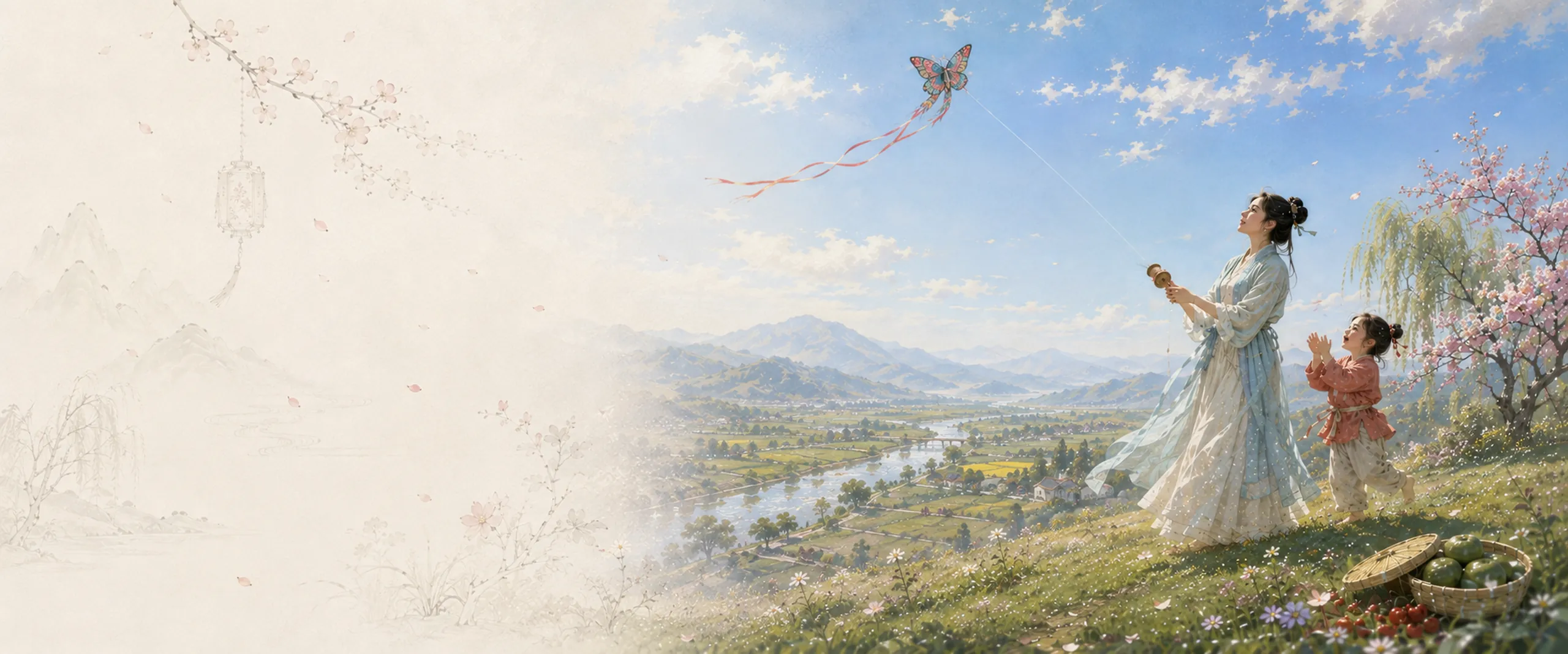
Qingming Festival has a history of over 2,500 years. Du Mu, in his poem “Qingming” (《清明》), wrote: “清明时节雨纷纷,路上行人欲断魂。” (*A drizzling rain falls during Qingming; travelers on the road are overcome with grief.*) The fine rain sets a…

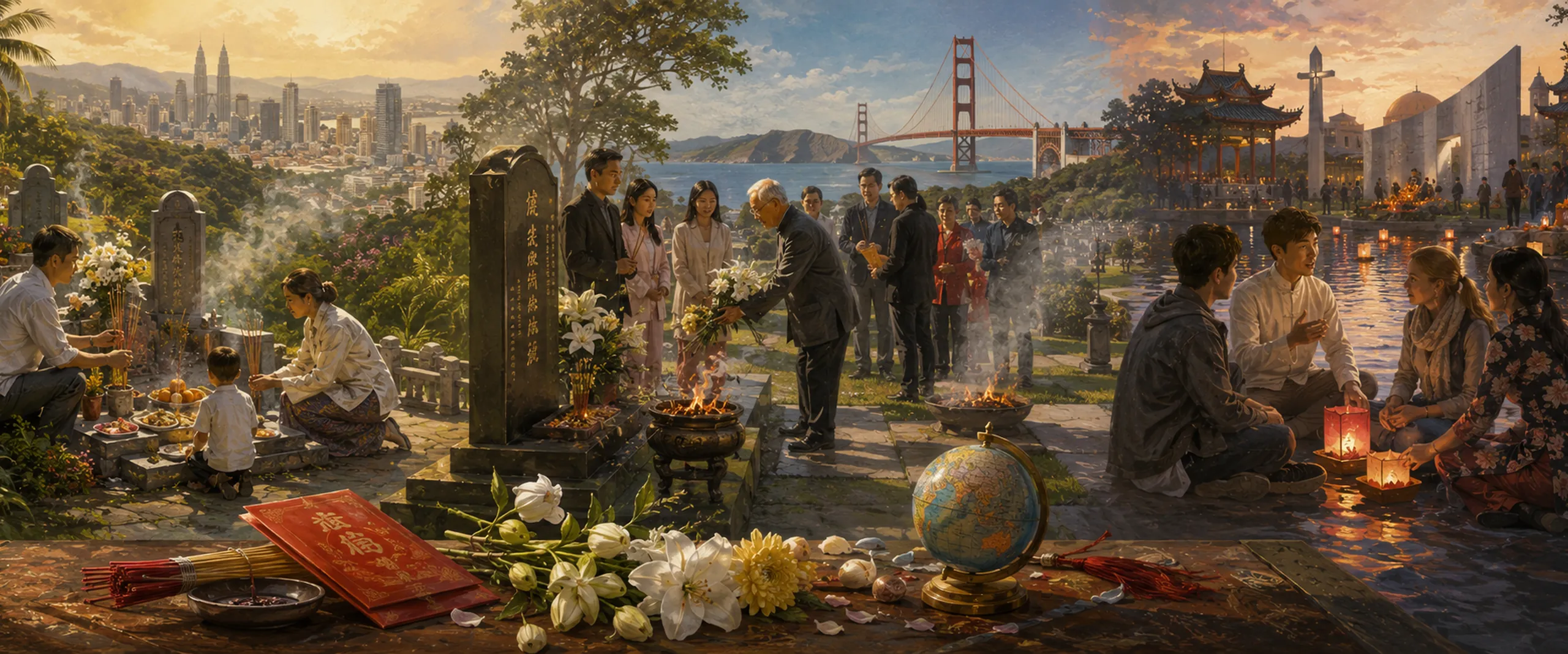
For overseas Chinese living far from their homeland, Qingming ancestor worship is not merely a ritual, but a “spiritual journey home.” During the Qingming Festival, Chinese communities in Southeast Asia honor their ancestors through tomb sweeping, the presentation of offerings, and other practices; while continuing traditional customs, these practices have also incorporated local characteristics. Chinese Indonesians begin buying joss paper, candles, flower baskets, and modern paper offerings such as “gold bars” and “mobile phones” as early as a week before Qingming, believing that Qingming is not only a time to sweep ancestral graves and pay respects to the departed, but also a day for brothers and sisters to reunite. The Fujian Association of Cambodia holds Qingming ancestor-worship activities every year—for Fujianese living overseas, Qingming is not merely a ritual for commemorating their ancestors, but also a continuation of their cultural roots. Through tomb-sweeping activities, younger generations are able to gain a deeper understanding of their ancestral hometowns, family histories, and traditional customs. “No matter how far one travels, one’s roots remain here.” Qingming is precisely a moment for awakening memory, allowing those living far from home to return spiritually to their roots through remembrance of their ancestors.

Qingming Festival / Global Spread

Celebrated Worldwide

Regional Highlights
01

The Americas

United States

The United States is one of the countries with the largest populations of Chinese immigrants in the world. Although Qingming is not a federal public holiday, ancestor-worship activities during Qingming have become one of the most important annual cultural activities for Chinese communities in cities with large Chinese populations, including New York, San Francisco, Los Angeles, and Chicago. Unlike the celebratory atmosphere of the Spring Festival, Qingming activities in the United States carry a deeper historical weight—not only commemorating family ancestors, but also preserving the collective memory of early Chinese immigrants who endured hardship and opened new paths in a new continent.

##### Baltimore

Baltimore is the American city where the first recorded arrival of a Chinese immigrant took place, and more than 200 years have passed since the first Chinese person set foot in the city. On April 5, 2025, Baltimore’s Chinese community held a Qingming public memorial at Lorraine Park Cemetery. Organized by descendants of an older generation of Chinese immigrants, the event was attended by about 100 people. Notably, not all participants had traditionally East Asian features—some descendants of early Chinese immigrants have fully integrated into local society, yet they still return to their ancestors’ graves during Qingming. A representative from the Office of the Governor of Maryland also attended the event.

Offerings included flowers, food, wine, incense, and joss paper. The food offerings were especially symbolic—chicken, fish, and pork represented animals of the sky, sea, and land respectively. About 200 members of an older generation of Chinese immigrants from the Baltimore area are buried in the cemetery. Some gravestones bear English names, while others bear Chinese names—the characters “王,” “吴,” and “广东台山” remain clearly visible. Many years ago, young men from Guangdong came to Baltimore in search of a better life and sent their hard-earned money back to their hometowns. At first, they could only be buried in one corner of the cemetery; later, a community leader purchased additional burial plots for Chinese residents. A memorial was erected there, providing later generations with a place to honor their ancestors and continue the tradition.

One moving story was shared at the event: Mr. Liu, a retired Baltimore police officer, often visits the cemetery to pay respects. During a trip to Beijing one year, he met a friend who mentioned that a relative had once lived and died in Baltimore. Through investigation, Mr. Liu eventually found that relative’s name on a gravestone. The story offered a profound reminder of the close ties within Chinese immigrant communities across time and space.

An organizer reflected on the meaning of Qingming: “Our ancestors were known for many admirable qualities, including intelligence, courage, diligence, and perseverance. Yet I believe one quality stands out above all others: ‘sacrifice.’ Whatever their social status, our ancestors made tremendous sacrifices for their families, giving up their own enjoyment and comfort simply to ensure a better future for their children. This spirit of sacrifice remains at the heart of our culture today.” New immigrant parents continue this spirit of sacrifice—working tirelessly to provide their children with the best education and often giving up their own personal time and enjoyment.

##### Salem

The Qingming memorial activities in Salem, Oregon, are one of the most distinctly “municipal” examples in North America. On April 5, 2025, Salem municipal officials held a Qingming memorial ceremony at Pioneer Cemetery according to Chinese tradition, commemorating 122 Chinese ancestors buried there who had made outstanding contributions to the city’s early development and construction. Salem Mayor Julie Hoy attended in person, proclaimed April 5 “Qingming Festival Day in the City of Salem,” and personally cleaned the altar dedicated to the Chinese pioneers.

The ceremony has continued for many years since it was first held in 2018. The city’s Historic Landmarks Commission has established permanent markers at the former Chinatown site, Pioneer Cemetery, downtown, and other locations, presenting to the public the contributions of Chinese pioneers to Salem’s historical development. The mayor compared the seven-year development of the project to “good seeds, good soil, sunlight, and water.” Students from Willamette University recited classical poems such as 《清明》 in Chinese and performed traditional music. Nearly 100 people attended, including descendants of Chinese pioneers, renowned writers, archaeologists, and representatives of multiple overseas Chinese organizations.

##### Chicago

The Chinese Consolidated Benevolent Association of Chicago was founded more than 130 years ago and has witnessed generations of Chinese people building their lives in a foreign land. On March 23, 2026, the association went to the Chinese cemetery in the suburbs of Chicago to hold a Qingming ancestor-worship ceremony. The ritual followed traditional rites: participants offered incense and wine in sequence and performed three bows. Chen Dawei, chairman of the Chinese Consolidated Benevolent Association of Chicago, said that holding the Qingming ancestor ceremony every year is not only a way to remember those who came before, but also a reminder to later generations not to forget their origins and to carry forward the hardworking spirit of the early Chinese pioneers. Lei Qi, director of the Chinese Culture and Education Center in Chicago, said that the spirit of honoring the departed and remembering distant ancestors carries even greater symbolic significance overseas in uniting the Chinese community and connecting it with its culture.

##### San Francisco Bay Area

On April 12, 2026, the third San Francisco Bay Area Chinese “Tracing Roots and Honoring Ancestors · Blessings for Future Generations” trans-Pacific memorial ceremony was solemnly held at Golden Gate Cemetery. Jointly organized by the North American San Francisco International Ladies Charity Alliance and the San Mateo Metropolitan Lions Club, the event included candle offerings across the ocean, a collective Taoist blessing and memorial ritual, presentations on traditional Chinese culture, and unified incense offerings by guests. The ceremony opened to the gentle yet mournful sound of a violin and piano duet. Several guests shared reflections on commemorating life and transmitting culture. The conviction conveyed by the ceremony was: “Never forget where you came from; never lose your original heart.”

##### New Jersey

On April 11, 2026, the United Chinese Association of New Jersey organized Chinese residents of the state to gather before the gravestone of Chinese railroad workers in the cemetery of the Dutch Reformed Church in Belleville, New Jersey, for the annual memorial ceremony honoring the first group of Chinese laborers in the eastern United States. More than 150 years ago, some Chinese laborers who had participated in the construction of American railroads moved to New Jersey and received shelter from the Dutch Reformed Church in Belleville. The remains of 68 Chinese laborers were buried in the church cemetery. In 2019, the late chairman Lin Jiehui led the association in erecting a memorial stone there.

At the event, Dr. Wang Jian performed the song 《地下室的碑文》, written especially for the Chinese laborers by Liu Youjun, former president of the Livingston Chinese Association. Hu Shiyuan, the new chairman of the United Chinese Association of New Jersey, reviewed the process of establishing the memorial. Representatives from different sectors said that commemorating the pioneers is not merely about remembrance and gratitude, but also a source of spiritual encouragement.

##### New York

In New York, Wenzhou people living in the United States have a distinctive way of continuing tradition—their hometown association organizes collective visits to cemeteries to honor their ancestors. Every Qingming, the American Wenzhou Association organizes collective tomb sweeping at Rose Cemetery and Geely Cemetery in New Jersey. Both cemeteries contain “auspicious burial grounds” purchased by the association, providing resting places for elderly fellow townspeople who died without being able to afford burial plots, as well as for predecessors who made outstanding contributions to the association. Association president Wang Chongzhang said: “Every year we come to sweep graves during Qingming not only to remember those who came before us, but also to express our respect for and appreciation of the bonds among people from the same hometown.”

At the same time, many Chinese families continue the tradition of visiting graves individually. One Chinese woman whose entire family had moved from New York to Texas many years earlier flew back to New York specifically to visit her father’s grave. She said: “I must come back to sweep my father’s grave during Qingming… so that the children born and raised here can see their parents’ commitment to Chinese traditional customs.”

Maple Grove Cemetery in New York City receives large numbers of Chinese visitors for tomb sweeping every year. Fo Guang Shan New York Buddhist Temple also went to Maple Grove Cemetery on April 9, 2025, to hold a Qingming memorial Dharma service, the first time in 14 years that the New York temple had once again worked with the cemetery to hold such a service. Chinese communities in Los Angeles likewise carried out ancestor worship and tomb-sweeping activities during Qingming, while cemeteries introduced crowd-control measures to cope with peak visitor numbers.

Zhao Wensheng, chairman of the Chinese Consolidated Benevolent Association of New York, said that the purpose of Qingming commemorative activities is “to ensure that we and the next generation do not forget the traditions of our own people, and to remember that without the arduous pioneering work of those who came before us, Chinese Americans would not have achieved what we have today.”

Canada

Canada likewise has a large Chinese community. Qingming memorial activities use monuments to early Chinese pioneers as spiritual landmarks, creating solemn and dignified collective rituals. Multiculturalism is a national policy in Canada, and government officials and legislators at different levels actively participate in Qingming activities, giving the festival official cultural recognition in Canada.

##### Toronto

Toronto is the Canadian city where Qingming memorial activities are most concentrated. Every April 5, the Chinese Consolidated Benevolent Association of Ontario and the Toronto Lin Jiumu Association jointly hold a “Qingming Memorial Ceremony for Early Chinese Pioneers” before the Chinese Pioneers Memorial at Mount Pleasant Cemetery in Toronto. Through rituals including laying flowers, offering incense, pouring libations, and presenting offerings, the ceremony commemorates early Chinese pioneers, embodies the principle of honoring the departed and remembering distant ancestors, and strengthens solidarity among overseas Chinese associations.

The director of the Toronto office serves as chief officiant and leads participants in three bows, paying the highest respect to generations of Chinese pioneers and remembering the arduous struggles through which they opened new paths. Lin Shurong, co-chairman of the Chinese Consolidated Benevolent Association of Ontario, reviewed the background to the monument’s establishment—many early single Chinese immigrants in Canada had no one to rely on, and their funerals were often handled by the association’s charitable burial group. As times changed, funds accumulated through years of charitable burials, together with donations from the Chinese community, were used in 1990 to build the “Ontario Memorial to Generations of Chinese Pioneers.” He emphasized that early Chinese crossed the ocean to Canada, endured immense hardship, and participated in the construction of the Pacific Railway, laying a solid foundation for later Chinese communities.

##### Victoria

The Chinese Cemetery in Victoria has been designated a National Historic Site of Canada. On April 5, 2026, the Victoria Chinese community held its Qingming spring memorial ceremony there. The director of the Vancouver office served as chief officiant, and the ceremony was solemn and grand. A number of traditional Chinese associations in Victoria participated, including the Lee Benevolent Association, the Wong Clan Association, and the Chinese Consolidated Benevolent Association. An overseas Chinese affairs advisory committee member over 90 years old, who was extremely familiar with the local Chinese community, also attended in person.

##### Nanaimo

In Nanaimo, Canada, the Nanaimo Hongmen organization and the Nanaimo Chinese Association continue the Chinese tradition of honoring the departed and remembering distant ancestors by organizing Qingming ancestor-worship activities, allowing Chinese culture to continue flourishing and to be passed down from generation to generation in the Nanaimo region.

##### British Columbia

On Qingming Day in 2025, British Columbia Premier David Eby issued a Qingming statement, saying, “We join everyone in remembering the lives of beloved family members and friends.” British Columbia MLA Teresa Wat also called in the provincial legislature for tribute to be paid to early Chinese pioneers during Qingming, saying: “Qingming is a tradition passed down from generation to generation, carrying remembrance and respect.” This official recognition from the provincial government has given Qingming a mainstream cultural standing in Canada that extends beyond the Chinese community.

Latin America

Although the number of Chinese immigrants in Latin America is smaller than in North America, Qingming traditions remain deeply rooted in countries including Peru, Mexico, and Cuba. Panama has one of the “world’s three great Chinatowns,” and Qingming ancestor worship there has formed a distinctive integration with local Catholic culture—some Chinese families, after honoring their ancestors during Qingming, also go to church to have Mass said for the deceased. Havana’s Chinese Cemetery in Cuba is one of the largest Chinese cemeteries in the Western Hemisphere; every Qingming, Chinese associations in Cuba hold public memorial activities there to commemorate early Chinese pioneers. The Chinese community in Lima, Peru, retains the tradition of Qingming tomb sweeping, combining Chinese-style offerings with local ingredients and creating distinctive Qingming food customs with something of a “Peruvian New Year flavor.”

02

Asia

Malaysia

Chinese people make up a relatively large proportion of Malaysia’s population. Although Qingming is not a public holiday, Chinese Malaysians continue to sweep graves and honor their ancestors. Public Chinese cemeteries are generally known as “义山”, and local people therefore often say that Qingming means “going up the hill to sweep graves” or simply “拜山”. On Qingming Day, worshippers first clean the graves, then arrange flowers, fruit, and other offerings before lighting incense. According to local custom, before sweeping the grave one must first worship the local Earth God—Datuk Gong.

The Chinese community in Kuching, Sarawak, retains strong Qingming customs. One or two weeks before Qingming, many families already begin visiting the “义山” to sweep graves and honor their ancestors. Unlike the large extended-family collective worship common in China, Chinese families in Kuching are more inclined to arrange their own time for ancestor worship. Offerings generally include incense and candles, gold and silver paper effigies, fruit, flowers, fa gao, tea, wine, a whole chicken, pork, and other items. After tomb sweeping, there is also a custom of bathing with mugwort leaves. Twenty-two-year-old Chinese Malaysian Yang Qianwei believes that Qingming carries profound cultural meaning and that young people are willing to continue the tradition.

Chinese Malaysians also use the term “古清明”—some local Fujianese or Teochew people call the third day of the third lunar month “古清明” or “老清明,” traditionally a day for sweeping graves and honoring ancestors. In recent years, more and more families have chosen to arrange tomb sweeping flexibly within about ten days before or after the actual festival date, both to avoid crowds and traffic congestion and to make it easier to coordinate family members’ schedules. Around one week before Qingming, crowds already begin appearing at the various 义山 and Chinese cemeteries.

Singapore

Chinese Singaporeans still sweep graves according to traditional rituals. Every Qingming, entire families go out together, placing wine, food, fruit, and flowers before the graves of their loved ones, lighting incense and candles, burning joss paper, and performing kowtows and formal bows. Qingming has become a day of family reunion for Chinese Singaporeans.

However, as urbanization has reduced the amount of cemetery land and cremation has become increasingly common, many people now pay respects to their ancestors at columbaria instead. Spring memorial ceremonies are often held at Mandai Cemetery and Choa Chu Kang Cemetery. Some families also prepare vegetarian offerings when honoring ancestors at temples. Certain Singaporean clan associations have a distinctive custom of using lion dances in ancestor worship—the Hok San Association’s lion-dance ancestor-worship tradition can be traced back to 1920.

Thailand

Although Qingming is not a public holiday in Thailand, Chinese families still visit graves on weekends around the festival. A Chinese “义山” outside Hat Yai in Songkhla Province is an important site for local Chinese Qingming worship. The ancestors buried in this cemetery were basically all from Guangdong, with Meizhou being the most common place of origin. Upon entering the cemetery, visitors first burn incense before the “Cemetery for Chinese in Thailand” monument to honor the earliest Chinese arrivals in Thailand, and only afterward pay respects to their own ancestors.

Li Keke, deputy president of Sing Sian Yer Pao in Thailand, noted that early Guangdong migrants to Thailand, especially the Chaoshan community, not only preserved Qingming customs in their entirety, but also deeply rooted the essence of Lingnan culture there. The most representative sight during Qingming is undoubtedly the golden, crisp roast suckling pig on the offering table. This classic Cantonese dish has transcended its meaning as mere food and become an important symbol of cultural identity. To respond to the impact of modernization, Chinese communities in Thailand have gradually begun using electronic candles in place of traditional candles or simplifying certain ritual procedures during Qingming tomb sweeping.

Indonesia

During Qingming, Chinese communities in Indonesia experience a “return-home wave” as people travel back to their ancestral hometowns in China to sweep graves. They present the “three sacrificial animals,” pastries and fruit, burn incense and joss paper, perform kneeling rituals, and make “Qingming cakes,” while community organizations hold “spring memorials” or “grand ancestor-worship ceremonies.” In 2018, the Indonesian Chinese Surname Association and various clan associations jointly held a grand Qingming ceremony to honor ancestors.

Cambodia

For people from Minnan living in Cambodia, Qingming is one of the most important traditional festivals of the overseas Chinese community. Despite living abroad, members of the community continue to preserve the fine customs of their hometowns in their entirety, regarding Qingming as an important moment for remembering their predecessors and reuniting with family. On April 5, 2026, following a long-standing practice, the Fujian Association of Cambodia called on both newer and long-established Fujianese residents in Cambodia to gather at the Fujian cemetery and jointly carry out Qingming tomb sweeping and ancestor worship. During the ceremony, each family presented roast pork, chicken and duck, fruit, pastries, tea and wine, gold and silver joss paper, as well as distinctive traditional Minnan foods. After the worship ceremony, association directors and community members shared a meal in the cemetery pavilion, sitting together to eat runbing and drink fragrant tea. This scene of gathering for a meal and conversation after tomb sweeping has become a highly distinctive Qingming cultural landscape within Cambodia’s Minnan Chinese community.

Japan

The evolution of Japan’s Qingming Festival (Old New Year) is one of the most distinctive and precious branches in the entire East Asian lineage.

In mainland Japan, “Qingming” is not regarded as a festival of worship, but merely as the name of a seasonal period. Okinawa, however, is an exception—Okinawa is the only region in Japan where traditions of the Lunar New Year and Qingming are preserved on a large scale. Influenced by China, the kings of the ancient Ryukyu Kingdom placed great importance on Qingming and called Qingming activities “清明祭,” pronounced “シーミー” in the Okinawan dialect.

The Qingming memorial is one of Okinawa’s three major festivals. Every spring, Qingming memorial ceremonies are held throughout Okinawa. It is an important custom in which family members and relatives gather before ancestral graves to express gratitude to their ancestors. During this period, Okinawans gather together to offer incense and flowers to deceased relatives and present “重箱料理.”

Okinawa’s Qingming memorial has one particularly distinctive custom—families spread mats in front of the grave and hold a “picnic.” This practice, which combines solemn ancestor worship with a warm family meal, belongs to the same cultural lineage as the tradition of “eating together after tomb sweeping” in Fujian, Guangdong, and other regions, yet no comparable custom can be found in mainland Japan. Okinawan tombs also differ from those elsewhere—they are especially large. On the Japanese mainland, people often regard cemeteries with some apprehension, but Okinawans do not.

Okinawa’s Qingming memorial is a living witness to the thousand-year transmission of Chinese culture through the Ryukyu Islands. When mainland Japan fully adopted the Gregorian calendar after the Meiji Restoration and gradually moved away from lunar-calendar festivals, Okinawa tenaciously preserved this cultural gene from China. Every Qingming, Okinawans working in different places return to their hometowns and gather together—the logic of this “return home” is emotionally identical to that of Chinese people returning home during Qingming to honor their ancestors.

South Korea

South Korea has likewise been deeply influenced by Chinese culture and possesses memorial traditions similar to Qingming. Korea has belonged to the Chinese cultural sphere since ancient times, and this festival likewise originated in China. Qingming in Korea falls on April 5 of the Gregorian calendar, although Qingming is not a statutory holiday in South Korea.

Unlike the Chinese custom of burning joss paper, Koreans prefer to honor their ancestors with fresh flowers, placing flowers at graves during tomb sweeping to express remembrance of the deceased. Orchids are their first choice and represent nobility and elegance in the Korean mind. Because of concerns about forest fires, Koreans do not burn joss paper when honoring ancestors. According to Korean custom, renovating the graves of one’s ancestors or deceased relatives is an important part of Qingming—the family goes to the cemetery together to remove weeds and solemnly arranges offerings such as wine, fruit, and mugwort rice cakes before the grave. The wine used among the offerings is not baijiu, but Korean rice wine.

In South Korea, Hansik is closely connected with Qingming. Many Koreans sweep graves and honor their ancestors on Hansik. On that day, Koreans place new turf on old graves, a practice known as “改莎草.” During the Goryeo period, numerous Chinese-language poems describing Hansik and Qingming customs already appeared, showing a close connection with Chinese culture. Korean memorial rites are broadly divided into ancestral sacrifice and tea rites.

Vietnam

Chinese communities in Vietnam have the custom of celebrating a “Tangyuan Festival” during Qingming. This custom combines the ancestor-worship tradition of the Chinese Qingming Festival with local Vietnamese food culture, forming a distinctive cultural expression.

03

Europe

France

Qingming commemorative activities in France possess a historical depth unmatched by those of other regions.

The Noyelles-sur-Mer Chinese Labour Corps Cemetery in the Somme department of northern France is the largest memorial cemetery in Europe dedicated to Chinese laborers of the First World War. Between 842 and 884 Chinese laborers who died during the war are buried there. Of the Chinese laborers, 20,000 remained forever on this land; at present, only 1,589 are recorded as having been buried separately in 24 cemeteries, with most of their remains interred at the Noyelles Chinese Labour Corps Cemetery.

Around Qingming every year, overseas Chinese living in France travel to the Noyelles Chinese Labour Corps Cemetery to pay respects. During Qingming in 2026, Chinese communities from different sectors across Europe held a tomb-sweeping ceremony there. Before the event began, the national anthems of China, France, and the United Kingdom were played, followed by a one-minute silence. Representatives from China, France, and the United Kingdom, together with representatives of overseas Chinese and student communities in France, solemnly paid tribute to the Chinese laborers resting there.

In 1983, Mr. Ding Weixing led Chinese people to the cemetery for the first time to lay flowers for Chinese laborers buried in France. In the more than 40 years since then, the tradition has never been interrupted. Chinese residents of Paris also organize groups during Qingming to visit the graves of Chinese laborers from the First World War. Some elderly people bring their grandchildren with them to honor their ancestors and tell stories of the hardships endured by earlier generations of immigrants in building their lives. Xu Dayu, president of the Association of Chinese Veterans of the French Foreign Legion, is one of the organizers of the commemorative activities. These memorials are not only a remembrance of the dead, but also historical testimony to the contribution of Chinese people to world civilization. As one overseas Chinese community leader said: “These gravestones engraved with Chinese names prove the contribution of Chinese people to France and Britain, prove the contribution of Chinese people to the First World War, and prove that Chinese people have never been absent from the development of world civilization.”

On the eve of Qingming in 2025, the Noyelles Chinese Labour Corps Cemetery also held its first collective burial ceremony. Cai Junzhu, chairman of a French overseas Chinese association who participated in the event, said that the historical contributions of the Chinese laborers cannot be erased, and expressed the hope that similar activities would allow more people to understand this history and pass on its spirit.

Germany

In Germany, the Hamburg Chinese Association, as in previous years, solemnly held an event on Qingming Day to honor early Chinese pioneers, traveling to the Hamburg Chinese Cemetery to lay flowers and pay tribute. Chinese associations in other German cities likewise organize memorial activities during Qingming.

United Kingdom

In the United Kingdom, because the graves of most overseas Chinese ancestors remain in China, many Chinese residents who do not return home during Qingming find it difficult to visit the graves of their ancestors in person. With each Qingming, homesickness grows stronger. Many elderly overseas Chinese who have lived in Britain for years say that they still preserve customs such as offering incense and bowing at home. Some overseas Chinese households set up dedicated ancestral altars in a corner of a room. One community member said: “Rather than thinking of it simply as Qingming, I prefer to see it as a family gathering second only to Lunar New Year’s Eve.”

During Qingming, Chinese associations across the United Kingdom also organize collective memorial activities, providing a shared place of remembrance for those unable to return to their hometowns.

Italy

In Italy, during Qingming, the Buddhist hall of Puhua Temple specially invites eminent monks to conduct Dharma ceremonies, providing a religious venue for Chinese people who cannot return home to honor their ancestors and fulfill their vows. People worship their ancestors in the Buddhist hall and pray for an early economic recovery and for happiness in the lives of their relatives back home.

04

Oceania

Australia

Qingming commemorative activities in Australia have a distinctive historical background—the gold rush of the 1850s attracted large numbers of Chinese laborers who crossed the ocean to Australia. Australian Chinese mainly honor their ancestors in three ways: first, by “拜山,” which requires worship of “后土”; second, by going to a temple, which requires preparing an “衣包袋”; and third, by worshipping ancestral tablets at home. If one’s ancestors are not in Australia, local worship requires writing a “路票.” An incense-and-candle shop in Sydney has operated for 30 years, and its owner hopes that the tradition of ancestor worship can be passed down from generation to generation.

On Qingming Day, April 4, 2025, the Australian Chinese Workers’ Union held a memorial ceremony at Liufu Cemetery in Sydney for Chinese people who died during the gold rush. The ceremony followed traditional Chinese rites and included solemn stages such as offering incense, lighting candles, presenting flowers, offering tea, and performing three bows. The following year, the Australian Chinese Workers’ Union held the “Ninth Anniversary Memorial for Chinese Victims of the Australian Gold Rush” at Sydney Metropolitan Memorial Cemetery, jointly commemorating Chinese laborers who died during the Australian gold rush of the 1850s.

In Melbourne, the Hung League’s Minzhi Party organized Qingming memorial activities for early Chinese pioneers, visiting Chinese pioneer graves at former gold-mining sites to hold traditional worship ceremonies, remember those who came before, and inspire later generations.

Sydney’s Springvale Evergreen Cemetery attaches great importance to Qingming and holds various commemorative ceremonies every year, promoting and encouraging diversity within Australia’s Chinese community. Members of the younger Chinese generation have said: “Every year, there should always be one moment reserved for those who have passed away.”

New Zealand

In New Zealand, Qingming is likewise highly valued by the Chinese community. On April 6, 2025, the Tzu Chi Humanities School held a special “Cultural Heritage Day” event in Sydney. The event skillfully combined the traditions of Easter and Qingming, aiming to educate children about cultural heritage through interactive activities. Teachers guided the children in learning more deeply about Qingming traditions and characteristic foods, as well as the origins of the Hanshi Festival and the historical stories behind it.

Global Public Memorial Ceremony for the Yellow Emperor Xuanyuan

In-Depth Feature

The public memorial ceremony for the Yellow Emperor Xuanyuan during Qingming is a shared cultural event for Chinese people around the world, and also the most cohesive ritual in the overseas spread of the Qingming Festival.

On the morning of April 4, 2025, the global bilingual livestream of “中华大祭祖——乙巳(2025)年清明公祭轩辕黄帝” was solemnly launched at the Qiaoshan ceremonial square in Huangling County, Yan’an, Shaanxi Province. Through a global bilingual livestream, the Qingming public memorial presented to audiences in China and abroad the traditional Chinese virtues of honoring the departed, remembering distant ancestors, respecting one’s forebears, and reverently offering tribute to them. The livestream attracted widespread public attention. Major media outlets including People’s Daily, Xinhua News Agency, Global Times, and The Paper broadcast the ceremony simultaneously, while Chinese communities at home and abroad responded actively and the livestream comment sections saw lively interaction.

On April 5, 2026, the Bingwu Year Qingming Public Memorial Ceremony for the Yellow Emperor Xuanyuan was jointly organized by the People’s Government of Shaanxi Province, the Taiwan Affairs Office of the State Council, the Overseas Chinese Affairs Office of the State Council, and the All-China Federation of Returned Overseas Chinese, and was solemnly held at the Mausoleum of the Yellow Emperor in Huangling County, Shaanxi Province. Weng Guoning, chairman of the Canadian Multicultural Media Confederation, attended the ceremony and said: “Living overseas, we are often asked where we come from. Qingming, with its reverence for those who came before us, reminds us again and again of where we came from.”

The public memorial ceremony for the Yellow Emperor Xuanyuan elevates Qingming’s spirit of “honoring the departed and remembering distant ancestors” from the level of the family to that of the nation—wherever Chinese people around the world may be, at the same moment and with the same heart, they remember the cultural progenitor of the Chinese nation. This cultural resonance across geographical barriers is precisely the most profound spiritual force in the contemporary global spread of the Qingming Festival.

Qingming in the Cloud

In-Depth Feature

With the development of digital technology, Qingming has given rise among overseas Chinese communities to an entirely new form of memorial practice—“cloud-based ancestor worship.” It is both a product of technological innovation and a form of cultural adaptation by overseas Chinese in response to geographical separation.

Global Chinese Cloud Memorial Platform

During Qingming in 2025, the Shandong International Communication Center launched the “2025 Qingming Festival Global Chinese Cloud Memorial Platform.” Through Chinese, English, Japanese, Korean, and other languages, it built for Chinese people around the world a bridge of remembrance crossing mountains and seas and transcending time and space. The platform specially introduced functions such as virtual flower offerings, digital blessings, and interactive messages, using digital technology to innovate traditional forms of memorial worship.

Upgrade of the “中华云祭祖” Platform

In the Bingwu year of 2026, the “中华云祭祖” platform was upgraded once again, offering 8K ultra-high-definition imagery and VR panoramic presentation, with more than 30 core scenic sites available for online exploration. Chinese people around the world, wherever they may be, can gather in the cloud before Xuanyuan Hall. The platform also added an “Ancient Tree Blessing” function—users around the world can hang digital “同心结” blessing plaques on virtual ancient cypress trees and write blessings for the motherland and thoughts for their loved ones.

Metaverse Ancestral Hall

Quanzhou, Fujian, launched a “Metaverse Ancestral Hall” platform. Overseas Chinese need only enter the personal information of their ancestors to generate a dedicated “cloud memorial hall,” where they can offer incense, worship, present flowers, and leave messages of remembrance online. This form of emotional remembrance—“though separated by ten thousand miles, as if standing before the grave”—is being accepted by an increasing number of overseas Chinese.

Grassroots Cloud Tomb Sweeping

In Singapore, New Zealand, and other places, many Chinese people use mobile apps or WeChat public accounts for “cloud tomb sweeping.” One person in Singapore has connected with their hometown for a third year through “cloud mourning”; another Chinese person who has lived in New Zealand for ten years remains connected with their homeland through “online remembrance.” As Sing Tao Daily commented, ancestor-worship practices among overseas Chinese often undergo creative integration with local cultures—Chinese communities in North America invented “cloud tomb sweeping,” using digital technology to overcome geographical barriers. Online memorial platforms represented by “小烛光” are used not only by people in China, but also by many overseas Chinese and Chinese nationals living abroad, with a particularly large number of North American users represented by the United States.

The “cloud memorial” for the thousand-person Chinese cemetery in San Francisco, jointly organized by the Overseas Chinese Federation of Yuexiu District, Guangzhou, and the Guangdong branch of the American Chinese Chamber of Commerce, has now been held for ten consecutive years. Through online livestreaming, overseas Chinese in San Francisco worship at the same time as their relatives in Guangzhou, realizing an emotional connection of “though separated by ten thousand miles, as if standing before the grave.”

Transnational Poetry Gatherings and Online Celebrations

During Qingming in 2025, Yanshan University innovatively created the multilingual transnational poetry gathering “诗韵清明·共筑未来,” allowing Chinese and international students at its Chinese and Polish campuses to cross six time zones and complete a distinctive cultural dialogue through poetry and the spirit of spring. This kind of cultural exchange in the cloud has given Qingming new meaning for the contemporary era.

The rise of Qingming “cloud memorials” reflects the wise balance overseas Chinese have found between preserving tradition and adapting to reality—when physical distance cannot be crossed, a digital bridge naturally emerges. This is not the dissolution of tradition, but its extension.

Mutual Learning Among Civilizations

In-Depth Feature

The Qingming Festival has gradually moved from being a traditional festival of the Chinese nation toward the wider world. This process follows a distinctive path different from those of the Spring Festival and the Lantern Festival—if the global spread of the Spring Festival takes “reunion” as its emotional core, and the Lantern Festival takes “lantern light” as its visual symbol, then the global spread of Qingming takes “remembrance” and “memory” as its spiritual core.

The Universal Value of Qingming Culture

Qingming has a history of more than 2,500 years, uniquely combining ancestor worship with the celebration of spring. This cultural logic of “remembering the dead in the season when all things return to life” transcends ethnicity and national borders and possesses universal emotional value for humanity. As one young South African woman participating in a Chinese New Year celebration said, the Spring Festival is “not only China’s Spring Festival, but also the world’s Spring Festival”—the same is true of Qingming.

A Cultural Dialogue with Western Festivals of the Dead

Qingming and Western festivals for the dead share a certain deep resonance in their spiritual core—both embody humanity’s remembrance of the deceased and reverence for the continuity of life. Poland has All Saints’ Day and All Souls’ Day, commemorating the dead in early November. When Germans visit graves, they water the cemetery plots and light candles, expressing the idea that life continues. This cross-cultural resonance means that Qingming is not only a festival of Chinese people, but is also gradually becoming a window through which the world can understand the Chinese spirit of “honoring the departed and remembering distant ancestors.”

Some observers have noted an interesting phenomenon—Chinese quantum physicists performing traditional kneeling rites before ancestral memorial tablets. This paradoxical coexistence of “scientific rationality” and “ancestor worship” reveals the profound need of modern people for spiritual anchors. This is precisely why Qingming continues to possess such powerful vitality in the contemporary context of globalization—it satisfies humanity’s universal longing to transcend the material world and seek spiritual belonging.

Qingming as a Bridge for Dialogue Between Civilizations

In North America, Qingming memorial activities are gradually becoming known and respected by local society—Salem’s mayor naming April 5 “Qingming Festival Day” and the premier of British Columbia issuing a Qingming statement both demonstrate that the value of Qingming is moving beyond the Chinese community and becoming a bridge of cross-cultural understanding. In France, memorial activities at the Noyelles Chinese Labour Corps Cemetery have attracted representatives from China, France, and the United Kingdom to participate together, making Qingming a bond connecting the historical memories of East and West.

Closing Note

Lingering Notes

The global spread of the Qingming Festival is a long road from a Chinese seasonal tradition to a part of world memory. Unlike the joyful celebrations of the Spring Festival or the brilliance of the Lantern Festival, the overseas spread of Qingming carries a deeper and more restrained emotion—the remembrance of ancestors by those far from home, the attachment of immigrants to their homeland, and the affirmation of “roots” by Chinese communities scattered across the world.

In the Chinese cemeteries of Southeast Asia, Qingming is a tangible witness to collective memory; before the Noyelles Chinese Labour Corps Cemetery in France, Qingming is a solemn remembrance of historical contributions; beneath monuments to early Chinese pioneers in North America and Australia, Qingming is an affectionate remembrance of the hardships through which earlier generations opened new paths; in family cemeteries in Okinawa, Japan, Qingming is the tenacious continuation of a thousand-year-old cultural gene; and on the “cloud memorial” platforms of Chinese people around the world, Qingming is an emotional extension of the digital age.

Qingming in Nanyang represents both the continuation and evolution of Qingming traditions from the ancestral hometowns of Chinese communities. Although overseas Chinese societies no longer continue some of the recreational customs of their ancestral regions during Qingming, they have been able to draw on the resources of their countries of residence to enrich their rites and customs, demonstrating the vitality of ancestral culture in adapting to different times and places. It is precisely this capacity for cultural adaptation according to time and place that enables Qingming culture to display rich and diverse forms around the world. Qingming memorial rituals teach people how to regard death, fostering the open-minded attitude expressed in “人生自古谁无死”, and helping people understand that relationships between human beings are not severed by death. The Chinese nation’s education about life is expressed through the memorial customs of Qingming.

When Chinese people around the world remember their ancestors together during Qingming, and when people from different cultural backgrounds experience together the spiritual force of “honoring the departed and remembering distant ancestors”—that is the Chinese nation, in its own way, offering its deepest declaration of “roots” and “origins,” “life” and “death,” “memory” and “inheritance.” The cultural light of Qingming is illuminating every corner of the world.

—

[Language: es]

Continue exploring Qingming Festival culture

Readers’ Comments

Calendar and traditional culture enthusiasts from around the world, sharing the same moon.

Sign in or register to join the conversation. Your comment account is created automatically the first time you use a connected account.