Double Ninth Festival

Double Ninth FestivalDouble Ninth Festival Cuisine

「 九月九,饮菊酒,食蓬饵,寿长久。 」

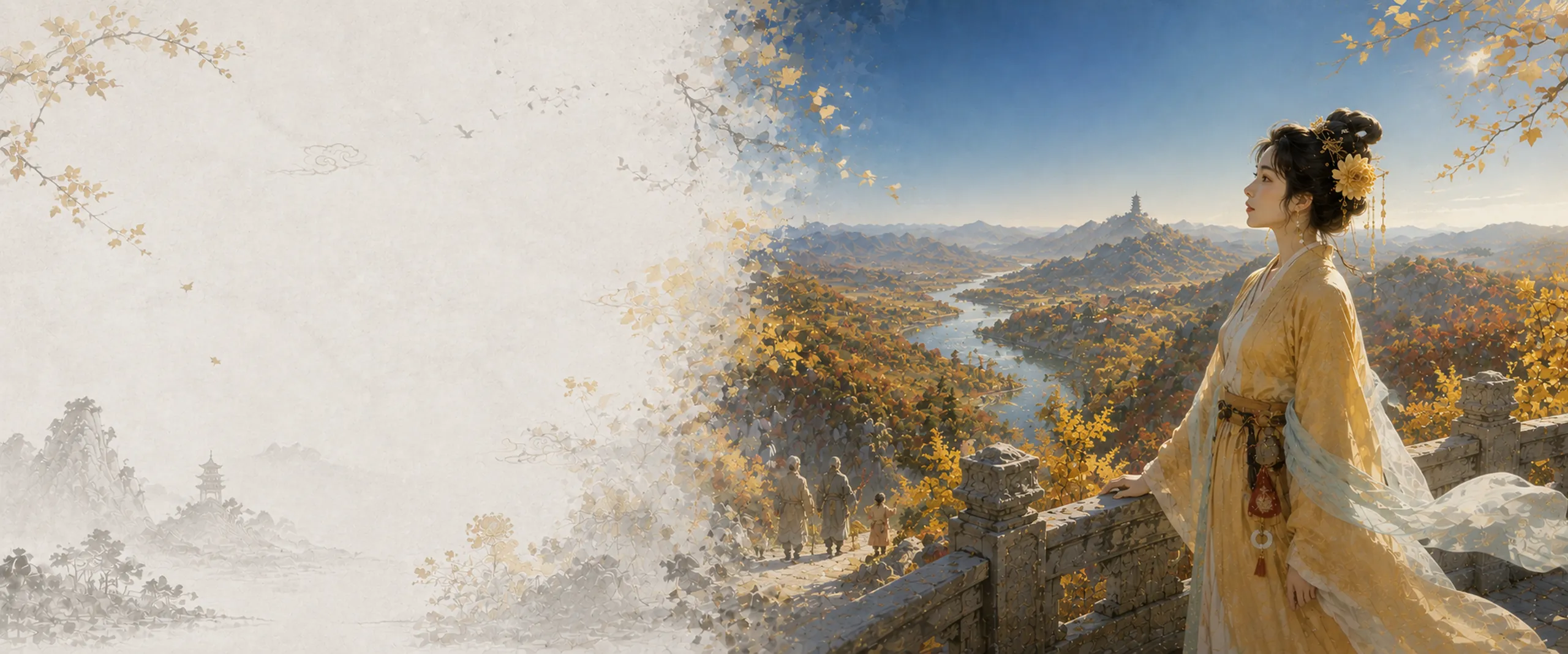
The Double Ninth Festival originated in the pre‑Qin period and was officially established as a folk festival in the Tang dynasty. At the age of seventeen, while living as a guest in Chang’an, Wang Wei wrote “Thinking of My Brothers in Shandong on…

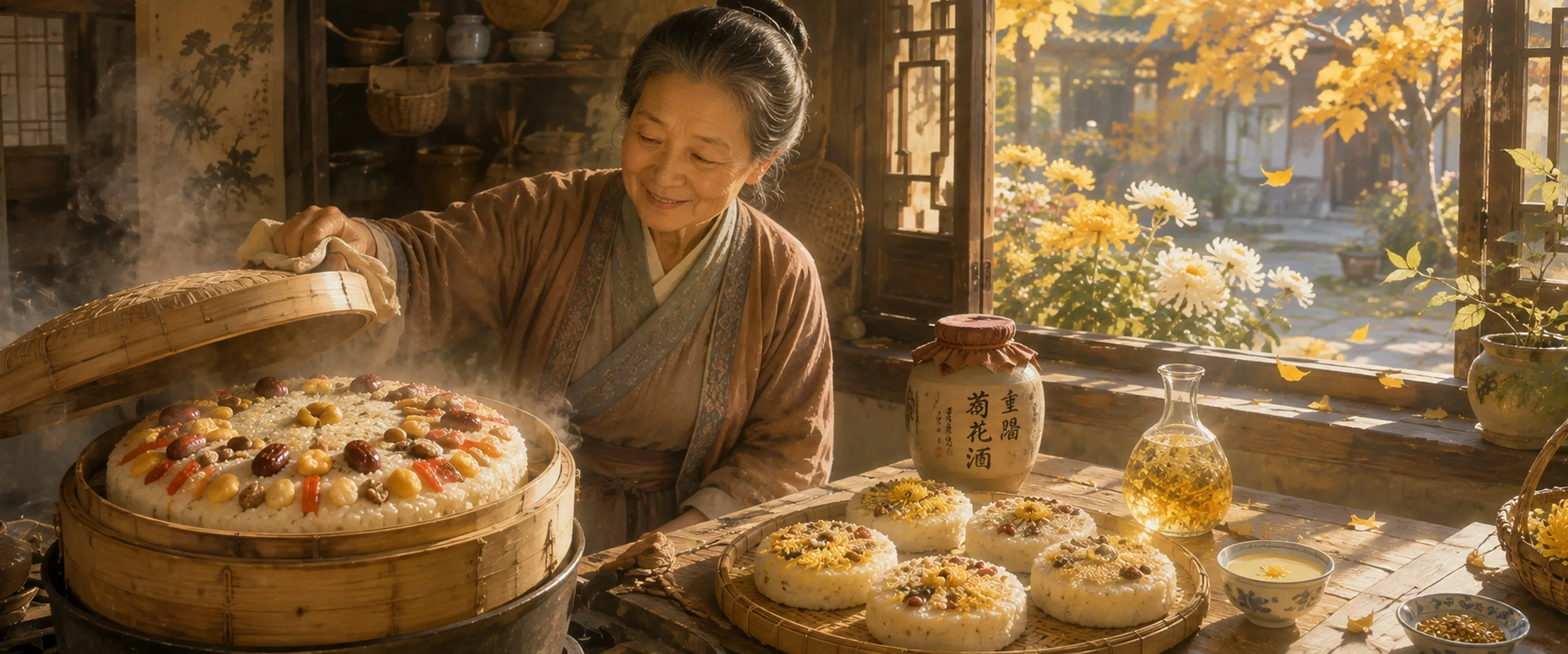
The food customs of the Double Ninth Festival are rich and deeply meaningful. Double Ninth cake is its most representative seasonal food. Because gao (糕, “cake”) and gao (高, “high”) are homophones, the cake carries auspicious wishes of rising layer by layer and advancing step by step. Its varieties differ from region to region, and there is no fixed form: any soft cake eaten during the Double Ninth Festival may be called Double Ninth cake. Chrysanthemum wine, meanwhile, is the festival’s traditional drink. According to the Xijing Zaji (《西京杂记》): “When the chrysanthemums open, their stems and leaves are gathered as well and mixed with millet to brew wine; it is not mature until the ninth day of the ninth month the following year.” Ancient people believed that drinking chrysanthemum wine on Double Ninth could prolong life. The custom of admiring chrysanthemums and drinking chrysanthemum wine is traditionally said to have originated with the great Jin-dynasty poet Tao Yuanming. One cake and one wine—Double Ninth cake and chrysanthemum wine together embody the festival’s cultural themes of honoring the elderly, praying for blessings, and pursuing longevity.

Double Ninth Festival / Double Ninth Festival Cuisine
350 days until Double Ninth Festival October 8, 2027 · Lunar 九月初九

Festival Food Gallery

Seasonal Menu

Food in Detail

Seeking the True Flavor

Double Ninth Cake

Pastries & Snacks

Basic Information

  • Category: Grain-based pastry
  • Popular Regions: Nationwide, especially northern China and Jiangnan
  • Main Ingredients: Glutinous-rice flour, japonica-rice flour, white sugar, red dates, chestnuts, nuts, and others
  • Alternative Names: Flower cake, chrysanthemum cake, five-colored cake, steamed leavened cake, peng’er (蓬饵)

Historical Origins

Double Ninth cake is the festival’s most representative seasonal food, and its history can be traced back to the pre-Qin period.

Its predecessor was the pre-Qin food known as peng’er (蓬饵). According to the Xijing Zaji (《西京杂记》), after Lady Qi, a favored consort of Han emperor Gaozu Liu Bang, was killed by Empress Lü, her maid Jia Peilan was expelled from the palace. In later conversation, she recalled that every year in the palace on the ninth day of the ninth month, people would “wear dogwood, eat peng’er, and drink chrysanthemum wine to ward off evil and prolong life.” Peng’er was a type of cake made from seeds of peng—an artemisia-like plant—and rice flour. The Zhou Li records that er cakes were used in sacrifices or eaten at banquets. When millet ripened in the ninth lunar month, people ate the new grain as a seasonal food and first offered it to their ancestors. This was the earliest origin of Double Ninth cake.

During the Han dynasty it was called peng’er; after the Jin dynasty, such foods came to be generally called gao (糕, “cake”). By the Tang dynasty, eating cake at Double Ninth was becoming increasingly popular, when it was known as mage cake (麻葛糕). Tradition holds that Wu Zetian once bestowed flower cakes upon her ministers during the festival. The Tang Liudian (《唐六典》) contains a reference to “ninth-day mage cake.” By the Song dynasty, the term “Double Ninth cake” was commonly used. Wu Zimu’s Mengliang Lu (《梦粱录》) records: “On this day, shops in the capital steam cakes from sugar and flour, decorate them with shredded pork, mutton, and duck, insert small colored flags, and call them Double Ninth cakes.” After the Ming and Qing dynasties, because of the many decorations placed on their surfaces, Double Ninth cakes were also commonly called flower cakes.

Cultural Meaning

Double Ninth cake differs greatly by region, and there has never been one strictly unified method. Traditional versions use rice flour and bean flour, ferment them, decorate them with fruits such as dates, chestnuts, and almonds, add sugar, and steam them.

Elaborate Double Ninth cakes are made in nine layers like pagodas, with two small sheep formed on top to correspond to the sound of Chongyang through yang (羊, sheep). Some are shaped as small deer and called “deer cakes,” symbolizing the hope that someone in the family will rise in office and gain official emolument; others are shaped as elephants and called “Ten-Thousand-Phenomena Cakes,” symbolizing renewal in all things. Some cakes have a small red paper flag inserted on top and candles lit upon them. Today, Double Ninth cake still has no single fixed form: soft cakes eaten during the festival in different parts of China may all be called Double Ninth cake.

In the rural areas of eastern Qin, wheat flour is the primary ingredient. Walnuts, dates, and other dried fruits are added to make a nine-layer cake two or three feet high, with insects, birds, flowers, and plants of various forms shaped on top. Every layer is rolled, pressed, pinched, combed, and otherwise worked to create patterns and forms, while the entire cake takes the shape of a large cylinder. After steaming, the separate cake sections are stacked layer by layer according to the intended design and covered with red cloth. In addition to presenting cakes as gifts, rural households in eastern Qin also arrange more than one hundred bright red persimmons around the cake.

Double Ninth cake carries several layers of symbolism. First, “ascending step by step.” Because gao (糕, cake) and gao (高, high) are homophones, eating cake symbolizes rising step by step and advancing in one’s career. Second, “everything rising higher.” At dawn on the ninth day of the ninth month, a slice of cake was touched to the foreheads of children while wishing that everything concerning them would rise higher. Third, “longevity through double nine.” A nine-layer cake symbolizes the Double Ninth and expresses the wish for enduring longevity. Fourth, “autumn tasting and ancestor worship.” Double Ninth cake originated as a food made from newly ripened millet in the ninth month and was used to honor gods and ancestors. Fifth, “warding off evil and avoiding disaster.” A small red paper flag inserted in the cake replaced dogwood, while lighting candles substituted for climbing to high places, all with the purpose of avoiding misfortune.

Regional Evolution

Double Ninth cake appears in many forms across China:

  • Beijing: Flower cake is a traditional Double Ninth food. It is steamed from wheat flour, layered with two or three tiers of dates, can be as large as a basin, and has colored flags inserted on top.
  • Northern China: Northern Double Ninth cakes are mainly wheat-based. They are commonly fermented and steamed, with upper and lower layers of dough and fillings of red dates, peanuts, nuts, sesame, and similar ingredients in between.
  • Suzhou-style Double Ninth cake: Made from rice flour blending japonica and glutinous rice, with slightly more glutinous-rice flour. Brown sugar is mixed in during steaming; common fillings include red-bean paste, walnut kernels, and pork fat. The top is decorated with green and red preserved shreds, roses, pine nuts, and melon seeds.
  • Henan: Chestnut flour and glutinous-rice flour are mixed with honey and steamed, accompanied by date paste and marked with colored flags.
  • Putian-Xianyou, Fujian: Nine-layer Double Ninth rice cakes are steamed in nine stacked layers and are sweet, soft, and pleasant to eat.
  • Wuxi: Double Ninth cake and Nine-Grade Soup are eaten.
  • Shenyang and Tieling: Leavened cakes are made from yellow millet flour with red-bean filling.

Simple Preparation

  • Ingredients: 200 g glutinous-rice flour, 100 g japonica-rice flour, 80 g brown sugar, about 180 g warm water, red dates, walnut kernels, pine nuts, and green and red preserved shreds as needed
  • Steps:
  1. Mix the glutinous-rice flour and japonica-rice flour in a ratio of about 2:1. Dissolve the brown sugar in warm water.
  2. Gradually add the brown-sugar water to the rice flour while stirring, working it into a loose but moist powder that holds together when squeezed yet falls apart when rubbed.
  3. Line a steamer with damp cheesecloth, spread in half of the rice-flour mixture, and smooth the surface.
  4. Add a layer of red-bean paste or chopped red dates, then spread the remaining rice flour on top and smooth again.
  5. Decorate the surface with red dates, walnut kernels, pine nuts, and green and red preserved shreds.
  6. Once the steamer is producing steam, place the cake inside and steam over high heat for 25–30 minutes. Remove, cool, and cut into pieces.

Tip: The moisture level of the rice flour is crucial. If it is too wet, the cake becomes sticky and heavy; if too dry, it will be loose and fail to hold its shape. Traditional Double Ninth cake emphasizes “three layers and two fillings,” rising layer upon layer to symbolize advancement step by step.

Chrysanthemum Wine

Drinks & Fine Wines

Basic Information

  • Category: Beverage
  • Popular Regions: Nationwide
  • Main Ingredients: Chrysanthemum flowers, glutinous rice or millet, fermentation starter
  • Alternative Names: Auspicious wine, longevity wine

Historical Origins

Chrysanthemum wine is the most representative drink of the Double Ninth Festival, and its history can be traced back to the Han dynasty or even earlier.

Brewing chrysanthemum wine was already widespread in China during the Han and Wei periods. The Xijing Zaji records: “When the chrysanthemums open, gather their stems and leaves as well, mix them with millet and brew them. They do not mature until the ninth day of the ninth month of the following year; then they are drunk, and this is why it is called chrysanthemum wine.” In the Han court, people wore dogwood, ate peng’er, and drank chrysanthemum wine on the ninth day of the ninth month to ward off evil and prolong life. Ge Hong of the Jin dynasty recorded in the Baopuzi (《抱朴子》) that people living in the mountains of Nanyang, Henan, prolonged their lives by drinking water from the Sweet Valley, where chrysanthemums grew everywhere.

Chrysanthemum wine is the festival’s most representative drink, and brewing it traditionally requires an entire year of patience. At the previous year’s Double Ninth Festival, newly blooming chrysanthemums and a few green branches and leaves are gathered, mixed with the grain prepared for brewing, and made into wine, which is then left until the following year’s Double Ninth Festival.

Cultural Meaning

Chrysanthemums occupy a special place in the Double Ninth Festival. They “flourish when frost descends, when this plant alone remains luxuriant,” making them symbols of vitality. In the minds of ancient people, chrysanthemums possessed extraordinary cultural significance and were known as the “guest of prolonged life” and the “herb of immortality.” Tao Yuanming of the Jin dynasty was associated with the saying: “Wine can dispel a hundred illnesses; chrysanthemums can restrain declining age.” From the Three Kingdoms and Wei-Jin periods onward, gathering at Double Ninth to drink wine, admire chrysanthemums, and compose poetry became fashionable. The ninth lunar month was even called the “Chrysanthemum Month” among the people.

In antiquity, chrysanthemum wine was brewed at Double Ninth specifically for drinking at the following year’s festival. On the ninth day of the ninth month, newly opened chrysanthemums and a small amount of fresh green stems and leaves were picked and mixed into the grain prepared for brewing. The wine was then left until the following ninth day of the ninth month. According to tradition, drinking it could prolong life.

By the Ming and Qing dynasties, various medicinal herbs were also added to chrysanthemum wine, further enhancing its effects. One method was to decoct sweet chrysanthemum flowers into a liquid, then brew wine using fermentation starter and rice, sometimes adding rehmannia, angelica, goji berries, and other medicinal ingredients. Ming physician Li Shizhen stated that chrysanthemum could “treat head wind, brighten the ears and eyes, remove wasting disorders, and treat a hundred illnesses.”

Chrysanthemum wine can dispel wind and heat, nourish the liver and brighten the eyes, reduce inflammation, and detoxify, and it is said to possess considerable medicinal value. From a medical perspective, the text states that it can improve eyesight, treat dizziness, lower blood pressure, aid weight loss, lighten the body, replenish liver qi, settle the stomach and intestines, and benefit the blood. In antiquity, chrysanthemum wine was regarded as an “auspicious wine” that had to be drunk at Double Ninth to dispel disaster and pray for blessings.

Simple Preparation

  • Ingredients: 50 g fresh chrysanthemums or dried chrysanthemums, 500 g glutinous rice, fermentation starter as needed
  • Steps:
  1. Wash fresh chrysanthemums and let them dry, or rehydrate dried flowers. Rinse the glutinous rice and soak for 4 hours.
  2. Steam the glutinous rice and allow it to cool to about 30°C. Chop the fresh chrysanthemums or rehydrate the dried ones.
  3. Mix the chrysanthemums with the cooked glutinous rice, add the fermentation starter, and transfer to a clean container.
  4. Seal and ferment in a cool place, leaving it until the following Double Ninth Festival before opening and drinking.

Tip: Traditional chrysanthemum wine requires a full year of brewing: chrysanthemums are picked and wine is made at Double Ninth, then the jar is opened at the following year’s festival. If one cannot wait a full year, it may be consumed after at least 1–2 months, though the flavor will not match that of aged wine.

Mutton Noodles

Grains & Staples

Basic Information

  • Category: Grain-based staple food
  • Popular Regions: Northern China
  • Main Ingredients: Mutton, noodles
  • Alternative Names: Longevity noodles, White Longevity noodles

Historical Origins

Eating mutton noodles at Double Ninth is an important northern custom. Yang (羊, “sheep”) and yang (阳) are homophones, corresponding to the name of the festival. The noodles should be made from white flour. Bai (白, “white”) may be understood as the character bai (百, “one hundred”) with the top stroke yi (一, “one”) removed, leaving ninety-nine and thus corresponding to the festival’s “double nine.” In the capital, a ninety-ninth birthday is called a “White Longevity” birthday.

Autumn is the season when sheep are at their fattest. Mutton is warm in nature and can protect against cold. Noodles are long and slender and are viewed as shou (瘦, “thin”), which sounds like shou (寿, “longevity”). Eating noodles has therefore long carried the meaning of long life. The Bencao Gangmu (《本草纲目》) records the warming and nourishing effects of mutton. Wealthy households could hold banquets centered on mutton on this day, serving it stir-fried, roasted, hot-potted, or even as an entire mutton banquet.

Cultural Meaning

Mutton noodles carry three layers of auspicious symbolism. First, “sheep” echoes “yang.” The Double Ninth Festival itself represents “two yangs overlapping,” and eating mutton noodles corresponds to this name. Second, “white” evokes “one hundred.” The character bai (白) is understood as bai (百) without its upper one, implying ninety-nine and echoing the festival’s double nine. Third, “longevity” expresses endurance. Noodles symbolize long life, and eating them is a prayer for health and longevity. A bowl of mutton noodles dissolves the Double Ninth theme of “honoring the elderly and praying for longevity” into steaming broth and noodles.

Simple Preparation

  • Ingredients: 300 g mutton, preferably leg meat or ribs; 200 g noodles; ginger slices; scallion sections; Sichuan peppercorns; salt; cilantro
  • Steps:
  1. Wash and cut the mutton into pieces. Place in cold water, bring to a boil to blanch off the blood foam, remove, and rinse clean.
  2. Add fresh water to a pot with the mutton, ginger, scallion, and Sichuan peppercorns. Bring to a boil over high heat, then simmer over low heat for 1.5–2 hours until the mutton is tender.
  3. Season with salt. Cook the noodles separately until done.
  4. Transfer the noodles to a bowl, ladle over the mutton broth and pieces of mutton, and sprinkle with cilantro.

Tip: Mutton broth should be simmered slowly for a long time so that it remains clear and develops a mellow flavor while the meat becomes tender. Double Ninth falls in late autumn, and a bowl of steaming mutton noodles both suits the season and warms the body against the cold.

Chestnut Cake

Pastries & Snacks

Basic Information

  • Category: Grain-based pastry
  • Popular Regions: Northern China
  • Main Ingredients: Chestnuts, glutinous-rice flour, sugar
  • Alternative Names: Chestnut cake, osmanthus chestnut cake

Historical Origins

Double Ninth falls during chestnut season, and Qing-dynasty Beijing had a custom of eating chestnut cake. In traditional culture, chestnuts symbolized “benefit to children” and “profitable trade.” Eating chestnut cake on Double Ninth therefore combined seasonal tasting with prayers for auspiciousness. Chestnut cake is commonly steamed from a mixture of chestnut flour and glutinous-rice flour. Its dense, sweet texture makes it an important northern variety of Double Ninth cake.

Cultural Meaning

Chestnut cake carries the auspicious meanings of “benefiting children” and “bringing profit.” Li (栗, “chestnut”) sounds like li (利, “benefit / profit”), so chestnut cake symbolizes “great auspiciousness and great benefit” as well as “benefit for one’s descendants.” Chestnuts also contain many seeds and therefore symbolize many children, many blessings, and a flourishing family.

Simple Preparation

  • Ingredients: 200 g chestnuts, 150 g glutinous-rice flour, 50 g white sugar, a little osmanthus
  • Steps:
  1. Shell the chestnuts, steam them until cooked, and mash into chestnut paste.
  2. Mix the chestnut paste with glutinous-rice flour and sugar, adding enough water to form a dough.
  3. Press the dough evenly into a mold and sprinkle osmanthus on the surface.
  4. Once the steamer is producing steam, steam for 20 minutes, remove, and cut into pieces.

Tip: Passing the chestnut paste through a sieve gives a finer texture. Osmanthus is the classic accompaniment to chestnut cake and adds the fragrance of autumn.

Persimmons

Fruits & Nuts

Basic Information

  • Category: Fruit
  • Popular Regions: Nationwide, especially northern China
  • Main Ingredient: Persimmons
  • Alternative Names: Red persimmon, vermilion fruit

Historical Origins

Double Ninth falls precisely during persimmon season. In places such as Pucheng, Shaanxi, more than one hundred bright red persimmons are arranged around the cake when Double Ninth cakes are presented as gifts. Persimmons carry rich auspicious meanings in traditional Chinese culture. Shi (柿, “persimmon”) sounds like shi (事, “affairs”), giving rise to expressions such as “may everything be as one wishes” and “may every affair go as desired.” Their fiery red color symbolizes a flourishing life and auspicious good fortune. Giving persimmons at Double Ninth is therefore one of the finest blessings for loved ones.

Cultural Meaning

Persimmons carry the auspicious meaning of “may everything go as wished.” Because shi (柿, persimmon) and shi (事, affairs) are homophones, two persimmons symbolize “may every affair go as wished,” while four symbolize “four generations under one roof.” Their vivid red color represents prosperous days and a sweet life. During Double Ninth, a festival devoted to honoring and caring for the elderly, giving a basket of red persimmons expresses the younger generation’s sincerest blessings to their elders.

  • Fresh persimmons may simply be washed and eaten, or dried to make preserved persimmons for storage.

Double Ninth Zongzi

Grains & Staples

Basic Information

  • Category: Grain-based staple food
  • Popular Region: Shaoxing, Zhejiang
  • Main Ingredients: Glutinous rice, zongzi leaves, fillings
  • Alternative Name: Autumn zongzi

Historical Origins

In Shaoxing and other parts of Zhejiang, people traditionally make zongzi during the Double Ninth Festival. In the Shaoxing prefecture, relatives and friends visited one another during the festival, made zongzi, and exchanged them as gifts, calling them “Double Ninth zongzi.” Unlike Dragon Boat Festival zongzi, these place greater emphasis on tasting the new autumn harvest: newly harvested glutinous rice is wrapped together with newly available beans, chestnuts, and other ingredients to correspond to the Double Ninth custom of autumn tasting.

Cultural Meaning

Double Ninth zongzi carry two meanings: “autumn tasting and ancestor worship” and “gifting relatives and friends.” Eating zongzi at Double Ninth both reflects the tasting of the new harvest and provides a gift through which relatives and friends maintain emotional bonds and exchange blessings.

See the zongzi recipe in the special feature on Dragon Boat Festival foods. Fillings may be adapted to newly available autumn ingredients such as chestnuts and red beans.

Ciba

Pastries & Snacks

Basic Information

  • Category: Grain-based pastry
  • Popular Regions: Southwest China, especially Guizhou and Sichuan
  • Main Ingredient: Glutinous rice
  • Alternative Names: Baba, pounded rice cake

Historical Origins

In Tujia areas of northeastern Guizhou, glutinous-rice baba must be pounded during the Double Ninth Festival. A local saying goes: “If you do not pound baba at Double Ninth, the tiger will bite Mother; if you do not grind tofu at Double Ninth, the tiger will bite your backside.” This custom closely links pounding ciba at Double Ninth with family safety and reflects the straightforward popular wish to ward off evil and avoid disaster. Around Double Ninth in Sichuan, people also steam glutinous rice to make wine and prepare laozao. During the festival, Tujia communities additionally grind tofu and offer sacrifices to the “family tiger.”

Cultural Meaning

Ciba carries multiple meanings of reunion, safety, and warding off evil. Its sticky grains bind into a single mass, symbolizing harmony and unity within the family. The custom of pounding ciba also contains the meaning of driving away evil and avoiding disaster—the family can remain safe only after the cakes have been pounded. The sweetness of ciba represents a sweet and happy life.

See the ciba recipe in the special feature on Mid-Autumn Festival foods.

Food Culture

Foodways

Looking across the entire food system of the Double Ninth Festival, several cultural principles can be traced throughout:

1. Using “cake” to evoke “height.” The most representative food of the Double Ninth Festival is Double Ninth cake. Because gao (糕, “cake”) and gao (高, “high”) are homophones, eating cake on Double Ninth symbolizes “ascending step by step” and “everything rising higher.” The Suishi Zaji (《岁时杂记》) records a Song-dynasty custom in which, at dawn on the ninth day of the ninth month, “a slice of cake was placed against the child’s forehead, while one offered the blessing: ‘May everything concerning the child rise high.’” This custom of embodying blessings in food vividly expresses the Chinese cultural tradition of “placing auspicious meaning in what one eats.”

Elaborate Double Ninth cakes were made in nine layers like a pagoda, with two small sheep fashioned on top to correspond to the sound of Chongyang (重阳) through yang (羊, “sheep”). Some cakes were also decorated with a small red paper flag and candles. This was probably a way of substituting “lighting lamps” and “eating cake” for “ascending heights,” while the small red flag stood in for sprigs of dogwood.

2. Using the chrysanthemum to evoke longevity. The chrysanthemum “flourishes when frost descends, when this plant alone remains luxuriant,” blooming proudly during the Double Ninth season. In the minds of ancient people, the chrysanthemum possessed exceptional cultural meaning and was called the “guest of prolonged life” and the “herb of immortality.” Drinking chrysanthemum wine, admiring chrysanthemums, and eating chrysanthemum cakes all revolve around the theme of longevity. In antiquity, chrysanthemum wine was regarded as an “auspicious wine” that had to be drunk on Double Ninth to ward off disaster and pray for blessings.

3. Using “sheep” to evoke “yang.” Eating mutton noodles is a Double Ninth custom because yang (羊, “sheep”) and yang (阳) are homophones, corresponding to the name Chongyang. The noodles should be made from white flour, because bai (白, “white”) may be understood as the character bai (百, “one hundred”) with the top stroke yi (一, “one”) removed, giving the number ninety-nine and thus echoing the festival’s “double nine.” Autumn is the season when sheep are at their fattest, and mutton is warm in nature and can protect against the cold. Noodles are long and slender, resembling shou (瘦, “thin”), which sounds like shou (寿, “longevity”); eating noodles has therefore long carried the meaning of long life.

4. Sacrifice as the origin. The roots of Double Ninth food culture lie in autumn tasting rituals. In the ninth lunar month, millet and other grains mature, and people used the new harvest to make cakes and pastries, first offering millet to their ancestors. The predecessor of Double Ninth cake was precisely this ninth-month food for tasting the new harvest. This also became the source of later popular autumn rituals in which Double Ninth cakes were used to honor deities and worship ancestors. From sacrificing to the gods to honoring ancestors, and from honoring ancestors to respecting the elderly, Double Ninth food culture completed a transformation from “revering Heaven” to “respecting people.”

Regional Distribution

Foodways
Region Distinctive Double Ninth Foods
Beijing Double Ninth flower cake made with glutinous rice and yellow millet flour, decorated with candied dates, chestnuts, and hawthorn cake
Shanghai Double Ninth cake
Nanjing, Jiangsu Double Ninth cake; five-colored paper flags inserted in the courtyard
Changzhou, Jiangsu “Camel hoof” wheat pastry
Wuxi, Jiangsu Double Ninth cake, Nine-Grade Soup (九品羹)
Shaoxing, Zhejiang Double Ninth zongzi, tied and exchanged as gifts
Tonglu, Zhejiang Pork and mutton prepared for ancestor worship in autumn rites
Zhejiang Red water caltrops, fox nuts, and steamed new chestnut-flour cake with osmanthus sugar, according to Dream of the Red Chamber
Putian-Xianyou, Fujian Nine-layer Double Ninth rice cake, whose nine layers can be peeled apart; sweet, soft, and not sticky to the teeth
Changting, Fujian Edamame Festival, in which soybeans are harvested from the fields and exchanged as gifts
Guangfeng, Jiangxi Pounding ciba
Wuyuan, Jiangxi Shaiqiu, drying vegetables and fruits in the sun to create a spectacular autumn scene
Changyi, Shandong Spicy radish soup, with the saying: “Drink radish soup and the whole family will escape disaster.”
Juancheng, Shandong Pan-baked crisp cakes, offered to the God of Wealth
Zaozhuang, Shandong Eating crab, with households preparing wine, cracking crab, and serving salted duck
Southern Shanxi Buckwheat noodles simmered with mutton
Henan Fried dough sticks, mung-bean flour foods, pancakes; pomegranates; tangyuan in the Xinyang area
Shaanxi Buckwheat noodles simmered with mutton, a Double Ninth specialty in northern Shaanxi eaten in the evening; chrysanthemums and chrysanthemum cakes exchanged as gifts
Xixiang, Shaanxi Friends and relatives exchange chrysanthemums and chrysanthemum cakes
Wuchang, Hubei Double Ninth wine-making, said to produce especially clear wine that keeps well for a long time
Yangxin, Hubei Tangyuan
Hunan Ciba
Sichuan Steaming glutinous rice wine and making laozao, with the saying: “Wine steamed at Double Ninth is fragrant and sweet.”
Southwest China Ciba, made by pounding glutinous rice and rolling it in soybean flour and brown-sugar syrup, symbolizing close family affection
Nationwide Double Ninth cake, with “cake” echoing “high,” symbolizing advancement; chrysanthemum wine, the festival’s essential “auspicious wine”; hairy crab, rich with roe and fat at this season; persimmons; mutton noodles, with “sheep” echoing “yang”

Additional Notes:

  • North-South differences in Double Ninth cake: In the north, cakes are mainly made from wheat flour and often take the form of steamed, fermented flower-and-fruit cakes. In the south, glutinous-rice flour is more common, producing cakes as white and finely shaped as carved jade, such as osmanthus lotus-root cake, mint cake, and red-bean-paste cake. Colored paper flags inserted into the top are an iconic feature.
  • The overall north-south flavor pattern: The rich sweetness of northern Double Ninth cakes contrasts with the fresh delicacy of southern crab; mutton in the northwest warms the body, ciba in the southwest warms the heart, and rice cakes in the southeast carry affection. The flavors seem very different, yet all express cherishing the autumn season and protecting family bonds.
  • The cultural meaning of “gao” and “high”: People living on the Jiangnan plains had no mountains to climb, so they inserted colored flags into cakes and used gao (糕, cake) in place of gao (高, high), symbolically ascending to avoid disaster. Married daughters were expected to return to their parents’ home at Double Ninth with Double Ninth cake. A folk song says: “Mid-Autumn has only just passed, and already we are busy for Double Ninth; clever and pretty flower cakes, all because the daughter misses her mother.”
  • The correspondence between Double Ninth and Qingming: In Putian-Xianyou, Fujian, more people traditionally worship ancestors on Double Ninth than at Qingming, giving rise to the saying: “The third month is the lesser Qingming; Double Ninth is the greater Qingming.”

Closing Reflections

Foodways

Maple leaves blaze crimson and autumn chrysanthemums open their buds. The foods of the Double Ninth Festival meet the golden, full-bodied colors of autumn like companions sharing a drink, while the mountain wind of the ninth day of the ninth month carries a lasting warmth. At the heart of the festival’s food customs lies a single word: gao (糕, “cake”). Cake stands in for gao (高, “high”), expressing the auspicious wish of rising step by step. In the north, Double Ninth cakes are steamed from yellow millet flour and glutinous-rice flour, decorated with candied dates, chestnuts, and hawthorn cake, their upper layers scattered with golden osmanthus. Southern flower cakes, by contrast, are mainly made from glutinous-rice flour, white and finely shaped like carved jade, and include layered varieties such as osmanthus-sugar lotus-root cake, mint cake, and red-bean-paste cake. In Beijing, five-colored paper flags inserted into the cake form an iconic Double Ninth scene. Qi (旗, “flag”) echoes qi (祈, “to pray”); as the tiny flags snap in the autumn wind, they seem to offer prayers to Heaven and Earth on behalf of those unable to climb to the heights.

Double Ninth food customs unfold across north and south in dramatically different landscapes of flavor. Jiangnan households eat crab with wine, and the elegance of holding a crab claw while admiring chrysanthemums entered literary memory through Lu Xun’s “Crab Monk.” At this season, hairy crabs are full of roe and rich with fat; the fresh sweetness of crab meat meets the clear sharpness of chrysanthemum wine on the tongue, forming an autumnal poem of taste passed down among generations of Jiangnan literati. On the northwestern plateau, buckwheat noodles simmered with mutton bubble on the stove. People in northern Shaanxi eat them to warm the body against the cold; after one bowl, the whole autumn seems warm again. In the southwestern mountains, ciba is pounded again and again in stone mortars, rolled in soybean flour and brown-sugar syrup, its dense, soft, glutinous texture carrying the wish that family affection remain close and unbroken. In Putian-Xianyou, Fujian, nine-layer rice cakes can be peeled apart layer by layer, their nine distinct tiers using “nine” to answer “nine,” at once a food and a deeply meaningful expression of the autumn sacrificial season. In Changyi, Shandong, a simple folk saying accompanies spicy radish soup: “Drink radish soup and the whole family will escape disaster.” A single bowl of hot soup becomes a prayer for an entire year of safety.

Double Ninth foods are also steeped in gratitude for “reporting the success of the autumn harvest.” Climbing to high places and feasting are longstanding festival traditions. Changzhou in Jiangsu has its “camel hoof” wheat foods; Wuxi its Nine-Grade Soup; Tonglu in Zhejiang its pigs and sheep for autumn sacrifice; Shaoxing its Double Ninth zongzi, exchanged among relatives and friends. The foods of different regions may each possess their own character, yet they all point toward the same theme: deep within the autumn light lies not only the vast clarity of high skies and pale clouds, but also the most enduring human attachment carried in the smoke and warmth of ordinary life. The steam rising from cakes, the orange-red shells of crabs, the softness of ciba, and the clear sharpness of chrysanthemum wine all express the same truth: the Double Ninth Festival is not merely a festival for honoring the elderly; it is also a ruler by which we measure our distance from home. It reminds every person who has traveled far away that, at the moment of climbing high and gazing into the distance, one should not forget to turn back and look at those who have left a light burning for them.

—-

Continue exploring Double Ninth Festival culture

Readers’ Comments

Calendar and traditional culture enthusiasts from around the world, sharing the same moon.

Sign in or register to join the conversation. Your comment account is created automatically the first time you use a connected account.