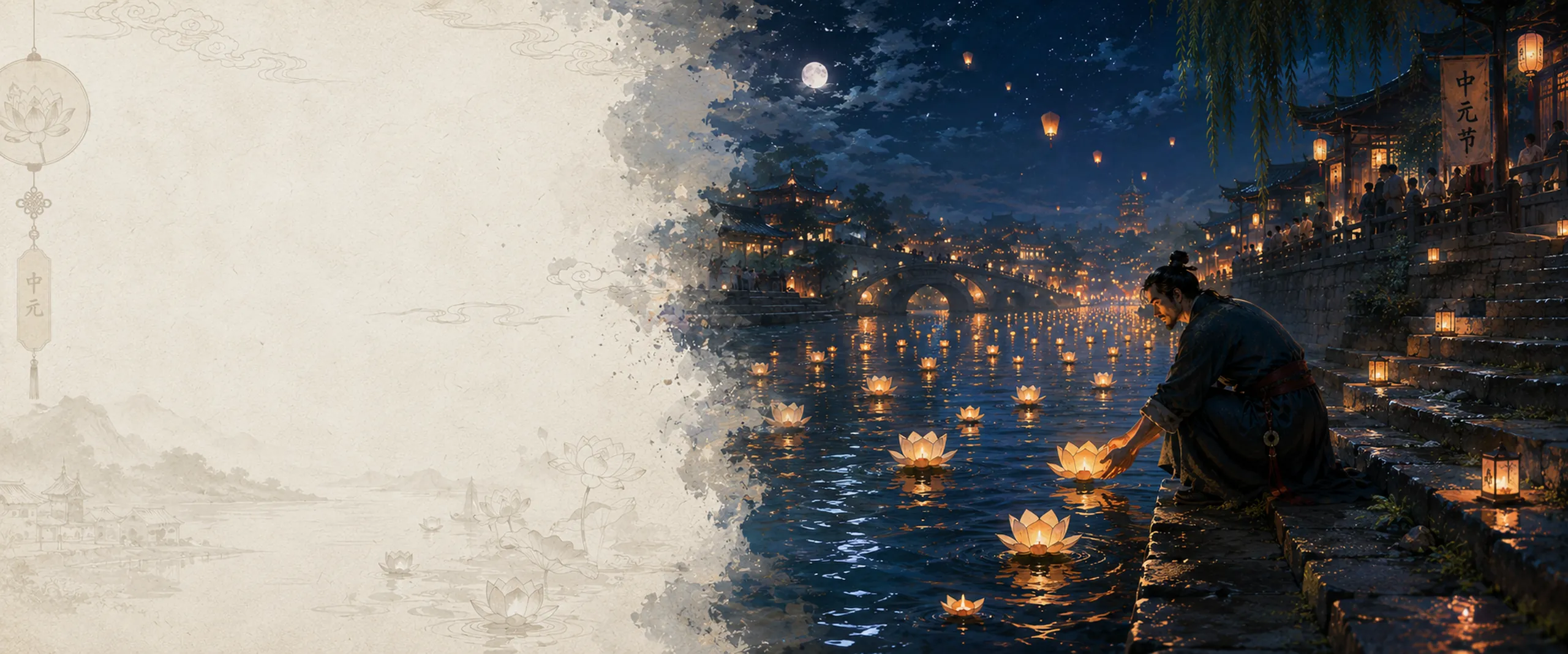

The Ghost Festival falls on the 15th day of the seventh lunar month. It is associated with the Daoist “Three Yuan” doctrine — the day when the Earth Official pardons sins — and also merged with the Buddhist Yulanpen Assembly, becoming a festival where Confucianism, Daoism, and Buddhism converge. Li Ying’s poem “The Night of the Ghost Festival” (《中元夜》) depicts the bustling temple festivities: “江南水寺中元夜,金粟栏边见月娥。红烛影回仙态近,翠环光动见人多。” (*On the Ghost Festival night at a waterside temple in Jiangnan, by the golden‑grain railings one sees the Moon Goddess. Red candle shadows flicker, drawing immortals near; jade bracelets gleam as crowds gather.*) The core custom of the festival is ancestral veneration — people burn paper money and offer sacrifices to express their remembrance of the departed. Releasing river lanterns is also a major activity; lanterns float downstream, illuminating the way for wandering souls. The Song‑dynasty poet Zhao Ding wrote: “年年人月喜团圆,好在诗边又酒边” (*Year after year, people rejoice in reunion under the full moon; we find joy in poetry and wine.*) This reveals the festival’s gentler side — the hope for family reunion on the full‑moon night. Between mourning and compassion, the Ghost Festival embodies reverence for life and devotion to family.
Festival Journey
Origins & Legends
History · Evolution · Legend
Tracing the Source · Historical Evolution
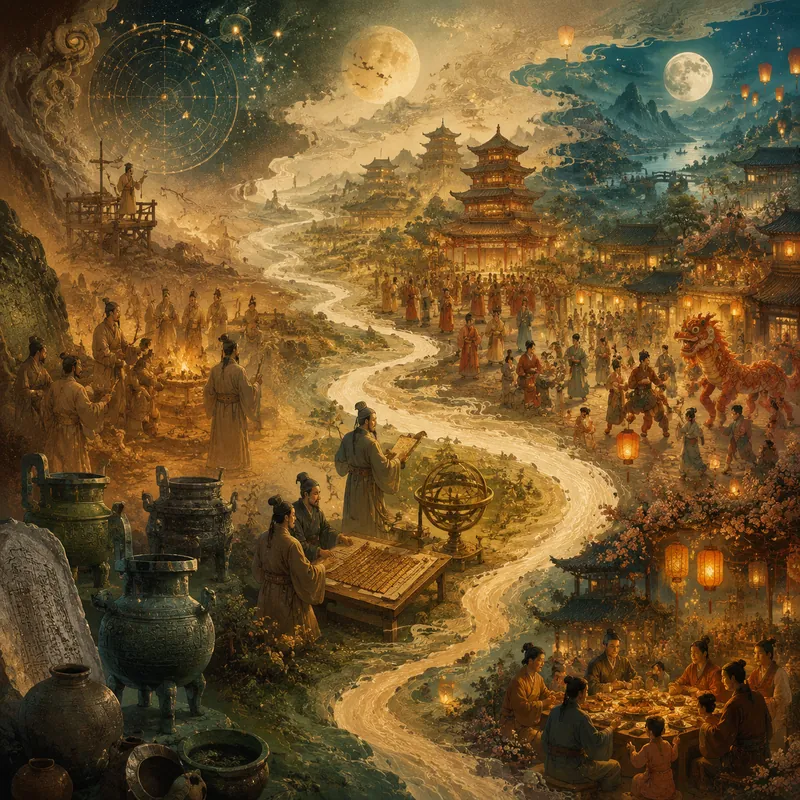
- Pre‑Qin to Han Dynasties The origin legend of the Ghost Festival is most reliably traced to an ancestor worship festival
- Wei‑Jin and Northern and Southern Dynasties It was not until the Wei‑Jin and Northern and Southern Dynasties, with the infiltration of Buddhism and Daoism, that the festival ultimately took the form of Zhongyuan and Yulanpen
- Sui and Tang Dynasties During the Sui and Tang dynasties, the interaction of the three teachings reached its peak, presenting the remarkable spectacle of Confucian Autumn Tasting, Buddhist Yulanpen, and Daoist Zhongyuan coexisting
- Song and Yuan Dynasties In the Song dynasty, the concept of “integration of the three teachings” evolved further, and Buddhism and Daoism accelerated their secularisation
- Ming and Qing Dynasties During the Ming and Qing dynasties, the Ghost Festival customs, while inheriting those of previous generations, displayed regional characteristics
Festival Customs
Customs · Local Traditions · Everyday Life
Seasonal Snapshots · Customs & Local Life
Festival Foods
Food Traditions · Local Flavors · Taste
Seasonal Flavours · Seasonal Menu
Poetry & Verse
Classics · Imagery · Legacy
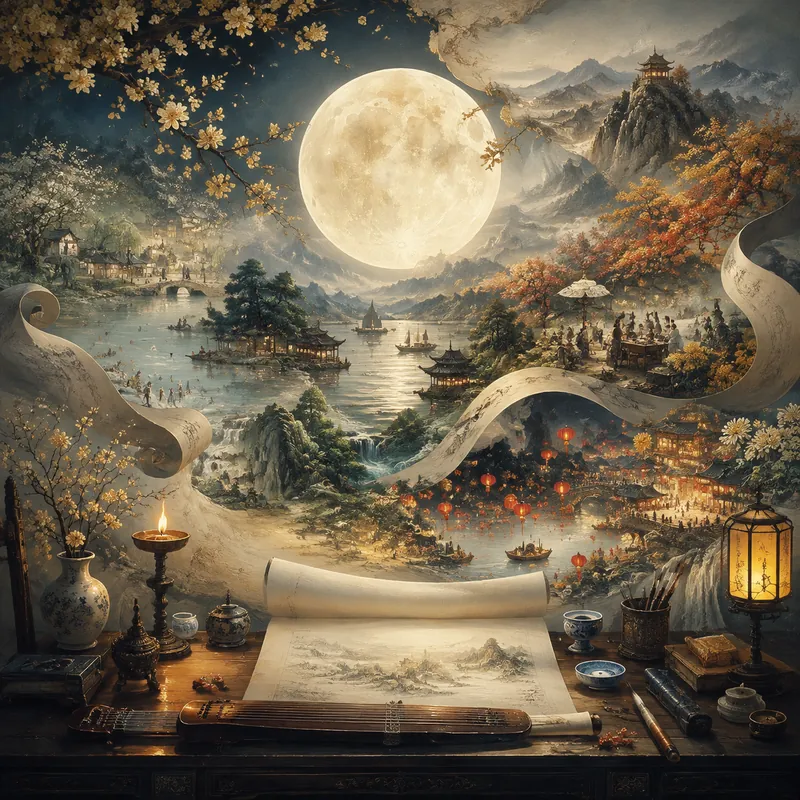
Representative Poems · Classic Selections
「中元作」
绛节飘飖宫国来,中元朝拜上清回。
羊权须得金条脱,温峤终虚玉镜台。
曾省惊眠闻雨过,不知迷路为花开。
有娀未抵瀛洲远,青雀如何鸩鸟媒。
Global Features
Overseas · Chinese Communities · Celebrations
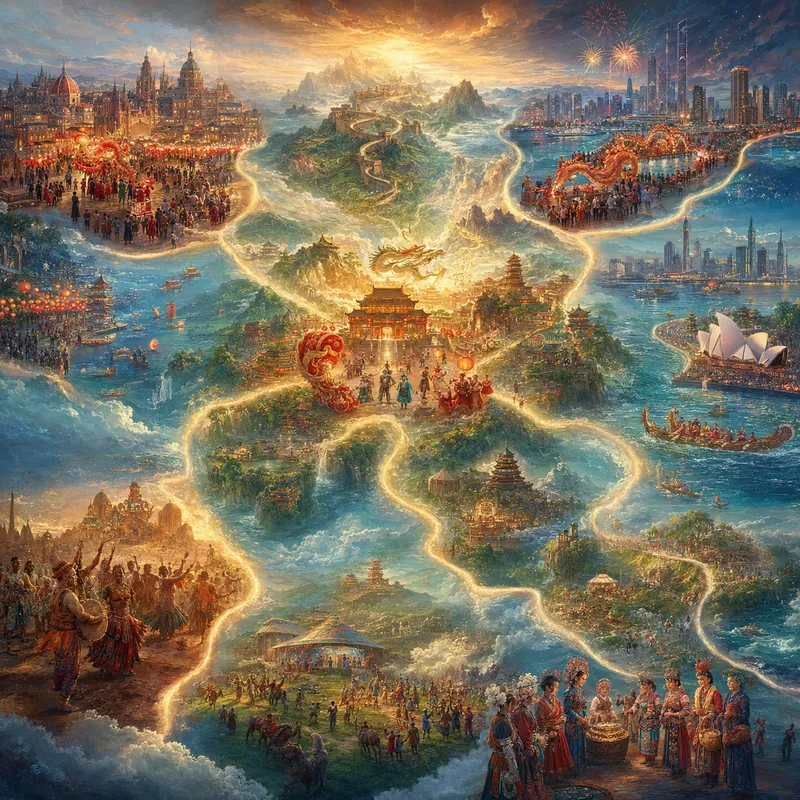
Overseas Celebrations · Lights of Chinese Communities
The United States is one of the countries with the largest Chinese immigrant populations in the world. Although Zhongyuan is not as widely known as the Spring Festival or Mid-Autumn Festival, its ritual traditions have continued for more than a century in Chinese-populated cities such as San Francisco, New York, and Los Angeles, and in contemporary times the festival has also been endowed with new cultural meanings. San Francisco: “Chinatown Hungry Ghost Festival”—from historical trauma to cultural strength. San Francisco’s Zhongyuan Festival is one of the most culturally layered examples in North America. In August 2025, the Chinese Culture Center of San Francisco held its third Chinatown Hungry Ghost Festival, themed “Demons of Our Time”, transforming traditional Zhongyuan observances into a cultural event combining music, art, procession, and ritual. Curator Leung Hoi-yiu noted that the Ghost Festival occupies an important place in the history of Chinese people in California: between 1860 and 1920, more than 350 Zhongyuan or Yulan ceremonies were documented across the state, providing spiritual solace to early immigrants who endured exclusion and hardship. The event invited three Hong Kong artists to interpret tradition through contemporary art. Tang Kwok-hin created a mobile sculpture inspired by the lotus flower; Lau Hok-shing created a monumental flame installation centered on the element of fire; and Cheng Yee-man transformed a traditional exorcistic rite into a processional work. A 14-foot-high giant paper effigy of Da Shi Wang (大士王) set out from 667 Grant Avenue and paraded through Chinatown, bidding farewell to wandering spirits and blessing the community with peace. Chinese Culture Center executive director Jenny Leung stated: “At a time when immigrant communities are repeatedly under attack, art can bring people together.” A senior member of Miu Lin Sin Koon explained that more than a century ago, large numbers of Chinese railroad workers, miners, and gold seekers crossed the ocean, and many died amid hardship and discrimination: “Today, we hope to use the Ghost Festival to pray for them and remember them, while also helping later generations remember what they contributed and sacrificed.” The Zhongyuan procession in San Francisco Chinatown attracted visitors from around the world. By transforming Zhongyuan from “folk belief” into “cultural action,” the festival has acquired a social significance in the United States that reaches beyond the religious sphere. Los Angeles: North American Yulanpen Offering-to-the-Sangha Dharma Assembly. On July 20, 2025, Buddha’s Light International Los Angeles Association held the “North American Yulanpen Offering-to-the-Sangha Dharma Assembly” at Fo Guang Shan Hsi Lai Temple. The ceremony was presided over by Venerable Hsin Bao, abbot of Fo Guang Shan, with 90 monastics from across North America and 27 young novice monks participating in short-term monastic practice invited to receive offerings. Around 1,300 devotees gathered at the temple, following Buddhist precepts and practicing filial gratitude through the merit of making offerings to the Sangha. Zhongyuan observances in Los Angeles center on the Buddhist Yulanpen tradition and emphasize the religious meaning of filial devotion and repaying parental kindness.
Zhongyuan celebrations in Canada’s Chinese communities carry a distinctive historical dimension: commemorating the thousands of Chinese laborers who died during construction of the transcontinental Canadian railway. Vancouver: “Spirit of the Square”—an altar for Chinese railroad workers. On September 6, 2025, the day of Zhongyuan, Vancouver Chinatown held the third annual “Spirit of the Square” event to celebrate and commemorate the festival. The event took place at Vancouver Chinatown Memorial Square. Organizers set up an altar for community members, burned incense, and made offerings in memory of the thousands of Chinese railroad workers who died while building the transcontinental Canadian railway. Activities also included lion dancing, qigong, small-zine making, karaoke, and mahjong. Vancouver’s Zhongyuan combines an ancient tradition of ritual remembrance with the particular historical memory of Chinese Canadians. Those honored are not only family ancestors, but also the Chinese laborers who gave their lives to the building of Canada and were long forgotten by history.
Southeast Asia has the greatest concentration of overseas Chinese communities. Here, Zhongyuan has not only preserved Chinese traditions in relatively complete form, but has also developed distinctive local expressions through interaction with surrounding cultures. Singapore: getai culture—the public carnival of Zhongyuan. Singapore’s Zhongyuan celebrations can be regarded as one of the world’s most vibrant versions. Zhongyuan takes place during the seventh lunar month, when sacrificial burning and live street performances are common across the island. It is estimated that hundreds of getai stages are set up across Singapore during Zhongyuan every year. Whether beneath public-housing blocks, outside shopping malls, or beside office buildings, red Zhongyuan notices can be seen everywhere, alongside tables filled with offerings, burning candles, and incense. In 2025, to celebrate the 60th anniversary of Singapore’s founding, a Zhongyuan getai titled “Stars Shine Together · Sixty Years in Shared Radiance” was staged on a grand scale in the Ubi industrial area, bringing together 60 performers from Singapore, Malaysia, mainland China, and Taiwan. According to observations, crowds streamed in continuously from the evening onward, and by nightfall almost every seat was occupied; over the course of the day, an estimated more than one thousand spectators attended. Performer Hao Hao explained that this major annual Zhongyuan getai symbolizes the traditional seventh-lunar-month rite of welcoming “good brothers” (好兄弟), a euphemistic term for ancestors or spirits, into the human world. Not only the hosts, but all 60 performers had to undergo a jiaobei divination ritual (掷筊杯) before being allowed onto the stage. Marine Parade GRC Member of Parliament Pang Li Yan also took the stage to sing, prompting the host to exclaim that he had “never seen an MP so happy to go onstage.” Singapore’s temples are equally lively during Zhongyuan. On Zhongyuan Day in 2025, Mahayana Chan Temple estimated that its Hundred-Thousand-Buddha Yulan Pudu Grand Assembly, held from the first through the sixteenth day of the seventh lunar month, would attract 8,000 to 10,000 participants. For the first time, the temple created lotus memorial tablets for pets, allowing monastics to perform purification rites for devotees’ beloved animals and for community cats and dogs. Lorong Koo Chye Sheng Hong Temple held a Pudu Dharma ceremony lasting about an hour and expected at least 500 worshippers on the fifteenth day of the seventh lunar month alone. The Taoist Federation of Singapore also invited around fifty representatives from Buddhism and Hinduism to visit temples and learn how Taoists celebrate Zhongyuan. The “bidding for blessed objects” (标福物) activity is organized by Zhongyuan associations and can be regarded as an important means through which Chinese society strengthens cohesion and practices mutual assistance. Singapore’s Zhongyuan combines solemn ritual worship with exuberant getai entertainment and large-scale Pudu ceremonies, presenting a distinctive cultural form that is both reverent and carnivalesque. Malaysia: the country’s largest Pudu, attended by 15,000 people. Malaysia’s Zhongyuan celebrations are equally remarkable in scale. In 2025, the Johor Bahru Guan Sheng Gong Association once again organized the country’s largest Zhongyuan Pudu celebration, attracting more than 15,000 participant-visits, the highest attendance on record. More than sixty food stalls were set up during the event. To highlight interethnic harmony, the organizers specially prepared halal food and invited more than 500 people from other ethnic communities to participate; for the first time, Malay and Indian dance groups were also invited to perform welcoming dances. The assembly prepared 1,500 cases of assorted alcoholic beverages and 60 roast pigs as offerings to the ancestors. Datuk Shi Yali, chairman of the Guan Sheng Gong Association, stated that Zhongyuan is not only a traditional religious ritual, but also carries the core values of filial piety, gratitude, diligence, and benevolence. He emphasized: “Today, we are not merely holding a banquet or a Pudu ceremony; we are also reminding one another to incorporate these traditional virtues into our everyday lives.” The “grabbing the offerings for wandering spirits” (抢孤) ritual at the port of Sungai Pinang in Balik Pulau, Penang, is one of Zhongyuan’s most visually striking traditions. The annual “offering to wandering spirits and grabbing the offerings” event is one of only two local celebrations of its kind in Penang. During the 2025 ritual, all the offerings laid out on the ground were cleared away within just five minutes. Preparations began at 7 a.m., worship began at 10 a.m., and after the rituals concluded, the grabbing began, with surrounding residents rushing forward to take the offerings. The event attracted more than one hundred visitors from outside the area, including tourists from China and Europe. Zhongyuan activities across Malaysia are highly varied. A celebration in Genting Jaya raised RM150,000; the Bukit Maluri Guanyin Pavilion peace banquet in Kepong raised RM128,000; and a welfare charity organization in Kuching, Sarawak distributed 240 packages of essential supplies to vulnerable groups. Malaysia’s Zhongyuan thus includes not only the grand spectacle of mass Pudu ceremonies, but also local traditions such as qianggu, together with a strong dimension of charitable assistance and social care. Indonesia: burning the royal boat and “returning spirits, praying for blessings.” Chinese communities in Indonesia preserve many ancient Zhongyuan traditions. On September 6, 2025, Zhongyuan Day, several hundred Chinese people from across Indonesia gathered at Fushui Temple in Bojonegoro, East Java, for rites honoring deities, while thousands of local residents participated enthusiastically. Prayers were conducted before dozens of “mountain bundles” (山包) filled with local specialties. After the ceremony, hundreds of people began competing to take the goods contained in the bundles. The event attracted Chinese participants from cities throughout Indonesia, as well as some from overseas. In Bangka Regency, Bangka Belitung Province, Chinese residents held a “Returning Souls and Praying for Blessings” (归魂祈福) ritual at Luohe Temple. The ceremony opened with participants competing for offerings—fruit, rice, pastries, and other items placed on the altar were eagerly taken away, symbolizing the sharing of blessings. At midnight, a 13-meter-high sacred effigy and a 12.7-meter-long paper boat model were set alight, symbolizing deities guiding wandering spirits across the river of the underworld. Most Chinese residents of Bangka Regency are descendants of migrants from Fujian and Guangdong who arrived from the Ming and Qing periods onward, and they have preserved traditional Chinese festival customs for centuries. In West Kalimantan, local Chinese communities conducted the southern Fujian tradition of “burning the royal boat” (烧王船), intended to allow ancestors who had journeyed to Southeast Asia to return to their homeland while also praying for “peace throughout the whole locality” (合坡平安). Wihara Gunung Timur in Medan also held a major Zhongyuan celebration attended by thousands of ethnic Chinese residents. Guanghui Temple in Jiabu, Central Java, not only conducted Zhongyuan rituals but also distributed 1,300 packages of daily necessities to local residents. By combining Zhongyuan rituals with charitable relief, Chinese Indonesians have made the festival concern not only the dead, but also the living. Cambodia: Yulan assemblies of the Teochew and Fujian associations. Zhongyuan celebrations among Cambodia’s Chinese communities are centered primarily on the Teochew and Fujian communities. On September 20, 2025, the Cambodia Teochew Association held a Zhongyuan Yulan worship ceremony at the Teochew cemetery grounds in Kambol, on the outskirts of Phnom Penh. During the ceremony, vice chairpersons worshipped at the temples of Dafeng Zushi and Bogong, praying for favorable weather and for the people to live and work in peace and contentment. In previous years, before Zhongyuan, the Teochew Association distributed daily necessities to local residents, and “this good deed has continued to be remembered by local people, who remain grateful for its virtue.” The Cambodia Fujian Association likewise successfully organized a series of Zhongyuan rituals honoring the “good brothers” and holding Yulan assemblies. Activities took place both at the Fujian Association headquarters and at the new Fujian cemetery grounds, where rice and instant noodles were distributed to poor families in Phnom Penh and Kampong Speu Province. Through these activities, the Fujian Association promoted the profound meaning of traditional culture while demonstrating a positive commitment to social responsibility and giving back to the local community. Thailand: preserving Zhongyuan amid economic fluctuations. Zhongyuan celebrations in Thailand are centered mainly on ethnic Chinese communities. On September 6, 2025, Phong Thep Kong Guang Li Gong in Nong Chang District, Uthai Thani Province, was filled with activity. Local Chinese residents dressed in auspicious red clothing and brought their families to the old Chinese shrine to celebrate Zhongyuan. People followed the tradition of “family first, community second”: they first set up altars at home to worship their ancestors, then carried offerings to the shrine for a second round of worship. Because of the economic downturn, however, the amount of offerings was smaller than in previous years. Local residents said that even during an important festival, they now had to budget carefully. Despite this, people’s regard for traditional festivals and the sincerity of their prayers remained undiminished. Teochew Chinese communities in Bangkok also held Yulanpen assemblies, ceremonially welcoming Da Shi Ye, Chenghuang Gong, and other deities, while Buddhist monks conducted the Yujia Yankou (瑜伽焰口) ritual to offer relief to wandering spirits. Myanmar: Taiwanese businesspeople combine Zhongyuan Pudu with charity. In Myanmar, Taiwanese business communities organize Pudu activities during Zhongyuan. In addition to continuing traditional ritual culture, they also incorporate charitable donations, sending collected supplies to disadvantaged groups and orphanages in different regions. This practice of combining Zhongyuan ritual observance with charitable relief is widespread among Chinese communities across Southeast Asia.
The Japanese evolution of Zhongyuan is the most distinctive branch within the wider East Asian lineage. After Zhongyuan entered Japan, it merged with indigenous ancestor worship and developed into Obon (盂兰盆节), becoming Japan’s second-largest festival after New Year. Japanese Obon is generally observed from August 13 to 16, and many companies and schools take around a week off. Graves are cleaned before the 13th; ancestral spirits are welcomed on the 13th and sent off on the 16th. In folk custom, people gather to perform a dance known as Bon Odori (盆踊). Unlike China’s “Ghost Festival,” Japan’s Zhongyuan tradition also developed a gift-giving custom: people present gifts to those who have supported or cared for them in everyday life as an expression of gratitude. Sofukuji Temple in Nagasaki holds an annual “Chinese Bon”, an Obon observance belonging to overseas Chinese communities in Japan. Beginning on the twenty-sixth day of the seventh lunar month, it lasts for three days. Five special pavilions are erected inside the temple, decorated with red lanterns and filled with offerings of fruit, vegetables, and other foods. This four-hundred-year-old tradition is now in urgent need of preservation and transmission. Japanese Obon has retained the ancestral-worship core of China’s Zhongyuan while transforming it, through nationwide holidays, Bon Odori dancing, and seasonal gift-giving, into a national festival with unmistakably Japanese characteristics.
Visitor Guide
Preparation · Etiquette · Take Part with Confidence
Readers’ Comments
Calendar and traditional culture enthusiasts from around the world, sharing the same moon.
Sign in or register to join the conversation. Your comment account is created automatically the first time you use a connected account.
No comments yet
Share your thoughts with readers around the world.