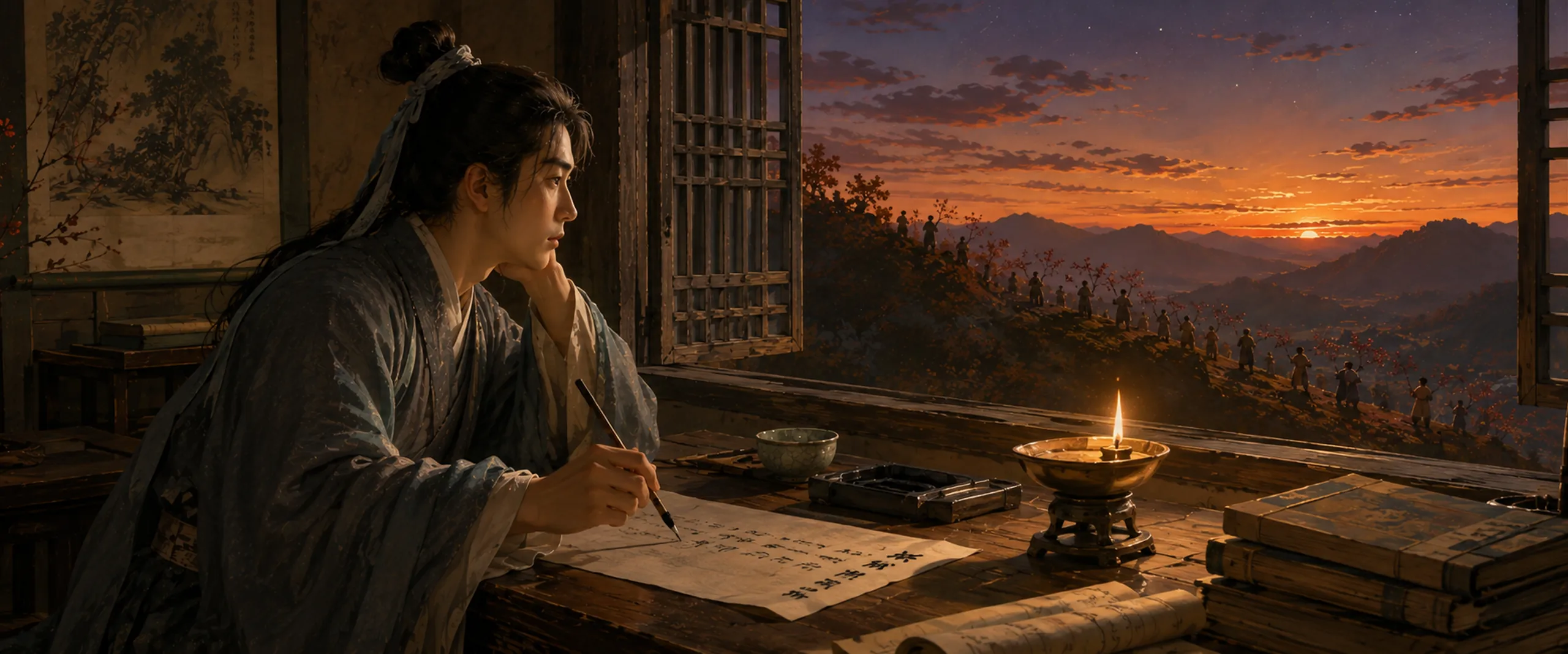
Alone and far from home, he is a stranger in a strange land. The opening immediately expresses the poet’s loneliness away from home. Within this brief line, he uses one “独” and two instances of “异”, revealing the intensity of his sense of being an outsider. The flourishing imperial capital held enormous attraction for a young scholar eager for advancement, yet to a teenage traveler without family nearby, it was ultimately still an “异乡”, a foreign place. Indeed, the more prosperous and lively the city, the more isolated the solitary traveler can appear within its immense crowds. The single “独” and the two “异” carry considerable emotional weight.
At the age of seventeen, while living away from home in Chang’an, Wang Wei wrote Thinking of My Brothers East of the Mountains on the Ninth Day of the Ninth Month (《九月九日忆山东兄弟》): “独在异乡为异客,每逢佳节倍思亲。遥知兄弟登高处,遍插茱萸少一人。” These lines express with extraordinary depth the homesickness and longing for family felt by a traveler during the Double Ninth Festival. Du Mu writes in Ascending Qishan on the Ninth Day (《九日齐山登高》), “尘世难逢开口笑,菊花须插满头归”, revealing an openhearted and unrestrained spirit during an autumn ascent. Meng Haoran’s Visiting an Old Friend’s Village (《过故人庄》), with “待到重阳日,还来就菊花”, expresses the anticipation of returning at the Double Ninth Festival to drink with friends and admire chrysanthemums. Du Fu’s Ascending (《登高》)—“无边落木萧萧下,不尽长江滚滚来。万里悲秋常作客,百年多病独登台”—fuses the custom of ascending heights with reflections on his own life. Li Qingzhao’s “佳节又重阳,玉枕纱厨,半夜凉初透” captures the solitude and chill of the festival. From Wang Wei to Du Fu, Double Ninth poetry consistently unfolds around three central themes: ascending heights, longing for family, and admiring chrysanthemums.
Historical Development
From the Pre-Qin Period to the Wei and Jin Dynasties
The name “Chongyang” (重阳, Double Yang) is closely connected with the numerical philosophy of the Yijing (《易经》). Nine is considered a yang number; because the ninth day of the ninth lunar month contains two nines, the day is called “Double Yang.” The Double Ninth Festival originated in ancient celestial worship and autumn harvest rituals. During the pre-Qin period, when crops were harvested in the ninth lunar month, people offered sacrifices to the Heavenly Emperor and to their ancestors. This was the festival’s earliest form as an autumn harvest ritual.
Written records of the name “Double Ninth Festival” first appear in the Three Kingdoms period. Emperor Wen of Wei, Cao Pi, wrote in Letter to Zhong Yao on the Ninth Day (《九日与钟繇书》): “岁往月来,忽复九月九日。九为阳数,而日月并应,俗嘉其名,以为宜于长久,故以享宴高会。” This is one of the earliest documentary records of the festival. Beginning from the homophonic relationship between “九” (jiu, nine) and “久” (jiu, long-lasting), Cao Pi endowed the festival with the cultural meaning of “宜于长久”—being auspicious for longevity and endurance. Jingchu Suishiji (《荆楚岁时记》), compiled during the Northern and Southern Dynasties, states: “九月九日宴会,未知起于何代。北人亦重此节。” This indicates that by the Northern and Southern Dynasties, the Double Ninth Festival had already become an important seasonal celebration.
The Tang Dynasty
The Tang dynasty was an important period in which the customs of traditional festivals were integrated and took stable form. Tang poetry on the Double Ninth Festival includes Wang Wei’s youthful homesickness as a traveler away from home, Du Fu’s late-life lament over autumn and illness, and Du Mu’s forced laughter amid frustration in official life. By the Tang, customs such as ascending heights, drinking wine, admiring chrysanthemums, and wearing or inserting zhuyu (茱萸) had become established seasonal motifs in poetry. Tang poets used the Double Ninth Festival to write of the joys and sorrows of human life and to reflect deeply on existence itself. Wang Changling writes in Ascending on the Ninth Day (《九日登高》): “茱萸插鬓花宜寿,翡翠横钗舞作愁”. The late-Tang poet Tang Yanqian, in The Ninth Day in Jinling (《金陵九日》), writes with heroic abandon of ascending heights and drinking wine: “野菊西风满路香,雨花台上集壶觞……绿酒莫辞今日醉,黄金难买少年狂。” Tang poetry on the Double Ninth Festival reached an unprecedented height in both quantity and quality.
The Two Song Dynasties
With the rise of ci during the Song dynasty, the Double Ninth Festival acquired a new artistic form. Song ci on the festival presents a wide range of emotional tones: the desolation of Yan Jidao, the delicate sorrow of Li Qingzhao, and the bold openness of Su Shi. Yan Jidao’s Northern Song lyric Ruanlanggui · Frost Forms from Dew beneath the Golden Palm at the Edge of Heaven (《阮郎归·天边金掌露成霜》) has been regarded as one of the most desolate lyrics ever written on the Double Ninth Festival, with “欲将沉醉换悲凉,清歌莫断肠” becoming an enduring line. In Dingfengbo · Double Ninth (《定风波·重阳》), Su Shi expresses a different realm through the openness of “古往今来谁不老,多少,牛山何必更沾衣”. Li Qingzhao’s Zuihuayin · Thin Mist and Heavy Clouds Make the Long Day Sorrowful (《醉花阴·薄雾浓云愁永昼》), meanwhile, uses delicate brushwork to portray her loneliness and solitude while missing her husband during the festival.
Yuan, Ming, Qing, and the Modern Era
During the Yuan, Ming, and Qing dynasties, Double Ninth customs largely continued those established during the Song. Although its poetry no longer reached the brilliant peaks of the Tang and Song, the tradition remained unbroken. In the modern era, Mao Zedong’s Caisangzi · Double Ninth (《采桑子·重阳》), with the expansive poetic realm of “战地黄花分外香” and “胜似春光,寥廓江天万里霜”, swept away the conventional melancholy of autumn that had long characterized Double Ninth poetry. It opened an entirely new path within the tradition, vividly reflecting Mao Zedong’s personality, broad spirit, optimism, and strength of will.
Core Imagery
The recurring images of Double Ninth poetry form a distinctive “Double Ninth image system.” They are both literary expressions of festival customs and vehicles for poetic emotion.
Ascending Heights
Ascending is the most central action-image in Double Ninth poetry. Wang Wei’s “遥知兄弟登高处” writes of ascending while longing for family; Du Mu’s “与客携壶上翠微” writes of climbing and drinking; Wang Bo’s “九月九日望乡台” writes of ascending to look toward home. Ascending is not merely a folk custom but also a posture toward life. Standing high above the world opens the field of vision: one can see farther outward, but also more deeply inward. The “height” of the ascent is both spatial elevation and spiritual realm. For the ancients, climbing upward was at once a movement of the body and a momentary release of the spirit.
Chrysanthemums
The chrysanthemum is the most frequently appearing plant image in Double Ninth poetry. As the saying goes, “霜降之时,唯此草盛茂”: while other plants wither in late autumn, chrysanthemums continue to bloom proudly, becoming symbols of purity and resilience. Li Qingzhao’s “人比黄花瘦” uses the chrysanthemum to describe the human figure; Du Mu’s “菊花须插满头归” makes it an ornament; Mao Zedong’s “战地黄花分外香” uses it to express resolve; Li Bai’s “菊花何太苦” uses the flower as a reflection of himself.
The chrysanthemum is both festival decoration and metaphor for poetic character. Not every flower can bloom in the autumn wind, just as not every person can remain steadfast in adversity. The Double Ninth Festival is also known as the “Chrysanthemum Festival,” and chrysanthemums have become deeply bound to its cultural identity.
Zhuyu
Zhuyu (茱萸) is a distinctive folk image of the Double Ninth Festival. The ancients regarded the ninth day of the ninth month as a day of extreme yang. Autumn rains brought dampness, poisonous creatures emerged, and mosquitoes and insects were abundant. Zhuyu, which ripens around the time of the festival, was believed to have the effects of killing insects and disinfecting, dispelling cold, and driving out wind. Wang Wei’s “遍插茱萸少一人” records the custom of inserting zhuyu during the festival.
In poetry, zhuyu is more than a marker of folk custom. It is also a bond of kinship. “插茱萸” symbolizes being together; “少一人” expresses the regret of separation.
Wine
Wine is one of the most contradictory images in Double Ninth poetry. Du Mu’s “但将酩酊酬佳节” uses wine to honor the festival; Yan Jidao’s “欲将沉醉换悲凉” uses it to drown sorrow; Su Shi’s “酩酊但酬佳节了” uses it to forget worry. In Double Ninth poetry, wine is both an object of celebration and a means of dissolving grief. Yet the more one drinks to celebrate, the more sorrow may emerge; the more one drinks to extinguish melancholy, the more awake one may become. This contradiction is one of the truest emotional features of Double Ninth poetry.
Thematic Categories
Homesickness and Longing for Family
Homesickness and longing for family are the most universal themes in Double Ninth poetry. Wang Wei’s Thinking of My Brothers East of the Mountains on the Ninth Day of the Ninth Month captures the Chinese emotional pattern of missing home during festivals through “每逢佳节倍思亲”. Wang Bo’s The Ninth Day in Shu intensifies homesickness by writing of one traveler bidding farewell to another while already away from home. Against the background of the Double Ninth Festival, these poems express the traveler’s profound longing for homeland and family: the more the festival celebrates reunion, the more alone the traveler feels.
Lamenting Autumn and Aging
The Double Ninth Festival falls in deep autumn, when the natural world is withering, easily stirring poets to reflect on the brevity of life. Du Mu’s Ascending Qishan on the Ninth Day uses “尘世难逢开口笑” to express life’s bitterness and “古往今来只如此” to confront impermanence. Du Fu’s Ascending writes the sorrow of old age and illness in “万里悲秋常作客,百年多病独登台”. With autumn scenery as their background, such poems give voice to profound reflections on the passage of time and the shortness of human life.
Openhearted Transcendence
Double Ninth poetry also contains a spirit of openness and transcendence. Su Shi’s Dingfengbo · Double Ninth writes a calm acceptance of aging through “古往今来谁不老,多少,牛山何必更沾衣”. Mao Zedong’s Caisangzi · Double Ninth praises the beauty of autumn with “胜似春光,寥廓江天万里霜”. These works move beyond the traditional sadness of autumn—not by denying sorrow, but by placing individual sorrow within a larger horizon and thereby gaining the power to transcend it.
Battlefield and Country
Another distinctive theme in Double Ninth poetry connects the festival with the fate of the country. Cen Shen’s Thinking of My Old Garden in Chang’an on the Ninth Day during a Military Campaign (《行军九日思长安故园》) writes: “强欲登高去,无人送酒来。遥怜故园菊,应傍战场开”, capturing the bleakness of the festival amid war. Mao Zedong’s Caisangzi · Double Ninth expresses revolutionary heroism through “战地黄花分外香”. Such works expand the festival beyond individual joy and sorrow toward the rise and decline of the country, giving Double Ninth poetry a broader historical perspective.
Double Ninth Festival Folk Songs
The Double Ninth Festival is not only a festival of the Han Chinese, but also an important celebration among many ethnic minority communities. In Yunnan, Guizhou, Guangxi, and other regions with significant minority populations, the festival has incorporated distinctive local traditions. Among the Zhuang, customs include ancestor worship, ascending heights, and drinking chrysanthemum wine, accompanied by traditional mountain songs. Miao, Dong, and other peoples also maintain traditions of climbing, admiring chrysanthemums, and antiphonal singing during the festival. Although many of these orally transmitted songs were never recorded in writing, they have been passed down from generation to generation through festival life and, together with the literary poetry of Han writers, form the broader cultural landscape of the Double Ninth Festival within the Chinese nation.
Closing Reflections
Double Ninth poetry forms a distinctive and profound landscape within the treasury of Chinese verse. From Wang Wei’s “每逢佳节倍思亲” and its immortal expression of longing for family, to Li Qingzhao’s “人比黄花瘦” and its extreme refinement of yearning; from Du Mu’s “尘世难逢开口笑” and its bitter reflection on life, to Su Shi’s “古往今来谁不老” and its openhearted wisdom; from Mao Zedong’s “战地黄花分外香” to the heroic aspirations of the revolutionary spirit—Double Ninth poetry has recorded for a thousand years Chinese reflections on life, longing for loved ones, aspiration toward higher ground, and hope for light.
Within these poems is the heartfelt remembrance of “独在异乡为异客,每逢佳节倍思亲”; the beautiful sorrow of “莫道不销魂,帘卷西风,人比黄花瘦”; the reflection on life contained in “尘世难逢开口笑,菊花须插满头归”; the openhearted transcendence of “古往今来只如此,牛山何必独沾衣”; and the expansive heroic spirit of “胜似春光,寥廓江天万里霜”. The meaning of Double Ninth poetry lies precisely in its ability to carry the autumn longing of ascending heights and gazing into the distance, together with the refined pleasure of drinking wine and admiring chrysanthemums, from a thousand years ago into every succeeding age of Chinese life.
The poetic writing of the Double Ninth Festival forms a long cultural scroll of the spiritual history of Chinese literati. From grieving over autumn to praising autumn, from lamenting age to transcending the fear of age, from the individual to the country—the poetry of Double Ninth reveals, across different eras and different circumstances of life, the varied ways Chinese writers have confronted the finitude of human existence and the seeming eternity of the cosmos. In these lines, Double Ninth is at once the vastness of ascending heights and looking afar, and the longing embodied in everyone wearing zhuyu; it is both the abandon of chrysanthemums filling the hair and the delicate sorrow of a person thinner than the yellow flowers; both the melancholy of “尘世难逢开口笑” and the heroic breadth of “寥廓江天万里霜”. Double Ninth poetry is one of the deepest and most enduring declarations Chinese people have made to “ascending” and “the chrysanthemum,” a record of reflections on life written in ink by generation after generation.
—-
[Language: es]
Selected Poems
Selected Poems
九月九日忆山东兄弟
Tang Dynasty · Wang Wei
独在异乡为异客,每逢佳节倍思亲。
遥知兄弟登高处,遍插茱萸少一人。
Background
Among all poems devoted to the Double Ninth Festival, Wang Wei’s Thinking of My Brothers East of the Mountains on the Ninth Day of the Ninth Month is unquestionably the most widely circulated and one of the most influential. It may almost be regarded as synonymous with the festival itself. The single line “每逢佳节倍思亲” lays bare a feeling that has shaped Chinese emotional life for more than a thousand years: whenever a festival arrives, those away from home miss their families all the more. The line has crossed centuries without losing its freshness. The poem is included in primary-school Chinese textbooks and is known to readers of all ages. Song Zongyuan of the Qing dynasty commented in Wangshiyuan Notes on Tang Poetry (《网师园唐诗笺》): “至情流露,岂是寻常流连光景者?” Wang Wei (701–761), courtesy name Mojie and literary name Mojie Jushi, was one of the most distinguished poets of the Tang dynasty. Su Shi famously said of him, “诗中有画,画中有诗”. Wang Wei wrote this poem when he was seventeen years old and living alone while traveling between Luoyang and Chang’an. His family home was in Puzhou, present-day Yongji in Shanxi. Because Puzhou lies east of Mount Hua, the title speaks of “brothers east of the mountains.” At seventeen, away from home for the first time, Wang Wei encountered the Double Ninth Festival and felt an especially intense longing for his family.
Line-by-Line Reading
Whenever a fine festival arrives, I miss my family twice as much. This is the emotional center of the entire poem and a line that has circulated for more than a thousand years. Here “佳节” can refer broadly to any joyous festival, but it also prepares specifically for the “ninth day of the ninth month,” the Double Ninth Festival of this poem. The more isolated the poet feels away from home, the more intensely he misses his family. The reason this became an immortal line is that it raises a personal experience into a universal human emotion: people living away from home often feel their homesickness more strongly whenever a festival arrives.
From afar, he imagines his brothers wearing zhuyu and ascending to a high place. This is an indirect approach. Rather than writing directly that he misses his brothers, the poet imagines them ascending heights at home. Double Ninth ascent was traditionally an occasion for relatives to gather, and customs of ascending, drinking wine, and wearing or inserting zhuyu had long existed.
His brothers have all inserted zhuyu, only to realize that one person is missing: him. The line pushes homesickness to its emotional climax. When his brothers ascend during the Double Ninth Festival and put on their zhuyu, they will feel regret because he is absent. Wang Wei appears particularly gifted at entering into emotions shared by ordinary people, expanding an intensely personal feeling into one recognizable to everyone.
Overall Appreciation
This poem expresses a traveler’s homesickness and longing for family. It begins by closely following its title, portraying the loneliness and desolation of life in a foreign place. Because the poet is constantly thinking of home and loved ones, the arrival of a festival makes that longing even stronger. The poem then suddenly shifts its perspective toward his brothers far away, imagining that as they follow the Double Ninth custom of ascending heights, they too are thinking of him. The poetic movement repeatedly shifts between viewpoints, remaining restrained yet profound, natural yet artfully layered.
Written because the poet missed his family during the Double Ninth Festival, the poem begins with “独” and ends with “少一人”, creating a complete circular structure. By using the custom of ascending at Double Ninth, Wang Wei expresses with extraordinary subtlety his deep attachment to his homeland and the people there. For Chinese people, homesickness is a feeling embedded deeply within cultural memory, accompanying a person throughout life.
醉花阴·薄雾浓云愁永昼
Song Dynasty · Li Qingzhao
薄雾浓云愁永昼,瑞脑销金兽。
佳节又重阳,玉枕纱厨,半夜凉初透。
东篱把酒黄昏后,有暗香盈袖。
莫道不销魂,帘卷西风,人比黄花瘦。
Background
Among all ci written for the Double Ninth Festival, Li Qingzhao’s Zuihuayin is one of the most moving in its delicate sorrow. Other versions bear the title “Double Ninth” or “The Ninth Day.” Through the scene of the poet drinking wine and admiring chrysanthemums during the festival, the lyric creates an atmosphere of bleak solitude and expresses her loneliness and longing for her husband. The closing lines—“莫道不销魂,帘卷西风,人比黄花瘦”—have been especially celebrated through the ages. Li Qingzhao (1084–c. 1155), literary name Yi’an Jushi, was one of the most distinguished women ci poets of the Southern Song and has been praised as “the foremost talented woman through the ages.” She wrote this lyric not long after her marriage, when her husband Zhao Mingcheng had “负笈远游”, traveling away from home for study. In the first year of Jianzhong Jingguo under Emperor Huizong of Song (1101), the eighteen-year-old Li Qingzhao married Zhao Mingcheng, then a student at the Imperial Academy. Soon after their marriage, he left home to pursue his studies. Alone in her inner chambers, Li Qingzhao deeply missed her husband. In the second year of Chongning (1103), when the Double Ninth Festival arrived and the festive season intensified longing for loved ones, she composed this lyric and sent it to Zhao Mingcheng.
An interesting story is associated with the work. After Li Qingzhao sent Zuihuayin to Zhao Mingcheng, he admired it greatly yet felt unable to equal her skill. He shut himself away from visitors and, forgetting food and sleep for three days and nights, wrote fifty ci. He mixed Li Qingzhao’s lyric among his own and showed them to his friend Lu Defu. After reading them repeatedly, Lu Defu said that only three lines were truly outstanding: “莫道不销魂,帘卷西风,人比黄花瘦”.
Line-by-Line Reading
Thin mist spreads, heavy clouds gather, sorrow lingers, and the daylight seems as though it will never end. The poet uses “薄雾浓云” to create a heavy and oppressive atmosphere, while “愁永昼” expresses the feeling of a day stretched endlessly by sorrow. These words are not merely descriptions of weather; they describe an inner state. “永昼” is especially subtle: the day is not literally longer, but grief makes time feel extended.
Ruinao, a fragrant incense, slowly burns away inside an animal-shaped incense burner. The gradual disappearance of the incense suggests the passing of time and also the poet’s boredom as she sits alone indoors.
Once again, the Double Ninth Festival has arrived. The character “又” conveys the movement of time: last year’s festival was spent alone, and this year it is the same. A single “又” contains a great deal of helplessness.
Beside the jade pillow and gauze bed curtains, the first chill penetrates at midnight. By Double Ninth, it is already deep autumn. The night’s coolness is not merely a physical sensation, but also a reflection of the poet’s inner state: the loneliness and chill of remaining alone in an empty chamber.
After dusk, she drinks beside the eastern hedge while admiring chrysanthemums, and their subtle fragrance fills her sleeves. The line invokes Tao Yuanming’s “采菊东篱下”, giving the chrysanthemum-viewing scene a refined elegance. But Tao Yuanming is calm and contented, while Li Qingzhao is lonely and desolate. The setting is similar; the emotional state could not be more different.
Do not say that this cannot consume the soul. When the west wind lifts the curtain, the woman you see is thinner even than the yellow chrysanthemum. These are the most dazzling lines of the entire work. “人比黄花瘦” uses the “thinness” of the chrysanthemum to describe the thinness of the human figure, and the flower’s withered appearance to suggest human exhaustion. The expression is restrained yet profound, finite in words yet inexhaustible in meaning. Li Qingzhao’s brilliance lies in refusing to say directly, “I have grown very thin.” Instead she writes, “I am thinner than the chrysanthemum.” An abstract condition—thinness—is expressed through a concrete image—the yellow flower—allowing the reader to see before the mind’s eye a solitary woman standing in the autumn wind.
Overall Appreciation
Through the scene of drinking wine and admiring chrysanthemums during the Double Ninth Festival, the lyric creates a bleak, lonely atmosphere and expresses the poet’s isolation and longing for her husband. The first stanza writes the season and the sorrow of separation; the second turns to chrysanthemum-viewing. From the weather to the ruinao incense and animal-shaped burner, from the jade pillow and gauze bed curtains to the chrysanthemums outside the curtain, everything is seen through the poet’s sorrowful state of mind, allowing objective surroundings and inner emotion to merge.
The final three lines are especially powerful. By comparing human emaciation with the chrysanthemum’s frailty and using “瘦” to suggest the depth of longing, Li Qingzhao achieves a restrained yet endlessly resonant expression. To express longing through the single word “瘦” is more powerful than any direct declaration of grief.
九日齐山登高
Tang Dynasty · Du Mu
江涵秋影雁初飞,与客携壶上翠微。
尘世难逢开口笑,菊花须插满头归。
但将酩酊酬佳节,不用登临恨落晖。
古往今来只如此,牛山何必独沾衣。
Background
Among all Double Ninth poems, Du Mu’s Ascending Qishan on the Ninth Day is one of the most frequently quoted by later generations. Its greatest power lies in its use of joyful scenery to express sorrow. On the surface there is wild abandon—flowers in the hair, heavy drinking—but underneath lies the melancholy of the setting sun. Wu Rulun of the Qing dynasty commented: “此等诗,自杜公外,盖不多见,当为小杜七律中第一。” Du Mu (803–852), courtesy name Muzhi and literary name Fanchuan Jushi, was one of the most distinguished poets of the late Tang. Together with Li Shangyin, he was known as one of the “Little Li and Du.” This poem was written during the Double Ninth Festival in the fifth year of Huichang under Emperor Wuzong of Tang (845), at Qishan in Chizhou, Anhui. Du Mu was forty-two and serving as prefect of Chizhou. That year, his close friend Zhang Hu came from Danyang in Jiangsu to visit him. Because it was the Double Ninth Festival, the two old friends carried good wine and climbed Qishan to look into the distance. Both were men frustrated in the official world of the late Tang, companions in disappointment.
Line-by-Line Reading
The river reflects the autumn scene, the first wild geese have begun flying south, and I climb the green hills with a friend, carrying a wine flask. The character “涵” is the poetic eye of the couplet. The river seems to “contain” the entire autumn landscape like a mirror, expressing the clarity of sky, clouds, and reflections. One “涵” writes both the transparency of the water and the richness of autumn light. “客” refers to Zhang Hu. Du Mu was an official and Zhang Hu a commoner, but at this moment they stand as equals—two men sharing the same frustrations at the edge of the world.
In this troubled human world, moments when one can laugh freely are rare; since we have climbed to admire chrysanthemums today, we should fill our hair with flowers before going home. The first half adapts an allusion from the Zhuangzi and strikes directly at the heart of the matter: life is brief, and days on which one can truly laugh are few. The second half contains the poem’s most rebellious gesture. On Double Ninth, people traditionally inserted zhuyu, yet Du Mu insists on wearing chrysanthemums instead—and covering his entire head with them. “须插满头” is not ordinary ornamentation but an almost carnivalesque posture: if genuine laughter is rare in life, then today one might as well abandon restraint. This line later became a famous Tang verse, and Su Shi, Zhu Xi, and many other poets drew on its poetic idea.
Let us simply become thoroughly drunk to honor this fine festival; there is no need to resent the setting sun while we stand upon the heights. This is almost an order imposed upon himself. “但将” and “不用” create a sharp contrast: one tells him what he must do, the other what he must not do. Yet “恨落晖”—resenting the sunset—is precisely his true feeling. The more he insists that he need not resent it, the more clearly he reveals his fear of passing time and unrealized achievement. The stronger the denial, the deeper the sorrow.
Human life has always been brief, from ancient times to the present; why should we, like Duke Jing of Qi on Mount Niu, wet our clothes with tears? The couplet uses a historical allusion: Duke Jing of Qi once climbed Mount Niu and wept because he feared death. Du Mu reverses the story’s meaning: why cry? Since everyone from ancient times onward must die and encounter disappointment, why magnify our own suffering? He uses the vastness of historical impermanence to dilute personal pain. It is not that he has genuinely let go; rather, he has no choice but to force himself toward acceptance.
Overall Appreciation
On the surface, the poem encourages drinking and filling one’s hair with flowers. At its core, however, lies the sadness of “尘世难逢开口笑”. This method of forcing oneself to smile is more powerful than direct lament. The poem’s language is brisk and expansive, its style vigorous while still carrying sorrowful reflection. Miao Yue commented in Biography of Du Mu (《杜牧传》): “抑郁之思而以旷达出之,音节高亮。” This is not a carefree autumn excursion. It is a scene of two middle-aged men frustrated in official life drinking together during the Double Ninth Festival, forcing themselves to laugh and using companionship as a form of self-consolation.
采桑子·重阳
Modern Era · Mao Zedong
人生易老天难老,岁岁重阳。
今又重阳,战地黄花分外香。
一年一度秋风劲,不似春光。
胜似春光,寥廓江天万里霜。
Background
Among all poems and ci on the Double Ninth Festival, Mao Zedong’s Caisangzi · Double Ninth stands entirely apart. It frees itself from the old convention of lamenting autumn, sweeping away decline and desolation. With an expansive, brilliant poetic realm and an uplifting heroic spirit, it occupies a distinctive place in poetry. Within the history of Double Ninth ci, it opened a new path and vividly reflects Mao Zedong’s character, broad-mindedness, optimism, and strong will. The lyric was written during the Double Ninth Festival in October 1929. Mao Zedong was then facing adversity and had only recently recovered from serious illness. His emotions were complex and deeply stirred. At one of the most difficult moments of the revolution, he did not sink into personal frustration but turned his attention toward the larger revolutionary cause. Through the Double Ninth Festival, the lyric praises the landscape of the battlefield and is filled throughout with revolutionary optimism.
Line-by-Line Reading
Human life ages easily, while the processes of nature change more slowly, as though heaven itself does not easily grow old. The lyric acknowledges the objective reality that “人生易老天难老” yet contains no atmosphere of sorrow. This stands in striking contrast with the traditional poetic habit of lamenting age and autumn.
Every year brings another Double Ninth; now the festival has come again, and the yellow flowers on the battlefield seem especially fragrant. Ancient poets often wrote on the festival, frequently dwelling on flowers, wine, empty sorrow, desolation, and solitude. Mao Zedong moves in the opposite direction. The festival remains the same festival, but because of the “战地黄花”, this year’s Double Ninth acquires a different meaning. The three characters “分外香” express the revolutionary’s love of a life of struggle.
The autumn wind comes once each year, vigorous and strong, unlike the gentleness of spring light. The lyric recognizes that autumn differs from spring, but does not therefore diminish autumn.
Yet this autumn light is even better than spring, because beneath the vast river sky, frost stretches for ten thousand li, revealing the grandeur of heaven and earth. The “strength” of autumn and the vastness of “万里霜” embody the vigorous qualities the revolutionary should possess. While acknowledging “人生易老”, the poet praises “战地黄花”; while admitting that autumn is “不似春光”, he declares that it “胜似春光”. In doing so, the poem completely transcends the traditional theme of autumnal sorrow.
Overall Appreciation
The lyric begins with the recurring natural phenomenon of the Double Ninth Festival and accepts the objective truth of “人生易老天难老”, yet contains none of the expected melancholy. The poet is filled with revolutionary optimism and praises the life of revolutionary struggle. The first stanza enthusiastically celebrates the fighting spirit of the Red Army in the revolutionary base areas; the second closes with the magnificent image “寥廓江天万里霜”. This is not merely a poem about the Double Ninth Festival. Rather, it uses the festival to praise the battlefield landscape and, through natural scenery, to express revolutionary passion. Within the tradition of Double Ninth poetry, the work possesses an entirely distinctive spirit and creates something new.
定风波·重阳
Song Dynasty · Su Shi
与客携壶上翠微,江涵秋影雁初飞。
尘世难逢开口笑,年少,菊花须插满头归。
酩酊但酬佳节了,云峤,登临不用怨斜晖。
古往今来谁不老,多少,牛山何必更沾衣。
Background
Su Shi’s Dingfengbo · Double Ninth has clear connections in both form and content with Du Mu’s Ascending Qishan on the Ninth Day. Su Shi climbs into the green hills with guests and a wine flask, drinking during the Double Ninth Festival and attempting to honor the occasion through complete intoxication. The lines “古往今来谁不老,多少,牛山何必更沾衣” form the work’s decisive stroke. Developing from the allusion to Duke Jing of Qi weeping on Mount Niu, Su Shi places the brevity of human life beside the eternity of the universe and concludes that there is no need to weep over aging. Su Shi (1037–1101), courtesy name Zizhan and literary name Dongpo Jushi, was one of the greatest writers of the Northern Song. This lyric was composed during a period of exile. His circumstances bore some resemblance to Du Mu’s: both experienced frustration in official life and ascended heights during the Double Ninth Festival. Su Shi transforms the poetic ideas of Du Mu but creates a different spiritual realm. Du Mu’s “古往今来只如此,牛山何必独沾衣” is a kind of self-anesthesia through forced openness, whereas Su Shi’s “古往今来谁不老,多少,牛山何必更沾衣” reflects a more genuine acceptance.
Overall Appreciation
The first stanza describes ascending during the Double Ninth Festival: “与客携壶上翠微”. The second moves from drinking in “酩酊但酬佳节” to self-consolation in “登临不用怨斜晖”, and finally closes with “古往今来谁不老,多少,牛山何必更沾衣”. The single word “谁” transforms aging from a private helplessness into the shared destiny of humanity. Since no one can escape old age, why weep over it? This is Su Shi’s characteristic openness: not the absence of sorrow, but the ability to place personal sorrow within humanity’s common fate and thereby gain the strength to transcend it.
蜀中九日
Tang Dynasty · Wang Bo
九月九日望乡台,他席他乡送客杯。
人情已厌南中苦,鸿雁那从北地来。
Background
Wang Bo’s The Ninth Day in Shu is one of the Tang poems on the Double Ninth Festival that most deeply expresses the homesickness of travel. It writes of ascending while far from home, “情中想情,境中构境,不求刻画,自觉深微”. Wang Bo (650–676), courtesy name Zi’an, was a Tang poet and foremost among the “Four Greats of the Early Tang.” During the Double Ninth Festival in the first year of Xianheng (670), Wang Bo, then living away from home in western Shu, climbed Mount Xuanwu with friends and looked toward his homeland. The festival itself, combined with the experience of seeing off another traveler while he was already living away from home, stirred intense homesickness and led him to compose the poem. It expresses a double loneliness: not only is he himself a guest in a foreign place, he must also bid farewell to someone else while living there. This can feel even heavier than solitude alone.
Line-by-Line Reading
On the Double Ninth Festival, he climbs the Terrace of Gazing Homeward. The three characters “望乡台” immediately reveal the intensity of his longing for home.
At a banquet in a foreign land, he raises a farewell cup for another guest. Sending off another traveler while oneself remains a traveler makes the loneliness of being away from home still more pronounced.
After living so long in the south, he has already grown weary of its hardships. The poet speaks directly of the pain in his heart, giving the line great emotional force.
Wild geese, why must you come precisely from the north? The birds do not know the hardships of the south, and their arrival from the north only sharpens the poet’s longing for that region. The expression is indirect, delicate, and distinctive.
九月十日即事
Tang Dynasty · Li Bai
昨日登高罢,今朝更举觞。
菊花何太苦,遭此两重阳。
Background
During the Tang and Song periods, the tenth day of the ninth lunar month was called the “Little Double Ninth.” Li Bai’s Written on the Tenth Day of the Ninth Month approaches the festival from this perspective. Chrysanthemums, he suggests, must endure people ascending heights, feasting, and plucking flowers on both the main Double Ninth and the Little Double Ninth, and thus have reason to complain that their fate is “too bitter.”
Through the experience of the chrysanthemum, the poem expresses the poet’s sympathy for the flower, while in fact using it to reflect upon his own misfortune after being slandered, forced from the capital, and exiled toward Yelang. The language is plain, but its implications are far-reaching. The first two lines say that the ascent of the Double Ninth has only just ended, yet on the Little Double Ninth people raise their cups and admire chrysanthemums again. The final two lament that the flowers suffer an unfortunate fate: they encounter two Double Ninth celebrations and are plucked twice.
Li Bai uses intoxication to drown sorrow. In the haze of drunkenness, he seems almost to see the chrysanthemum mocking him, an “expelled minister” of the court. Painfully, he asks why the flower must suffer the double blow of “两重阳”. The poem fuses the chrysanthemum imagery of the festival with the poet’s own experience, making it a distinctive work within Double Ninth poetry.
Readers’ Comments
Calendar and traditional culture enthusiasts from around the world, sharing the same moon.
Sign in or register to join the conversation. Your comment account is created automatically the first time you use a connected account.
No comments yet
Share your thoughts with readers around the world.