
Double Ninth Cake
Pastries & SnacksBasic Information
- Category: Grain-based pastry
- Popular Regions: Nationwide, especially northern China and Jiangnan
- Main Ingredients: Glutinous-rice flour, japonica-rice flour, white sugar, red dates, chestnuts, nuts, and others
- Alternative Names: Flower cake, chrysanthemum cake, five-colored cake, steamed leavened cake, peng’er (蓬饵)
Historical Origins
Double Ninth cake is the festival’s most representative seasonal food, and its history can be traced back to the pre-Qin period.
Its predecessor was the pre-Qin food known as peng’er (蓬饵). According to the Xijing Zaji (《西京杂记》), after Lady Qi, a favored consort of Han emperor Gaozu Liu Bang, was killed by Empress Lü, her maid Jia Peilan was expelled from the palace. In later conversation, she recalled that every year in the palace on the ninth day of the ninth month, people would “wear dogwood, eat peng’er, and drink chrysanthemum wine to ward off evil and prolong life.” Peng’er was a type of cake made from seeds of peng—an artemisia-like plant—and rice flour. The Zhou Li records that er cakes were used in sacrifices or eaten at banquets. When millet ripened in the ninth lunar month, people ate the new grain as a seasonal food and first offered it to their ancestors. This was the earliest origin of Double Ninth cake.
During the Han dynasty it was called peng’er; after the Jin dynasty, such foods came to be generally called gao (糕, “cake”). By the Tang dynasty, eating cake at Double Ninth was becoming increasingly popular, when it was known as mage cake (麻葛糕). Tradition holds that Wu Zetian once bestowed flower cakes upon her ministers during the festival. The Tang Liudian (《唐六典》) contains a reference to “ninth-day mage cake.” By the Song dynasty, the term “Double Ninth cake” was commonly used. Wu Zimu’s Mengliang Lu (《梦粱录》) records: “On this day, shops in the capital steam cakes from sugar and flour, decorate them with shredded pork, mutton, and duck, insert small colored flags, and call them Double Ninth cakes.” After the Ming and Qing dynasties, because of the many decorations placed on their surfaces, Double Ninth cakes were also commonly called flower cakes.
Cultural Meaning
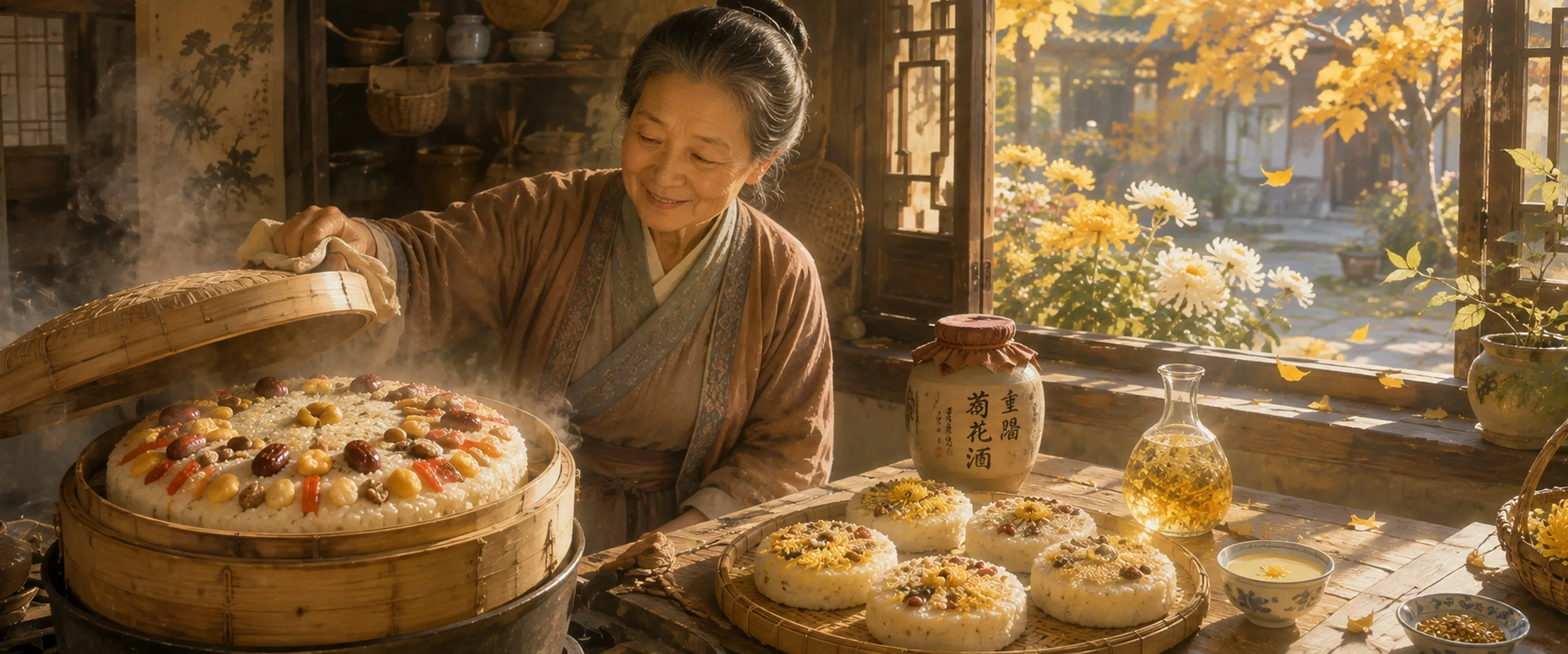
Double Ninth cake differs greatly by region, and there has never been one strictly unified method. Traditional versions use rice flour and bean flour, ferment them, decorate them with fruits such as dates, chestnuts, and almonds, add sugar, and steam them.
Elaborate Double Ninth cakes are made in nine layers like pagodas, with two small sheep formed on top to correspond to the sound of Chongyang through yang (羊, sheep). Some are shaped as small deer and called “deer cakes,” symbolizing the hope that someone in the family will rise in office and gain official emolument; others are shaped as elephants and called “Ten-Thousand-Phenomena Cakes,” symbolizing renewal in all things. Some cakes have a small red paper flag inserted on top and candles lit upon them. Today, Double Ninth cake still has no single fixed form: soft cakes eaten during the festival in different parts of China may all be called Double Ninth cake.
In the rural areas of eastern Qin, wheat flour is the primary ingredient. Walnuts, dates, and other dried fruits are added to make a nine-layer cake two or three feet high, with insects, birds, flowers, and plants of various forms shaped on top. Every layer is rolled, pressed, pinched, combed, and otherwise worked to create patterns and forms, while the entire cake takes the shape of a large cylinder. After steaming, the separate cake sections are stacked layer by layer according to the intended design and covered with red cloth. In addition to presenting cakes as gifts, rural households in eastern Qin also arrange more than one hundred bright red persimmons around the cake.
Double Ninth cake carries several layers of symbolism. First, “ascending step by step.” Because gao (糕, cake) and gao (高, high) are homophones, eating cake symbolizes rising step by step and advancing in one’s career. Second, “everything rising higher.” At dawn on the ninth day of the ninth month, a slice of cake was touched to the foreheads of children while wishing that everything concerning them would rise higher. Third, “longevity through double nine.” A nine-layer cake symbolizes the Double Ninth and expresses the wish for enduring longevity. Fourth, “autumn tasting and ancestor worship.” Double Ninth cake originated as a food made from newly ripened millet in the ninth month and was used to honor gods and ancestors. Fifth, “warding off evil and avoiding disaster.” A small red paper flag inserted in the cake replaced dogwood, while lighting candles substituted for climbing to high places, all with the purpose of avoiding misfortune.
Regional Evolution
Double Ninth cake appears in many forms across China:
- Beijing: Flower cake is a traditional Double Ninth food. It is steamed from wheat flour, layered with two or three tiers of dates, can be as large as a basin, and has colored flags inserted on top.
- Northern China: Northern Double Ninth cakes are mainly wheat-based. They are commonly fermented and steamed, with upper and lower layers of dough and fillings of red dates, peanuts, nuts, sesame, and similar ingredients in between.
- Suzhou-style Double Ninth cake: Made from rice flour blending japonica and glutinous rice, with slightly more glutinous-rice flour. Brown sugar is mixed in during steaming; common fillings include red-bean paste, walnut kernels, and pork fat. The top is decorated with green and red preserved shreds, roses, pine nuts, and melon seeds.
- Henan: Chestnut flour and glutinous-rice flour are mixed with honey and steamed, accompanied by date paste and marked with colored flags.
- Putian-Xianyou, Fujian: Nine-layer Double Ninth rice cakes are steamed in nine stacked layers and are sweet, soft, and pleasant to eat.
- Wuxi: Double Ninth cake and Nine-Grade Soup are eaten.
- Shenyang and Tieling: Leavened cakes are made from yellow millet flour with red-bean filling.
Simple Preparation
- Ingredients: 200 g glutinous-rice flour, 100 g japonica-rice flour, 80 g brown sugar, about 180 g warm water, red dates, walnut kernels, pine nuts, and green and red preserved shreds as needed
- Steps:
- Mix the glutinous-rice flour and japonica-rice flour in a ratio of about 2:1. Dissolve the brown sugar in warm water.
- Gradually add the brown-sugar water to the rice flour while stirring, working it into a loose but moist powder that holds together when squeezed yet falls apart when rubbed.
- Line a steamer with damp cheesecloth, spread in half of the rice-flour mixture, and smooth the surface.
- Add a layer of red-bean paste or chopped red dates, then spread the remaining rice flour on top and smooth again.
- Decorate the surface with red dates, walnut kernels, pine nuts, and green and red preserved shreds.
- Once the steamer is producing steam, place the cake inside and steam over high heat for 25–30 minutes. Remove, cool, and cut into pieces.
Tip: The moisture level of the rice flour is crucial. If it is too wet, the cake becomes sticky and heavy; if too dry, it will be loose and fail to hold its shape. Traditional Double Ninth cake emphasizes “three layers and two fillings,” rising layer upon layer to symbolize advancement step by step.
Readers’ Comments
Calendar and traditional culture enthusiasts from around the world, sharing the same moon.
Sign in or register to join the conversation. Your comment account is created automatically the first time you use a connected account.
No comments yet
Share your thoughts with readers around the world.