
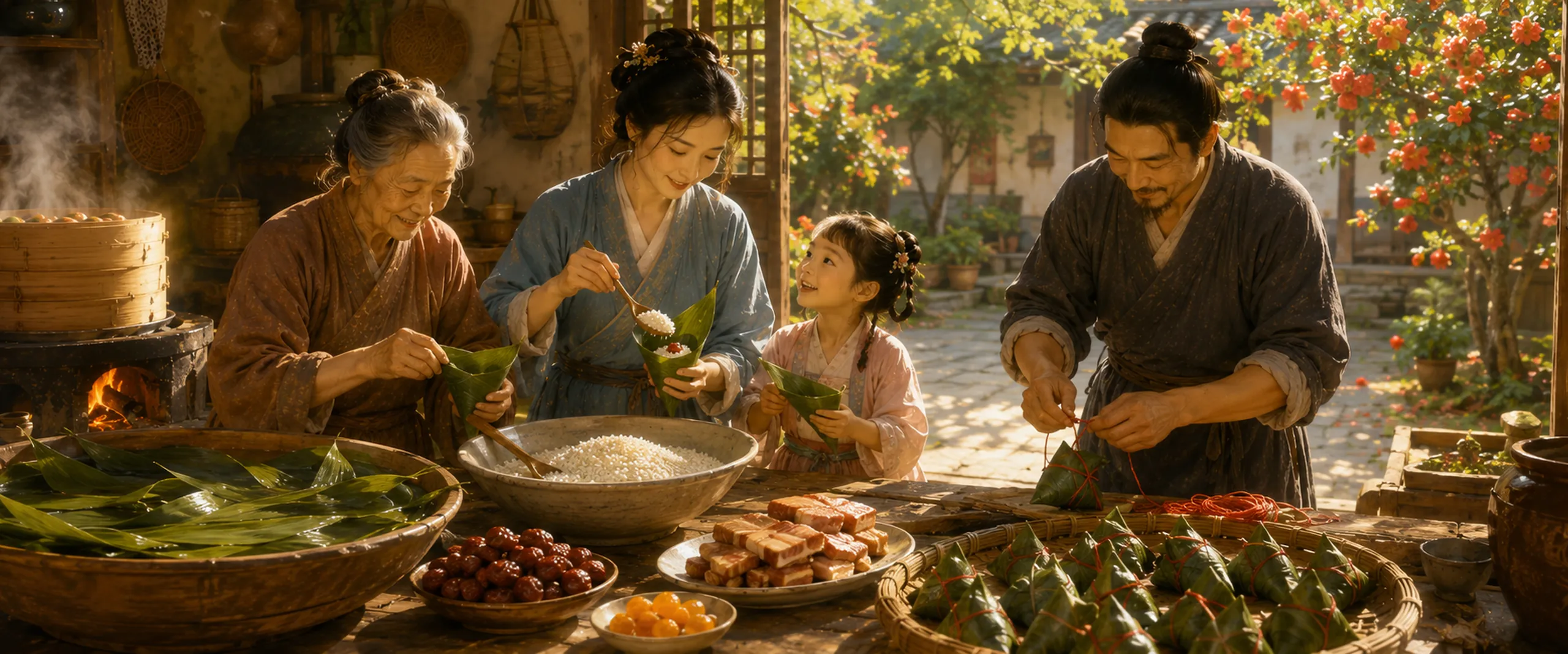

Zongzi (粽子)
Grains & StaplesBasic Information
- Category: Grain staple
- Popular Regions: Nationwide
- Main Ingredients: Glutinous rice, zongzi leaves (bamboo leaves, reed leaves, wild-rice leaves, etc.), fillings (red dates, red bean paste, pork, egg yolk, ham, etc.)
- Alternative Names: Jiaoshu (角黍), tongzong (筒粽), guozong (裹粽), nianshu (黏黍)
Historical Origins
Zongzi are among the traditional foods with the deepest accumulation of cultural meaning in Chinese history. Their origins reach far beyond the later legend commemorating Qu Yuan. They began as a midsummer sacrificial food custom in antiquity, carrying the early intention of honoring heaven and earth and remembering one’s ancestors.
The earliest form was known as tongzong (筒粽), made by packing glutinous grain into bamboo tubes and cooking it in water mixed with plant ash. Distinguished by its color, aroma, and flavor, it was also regarded as a seasonal food capable of clearing heat, reducing internal “fire,” and regulating the stomach and intestines. The appearance of zongzi marked the seasonal transition into summer, signaling a turning point in the annual cycle of life; originally, it carried no special commemorative significance. By the Spring and Autumn period, glutinous grain was increasingly wrapped in leaves of gu—wild rice or Manchurian wild rice—and shaped like ox horns for offerings to ancestors and deities. This form was known as jiaoshu (角黍), literally “horned millet.” The horn shape derived from ancient sacrificial practice: animals with horns were often used as offerings, and their horns were believed to possess a sacred quality linking humans with the divine, through which people prayed for abundant grain and full granaries.
The legend of Qu Yuan’s death by drowning gave zongzi a powerful humanistic dimension. During the Warring States period, Qu Yuan, a minister of the state of Chu, was remembered for his patriotism and concern for the people, but was later harmed by slanderous court officials. According to legend, he threw himself into the Miluo River (汨罗江) on the fifth day of the fifth lunar month. Grieving his death, people began associating it with the Dragon Boat Festival and threw jiaoshu into the river to prevent fish, turtles, shrimp, and crabs from damaging his body, expressing reverence and mourning for a heroic figure. Wu Jun’s (吴均) Xu Qi Xie Ji (《续齐谐记》), written during the Liang dynasty of the Southern Dynasties, was the first text to connect zongzi explicitly with Qu Yuan. It is the earliest surviving written record to unite these two cultural symbols. Historical sources indicate that zongzi were formally established as a Dragon Boat Festival food during the Jin dynasty.
By the Tang dynasty, the rice used for zongzi was described as “white and lustrous as jade,” and shapes such as diamonds and cones appeared. Zongzi became both festival foods and popular local delicacies. The Song dynasty saw the emergence of candied-fruit zongzi, with fruits incorporated into the filling. After the Yuan dynasty, wrappers were no longer limited to wild-rice leaves, with bamboo and reed leaves becoming increasingly common. During the Ming and Qing dynasties, zongzi acquired still more auspicious associations. Tradition holds that candidates sitting the imperial examinations would eat a long, slender zongzi shaped like a writing brush before the test. Known as bizong (笔粽), its name echoed bi zhong (必中), “certain to succeed.”
The Jin-dynasty scholar Zhou Chu (周处) provided the earliest detailed account of the custom of eating zongzi at Duanwu in his Fengtu Ji (《风土记》). When fresh millet ripened in midsummer, people selected full, fresh grains, wrapped them in wild-rice leaves into neat ox-horn shapes, and offered them to heaven, earth, and the ancestors. In earlier periods, the summer solstice and Duanwu fell close together, and the food traditions of the two observances gradually blended. After centuries of development, by the Tang and Song dynasties eating zongzi had become firmly established as a distinctive Dragon Boat Festival custom, continuing for a thousand years without interruption.
Cultural Meaning
At its core, the Duanwu custom of eating zongzi reflects ancient health wisdom adapted to the climate of midsummer. In traditional Chinese medicine, glutinous rice is considered sweet in flavor and warm in nature; it is said to tonify the center, replenish qi, strengthen the spleen, and harmonize the stomach, thereby countering the weakness of the spleen and stomach and loss of appetite associated with midsummer dampness. The bamboo and reed leaves used to wrap zongzi are likewise regarded as natural medicinal materials: cool in nature and sweet in flavor, they are traditionally associated with clearing heat, dispelling dampness, detoxifying, and aiding digestion, thus balancing the heavy, sticky quality of glutinous rice. Warm rice and cooling leaves, one nourishing and one clearing, one warming and one moistening, together create a balance of yin and yang that closely accords with the ancient summer health ideal of nurturing the spleen and stomach while dispelling turbidity and warding off impurity.
The symbolism of zongzi operates on several levels. First, “honoring worthy figures of the past.” Zongzi began as offerings to ancestors and deities and later became associated with the legend of Qu Yuan, turning them into a medium for commemorating revered figures and expressing admiration. Second, “praying for descendants.” The sound of zongzi was associated with zhongzi, interpreted as “gaining a son,” and folk custom held that eating zongzi could bring the birth of a boy. Third, “praying for scholarly success.” Bizong (笔粽) sounds like bi zhong (必中), “certain to succeed,” and therefore symbolized success in the imperial examinations. Fourth, “driving away evil.” According to tradition, wrapping zongzi with chinaberry leaves and multicolored silk threads could protect against aquatic dragons. Fifth, “following the rhythms of heaven.” As a midsummer seasonal food, zongzi embody adaptation to the turning of the four seasons and the harmonization of yin and yang between heaven and earth.
- Ingredients: 500 g glutinous rice, 300 g pork belly, 20 zongzi leaves, cotton string, 2 tbsp light soy sauce, 1 tbsp dark soy sauce, 1 tbsp white sugar, salt to taste
- Steps:
- Soak the glutinous rice for 4 hours, drain, and mix with light soy sauce, dark soy sauce, and salt. Cut the pork belly into pieces and marinate for 2 hours with light soy sauce, dark soy sauce, and white sugar.
- Soak the zongzi leaves in warm water until soft, then wash them thoroughly. Layer 2–3 leaves and fold them into a funnel shape.
- Add a layer of glutinous rice, place a piece of pork belly in the center, and cover with another layer of rice.
- Fold the leaves over tightly and secure firmly with cotton string.
- Place in cold water, bring to a boil over high heat, then reduce to low heat and cook for 3–4 hours.
Tip: Do not soak the glutinous rice for too long, or the final texture may become overly soft. Pork belly with a good balance of fat and lean meat works best; the fat melts during cooking, making the zongzi moist, fragrant, and glutinous. Keep the zongzi fully submerged while boiling and add water if necessary.
Regional Evolution
Across China, zongzi display an extraordinary range of forms and flavors. The differences between north and south reflect a traditional culinary wisdom of adapting to climate and local produce. Broadly speaking, northern China tends to favor sweet zongzi, while southern China prefers savory varieties.
- Beijing: Beijing date zongzi are among the most classic, filled with red dates or red bean paste and often eaten with sugar. Their texture is sticky and resilient, with a clean fragrance. They are commonly shaped as slanted quadrilaterals or triangles.
- Shaanxi: Chilled honey zongzi are popular. They have no filling and are served without their wrappers, simply drizzled with honey or syrup for a cool, sweet, moist taste.
- Xinjiang: Yogurt zongzi are plain white zongzi topped with yogurt or fruit jam, producing a distinctive sweet-and-sour flavor.
- Shandong: Yellow-millet zongzi with red dates are a regional specialty, made by wrapping red dates in large yellow millet. They are sticky and resilient, with a rich date aroma.
- Jiaxing: Jiaxing meat zongzi are representative of the savory southern tradition. Made with glutinous rice and pork belly, they are rich without being greasy, glutinous without becoming overly sticky, and are celebrated as the “King of Zongzi.”
- Huzhou: Huzhou pillow-shaped zongzi resemble cushions and feature a wide range of fillings, including fresh pork, salted egg yolk, and red bean paste.
- Guangdong: Cantonese savory pork zongzi combine glutinous rice, mung beans, salted egg yolk, and pork belly, wrapped in bamboo leaves for a deeply savory aroma. Guangdong also has alkaline-water zongzi, golden in color and commonly dipped in sugar.
- Southern Fujian: Southern Fujian roasted-pork zongzi are filled with glutinous rice, pork belly, mushrooms, chestnuts, and salted egg yolk, developing a rich aroma after cooking.
- Sichuan: Sichuan spicy zongzi incorporate Sichuan peppercorn, chili, and other seasonings into the glutinous rice, producing a distinctive combination of saltiness, heat, freshness, and fragrance.
- Yunnan: Yunnan bamboo-tube zongzi are made by placing glutinous rice together with ham, red bean paste, and other ingredients inside bamboo tubes, then roasting or steaming them so that the rice absorbs the fresh fragrance of bamboo.
- Taiwan: Taiwanese zongzi are broadly divided into northern and southern styles. Northern-style zongzi are stir-fried before steaming, while southern-style zongzi are boiled in water. Common fillings include pork, egg yolk, chestnuts, and mushrooms.
Readers’ Comments
Calendar and traditional culture enthusiasts from around the world, sharing the same moon.
Sign in or register to join the conversation. Your comment account is created automatically the first time you use a connected account.
No comments yet
Share your thoughts with readers around the world.