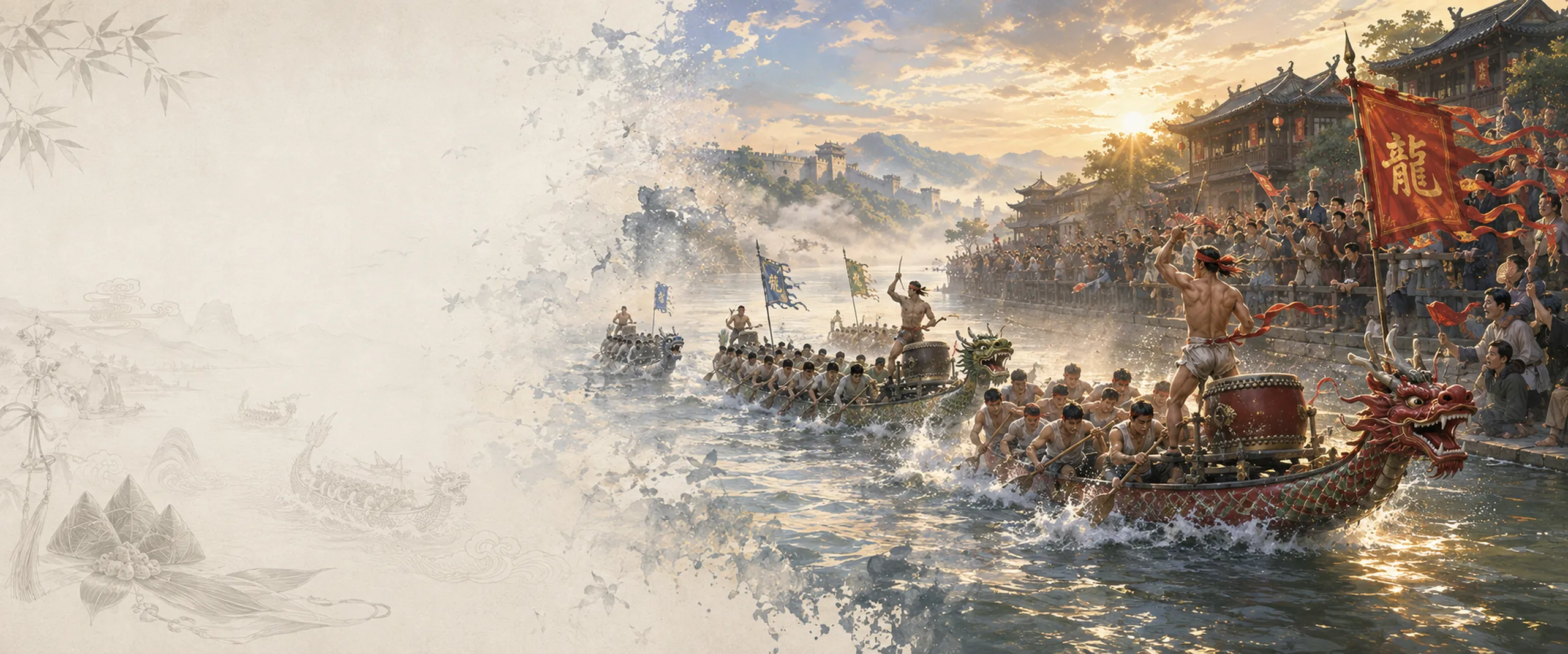
Dragon boat racing is the most recognizable custom of the Dragon Boat Festival. Paddles churn the water and drums thunder across the waves; what is being tested is not merely speed, but the spirit of unity expressed in the idea that “one boat shares one heart.” A traditional dragon boat must pass through a series of elaborate processes, from selecting timber to carving and painting, while the pounding of drums reverberates across the water during the race.
Eating zongzi is another major Dragon Boat Festival tradition. Glutinous rice is wrapped in leaves and cooked, and over centuries this simple food has developed into countless sweet and savory regional varieties. People also hang mugwort and calamus above their doors to ward off harmful influences and seasonal illness, while children wear fragrant sachets and five-colored silk cords as symbols of protection and good fortune.
In 2009, the Dragon Boat Festival was inscribed on UNESCO’s Representative List of the Intangible Cultural Heritage of Humanity, becoming the first Chinese festival to receive this form of international intangible-cultural-heritage recognition.
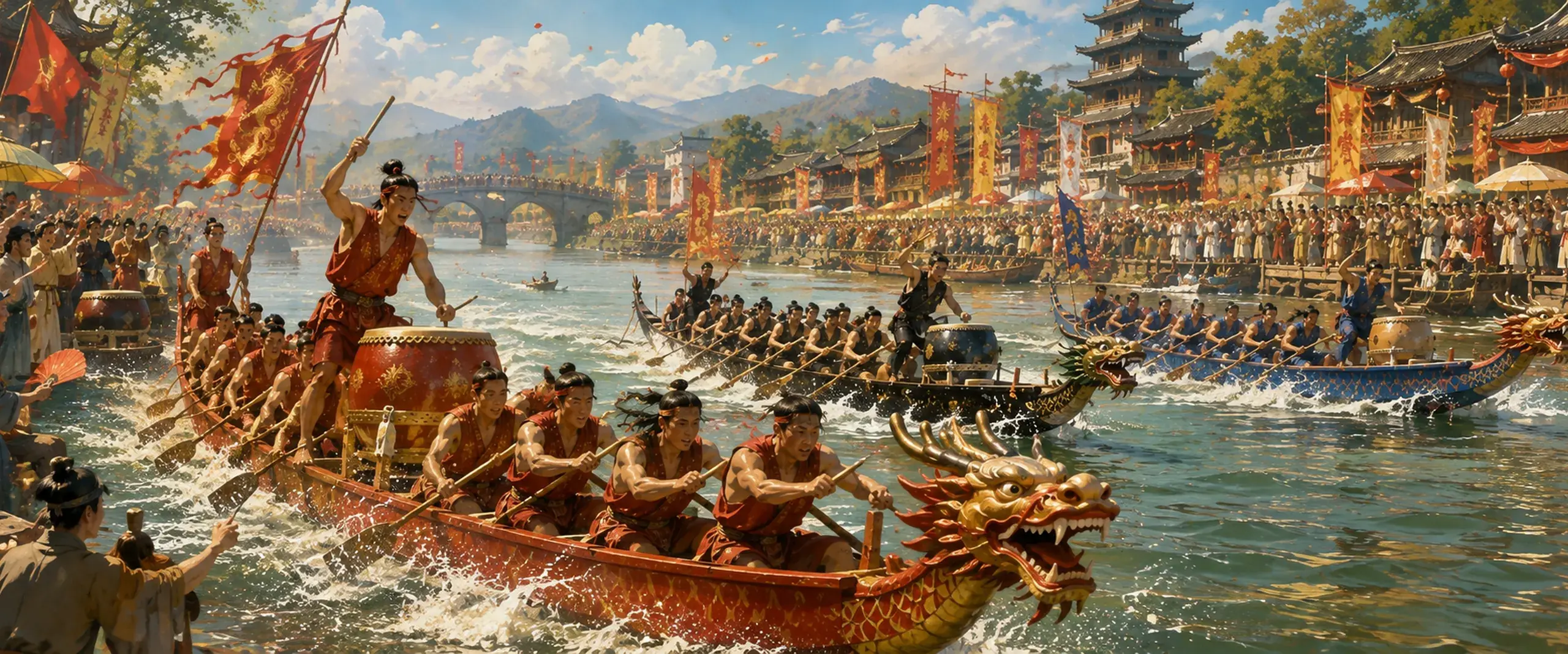
Main Customs
Dragon Boat Racing
Popular regions: Traditionally concentrated in the river and lake regions of southern China; now practiced throughout China and in overseas Chinese communities
Time: On and around the day of the Dragon Boat Festival
Category: Competitive recreation / Ritual
What Happens
Dragon boat racing is the most iconic and exhilarating custom of the Dragon Boat Festival. A dragon boat is a dragon-shaped vessel used specifically for festival races. Dragon boat racing has long been one of the principal customs of the Han Chinese Dragon Boat Festival.
During a race, dozens of paddlers sit along both sides of the boat and drive their paddles through the water in time with the drummer. Paddles churn the waves and drums thunder across the river; what is being tested is not merely speed, but the collective spirit of “one boat, one heart.”
Traditional dragon boats are painstakingly constructed. The process includes selecting timber, building the hull, carving the dragon, and applying painted decoration. A typical boat is long and narrow, with an intricately carved dragon head at the bow and a dragon tail at the stern, while the hull is decorated with painted scales. Dragon heads vary in color from region to region and may be red, yellow, blue-green, white, or other colors.
Besides the paddlers, a racing crew generally includes a drummer, helmsman, and flag bearer. The drummer sits aboard the boat and beats out the rhythm; the helmsman controls the direction; and the flag bearer waves a banner at the bow to raise the crew’s spirits.
The spectacle can be extraordinary: boats race abreast across the river while crowds pack the banks, cheering at full voice. Tang-dynasty poet Zhang Jianfeng (张建封) captured the scene vividly in his Song of the Boat Race (《竞渡歌》):
鼓声三下红旗开,两龙跃出浮水来。 棹影斡波飞万剑,鼓声劈浪鸣千雷。
Today, dragon boat racing is not only an important activity during Chinese traditional festivals; it has also become popular internationally and developed into a competitive sport in many countries.
Historical Origins
There are several explanations for the origin of dragon boat racing. The best-known connects it with the commemoration of Qu Yuan (屈原), the poet and statesman of the ancient State of Chu during the Warring States period. According to legend, Qu Yuan drowned himself in the Miluo River on the fifth day of the fifth lunar month. The people of Chu, unwilling to let their respected minister perish, rushed out in boats to rescue him. They raced as far as Dongting Lake but could not find him. Thereafter, people are said to have raced dragon boats every fifth day of the fifth lunar month in his memory, beating the water and driving away fish so that they would not consume his body.
This explanation appears in works including Wu Jun’s (吴均) Xu Qi Xie Ji (《续齐谐记》, Continuation of Records of Strange and Marvelous Things) of the Liang dynasty and Zong Lin’s (宗懔) Jingchu Suishi Ji (《荆楚岁时记》, Record of the Seasons and Customs of Jing-Chu).
Another explanation holds that dragon boat racing originally formed part of seasonal rites for preventing illness and epidemics. Before the Spring and Autumn period, communities in the Jiangsu-Zhejiang region are said to have conducted dragon-totem rituals through boat races on the fifth day of the fifth lunar month. Other traditions associate the races with Cao E (曹娥), who entered the river in connection with her father’s death, and Wu Zixu (伍子胥), remembered for avenging his father. Dragon boats have also been associated with driving away fish and shrimp, commemorating ancestral spirits, and worshipping water deities.
Written records of Dragon Boat Festival racing can be traced at least to the Northern and Southern Dynasties. Jingchu Suishi Ji records dragon boat competition on the fifth day of the fifth month. Racing was associated with the ancient states of Wu, Yue, and Chu and had become highly popular by the Northern and Southern Dynasties. What may initially have included rites for averting misfortune later acquired moral and commemorative meanings centered on figures such as Qu Yuan, Wu Zixu, and Cao E.
How to Take Part
During the Dragon Boat Festival, visitors can watch races in many river and lake cities of southern China. Miluo in Hunan and Zigui in Hubei are particularly important centers of Qu Yuan and dragon boat traditions, while races in Guangdong, Fujian, Zhejiang, and other regions have distinctive local styles.
Many cities organize public competitions during the festival, and visitors can watch from designated safe areas along the riverbanks. Some scenic areas also offer supervised dragon boat experiences in which visitors can try paddling themselves.
Eating Zongzi
Popular regions: Nationwide
Time: On the day of the Dragon Boat Festival; usually wrapped and cooked the previous day
Category: Food custom
What Happens
Eating zongzi (粽子) is one of the most widespread Dragon Boat Festival traditions in China. Also historically known as zonghe (粽籺), zongzi are made primarily from glutinous rice and fillings wrapped in leaves such as bamboo or other broad leaves. They come in many shapes, including triangular and four-cornered forms. Their history is extremely old, and they were originally used as offerings to ancestors and deities.
Making zongzi requires considerable skill. Tender reed leaves growing beside rivers and ponds are commonly used, while bamboo leaves are preferred in some regions; these wrapping leaves are collectively known as zongye (粽叶). The glutinous rice is first soaked, often overnight. Two leaves are folded into a funnel, filled with rice and other ingredients, and then tightly bound with thread or plant fiber. Finished zongzi may be tied in pairs or sometimes in strings of four.
Families traditionally eat zongzi on the morning of the Dragon Boat Festival in memory of Qu Yuan. They are commonly wrapped the previous day, cooked during the night, and eaten the following morning.
Traditional zongzi are often triangular and named according to their fillings. Plain glutinous-rice dumplings may be called rice zongzi; those containing adzuki beans are bean zongzi; and those containing red dates are date zongzi. The word for date, zao (枣), echoes the word “early” (早), while zhong in zong can evoke “passing” or “succeeding” in popular wordplay. Date zongzi therefore became associated with the wish that a student might achieve success early. In the past, examination candidates might eat them before taking the imperial examinations; even today, some parents prepare them for children before important school or university entrance examinations.
Historical Origins
Zongzi have an ancient history. Early written references are associated with Xu Shen’s (许慎) Han-dynasty dictionary Shuowen Jiezi (《说文解字》, Explaining Graphs and Analyzing Characters). They were originally offerings to ancestors and deities.
During the Spring and Autumn period, millet was wrapped in wild-rice leaves in the shape of an ox horn and called jiaoshu (角黍, “horned millet”). Rice was also sealed inside bamboo tubes and roasted, producing tongzong (筒粽, “tube zongzi”). By the late Eastern Han period, millet could be soaked in alkaline water made from plant ash, wrapped into four-cornered parcels, and boiled—an early form related to the alkaline-water zongzi still found in southern China.
The food later became closely associated with the legend of Qu Yuan. According to tradition, after Qu Yuan drowned himself, people threw rice balls into the river to keep fish and shrimp from feeding on his body. Later, the rice was wrapped in chinaberry leaves and bound with five-colored silk, which legend held would prevent flood dragons from stealing it.
Regional cuisines eventually produced markedly different styles. After zongzi spread northward, northern millet was also used to make jiaoshu. Today, one of the broadest distinctions is between sweet northern-style zongzi and the many savory southern varieties.
How to Take Part
Families can make zongzi together during the festival and experience the traditional wrapping technique firsthand. In northern China, sweet varieties filled with red dates or red-bean paste are common; in southern China, savory versions containing pork, salted egg yolk, and other fillings are popular.
Supermarkets, traditional pastry shops, and restaurants sell numerous varieties during the festival season. Visitors can also travel to places particularly famous for zongzi, such as Jiaxing and Huzhou, to sample local styles.
Hanging Mugwort and Calamus
Popular regions: Nationwide
Time: Early morning on the day of the Dragon Boat Festival
Category: Household blessing / Traditional hygiene custom
What Happens
An old saying goes:
“Willow at Qingming, mugwort at Duanwu.”
Hanging mugwort (艾草) and calamus (菖蒲) is one of the festival’s most characteristic household customs. Families traditionally sweep and clean their courtyards, then place bundles of mugwort and calamus above doorways or hang them inside the main hall. Calamus, mugwort, pomegranate flowers, garlic, and ixora may also be fashioned into human or tiger shapes known as Mugwort Figures and Mugwort Tigers, or woven into wreaths and ornaments.
Traditional practice also developed detailed rules. Because odd numbers were associated with yang energy and the left side was likewise regarded as yang, there arose the saying:
“Hang an odd number, not an even number; hang on the left, not the right.”
Bundles of three, five, or seven stalks might therefore be tied together and hung upside down on the left side of the main doorway. Mugwort, banyan twigs, and calamus might be tied together with red paper before being placed above the entrance.
Calamus was counted among the “Five Auspicious Plants of Mid-Heaven” (天中五瑞). Its long, narrow leaves resemble swords, so it became a symbol for cutting away harmful influences. Daoist ritual specialists sometimes called it the “water sword.”
Behind these beliefs was also an accumulated body of seasonal practical knowledge. The fifth lunar month falls during a hot and humid period when insects multiply and infectious diseases historically became more common. Mugwort’s strong fragrance can repel some insects, while calamus contains aromatic volatile oils. Hanging these plants around doors and windows allowed their scents to disperse through living spaces.
The Dragon Boat Festival has therefore sometimes been described as an ancient Chinese “festival of hygiene.” People cleaned their homes, hung medicinal plants, sprinkled realgar water, and traditionally used realgar wine as part of a broader seasonal effort to remove impurity, deter insects, and protect health.
Historical Origins
The custom has a long history, and one popular legend connects it with the rebel leader Huang Chao (黄巢) during the Tang dynasty.
According to the story, when Huang Chao’s army approached Dengzhou in the fifth lunar month, he encountered a young woman fleeing with two children. Curiously, she carried the older child while making the younger one walk. When questioned, she explained that the older boy was the orphaned son of her elder brother, while the younger child was her own. If she could save only one, she felt obligated to save her brother’s child first.
Moved by her sense of duty, Huang Chao cut mugwort and calamus from the roadside and told her to hang them above her door. He then ordered his soldiers to protect any household displaying the plants. The woman returned to the city and told her neighbors, and soon every household had hung mugwort and calamus. According to the legend, Huang Chao kept his promise and spared them, and the custom subsequently spread.
Traditional Chinese medicine describes mugwort as warming and aromatic, while calamus is likewise valued for its penetrating fragrance. Their volatile oils have been studied for various antimicrobial and insect-repelling properties, which helps explain why aromatic plants became associated with seasonal household sanitation.
How to Take Part
On the morning of the festival, fresh mugwort and calamus can be purchased at traditional markets. They may be tied into bundles of three or five stalks with red cord and hung beside the doorway or window.
Where fresh plants are difficult to obtain, dried mugwort can be found in Chinese herbal medicine shops. For overseas visitors, simply observing the bundles hanging outside homes, shops, and traditional buildings can provide an accessible introduction to the festival’s combination of ritual symbolism and seasonal health practices.
Wearing Fragrant Sachets and Five-Colored Cords
Popular regions: Nationwide
Time: On the Dragon Boat Festival; sachets may be worn throughout the summer
Category: Clothing ornament / Blessing custom
What Happens
Wearing fragrant sachets and tying five-colored cords are important Dragon Boat Festival customs associated with protection and good fortune.
Fragrant sachets are known by several Chinese names, including xiangbao (香包), xiangdai (香袋), xiangnang (香囊), and hebao (荷包). Some are woven from five-colored silk thread; others are sewn from scraps of cloth and filled with aromatic substances. Traditional fillings include Chinese medicinal herbs such as Atractylodes, patchouli, Eupatorium fortunei, Angelica dahurica, and mint. The filling is enclosed in silk or cloth and decorated with five-colored cords, creating small ornaments in an enormous variety of shapes.
Different ages traditionally favored different designs. Elderly people might wear sachets shaped like plum blossoms, chrysanthemums, peaches, apples, lotuses, or a child riding a fish—all carrying auspicious associations. Children preferred animals such as tigers, leopards, monkeys, fighting cocks, or rabbits. For young people, sachets could also become tokens of affection: a young woman might carefully embroider a distinctive sachet and present it to her sweetheart before the festival.
The five-colored cord (五彩绳), historically also called the five-colored longevity thread, is made from threads in blue-green, red, white, black, and yellow—colors traditionally regarded as auspicious. The cord is tied around children’s wrists, ankles, or necks as a protective charm.
According to custom, the cord should not simply be cut off and discarded at random. In different regions it may be removed on the sixth day of the sixth lunar month, during the first major summer rain, or at the child’s first bath after the festival, then cast into flowing water so that misfortune is symbolically carried away. Some Shaanxi traditions associate this act with the celebrated physician Sun Simiao (孙思邈). Children are also traditionally told not to speak while the cord is being tied.
Fragrant sachets were not understood merely as decorative objects. In traditional Chinese medical culture, aromatic herbs worn close to the body were considered part of a broader practice sometimes described as “garment therapy.” Their fragrances were believed to refresh the mind, dispel dampness, support digestion, and help people cope with the humid heat of midsummer.
Historical Origins
The custom of wearing sachets is ancient. Chen Shiliang’s (陈示靓) Suishi Guangji (《岁时广记》, Extensive Records of Seasonal Customs), quoting earlier seasonal writings, describes festival pouches made from red and white colored cloth and threaded with colored cords into flower-like forms. It also records small silk ornaments filled with powdered shell and worn by children to absorb perspiration.
Over time, the contents of such pouches changed—from shell powder, talismans, coins, and realgar powder to aromatic herbs and spices. Their craftsmanship became increasingly elaborate, eventually making the fragrant sachet one of the Dragon Boat Festival’s distinctive forms of folk art.
How to Take Part
Five-colored cords can be tied around children’s wrists or ankles on the morning of the festival. Fragrant sachets can be purchased or handmade and worn on the chest or waist, or attached to a bag.
Making one by hand is also an accessible way to experience traditional craft: choose a fabric, sew it into a small pouch, fill it with aromatic herbs, and decorate it with colorful cords or embroidery.
Realgar Wine and Forehead Painting
Popular regions: Nationwide, historically especially common in northern China
Time: Dragon Boat Festival day
Category: Traditional health and blessing custom
What Happens
The traditional use of realgar wine, or xionghuang jiu (雄黄酒), is one of the best-known historical Dragon Boat Festival customs. Realgar is an arsenic-containing mineral traditionally called “cockscomb stone” in Chinese materia medica. Historically, people mixed realgar with alcohol and used it in rituals intended to repel insects and the so-called Five Poisons.
Realgar wine was also applied to children’s ears, noses, foreheads, wrists, and ankles, traditionally believed to keep mosquitoes, snakes, scorpions, centipedes, geckos, spiders, and other creatures away.
A particularly recognizable custom is forehead painting. Adults use realgar to draw the Chinese character 王 (wang, “king”) on a child’s forehead. The design carries two layers of symbolism: realgar represents protection from poisonous creatures, while the character 王 resembles the markings on a tiger’s forehead. Because the tiger is traditionally regarded as the king of beasts, the mark symbolically transforms the child into a tiger protected against harmful forces.
Local gazetteers and Qing-dynasty seasonal records describe similar customs of applying realgar wine to children’s foreheads, ears, noses, hands, and feet.
Historical Origins and Modern Safety
The custom can be traced back many centuries, and realgar was traditionally believed to counteract numerous poisons.
Modern medicine, however, advises against drinking realgar wine. Realgar contains arsenic compounds, and heating or improper preparation can produce highly toxic substances. Ingestion can cause serious poisoning, including gastrointestinal distress, vomiting, convulsions, coma, and potentially death.
For that reason, the historical practice should be understood today primarily as cultural heritage rather than a recommended health practice. Even topical use may expose the skin to inorganic arsenic, so modern visitors should avoid direct use unless appropriate safety guidance is available.
How to Take Part
The safest way to experience this custom is through cultural demonstrations, museum activities, or symbolic forehead painting with a non-toxic substitute rather than actual realgar. Historical realgar wine should not be consumed.
Warding Off the “Five Poisons” and Seasonal Illness
Popular regions: Nationwide
Time: Around the Dragon Boat Festival
Category: Traditional health and blessing customs
What Happens
The fifth lunar month was historically regarded as a dangerous period of heat, humidity, insects, and disease. The Dragon Boat Festival therefore developed a large group of customs centered on avoiding the “Five Poisons” (五毒).
The exact list varies by region and tradition, but commonly includes creatures such as snakes, centipedes, scorpions, geckos, spiders, or toads. Some folk traditions symbolically countered them by eating five red-colored foods, associating their red color with the blood of the poisonous creatures. Foods could include roast duck, amaranth, salted duck eggs with red oil, crayfish, and historically realgar wine.
Gathering medicinal herbs is another important festival activity. In earlier times, people traveled into the countryside together to collect herbs. Folk belief held that plants were especially potent around the Dragon Boat Festival. Mugwort, calamus, and numerous medicinal plants were gathered, dried for later use, or boiled to prepare herbal bathing water.
Herbal bathing became an important festival practice in its own right and was traditionally believed to cleanse the body, prevent illness, and remove harmful influences.
Another custom is collecting “noon water” (午时水)—water drawn from a well or river at midday on the festival. Because noon was associated with the height of yang energy, the water was traditionally regarded as especially auspicious. It might be used for making tea, brewing, or bathing.
Historical Origins
Customs for warding off the Five Poisons grew from ancient concerns about summer disease. The fifth lunar month corresponds to the onset of intense summer heat in much of China, when humidity increases and insects multiply. Ancient communities consequently regarded it as a dangerous “poison month.”
Hanging mugwort, displaying calamus, wearing fragrant sachets, gathering medicinal plants, taking herbal baths, and collecting noon water can therefore be understood as parts of a larger seasonal system combining ritual protection with practical hygiene.
How to Take Part
Visitors can gather or purchase mugwort, calamus, and other traditional aromatic plants and learn how they were historically used. Herbal foot baths or baths made with safe ingredients offer one way to experience the custom.
The traditional “noon water” ritual can also be explored symbolically, although modern participants should of course use clean, safe water rather than untreated water from wells or rivers.
Fighting the Hundred Herbs and Gathering Medicinal Plants
Popular regions: Nationwide
Time: Around the Dragon Boat Festival
Category: Folk game / Gathering activity
What Happens
Fighting the Hundred Herbs (斗百草) was one of the most popular traditional Dragon Boat Festival games. In ancient times, people traveled into the countryside to gather medicinal plants and began playing with the plants they collected; over time, the activity developed into a recognized festival game.
One version is physical: two players each hold the ends of a grass or flower stem and interlock the stems. They pull until one breaks; the player whose stem remains intact wins.
Another form is intellectual and is sometimes described as “literary herb fighting.” Participants challenge one another by naming plants and responding with corresponding plant names. The stem-pulling version is accordingly sometimes called “martial herb fighting.”
The game was more than entertainment. It encouraged people to recognize plants, remember their names and properties, and interact socially while gathering herbs. During the Tang and Song dynasties it became a particularly popular seasonal pastime.
Tang poet Bai Juyi (白居易) wrote:
弄尘复斗草,尽日乐嬉嬉
—describing children happily playing with dust and competing with grasses throughout the day.
Historical Origins
The custom can be traced at least to the Northern and Southern Dynasties. Zong Lin’s Jingchu Suishi Ji records that on the fifth day of the fifth month, people went out among the herbs and played the game of fighting grasses.
It became increasingly popular in the Tang and Song dynasties. Tang poet Sikong Tu (司空图) also referred to grass-fighting, while the Song-dynasty urban chronicle Dongjing Meng Hua Lu (《东京梦华录》, The Eastern Capital: A Dream of Splendor) records the activity among Dragon Boat Festival entertainments.
The game thus represents not only recreation, but also a lively folk expression of China’s traditional bencao (本草, herbal materia medica) culture.
How to Take Part
During a festival outing, friends or families can collect common grasses and try the traditional stem-pulling game. Children can also learn the names and uses of local plants, turning the activity into both a game and a form of nature education.
Flying Kites
Popular regions: Southern China
Time: Around the Dragon Boat Festival
Category: Outdoor activity
What Happens
Flying a zhiyuan (纸鸢), the traditional Chinese term for a kite, is associated with the symbolic idea of “releasing misfortune” and praying for good fortune.
Traditional kites are made by pasting paper or silk onto a bamboo framework and decorating the surface with auspicious designs or inscriptions. Once attached to a long line, the kite is carried into the sky by the wind.
In some southern regions, children flying kites during the Dragon Boat Festival was known as fang yang (放殃), literally “releasing calamity.” The idea resembles certain Qingming kite customs: disease, bad luck, and disaster are symbolically sent away with the kite.
Historical Origins
Chinese kite traditions have an extremely long history, with legendary prototypes associated with Mozi and Lu Ban during the Spring and Autumn and Warring States periods.
The word yuan (鸢) originally refers to a bird of prey. Over time, flying a kite acquired various symbolic meanings, including the removal of harmful influences. Its incorporation into Dragon Boat Festival practice therefore fits naturally with the festival’s wider theme of seasonal protection.
How to Take Part
Visitors can fly a kite in an open park or countryside area during the festival. Wishes or auspicious designs can be written or painted on the kite.
Some older customs involved cutting the string and allowing the kite to drift away as a symbol of releasing misfortune. For modern environmental and safety reasons, however, it is better to keep control of the kite and bring it home afterward rather than deliberately releasing it.
“Hiding from Duanwu” and Epidemic-Avoidance Customs
Popular regions: Certain regions throughout China
Time: Dragon Boat Festival day
Category: Protection from illness / Blessing custom
What Happens
“Hiding from Duanwu” (躲端午), also called duowu (躲午, “hiding from noon”), is a distinctive traditional custom. Because the fifth day of the fifth lunar month was historically regarded in some traditions as an inauspicious or dangerous day, newly married daughters might return to their natal families before the festival to symbolically avoid potential misfortune. This custom was particularly widespread in parts of northern China.
The festival also developed a broader range of practices for avoiding the Five Poisons. Families might display pictures of the Five Poisons or embroider their images onto clothing, following the symbolic principle of “using poison to counter poison.” In some places, people remained indoors and displayed an image of Zhong Kui, the legendary demon-queller, to protect the household.
Although the forms vary considerably, these practices share a common concern with the dangers historically associated with the hot and disease-prone fifth lunar month.
Historical Origins
Protective Dragon Boat Festival practices have a very long history. Ying Shao’s (应劭) Han-dynasty Fengsu Tongyi (《风俗通义》, Comprehensive Meaning of Customs) records the tying of five-colored silk around the arm on the fifth day of the fifth month, calling it a “longevity thread.”
Ancient perceptions of the fifth month as dangerous were also connected with ideas about the seasonal struggle between yin and yang. The Liji · Yueling (《礼记·月令》, “Monthly Ordinances” in the Book of Rites) describes the period around the summer solstice in terms of the interaction and contest between yin and yang, life and death. Such ideas contributed to the later notion of the fifth month and fifth day as a dangerous seasonal threshold.
How to Take Part
Modern visitors can learn about the tradition by viewing Five Poisons images, Zhong Kui prints, protective embroidery, and other festival objects in markets or cultural exhibitions.
The custom of a newly married daughter returning to her parents’ home can likewise be understood today as a historical family tradition rather than a literal method of avoiding disease.
Regional Variations
North China
Beijing:Traditionally, people avoided drawing well water during the Dragon Boat Festival and often stored water beforehand, reportedly to avoid “well poison.” Street vendors sold cherries and mulberries, which folk belief held could prevent people from accidentally swallowing flies for the rest of the year. Bakeries also sold Five Poisons Cakes (五毒饼), decorated with motifs representing five traditionally feared poisonous creatures. In Beijing and neighboring Hebei, black mulberries were similarly associated with protection from accidentally swallowing flies, while “Five Poisons” pastries were another customary festival food.
Hebei:In Luan County, families whose children were formally betrothed traditionally exchanged gifts during the Dragon Boat Festival. In Zhao County, local officials gathered south of the city and invited scholars and local notables to drink, feast, and compose poetry, an occasion known as Taliu (踏柳, “Treading the Willows”).
Shanxi:In Xiezhou, men and women wore mugwort leaves in a custom known as “dispelling illness,” while children wore hundred-strand cords around their necks, said to represent “binding the flood dragon for Qu Yuan.” In Xizhou, villages worshipped the Dragon King and hung paper offerings in the fields. In Huairen County, the festival was also known as Zhumen. In Dingxiang County, students presented festival gifts to their teachers. In Lu’an Prefecture, steamed wheat-flour dumplings called baituan (白团, “white dumplings”) were exchanged together with zongzi. In some Jin-speaking areas, steamed yellow millet rice is also a popular festival food.
Inner Mongolia:Eastern Inner Mongolia has the popular communal entertainment known as “Turning the Yellow River” (转黄河), centered on the winding Nine-Bend Yellow River lantern formation. Pastoral communities also preserve traditions such as fire worship.
Northeast China
Liaoning / Jilin / Heilongjiang:Among the Manchu, people traditionally place fotuo (佛托), ritual objects made from willow branches and five-colored paper, at ancestral graves during festival rites. Another Manchu custom is “burying eggs”: before spring plowing, eggs are roasted over a fire beside the fields and then buried in the soil as a symbol of abundant grain harvests. In some places the Dragon Boat Festival is also popularly called the “Willow-Branch Festival.” Small wild-garlic pancakes are another seasonal food.
East China
Shanghai:Customs include eating zongzi and hanging calamus and mugwort. Older traditions also included ancestral rites and offerings.
Jiangsu:In Jiading County, families traditionally bought and cooked croaker during the festival regardless of wealth or social status. Yizheng had a saying meaning “pawn your trousers to buy yellow croaker,” reflecting the importance attached to the fish. In Nanjing, households prepared clean water mixed with a small amount of realgar and two old coins, then used it to wash their eyes in a rite called “breaking fiery eyes”, traditionally believed to prevent eye ailments for the coming year. Wujin was known for nighttime dragon boat races, with small lanterns hung around the boats while flutes, drums, and singing accompanied the competition. Gaoyou traditions include tying hundred-strand cords, displaying Five Poisons images and protective talismans, releasing yellow smoke, and eating the “Twelve Reds.” Children traditionally wore “duck-egg nets,” colorful knotted pouches containing an attractive duck egg and hung from the chest. Elsewhere in Jiangsu, the midday festival banquet could feature the “Thirteen Reds”: four fruits—cherries, red radishes, red loquats, and red cucumbers; four cold dishes—saltwater shrimp, sliced ham, braised pork knuckle, and red-yellow salted eggs; four cooked dishes—red-braised yellow croaker, braised lion’s-head meatballs, red-braised goose, and noodles in red broth; together with realgar wine. Suzhou, Changzhou, Nanjing, and other places traditionally eat the “Five Yellows”: yellow croaker, cucumber, eel, salted duck-egg yolk, and realgar wine.
Zhejiang:In Tonglu County, students in traditional village schools presented gifts to their teachers in a custom called yisi (衣丝). Physicians gathered medicinal herbs at noon, when the celestial “Divine Physician Star” was traditionally believed to be overhead. Jiaxing customs include making zongzi, hanging calamus and mugwort, burning aromatic herbs such as Atractylodes and Angelica dahurica, wearing fragrant sachets, eating the “Five Yellows,” eating the “Five Whites,” and eating slow-cooked eggs. In northern Zhejiang, people traditionally eat “Celestial Master Seal Tofu”, stamped with an image of Zhong Kui (钟馗), the legendary demon-queller. Wuyi in Jinhua, Quzhou, and neighboring areas have a custom of eating garlic. Around Jinhua, married daughters traditionally prepare a “Dragon Boat Festival shoulder-load” for their parents, including bundles of zongzi and gifts such as pork. Ningbo has a similar Duanwu dan (端午担), traditionally consisting largely of fish, meat, goose, wine, and other foods arranged in baskets, with anywhere from four to twelve varieties. Wenzhou is known for a thin, translucent pancake resembling fine silk, filled with mung-bean sprouts, Chinese chives, shredded meat, strips of egg, mushrooms, and other ingredients before being rolled into a cylinder.
Anhui:Customs include walking among and gathering medicinal herbs, married daughters returning to their natal homes, dragon boat racing, eating urban-style zongzi and rural daba cakes, hanging calamus and mugwort, drinking realgar wine, wearing fragrant sachets and five-colored silk ornaments, and “fighting the hundred herbs.” This game generally takes two forms: contestants either challenge one another by naming plants or test the toughness of plant stems. Traditionally, townspeople ate zongzi, while rural communities ate large-leaf cakes. Around Hefei, eel and soft-shelled turtle were eaten as festival foods. Huaining is known for Duanwu ba, made from fine wheat flour and fermented rice starter and steamed on Chinese parasol or lotus leaves. Around He County, the midday meal includes wheat wine, hilsa fish, dried goose, and other dishes in a custom known as “celebrating noon.” In Anqing, the festival is also called the “Fifth-Month Festival” or “Daughters’ Festival,” and women traditionally travel together into the countryside, return to their natal homes, and visit relatives.
Fujian:In old Fuzhou custom, daughters-in-law presented their parents-in-law with longevity garments, shoes and socks, round zongzi, and fans. In Jianyang, the fifth day was regarded as the Medicine King’s day for airing medicinal pouches, and households traditionally prepared sauces. In Shanghang County, small boats were bound with reeds into dragon shapes and played with along the waterfront as a form of racing. In Xianyou, paper offerings were made at Huxiao Pool after the races to commemorate soldiers under Qi Jiguang who drowned there during the Jiajing reign. In Shaowu Prefecture, women made crimson-gauze pouches containing talismans and colorful decorative knots, while young girls wore similar ornaments on their backs, known as douniang (窦娘). In Jinjiang, households eat jiandui (煎堆), pan-fried cakes made with glutinous-rice flour, sugar, crushed fried peanuts, sesame, and other ingredients. A southern Fujian legend connects the food with “mending Heaven” after prolonged festival rains. Seasonal fruits such as waxberries, peaches, plums, and loquats are also eaten and offered to ancestors.
Jiangxi:In Jianchang Prefecture, people traditionally bathed in water infused with numerous herbs to prevent skin ailments. In Xinchang County, realgar and cinnabar were mixed into wine in a rite called “opening the eyes.” In Nanchang, tea eggs and salted boiled eggs are popular festival foods. Other customs include eating zongzi, drinking realgar wine, hanging calamus, mugwort and other herbs, making decorative douniang headpieces, weaving five-colored cords, wearing fragrant sachets, painting children’s foreheads, and racing dragon boats.
Shandong:In Zouping County, everyone traditionally rose early and drank a cup of wine, believed to ward off harmful influences. In Rizhao, children wore seven-colored cords until the first rain after the festival, when the cords were removed and thrown into the rainwater. In Linqing County, boys under seven wore protective charms made from wheat stalks, while girls wore pomegranate flowers. Children also wore yellow cloth shoes handmade by their mothers, with the Five Poisons painted on the uppers in ink, symbolically invoking Qu Yuan to destroy them. In Jimo, people traditionally washed their faces with morning dew.
Central China
Henan:In rural areas of Henan, as in parts of Zhejiang, garlic and eggs are traditionally boiled together and eaten for breakfast during the Dragon Boat Festival.
Hubei:In Bahe Town, Huanggang, ritual Nuo performers wear flowered headdresses and body decoration while sounding metal instruments to drive away epidemic influences. Dragon boat racing is particularly lively in Zigui County, Yichang, on the 13th, 14th, and 15th days of the fifth lunar month, accompanied by sacrificial and soul-summoning rites commemorating Qu Yuan (屈原). The 15th is also known as the “Great Duanyang,” while the 25th is called the “Final Duanyang”; zongzi and calamus wine are consumed much as they are on the main festival day. Zigui also has a custom of leaving a basin of water in the sun at noon and then bathing children in the warmed water, traditionally believed to wash away impurity and illness.
Hunan:Dragon Boat Festival customs along the Miluo River are recognized as national intangible cultural heritage. In addition to eating zongzi, hanging mugwort and calamus, drinking realgar wine, and racing dragon boats, distinctive customs include carving dragon heads, obtaining sacred timber, singing words of praise, launching dragon boats, tying red cloth to the dragon head, visiting temples, worshipping the dragon, and commemorating Qu Yuan. Traditional Miluo dragon boats have a “flying-duck” form with a dragon head and phoenix tail. Before entering the river, the master craftsman must perform rites including worshipping the dragon head, adding red cloth, and “opening the eyes.” Miluo also has the custom of “seizing dragon water”: at first light, people hurry to the river to collect water. In You County, families of pregnant women make offerings before the dragon head to pray for a safe delivery. In Yuezhou Prefecture, racing was regarded as a means of averting disaster and illness, while grass boats were floated downstream in a rite known as “sending away pestilence.” Folk sayings include, “Better to leave a field uncultivated for a year than lose the boat race in the fifth month.”
South China
Guangdong:Cantonese communities commonly call dragon boating pa longchuan (扒龙船, literally “paddling the dragon boat”). In Guangfu villages, dragon boat season runs from the first to the fifth day of the fifth lunar month, while in Dongguan’s water towns events rotate among different towns and may continue for about a month. In Shenzhen, dragon boating is also called pa longzhou, and some boats carry a ceremonial parasol. Guangdong has an extraordinary variety of zongzi, including savory pork zongzi, guozheng zong, linpang zong, and alkaline-water zongzi. In Conghua County, people traditionally washed their hands and eyes at noon with water prepared from burned talismans and then splashed it onto the road in a rite called “sending away disaster.” In Xinxing County, temple images were escorted through the community with music, while ritual specialists used consecrated water and talismans to drive away harmful spirits. In Shicheng County, children flew kites in a custom called “releasing calamity.” In Huizhou, an important zongzi tradition is jiaoshu hुकui (角黍互馈), the mutual exchange of rice dumplings among neighbors and relatives. In Guangdong, Hong Kong, and Macao, zongzi may be accompanied by Buzha-leaf tea, traditionally consumed to aid digestion.
Guangxi:Festival activities include dragon dances, lion dances, waist-drum performances, and other folk arts. In southern areas such as Ningming, Chongzuo, and Longzhou, people make ash-water zongzi (灰水粽), soaking glutinous rice in filtered alkaline water made from the ashes of plants such as chinaberry branches. The finished dumplings are pale yellow or brownish yellow and carry a distinctive wood-ash fragrance. People in Guangxi also eat raw or finely sliced meat dishes, glutinous rice, and bitter melon; in some places this association has led to the Dragon Boat Festival being called the “Bitter Melon Festival.”
Hainan:Dragon boat races are held throughout Hainan. Inside the approximately five-hundred-year-old Ming-era city gate at Ding’an, two dragon boats are still stored on stone supports. Coastal and riverside communities in Wenchang hold dragon boat races to pray for safety and good fortune. Hainan’s most distinctive custom is “washing in dragon water” (洗龙水). Rivers and seawater are regarded as “dragon water,” and bathing before or around noon on the festival is traditionally understood as bathing together with the Dragon God and washing away misfortune. The ritual bath may include mugwort, betel-nut flowers, and several other plants. Herbal bathing is also widely practiced alongside dragon boat racing, eating zongzi, and hanging calamus and mugwort.
Hong Kong and Macao:Hong Kong is famous for Dragon Boat Festival racing. In Guangdong, Hong Kong, and Macao, zongzi are also traditionally eaten with Buzha-leaf tea to aid digestion.
Southwest China
Sichuan:Shizhu—now part of Chongqing—has a custom known as “bringing out the Duanwu Old Man.” Four people carry a large table covered with a red carpet on two bamboo poles; on the table sits a bamboo-woven Daoist figure riding a tiger, which is paraded through the streets to the sound of gongs and drums. In old western Sichuan, Chengdu had a festival custom involving throwing plums near a city gate tower; tens of thousands reportedly gathered to watch, but the practice was discontinued in the twenty-first year of the Guangxu reign after a conflict involving foreign missionaries. Leshan, Xinjin, and other places traditionally hold large trade fairs alongside dragon boat races. In parts of Mianyang and Suining, people eat baomian, a dumpling-like food. Across Sichuan, zongzi, salted eggs, and amaranth are common festival foods.
Chongqing:Shizhu preserves the custom of “bringing out the Duanwu Old Man,” while Tongliang is known for traditional performances such as its celebrated dragon dance.
Guizhou:Miao communities in Qiandongnan Miao and Dong Autonomous Prefecture, Songtao Miao Autonomous County, and neighboring areas celebrate a Dragon Boat Festival around the fifth day of the fifth lunar month. In Taijiang County, Miao communities make five-colored zongzi using glutinous rice dyed with natural plants. From the 24th to the 27th day of the fifth lunar month, Shidong Town in Taijiang holds the Miao Dugout Dragon Canoe Festival, called Qia Yang Yong in the Miao language. The canoes are constructed by hollowing out and joining three large fir logs, and paddlers characteristically stand while rowing. The festival was included in China’s national intangible cultural heritage list in 2008. Zhenyuan maintains traditional dragon boat races together with dragon-worship ceremonies incorporating Confucian, Daoist, and Buddhist elements, as well as lotus boats, dragon dances, clam-shell dances, Miao drum dances, and Miao and Dong lusheng dances. Dong communities also prepare fried cakes, rice noodles, and alkaline foods. In some parts of Guizhou, the custom known as “wandering away the hundred illnesses” is popular.
Yunnan:Customs include welcoming deities, presenting ritual offerings, successive libations, receiving sacrificial blessings, and the final wangliao rite for sending off the gods. Some celebrations also feature Han-style historical dress, poetry recitation, Yue opera, and traditional archery. In Pu’er, people traditionally eat medicinal roots rather than zongzi. A local saying goes: “Celebrate Duanwu, eat medicinal roots, renew the stomach and intestines, and stay free of illness throughout the year.” Families purchase anywhere from several to more than a dozen varieties of medicinal roots and stew them with chicken, pork ribs, or ham to make medicinal-root soup. The period around the Dragon Boat Festival is traditionally regarded as an important time for preventing illness, and the festival has gradually developed into a popular “Medicinal Root Festival.” In Bulang villages of Changning County, Baoshan, medicinal dishes combine dozens of fresh herbs—including goat grass, fennel root, and Angelica—with free-range chicken and ham.
Tibet:When Tibetan calendrical festivals fall near or overlap with the Dragon Boat Festival period, traditional activities may include sang smoke offerings with fragrant juniper, guozhuang circle dancing, and hanging prayer flags.
Northwest China
Shaanxi:In Xing’an Prefecture, local officials led their subordinates to watch boat races in an outing called tashi. In Xingping County, small jiaoshu dumpling shapes were sewn from silk, with a tiny human figure attached below, in an ornament known as “playing with dolls.” In Tongchuan County, calamus, mugwort, and paper oxen were pasted on doors in a custom called “suppressing illness.” Shaanxi people also traditionally eat saozi noodles during the festival.
Gansu:In Jingning Prefecture, roses were picked and preserved with honey. In Zhenyuan County, newly married couples were presented with fragrant fans, silk fabrics, handkerchiefs, and mugwort tigers; younger family members also invited their fathers and elder brothers to banquet their teachers in a custom known as “enjoying the festival.” In Zhang County, herdboys worshipped mountain deities, piling and burning firewood before cockcrow in a rite popularly called “burning the high mountain.” Around Minqin County, people steam fan-shaped flour breads known as mian shanzi, said to derive from the custom of giving fans as festival gifts.
Ningxia:Hui Muslim families prepare traditional fried foods such as youxiang and sanzi, while community folk performances known as shehuo may also be held.
Qinghai:Tibetan communities perform guozhuang dances, while shehuo folk performances are also part of local celebrations.
Xinjiang:Han Chinese families make zongzi and hang mugwort, while people from different ethnic communities exchange festival greetings.
Taiwan:Taiwan has a custom of eating jiandui, similar to traditions in Nan’an and Jinjiang in Fujian. One explanation links its transmission to the merging of commemorations of Zheng Chenggong (Koxinga) with the Dragon Boat Festival. People also eat peaches, eggplants, and beans as symbols of health and longevity. Dragon boat racing and zongzi-making are widely practiced.
Closing Note
The folk traditions of the Dragon Boat Festival form a vast cultural panorama woven around two enduring themes: protection from seasonal dangers and remembrance. From the spectacle of dragon boats surging across the river to the fragrance of zongzi rising from countless family kitchens; from mugwort and calamus perfuming household doorways to colorful sachets and five-colored cords worn on the body; from realgar forehead painting and prayers for protection to herb gathering and grass-fighting games that bring people closer to the natural world—the customs of Duanwu preserve both ancient responses to the health risks of summer and the Chinese people’s remembrance of revered figures from the past.
The Dragon Boat Festival is, in one sense, a festival of “driving away poison.” Ancient people regarded the fifth lunar month as an “inauspicious month” and the fifth day as an “inauspicious day.” Through customs such as hanging mugwort, wearing fragrant sachets, using realgar, and painting children’s foreheads, they gradually developed an elaborate system of seasonal protection.
Some of these customs are rooted in beliefs that would today be understood as traditional rather than scientific, yet others also preserve practical observations accumulated through generations: aromatic plants can deter insects, household cleaning reduces sources of disease, and certain herbs contain biologically active compounds. In this sense, the Dragon Boat Festival preserves an important historical record of how earlier communities understood and responded to the health challenges of summer.
At the same time, Duanwu is a festival of remembrance. The tragic story of Qu Yuan, who according to tradition drowned himself in the Miluo River, gave this ancient seasonal festival a profound human and moral dimension. For more than two thousand years, generations of Chinese people have associated dragon boat racing and zongzi with the memory of this celebrated poet and statesman.
Dragon boat racing, once connected with seasonal rites, water worship, and protection from disease, accumulated new meanings as a commemoration of virtuous figures such as Qu Yuan. Zongzi, once used as offerings to ancestors and deities, likewise became food through which remembrance and grief could be expressed. The traditions of the Dragon Boat Festival have therefore continued to expand in meaning as they have been transmitted from generation to generation.
Duanwu ultimately brings together protection and remembrance. Protection safeguards life; remembrance preserves the spirit. One concerns the health of the body, the other the values carried by memory.
The dragon boat on the river embodies both meanings: it surges through the water in an ancient ritual landscape while recalling a figure remembered from more than two millennia ago. The zongzi held in the hand is likewise both food and memory. This concern for both body and spirit, physical life and moral inheritance, is one of the cultural qualities that has allowed the Dragon Boat Festival to remain vibrant across more than two thousand years.
In 2009, the Dragon Boat Festival was inscribed on UNESCO’s Representative List of the Intangible Cultural Heritage of Humanity, becoming the first Chinese festival to receive this international intangible-cultural-heritage recognition.
Its customs vividly embody the traditional Chinese idea of harmony between humanity and nature (天人合一), while also giving everyday expression to enduring feelings of devotion to one’s country, family, community, and cultural inheritance. Between protection and remembrance, the Dragon Boat Festival continues to create a profound dialogue between life and spirit, the present and the past.
—
Readers’ Comments
Calendar and traditional culture enthusiasts from around the world, sharing the same moon.
Sign in or register to join the conversation. Your comment account is created automatically the first time you use a connected account.
No comments yet
Share your thoughts with readers around the world.