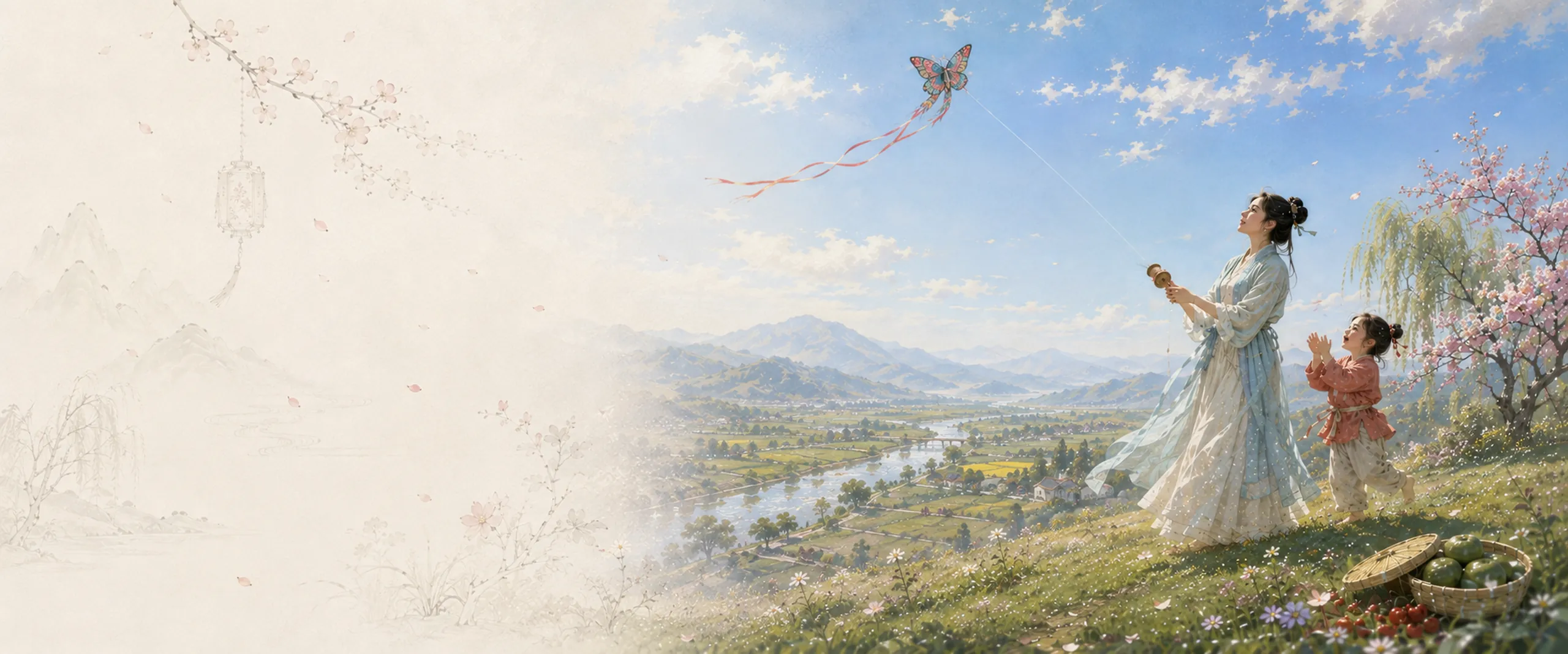

Qingming Festival has a history of over 2,500 years. Du Mu, in his poem “Qingming” (《清明》), wrote: “清明时节雨纷纷,路上行人欲断魂。” (*A drizzling rain falls during Qingming; travelers on the road are overcome with grief.*) The fine rain sets a melancholic tone, capturing the wistful mood of those mourning their ancestors. Tomb‑sweeping is the central custom, expressing filial piety and reverence for the deceased. In addition, spring outings, swinging, cuju (ancient football), and planting willow branches are also widely practiced — as the Cold Food Festival (which coincides with Qingming) required abstaining from fire, people turned to physical activities to stay healthy. Huang Tingjian, in his poem “Qingming” (《清明》), wrote: “佳节清明桃李笑,野田荒冢只生愁。” (*On this fine Qingming day, peach and plum trees bloom with smiles, yet the wild fields and lonely graves only bring forth sorrow.*) This verse captures Qingming’s unique duality — connected both to death and to life. The coexistence of tomb‑sweeping and spring excursions creates the distinctive emotional tension of this festival.
Festival Journey
Origins & Legends
History · Evolution · Legend

Tracing the Source · Historical Evolution
- Zhou Dynasty Qingming was first and foremost a solar term
- Han Dynasty By the Eastern Han dynasty, Qingming as a solar term already had clear agricultural connotations
- Sui and Tang Dynasties The Tang dynasty was a crucial period in the formation of Qingming
- Song and Yuan Dynasties By the Song dynasty, Qingming gradually replaced the Cold Food Festival as the dominant festival, forming a traditional festival centred on ancestor worship and tomb‑sweeping, integrating Cold Food customs with Shangsi spring outings.
- Ming and Qing Dynasties During the Ming and Qing dynasties, the festival largely inherited previous traditions, maintaining and developing Qingming’s essential place as a major festival.
- Modern Era On 20 May 2006, Qingming was officially inscribed on China’s first list of National Intangible Cultural Heritage with the approval of the State Council
Festival Customs
Customs · Local Traditions · Everyday Life
Festival Foods
Food Traditions · Local Flavors · Taste
Seasonal Flavours · Seasonal Menu
Poetry & Verse
Classics · Imagery · Legacy

Representative Poems · Classic Selections
「清明」
清明时节雨纷纷,路上行人欲断魂。
借问酒家何处有,牧童遥指杏花村。
Global Features
Overseas · Chinese Communities · Celebrations

Overseas Celebrations · Lights of Chinese Communities
The United States is one of the countries with the largest populations of Chinese immigrants in the world. Although Qingming is not a federal public holiday, ancestor-worship activities during Qingming have become one of the most important annual cultural activities for Chinese communities in cities with large Chinese populations, including New York, San Francisco, Los Angeles, and Chicago. Unlike the celebratory atmosphere of the Spring Festival, Qingming activities in the United States carry a deeper historical weight—not only commemorating family ancestors, but also preserving the collective memory of early Chinese immigrants who endured hardship and opened new paths in a new continent. ##### Baltimore Baltimore is the American city where the first recorded arrival of a Chinese immigrant took place, and more than 200 years have passed since the first Chinese person set foot in the city. On April 5, 2025, Baltimore’s Chinese community held a Qingming public memorial at Lorraine Park Cemetery. Organized by descendants of an older generation of Chinese immigrants, the event was attended by about 100 people. Notably, not all participants had traditionally East Asian features—some descendants of early Chinese immigrants have fully integrated into local society, yet they still return to their ancestors’ graves during Qingming. A representative from the Office of the Governor of Maryland also attended the event. Offerings included flowers, food, wine, incense, and joss paper. The food offerings were especially symbolic—chicken, fish, and pork represented animals of the sky, sea, and land respectively. About 200 members of an older generation of Chinese immigrants from the Baltimore area are buried in the cemetery. Some gravestones bear English names, while others bear Chinese names—the characters “王,” “吴,” and “广东台山” remain clearly visible. Many years ago, young men from Guangdong came to Baltimore in search of a better life and sent their hard-earned money back to their hometowns. At first, they could only be buried in one corner of the cemetery; later, a community leader purchased additional burial plots for Chinese residents. A memorial was erected there, providing later generations with a place to honor their ancestors and continue the tradition. One moving story was shared at the event: Mr. Liu, a retired Baltimore police officer, often visits the cemetery to pay respects. During a trip to Beijing one year, he met a friend who mentioned that a relative had once lived and died in Baltimore. Through investigation, Mr. Liu eventually found that relative’s name on a gravestone. The story offered a profound reminder of the close ties within Chinese immigrant communities across time and space. An organizer reflected on the meaning of Qingming: “Our ancestors were known for many admirable qualities, including intelligence, courage, diligence, and perseverance. Yet I believe one quality stands out above all others: ‘sacrifice.’ Whatever their social status, our ancestors made tremendous sacrifices for their families, giving up their own enjoyment and comfort simply to ensure a better future for their children. This spirit of sacrifice remains at the heart of our culture today.” New immigrant parents continue this spirit of sacrifice—working tirelessly to provide their children with the best education and often giving up their own personal time and enjoyment. ##### Salem The Qingming memorial activities in Salem, Oregon, are one of the most distinctly “municipal” examples in North America. On April 5, 2025, Salem municipal officials held a Qingming memorial ceremony at Pioneer Cemetery according to Chinese tradition, commemorating 122 Chinese ancestors buried there who had made outstanding contributions to the city’s early development and construction. Salem Mayor Julie Hoy attended in person, proclaimed April 5 “Qingming Festival Day in the City of Salem,” and personally cleaned the altar dedicated to the Chinese pioneers. The ceremony has continued for many years since it was first held in 2018. The city’s Historic Landmarks Commission has established permanent markers at the former Chinatown site, Pioneer Cemetery, downtown, and other locations, presenting to the public the contributions of Chinese pioneers to Salem’s historical development. The mayor compared the seven-year development of the project to “good seeds, good soil, sunlight, and water.” Students from Willamette University recited classical poems such as 《清明》 in Chinese and performed traditional music. Nearly 100 people attended, including descendants of Chinese pioneers, renowned writers, archaeologists, and representatives of multiple overseas Chinese organizations. ##### Chicago The Chinese Consolidated Benevolent Association of Chicago was founded more than 130 years ago and has witnessed generations of Chinese people building their lives in a foreign land. On March 23, 2026, the association went to the Chinese cemetery in the suburbs of Chicago to hold a Qingming ancestor-worship ceremony. The ritual followed traditional rites: participants offered incense and wine in sequence and performed three bows. Chen Dawei, chairman of the Chinese Consolidated Benevolent Association of Chicago, said that holding the Qingming ancestor ceremony every year is not only a way to remember those who came before, but also a reminder to later generations not to forget their origins and to carry forward the hardworking spirit of the early Chinese pioneers. Lei Qi, director of the Chinese Culture and Education Center in Chicago, said that the spirit of honoring the departed and remembering distant ancestors carries even greater symbolic significance overseas in uniting the Chinese community and connecting it with its culture. ##### San Francisco Bay Area On April 12, 2026, the third San Francisco Bay Area Chinese “Tracing Roots and Honoring Ancestors · Blessings for Future Generations” trans-Pacific memorial ceremony was solemnly held at Golden Gate Cemetery. Jointly organized by the North American San Francisco International Ladies Charity Alliance and the San Mateo Metropolitan Lions Club, the event included candle offerings across the ocean, a collective Taoist blessing and memorial ritual, presentations on traditional Chinese culture, and unified incense offerings by guests. The ceremony opened to the gentle yet mournful sound of a violin and piano duet. Several guests shared reflections on commemorating life and transmitting culture. The conviction conveyed by the ceremony was: “Never forget where you came from; never lose your original heart.” ##### New Jersey On April 11, 2026, the United Chinese Association of New Jersey organized Chinese residents of the state to gather before the gravestone of Chinese railroad workers in the cemetery of the Dutch Reformed Church in Belleville, New Jersey, for the annual memorial ceremony honoring the first group of Chinese laborers in the eastern United States. More than 150 years ago, some Chinese laborers who had participated in the construction of American railroads moved to New Jersey and received shelter from the Dutch Reformed Church in Belleville. The remains of 68 Chinese laborers were buried in the church cemetery. In 2019, the late chairman Lin Jiehui led the association in erecting a memorial stone there. At the event, Dr. Wang Jian performed the song 《地下室的碑文》, written especially for the Chinese laborers by Liu Youjun, former president of the Livingston Chinese Association. Hu Shiyuan, the new chairman of the United Chinese Association of New Jersey, reviewed the process of establishing the memorial. Representatives from different sectors said that commemorating the pioneers is not merely about remembrance and gratitude, but also a source of spiritual encouragement. ##### New York In New York, Wenzhou people living in the United States have a distinctive way of continuing tradition—their hometown association organizes collective visits to cemeteries to honor their ancestors. Every Qingming, the American Wenzhou Association organizes collective tomb sweeping at Rose Cemetery and Geely Cemetery in New Jersey. Both cemeteries contain “auspicious burial grounds” purchased by the association, providing resting places for elderly fellow townspeople who died without being able to afford burial plots, as well as for predecessors who made outstanding contributions to the association. Association president Wang Chongzhang said: “Every year we come to sweep graves during Qingming not only to remember those who came before us, but also to express our respect for and appreciation of the bonds among people from the same hometown.” At the same time, many Chinese families continue the tradition of visiting graves individually. One Chinese woman whose entire family had moved from New York to Texas many years earlier flew back to New York specifically to visit her father’s grave. She said: “I must come back to sweep my father’s grave during Qingming… so that the children born and raised here can see their parents’ commitment to Chinese traditional customs.” Maple Grove Cemetery in New York City receives large numbers of Chinese visitors for tomb sweeping every year. Fo Guang Shan New York Buddhist Temple also went to Maple Grove Cemetery on April 9, 2025, to hold a Qingming memorial Dharma service, the first time in 14 years that the New York temple had once again worked with the cemetery to hold such a service. Chinese communities in Los Angeles likewise carried out ancestor worship and tomb-sweeping activities during Qingming, while cemeteries introduced crowd-control measures to cope with peak visitor numbers. Zhao Wensheng, chairman of the Chinese Consolidated Benevolent Association of New York, said that the purpose of Qingming commemorative activities is “to ensure that we and the next generation do not forget the traditions of our own people, and to remember that without the arduous pioneering work of those who came before us, Chinese Americans would not have achieved what we have today.”
Canada likewise has a large Chinese community. Qingming memorial activities use monuments to early Chinese pioneers as spiritual landmarks, creating solemn and dignified collective rituals. Multiculturalism is a national policy in Canada, and government officials and legislators at different levels actively participate in Qingming activities, giving the festival official cultural recognition in Canada. ##### Toronto Toronto is the Canadian city where Qingming memorial activities are most concentrated. Every April 5, the Chinese Consolidated Benevolent Association of Ontario and the Toronto Lin Jiumu Association jointly hold a “Qingming Memorial Ceremony for Early Chinese Pioneers” before the Chinese Pioneers Memorial at Mount Pleasant Cemetery in Toronto. Through rituals including laying flowers, offering incense, pouring libations, and presenting offerings, the ceremony commemorates early Chinese pioneers, embodies the principle of honoring the departed and remembering distant ancestors, and strengthens solidarity among overseas Chinese associations. The director of the Toronto office serves as chief officiant and leads participants in three bows, paying the highest respect to generations of Chinese pioneers and remembering the arduous struggles through which they opened new paths. Lin Shurong, co-chairman of the Chinese Consolidated Benevolent Association of Ontario, reviewed the background to the monument’s establishment—many early single Chinese immigrants in Canada had no one to rely on, and their funerals were often handled by the association’s charitable burial group. As times changed, funds accumulated through years of charitable burials, together with donations from the Chinese community, were used in 1990 to build the “Ontario Memorial to Generations of Chinese Pioneers.” He emphasized that early Chinese crossed the ocean to Canada, endured immense hardship, and participated in the construction of the Pacific Railway, laying a solid foundation for later Chinese communities. ##### Victoria The Chinese Cemetery in Victoria has been designated a National Historic Site of Canada. On April 5, 2026, the Victoria Chinese community held its Qingming spring memorial ceremony there. The director of the Vancouver office served as chief officiant, and the ceremony was solemn and grand. A number of traditional Chinese associations in Victoria participated, including the Lee Benevolent Association, the Wong Clan Association, and the Chinese Consolidated Benevolent Association. An overseas Chinese affairs advisory committee member over 90 years old, who was extremely familiar with the local Chinese community, also attended in person. ##### Nanaimo In Nanaimo, Canada, the Nanaimo Hongmen organization and the Nanaimo Chinese Association continue the Chinese tradition of honoring the departed and remembering distant ancestors by organizing Qingming ancestor-worship activities, allowing Chinese culture to continue flourishing and to be passed down from generation to generation in the Nanaimo region. ##### British Columbia On Qingming Day in 2025, British Columbia Premier David Eby issued a Qingming statement, saying, “We join everyone in remembering the lives of beloved family members and friends.” British Columbia MLA Teresa Wat also called in the provincial legislature for tribute to be paid to early Chinese pioneers during Qingming, saying: “Qingming is a tradition passed down from generation to generation, carrying remembrance and respect.” This official recognition from the provincial government has given Qingming a mainstream cultural standing in Canada that extends beyond the Chinese community.
Although the number of Chinese immigrants in Latin America is smaller than in North America, Qingming traditions remain deeply rooted in countries including Peru, Mexico, and Cuba. Panama has one of the “world’s three great Chinatowns,” and Qingming ancestor worship there has formed a distinctive integration with local Catholic culture—some Chinese families, after honoring their ancestors during Qingming, also go to church to have Mass said for the deceased. Havana’s Chinese Cemetery in Cuba is one of the largest Chinese cemeteries in the Western Hemisphere; every Qingming, Chinese associations in Cuba hold public memorial activities there to commemorate early Chinese pioneers. The Chinese community in Lima, Peru, retains the tradition of Qingming tomb sweeping, combining Chinese-style offerings with local ingredients and creating distinctive Qingming food customs with something of a “Peruvian New Year flavor.”
Chinese people make up a relatively large proportion of Malaysia’s population. Although Qingming is not a public holiday, Chinese Malaysians continue to sweep graves and honor their ancestors. Public Chinese cemeteries are generally known as “义山”, and local people therefore often say that Qingming means “going up the hill to sweep graves” or simply “拜山”. On Qingming Day, worshippers first clean the graves, then arrange flowers, fruit, and other offerings before lighting incense. According to local custom, before sweeping the grave one must first worship the local Earth God—Datuk Gong. The Chinese community in Kuching, Sarawak, retains strong Qingming customs. One or two weeks before Qingming, many families already begin visiting the “义山” to sweep graves and honor their ancestors. Unlike the large extended-family collective worship common in China, Chinese families in Kuching are more inclined to arrange their own time for ancestor worship. Offerings generally include incense and candles, gold and silver paper effigies, fruit, flowers, fa gao, tea, wine, a whole chicken, pork, and other items. After tomb sweeping, there is also a custom of bathing with mugwort leaves. Twenty-two-year-old Chinese Malaysian Yang Qianwei believes that Qingming carries profound cultural meaning and that young people are willing to continue the tradition. Chinese Malaysians also use the term “古清明”—some local Fujianese or Teochew people call the third day of the third lunar month “古清明” or “老清明,” traditionally a day for sweeping graves and honoring ancestors. In recent years, more and more families have chosen to arrange tomb sweeping flexibly within about ten days before or after the actual festival date, both to avoid crowds and traffic congestion and to make it easier to coordinate family members’ schedules. Around one week before Qingming, crowds already begin appearing at the various 义山 and Chinese cemeteries.
Visitor Guide
Preparation · Etiquette · Take Part with Confidence
Readers’ Comments
Calendar and traditional culture enthusiasts from around the world, sharing the same moon.
Sign in or register to join the conversation. Your comment account is created automatically the first time you use a connected account.
No comments yet
Share your thoughts with readers around the world.