The formation of the Dragon Boat Festival did not originate from a single event or tradition, but from the gradual fusion of multiple cultural sources over a long historical period. These sources include ancient celestial worship, the dragon‑totem sacrifices of the Baiyue peoples, and the concept of the fifth day of the fifth month as an inauspicious day with evil‑warding customs from the pre‑Qin period onwards. Converging from different directions, they jointly formed the foundation of the Dragon Boat Festival.
Celestial Astronomy
The origins of the Dragon Boat Festival can be traced back to ancient celestial worship. This is one of the oldest and most essential cultural sources of the festival.
In ancient times, the Chinese had already developed refined observations of the stars. The ancients divided the stars near the ecliptic into twenty‑eight mansions, among which the seven eastern mansions — Horn, Neck, Root, Room, Heart, Tail, and Winnowing Basket — were imagined as the image of a green dragon, known as the “Azure Dragon of the East.” In midsummer, all seven mansions of the Azure Dragon appear in the center of the southern sky, presenting their most complete and prominent form. This specific celestial phenomenon is the most primitive astronomical basis of the Dragon Boat Festival.
The fifth line of the Book of Changes · Qian Hexagram states: “The flying dragon is in the sky.” The Book of Documents · Canon of Yao records: “When the day is longest and the star Huo is in the south, this marks midsummer.” The Xia Xiaozheng also records: “At dusk of the fifth month, the Great Fire is in the south.” “Great Fire” refers to Antares, the main star of the Azure Dragon. These ancient documentary records all point to the same astronomical phenomenon: in midsummer, the Azure Dragon constellation rises to the center of the southern sky. The ancients designated the day of the “flying dragon in the sky” as the Dragon Festival, and dragon and dragon boat culture have always run through the inherited history of the festival.
The Dragon Boat Festival has a very close astronomical connection with the Summer Solstice. In fact, the original time node of the festival was most likely the Summer Solstice. As scholars have pointed out: “As one of the particularly important festivals of summer, the content of the Dragon Boat Festival bears the characteristics of summer.” The name “Duan Yang” provides a clue — Duan Yang means the extreme point of yang energy. This means yang energy reaches its peak, clearly referring to the Summer Solstice solar term. In ancient times, at dusk of the Summer Solstice, the celestial phenomenon of the “flying dragon in the sky” could be observed. In ancient times, people believed that the dragon was a yang creature, ascending to heaven at the Spring Equinox and descending into the abyss at the Autumn Equinox. Therefore, the Azure Dragon constellation reaching its highest point at the Summer Solstice expressed the astronomical meaning of “Duan Yang.” The ancients also called the festival the “Heavenly Center Festival,” which contains the same idea.
Mr. Huang Shi, in his History of Duanwu Rituals and Customs, proposed that the Dragon Boat Festival, like a trickling stream, originated in ancient times, merged into a river in the Three Dynasties, expanded into a river in the Qin and Han, and absorbed hundreds of streams to become a lake and sea in the Tang and Song. This judgment profoundly reveals the long evolutionary process of the festival from celestial astronomy to folk custom. China’s ancient astronomical culture has a long history. The formation of the Dragon Boat Festival’s dragon‑sacrifice rituals is related to primitive beliefs, sacrificial culture, the celestial‑stem and earthly‑branch calendar, and the celestial phenomenon of the Azure Dragon’s seven mansions being due south.
Totem Worship
Among the various academic discussions on the origin of the Dragon Boat Festival, the “totem worship theory” of the renowned modern scholar Wen Yiduo has had the most far‑reaching influence. In his articles “A Study of Duanwu” and “The Historical Education of Duanwu,” Wen Yiduo systematically expounded the view that the Dragon Boat Festival originated from the dragon‑totem sacrifices of the ancient Wu and Yue peoples.
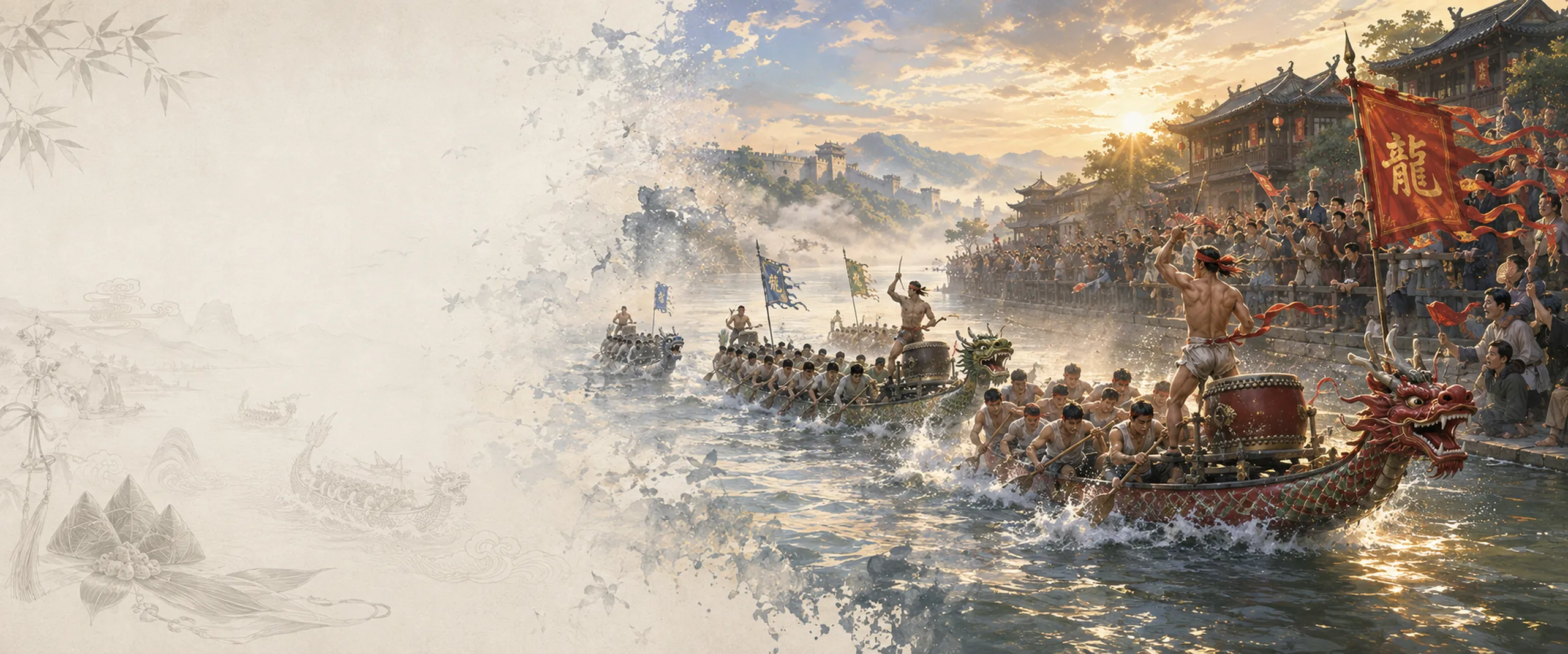
Wen Yiduo consulted a large number of ancient records and sorted out the close connection between Duanwu customs and the “dragon” from the literature. He found that the core customs of the Dragon Boat Festival — dragon boat racing, eating zongzi, and tying five‑colored silk threads — all have countless connections with the dragon. Dragon boat racing goes without saying, and zongzi were also to prevent the dragon from stealing offerings. The two major events of dragon boat racing and eating zongzi are both related to the water god, namely the dragon. Dragon boats have dragon decorations, and zongzi are stuffed with chinaberry leaves and tied with five‑colored silk — although folklore says this is “what the dragon fears,” conversely it precisely shows the connection between zongzi and the dragon; originally, zongzi were likely thrown into the water to entertain the dragon.
Wen Yiduo further associated this with the custom of “cutting hair and tattooing the body” in the ancient Wu and Yue regions. The ancient Yue people took the dragon as their totem. To show their identity as “dragon descendants,” they not only had the custom of cutting hair and tattooing the body, but also held a grand totem sacrifice on the fifth day of the fifth lunar month each year. The tattoos were dragon patterns; the Wu and Yue peoples should have been dragon‑totem peoples. Dragon boat racing was a “semi‑religious, semi‑entertaining event in the sacrificial ritual.”
Based on these investigations, Wen Yiduo concluded: The Dragon Boat Festival was originally a festival of the Wu and Yue peoples for holding dragon‑totem sacrifices. Its actual origin long predates Qu Yuan, and it is “as ancient as the Chinese people themselves.” He believed that dragon boat racing and eating zongzi also originated from the ancients’ worship of and sacrifice to the dragon. The Dragon Boat Festival may initially have been merely a custom of the Wu and Yue peoples in the lower Yangtze region. Since the Eastern Han dynasty, as the Wu and Yue territories were gradually opened up, and through the mutual blending of Wu‑Yue culture and Central Plains culture, the festival gradually spread to the upper Yangtze and the northern regions.
Wen Yiduo’s “Dragon Sacrifice Theory” has been confirmed by later archaeological discoveries. According to prehistoric cultures at the Hemudu site and the Tianluoshan site, as early as 7,000 years ago, there were dugout canoes and wooden paddles. The original form of dragon boats was a dugout canoe carved with dragon motifs, later developing into dragon‑shaped boats made of wooden planks. Archaeological discoveries — dugout canoe remains from the Hemudu site 7,000 years ago, and dragon boat racing motifs on bronze vessels from the Spring and Autumn period — all confirm that dragon boat culture predates the era of Qu Yuan. The fifth day of the fifth month in the Yangtze basin coincided with the period after rice transplanting; the earliest form of dragon boat activities was an important activity in people’s agricultural production at that time, namely praying to avoid water damage, pray for rain, and eliminate disasters and diseases.
Although Mr. Wen Yiduo’s views remain academically controversial, as an interpretation of the festival’s origin that cannot be ignored, they inspire us to think about the relationship between the evolution of Chinese civilisation and historical reality.
The Dragon Boat Festival originated in China, initially as a totem sacrifice festival held by tribes in the ancient Baiyue region (the middle and lower Yangtze River and southwards) that worshipped the dragon totem. Before the Spring and Autumn period, the Baiyue region had the custom of holding tribal totem sacrifices in the form of dragon boat races on the fifth day of the fifth lunar month. According to research, the custom of dragon boat racing predates Qu Yuan. The ancient Yue people took the dragon as their totem. To show their identity as “dragon descendants,” they not only had the custom of cutting hair and tattooing the body, but also held a grand totem sacrifice on the fifth day of the fifth lunar month each year, which included games similar to today’s races. The Wu and Yue regions had the custom of cutting hair and tattooing, and they took pride in dragon tattoos — a relic of dragon totem worship. The northern Hu people and the southern Yue people both had the custom of “inviting the dragon,” held several times a year, with the fifth lunar month being the most grand. Therefore, Wen Yiduo believed that the Dragon Boat Festival was a festival in which the Wu and Yue peoples held totem sacrifices, and through the process of north‑south integration, it gradually spread to all parts of the country.
Inauspicious Month and Day
As early as the pre‑Qin period, the fifth month was considered an “inauspicious month.” The Book of Rites · Monthly Ordinances states about the fifth month: “When the day reaches its longest, yin and yang contend, and life and death are divided.” In this month, yang energy reaches its peak and yin energy begins to rise — it is an inauspicious month of yin‑yang transition. The ancients believed that the fifth month was a season of yin‑yang struggle and life‑and‑death combat, hence the concept of an inauspicious month and day.
The Han dynasty Ying Shao’s Comprehensive Meanings of Customs records: “It is commonly said that taking office in the fifth month leads to dismissal without promotion,” and “building a house in the fifth month makes one bald.” Even children born on the fifth day of the fifth month were considered unlucky: “It is commonly said that a child born on the fifth day of the fifth month will harm the father if male and the mother if female.” This concept was already popular from the Warring States period at the latest. One of the Four Gentlemen of the Warring States, Lord Mengchang, was born on the fifth day of the fifth month. His father, Tian Ying, believed that he would bring harm to his parents when he grew up, and ordered his mother to abandon him. His mother could not bear to do so and secretly raised him, which shows how great the influence of the inauspicious month and day was.
The Han people believed that the fifth day of the fifth month was an inauspicious month and day, and had the custom of “not raising children born in the fifth month” — children born on the fifth day of the fifth month, whether male or female, could not be raised to adulthood. Once raised, “a male harms the father, a female harms the mother.” Sima Qian’s Records of the Grand Historian · Biography of Lord Mengchang also involves this concept. Lord Mengchang, born on the fifth day of the fifth month, was nearly abandoned by his father; his mother hid him and raised him to adulthood, and the result did not harm his father. In addition, there were sayings such as “taking office in the fifth month leads to dismissal without promotion,” and “building a house in the fifth month makes one bald.” These superstitious sayings are clearly recorded in Han‑dynasty texts such as Comprehensive Meanings of Customs and Discourses Weighed in the Balance. This fear and taboo of the fifth day of the fifth month was the direct cause of the many evil‑warding customs of the Dragon Boat Festival.
To ward off the evil of the inauspicious month and day, the ancients invented many rituals to avoid calamities and ward off evil. The Da Dai Li Ji records: “On the fifth day of the fifth month, store orchids for bathing.” Qu Yuan’s Songs of Chu also says: “Bathe in orchid water, wash in fragrant blossoms.” Using orchid water to ward off evil was because orchids have detoxifying and cooling properties, and also have a clear fragrance. The Xia Xiaozheng records: “On this day, gather medicinal herbs to eliminate toxic vapors.” The custom of gathering herbs can be traced back to the legendary Shennong tasting hundreds of herbs.
According to the Book of the Later Han · Treatises on Rites, on the fifth day of the fifth month, “red cords and five‑colored seals were used as door decorations to stop evil vapors with exorcism.” The Han people also tied five‑colored silk threads around their arms to ward off evil. Ying Shao’s Comprehensive Meanings of Customs records: “On the fifth day of the fifth month, tie five‑colored silk threads around the arms, called the Thread of Long Life, also called the Thread of Continuing Life… to prevent people from falling ill.” The Jingchu Suishiji records: “Pick mugwort leaves to make figures, hang them on doorways to ward off toxic vapors; use calamus either carved or ground to mix with wine.” Later customs to expel poison and ward off evil included catching toads for medicine, treading on hundreds of herbs, gathering medicinal herbs, picking mugwort, hanging mugwort on doorways, tying five‑colored silk threads around the arms, and drinking calamus wine or realgar wine. In the folk story Legend of the White Snake, the White Lady reveals her true form after drinking realgar wine offered by Xu Xian on Duanwu — a vivid reflection of this custom in folk literature.
As scholar Xiang Baisong has pointed out: “The consciousness of warding off evil can be said to be the driving force behind the formation and development of the Dragon Boat Festival.” The source of the Dragon Boat Festival’s evil‑warding consciousness can be traced back to the ancient custom of gathering herbs to detoxify, containing the most primitive cultural factors, and also the most distinctive cultural factors of traditional Chinese culture. From the pre‑Qin to the Han dynasty, the concepts and rituals of warding off evil developed greatly, which was crucial to the formation and finalisation of the Dragon Boat Festival.
Readers’ Comments
Calendar and traditional culture enthusiasts from around the world, sharing the same moon.
Sign in or register to join the conversation. Your comment account is created automatically the first time you use a connected account.
No comments yet
Share your thoughts with readers around the world.