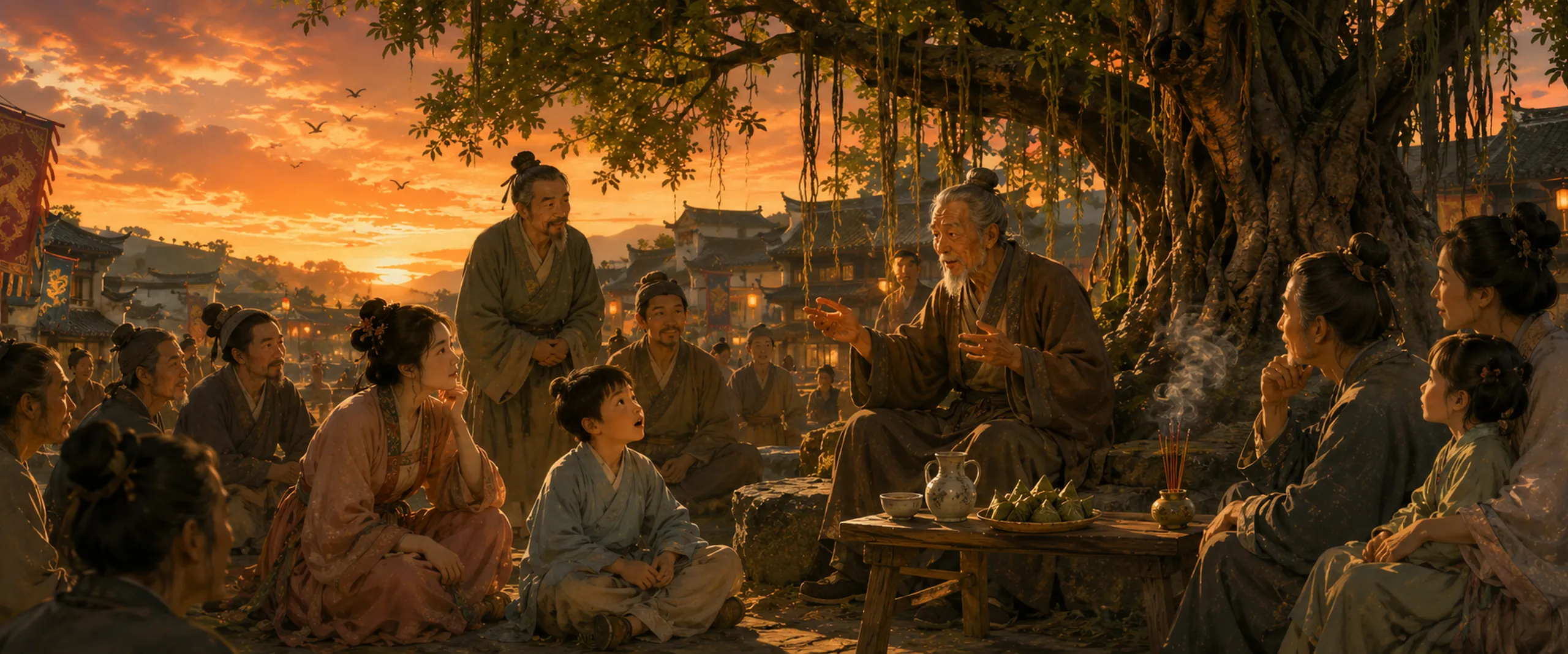
Where did the Dragon Boat Festival come from? Who first spoke of it? The poet opens with a question. On the surface, he is asking about the festival’s origin; in reality, he is guiding the reader toward a deeper reflection on its meaning. The three characters “自谁言” remain restrained and implicit, yet they provoke thought.
Tang poet Wen Xiu wrote in Dragon Boat Festival (《端午》): “节分端午自谁言,万古传闻为屈原。堪笑楚江空渺渺,不能洗得直臣冤”, identifying the remembrance of Qu Yuan as the essential origin of the festival. In Su Shi’s Liuyangling · Tianzhong Festival (《六幺令·天中节》), the lines “粽叶香飘十里,对酒携樽俎。龙舟争渡,助威呐喊,凭吊祭江诵君赋” bring together Dragon Boat Festival customs such as making zongzi, drinking realgar wine, and racing dragon boats with the commemoration of Qu Yuan. Zhang Jianfeng’s Song of the Boat Race (《竞渡歌》), “鼓声三下红旗开,两龙跃出浮水来”, portrays the fierce spectacle of dragon-boat racing. Emperor Xuanzong of Tang, Li Longji, recorded the scene of ruler and ministers feasting together during the festival in “端午临中夏,时清日复长。盐梅已佐鼎,曲糵且传觞”. Amid the festival’s bustle and celebration, Dragon Boat Festival poetry remains consistently threaded with remembrance of the spirit of Qu Yuan.
Historical Development
From the Han Dynasty to the Northern and Southern Dynasties
The term “Dragon Boat Festival” first appears in the Western Jin writer Zhou Chu’s regional account Fengtu Ji (《风土记》): “仲夏端午,烹鹜角黍。” Yet the festival did not arise from a single source. Within the culture of the seasonal calendar, the fifth lunar month fell in midsummer in the traditional understanding. As temperatures rose and humidity increased, customs developed around gathering medicinal herbs, hanging mugwort, wearing fragrant sachets, and bathing in orchid-infused water. These practices embodied simple wishes to avoid harm, cleanse body and mind, and pray for health and safety. According to the research of the celebrated modern poet and scholar Wen Yiduo, dragon-boat racing existed long before Qu Yuan. It was originally a festival activity through which ancient communities worshipped dragon deities and water gods.
After the Eastern Han dynasty, the story of Qu Yuan gradually became associated with the fifth day of the fifth lunar month. The simple grief of the people of Chu, who placed rice in bamboo tubes and cast it into rivers in remembrance of the dead, quietly intertwined with much older seasonal customs. Qu Yuan occupies a distinctive place in both Chinese literary history and the history of Chinese spiritual culture. His works, represented above all by Li Sao (《离骚》), founded the magnificent and profound tradition of Chuci, while his attachment to his homeland and concern for the people continued to move later generations. The association between the Dragon Boat Festival and Qu Yuan is not a simple retelling of history. Rather, through long transmission, later generations continually invested the festival with deeper values: races on the water came to signify remembrance of a loyal soul; casting zongzi into the river acquired legends of mourning; and beneath the festival’s lively surface there emerged a solemn spiritual foundation.
The Tang Dynasty
By the Tang dynasty, the Dragon Boat Festival had become fully established throughout the country. The meaning of ancient forms of primal worship gradually receded, while the humanistic spirit of commemorating Qu Yuan took deep root and turned the festival into a poetic celebration shared across society. The festival flourished not only among the people; court celebrations also grew increasingly grand, and banqueting accompanied by poetry became fashionable. When Emperor Xuanzong of Tang, Li Longji, entertained civil and military officials during the festival, he composed Dragon Boat Festival (《端午》), creating an elegant and splendid scene. In the first year of Qianyuan (758), when Du Fu served as Zuo Shiyi, he wrote Receiving a Robe on the Dragon Boat Festival (《端午日赐衣》), recording the honor enjoyed by a scholar who received an imperial robe for the occasion. While exiled to Langzhou, present-day Changde in Hunan, the mid-Tang poet Liu Yuxi witnessed the grandeur of boat races along the Yuan River and wrote the vigorous seven-character poem Boat-Racing Song (《竞渡曲》). The late-Tang poet-monk Wen Xiu, meanwhile, opened his Dragon Boat Festival with a question, directing his words toward the spirit of the ancient worthy who rests in the Miluo River.
The Two Song Dynasties
By the Song dynasty, Dragon Boat Festival poetry presented a much richer picture of everyday life. Su Shi’s Huanxisha · Dragon Boat Festival (《浣溪沙·端午》) writes of customs within women’s quarters, transforming practices such as bathing in orchid water and winding colored threads around the arm into a form of everyday aesthetics. Lu You’s Poem for the Double Fifth in the Yimao Year (《乙卯重五诗》) brings the festival back into the warmth of village life, writing of pomegranate blossoms, making zongzi, inserting mugwort, and storing medicinal herbs to create a complete picture of a rural Dragon Boat Festival. Northern Song poet Zhang Lei’s In Response to the Dragon Boat Festival (《和端午》) is mournful and deeply sorrowful. Beginning with the boat races, it explains them as an act of mourning for the thousand-year injustice suffered by Master Qu. The Southern Song national hero Wen Tianxiang used Scenes of the Dragon Boat Festival (《端午即事》) to declare his convictions through poetry, taking Qu Yuan as his model while laboring amid national crisis. Su Shi’s Liuyangling · Tianzhong Festival sings of the present while lamenting the past: the first stanza renders the contemporary festival in full splendor, but the second turns toward Qu Yuan’s tragic fate, openly writing of Qu Yuan while indirectly criticizing contemporary politics.
Yuan, Ming, and Qing
By the Yuan, Ming, and Qing dynasties, Dragon Boat Festival customs had largely taken their settled form. Although poetic creation no longer reached the dazzling heights of the Tang and Song, it continued without interruption. In the first stanza of Yuan poet Shu Di’s Xiaochongshan · Dragon Boat Festival (《小重山·端午》), a busy and festive Jing-Chu Dragon Boat Festival scene unfolds, filled with shared family happiness. In the second stanza, however, the tone suddenly changes with “离骚读罢总堪伤”. Apart from the poet himself, among all those cheerfully busy “celebrating Duanyang,” who still remembers Master Qu, whose loyalty and integrity could stand beside the sun, moon, and stars? Ming poet Bian Gong’s Watching the Boat Race on the Fifth Day (《午日观竞渡》) begins with the thunderous gongs and drums of dragon-boat racing, then moves from the ancient Chu custom of racing boats during the festival toward reverence and mourning for the solitary loyal spirit above the Miluo River.
Core Imagery
Recurring images in Dragon Boat Festival poetry form a distinctive “Dragon Boat Festival image system.” These images are both literary expressions of festival customs and vehicles for poetic emotion.
Dragon-Boat Racing
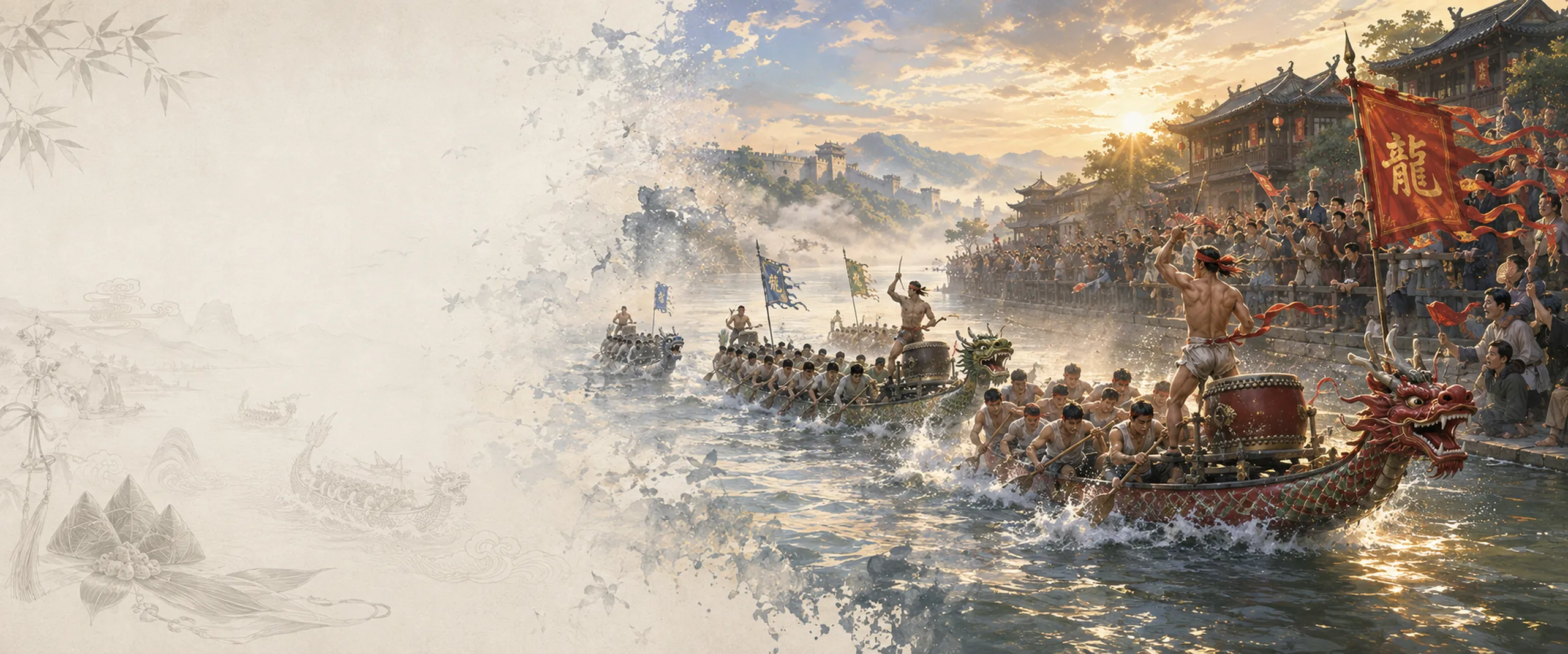
Dragon-boat racing is the most iconic custom of the Dragon Boat Festival and one of the most frequently recurring images in its poetry. The earliest dragon-boat races were originally festival activities through which ancient communities worshipped dragon gods and water deities. By the Tang dynasty, racing had become closely connected with the commemoration of Qu Yuan and came to symbolize remembrance of a loyal spirit. Zhang Lei’s “竞渡深悲千载冤” opens directly with the “race,” connecting the folk custom of dragon-boat competition with Qu Yuan’s thousand-year injustice. Huang Shang’s Jianzi Mulanhua · Boat Racing (《减字木兰花·竞渡》) writes: “红旗高举,飞出深深杨柳渚。鼓击春雷,直破烟波远远回”, using direct description to recreate the excitement and tension of dragon boats competing for victory. Ming poet Bian Gong’s Watching the Boat Race on the Fifth Day begins “共骇群龙水上游,不知原是木兰舟”, moving from amazement at what seems like a multitude of dragons coursing over the water toward reverence and mourning for Qu Yuan. Dragon-boat racing is both festival revelry and historical remembrance.
Zongzi (Jiaoshu)
Zongzi are the iconic food of the Dragon Boat Festival and appear frequently in festival poetry. Su Shi’s “粽叶香飘十里” uses scent to evoke the fragrance of zongzi; Lu You’s “粽包分两髻” uses vision to describe their shape. More profound, however, is the grief carried by the food. Song poet Yu Chou wrote “角黍堆盘何处奠,沉湘千古使人悲”, directly connecting plates piled with zongzi to mourning for Qu Yuan. Huang Geng’s “朱符不写湘累恨,角黍难包楚国羞” goes further: “角黍难包” suggests that although zongzi can wrap glutinous rice, they cannot wrap away the shame of Chu’s destruction. Yuan Zhen described the beautiful appearance of zongzi with “彩缕碧筠粽,香粳白玉团”, while “逝者良自苦,今人反为欢” expresses sympathy for Qu Yuan’s fate and reflection on the joy of those living in the present.
Mugwort and Calamus
Mugwort and calamus are recurring plant images in Dragon Boat Festival poetry. Su Shi’s “门前艾蒲青翠” writes of the custom of hanging both plants before the door, while Lu You’s “艾束著危冠” places mugwort in a hat. Yuan poet Shu Di’s Xiaochongshan · Dragon Boat Festival contains “碧艾香蒲处处忙”, using the characters “碧” and “香” to convey the vitality and fragrance of mugwort and calamus. The Dragon Boat Festival falls in midsummer, when the weather grows hot and humidity increases. Popular customs such as hanging mugwort and wearing fragrant sachets developed as expressions of simple hopes to avoid harm and cleanse body and mind. These plants are not merely symbols of custom, but also expressions of ancient wisdom in responding to the natural environment.
Orchid Baths and Colored Threads
Bathing in orchid-infused water and tying five-colored threads are among the most intimate and vividly everyday images in Dragon Boat Festival poetry. Su Shi’s “明朝端午浴芳兰” writes the custom of bathing in orchid water. “流香涨腻满晴川” describes the widespread social scene of fragrant bathing. “彩线轻缠红玉臂,小符斜挂绿云鬟” uses delicate brushwork to portray the customs of tying colored threads and hanging talismans. Su Shi transforms these practices into an aesthetics of daily life: vapor, fragrance, clothing, and laughter mingle together, making the Dragon Boat Festival a gentle moment in which people order body and mind and exchange blessings.
The Miluo River and Li Sao
The Miluo River and Li Sao are the most profound images in Dragon Boat Festival poetry. Wen Xiu’s “楚江空渺渺” uses the vastness of river water to express how impossible it is to wash away injustice. Zhang Lei’s “只留离骚在世间” condenses Qu Yuan’s spiritual legacy into the two characters “离骚”. Su Shi’s “汨罗江渚,湘累已逝,惟有万千断肠句” places the Miluo River beside Qu Yuan’s immortal writings. These images raise the Dragon Boat Festival from the level of custom to the level of spirit: it is not only a festival for eating zongzi, but also a festival for reading Li Sao; not only a day for racing dragon boats, but also a day for remembering a loyal soul.
Thematic Categories
Remembering Qu Yuan
The most numerous and influential theme in Dragon Boat Festival poetry is remembrance of Qu Yuan. Wen Xiu’s Dragon Boat Festival opens with a question, asking where the festival came from, then answers “万古传闻为屈原”, before expressing deep sympathy for Qu Yuan’s injustice in “堪笑楚江空渺渺,不能洗得直臣冤”. Zhang Lei’s In Response to the Dragon Boat Festival begins with “竞渡深悲千载冤” and concludes with “只留离骚在世间”, finding spiritual consolation within mourning. Wen Tianxiang’s Scenes of the Dragon Boat Festival writes his desire to follow Qu Yuan in “我欲从灵均,三湘隔辽海”. These poems fuse the folk practices of the Dragon Boat Festival with Qu Yuan’s spiritual legacy, elevating the festival from an ordinary seasonal celebration into a spiritual festival bearing collective cultural memory.
Dragon-Boat Racing
Dragon-boat racing is the most visually powerful theme in Dragon Boat Festival poetry. Liu Yuxi’s Boat-Racing Song contains “杨桴击节雷阗阗,乱流齐进声轰然”, using sound to convey the violence and intensity of the competition. Huang Shang’s Jianzi Mulanhua · Boat Racing writes “红旗高举,飞出深深杨柳渚。鼓击春雷,直破烟波远远回”, weaving together color and sound to recreate the sight of dragon boats racing on the festival day before crowds of spectators. Bian Gong’s Watching the Boat Race on the Fifth Day uses the images “云旗猎猎翻青汉,雷鼓嘈嘈殷碧流” to capture the grandeur of the race through snapping banners and thunderous drums.
Festival Customs
Another important theme of Dragon Boat Festival poetry is the vivid portrayal of seasonal customs. Lu You’s Poem for the Double Fifth in the Yimao Year takes a mountain village as its setting and writes a sequence of customs including pomegranate blossoms, making zongzi, inserting mugwort, storing medicine, and applying cinnabar. Su Shi’s Huanxisha · Dragon Boat Festival takes women celebrating the festival as its subject and describes orchid baths, colored threads, and talismans. Ouyang Xiu’s Yujia’ao · Fifth-Month Pomegranate Blossoms Glow Brilliantly (《渔家傲·五月榴花妖艳烘》) includes “五色新丝缠角粽。金盘送。生绡画扇盘双凤”, writing the customs of wrapping zongzi and giving fans. With delicate brushwork, these poems record the Dragon Boat Festival life of people a thousand years ago and are among the most vivid and valuable sources for studying its folk customs.
Love of Country
The deepest dimension of Dragon Boat Festival poetry lies in the poets’ concern for country and state. Du Fu’s Receiving a Robe on the Dragon Boat Festival uses “终身荷圣情” to express a scholar’s gratitude for imperial favor and loyalty to ruler and country. Wen Tianxiang’s Scenes of the Dragon Boat Festival uses “丹心照夙昔” to write the unwavering loyalty of an anti-Yuan hero. Su Shi’s Liuyangling · Tianzhong Festival directly attacks an incompetent ruler through “感叹怀王昏聩” while implicitly criticizing contemporary politics. These poems tightly bind personal Dragon Boat Festival emotions to the destiny of the country, moving festival poetry from “describing scenery and expressing emotion” toward “contemplating history and the fate of the nation.”
Dragon Boat Festival Folk Songs
The Dragon Boat Festival is not only a Han Chinese festival but also an important festival for many ethnic minority communities. In areas of Yunnan, Guizhou, Guangxi, and elsewhere where minority peoples live in concentrated communities, the festival has also incorporated distinctive ethnic characteristics. Miao, Dong, Zhuang, and other peoples maintain customs such as dragon-boat racing, eating zongzi, and hanging mugwort during the festival, accompanied by songs in their own traditions. In Zhuang communities of the Guangxi Zhuang Autonomous Region, there is also a tradition of singing mountain songs during the festival. These songs include both remembrance of Qu Yuan and prayers for a good harvest. Although many of these orally transmitted songs were never recorded in writing, they have passed from generation to generation through the festival life of minority communities and, together with the written poetry of Han literati, form the complete cultural landscape of the Dragon Boat Festival within the Chinese nation.
Closing Reflections
Dragon Boat Festival poetry forms a distinctive and profound landscape within the treasury of Chinese verse. From Wen Xiu’s “节分端午自谁言” and its questioning of the festival’s origins, to Zhang Lei’s “竞渡深悲千载冤” and its mourning for the loyal soul; from Su Shi’s “彩线轻缠红玉臂” and its writing of the aesthetics of festival custom, to Lu You’s “日斜吾事毕,一笑向杯盘” and its portrayal of the warmth of village life; from Du Fu’s “终身荷圣情” and gratitude for imperial favor, to Wen Tianxiang’s “丹心照夙昔” and loyalty to country and state—the poetry of the Dragon Boat Festival has recorded, across a thousand years, the Chinese remembrance of Qu Yuan, love of festival customs, loyalty to country, and reflections on life.
Within these poems is the grandeur of dragon-boat racing—“红旗高举,飞出深深杨柳渚”; the warmth of fragrant zongzi leaves—“粽包分两髻,艾束著危冠”; the refinement of orchid bathing and gathering medicinal herbs—“明朝端午浴芳兰”; the grief of remembering a loyal soul—“忠魂一去讵能还”; and the depth of devotion to country—“丹心照夙昔,鬓发日已改”. The meaning of Dragon Boat Festival poetry lies precisely in its ability to carry the fragrance of zongzi and the sound of drums, remembrance and moral character, from a thousand years ago into every succeeding age of Chinese life.
From Wen Xiu to Su Shi and Lu You, the center of Dragon Boat Festival poetry continually expands: Wen Xiu emphasizes remembrance of Qu Yuan, Su Shi reveals the beauty of festival customs, and Lu You records the everyday life of the countryside. Read together, the three reveal the layered structure of Dragon Boat Festival culture. The first layer is the rhythm of the natural season; the second, the transmission of folk custom; the third, the remembrance of Qu Yuan’s spirit. The Dragon Boat Festival poems handed down through the ages form, as it were, a long cultural scroll recording the moral character of Chinese men of letters. The poetic tradition of the Dragon Boat Festival is itself a cultural scroll of the spiritual history of Chinese literati. In these lines, the festival is both the surge of countless boats competing on the water and the warm lights of countless homes filled with the fragrance of zongzi; both the everyday wisdom of orchid bathing and herb gathering and the eternal echo of the masterpiece Li Sao. The confidence and transcendence contained in the line “只留离骚在世间” lift Dragon Boat Festival remembrance beyond remembrance itself and transform it into a profound understanding of the permanence of culture. Dragon Boat Festival poetry is one of the deepest and most enduring declarations Chinese people have made to loyalty and righteousness, a record of literati integrity written in ink by generation after generation.
—
[Language: es]
Selected Poems
Selected Poems
Dragon Boat Festival
Tang Dynasty · Wen Xiu
节分端午自谁言,万古传闻为屈原。
堪笑楚江空渺渺,不能洗得直臣冤。
Background
Among all poems on the Dragon Boat Festival, Wen Xiu’s Dragon Boat Festival is brief, yet it reaches directly into the deepest emotional core of the festival’s poetic tradition. As a poet-monk, Wen Xiu wrote this thought-provoking quatrain from a distinctive position and perspective. He was a late-Tang Jiangnan monk-poet who lived in Chang’an during the reign of Emperor Zhaozong, served as a literary attendant, and was a poetic friend of Zheng Gu and Qiji. The poem does not dwell on festive scenes. Instead, it asks after the most fundamental meaning of the Dragon Boat Festival: why has the fate of one poet been remembered for so long?
Line-by-Line Reading
For countless generations, tradition has said that the festival exists to commemorate Qu Yuan. “万古” emphasizes the immense passage of time, while “传闻” indicates a memory transmitted orally from generation to generation. In the poet’s view, the remembrance of Qu Yuan had long entered the public culture through folk storytelling, seasonal customs, and literary writing.
How ironic that the Chu River should stretch so vast, its waters disappearing into mist. The phrase “空渺渺” renders the immensity of the river, but also emphasizes the sense of “emptiness”: no matter how great the waters, in the end they are powerless.
Yet even such waters cannot wash away the injustice suffered by an upright minister. “直臣” is the poem’s central phrase. Qu Yuan has been remembered through the ages not simply because he drowned himself, but because he was “upright”: steadfastly concerned with the fate of his country and unwavering in personal integrity.
Overall Appreciation
The value of Wen Xiu’s poem lies in its refusal to dwell on festive spectacle. Instead, it seizes the aspect of the Dragon Boat Festival with the greatest spiritual tension. The festival is not only about eating zongzi and racing dragon boats; it is also a historical question: why should the fate of one poet be remembered for so long? Later generations commemorate Qu Yuan not because he drowned himself, but because of his unwavering concern for the fate of his homeland, his fidelity to moral integrity, and his pursuit of cultural ideals. The poem uses simple words but reaches far in meaning; it is concise yet profound and powerful. It does not write of the fragrance of zongzi or the motion of dragon boats. Its brush goes directly toward the spirit of the worthy who sleeps beneath the Miluo River. The two characters “堪笑” contain the full lament of an upright man of letters confronting an ancient injustice: even the boundless waters of the Chu River cannot wash away that grievance.
和端午
Song Dynasty · Zhang Lei
竞渡深悲千载冤,忠魂一去讵能还。
国亡身殒今何有,只留离骚在世间。
Background
Zhang Lei (1054–1114), courtesy name Wenqian and literary name Keshan, was a Northern Song writer and one of the “Four Scholars of Su Shi’s School.” This is one of his representative poems. Taking Dragon Boat Festival racing as its subject, it is mournful, sorrowful, and emotionally profound. The poet begins with the festival custom of dragon-boat racing and turns toward Qu Yuan’s unjust fate across a thousand years. “忠魂一去讵能还” expresses boundless sorrow and helplessness; “只留离骚在世间” closes the poem by raising personal grief into praise for the permanence of culture.
Line-by-Line Reading
Dragon-boat racing carries profound grief: the grief of an injustice that has lasted a thousand years. From the opening, the poet makes clear that the boat race is not merely entertainment, but mourning. The line directly connects a folk custom with historical memory: every stroke of the paddle becomes remembrance of Qu Yuan’s wronged spirit.
Once that loyal soul has gone, how could it ever return? “讵” introduces a rhetorical question meaning “how could” or “could it possibly.” The line contains limitless sorrow and helplessness, yet it also carries the heroic tragedy of “风萧萧兮易水寒,壮士一去兮不复还”. It lifts the poem’s realm abruptly upward into something broader and more elevated.
The state has fallen and the body has perished; what remains now? This is both a summary of Qu Yuan’s fate and a question about death itself: when all material existence has disappeared, what can still endure?
Only Li Sao remains in the human world. This is the poem’s decisive line. Though “国亡身殒”, the patriotic spirit that illuminates later generations and the immortal masterpiece Li Sao will never disappear. Qu Yuan’s spirit does not die because his words do not die. His body sank into the Miluo River, but his soul rose into every line of Li Sao.
Overall Appreciation
The poem begins with Dragon Boat Festival racing. Its surface is simple, but its implications are deep. The races commemorate Qu Yuan’s thousand-year injustice, and “忠魂一去讵能还” contains infinite grief and helplessness. The poem opens with “竞渡” and closes with “离骚”, joining the folk practice of racing dragon boats with Qu Yuan’s literary legacy. The man is gone, but his patriotic spirit, which continues to illuminate later generations, and the immortal masterpiece Li Sao endure between heaven and earth. Compared with Wen Xiu’s Dragon Boat Festival, which questions the unresolved injustice, Zhang Lei’s In Response to the Dragon Boat Festival offers a more affirmative answer: the injustice cannot be washed away and the loyal spirit cannot return, but Li Sao remains; the spirit remains; culture remains. This is the most fundamental meaning of commemorating Qu Yuan during the Dragon Boat Festival.
浣溪沙·端午
Song Dynasty · Su Shi
轻汗微微透碧纨,明朝端午浴芳兰。
流香涨腻满晴川。
彩线轻缠红玉臂,小符斜挂绿云鬟。
佳人相见一千年。
Background
This ci was written for the Dragon Boat Festival in the second year of Shaosheng under Emperor Zhezong of Song (1095), when Su Shi had already been exiled to Huizhou for two years. During a festival associated with reunion, he thought of his concubine Chaoyun and composed the lyric for her. The first stanza describes women preparing for the festival, while the second portrays them celebrating according to popular customs.
Overall Appreciation
First Stanza — Preparations and Anticipation before the Festival
“轻汗微微透碧纨” — A faint sheen of perspiration passes through green fine silk. The weather is growing warm around the Dragon Boat Festival, and a woman dressed in elegant clothing begins to perspire lightly. A hazy beauty emerges vividly on the page. The verb “透” is especially apt, bringing out the softly veiled beauty of skin half-seen and half-concealed.
“明朝端午浴芳兰” — Tomorrow is the Dragon Boat Festival, and according to custom one will bathe in fragrant orchid water. The festival had a tradition known as “浴兰汤,” bathing in orchid-infused water. The line not only reflects Chaoyun’s purity and noble character, extending from the fragrance of the body to the purity of the heart, but also expresses the simple and unadorned beauty of this seasonal custom.
“流香涨腻满晴川” — After bathing and grooming, fragrant powder and rouge left behind flow with the water into the river, spreading across the surface as fragrance fills the air. Bathing in fragrant orchids was widespread across society, with crowds of participants and an atmosphere of intense festivity.
Second Stanza — Festival Blessings and Wishes for Enduring Love
“彩线轻缠红玉臂” — Five-colored threads are gently wound around jade-like arms. The Dragon Boat Festival custom of “以五彩丝系臂” was intended to ward off evil spirits and pray for long life. “轻缠” conveys both tenderness of movement and affection.
“小符斜挂绿云鬟” — A small talisman hangs at an angle from the woman’s coiffure. The custom of placing “赤灵符著心前” was intended to communicate with the spirits, repel evil, and protect the body.
“佳人相见一千年” — The only wish is to remain with the beloved for a thousand years, growing old together. This is the lyric’s decisive line. The poet’s emphasis on winding threads and wearing talismans ultimately serves the wish “佳人相见一千年”: may the blessings truly come to pass. The imagery of this ci is bright, fresh, and clear. Fine perspiration, green silk, fragrant orchids, colored threads, and small talismans are all tangible details from everyday Dragon Boat Festival life. Su Shi does not render these customs as mysterious practices. Instead, he turns them into an aesthetics of daily life: vapor, fragrance, clothing, and laughter mingle together, making the Dragon Boat Festival a gentle moment for people to cleanse and order body and mind while exchanging wishes for one another’s well-being. The lyric shows that Dragon Boat Festival customs contain not only grand acts of remembrance, but also intimate forms of daily life. Traditional festivals endure precisely because they can carry both historical spirit and the ordinary emotions of everyday people. Colored threads softly wound around the arm express wishes for the health and safety of relatives and friends; bathing in fragrant orchids embodies ideas of following the season and keeping life clean; “佳人相见一千年” uses beautiful exaggeration to express the warmth of mutual blessing during the festival. The entire piece is a poem of folk custom, rich with the atmosphere of ancient traditions, and is among the most vivid and valuable materials for studying Dragon Boat Festival customs.
乙卯重五诗
Song Dynasty · Lu You
重五山村好,榴花忽已繁。
粽包分两髻,艾束著危冠。
旧俗方储药,羸躯亦点丹。
日斜吾事毕,一笑向杯盘。
Background
Lu You (1125–1210), courtesy name Wuguan and literary name Fangweng, was one of the greatest patriotic poets of the Southern Song. This poem was written during the Dragon Boat Festival in the first year of Qingyuan under Emperor Ningzong (1195), when the poet was seventy-one and living in retirement at his Sanshan estate in Shanyin, Yuezhou, present-day Shaoxing in Zhejiang. The poem describes village customs during the festival and the poet’s leisurely life, using plain language to capture the strong warmth of ordinary human life.
Line-by-Line Reading
How lovely the mountain village is during the Double Fifth; suddenly, the pomegranate blossoms are already abundant. The poem establishes a cheerful tone at once. “好” gives the overall judgment, while “繁” paints the scene. Brilliant red pomegranate flowers covering the village are among the clearest natural images of the Dragon Boat Festival season.
The zongzi are wrapped in shapes resembling a pair of hair buns, while a bundle of mugwort is inserted into a tall hat. “分两髻” compares the shape of the zongzi to a young woman’s paired hair buns, vivid and playful. “危冠” means a high hat, described here as the kind worn by Qu Yuan during his exile in Jiangnan, quietly carrying remembrance of him. The two lines refine folk custom into poetry while remaining realistic and full of charm.
Following old custom, medicinal herbs are being stored, and even this frail body receives a dab of cinnabar to ward off evil. The Dragon Boat Festival marks the coming of summer, when harmful insects and pests emerge. The ancients therefore stored medicinal herbs, realgar, cinnabar, and similar substances against possible harm. “点丹” refers to placing a red dot of cinnabar at the Yintang point between the brows in order to repel evil.
The sun is slanting westward; my tasks are done, and with a smile I turn toward wine and food. This is the poem’s most moving stroke. After a day spent storing medicine, applying cinnabar, wrapping zongzi, and inserting mugwort, everything is finally in order, and the poet sits down, raises his cup, and smiles. This composure and satisfaction embody Lu You’s attitude toward life in old age.
Overall Appreciation
Lu You’s poem uses plain language and combines landscape, narrative, and emotion. The village filled with pomegranate blossoms, the customs of the Jiangnan Dragon Boat Festival, and the quiet contentment between the lines all rise vividly before the eyes and seem almost physically felt. Because there is no ornament, the poem is beautiful; because there is no affectation, its feeling is genuine. The poet entrusts the true flavor of life to his vivid description of ordinary Dragon Boat Festival activities. Within these familiar seasonal details lies a quiet reflection: all things in the world have their proper time, flourishing and declining in accordance with the seasons.
端午日赐衣
Tang Dynasty · Du Fu
宫衣亦有名,端午被恩荣。
细葛含风软,香罗叠雪轻。
自天题处湿,当暑著来清。
意内称长短,终身荷圣情。
Background
Du Fu (712–770), courtesy name Zimei and literary name Shaoling Yelao, was one of the greatest realist poets of the Tang dynasty. This poem was written during the Dragon Boat Festival in the first year of Qianyuan (758), when Du Fu was serving in Chang’an as Zuo Shiyi. After the displacement and hardship of the An Lushan Rebellion, he had sought refuge with Emperor Suzong and was given an important position. On the Dragon Boat Festival, the emperor bestowed a court robe upon him. Deeply honored, Du Fu wrote this poem filled with gratitude. It is one of the relatively few works by Du Fu suffused with joy.
Line-by-Line Reading
Even the imperial robe bears my name; on this Dragon Boat Festival I have received the emperor’s favor. The word “亦” captures Du Fu’s surprise at discovering that he too was included among those receiving the gift: imperial grace was vast enough not to forget even a scholar of humble background such as himself.
The fine hemp cloth is soft as though it held the wind within it; fragrant gauze, folded, is as light as snow. The two lines emphasize the excellence of the robe’s materials. “含风软” describes its texture; “叠雪轻” its lightness. Fine ge was high-quality summer cloth, cool and breathable against the body. “香罗叠雪轻” compares the gauze to snow, emphasizing its whiteness and weightlessness.
Where the imperial inscription was written, the ink is still damp; worn in summer heat, the robe feels especially cool. “自天题处湿” describes the imperial writing before its ink has fully dried, suggesting the immediacy and freshness of imperial favor. “当暑著来清” describes the comfort and coolness of wearing the robe during hot weather.
Inwardly I measure it and find the length just right; for the rest of my life I shall remain grateful for the sovereign’s kindness. Here the poem’s emotion rises from the fit of a single garment to lifelong gratitude.
Overall Appreciation
On this Dragon Boat Festival, a day associated with welcoming auspiciousness and blessings, Du Fu received favor from Emperor Suzong. Having been appointed Zuo Shiyi, he was filled with gratitude and felt that his ambitions might finally find room for fulfillment. The poem describes the robe’s material and texture in detail: fine hemp soft as wind, fragrant gauze light as snow. Wearing it, the poet feels its coolness and comfort, while his heart is filled with gratitude toward the emperor. From the surprise of “宫衣亦有名” to the sincerity of “终身荷圣情”, Du Fu uses a summer robe as the thread linking a scholar’s gratitude for imperial favor with loyalty to ruler and country, all within the seasonal imagery of the Dragon Boat Festival.
六幺令·天中节
Song Dynasty · Su Shi
虎符缠臂,佳节又端午。
门前艾蒲青翠,天淡纸鸢舞。
粽叶香飘十里,对酒携樽俎。
龙舟争渡,助威呐喊,凭吊祭江诵君赋。
感叹怀王昏聩,悲戚秦吞楚。
异客垂涕淫淫,鬓白知几许?
朝夕新亭对泣,泪竭陵阳处。
汨罗江渚,湘累已逝,惟有万千断肠句。
Background
Su Shi’s life was filled with hardship, repeated rises and falls, and ultimately death far from home, giving his fate certain similarities to that of Qu Yuan. This ci takes the Dragon Boat Festival—also known as the “Tianzhong Festival”—as its setting and depicts Song customs such as hanging mugwort, racing dragon boats, and making zongzi. The first stanza presents festival scenes through images such as “虎符缠臂” and “龙舟争渡”; the second turns toward Qu Yuan through “汨罗江渚” and “湘累已逝”, invoking the foolishness of King Huai and the Qin conquest of Chu while indirectly reflecting Su Shi’s own experience of exile and wandering.
Overall Appreciation
First Stanza — A Lively Picture of Dragon Boat Festival Customs
“虎符缠臂,佳节又端午。门前艾蒲青翠,天淡纸鸢舞” — Tiger-shaped talismans are bound around the arm: once again the Dragon Boat Festival has arrived. Mugwort and calamus before the door are lush and green, while kites dance beneath a pale sky. “虎符缠臂” was one of the festival customs for warding off evil, in which tiger-shaped charms were tied around the arm.
“粽叶香飘十里,对酒携樽俎” — The fragrance of zongzi leaves drifts for ten li, while people bring wine and food vessels and drink together.
“龙舟争渡,助威呐喊,凭吊祭江诵君赋” — Dragon boats race fiercely across the water; cheers and shouts rise into the sky; people mourn at the river, making offerings and reciting Qu Yuan’s writings.
Second Stanza — Historical Grief and Personal Sorrow
“感叹怀王昏聩,悲戚秦吞楚” — The poet laments the blindness and foolishness of King Huai of Chu and grieves over Qin’s conquest of Chu. The two lines point directly to the source of Qu Yuan’s tragedy: it was not that Qu Yuan lacked loyalty, but that the ruler of Chu lacked wisdom.
“异客垂涕淫淫,鬓白知几许” — The traveler far from home sheds tears without end; who knows how much more white has appeared at his temples? Here Su Shi turns from remembering Qu Yuan toward reflecting on himself. He too is an “异客”, an exile in Huizhou, wandering far from home.
“朝夕新亭对泣,泪竭陵阳处” — Morning and evening, facing one another as in the story of the New Pavilion, tears are exhausted at Lingyang. “新亭对泣” comes from Shishuo Xinyu (《世说新语》), referring to scholars of the Jin dynasty weeping together at Xinting after the court fled south, lamenting the ruin of the country and the loss of their homes. Su Shi compares himself to them, implicitly expressing anxiety about the political situation.
“汨罗江渚,湘累已逝,惟有万千断肠句” — Beside the Miluo River, Qu Yuan—the “Xianglei”—is long gone; only countless heart-rending lines remain. This ci sings of the present while lamenting the past. The first stanza renders the various splendors of the contemporary Dragon Boat Festival with great force, while the second turns toward emotional reflection and Qu Yuan’s tragic fate. Its intention is to use the present to remember the past, “borrowing antiquity” in order to “illuminate the present.” The poem works through both open and implicit writing: openly, it writes of Qu Yuan and directly condemns the “foolishness” of the king of Chu; implicitly, it criticizes contemporary politics, directing its edge toward the Northern Song court while concealing within it the poet’s own loves, hates, and personal grievances. From the lively spectacle of “龙舟争渡” to the sorrow of “万千断肠句”, the poem completes a profound movement from folk custom into history.
端午即事
Song Dynasty · Wen Tianxiang
五月五日午,赠我一枝艾。
故人不可见,新知万里外。
丹心照夙昔,鬓发日已改。
我欲从灵均,三湘隔辽海。
Background
Wen Tianxiang (1236–1283), courtesy name Songrui and literary name Wenshan, was a national hero of the late Southern Song. This poem was written after he had been forcibly detained while serving as an envoy to the Yuan camp and, after many difficulties, finally escaped, only to find himself falsely accused through rumors and slander. It was the Dragon Boat Festival, and in order to make his intentions clear, he wrote this poem in indignation. The anti-Yuan hero, his temples already graying, declared his convictions through poetry after being falsely accused. Even with the country shattered and national salvation seemingly beyond hope, he continued to take Qu Yuan as his model, laboring for the national cause and remaining without regret even in the face of repeated death.
Line-by-Line Reading
At noon on the fifth day of the fifth month, someone gives me a sprig of mugwort. Inserting or hanging mugwort is a popular Dragon Boat Festival custom, and the plant symbolizes the warding off of evil and disease. The line seems simple, but it establishes the seasonal setting for the entire poem.
Old friends cannot be seen, while new acquaintances are ten thousand li away. Surrounded by difficulty, the poet can neither see old friends nor reach new ones, and a profound sense of loneliness arises.
A loyal red heart still shines as before, yet the hair at my temples changes day by day. “丹心” is the poet’s declaration of unwavering loyalty; “鬓发日已改” is his sigh at the passage of time and the frustration of ideals that remain unrealized.
I wish to follow Qu Yuan, Lingjun, but the lands of the Three Xiang are separated from me by a vast sea. This is the poem’s most tragic and heroic line. The poet wishes, like Qu Yuan, to prove his convictions through death, but reality—“三湘隔辽海”—stands in the way. In the end, he chooses a path different from Qu Yuan’s, continuing his efforts in the hope of restoring the Southern Song.
Overall Appreciation
Set against the Dragon Boat Festival, the poem expresses the poet’s remembrance of old friends and his longing for new companions. Old friends cannot be seen, and new ones are ten thousand li away, leaving him melancholy and alone. Yet the poet does not sink into despair. He reaffirms his convictions: his loyal heart remains unchanged, and even as his hair turns white, he will hold to his principles. The poem’s emotions rise and fall sharply. The poet burns with devotion to his country but suffers false accusations. He once thought of proving himself through death, yet ultimately chose a path different from Qu Yuan’s in order to continue working for the restoration of the Southern Song. The poem reveals his steadfast loyalty to the court and his enduring commitment to righteousness.
Readers’ Comments
Calendar and traditional culture enthusiasts from around the world, sharing the same moon.
Sign in or register to join the conversation. Your comment account is created automatically the first time you use a connected account.
No comments yet
Share your thoughts with readers around the world.