Dragon Boat Festival

Dragon Boat FestivalGlobal Spread

「 节分端午自谁言,万古传闻为屈原。 」

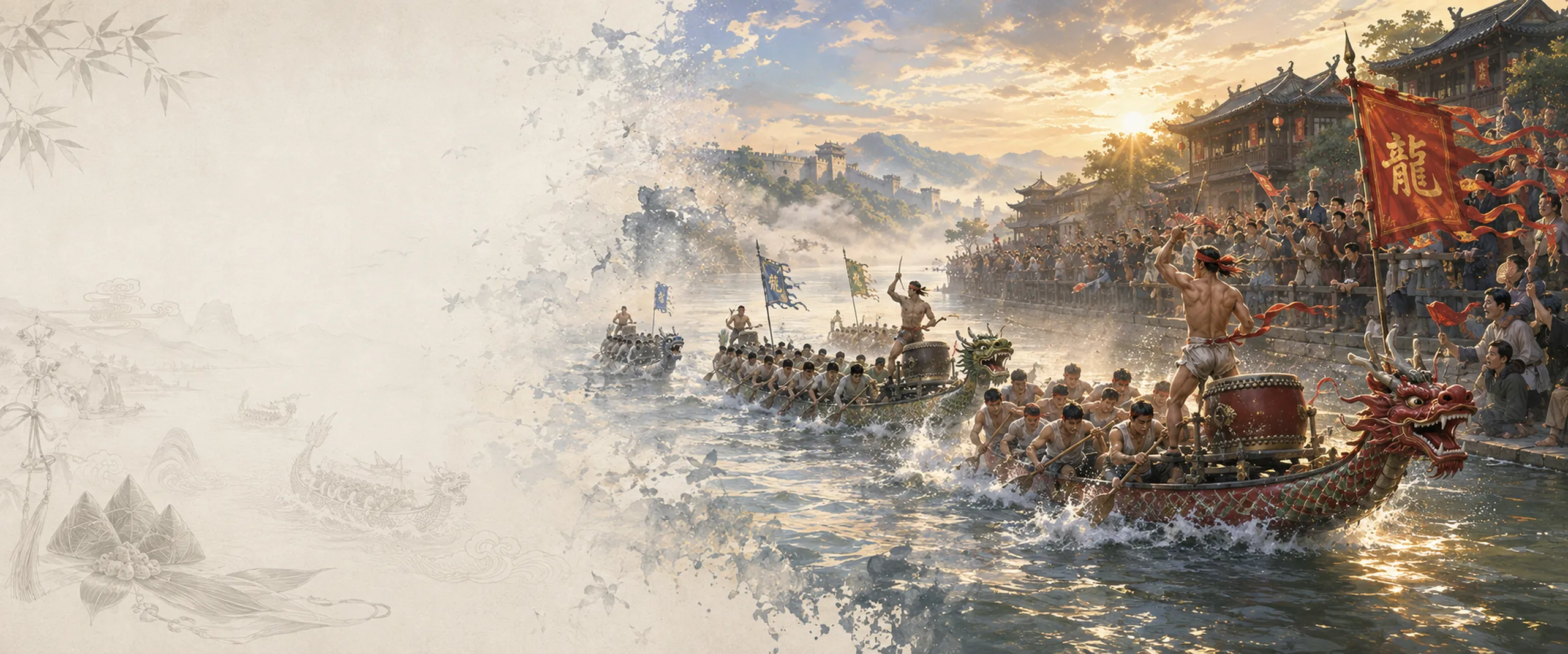
The Dragon Boat Festival originated from dragon totem sacrifices in the pre‑Qin period. Later, because Qu Yuan drowned himself in the Miluo River on the fifth day of the fifth lunar month, the day became a festival commemorating this patriotic…

In 2009, at the fourth session of UNESCO’s Intergovernmental Committee for the Safeguarding of the Intangible Cultural Heritage, held in the United Arab Emirates, China’s “Dragon Boat Festival” was reviewed and approved for inscription on the Representative List of the Intangible Cultural Heritage of Humanity. It was China’s first festival to be inscribed as world intangible cultural heritage, comprising four components: the “Dragon Boat Festival Customs of Qu Yuan’s Hometown” in Zigui, Hubei; the “Xisai Divine Boat Festival” in Huangshi; the “Dragon Boat Festival Customs along the Miluo River” in Miluo, Hunan; and the “Suzhou Dragon Boat Festival Customs” in Suzhou, Jiangsu.

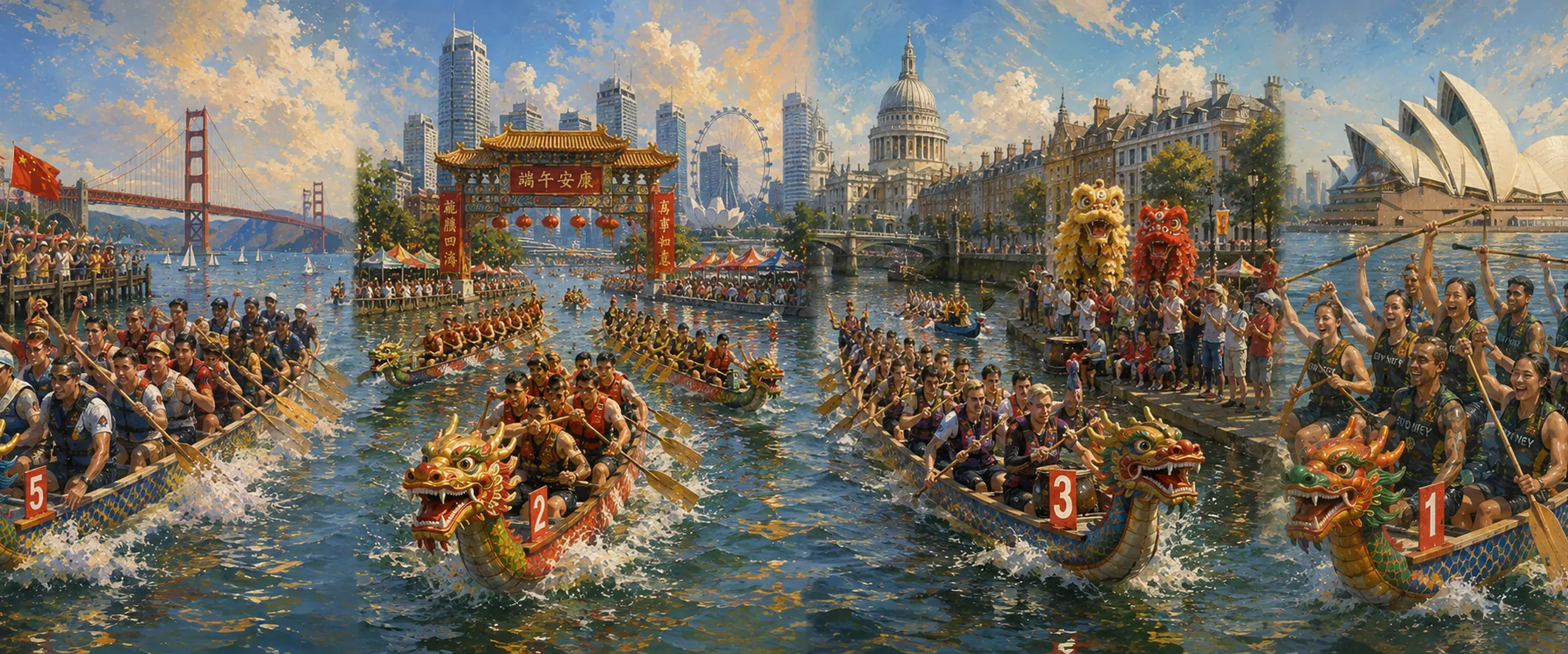
The Dragon Boat Festival has spread ever more widely overseas. Dragon boat racing has become a global sporting and cultural activity—from North America and Europe to Southeast Asia, dragon boat races are held in many places each year during the festival. The custom of eating zongzi has likewise traveled around the world with Chinese communities. In Chinese communities in Malaysia, Singapore, the United States, Australia, and other countries, making zongzi and racing dragon boats during the Dragon Boat Festival have become important cultural traditions. Through the exhilaration of dragon boat racing and the warmth evoked by the fragrance of zongzi leaves, the Dragon Boat Festival is telling the world a Chinese story of commemorating Qu Yuan, warding off evil, and praying for blessings.

Dragon Boat Festival / Global Spread
229 days until Dragon Boat Festival June 9, 2027 · Lunar 五月初五

Celebrated Worldwide

Regional Highlights
01

The Americas

United States

The United States is one of the countries where dragon boat sport is most active worldwide. Dragon Boat Festival celebrations extend from the East Coast to the West Coast, shaped both by the spontaneous initiatives of Chinese communities and by deep participation from mainstream society.

Washington, D.C.: Dragon boat clubs train through the night. In the U.S. capital, dragon boat clubs practice through the night in preparation for Dragon Boat Festival races. Francis Lira, who began dragon boating in 2006, said: “It takes 20 people to move a dragon boat. You cannot do it alone. There is no individual in this sport; everyone has to work together.” Local media commented that “this growing sport is paying tribute to Chinese history.” Washington’s dragon boat races have become one of the city’s most influential multicultural events.

California: A Dragon Boat Festival celebration for a multicultural community. In California, the 2025 Annual Dragon Boat Festival, organized by the Asian American Community Involvement Association, was held on May 31 at West Valley College in Saratoga, attracting hundreds of enthusiastic participants. The event not only showcased the appeal of diverse Asian cultures, but also demonstrated strong community cohesion and a spirit of exchange across ethnic groups.

On the day of the Dragon Boat Festival, the third Dragon Boat Folk Culture Festival was held at Qiyang Cultural Center. Activities included hands-on zongzi making; tasting mugwort cakes, foods made with ai (艾), or Chinese mugwort, a plant closely associated with traditional Dragon Boat Festival customs; weaving five-colored cords (五彩绳), colored threads traditionally worn during the festival; calligraphy; papercutting; and “shooting the five poisons” (射五毒), an interactive folk game associated with the traditional wudu (五毒), or “five poisons.” The program also included traditional Chinese face painting and assessments of individual traditional Chinese medicine body constitutions (体质). Gao Huiling of Los Angeles said that the Dragon Boat Festival is an important traditional festival for Chinese people, carrying profound cultural and historical significance; through storytelling, music and dance, food stalls, and other activities, people of different generations and ethnic backgrounds are invited to experience the beauty of Chinese culture together.

Seattle: A Chinese school’s cultural return. Located south of Seattle, Nanpu Xiaxida Chinese School returned after a six-year absence to participate in the 17th Kent International Festival, organized by the Kent Chamber of Commerce on May 31, 2025, presenting Dragon Boat Festival culture to local residents.

Michigan: A Dragon Boat Festival celebration in the library. On April 26, the Michigan Lion Dance Team held a “Taiwanese American Dragon Boat Festival” cultural event in Adam Strohm Hall at the Detroit Public Library. Holding the event in this historic hall—renowned for its soaring vaulted ceiling, ornate decoration, and murals by American artist Gari Melchers—gave the occasion particular significance; within a space where knowledge and history intertwine, the Dragon Boat Festival celebration took on an added depth while opening a new chapter for different communities.

Corporate cultural transmission. Huamao Logistics also organized Dragon Boat Festival celebrations across several of its U.S. offices. The Miami and Los Angeles offices strengthened awareness of tradition through dragon boat race videos and cultural introductions; the Chicago office created a rich festive atmosphere with themed backdrops, while its e-commerce team brought colleagues closer through food, games, and cultural learning, with touhu (投壶), the traditional Chinese game of tossing arrows into a narrow vessel, generating particularly lively interaction; the New York office introduced employees to traditional Chinese culture, and everyone tasted traditional zongzi.

Canada

Dragon Boat Festival celebrations are equally vibrant in Canada. Even before the festival arrives, many supermarkets and stores begin offering an array of zongzi; the fragrance of zongzi leaves spreads through the early-summer air, while dragon boat racing has become one of the favorite sports of people in Canada’s mainstream communities. During the festival period, Vancouver and other places in Canada hold dragon boat races and related activities, drawing large crowds of spectators and creating a lively atmosphere. Huamao Logistics Canada organized employees in Toronto to taste traditional zongzi and exchange cultural stories, strengthening employees’ sense of belonging through the principle of “people first, cultural integration.” Weng Guoning, chairman of the Federation of Chinese Associations in Toronto, said that the Dragon Boat Festival has long since become more than merely a traditional Chinese festival; it has become a vibrant calling card for Chinese culture as it reaches the world.

Argentina

The 2025 Argentina Dragon Boat Competition was held on May 24 at the dragon boat base in Escobar, Buenos Aires Province, attracting more than 100 competitors. The scale of the event reached a new record, and a 2,000-meter long-distance race was introduced for the first time. Liu Jingang, chairman of the Argentine Dragon Boat Association, said that dragon boat sport not only embodies the spirit of unity, cooperation, and striving forward, but has also become an important bond connecting the peoples of China and Argentina.

Nicolás Ceruya, director of Escobar’s municipal sports bureau, said that dragon boat sport has become an effective platform connecting different cultural groups: “This is a sport worth promoting, not only because it is highly competitive and exciting to watch, but also because it is a symbol of tradition and unity.” Since its establishment in 2019, the Argentine Dragon Boat Association has actively promoted the sport and gradually built a training and competition system covering several provinces across Argentina.

Ecuador

On May 10, 2025, Consul General Gao Zhenting in Guayaquil attended a Dragon Boat Festival celebration jointly organized by Guayaquil’s Chinese community and the municipal government. Consul General Gao said that the traditional Chinese Dragon Boat Festival had been inscribed by UNESCO on the Representative List of the Intangible Cultural Heritage of Humanity; the joint organization of Dragon Boat Festival activities by the Chinese community of Guayaquil and the municipal government had created a platform for exchange and mutual learning between Chinese and Ecuadorian civilizations.

Brazil

On the day of the festival, the Brazilian Rui’an Chamber of Commerce and the Brazilian Qingtian Hometown Association jointly held a “Celebrating the Dragon Boat Festival, Dragon Boats Racing” event at the Guarapiranga Reservoir in São Paulo, attracting nearly 500 overseas Chinese and Brazilian friends.

São Paulo’s Dragon Boat Festival races featured a rich array of activities. Before the competition, ceremonies including dragon and lion dances, decorating the dragon heads, paddle presentations, and launching the dragon boats were held. In Rio de Janeiro, many local Brazilians, guided by overseas Chinese, enthusiastically tried wrapping zongzi with their own hands and experienced folk traditions such as making xiangnang (香囊), traditional fragrant sachets, and weaving five-colored cords.

Mexico and Panama

Huamao Logistics Mexico introduced Chinese and international employees to the origins of the Dragon Boat Festival, together exploring the story of Qu Yuan and the cultural background of dragon boat racing and eating zongzi. A Dragon Boat Festival cultural knowledge quiz followed, together with a shared tasting of zongzi. The Panama company organized a dragon boat race and shared festive foods. The Chile company introduced employees to traditional Dragon Boat Festival stories and shared delicious zongzi; many Chilean employees tasted Chinese zongzi for the first time and remarked that “the texture and flavor were novel and interesting.”

02

Europe

Europe is another important region in the overseas spread of the Dragon Boat Festival, with dragon boat racing flourishing in the United Kingdom, Germany, France, Luxembourg, Serbia, Greece, and numerous other countries.

United Kingdom

The United Kingdom hosts Europe’s largest Dragon Boat Festival event. The 11th UK Chinese Dragon Boat Festival was held on May 25, 2025, in Salford, Greater Manchester, attracting nearly 10,000 participants. The Manchester Evening News reported that it was Europe’s largest dragon boat event, with more than 40 teams competing that year.

The festival grounds also featured dragon and lion dances, martial arts, Chinese opera, traditional instrumental music, ethnic dance, and food stalls offering zongzi, spring rolls, dumplings, and other specialties, giving spectators a comprehensive Chinese cultural experience of “sight, sound, and taste.” Salford Mayor Paul Dennett told the Manchester Evening News that the Dragon Boat Festival was one of the most exciting and joyful events on Salford’s calendar. Now in its 11th year, the event has become one of the United Kingdom’s most influential Chinese cultural activities.

In 2026, the Cambridge Dragon Boat Festival opened along the banks of the River Cam. Chinese Dragon Boat Festival culture blended with the scenery of Britain’s waterside landscape, as a transnational cultural carnival combining folk performances, waterborne competition, and people-to-people exchange came to Cambridge, bringing a rich Eastern character to the city’s early summer.

Germany

Germany is one of the European countries where dragon boat sport has reached its greatest maturity. Dragon boat racing has had a tradition of several decades in Germany. On May 24, 2025, the second “Red Flag Cup” Frankfurt International Dragon Boat Friendship Race opened on Germany’s Main River. Seventeen dragon boat teams from China, Germany, France, Italy, the United States, Thailand, and other countries and regions competed together, with the Jingzhou team from Hubei, China, making a prominent appearance.

Wang Wen, who had worked and lived in Germany for more than 30 years, said: “Dragon boat racing has already had a tradition of several decades in Germany. In the past, however, we Chinese would organize one team to participate in local dragon boat races, and I was once even a member of the cheerleading team. Starting last year, we began participating in the Frankfurt International Dragon Boat Friendship Race, which has a strong Chinese character. In Germany, the festive atmosphere of the Dragon Boat Festival is becoming stronger and stronger.”

In 2026, the third “Red Flag Cup” Frankfurt International Dragon Boat Festival once again brought the Main River to life, with 18 teams from China, Germany, France, the Netherlands, and other countries competing side by side. Boats surged across the Main and paddles flashed above the water. Cultural carnival activities held during the event—including Chinese opera and Dragon Boat Festival food experiences—drew large numbers of spectators who stopped to watch and taste.

Luxembourg

On June 15, 2025, the third Luxembourg International Dragon Boat Festival was held in Remich on the Moselle River. As an important cultural event celebrating the Dragon Boat Festival and an annual flagship project for China-Luxembourg people-to-people exchange, the festival took “Working Together in the Same Boat, Building the Future Together” as its theme, integrating sporting competition, cultural exchange, and financial and tourism promotion. It attracted numerous institutions, businesses, and members of the public from China, Luxembourg, and neighboring countries. According to statistics, this edition of the festival drew more than 4,000 visits.

Chinese Ambassador to Luxembourg Hua Ning said that the Dragon Boat Festival is not only a traditional festival commemorating Qu Yuan, but also embodies the spirit of unity, cooperation, and tongzhou gongji (同舟共济)—literally, “crossing the river together in the same boat,” an expression of solidarity in the face of shared challenges. It has been listed by the United Nations as intangible cultural heritage of humanity and has become cultural wealth shared by the world.

Luxembourg’s Minister of the Economy, SMEs, Energy and Tourism, Lex Delles, said that the Dragon Boat Festival combines sporting and cultural dimensions and demonstrates the increasingly deep cooperation between China and Luxembourg in tourism, people-to-people exchange, the economy, and other fields. Remich Mayor Jacques Sitz said that the Dragon Boat Festival has become one of Remich’s most representative international cultural events; dragon boat sport symbolizes unity, cooperation, and striving forward, qualities closely aligned with Remich’s diverse and inclusive urban spirit.

At the event, 15 teams from different sectors of China and Luxembourg competed fiercely on the Moselle River. The cultural activity zone was equally vibrant—the traditional instrumental ensemble of the China Conservatory of Music performed on instruments including the pipa (琵琶), a plucked lute; the guzheng (古筝), a Chinese zither; and the dizi (笛子), a transverse bamboo flute. The “Tea for Harmony” intangible cultural heritage themed exhibition centered on the cultures of Yunnan’s ethnic minorities, presenting tea arts, clothing, cultural and creative products, and other content.

Serbia

The 2025 “Hello! China” China-Serbia International Dragon Boat Festival was held from May 24 to 25 in Belgrade, the capital of Serbia, attracting nearly 20 dragon boat teams from China and Serbia and hundreds of spectators. On the opening day, nearly 20 dragon boat teams from China, Serbia, Romania, and other countries took part in the competition.

Greece

On the eve of the Dragon Boat Festival in 2026, the Silk Road Dragon Soars · Racing on the Aegean—Second “China-Greece Friendship Cup” Dragon Boat Race, jointly organized by the Chinese Embassy in Greece and Chinese overseas associations in Greece, was successfully held at the Schinias Olympic Rowing and Canoeing Centre in Marathon, Greece. The atmosphere was at once lively and solemn, with stirring drumbeats resounding through the venue; nearly 1,000 guests, including representatives from various sectors of China and Greece, overseas Chinese associations, participating athletes, and members of the public, gathered together.

Spain

An overseas session of Qingtian County, Zhejiang Province’s “Overseas Chinese Hometown China ‘Knot’” Dragon Boat Festival series was held at the harbor in Badalona, Spain. Six dragon boat teams from China and Spain were divided into three groups and competed fiercely. Zhou Jianhong, president of the Barcelona Qingtian Hometown Association, said that he would bring seven Spanish friends to participate in Qingtian dragon boat culture themed activities, allowing them to experience Qingtian’s dragon boat culture.

Malta

On May 24, the China Cultural Centre in Malta, the Birgu Regatta Club, the Malta-China Chamber of Commerce, and the Malta Chinese Association jointly held the inaugural “Dragon Boat Festival Cup” China-Malta Dragon Boat Friendship Race in the picturesque ancient city of Birgu.

Slovakia, Norway, and Hungary

On the eve of the Dragon Boat Festival in 2026, lanterns hung high over the square of the Chinese Business Center in Bratislava, Slovakia, while the fragrance of zongzi filled the air. Nearly 300 representatives of overseas Chinese from across Slovakia, together with teachers and students from two local Chinese schools, gathered to celebrate the traditional festival in a foreign land. Students from the China-Slovakia Mengxiang Academy and Jinghua Chinese School presented traditional cultural performances.

In Norway, the fragrance of zongzi filled Oslo’s Panda Restaurant, where local overseas Chinese organizations distributed several hundred boxes of zongzi gifts to Chinese residents and Norwegian friends. In Budapest, Hungary, a Chinese Dragon Boat Culture Festival was held, with Chinese and Hungarian guests making zongzi together.

Russia

Zhou Sumeng, vice president of the Russian Federation of Overseas Chinese Youth, said that the Dragon Boat Festival ideals of “harmony in diversity” (和而不同) and “appreciating each other’s beauty and sharing beauty together” (美美与共) are highly consistent with the values pursued by a community with a shared future for humanity. When foreign friends take part in dragon boat races, taste Chinese zongzi, and listen to Dragon Boat Festival stories, they are not merely experiencing a culture, but also encountering a spirit and a set of values.

03

Asia

Asia is the region where Dragon Boat Festival culture has spread most deeply and extensively. Not only do Chinese communities celebrate the festival, but many East Asian and Southeast Asian countries have also developed distinctive Dragon Boat Festival traditions of their own.

Indonesia

On May 31, 2025, the day of the Dragon Boat Festival, people took part in dragon boat races on the Cisadane River in Tangerang, Indonesia, while Chinese residents commemorated the festival in various ways. In addition to dragon boat racing, one man also took part in a duck-catching activity in the river.

Huamao Logistics Thailand created a themed event titled “Fragrant Zongzi for the Dragon Boat Festival · Enjoying Happiness in Thailand.” Through bilingual Chinese-Thai explanations of the festival’s origins, dragon boat racing, tastings of Chinese zongzi and Thai spice zongzi, and livestreams of Chinese dragon boat races, the event strengthened the deep integration of Chinese and Thai cultural elements. Huamao Logistics Cambodia held an event themed “Paddle by Paddle, Rowing toward Wider Markets,” combining the festival with team cohesion building and localized brand practice.

Myanmar

Zhang Guodong, chairman of the Myanmar Chinese Media Group, said that when dragon boat racing becomes a cultural symbol through which the world perceives China, what we see is not merely the rebirth of a festival, but the confident advance of an ancient civilization toward the world through shouzheng chuangxin (守正创新)—preserving its essential traditions while pursuing innovation.

Sri Lanka

In 2026, the lively scenes of Sri Lanka’s Dragon Boat Cultural Festival were no less impressive than those in China, with 19 teams participating in the dragon boat competition. The spirit of tongzhou gongji—working together in the same boat—the patriotic sentiment of remembering worthy predecessors, and the wishes for health and well-being through harmony with nature carried by the Dragon Boat Festival are crossing the boundaries of language and ethnicity, becoming a gentle bond for dialogue between different civilizations.

Japan

Japan was one of the earliest countries outside China to receive Dragon Boat Festival culture. After the festival was introduced to Japan, it combined with the local “Boys’ Festival” on May 5, giving rise to a distinctive Japanese Dragon Boat Festival culture. On this day, Japanese people hang carp streamers, evoking the Chinese cultural image of “the carp leaping over the Dragon Gate” (鲤鱼跃龙门), as a wish for boys to grow up healthy.

During the 2025 Dragon Boat Festival, Osaka held a “Dragon Boat Festival Cultural Study Activity,” attracting more than 20 Taiwanese overseas residents in Japan and Japanese participants with an interest in Taiwanese culture. Together they immersed themselves in a cultural program combining language, Dragon Boat Festival celebrations, and Hakka traditions. The Osaka International House Foundation also held an experiential lecture introducing Taiwanese Dragon Boat Festival culture.

South Korea

Korea’s Dragon Boat Festival culture likewise has a long history. The Gangneung Danoje Festival (江陵端午祭) is Korea’s most representative Dragon Boat Festival cultural event, sharing the same origin as China’s Dragon Boat Festival while developing along a different course. Korea has preserved many traditional folk activities during the festival, including swinging and wrestling. Unlike China, however, the Korean Danoje Festival places greater emphasis on the combination of ritual worship and shamanic traditions.

04

Oceania

Australia

The 2026 “Australia-China Tasting · Dragon Boat Festival Banquet” celebration for overseas Chinese in Australia was held in Sydney on the evening of June 19. Organized by Australia Vision Media and the Australia-China Cultural Friendship Association, the event brought together more than 100 representatives from Australia’s political, business, and overseas Chinese communities to celebrate the festival. Media organizations including Australian Chinese Television also provided extensive coverage of Dragon Boat Festival activities.

New Zealand

Li Fen, chairwoman of the New Zealand Huaxia Multicultural Arts Exchange Center, said that as overseas Chinese, “we are witnessing outstanding traditional Chinese culture taking root and flourishing in foreign lands. Whenever I see people of different skin colors and different languages participating together in Dragon Boat Festival activities, experiencing Qu Yuan’s patriotic spirit and the distinctive appeal of Chinese culture, I always feel a deep sense of cultural confidence and national pride.”

05

Africa

South Africa

South Africa is the country in Africa where the Dragon Boat Festival has spread most deeply. To celebrate the traditional Chinese Dragon Boat Festival, the third “Culture China · Cape Town Dragon Boat Festival,” jointly organized by the Cape Town Chinese Community and the Cape Town Dragon Boat Association, opened from May 24 to 25, 2025, at Battery Park in Cape Town’s Victoria & Alfred Waterfront. Across the shimmering water, paddlers of different skin colors moved their paddles in unison as more than ten teams cut through the waves and raced for the lead. This year’s competition had 10 participating teams, with events including men’s, women’s, and mixed 200-meter and 1,000-meter races, as well as dragon boat tug-of-war.

Among the competitors were young and middle-aged adults, white-haired elderly participants, and a team composed of breast cancer patients. Chinese Consul General in Cape Town You Wenze and Cape Town Mayor Hill-Lewis served as drummers for their respective crews and took part in the 1,500-meter dragon boat speed race. The Cape Argus reported that “although he was soaked from head to toe, Hill-Lewis thoroughly enjoyed dragon boating.” Hill-Lewis said excitedly: “This is my first time on a dragon boat, and it is absolutely fantastic!” He added that the Dragon Boat Festival allowed local residents to experience delicious tea, remarkable traditional Chinese medicine, and fascinating Dragon Boat Festival customs.

Igsaan Sali, chairman of the Cape Town Dragon Boat Association, has witnessed the festival steadily “winning more and more fans” locally. He explained that since the festival began, “the scale of the event has grown year by year, and the number of teams and competitors has increased year by year.” By 2025, the number of participating teams had reached 13, with nearly 200 competitors. Sali regarded the Dragon Boat Festival as an excellent way to experience Chinese culture, saying that it “promotes a wonderful dialogue between cultures and allows South Africans to understand the differences and similarities between the two cultures.”

Alongside the dragon boat races, the event also featured a lively “dragon boat tug-of-war” competition, a Chinese cultural exhibition area, and stalls offering Chinese handicrafts and food. At the Confucius Institute booth of the University of Cape Town, children lined up to play touhu (投壶) and ring toss; the acupuncture experience area of the Confucius Institute at the University of the Western Cape attracted many local visitors; and South African young women gathered at the Confucius Institute booth of Stellenbosch University to try on Quanzhou zanhua (泉州簪花), the distinctive floral head adornments associated with Quanzhou.

People tasted traditional Chinese foods such as zongzi and roast duck and explored distinctive handicrafts, filling the festival grounds with laughter and joy. Dong Gang, a representative of the Cape Town Chinese community, said: “By celebrating a traditional Chinese festival together with local people through the Dragon Boat Festival, we truly feel that civilization is like water, silently nourishing all things. Civilization can cross national borders and be inherited and innovated.”

Tanzania

Huamao Logistics Africa organized Dragon Boat Festival themed team-building and joint activities for its Tanzania team and business clients, bringing Dragon Boat Festival culture to the east coast of Africa.

Dragon Boat Festival in the Cloud

In-Depth Feature

With the development of digital technology, the Dragon Boat Festival has given rise to various forms of online celebration among overseas Chinese, becoming a digital bond connecting Chinese communities around the world.

“The Fragrance of Zongzi Across the Four Seas, Talking of Duanyang” — Global Overseas Chinese Dragon Boat Festival Exchange. During the Dragon Boat Festival in 2026, China Media Group’s Chinese Global Radio held the “The Fragrance of Zongzi Across the Four Seas, Talking of Duanyang—2026 Overseas Chinese Dragon Boat Festival Exchange.” Here, Duanyang (端阳) is a traditional name for the Dragon Boat Festival. Leaders of several overseas Chinese associations were invited to share their experiences and reflections. Overseas Chinese community leaders from Greece, Germany, Canada, Sri Lanka, Myanmar, New Zealand, Russia, Australia, and other countries shared local Dragon Boat Festival celebrations through the cloud. This form of online exchange broke through geographical barriers, allowing overseas Chinese around the world to share the cultural warmth of the Dragon Boat Festival at the same moment.

Livestreaming and interaction for dragon boat races in the cloud. During its Dragon Boat Festival activities, Huamao Logistics Thailand organized employees to watch livestreams of dragon boat races in China, experiencing the passion of dragon boat competition through the screen. Many overseas Chinese associations likewise livestream local dragon boat races through social media, allowing audiences unable to attend in person to watch online.

Online Dragon Boat Festival cultural classes. Chinese schools and Chinese-language educational institutions in different places offer online cultural courses during the festival, using video lessons to introduce overseas Chinese youth to the origins of the Dragon Boat Festival, the story of Qu Yuan, the techniques of wrapping zongzi, and other content, allowing the seeds of culture to take root and sprout in digital space.

Mutual Learning Among Civilizations

In-Depth Feature

The Dragon Boat Festival has gradually journeyed from being a traditional festival of the Chinese nation into the wider world. Its path has been distinct from those of the Spring Festival, the Lantern Festival, and Qingming—if the Spring Festival takes “reunion” as its emotional core, the Lantern Festival takes “lantern light” as its visual symbol, and Qingming takes “remembrance” as its spiritual core, then the Dragon Boat Festival takes “dragon boat racing” as its most recognizable cultural symbol, with “unity and cooperation, striving courageously to be first” as its spiritual core.

Dragon boats: a cultural language that needs no translation. Dragon boat racing possesses a natural advantage in cross-cultural communication. As one American enthusiast who began dragon boating in 2006 said: “It takes 20 people to move a dragon boat. You cannot do it alone. There is no individual in this sport; everyone has to work together.” This spirit of tongzhou gongji (同舟共济)—literally, “working together in the same boat,” and by extension standing together through shared challenges—needs no linguistic translation to be understood and embraced by people around the world. Experts have noted that in recent years, as traditional Chinese culture has accelerated its “going global,” the ancient Dragon Boat Festival custom of dragon boat racing has generated a wave of enthusiasm overseas. Increasing numbers of foreign participants have not only fallen in love with the sport; in the movement of their paddles, they have also begun to “perceive” the spiritual code of Chinese culture.

The universal value of Dragon Boat Festival culture. Over more than 2,500 years of development, the Dragon Boat Festival has absorbed multiple layers of meaning: warding off epidemics and nurturing health, worshipping dragons and praying for blessings, and commemorating Qu Yuan. Some scholars believe that the cultural value of the Dragon Boat Festival possesses “distinctive qualities” in international communication, and that its cultural value has already gained universal recognition beyond national boundaries. At the heart of this recognition are the shared human values carried by the festival—reverence for worthy predecessors, esteem for unity, and prayers for health.

The Dragon Boat Festival as a bridge for dialogue between civilizations. From Cape Town’s mayor personally boarding a dragon boat in South Africa, to Salford’s mayor in the United Kingdom describing the Dragon Boat Festival as “one of the most exciting events on the calendar”; from the Argentine Dragon Boat Association establishing a training system covering several provinces, to the Luxembourg Dragon Boat Festival attracting more than 4,000 visits—the Dragon Boat Festival is becoming an important cultural bond connecting China and the world. As Chinese Consul General in Cape Town You Wenze said: “Civilizations need exchange and mutual learning. Chinese dragon boats shining on the African continent, which likewise possesses an outstanding civilization, are a vivid example of the diversity of world civilizations and dialogue between different civilizations.”

From “cultural export” to “cultural sharing.” The overseas spread of the Dragon Boat Festival is shifting from one-way “cultural export” toward two-way “cultural sharing.” Increasing numbers of people outside China are no longer merely “watching” Dragon Boat Festival culture, but are “participating in” and “creating” it—they paddle dragon boats, make zongzi, wear five-colored cords, and incorporate elements of the festival into their own lives. This form of “participatory transmission” means that the Dragon Boat Festival is no longer merely “China’s festival,” but is becoming “a festival of the world.”

Closing Note

Lingering Notes

The global spread of the Dragon Boat Festival traces a long journey from China’s Miluo River to the five continents of the world. Its inscription in 2009 on UNESCO’s Representative List of the Intangible Cultural Heritage of Humanity marked the Dragon Boat Festival’s passage from a traditional festival of the Chinese nation to a cultural heritage shared by all humanity. Unlike the reunion of the Spring Festival, the brilliance of the Lantern Festival, or the remembrance of Qingming, the Dragon Boat Festival has traveled overseas with the dragon boat as its vessel, the fragrance of zongzi as its sail, and unity and cooperation as its paddle, carrying it toward every corner of the world.

Across the Americas, from Washington’s dragon boat clubs training through the night to the expanding scale and innovation of Argentina’s dragon boat competition, from the diverse experiences of San Francisco’s Dragon Boat Folk Culture Festival to the dragon boat races of São Paulo, the drums of the Dragon Boat Festival echo across the rivers and bays of the New World. Across Europe, from Manchester’s spectacle of 40 dragon boat teams to the boats surging along Germany’s Main River, from the 4,000 participants on the banks of Luxembourg’s Moselle to the China-Greece Friendship Cup on the Aegean Sea, the flash of Dragon Boat Festival paddles sweeps across Europe’s ancient waterways. Across Asia, from “duck catching” in Tangerang, Indonesia, to Sri Lanka’s 19 dragon boat teams, Dragon Boat Festival traditions have taken root, sprouted, and spread their branches across neighboring countries. Across Africa, from Cape Town’s mayor personally boarding a dragon boat to Dragon Boat Festival team-building in Tanzania, the festival’s footsteps have reached the southernmost lands of the African continent. Across Oceania, from Sydney’s “Dragon Boat Festival Banquet” to Chinese culture taking root in New Zealand, the fragrance of zongzi drifts beneath the warm sunlight of the Southern Hemisphere.

The global spread of the Dragon Boat Festival is not merely a cultural celebration; it is a dialogue between civilizations. As one representative of the Chinese community in South Africa said: “Civilization is like water, silently nourishing all things. Civilization can cross national borders and be inherited and innovated.” When people of different skin colors and different languages draw their dragon-boat paddles through the water together, when people from different cultural backgrounds share the fragrance and flavor of zongzi, and when competitors of different nationalities sprint shoulder to shoulder in the same dragon boat—that is the Chinese nation, in its own way, offering its deepest expression of “unity” and “striving forward,” of “inheritance” and “innovation.”

—–

Continue exploring Dragon Boat Festival culture

Readers’ Comments

Calendar and traditional culture enthusiasts from around the world, sharing the same moon.

Sign in or register to join the conversation. Your comment account is created automatically the first time you use a connected account.