Mid-Autumn Festival

Mid-Autumn FestivalMid-Autumn Festival Cuisine

「 小饼如嚼月,中有酥与饴。 」

The Mid‑Autumn Festival originated in the Tang dynasty and became widespread in the Song dynasty, celebrated on the night of the full moon on the 15th day of the eighth lunar month. Su Shi, in his ci poem “Water Melody · Mid‑Autumn Moon”…

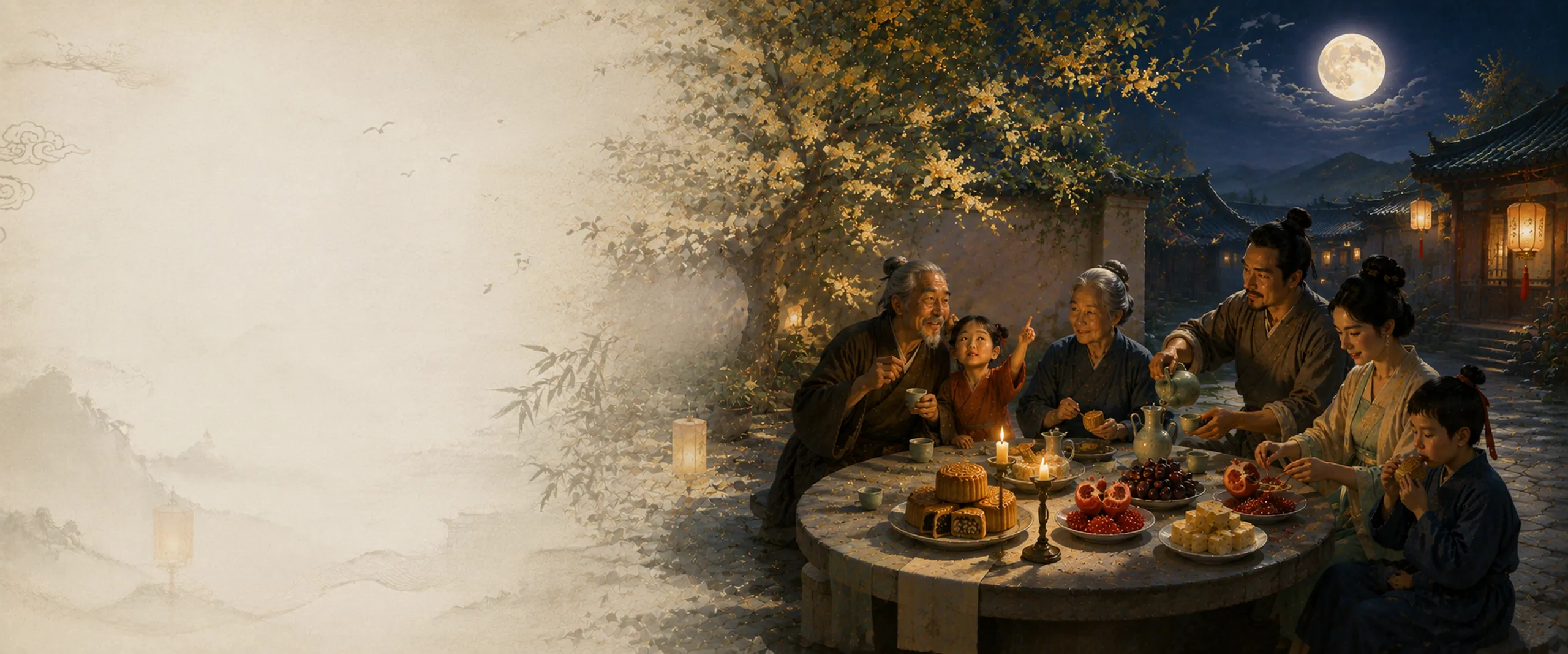
The mooncake is the most symbolically significant food of the Mid-Autumn Festival. The earliest poetic association between a round cake and the moon is found in the Northern Song poet Su Shi’s line, “A little cake, like chewing the moon, with crispness and sweetness within.” Liu Ruoyu’s Ming-dynasty Zhuozhong Zhi (《酌中志》) records: “On the fifteenth day, every household offers mooncakes, melons, and fruits. Once the moon has risen and incense has been burned, people then feast and drink without restraint.” Mooncakes were originally offerings presented to the Moon Goddess, but gradually evolved into an indispensable part of the Mid-Autumn reunion banquet. Because both the full moon and the cake are round, and because the whole family shares the cake together, the mooncake came to symbolize reunion. Qing-dynasty poet Qi Qi’e wrote in his poem Mooncakes (《月饼》), “Mid-Autumn festival foods are by no means insignificant; round cakes emerge evenly from the oven,” pointing to the meaning embodied in the mooncake’s name. On Mid-Autumn night, the whole family sits together, shares mooncakes, and admires the bright moon, while the mooncake carries the deep emotional resonance of “sharing the beauty of the moon across a thousand miles.”

Mid-Autumn Festival / Mid-Autumn Festival Cuisine
327 days until Mid-Autumn Festival September 15, 2027 · Lunar 八月十五

Festival Food Gallery

Seasonal Menu

Food in Detail

Seeking the True Flavor

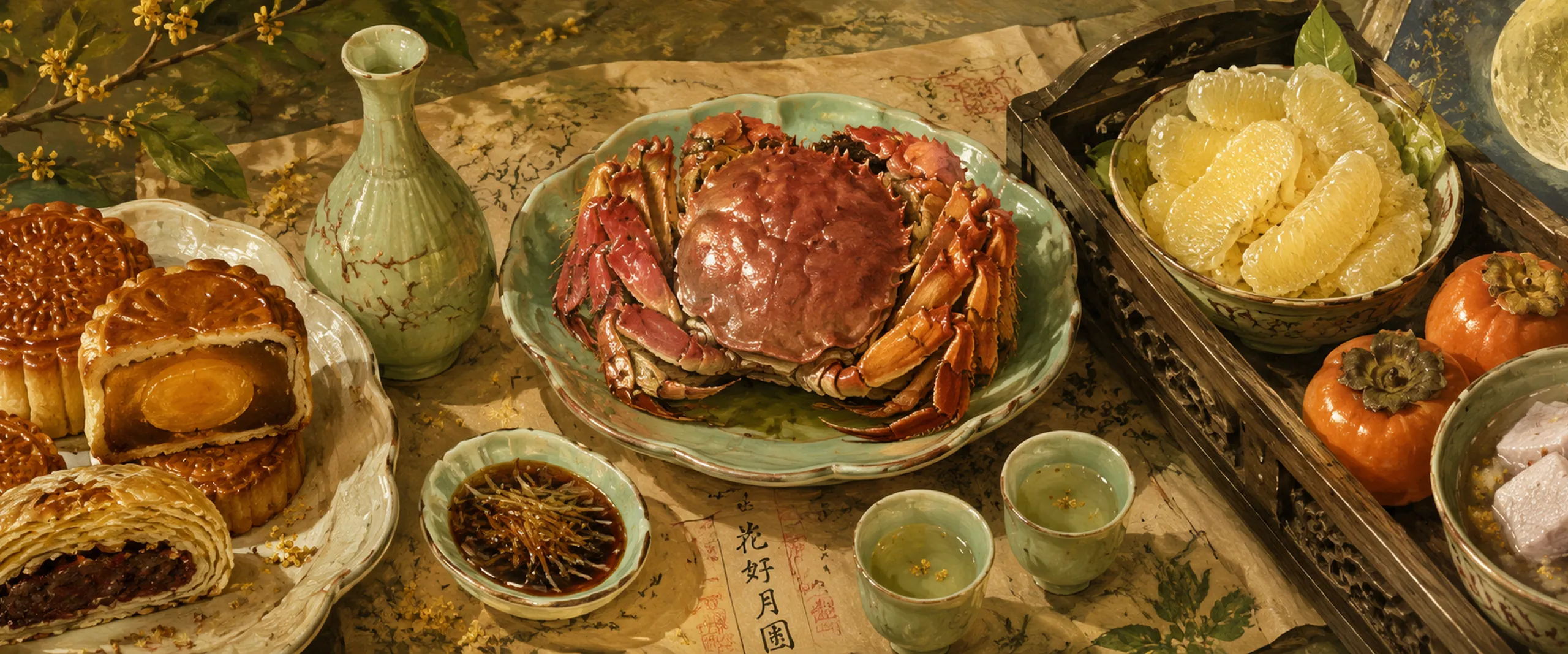
Mooncakes

Pastries & Snacks

Basic Information

  • Category: Grain-based pastry
  • Popular Regions: Nationwide
  • Main Ingredients: Wheat flour, sugar, fats, and fillings such as lotus-seed paste, red bean paste, five-nut mixture, salted egg yolk, ham, and others
  • Alternative Names: Hubing (胡饼), palace cakes, small cakes, moon rounds, reunion cakes

Historical Origins

Mooncakes are the most representative folk food and festive gift of the Mid-Autumn Festival. Their history is a thousand-year evolution from the “hubing” to the “reunion cake.”

Cultural Meaning

The predecessor of the mooncake can be traced to the Han-dynasty hubing (胡饼). When Zhang Qian traveled to the Western Regions, he introduced sesame and walnuts, adding new ingredients to the production of cakes. Round cakes filled with walnut kernels subsequently appeared and were known as hubing. Hubing were round baked wheat cakes sprinkled with sesame on the surface, products of cultural exchange along the Silk Road.

By the Tang dynasty, early records of mooncakes began to appear. A beautiful legend surrounds the origin of the name. According to tradition, the Tang court prepared a pastry known as hubing and presented it during Mid-Autumn. Emperor Xuanzong disliked the name hubing. Looking up at the moon, Yang Guifei casually suggested “mooncake,” and the name supposedly spread from then on. A surviving Tang-style mooncake decorated with baoxianghua patterns, paired pearl-round motifs, a ring of lotus-petal designs, and pine-needle ornamentation is described as a physical example of mooncake-like pastries from that period. The Tang text Luozhong Jiwen (《洛中记闻》) records that Emperor Xizong ate mooncakes during Mid-Autumn, found them extremely delicious, and ordered the imperial kitchen to wrap them in red silk and bestow them upon newly successful imperial examination candidates.

Records of mooncakes became more numerous during the Song dynasty. The earliest written record of the term “mooncake” appears in the Southern Song work Mengliang Lu (《梦粱录》) by Wu Zimu. At that time, however, the mooncake was made in a rhomboid flower shape and belonged to the category of “market pastries”; it was not yet an indispensable Mid-Autumn food. Mengliang Lu, which specifically records Song customs, states: “Market pastries are available throughout the seasons… hibiscus cakes, chrysanthemum cakes, plum-blossom cakes, mooncakes… sold directly at people’s doors.” Su Dongpo wrote: “A little cake, like chewing the moon, with crispness and sweetness within,” already bringing together the ideas of “moon” and “cake.” The term “mooncake” also appears in the Southern Song writer Zhou Mi’s Wulin Jiushi (《武林旧事》).

It was not until the Ming dynasty that mooncakes truly became an established seasonal food of the Mid-Autumn Festival and gradually spread widely among the people. During the Jiajing reign, mooncakes increasingly became a special food associated with the festival. A copy of Tian Rucheng’s Xihu Youlan Zhiyu preserved in the Zhejiang Library, printed in the twenty-sixth year of Jiajing, describes how the mooncake became a “reunion cake”: “The fifteenth day of the eighth month is called Mid-Autumn. Among the people, mooncakes are given to one another, taking the meaning of reunion.” Wanshu Zaji (《宛署杂记》) records that every Mid-Autumn, people made flour cakes and exchanged them as gifts, calling them “mooncakes.”

From the Ming dynasty onward, numerous records of mooncakes survive. By then, mooncakes were round and eaten specifically at Mid-Autumn, becoming the principal offering used in popular moon-worship rituals. Wanshu Zaji records that mooncakes of the period had “ingenious names and unusual forms, with some single cakes worth several hundred coins.” Skilled pastry makers even impressed myths such as Chang’e Flying to the Moon onto mooncakes as decorative food art.

During the Qing dynasty, mooncake-making techniques improved greatly. Mooncakes became not only more refined but also increasingly diverse. Qing imperial food archives record that every fifteenth day of the eighth lunar month, the palace made “fanmao mooncakes”, whose skins were thin and finely layered; with the slightest pressure, flakes of pastry would fall like drifting snow.

Qing palace fillings also incorporated cream and other ingredients, producing varieties such as A’erbuha mooncakes and milk mooncakes. A’erbuha is a Manchu term whose Chinese meaning is milk cake. In size, Qing imperial mooncakes ranged from roughly an inch across to more than a foot, while their weight ranged from just over one liang to more than twenty jin. Yuan Mei described flaky mooncakes in Suiyuan Shidan (《随园食单》), filled with pine nuts, walnuts, melon seeds, rock sugar, and lard—an early prototype of the modern five-nut mooncake. By the Qing dynasty, many regional styles had already formed, including Cantonese, Beijing, and Suzhou varieties.

A popular uprising legend also became associated with mooncakes. In the late Yuan dynasty, Han Chinese people wanted to rise up against Mongol rule but had difficulty transmitting messages. Liu Bowen devised a plan to hide slips of paper inside mooncakes bearing the call “On the fifteenth day of the eighth month, every household act together.” Mooncakes were thus used as a communication signal for a national uprising that, according to the legend, overthrew the Yuan dynasty in a single stroke. Mooncakes thereafter became a required Mid-Autumn food. Although this story may not accord with historical fact, it adds a legendary dimension to the mooncake.

The mooncake carries multiple layers of cultural meaning. First, “symbolizing reunion.” Its round shape represents reunion and harmony. When a family shares one mooncake, it symbolizes sharing happiness and remaining closely connected. Second, “an offering to the moon.” Mooncakes originally served as offerings in moon worship and, from the Ming dynasty onward, became closely associated with Mid-Autumn reunion. Third, “a gift of affection.” Mooncakes are also important gifts exchanged among friends at Mid-Autumn to maintain emotional bonds. Fourth, “an artistic medium.” Mooncake surfaces may feature legendary designs or inscriptions associated with Chang’e Flying to the Moon: Chang’e in celestial-maiden form, the osmanthus paradise of Guanghan Palace, the Jade Rabbit pounding medicine, or auspicious motifs and characters for fortune, emolument, longevity, happiness, and wealth.

Regional Evolution

China has a great many mooncake varieties. By region of origin, major styles include Suzhou, Cantonese, Beijing, Ningbo, Chaoshan, and Yunnan. Their appearances may be similar, but their flavors differ greatly.

  • Cantonese-style mooncakes: Originating in Guangdong and surrounding areas, they are currently one of the most popular types. They feature thin skins, generous fillings, and a higher fat content in both crust and filling than other styles. Their texture is soft. Lotus-seed paste, red bean paste, and five-nut mooncakes are representative varieties. Cantonese mooncakes use relatively little oil but are comparatively heavy on sugar.
  • Suzhou-style mooncakes: A form of Suzhou pastry, characterized by loose, flaky layers, attractive color, rich but not greasy fillings, and a crisp, crumbly texture. Both oil and sugar are emphasized, with a particular preference for flakiness. Their name is associated with su (酥, “flaky”), and they are best eaten freshly made.
  • Beijing-style mooncakes: Made somewhat like shaobing, with fragrant, crisp outer crusts. They are known for vegetarian ingredients: both oils and fillings are traditionally plant-based. Classic Beijing varieties are especially known for wisteria-flower and hawthorn fillings, extensive use of sesame oil, crisp texture, and a light, sweet fragrance.
  • Chaoshan-style mooncakes: Flatter in shape, with pale white pastry skins and crisp sugary fillings. Originating in Chaoshan, Guangdong, they use abundant oil and sugar. Their fillings resemble Cantonese ones, while candied winter melon is a major supplementary ingredient.
  • Yunnan-style mooncakes: Their main feature is the use of Yunnan-style ham in the filling. The pastry is loose, the filling balances savory and sweet flavors, and it has a distinctive Yunnan ham aroma. In Yunnan dialect they are called “tuo” (酡). Representative varieties include fresh-flower, white-glutinous-rice, sesame-kernel, fine-bean-paste, and ham mooncakes.
  • Ningbo-style mooncakes, Shanghai-style mooncakes, and other regional varieties likewise have their own distinctive characteristics.

In recent years, new mooncake styles have appeared continuously. Snow-skin mooncakes require no baking and are eaten chilled, with translucent milky-white skins; fruit-and-vegetable mooncakes use fillings such as Hami melon, pineapple, lychee, and strawberry; seafood mooncakes may contain abalone, shark fin, seaweed, and other fillings; tea mooncakes use fresh green tea as a principal filling.

Simple Preparation

  • Ingredients: 75 g invert syrup, 25 g peanut oil, 2 g alkaline water, 100 g low-gluten flour, 250 g lotus-seed paste, 5 salted egg yolks, beaten egg as needed
  • Steps:
  1. Mix the invert syrup, peanut oil, and alkaline water thoroughly. Sift in the low-gluten flour, knead into a smooth dough, cover with plastic wrap, and rest for 2 hours.
  2. Soak the salted egg yolks in baijiu to remove odors, then bake at 180°C for 5 minutes.
  3. Divide the lotus-seed paste into portions. Wrap one salted egg yolk in each portion and roll into balls.
  4. Take a small piece of pastry dough, about 15 g, flatten it, wrap it around the filling, and slowly close the dough around it using the web between thumb and forefinger.
  5. Dust lightly with dry flour and press in a mooncake mold to create the pattern.
  6. Spray the surface lightly with water and bake at 200°C for 5 minutes to set the shape. Remove, brush with beaten egg, lower the temperature to 180°C, and bake for another 15 minutes.
  7. Allow to cool, seal, and leave for 2–3 days for the oils to redistribute and soften the pastry.

Tip: The ratio of pastry skin to filling is approximately 3:7. A thin crust and generous filling are hallmarks of Cantonese mooncakes. The oil-returning process is a key step: freshly baked mooncake skins are firm, but after resting for 2–3 days, the oils redistribute and the crust becomes softer and glossier.

Osmanthus Wine

Drinks & Fine Wines

Basic Information

  • Category: Beverage
  • Popular Regions: Nationwide, especially the Yangtze River Delta
  • Main Ingredients: Osmanthus flowers, baijiu or yellow wine, rock sugar
  • Alternative Names: Osmanthus Dong Wine, guijiang, guijiu

Historical Origins

The history of osmanthus wine is almost as long as that of the Mid-Autumn Festival itself. Chinese consumption of osmanthus wine can be traced back more than two thousand years to the Eastern Zhou period. Qu Yuan wrote in Nine Songs: Donghuang Taiyi (《九歌·东皇太一》): “Steamed fragrant dishes on orchid mats; offerings of osmanthus wine and peppered liquor.” In Nine Songs: Dongjun (《九歌·东君》), he wrote: “I grasp my bow and turn downward; I draw the Northern Dipper to pour osmanthus nectar.” Records of osmanthus wine therefore already appear in writings from the Spring and Autumn and Warring States periods. Osmanthus was valued not only for ornamental purposes but also as an edible ingredient.

China has a long history of brewing fragrant wines with osmanthus. Osmanthus wine was already being made during the Warring States period. By the Qing dynasty, drinking osmanthus wine at Mid-Autumn had become an established custom. Pan Rongbi’s Qing work Dijing Suishi Jisheng (《帝京岁时纪胜》) records not only the eating of osmanthus cakes at Mid-Autumn but also the drinking of “Osmanthus Dong Wine.”

Cultural Meaning

The eighth lunar month is filled with osmanthus fragrance. On Mid-Autumn night, looking up at the cinnabar osmanthus tree imagined in the moon, drinking osmanthus honey wine, and eating osmanthus honey cakes became another pleasure of the festival’s food traditions. People gazed at the bright moon, breathed in waves of osmanthus fragrance, imagined Wu Gang chopping the osmanthus tree, drank a cup of osmanthus honey wine, and gathered with the whole family in sweetness and joy.

Osmanthus has an inseparable connection with the moon. According to legend, an osmanthus tree five hundred zhang tall grows in the Moon Palace. Wu Gang was punished for wrongdoing and ordered to cut it down, but each time he chopped it, the tree immediately healed. Drinking osmanthus wine at Mid-Autumn thus feels almost like sharing a cup with the immortals of the Moon Palace.

Simple Preparation

  • Ingredients: 50 g dried osmanthus, 500 ml high-proof baijiu, 100 g rock sugar
  • Steps:
  1. Rinse the dried osmanthus and allow it to dry completely, then place it in a clean glass jar.
  2. Add rock sugar, pour in the baijiu, and seal the jar.
  3. Store in a cool place for 1–3 months. When the liquid turns amber, it is ready to drink.
  4. It may be sipped directly or diluted with warm or iced water.

Tip: A light-aroma baijiu is preferable. Strong-aroma styles may overpower the fragrance of osmanthus. Osmanthus wine becomes more fragrant with age and may be brewed six months in advance for Mid-Autumn.

Hairy Crab

Meat & Seafood

Basic Information

  • Category: Freshwater delicacy
  • Popular Regions: Nationwide, especially Jiangsu, Zhejiang, and Shanghai
  • Main Ingredient: Chinese mitten crab
  • Alternative Names: Hairy crab, river crab, freshwater crab

Historical Origins

Among the Han Chinese, ancient Mid-Autumn banquet customs were especially refined at the imperial court. During the Ming dynasty, for example, eating crab became fashionable in the palace. Crabs were steamed in cattail-leaf wrappers, after which everyone sat together to eat them with wine and vinegar. Afterward, people drank perilla-leaf soup and used it to wash their hands. The banquet table was surrounded by fresh flowers, large pomegranates, and other seasonal produce, while mythological Mid-Autumn operas were performed.

The custom of eating crab at Mid-Autumn has a long history. The saying “when the west wind blows, crab legs itch” refers to Mid-Autumn as the ideal time for enjoying crab. Of all crab banquets, court banquets were the most refined. Eating hairy crab also became an added pleasure during Mid-Autumn and the Double Ninth Festival: after celebrating reunion at Mid-Autumn or returning from climbing heights at Double Ninth, people could drink wine, eat crab, admire chrysanthemums, relax their fatigue, and bring the day to a satisfying close.

Cultural Meaning

Eating hairy crab at Mid-Autumn carries the meaning of “celebrating the autumn harvest.” At this time of year, crabs are at their richest and most delicious, so eating them is both an enjoyment of and gratitude for nature’s generous bounty. Crab (xie, 蟹) sounds like thanks (xie, 谢), so eating crab also expresses gratitude—gratitude to Heaven and Earth for the harvest and gratitude to family members for accompanying one another throughout the year.

Simple Preparation

  • Ingredients: 4–6 live hairy crabs, ginger slices, perilla leaves, Zhenjiang fragrant vinegar, shredded ginger, white sugar
  • Steps:
  1. Rinse the crabs under clean water and scrub the shells and claws with a brush. Do not untie the strings binding their legs.
  2. Bring water to a boil in a steamer and add ginger slices and perilla leaves to remove odors and add fragrance.
  3. Place the crabs belly-side up in the steamer basket to prevent the roe from leaking out. Steam over high heat for 15–20 minutes, depending on size.
  4. Mix shredded ginger with Zhenjiang fragrant vinegar and a little white sugar to make the dipping sauce.
  5. Serve hot with ginger-vinegar sauce, accompanied by yellow wine or ginger tea to warm the stomach.

Tip: Crab is considered cold in nature, so ginger and vinegar are traditionally served with it to dispel the cold. Perilla leaves are an ideal companion when steaming crab, helping remove fishiness and balance its cold nature. Hairy crabs must be cooked while fresh and alive; dead crabs must not be eaten.

Taro

Seasonal Vegetables

Basic Information

  • Category: Root vegetable
  • Popular Regions: Southern China, especially Guangdong, Chaoshan, Jiangsu, and Zhejiang
  • Main Ingredient: Taro
  • Alternative Names: Yunai, yuzai, betel-nut taro

Historical Origins

Eating taro at Mid-Autumn is an important custom in southern China. Throughout Chaoshan, Guangdong, people worship the moon during the festival and also customarily eat taro. A Chaoshan saying goes: “When rivers and streams meet mouth to mouth, taro is ready to eat.” The eighth lunar month is taro-harvest season, and farmers traditionally use taro in ancestor worship.

The Chaozhou Fuzhi (《潮州府志》) from the Guiwei year of the Qianlong reign records: “At Mid-Autumn people enjoy the moon, peel taro and eat it, calling this ‘peeling ghost skin.’” Eating taro therefore carries the meaning of dispelling disaster and warding off evil.

In southern China, Mid-Autumn taro also symbolizes protection from misfortune. Taro (yu, 芋) sounds like encounter (yu, 遇) and therefore conveys the wish to encounter good omens. Taro plants produce many offspring corms, with the mother taro and child taros growing together, symbolizing reunion between mother and children and perfectly matching the Mid-Autumn theme of family reunion. Jiangsu, Zhejiang, and Guangdong all have customs of eating taro at Mid-Autumn for protection and good fortune. In Suzhou, sweet taro is served as a dessert at Mid-Autumn banquets, while people in Wujin, Jiangsu, eat sweet taro in the morning.

Cultural Meaning

The symbolism of taro at Mid-Autumn is multilayered. First, “warding off evil and disaster.” The saying “At Mid-Autumn people enjoy the moon, peel taro and eat it, calling this ‘peeling ghost skin’” evokes the bold spirit of Zhong Kui driving away ghosts. Second, “reunion.” Taro produces many offspring, with mother and child taros growing together, symbolizing reunion of mother and children. Third, “encountering good omens.” Yu (芋, taro) sounds like yu (遇, encounter) and therefore suggests meeting with good fortune. Fourth, “commemorating worthy predecessors.” In the south, taro used in moon worship at Mid-Autumn is also said to commemorate the historical story of Han people killing the Tatars at the end of the Yuan dynasty.

Simple Preparation

  • Ingredients: 500 g small taros, 50 g brown sugar, a little osmanthus
  • Steps:
  1. Wash the taros without peeling. Boil in water until soft, about 20–30 minutes.
  2. Remove, cool briefly in cold water, and peel off the skins.
  3. Bring fresh water to a boil, add the peeled taros, and add brown sugar.
  4. Simmer for 10 minutes so the taro absorbs the flavor, then sprinkle with osmanthus.

Tip: Boiling taro with the skin on helps preserve its shape and texture. Sweet taro is a classic Suzhou Mid-Autumn dessert, soft, glutinous, fragrant, and suitable for all ages.

Lotus-Root Sandwiches

Meat & Seafood

Basic Information

  • Category: Pan-fried / fried dish
  • Popular Regions: Jiangsu and Zhejiang
  • Main Ingredients: Lotus root, meat filling, wheat flour
  • Alternative Names: Lotus-root cakes, lotus-root boxes

Historical Origins

Eating lotus root at Mid-Autumn likewise expresses reunion, especially in the form of lotus-root sandwiches. In Jiangsu and Zhejiang, lotus root is often sliced so that pairs of slices remain attached at the lower edge. A filling of meat, clams, or other ingredients is placed between the slices, which are then coated in batter and fried until golden. These are also called lotus-root cakes and, in symbolic meaning, echo mooncakes.

Lotus-root sandwiches are particularly popular in Jiangsu and Zhejiang and symbolize reunion and longing. One interpretation draws on the image “the lotus root breaks, but its fibers remain connected,” likening the threads to a young woman’s longing. In addition, lotus root (ou, 藕) sounds like partner (ou, 偶). Lotus root therefore became, for some young women during Mid-Autumn, an offering presented to Chang’e while praying that love would blossom and bear fruit. Seven-hole lotus roots are widely grown in Jiangsu and Zhejiang and are valued for their excellent quality, crispness, and tenderness, making them particularly suitable for Mid-Autumn lotus-root sandwiches.

Cultural Meaning

Lotus-root sandwiches carry three meanings: reunion, longing, and a perfect match. Ou (藕, lotus root) and ou (偶, partner) are homophones, symbolizing a perfectly matched couple and pairs joined together. The image of “the lotus root breaks, but the threads remain connected” expresses longing and attachment. The two connected lotus slices with filling between them resemble a full moon and, like mooncakes, carry the symbolism of reunion.

Simple Preparation

  • Ingredients: 1 section lotus root, about 300 g; 200 g pork filling; minced scallion and ginger; 1 tablespoon light soy sauce; salt; 100 g flour; 1 egg; water as needed
  • Steps:
  1. Season the pork filling with minced scallion, ginger, light soy sauce, and salt.
  2. Peel the lotus root and cut into thin slices, leaving every two slices attached at one edge.
  3. Place meat filling between each pair of slices and press gently.
  4. Mix flour, egg, and water into a batter.
  5. Coat the lotus-root sandwiches in batter and pan-fry over medium-low heat until golden on both sides.
  6. They may be fried a second time for an even crisper exterior.

Tip: The thinner the lotus-root slices, the crisper the texture. Do not cut completely through between each pair, so the characteristic lotus-root sandwich shape is preserved. They taste best served hot.

Field Snails

Meat & Seafood

Basic Information

  • Category: Freshwater delicacy
  • Popular Regions: Guangdong and the Pearl River Delta
  • Main Ingredient: Field snails, including stone snails
  • Alternative Names: Stone snails, snails

Historical Origins

Among ordinary families in Guangzhou, many have the custom of stir-frying field snails during the Mid-Autumn period. Field-snail meat is especially plump at this time, making Mid-Autumn the best season for eating it. The Shunde Xianzhi (《顺德县志》) from the Xianfeng reign of the Qing dynasty records: “On the full-moon day of the eighth month, people value taro and eat snails.”

There are several explanations for the origin of the custom. One story tells of a poor scholar who could not afford meat for Mid-Autumn, so he gathered snails from the fields, cooked them at home, and ate them while admiring the moon. He later succeeded in the imperial examination and became famous, and eating snails at Mid-Autumn acquired an association with “climbing toward nobility.” Another explanation is that snail (luo, 螺) sounds like Cantonese 攞 (lo, “to take”). Field snails thus become “taking food from the fields,” and eating them on Mid-Autumn night represents a plentiful harvest and abundance of the five grains.

Folk tradition also holds that eating field snails at Mid-Autumn improves eyesight. Snail meat is nutritious, and its vitamin A is an important component involved in visual pigments. In Guangzhou and the Pearl River Delta, people traditionally use snails in Mid-Autumn worship of Zhang Gulao. After the ritual, everyone sucks the snail meat from the shells together, believing that doing so makes the eyes brighter.

Cultural Meaning

Field snails carry multiple meanings: bright eyesight, abundant harvest, and rising to distinction. Folk belief holds that sucking snails at Mid-Autumn makes the eyes brighter. Field snails are also colloquially associated with “climbing the osmanthus,” which sounds like “climbing toward nobility,” and therefore symbolizes succeeding in the imperial examinations and serving the country. Eating field snails on Mid-Autumn night also represents a plentiful harvest.

Simple Preparation

  • Ingredients: 500 g field snails, ginger slices, minced garlic, fermented black beans, perilla leaves, chili, cooking wine, light soy sauce, oyster sauce, white sugar
  • Steps:
  1. Soak the snails in clean water with a few drops of sesame oil for 2 hours so they expel sand.
  2. Use pliers to clip off the pointed tips of the shells, making them easier to season and suck from. Wash and drain thoroughly.
  3. Heat a wok with oil and stir-fry ginger, garlic, fermented black beans, and chili until fragrant.
  4. Add the snails and stir-fry over high heat. Add cooking wine to remove odors.
  5. Season with light soy sauce, oyster sauce, and sugar, add a small amount of water, and braise for 5 minutes.
  6. Add perilla leaves, stir-fry, reduce the liquid, and serve.

Tip: The snails must be thoroughly purged of sand or the texture will be affected. Cutting off the pointed ends helps seasoning penetrate and makes the meat easier to suck out. Perilla leaves are an ideal companion for stir-fried snails, removing odors and adding fragrance.

Pomelo

Fruits & Nuts

Basic Information

  • Category: Fruit
  • Popular Regions: Southern China
  • Main Ingredient: Pomelo
  • Alternative Names: Wendan, xiangluan

Historical Origins

Pomelo is one of the essential foods of the Mid-Autumn Festival. Around Mid-Autumn, Guangdong, Guangxi, Jiangxi, and other regions have traditions of eating pomelo. In Chaoshan, the festival falls in a season of clear skies and ripening fruit, and pomelos, persimmons, starfruit, pineapples, pomegranates, olives, bananas, and other fruits become another major category of festival food.

Fruits and cakes used as Mid-Autumn offerings are expected to be round. Mooncakes, pomelos, apples, and other round foods all convey the meaning of complete reunion.

Cultural Meaning

Pomelo (you, 柚) sounds like protection (you, 佑) and therefore expresses the hope that the moon will bestow protection. After eating sweet mooncakes, a little sweet-and-tart pomelo stimulates the appetite and cuts through richness. Its rounded shape symbolizes reunion, its golden skin represents wealth and honor, and its many seeds symbolize many children and abundant blessings. Pomelo is also a common moon-worship offering, placed on the incense table and presented to the Moon Goddess.

  • Ingredient: 1 pomelo
  • Steps:
  1. Use a knife to score several lines into the peel, in a cross or rice-character pattern, without cutting into the flesh.
  2. Peel back the skin and remove the fruit.
  3. Remove the white membrane and separate into segments for eating.

Tip: Choose a pomelo that feels heavy in the hand, indicating abundant juice. Pomelo peel may be dried to make pomelo tea or used as a natural deodorizer.

Pomegranate

Fruits & Nuts

Basic Information

  • Category: Fruit
  • Popular Regions: Nationwide
  • Main Ingredient: Pomegranate
  • Alternative Names: Danruo, Anshi liu, Jinpang

Historical Origins

Mid-Autumn coincides with pomegranate season. Red like agate, white like crystal, and tasting like crystalline nectar, pomegranates became one of the offerings placed on the festival table. Since ancient times, they have been regarded as auspicious fruits representing good fortune. Giving pomegranates as Mid-Autumn gifts is also customary. Their brilliant red flowers and translucent seeds symbolize a flourishing, prosperous life. Around Mid-Autumn, pomegranates are at their sweetest and juiciest and therefore count among the festival’s seasonal delicacies.

Pomegranates originated in Persia, present-day Iran, and were introduced into China when Zhang Qian traveled to the Western Regions during the Han dynasty. Ancient writers described the fruit as “a thousand chambers under one membrane, a thousand seeds as one.” Chinese people used the pomegranate as a symbol of blessings through offspring, with one of the earliest records said to appear in the History of the Northern Dynasties (《北史》). Buddhist culture states: “A pomegranate has one flower and many fruits, one chamber and a thousand seeds; therefore it is an auspicious fruit.”

Cultural Meaning

The pomegranate carries especially rich symbolism. First, “many children and many blessings.” Its many seeds symbolize flourishing descendants and a prosperous family line. Second, “flourishing prosperity.” The seeds are translucent and red like fire, expressing the wish for a prosperous life and thriving career. Third, “auspicious reunion.” The rounded shape of the pomegranate also carries the symbolism of reunion.

  • Ingredient: 1 pomegranate
  • Steps:
  1. Cut a square around the top of the pomegranate and remove the “lid.”
  2. Score along the internal white membranes.
  3. Gently pull the fruit apart with your hands and remove the seeds into a bowl.
  4. Eat directly or press into juice.

Tip: Removing pomegranate seeds under water helps prevent juice from splashing. The seeds may be chilled before eating for a better texture. Dried pomegranate peel can also be used medicinally.

Water Caltrops

Fruits & Nuts

Basic Information

  • Category: Aquatic fruit
  • Popular Regions: Southern water-town regions
  • Main Ingredient: Water caltrops
  • Alternative Names: Water chestnuts, jishi

Historical Origins

“In the eighth month, Mid-Autumn brings the water caltrops.” Mid-Autumn is when water caltrops are at their fullest and ripest, sweet and crisp. Giving water caltrops to children at Mid-Autumn expresses adults’ wish that they grow up clever and quick-witted. The most common way to eat them is to boil them in plain or salted water, peel off the shells, and enjoy them as a snack. Water caltrops are an emblematic Mid-Autumn snack of the Jiangnan water towns and, together with mooncakes and taro, form part of the region’s taste memory of the festival.

Cultural Meaning

Ling (菱, water caltrop) sounds like ling (伶, clever / quick-witted), so giving water caltrops to children at Mid-Autumn expresses the wish that they become “clever and quick-witted.” Their horn-like shape also carries the meaning of “taking first place,” expressing elders’ hopes that younger generations succeed in their studies and distinguish themselves.

  • Ingredients: 500 g fresh water caltrops, salt as needed
  • Steps:
  1. Wash the water caltrops and place them in a pot with enough water to cover.
  2. Add a little salt. Bring to a boil over high heat, then cook over medium heat for 15–20 minutes.
  3. Remove, allow to cool, peel, and eat.

Tip: Water caltrops are divided into tender and mature types. Tender ones are suitable for eating raw or stir-frying, while mature ones are better boiled. Adding salt during cooking enhances the flavor.

Ciba

Pastries & Snacks

Basic Information

  • Category: Grain-based pastry
  • Popular Regions: Guangxi, Sichuan, Chongqing, and other parts of southern China
  • Main Ingredient: Glutinous rice
  • Alternative Names: Baba, maci

Historical Origins

In Guangxi, people eat ciba while admiring the moon during the eighth-month Mid-Autumn Festival, symbolizing reunion, happiness, and auspiciousness for every household. A folk saying goes: “In the eighth month, Mid-Autumn arrives, and every household pounds ciba.” Around Mid-Autumn, households throughout Sichuan and Chongqing begin pounding ciba. The custom of eating ciba at Mid-Autumn is also found in the Zhumadian area of Henan.

The custom has a long history. Because ciba sticks together into a single mass, it symbolizes family harmony and unity. Its sweetness represents a sweet and happy life. Ciba is made into large or small round shapes, symbolizing festivity, affinity, good fortune, and reunion. Eating round ciba at Mid-Autumn naturally represents family harmony, complete reunion, and peace. In some regions, osmanthus is added before pounding to make osmanthus ciba, which is then dipped in roasted soybean flour and white sugar, producing a sweet, fragrant, refreshing flavor of its own.

Cultural Meaning

Ciba carries several auspicious meanings. First, “reunion.” Its round shape symbolizes reunion. Second, “harmony.” Because it sticks together as one mass, it represents family harmony and unity. Third, “sweetness.” Its sweet flavor symbolizes a sweet and happy life. Eating ciba is also part of the Mid-Autumn custom of “pounding rice cake,” embodying the practical wisdom of “working with one’s own hands to achieve abundant food and clothing.”

Simple Preparation

  • Ingredients: 500 g glutinous rice, roasted soybean flour as needed, white sugar as needed, sesame powder as needed
  • Steps:
  1. Soak the glutinous rice for at least 4 hours, then drain thoroughly.
  2. Line a steamer with cloth, add the glutinous rice, and steam over high heat for 30–40 minutes until fully cooked.
  3. Transfer the steamed rice to a stone mortar, or a sturdy bowl, and pound repeatedly with a wooden pestle until soft, sticky, and cohesive.
  4. Rub oil on your hands to prevent sticking, pinch off small portions of ciba, and roll them into balls.
  5. Coat with soybean flour, sesame powder, and white sugar before eating.

Tip: Ciba must be pounded while hot; once it cools, it becomes difficult to work. Oiling the hands prevents sticking. Ciba can also be pan-fried, deep-fried, or grilled.

Closing Reflections

Foodways

The full moon hangs overhead and osmanthus fragrance lingers nearby. Through the perfect roundness of a single mooncake, the Mid-Autumn Festival awakens the deepest homesickness of an autumn night. Many explanations have been offered for the origin of mooncakes, but perhaps the most moving is the folk story in which late-Yuan rebels hid slips of paper inside cakes to transmit messages; later generations therefore came to regard round cakes as fitting foods for Mid-Autumn. In this way, a small mooncake, between layers of flaky pastry and dense filling, came to hold centuries of the Chinese people’s most enduring longing for reunion. From Cantonese lotus-seed paste with salted egg yolk to Suzhou pepper-and-salt mixed-fruit fillings, from Beijing-style Zilaihong to Yunnan ham mooncakes, the Mid-Autumn mooncake spreads across north and south as a map of profoundly different flavors. People in Lingnan favor the delicate sweetness of lotus-seed paste; those of Gusu cherish the crisp, layered pastry of Suzhou-style cakes; and Yunnan diners are especially devoted to the rich savory fragrance of ham. Sweet and salty, meat-filled and vegetarian, a hundred flavors unfold—and every one of them tastes of home.

The world of mooncakes extends far beyond the four major styles of Cantonese, Suzhou, Beijing, and Yunnan. Chaoshan laobing (朥饼) use lard to create a flaky pastry that melts in the mouth; Huizhou Huibing (徽饼) are coated in sesame and conceal a sweet filling within; Shanxi huntang mooncakes (混糖月饼) are thick, plain, and unadorned yet leave a lingering sweetness; Hong Kong snow-skin mooncakes use glutinous rice for their wrappers and rely on refrigeration, producing a refreshing style that has become popular across north and south in recent years. Among Cantonese mooncakes, double-yolk lotus-seed paste is the classic of classics—the egg yolks glisten with oil, the lotus paste is dense and smooth, and once the cake is cut open, golden yolk and pale filling form one of the most tempting color contrasts of Mid-Autumn night. Suzhou-style mooncakes, by contrast, are made of layer upon layer of flaky pastry; they crumble at the slightest touch, and one gentle bite sends delicate flakes scattering across one’s clothes. That fine, fragmentary sense of satisfaction is a uniquely Jiangnan Mid-Autumn elegance.

Mid-Autumn cuisine reaches far beyond the mooncake. In Jiangnan, there is particular emphasis on “eating crab on the fifteenth day of the eighth month.” At this time, crabs are full of roe and rich with fat, and the folk saying “round-bellied in the ninth month, pointed in the tenth” speaks to their seasonal excellence. Holding a crab claw while admiring the moon became, in the imagination of literati, one of autumn’s most refined pleasures. In Jinling, osmanthus duck is indispensable at Mid-Autumn: the meat is tender, the osmanthus fragrance seems to drift through it, and a single dish contains the whole autumn of Jiangnan. Lingnan households set taro, water caltrops, and pomelo on the same table, drawing on homophonic associations of “protecting the head,” “cleverness,” and “protecting children,” and entrusting their simplest blessings for family to the foods between their lips and teeth. With the mooncake at its core and autumn’s harvest as its companion, Mid-Autumn cuisine sustains a rich, gentle autumn evening between moon-gazing and reunion. However distant the moonlight, it can still illuminate the road home; however round the mooncake, it can still hold every longing. The sweetness and savoriness hidden between layers of pastry and dense fillings make Mid-Autumn more than a festival about mooncakes: it becomes the softest and brightest full moon in the heart of every traveler far from home.

—

Continue exploring Mid-Autumn Festival culture

Readers’ Comments

Calendar and traditional culture enthusiasts from around the world, sharing the same moon.

Sign in or register to join the conversation. Your comment account is created automatically the first time you use a connected account.