Mid-Autumn Festival

Mid-Autumn FestivalPoetry

「 但愿人长久,千里共婵娟。 」

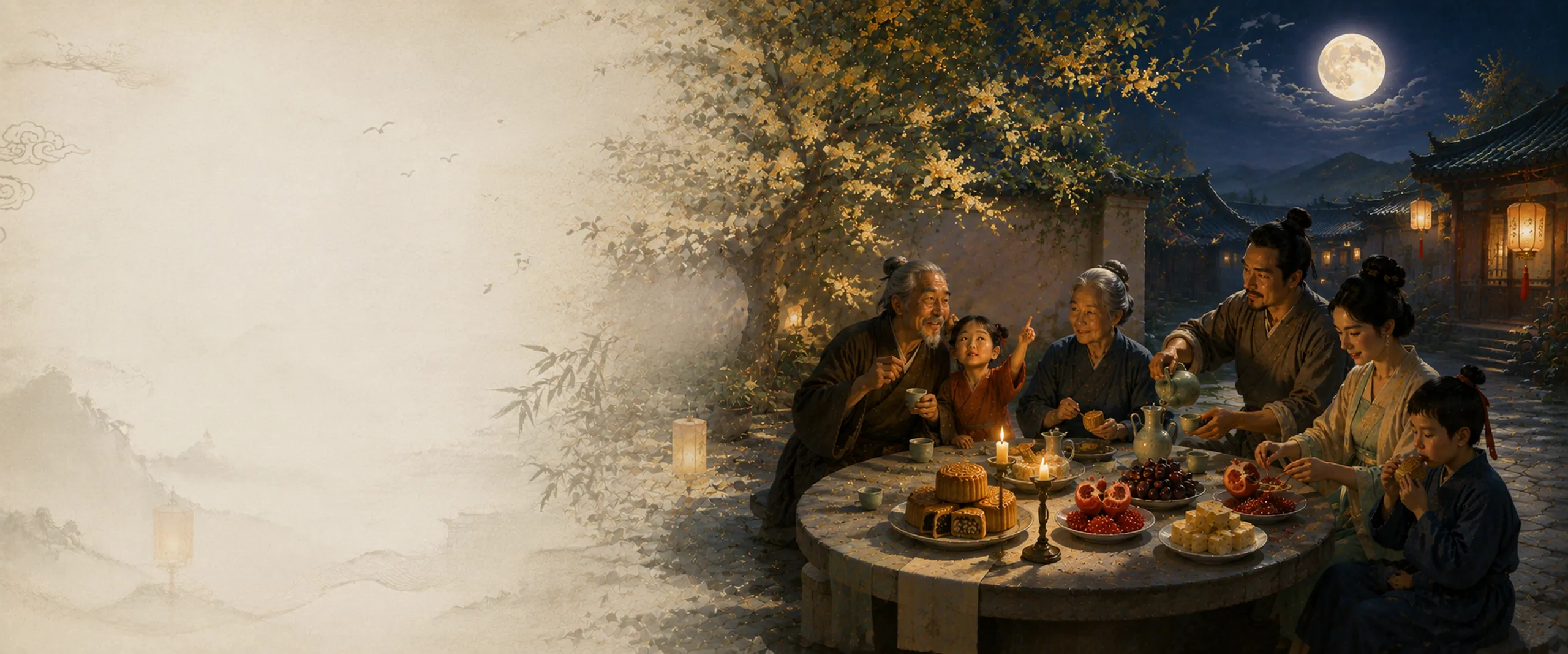
The Mid‑Autumn Festival originated in the Tang dynasty and became widespread in the Song dynasty, celebrated on the night of the full moon on the 15th day of the eighth lunar month. Su Shi, in his ci poem “Water Melody · Mid‑Autumn Moon”…

The bright moon is the eternal theme of Mid-Autumn poetry. Su Shi’s Shuidiao Getou · When Will the Bright Moon Appear? (《水调歌头·明月几时有》), with the lines “人有悲欢离合,月有阴晴圆缺,此事古难全。但愿人长久,千里共婵娟”, became one of the immortal masterpieces of Mid-Autumn ci. Zhang Jiuling’s Gazing at the Moon and Thinking of One Far Away (《望月怀远》)—“海上生明月,天涯共此时。情人怨遥夜,竟夕起相思”—expresses the profound feeling of people separated by vast distances sharing the same moon on Mid-Autumn night. Wang Jian’s Gazing at the Moon on the Fifteenth Night (《十五夜望月》)—“中庭地白树栖鸦,冷露无声湿桂花。今夜月明人尽望,不知秋思落谁家”—captures the universal autumn longing of the human world. Du Fu’s “满月飞明镜,归心折大刀” entrusts the desire to return home to the moon, while Li Bai’s “举头望明月,低头思故乡” is known in virtually every household. Mid-Autumn poetry brings together moon and humanity, the farthest horizon and the nearest heart, becoming one of the deepest cultural memories of reunion among Chinese people.

Mid-Autumn Festival / Poetry
327 days until Mid-Autumn Festival September 15, 2027 · Lunar 八月十五

Historical Development

Seasonal Poetry

From the Pre-Qin Period to the Northern and Southern Dynasties

By the pre-Qin period, the moon had already left its earliest traces in poetry. In Shijing · Chen Feng · Yue Chu (《诗经·陈风·月出》), the line “月出皎兮,佼人僚兮” uses the radiance of moonlight to set off the beauty of a woman’s face, establishing an aesthetic connection between the moon and human emotion. At this time, however, “Mid-Autumn” was still only a seasonal concept and had not yet become a distinct festival. During the Northern and Southern Dynasties, Xie Zhuang’s Rhapsody on the Moon (《月赋》) used the fu form to write of the moon, linking it with themes of separation, longing, and the passage of time, and laying an important literary foundation for the later flourishing of Mid-Autumn poetry. Before the Tang dynasty, Mid-Autumn festival customs had not yet fully taken shape. Although the moon had already become a poetic image, it was not yet deeply bound to the specific moment of “Mid-Autumn.”

The Tang Dynasty

The Tang dynasty was the formative period of Mid-Autumn poetry. Poems written by Tang poets on Mid-Autumn night transformed the moon from a general poetic image into a cultural symbol closely tied to a particular festival. Zhang Jiuling’s Gazing at the Moon and Thinking of One Far Away, with the immortal line “海上生明月,天涯共此时”, established a grand and expansive model for gazing at the moon and longing for those far away. Wang Jian’s Gazing at the Moon on the Fifteenth Night, with the delicate “今夜月明人尽望,不知秋思落谁家”, expressed the universal experience of everyone beneath heaven looking upon the same Mid-Autumn moon while carrying different forms of autumn longing. Tang Mid-Autumn poetry was written chiefly in five-character and seven-character forms. Its styles ranged from vigorous grandeur to restrained lyricism, together establishing the emotional foundation of Mid-Autumn verse.

The Two Song Dynasties

With the rise of ci in the Song dynasty, Mid-Autumn themes acquired a new artistic form, and Mid-Autumn ci reached an unprecedented height. Su Shi’s Shuidiao Getou · When Will the Bright Moon Appear? has been praised as “the foremost Mid-Autumn ci through the ages.” Its lofty realm, broad spirit, vigorous brushwork, expansive emotion, and lucid language made it an unsurpassed summit of Mid-Autumn poetry. Xin Qiji’s Taichangyin · Written for Lü Shuqian on Mid-Autumn Night in Jiankang (《太常引·建康中秋夜为吕叔潜赋》) uses distinctive imagination and a bold style to question the encroachment of white hair and place hope in the moon’s pure radiance. Zhang Xiaoxiang’s Niannujiao · Crossing Dongting (《念奴娇·过洞庭》), with its pure realm of “表里俱澄澈”, renders Dongting Lake on Mid-Autumn night like an immortal landscape. Su Shi’s Yangguan Melody · Mid-Autumn Moon (《阳关曲·中秋月》), meanwhile, writes both the joy of reunion beneath the full moon and the sadness of impending separation, using a short lyric to convey deep feeling.

Yuan, Ming, and Qing

By the Yuan, Ming, and Qing dynasties, Mid-Autumn customs had become firmly established: moon-viewing, eating mooncakes, and family reunion had become enduring traditions. Although Mid-Autumn poetry no longer reached the dazzling peaks of the Tang and Song, its creation continued without interruption. Yuan poets placed greater emphasis on personal reflection; Ming Mid-Autumn poetry inherited earlier traditions while incorporating more depictions of popular festival customs; Qing poetry continued the classical tradition of singing of the moon. Ming poet Xu Youzhen wrote in Mid-Autumn Moon (《中秋月》), “阴晴圆缺都休说,且喜人间好时节”, expressing a generous spirit of acceptance and delight in the season. Qing poet Zha Shenxing’s Song of Gazing at the Moon over Dongting Lake on Mid-Autumn Night (《中秋夜洞庭湖对月歌》) continued the Dongting imagery of Zhang Xiaoxiang and portrayed the magnificent moonlit scenery of the lake on Mid-Autumn night.
Core Imagery

Seasonal Poetry

Images that recur throughout Mid-Autumn poetry form a distinctive “Mid-Autumn image system.” They are both literary expressions of festival culture and vehicles for poetic emotion.

The Bright Moon

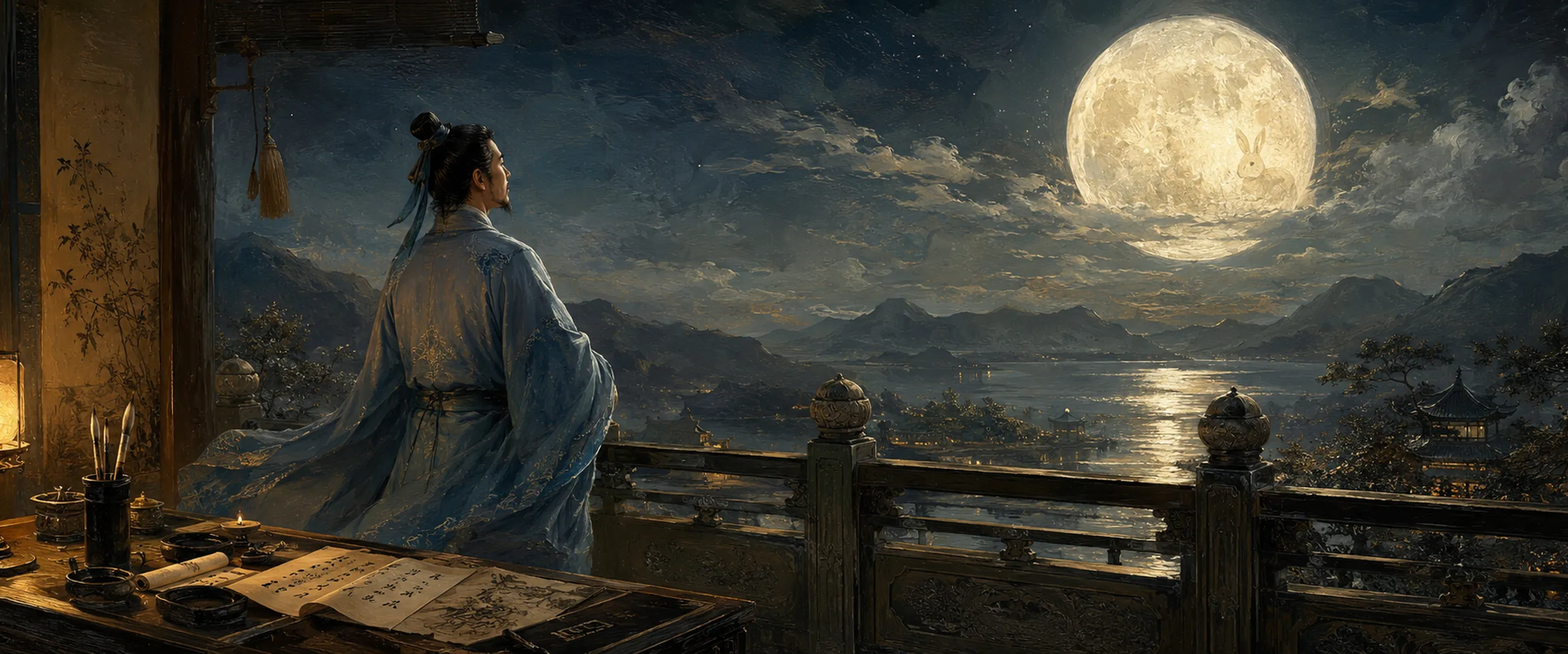
The bright moon is the most central and essential image in Mid-Autumn poetry. From Zhang Jiuling’s “海上生明月” to Su Shi’s “明月几时有”, from Wang Jian’s “今夜月明人尽望” to Xu Youzhen’s “月到中秋偏皎洁”, the moon runs through the entire history of Mid-Autumn verse. The Mid-Autumn moon is round and therefore symbolizes reunion; it is bright and therefore symbolizes light; it appears eternal and therefore becomes a vessel for the human longing for enduring feeling.

The grandeur of “海上生明月” is humanity looking upward toward the moon. The question “明月几时有” is humanity’s search for eternity. The blessing “千里共婵娟” is humanity’s longing for reunion. The bright moon is the soul of Mid-Autumn poetry—without the moon, there would be no Mid-Autumn verse.

Chang’e and the Osmanthus Tree

Chang’e flying to the moon and Wu Gang cutting the osmanthus tree are recurring mythic images in Mid-Autumn poetry. Su Shi’s “我欲乘风归去,又恐琼楼玉宇,高处不胜寒” imagines the Moon Palace as a place of return and writes out the tension between leaving the world and remaining within it. Xin Qiji’s “斫去桂婆娑,人道是清光更多” uses the osmanthus myth to express a political ideal. Mi Fu’s Climbing a Tower to Gaze at the Moon at Mid-Autumn (《中秋登楼望月》) refers to two folk legends: that the formation of pearls is related to the moon’s waxing and waning, with oysters conceiving pearls at the full moon; and that the moon is composed of seven treasures, with eighty-two thousand households in the human world constantly repairing it. Such mythic images raise the Mid-Autumn moon from an astronomical phenomenon into the realm of cultural imagination.

Autumn Longing

Wang Jian’s question “不知秋思落谁家” is one of the most universal emotional expressions in Mid-Autumn poetry. Autumn longing belongs not to a single person but to everyone; it belongs not to one place but to all beneath heaven. On Mid-Autumn night, “autumn longing” is longing for distant relatives, concern for those from whom one is separated, and reflection on the circumstances of life. Zhang Jiuling’s “情人怨遥夜,竟夕起相思” writes the depth of longing; Su Shi’s “转朱阁,低绮户,照无眠” writes the suffering of sleeplessness; Xin Qiji’s “被白发、欺人奈何” writes the sorrow of passing years. Autumn longing is the emotional ground of Mid-Autumn verse—without it, Mid-Autumn poetry would lose its depth.

Reunion and Separation

Reunion and separation are inseparable sides of the same whole in Mid-Autumn poetry. Su Shi’s Shuidiao Getou writes longing within separation: the brothers have not met for seven years and can only “千里共婵娟”. Yangguan Melody · Mid-Autumn Moon writes the premonition of separation within reunion: the brothers are finally together, yet Su Shi already knows “此生此夜不长好”. Reunion is the hope of Mid-Autumn; separation is its reality. Precisely because separation exists, reunion becomes precious. Precisely because longing exists, the Mid-Autumn moon appears especially bright. In Mid-Autumn poetry, reunion is the wish, separation the emotional ground, and longing the bridge that joins separated people beneath a single moon.

Thematic Categories

Seasonal Poetry

Gazing at the Moon and Thinking of Those Far Away

Gazing at the moon and thinking of distant loved ones is the most classic theme in Mid-Autumn poetry. Zhang Jiuling’s Gazing at the Moon and Thinking of One Far Away raises personal longing into a universal realm through “海上生明月,天涯共此时”. Wang Jian’s Gazing at the Moon on the Fifteenth Night uses “今夜月明人尽望,不知秋思落谁家” to express the universal experience of everyone looking upon the same moon while carrying different forms of autumn longing. Su Shi’s Shuidiao Getou transforms longing for his younger brother into a blessing for all who are separated through “但愿人长久,千里共婵娟”. These works begin with gazing at the moon and arrive at thinking of the distant, blending individual emotion with universal human concern.

The Joy of Reunion

Mid-Autumn is a festival of reunion, and Mid-Autumn poetry also records the joy of being together. Su Shi’s Yangguan Melody · Mid-Autumn Moon writes of brothers reunited after seven years, admiring the Mid-Autumn moon together—the joy of “people and moon both full.” Xu Youzhen’s Mid-Autumn Moon uses “且喜人间好时节” to express delight in and appreciation for this fine season. Against the background of Mid-Autumn reunion, these poems write the warmth of loved ones gathering together and the joy of the festival.

Yet even when writing reunion, Mid-Autumn poetry often contains an unspoken reluctance to separate. At the very moment of reunion, Su Shi already senses “此生此夜不长好”. The more beautiful reunion is, the more painful separation becomes.

Unfulfilled Ambition

Mid-Autumn poetry also contains a distinctive group of works that use the bright moon as a background for feelings of ambition left unrealized. Xin Qiji’s Taichangyin · Written for Lü Shuqian on Mid-Autumn Night in Jiankang gazes at the moon and reflects upon Chang’e, the osmanthus tree, and other myths. Through “乘风好去,长空万里,直下看山河”, he expresses attachment to the mountains and rivers of his homeland; through “斫去桂婆娑,人道是清光更多”, he places hope in enlightened politics. Zhang Xiaoxiang’s Niannujiao · Crossing Dongting, written while boating across Dongting after losing office, uses “肝肺皆冰雪” to declare the purity of his inner convictions and “万象为宾客” to transcend personal gain and loss.

Philosophical Reflection

The deepest theme in Mid-Autumn poetry is reflection on the principles of human life. Su Shi’s Shuidiao Getou steps beyond personal sorrow through “人有悲欢离合,月有阴晴圆缺,此事古难全”, transforming the pain of separation into calm acceptance of the patterns of existence. Xu Youzhen’s Mid-Autumn Moon, with the openness of “阴晴圆缺都休说,且喜人间好时节”, turns reflection on the moon’s fullness and waning into an appreciation of the beauty of the present moment. These works understand human sorrow and joy, separation and reunion, through the changing phases of the moon, finding in the lament “此事古难全” a form of transcendence expressed by “千里共婵娟”.

Mid-Autumn Festival Folk Songs

Seasonal Poetry

The Mid-Autumn Festival is not only a festival of the Han Chinese, but also an important celebration for many ethnic minority communities. In minority regions of Yunnan, Guizhou, Guangxi, and elsewhere, Mid-Autumn traditions have incorporated distinctive local ethnic characteristics. Zhuang, Miao, Dong, and other peoples observe customs such as moon-viewing, worshipping the moon, and antiphonal singing during the festival, accompanied by songs from their own traditions. The Dong custom of “stealing moon vegetables” during Mid-Autumn is among the most romantic folk activities of the night; the Miao custom of “dancing beneath the moon” uses song and dance to express longing for reunion and love. Although many of these orally transmitted songs were never recorded in writing, they have been passed down from generation to generation through the festival life of minority communities and, together with the written poetry of Han literati, form the complete cultural landscape of the Mid-Autumn Festival within the Chinese nation.

Closing Reflections

Seasonal Poetry

Mid-Autumn poetry forms a distinctive and radiant landscape within the treasury of Chinese verse. From Zhang Jiuling’s “海上生明月” and the grand opening of Tang Mid-Autumn poetry, to Su Shi’s “明月几时有” and the immortal summit of Mid-Autumn ci; from Xin Qiji’s “乘风好去,长空万里” and the heroic passion of unrealized ambition, to Zhang Xiaoxiang’s “表里俱澄澈” and its realm of immaculate purity; from Xu Youzhen’s “且喜人间好时节” to an openhearted and joyful attitude toward life—Mid-Autumn poetry has recorded for a thousand years the Chinese longing for reunion, sorrow over separation, reflection on life, and aspiration toward beauty.

Within these poems is the deep attachment of “海上生明月,天涯共此时”; the enduring blessing of “但愿人长久,千里共婵娟”; the universal autumn longing of “今夜月明人尽望,不知秋思落谁家”; the devotion to country expressed in “乘风好去,长空万里,直下看山河”; the sigh over passing time in “此生此夜不长好,明月明年何处看”; and the pure realm of “表里俱澄澈”. From Qu Yuan’s Tianwen to Su Shi’s “把酒问青天”, Mid-Autumn poetry continues the thousand-year questioning of Chinese poets toward cosmos and life. From Li Bai’s “举头望明月” to Zhang Xiaoxiang’s “万象为宾客”, it completes a spiritual ascent from personal longing toward the realm of heaven and earth.

From “月出皎兮” in the Shijing to the Mid-Autumn songs of contemporary poets, the bright moon has carried the Chinese nation’s appreciation of beautiful scenery, hope for reunion, reflection on time and space, and questioning of history. The meaning of Mid-Autumn poetry lies precisely in its ability to carry moonlight and longing from a thousand years ago into every succeeding age of Chinese life. “明月几时有?把酒问青天。” The question is not merely when the moon first appeared, but when reunion in the human world might become eternal. The answer is not what year it is in the Moon Palace, but the truth of life contained in “此事古难全” and the heartfelt blessing of “千里共婵娟”. Mid-Autumn poetry is one of the deepest and most enduring declarations Chinese people have made to reunion, a long scroll of moonlight written in ink by generation after generation. Within that scroll, the moon is never only the moon; it is also the simplest and most profound expression of Chinese longing for reunion, beauty, and eternity.

—

[Language: es]

Continue exploring Mid-Autumn Festival culture

Readers’ Comments

Calendar and traditional culture enthusiasts from around the world, sharing the same moon.

Sign in or register to join the conversation. Your comment account is created automatically the first time you use a connected account.