Mid-Autumn Festival

Mid-Autumn FestivalGlobal Spread

「 但愿人长久,千里共婵娟。 」

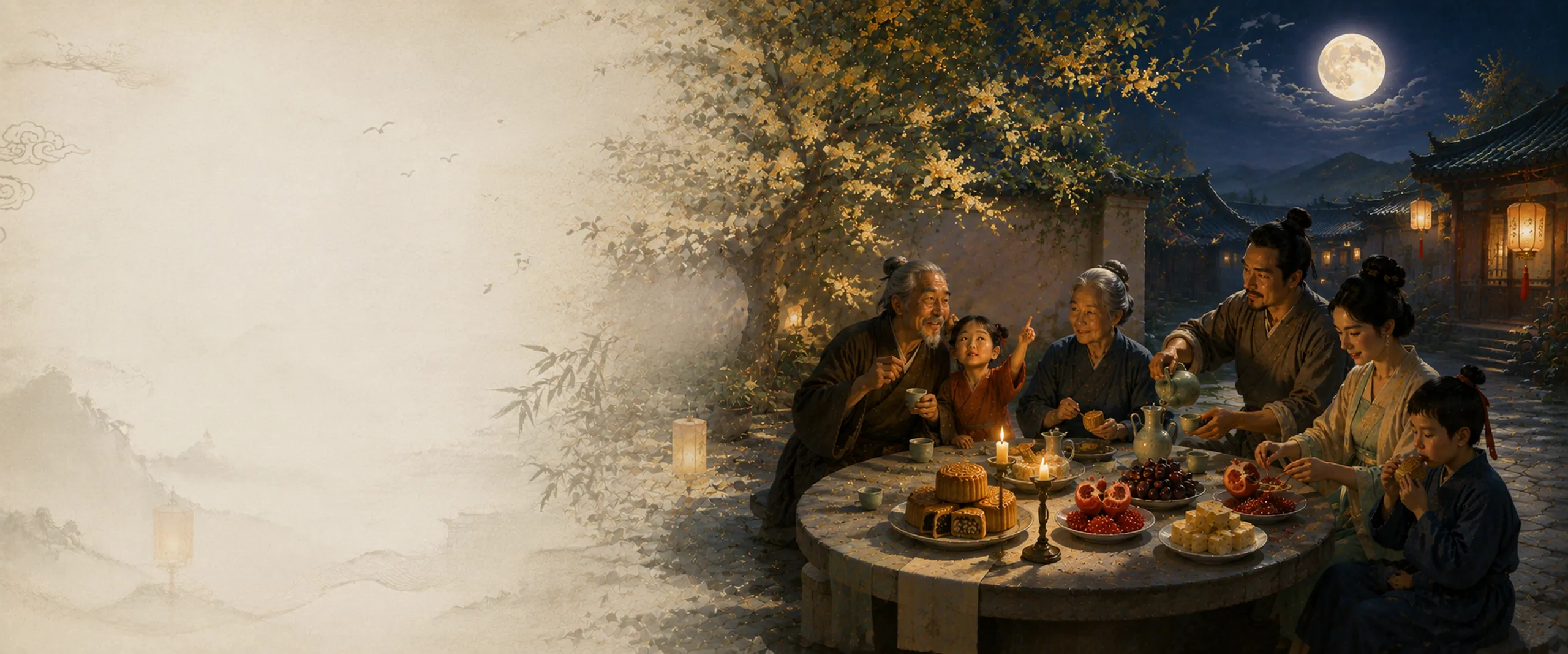
The Mid‑Autumn Festival originated in the Tang dynasty and became widespread in the Song dynasty, celebrated on the night of the full moon on the 15th day of the eighth lunar month. Su Shi, in his ci poem “Water Melody · Mid‑Autumn Moon”…

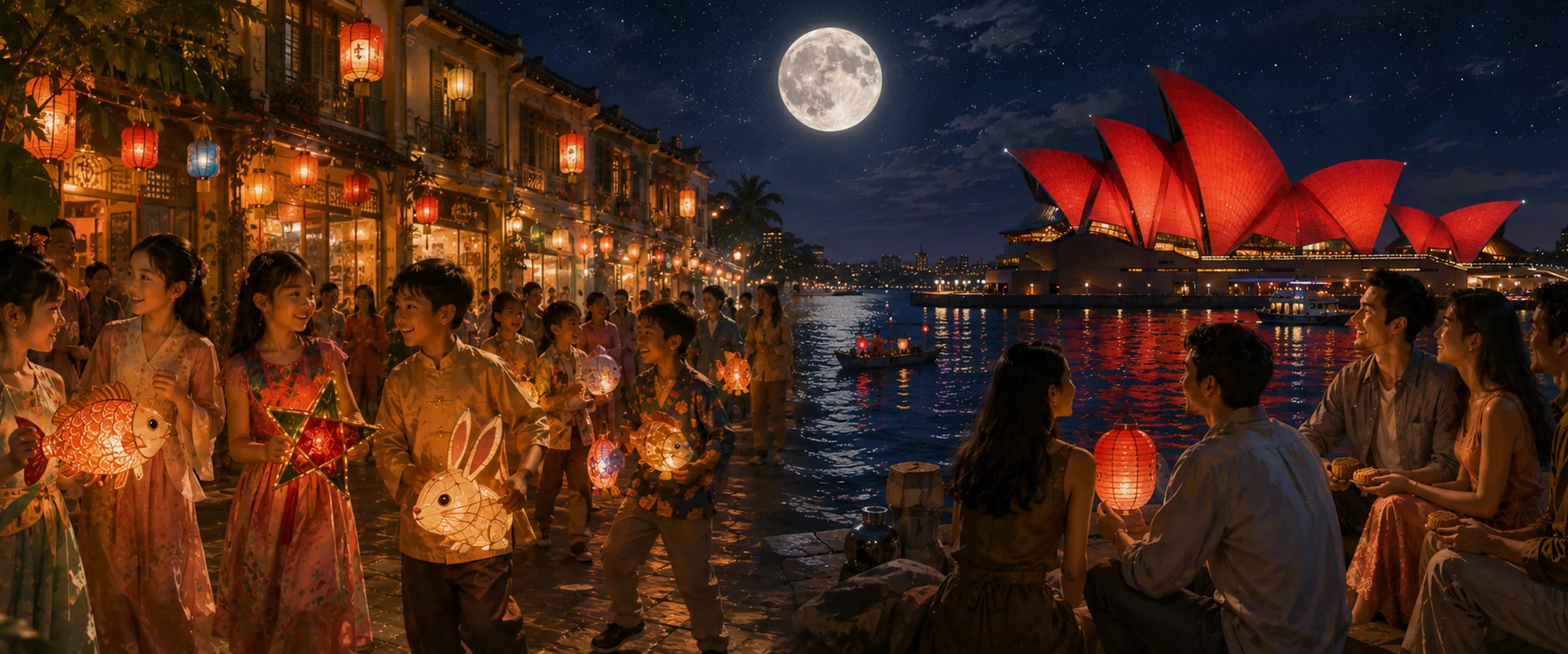
The Mid-Autumn Festival has followed the footsteps of Chinese communities across the world. In Southeast Asia, Chinese communities in Malaysia, Singapore, Indonesia, and elsewhere hold annual moon-viewing gatherings, mooncake tastings, lantern processions, and other activities, making the festival an important part of local cultural life. In North America, Chinatowns in New York, San Francisco, Vancouver, and other cities are illuminated with festive decorations each year, hosting Mid-Autumn fairs, cultural performances, and mooncake markets. In Europe, Chinese community groups in London, Paris, and elsewhere likewise organize celebrations during the festival, inviting local residents to experience such traditions as admiring the moon, eating mooncakes, and solving lantern riddles.

The festival’s overseas reach is no longer confined to Chinese communities. Increasing numbers of people from other cultural backgrounds are beginning to understand and take part in this “festival of reunion.” With the bright moon as its medium, the Mid-Autumn Festival carries the poetic sentiment of “sharing the beauty of the moon across a thousand miles”—the spirit of 千里共婵娟—to every corner of the world.

Mid-Autumn Festival / Global Spread
327 days until Mid-Autumn Festival September 15, 2027 · Lunar 八月十五

Celebrated Worldwide

Regional Highlights
01

The Americas

United States

The United States is one of the countries with the world’s largest Chinese immigrant populations. Although the Mid-Autumn Festival is not a federal public holiday, in cities with substantial Chinese communities—including New York, San Francisco, Los Angeles, and Philadelphia—it has become an important event on the urban cultural calendar.

San Francisco: The 35th Mid-Autumn Autumn Moon Festival. On September 27–28, 2025, San Francisco Chinatown’s 35th Mid-Autumn street fair opened with great fanfare. People came from near and far to buy mooncakes and festival goods and to enjoy Chinese song and dance, dragon dances, and lion dances. San Francisco Chinatown’s Mid-Autumn street fair is one of the oldest and largest Mid-Autumn celebrations in the United States and has been held continuously for more than three decades.

Philadelphia: Community organizations and multicultural participation. Philadelphia Chinatown’s 2025 Mid-Autumn Festival celebration was organized by two nonprofit organizations, PCDC (Philadelphia Chinatown Development Corporation) and AAU (Asian Americans United), drawing large numbers of Asian Americans as well as residents from many other ethnic communities. One of the most memorable moments came when a local American performer sang 《月亮代表我的心》 in Chinese, with remarkably standard pronunciation. The event also featured calligraphy, art displays, and inflatable play structures for children. Philadelphia’s Mid-Autumn celebration has now reached its 30th edition.

Boston: Mid-Autumn Lantern Festival. Boston Chinatown held its Mid-Autumn Lantern Festival on September 13, 2025. Handmade lanterns filled the streets of Chinatown, creating an exceptionally vivid festive atmosphere. A wide range of cultural performances added to the celebration and attracted large numbers of local residents.

New York: A Mid-Autumn celebration attended by the mayor. During the 2025 Mid-Autumn Festival, New York City Mayor Eric Adams specially invited members of the Chinese community to a Mid-Autumn celebration, where they shared mooncakes together. Mid-Autumn activities in New York Chinatown also included celebrations organized by local businesses and tastings of low-sugar mooncakes, offering healthier ways to mark the festival.

One Chinese resident in the United States exclaimed: “Celebrating Mid-Autumn in America somehow felt like celebrating Chinese New Year! The Chinatown festivities really hit me emotionally… Red lanterns covered the entire street, and even the air smelled of sugar-roasted chestnuts and roast duck… I may physically be in America, but at that moment I truly felt, ‘where the heart finds peace, there is home’—此心安处是吾乡.”

Canada

Canada’s Mid-Autumn celebrations are equally vibrant and diverse. From large night markets to community events honoring the elderly, from cultural exchanges in public libraries to folk performances in schools, together they form a richly varied portrait of the festival.

Toronto: “The Moon Is Shared Across the World” Mid-Autumn Night Market. During the 2025 Mid-Autumn Festival, the Chinese Consulate General in Toronto supported a series of events under the theme “天涯共此时—中秋节”, expressing the poetic idea that people separated by great distances may still share the same moment beneath the same moon. The 2025 Mid-Autumn Night Market in Mississauga was a centerpiece of the series. Lasting three days and centered on the traditional Chinese Mid-Autumn Festival, the night market created a joyful festive atmosphere through food, lanterns, and cultural performances, while building a bridge for friendship and mutual understanding between the peoples of China and Canada. Organizers expected 30,000 visitors.

The series also included a complete performance of the Peking opera 《白蛇传》 (The Legend of the White Snake) under the theme “National Opera Celebrates Mid-Autumn · The Moon Is Shared Across the World,” as well as the “Bank of China Night · The Moon Is Shared Across the World” concert.

Montreal: An eight-hour celebration of Mid-Autumn culture. In October 2025, Montreal hosted a Mid-Autumn cultural celebration themed “明月寄情·共庆中秋”, evoking the sending of affection through the bright moon and the shared celebration of Mid-Autumn. The entire program lasted eight hours, featuring songs, dance, traditional opera, Chinese instrumental music, and other performances.

Vancouver: Mid-Autumn folk culture showcase. On October 4, 2025, Vancouver United Chinese School held a large-scale “Mid-Autumn Folk Culture Showcase” at Moscrop Secondary School in Burnaby, attracting nearly 400 teachers and students from across the school.

Calgary: A dual expression through community associations and the public library. Calgary’s Mid-Autumn celebrations were especially varied. On September 27, the long-established Calgary Chiu Chow Association took the lead in organizing a Mid-Autumn gathering honoring the elderly, combining the celebration of the festival with the traditional Chinese virtues of respecting and caring for older generations. More than one hundred community members of Chaozhou origin gathered together.

On October 3, the Calgary Jiangsu-Zhejiang-Shanghai Friendship Association held a Mid-Autumn celebration. With an impromptu accordion accompaniment by an instructor from the Jasmine Choir, singing and laughter filled the venue.

On October 5, Calgary’s New Central Library hosted a Mid-Autumn Youth Cultural Exchange, ranging from the making of snow-skin mooncakes, a soft, uncooked style of mooncake with a pale glutinous-rice-flour exterior, to calligraphy experiences and Chinese traditional instrumental music performed throughout the event. The activities attracted large numbers of people from different ethnic backgrounds. Music is a language without borders: the ensemble performed festive traditional Chinese pieces such as 《花好月圆》, whose title evokes “blossoming flowers beneath a full moon” and, by extension, happiness and completeness. Whatever their background, visitors entering the venue could immediately sense the joyful atmosphere of Mid-Autumn and its spirit of reunion.

That evening, the nearly century-old Calgary 至孝笃亲公所 held a grand Mid-Autumn banquet honoring the elderly. Its chairman, Chen Zhiqiang, said: “At the heart of Mid-Autumn is ‘reunion,’ while the guiding principle of our association is ‘filial piety.’ When the moon in the sky becomes full, families on earth should come together. That, in itself, is the finest expression of ‘filial piety.’”

02

Latin America

Although Mid-Autumn celebrations in Latin America are smaller in scale than those in North America, they display a distinctive warmth and vitality.

Brazil: The “Chinese Mid-Autumn Festival” becomes an official festival in São Paulo. On November 28, 2025, the São Paulo City Council formally passed legislation incorporating the “Chinese Mid-Autumn Festival” into the city’s annual calendar of municipal activities between early September and early October. This marked an important milestone in the official recognition of the Mid-Autumn Festival in Latin America.

On October 4, 2025, the third “欢聚中秋” Mid-Autumn Carnival opened with great fanfare on São Paulo’s famous commercial thoroughfare, 25th Street. The street is the largest open-air market in South America and was also an early center from which Chinese people established businesses and enterprises in Brazil. Chinese Consul General in São Paulo Yu Peng, Brazilian Chinese Association President Ye Zhouyong, and others attended the opening ceremony.

Activities included Chinese folk dance, martial arts performances, arts and crafts exhibitions, workshops offering experiences of traditional Chinese medicine, and food stalls serving a variety of Chinese dishes. On the evening of October 4, the São Paulo Asian Cultural Center also held an “Itaipu Mid-Autumn Night” gala at the Itaipu Hydroelectric Power Station in Foz do Iguaçu, Paraná State, where Brazilian and Paraguayan singers performed accompanied by musicians from China, Brazil, and Paraguay.

Venezuela: “The Moon Is Shared Across the World” Mid-Autumn event. The Chinese Embassy in Venezuela organized a Mid-Autumn event themed “天涯共此时”, using cultural performances, exhibitions, food tastings, interactive experiences, and other formats to showcase outstanding traditional Chinese culture and the Mid-Autumn ideals of reunion, harmony, and mutual learning among civilizations.

03

Europe

United Kingdom

On October 5, 2025, London Chinatown held a Mid-Autumn Festival celebration organized by the London Chinatown Chinese Association. Its chairman, Deng Zhuting, said that since its establishment, the association had remained committed to promoting cultural exchange between China and the United Kingdom and fostering harmony within the community. By organizing a Mid-Autumn celebration, it hoped that overseas Chinese could experience the warmth of home, the cohesion of community, and the beauty of multicultural coexistence even while living abroad.

At the event, local residents tried traditional Chinese performance arts including kuaiban (快板), a rhythmic storytelling form performed with bamboo clappers, while performers dressed in Mongolian ethnic attire also took to the stage. People gathered in London Chinatown to watch the Mid-Autumn festivities and experience the atmosphere of the festival far from its homeland.

Germany

Germany is one of the European countries with the richest range of Mid-Autumn activities.

Berlin’s Gardens of the World: Tens of thousands celebrate Mid-Autumn together. On September 27, 2025, the annual Mid-Autumn celebration was held at Berlin’s Gardens of the World, where tens of thousands of German residents experienced the festival’s atmosphere of reunion amid laughter and festivity. Since the completion of its Chinese Garden, “得月园”, in 2000, the Gardens of the World has held Mid-Autumn celebrations every year.

Berlin Mid-Autumn musical exchange. The Chinese Embassy in Germany and several German friendship organizations held a Mid-Autumn musical exchange in Berlin. German resident Isabella Hansen said: “I think it [the Mid-Autumn Festival] is a wonderful family gathering—a time to celebrate autumn together, enjoy delicious food together, and gaze romantically at the moon.”

German resident Peter Krotzberg said: “The Mid-Autumn Festival lives up to its name because the moon is full. Looking at the moon, you feel peaceful and feel at home, because it returns to an ancient tradition: wishing that everything goes well throughout the year, that the harvest is abundant, and that everyone remains healthy.”

The Chinese Cultural Center in Berlin also held a “天涯共此时” Mid-Autumn Concert, bringing together more than 180 guests from Chinese and German political, cultural, academic, and other circles, as well as representatives of cultural institutions from several countries based in Germany. German university student Phil Milenz said: “Holding this kind of event in Germany and having the opportunity to show Chinese culture to German audiences is very important, because culture can communicate with and understand other cultures through things such as music.”

Eysach Palace: Mid-Autumn inside a castle. On October 11, 2025, a “Mid-Autumn Celebration” jointly organized by the Eysach Palace Museum, the Confucius Institute Nuremberg-Erlangen, and the Bayreuth Chinese Cultural Association was held at Eysach Palace in Bavaria. As Mid-Autumn entered a German castle, Eastern and Western cultures met and mingled within its historic architecture.

Frankfurt Book Fair: A refined Mid-Autumn literary gathering. On October 17, 2025, the event “天涯共此时——中秋书香雅集”, organized by the China National Tourist Office in Frankfurt, was held at the Frankfurt Book Fair, bringing the atmosphere of Mid-Autumn into a gathering shaped by books and literary culture.

France

Lyon: A Mid-Autumn chapter in the China-France Theatre Culture Festival. In early October 2025, Lyon deepened its character as a World Heritage city through a cross-disciplinary dialogue with traditional arts. On October 6, a team of Chinese artists visited Lycée Saint-Exupéry in Lyon, where nearly one hundred French secondary-school students participated in a Jinju (晋剧) masterclass, introducing them to the traditional opera of Shanxi, as well as an online cultural course presented by the Shanxi Museum.

On October 7, the artists visited the New Franco-Chinese Institute, where its vice president recounted the history of the first 400 Chinese youths who traveled to France to study in 1921. That evening, inside the UNESCO World Heritage Basilica of Notre-Dame de Fourvière, Chinese and Western music intertwined with the vocal traditions of Jinju.

These few days of cultural activities were not merely artistic performances; they also built a bridge of understanding and cooperation between China and France, and more broadly between China and Europe. As Chinese Consul General in Lyon Yu Jiang stated: “The flourishing of civilizations and the progress of humanity are inseparable from exchange and mutual learning among civilizations.”

Paris: The Vietnamese community’s “Mid-Autumn Festival—Night of the Full Moon.” On October 5, 2025, the Union Générale des Vietnamiens de France and several community organizations jointly held a “Mid-Autumn Festival—Night of the Full Moon” event at the Vietnamese Cultural Center in Paris’s 13th arrondissement, attracting hundreds of young people, parents, and international friends.

Sweden

The “Mid-Autumn Peace Mooncake Charity Sale,” organized by the Stockholm Association of Buddha’s Light International, has now been held in Sweden for three consecutive years. Taking the Mid-Autumn Festival as an occasion, the event allows members of the Fo Guang community to celebrate reunion in a meaningful way while also raising funds for the construction of temples in Europe. The Copenhagen Association of Buddha’s Light International also traveled to Sweden to participate in the charity sale, demonstrating the strength of cross-border cooperation within the Fo Guang community.

04

Asia

Asia is the region where Mid-Autumn culture has spread most deeply and extensively. The festival is celebrated not only by Chinese communities; Vietnam, South Korea, Japan, Singapore, Malaysia, and other countries have also developed distinctive Mid-Autumn traditions of their own.

Southeast Asia

Southeast Asia has one of the world’s largest concentrations of overseas Chinese communities. Here, the Mid-Autumn Festival has not only preserved Chinese traditions in relatively complete form, but has also developed distinctive local expressions through its interaction with surrounding cultures.

Singapore: A citywide “reunion celebration.” The Mid-Autumn atmosphere is especially vibrant in Singapore. Celebrations retain traditional activities such as carrying lanterns, solving lantern riddles, and eating mooncakes, while also incorporating innovative elements including community festivities, creative lantern installations, and modern markets. For families, the festival offers an opportunity to visit relatives and friends and spend time with older generations; for younger people, it has also become a lively occasion for dates and outings, trying new mooncake flavors, and exploring night markets.

Lantern viewing and festival outings are among the most popular activities during Mid-Autumn, and Chinatown is one of Singapore’s liveliest destinations each year. Mid-Autumn decorations generally extend from New Bridge Road to Upper Cross Street, with large themed installations, street performances, and markets appearing during the festive period. Organizers arrange annual group lantern processions and stage programs, inviting community residents to take part in activities combining tradition with creativity.

Beyond Chinatown, Gardens by the Bay, Jurong Lake Gardens, and other locations have in recent years transformed Mid-Autumn celebrations into large-scale exhibitions. In 2025, the Jurong Lake Gardens Mid-Autumn lantern festival began on September 27 and ran for 16 consecutive days, displaying as many as 1,200 lanterns. Eye-catching themed lantern series inspired by 《西游记》 (Journey to the West) recreated classic episodes and settings including Flaming Mountain and the Cave of Silken Web.

Singapore’s mooncake market embraces both tradition and continual innovation: from classic salted egg-yolk lotus-seed-paste mooncakes and five-nut mooncakes (五仁月饼) to snow-skin varieties, and more recent popular flavors such as durian, taro, and Peranakan-inspired mooncakes. In Singapore, Mid-Autumn is not simply a Chinese festival; it increasingly resembles a citywide “reunion celebration”, connecting families, neighborhoods, businesses, and visitors in different ways.

Malaysia: From lantern processions to carnival-style celebrations. Malaysian Chinese have long observed the custom of sharing a reunion dinner during the Mid-Autumn Festival, while also celebrating by drinking tea and enjoying mooncakes. During the festive period, local associations, schools, villages, and even temples organize a variety of activities, including community fairs, moonlight gatherings, lantern street processions, and blessing ceremonies.

In 2025, Jonker Street in Malacca once again introduced new approaches, bringing together the strengths of various local civic groups and working with the Malacca state government to organize Mid-Autumn festivities. Mooncake-making sessions were also provided for residents and visitors to experience firsthand.

As times have changed, Malaysian Chinese celebrations have evolved from an earlier focus on carrying lanterns, drinking tea, and eating mooncakes into large-scale carnival-style festivities incorporating markets, game stations, and major cultural performances. In Singapore and Malaysia, where Chinese immigrant communities are substantial, the atmosphere of Mid-Autumn most closely resembles that of Chinese society. People worship the Moon Goddess (拜月娘), admire the moon, share mooncakes, and organize large lantern festivals. In recent years, cities such as Singapore and George Town, Penang, have held lantern displays, markets, and performances that attract people of different ethnic groups, symbolizing reunion and integration within multicultural societies.

Vietnam: Mid-Autumn is also a children’s festival. In Vietnam, the Mid-Autumn Festival is also known as a children’s festival, and parents prepare snacks and lanterns for their children. Children carry lanterns through markets, watch dragon and lion dances, and walk along streets decorated with brightly colored lanterns, forming beautiful “lantern streets.” Children often carry distinctive five-pointed star lanterns.

From October 3 to 6, 2025, Hội An Ancient Town in Da Nang held four days of Mid-Autumn festivities, including lantern displays, lion dances, lantern processions, and multiple outdoor art performances. The year 2025 was the “China-Vietnam Year of People-to-People Exchanges,” during which the series “彩云追月·睦邻情深” brought Mid-Autumn culture into Vietnam. Nguyễn Trí Mẫn, an inheritor of the craft of making Tang-style confectionery (唐菓子), said that for people in both China and Vietnam, eating mooncakes and pastries is an indispensable Mid-Autumn custom.

Thailand: The distinctive tradition of the “Moon-Praying Festival.” In Thailand, the Mid-Autumn Festival is also called the “Moon-Praying Festival” (祈月节). Families set up square tables in their homes, while Chinese communities in Thailand preserve the tradition of paying reverence to the Moon Goddess and praying for good fortune.

South Korea

In South Korea, the Mid-Autumn Festival is known as Chuseok (秋夕) and, alongside the Lunar New Year, is one of the country’s most important traditional festivals. In 2025, the Chuseok holiday ran from October 5 to 8. Many Koreans return to their hometowns during Chuseok to spend the holiday with relatives and friends, sharing both the fruits of the harvest and feelings of longing for one another.

Unlike in China, the representative food of Korean Chuseok is not the mooncake but songpyeon, a half-moon-shaped rice cake made from newly harvested rice. Ancestral rites are a central ritual of Chuseok, although in recent years they have become increasingly simplified. A survey by South Korea’s Rural Development Administration showed that 62.5% of respondents said they did not plan to conduct ancestral rites during Chuseok; among families that continued the tradition, 92% had simplified the ritual.

In terms of gift preferences, cash gifts (41.6%) were the most popular Chuseok present, followed by fruit (19.6%) and health foods (16.2%). Koreans also maintain a number of traditional activities: men take part in wrestling contests or bullfighting, women put on their favorite clothes and gather to sing and dance, while children have games of their own.

During Chuseok, Seoul hosts numerous cultural activities, including the “Seoul Car-Free Jamsu Bridge Walking Festival” from September 27 to October 19 and the “Seoul Palace Cultural Festival” from October 8 to 12.

Japan

After the Mid-Autumn Festival was introduced to Japan from China, it gradually developed distinctive forms of celebration. In Japan, the festival is known as Jūgoya (十五夜, “the Fifteenth Night”) or Imo Meigetsu (芋名月, “the Taro Harvest Moon”), with moon viewing and gratitude toward nature at its heart.

Japanese Mid-Autumn customs differ from those in China. Because autumn is the harvest season for taro and other crops, on Jūgoya people prepare 15 rice dumplings arranged in a tower, together with offerings such as pampas grass, taro, beans, and sacred sake (神酒). These are placed in the center of a courtyard or somewhere with a clear view of the moon, in gratitude to the deities for protecting the harvest.

Japan’s tsukimi (月見), or moon-viewing culture, has a long history. Aristocrats once took boats onto lakes beneath the Mid-Autumn moon, composing poetry and enjoying themselves. For farmers among the common people, Mid-Autumn was likewise an important occasion to celebrate the agricultural harvest and give thanks for divine blessings. Kyoto’s moon-viewing gatherings consist of Shinto rituals followed by folk songs, dance, and gagaku, Japan’s ancient court music.

Japan also developed the custom of viewing the moon three times in a year. Modern Japan has become even more inventive—from traditional tsukimi dango, moon-viewing rice dumplings, to the “Tsukimi Burger,” Jūgoya preserves the elegance of tradition while continually generating new ways to celebrate.

05

Oceania

Australia

Sydney: The Mid-Autumn Cultural Festival enters a mainstream commercial district. The 2025 Mid-Autumn Cultural Festival was held in Chatswood, on Sydney’s North Shore. Themed “A Full Moon, People Reunited—Celebrating Mid-Autumn Together,” the festival brought together music, dance, food, traditional arts, and a cultural market. Lion dances, Sichuan opera face-changing, Hanfu fashion shows, and other performances drew large numbers of Sydney residents. Chinese Consul General in Sydney Wang Yu, Australian federal senator Paul Scarr, New South Wales parliamentarian Tim James, and others attended the opening ceremony.

Sydney Chinatown: Lion dancers distribute mooncakes. On October 6, 2025, a lion dance performance was held inside a shopping center in Sydney Chinatown, where mooncakes were distributed to local residents in celebration of the festival. The energetic lion dance and randomly distributed mooncakes prompted repeated applause and cheers from the crowd.

Brisbane: The Hakka association honors the elderly at Mid-Autumn. On October 5, the Queensland Hakka Association held its “2025 General Meeting and Celebration of the Double Ninth Festival Honoring the Elderly and the Mid-Autumn Festival” in southern Brisbane.

New Zealand

Li Fen, chair of the New Zealand Huaxia Multicultural Arts Exchange Center, said that as members of overseas Chinese communities, they were witnessing outstanding traditional Chinese culture take root and flourish in foreign lands. Whenever she saw people of different skin colors and languages participating together in Mid-Autumn activities and experiencing the warmth of Mid-Autumn reunion, she felt a deep sense of cultural confidence and national pride.

06

Africa

Although the Mid-Autumn Festival began spreading across the African continent relatively late, it is now taking root and sprouting across the vast African landscape, with Confucius Institutes and Chinese cultural centers serving as important points of support.

Morocco: “The Moon Is Shared Across the World” Mid-Autumn Gala. On October 11, 2025, a “天涯共此时” Mid-Autumn Gala was held in Rabat, the capital of Morocco, where several hundred Chinese and Moroccan audience members enjoyed performances by artists from Sichuan, China. Among the performances was the puppet-and-long-silk program 《秋月》 (“Autumn Moon”).

Nigeria: “The Moon Is Shared Across the World · Mid-Autumn Poetry Gathering.” On September 25, 2025, the “天涯共此时·中秋诗会”, hosted by the Chinese Embassy in Nigeria and organized by the China Cultural Center in Nigeria, was successfully held in Abuja. Chinese Ambassador to Nigeria Yu Dunhai attended and delivered remarks. The poetry gathering offered a vivid reflection of cultural exchange between the two countries.

Rwanda: An immersive Mid-Autumn experience at the Confucius Institute. As the festival approached, the Confucius Institute at the University of Rwanda organized a rich variety of cultural activities, including lectures on Mid-Autumn culture, recitations of Mid-Autumn poetry, lantern-riddle treasure hunts, and experiences with huadian (花钿), traditional decorative floral ornaments worn on the face or forehead. The venue was arranged with distinctly Chinese elements, with lanterns and Chinese knots creating a strong festive atmosphere. African teachers and students immersed themselves in the “flavor of reunion” at Mid-Autumn.

Republic of the Congo: A Mid-Autumn-themed cultural day. On October 9, 2025, Chinese Ambassador to the Republic of the Congo An Qing visited the Brazzaville Chinese International School and attended its Mid-Autumn-themed cultural day. Ambassador An presented awards to winners of the “中秋咏月” calligraphy competition, and joined students in making mooncakes, solving lantern riddles, and crafting rabbit lanterns, together experiencing the beauty of Mid-Autumn culture.

Benin: A Mid-Autumn celebration at the Chinese Cultural Center. The Chinese Cultural Center in Benin organized a Mid-Autumn celebration featuring a photography exhibition, mooncake tasting, dance, acrobatics, and other activities, attracting 180 guests from various sectors.

Tanzania: Chinese and Tanzanian teachers and students celebrate reunion together. The Tanzania branch organized a Mid-Autumn cultural exchange under the theme “同筑丝路情,共享中秋月”, bringing together representatives of the Confucius Institute at the University of Dar es Salaam, local government officials, and teachers and students from several schools to celebrate the festival of reunion together.

Mid-Autumn in the Cloud

In-Depth Feature

With the development of digital technology, the Mid-Autumn Festival has generated entirely new forms of celebration among overseas Chinese communities, transforming the poetic idea of “天涯共此时”—sharing the same moment though separated by the ends of the earth—into a digital reality.

CMG Mid-Autumn Gala: A global celebration reaching 132 million viewers. China Media Group’s 2025 Mid-Autumn Gala was broadcast worldwide on the evening of October 6, the Mid-Autumn Festival. Its live television broadcast reached 132 million viewer engagements, with a simulcast audience share of 20.39%, the highest share recorded since the gala began simulcasting. More than 1,000 trending topics related to the gala appeared on trending lists across multiple platforms.

The gala was broadcast simultaneously through television channels including CCTV-1, CCTV-3, CCTV-4, CCTV-15, the 4K Ultra HD channel, and the 8K Ultra HD channel, as well as new-media platforms including CCTV News, Yangshipin, CCTV.com, and overseas social platforms.

《传奇中国节·中秋》: A globally connected integrated-media broadcast. CMG’s Chinese International Channel launched the integrated-media special live program 《传奇中国节·中秋》, with studios in Beijing, at the Mid-Autumn Gala, and for new media. Through a combination of live video connections, dynamic festival reporting, explorations of urban customs, expert interviews, and new-media interaction, the program presented festival activities from locations around the world and transitioned seamlessly into CMG’s Mid-Autumn Gala.

“文化中国·月是故乡明”: A cloud-based reunion for Chinese communities worldwide. The 2025 “文化中国·月是故乡明” Overseas Chinese Mid-Autumn Gala was broadcast globally through Zhejiang Satellite TV, Zhejiang International Channel, and Z Vision. An interactive section continuously featured short videos of Mid-Autumn greetings from international friends, creating a genuine “cloud reunion party” for Chinese people around the world.

“天涯live共此时”: A 24-hour uninterrupted global livestream. Xiaohongshu launched a 24-hour continuous worldwide livestream under the theme “The Whole World Is Celebrating the Mid-Autumn Festival.” By opening the livestream, viewers could see outdoor scenery from around the world.

The deeper meaning of reunion in the cloud. From the 2016 Mid-Autumn livestream jointly organized by China Youth Daily and Beijing New Media Group, which broadcast through the studio both the celebrated scenery of “卢沟晓月” and the vision of “海上生明月”, to the globally connected broadcasts across major platforms in 2025, Mid-Autumn in the cloud has allowed relatives living far apart and Chinese people overseas to reunite digitally and express their longing for home. Through the internet, Chinese communities worldwide have transformed “天涯共此时” into a shared emotional connection across distance.

Mutual Learning Among Civilizations

In-Depth Feature

The Mid-Autumn Festival has gradually journeyed from a traditional festival of the Chinese nation onto the world stage. Its path differs from those of the Spring Festival, Lantern Festival, Qingming Festival, and Dragon Boat Festival: if the Spring Festival is defined by “bidding farewell to the old and welcoming the new,” the Lantern Festival by the visual symbol of “lantern lights,” Qingming by the spiritual core of “remembrance,” and the Dragon Boat Festival by the cultural emblem of “dragon boat racing,” then the Mid-Autumn Festival finds its greatest shared cultural denominator in the “bright moon,” and its universal value in “reunion.”

“The Moon Is Shared Across the World”: A poetry gathering at United Nations Headquarters. On October 13, 2025, the “天涯共此时—Mid-Autumn Poetry Gathering” was held at United Nations Headquarters. With poetry as its medium and the moon as its bridge, the event sought to convey the Mid-Autumn meanings of “reunion, harmony, and harvest” while promoting exchange and mutual learning between Eastern and Western civilizations. This was the first time Mid-Autumn culture had entered United Nations Headquarters, marking the festival’s formal arrival, from a traditional festival of the Chinese nation, onto the stage of global dialogue among civilizations.

The universal values of Mid-Autumn culture. Mid-Autumn activities symbolizing reunion and happiness are now held in many countries around the world, becoming important windows through which people can understand traditional Chinese culture and advance exchange and mutual learning among civilizations.

As one German resident put it, Mid-Autumn is a “wonderful family gathering,” a time to “celebrate autumn together, enjoy delicious food together, and gaze romantically at the moon.” Looking at the full moon, “you feel peaceful and feel at home, because it returns to an ancient tradition: wishing that everything goes well throughout the year, that the harvest is abundant, and that everyone remains healthy.”

German social-media blogger Zelen said: “I know these Chinese festivals are very important. Their cultural and emotional values can bring together not only the people of one country, but the whole world.”

Mid-Autumn as a bridge for dialogue among civilizations. From the interweaving of Chinese and Western music with Jinju melodies inside Lyon’s Basilica of Notre-Dame de Fourvière to the laughter of tens of thousands of Germans at Berlin’s Gardens of the World; from São Paulo’s official recognition of the “Chinese Mid-Autumn Festival” to the “天涯共此时” Mid-Autumn Poetry Gathering at United Nations Headquarters—the Mid-Autumn Festival is becoming an important cultural bond connecting China with the world.

As Chinese Consul General in Lyon Yu Jiang said: “The flourishing of civilizations and the progress of humanity are inseparable from exchange and mutual learning among civilizations.” From Brazil’s “欢聚中秋” Carnival to Nigeria’s Mid-Autumn Poetry Gathering, from Morocco’s “天涯共此时” Gala to the immersive experience at the Confucius Institute in Rwanda, the Mid-Autumn Festival is becoming an important window through which the world can understand China and experience Chinese civilization.

Closing Note

Lingering Notes

The global journey of the Mid-Autumn Festival is a long road from China’s ancient Moon Palace to the world’s five continents. Its inclusion in China’s national list of intangible cultural heritage in 2006 marked the festival’s passage from a folk celebration into the sphere of national protection; its widespread presence across nearly one hundred countries and regions, meanwhile, demonstrates that the cultural appeal of Mid-Autumn has long transcended national borders.

Unlike the Spring Festival, with its farewell to the old and welcome of the new; the Lantern Festival, radiant with lantern light; Qingming, with its reverent remembrance of those who came before; or the Dragon Boat Festival, with its racing boats, the Mid-Autumn Festival has traveled overseas with the “bright moon” as its greatest common denominator and “reunion” as its universal value. The moon needs no translation; reunion needs no explanation. Wherever one may be, looking upward reveals the same bright moon; whatever one’s culture, the longing to be reunited with family is shared.

Across the Americas, from San Francisco’s 35th Mid-Autumn street fair to Philadelphia’s 30th Mid-Autumn celebration, from Boston’s Lantern Festival to the Mid-Autumn gala personally hosted by New York’s mayor, the fragrance of mooncakes drifts across the New World. From Toronto’s Mid-Autumn Night Market to Calgary community associations’ gatherings honoring the elderly, from Montreal’s eight-hour cultural celebration to Vancouver’s folk showcase involving 400 teachers and students, the warmth of Mid-Autumn reaches across the land of maple leaves. In Brazil, the “Chinese Mid-Autumn Festival” has formally become an official festival of São Paulo, allowing Mid-Autumn culture to take root and grow in Latin America.

Across Europe, from the experience of kuaiban in London Chinatown to the festivities of tens of thousands at Berlin’s Gardens of the World, from a refined Mid-Autumn gathering inside Eysach Palace to the dialogue between Chinese and Western music in Lyon’s Basilica of Notre-Dame de Fourvière, Mid-Autumn moonlight spreads across the European continent.

Across Asia, 1,200 lanterns illuminate Singapore’s Jurong Lake, Malaysia’s carnival-style Mid-Autumn celebrations bustle with life, Vietnamese children carry five-pointed star lanterns through the streets, Koreans return home for Chuseok and share songpyeon with their families, while in Japan people arrange tsukimi dango on Jūgoya and give thanks for the harvest. Across neighboring countries, Mid-Autumn traditions unfold in forms of their own.

Across Africa, from Morocco’s “天涯共此时” gala to poetry recitations at the Confucius Institute in Rwanda, from Nigeria’s Mid-Autumn Poetry Gathering to Chinese and Tanzanian teachers and students celebrating together, the footsteps of Mid-Autumn have reached the African continent. In Oceania, Sydney’s Mid-Autumn Cultural Festival has entered a mainstream commercial district, while beneath the moonlight of the Southern Hemisphere, stories of reunion are being told in their own way.

More moving still is the moment when “Mid-Autumn in the cloud” allows Chinese people around the world to admire the same moon together in digital space; when the “天涯共此时” Mid-Autumn Poetry Gathering is heard at United Nations Headquarters; when the Mid-Autumn meanings of “reunion, harmony, and harvest” travel between Eastern and Western civilizations. In these moments, the Chinese nation offers, in its own way, its most heartfelt expression of “family” and “country,” “Heaven” and “humanity,” “longing” and “reunion.”

The bright moon of Mid-Autumn is illuminating every corner of the world.

—-

Continue exploring Mid-Autumn Festival culture

Readers’ Comments

Calendar and traditional culture enthusiasts from around the world, sharing the same moon.

Sign in or register to join the conversation. Your comment account is created automatically the first time you use a connected account.