Double Ninth Festival

Double Ninth FestivalDouble Ninth Festival Origins

「 <p>九月九日,费长房告恒景,登高避祸,佩萸饮菊。</p> 」

The Double Ninth Festival traces its origins to the period before the Qin dynasty and took shape during the Spring and Autumn and Warring States periods. In ancient Chinese cosmology, nine was regarded as a yang number; hence the ninth day of the…

The Double Ninth Festival has a history of more than 2,000 years. The term “重阳” may be traced back to the Spring and Autumn and Warring States periods. Although the festival itself had not yet taken shape at that time, the custom of ascending heights was already practiced, associated with the worship of mountains and the desire to avert misfortune and escape disaster. Ancient Chinese thought classified all things between Heaven and Earth according to yin and yang: odd numbers were yang, and nine was the highest of the odd numbers. Thus, the ninth day of the ninth lunar month was called “重阳” or “重九”.

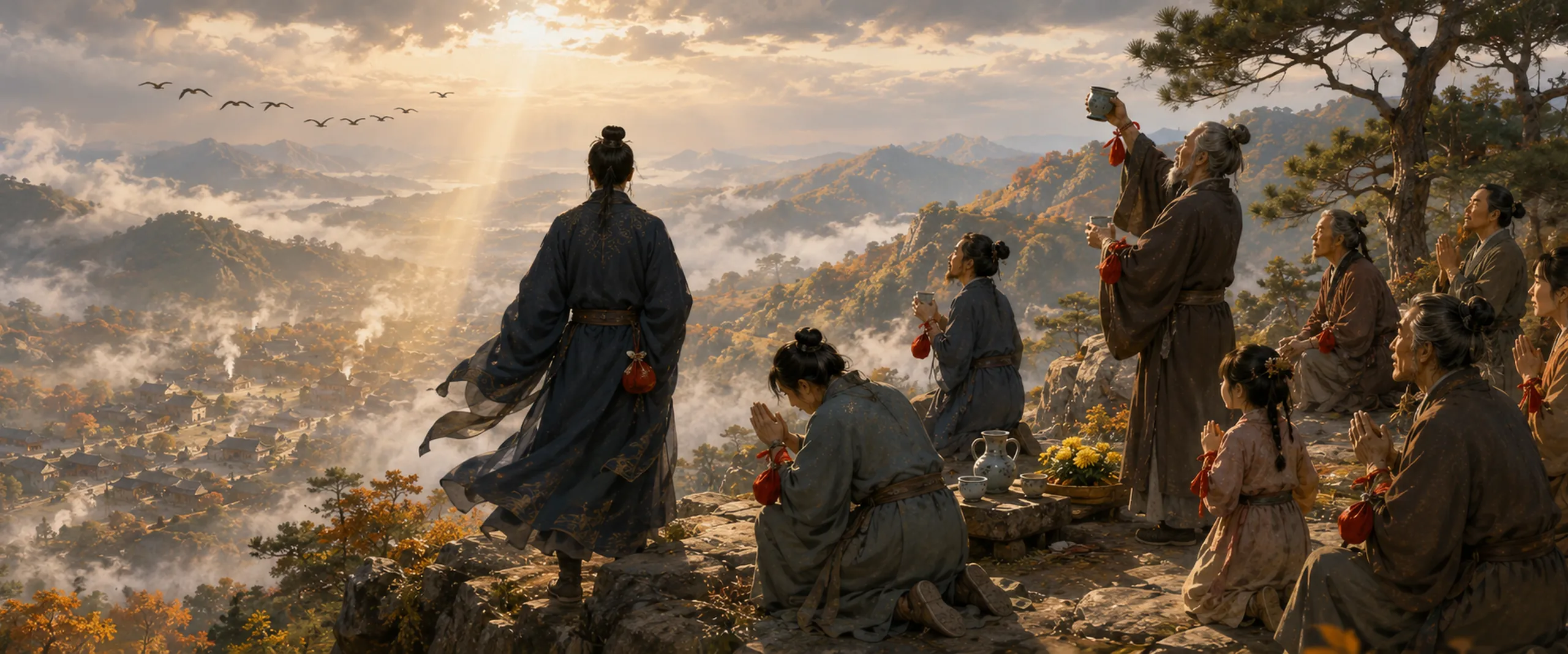
Among the many explanations for the festival’s origins, the most widely circulated is the legend of warding off evil and averting calamity. According to the Southern Dynasties text 《续齐谐记》, the Eastern Han figure Heng Jing (恒景) studied the Way under the immortal Fei Changfang (费长房). Fei warned him that a great disaster would befall his household on the ninth day of the ninth month and told him that the calamity could be escaped by ascending to a high place, drinking chrysanthemum wine, and wearing dogwood. Heng Jing and his family followed these instructions and survived unharmed. Other theories associate the festival’s origins with prayers for longevity, tasting the new harvest, and rites connected with the Great Fire Star. The Han-dynasty 《西京杂记》 records: “汉武帝宫人贾佩兰九月九日佩茱萸,食蓬饵,饮菊花酒,云令人长寿。”

Double Ninth Festival / Double Ninth Festival Origins
350 days until Double Ninth Festival October 8, 2027 · Lunar 九月初九

The Name “重阳”

Origins & Anecdotes · Tracing the Past

The Philosophy of the *Yijing*

The name “重阳” is rooted in the ancient Chinese theory of yin and yang. The 《易经》 classifies numbers into yin and yang: odd numbers are yang, even numbers yin. Nine is the highest of the yang numbers, the greatest yang number, and is also known as “old yang” (老阳). On the ninth day of the ninth lunar month, both the month and the day are represented by nine. Two nines are thus repeated, giving rise to the name “Double Nine” (重九); because two yang numbers coincide, the day is called “Double Yang” (重阳).

In the 《易经》, yang lines are represented by the number nine, which is treated as an ultimate number of Heaven and Earth. The 《楚辞·远游》 already contains the line “集重阳入帝宫兮,造旬始而观清都”. Here, however, “重阳” originally refers to the heavens—the accumulated layers of yang qi in the sky—and is not yet directly connected with the ninth day of the ninth month. Even so, the philosophical meaning of “yang at its utmost” embedded in the term later provided a deep cultural foundation for naming the ninth day of the ninth month “重阳”.

The Ming writer Zhang Dai (张岱) further explained in 《夜航船》: “九为阳数,其日与月并应,故号曰重阳”. Nine was not only the highest yang number; its pronunciation was also homophonically associated with “久”, meaning “long-lasting.” The ninth day of the ninth month thus came to carry auspicious meanings of long life, enduring vitality, health, and longevity. Through the combined influence of numerical philosophy and homophonic symbolism, an otherwise ordinary date was gradually elevated into an auspicious festival worthy of celebration.

From “九月九日” to the Double Ninth Festival

Before the name “重阳” became established, the festival was commonly known simply as “九月九日” or “九日”. Although the earliest roots of the festival can be traced to the pre-Qin period and perhaps even earlier, the earliest written record of “重阳节” as a named festival appears in the Three Kingdoms period. Emperor Wen of Wei, Cao Pi (曹丕), wrote in 《九日与钟繇书》:

“岁往月来,忽复九月九日。九为阳数,而日月并应,俗嘉其名,以为宜于长久,故以享宴高会。”

This is the earliest textual basis for investing the ninth day of the ninth month with the name “重阳”. Drawing on numerical philosophy and homophonic culture, Cao Pi interpreted the day as an auspicious occasion “宜于长久”, thereby helping establish the Double Ninth Festival’s cultural character as a festival of prayers for longevity.

The Jin-dynasty poet Tao Yuanming (陶渊明) wrote in the preface to 《九日闲居》:

“余闲居,爱重九之名。秋菊盈园,而持醪靡由,空服九华,寄怀于言”。

This is an early record of literati treating “重九” itself as an object of aesthetic appreciation and poetic reflection. By the Tang dynasty, the name “重阳” had become firmly established as the festival’s standard designation.

Alternative Names

Throughout history, the Double Ninth Festival developed an exceptionally rich system of alternative names. In addition to “重阳” and “重九”, it has also been called “登高节” because of the custom of ascending heights, “茱萸节” because of wearing dogwood, “菊花节” because of admiring chrysanthemums and drinking chrysanthemum wine, “女儿节” because of the custom of married daughters returning to their natal homes, as well as “九月九”, “九日”, and “重九”.

These different names reveal precisely the diversity of Double Ninth customs and the complexity of cultural fusion within the festival. “登高节” emphasizes the dimension of outdoor activity; “茱萸节” foregrounds the function of warding off evil and avoiding calamity; “菊花节” highlights aesthetic pleasure and seasonal enjoyment; and “女儿节” reflects the warmth of family ethics. Every alternative name is, in its own way, a mark left upon the festival by the long course of history.

Origins of the Festival

Origins & Anecdotes · Tracing the Past

The oldest roots of the Double Ninth Festival can be traced to the pre-Qin period, and perhaps even further back into high antiquity. These early sources did not directly refer to the ninth day of the ninth month itself, but rather to the multiple cultural meanings attached to the autumn season: harvest sacrifice, astral worship, and care for the elderly with prayers for longevity.

The Autumn Tasting Sacrifice

The ninth lunar month is the final month of autumn. By this time, crops have been gathered, the granaries are full, and cattle and sheep are well-fed—the ideal season for celebrating the harvest and making offerings to Heaven, Earth, and the ancestors. The 《吕氏春秋·季秋纪》 explicitly records important sacrificial activities held in the ninth month during the pre-Qin period:

“(九月)命家宰,农事备收,举五种之要。藏帝籍之收于神仓,祗敬必饬。”

It further states:

“是日也,大飨帝,尝牺牲,告备于天子。”

In the last month of autumn, the Son of Heaven was to make offerings to the Five Emperors and the ancestral temple, presenting newly harvested grain and sacrificial animals to Heaven and the ancestors as a formal report of the year’s abundance. This “autumn tasting” (秋尝) was one of the central annual sacrificial rites of the pre-Qin ritual system.

At the heart of the autumn tasting sacrifice was gratitude—gratitude to Heaven and Earth for the harvest, and gratitude to the ancestors for safeguarding the year. This tradition formed one of the deepest cultural layers underlying the later Double Ninth Festival. As scholars have noted: “九月丰收已成,祭祀先祖、告备天子的活动,展现了丰收的喜悦,表达了对祖先神灵的告慰。周代立国以农耕为本,丰收是最大的愿望。” It was precisely this celebration of abundance and gratitude toward the divine that later gave the Double Ninth Festival its festive tone of “宴饮高会” and “享宴高会”.

Sacrifice to the “Great Fire Star”

Another important source of the Double Ninth Festival lies in ancient rites dedicated to the “Great Fire Star” (大火星). The Great Fire Star, identified with Antares in the Heart mansion, was one of the principal celestial markers by which ancient people determined the seasons. In spring, it appeared in the eastern sky at dusk, signaling the beginning of spring plowing; by the ninth lunar month, in late autumn, it disappeared below the western horizon at dusk, marking the end of the farming season and the approach of the long winter.

The 《夏小正》 states “九月内火”. Here, “内” is interchangeable with “纳”, meaning that the Great Fire Star retreats beneath the earth. Its disappearance deprived people, who relied on it as a marker of seasonal production and daily life, of an important temporal coordinate. At the same time, for those who revered the Great Fire as divine, its withdrawal provoked an undefined sense of fear. The dormancy of the fire deity signaled the coming of the long winter. Thus, just as the star’s appearance was greeted with a rite of welcoming fire, its disappearance was accompanied by a corresponding ritual of farewell.

This ceremony of seeing off the Great Fire Star forms one of the most ancient astronomical foundations associated with the Double Ninth Festival. The star’s disappearance was closely connected with the ninth lunar month: as it withdrew from view, people performed rituals to bid farewell to the fire deity and prepare for winter. Although the precise form of these ancient rites has long faded beyond recovery, the later custom of worshipping the kitchen god at the Double Ninth Festival in parts of Jiangnan has been regarded as a surviving trace of the old ninth-month rites dedicated to the “Great Fire.”

Autumn Care for the Elderly

The Double Ninth Festival is also closely connected with the ancient Chinese tradition of caring for the elderly in autumn. The 《礼记·月令》 records that in the eighth lunar month, during mid-autumn, elderly people were to be supported, supplied with tables and walking staffs, and given thin porridge and other food. This autumnal practice of caring for the aged is one of the earliest sources of the later Double Ninth themes of respecting the elderly and praying for longevity.

Some scholars explicitly argue that the ninth-day-of-the-ninth-month festival “来源于先秦秋季的养老节与秋尝之祭,节日中‘养老祈寿’的观念比‘辟邪消灾’有着更悠久的渊源”.

Why was respect for the elderly emphasized in autumn? Spring is the season of growth, when the union of men and women and the continuation of descendants are central themes. Autumn, by contrast, is the season when all things mature and move toward storage; caring for the elderly and praying for longevity accord with the natural rhythm of “spring birth, summer growth, autumn harvest, winter storage.” Ancient people arranged human affairs according to the wisdom of acting in harmony with the seasons. Worshipping ancestors, praying for blessings, and honoring the elderly in autumn all reveal the agrarian civilization’s deep understanding of the cycle of life.

Whether the ninth-day festival arose from harvest sacrifice, Great Fire Star worship, or prayers for longevity among the elderly, each explanation reflects the same underlying wisdom: the ability of an agricultural civilization to grasp the rhythm of autumn and organize human life in accordance with seasonal order.

Multiple Theories of Origin

Taken together, these pre-Qin sources have given rise to several major scholarly interpretations of the origins of the Double Ninth Festival:

Harvest-Sacrifice Theory — The festival developed from harvest rites held in the ninth lunar month during the late-autumn season of the pre-Qin period, when people offered sacrifices to Heaven and the ancestors after the harvest in gratitude for their blessings.

Great Fire Star Sacrifice Theory — The festival arose from ancient rites dedicated to the Great Fire Star. When the star disappeared in the ninth lunar month, people held farewell ceremonies.

Care for the Elderly and Longevity Theory — The festival grew out of the pre-Qin tradition of supporting elderly people in autumn. The 《礼记·月令》 records the care of the elderly in the eighth lunar month.

Averting Evil Theory — The festival arose from fear of the idea that “when yang reaches its extreme, change must follow.” People sought to avoid disaster by ascending heights, wearing dogwood, and drinking chrysanthemum wine.

These theories are each grounded in historical evidence and are not mutually exclusive. Rather, together they reveal the festival’s multiple origins across different historical dimensions. As scholars have observed, “节日的产生与发展与历法制度的演变息息相关”. The true formation of the Double Ninth Festival was the gradual fusion of these diverse sources through changes in the calendar system and transformations in society.

Core Festival Customs

Origins & Anecdotes · Tracing the Past

Over the course of its long historical development, the customs of the Double Ninth Festival grew increasingly rich and eventually formed a system centered on ascending heights, admiring chrysanthemums, wearing dogwood, drinking chrysanthemum wine, and eating Double Ninth cake.

Ascending Heights

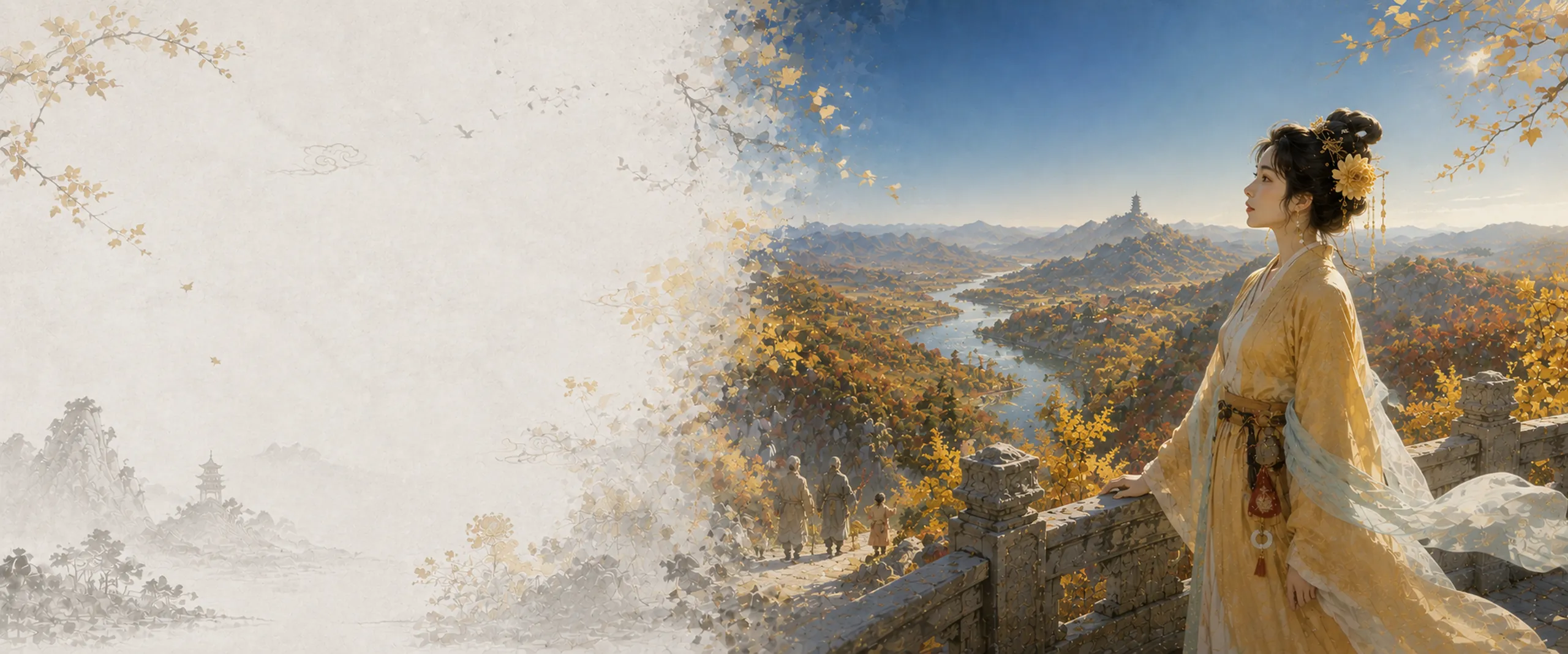
The custom of ascending heights at the Double Ninth Festival has a long history. Because climbing to elevated places was so closely associated with the occasion, the festival was also known as the “Festival of Ascending Heights” (登高节).

Several explanations have been offered for the origin of this custom. One links it to ancient mountain worship, based on the belief that mountain deities could protect people from disaster. Another associates it with ascending heights to escape calamity: in an age before the development of modern science, people believed that at the Double Ninth, earthly qi rose while heavenly qi descended, filling the world with harmful influences and making the day inauspicious. A third explanation relates it to “ascending heights to bid farewell to the green season” (登高辞青)—the Double Ninth was regarded as autumn’s final outdoor excursion, and people climbed high to say farewell to the season.

As Professor Wang Laihua of the Tianjin Academy of Social Sciences has summarized, there are roughly three main explanations for the custom: ascending to avoid disaster, mountain worship, and ascending to bid farewell to autumn.

Chrysanthemum Appreciation and Chrysanthemum Wine

The Double Ninth Festival falls precisely when chrysanthemums are in full bloom. Blossoming proudly in late autumn after most other flowers have withered, chrysanthemums became symbols of purity, integrity, and resilience. The custom of admiring chrysanthemums at the Double Ninth has a long history.

The 《西京杂记》 already records a Han-dynasty method of brewing chrysanthemum wine:

“菊花舒时,并采茎叶,杂黍米酿之,至来年九月九日始熟,就饮焉,故谓之菊花酒。”

Chrysanthemum wine required a full year to mature—from one Double Ninth to the next—and the process itself embodied a patient waiting upon time. In antiquity, chrysanthemum wine was regarded as an auspicious wine that should be drunk at the festival to ward off disaster and pray for blessing.

Wearing Dogwood

Dogwood is one of the most important cultural symbols of the Double Ninth Festival. Ancient people often inserted it into their hair or wore it on the body as an ornament. Dogwood has a strong fragrance and was traditionally regarded as useful for repelling insects and dampness, dispelling harmful wind, relieving digestive stagnation, and treating disorders of cold and heat. At a time of seasonal transition between warmth and cold, wearing dogwood was believed to contribute positively to the prevention of illness.

Because the ancients also believed it could repel evil, the Double Ninth Festival was sometimes called the “Dogwood Festival” (茱萸节). Wang Wei’s celebrated line “遥知兄弟登高处,遍插茱萸少一人” has become an enduring literary image of this custom.

Eating Double Ninth Cake

Just as the Mid-Autumn Festival has mooncakes and the Dragon Boat Festival has zongzi, the Double Ninth Festival also has its characteristic seasonal food: Double Ninth cake (重阳糕). In the Han dynasty it was called “蓬饵”, and in later periods it developed into Double Ninth cake or flower cake.

The character “糕” is homophonically associated with “高”, meaning “high.” It refers not only to the height of ascending, but also evokes the expression “芝麻开花节节高”, carrying auspicious wishes that life may rise step by step and all things continue upward. Small colored flags are often inserted into Double Ninth cakes, symbolizing climbing to greater heights and suggesting that those who eat the cake may likewise rise step by step in life.

Today, there is no single fixed variety of Double Ninth cake. Soft cakes eaten in different regions on the festival are generally grouped under the collective name “重阳糕.”

Final Reflections

Origins & Anecdotes · Tracing the Past

The formation of the Double Ninth Festival was the result of thousands of years of accumulated Chinese cultural tradition continually renewed by the spirit of successive ages. Its roots lie in ancient autumn sacrificial rites and astral worship; its earliest contours emerged in pre-Qin harvest ceremonies and rites of farewell to the Great Fire Star; its basic body of customs took shape in the courts and communities of the Han; it gained the name “重阳” amid Daoist thought and literati culture during the Wei and Jin periods; it became an officially recognized state festival in the Tang; and through broad participation across society in the Song, Yuan, Ming, and Qing dynasties, it reached maturity and was transmitted onward.

From the pre-Qin “秋尝之祭” to the Han practices of “佩茱萸、食蓬饵、饮菊花酒”; from Cao Pi’s Wei-Jin ideal of “宜于长久” to its designation as one of the Tang dynasty’s “三令节”; from Song-dynasty “重阳糕” and grand chrysanthemum feasts to the Ming-Qing “女儿节” and traditions of respecting the elderly—the Double Ninth Festival underwent a long evolution from sacrifice to folk custom, from warding off evil to praying for longevity, from elite culture to popular participation, and from religion to ethics. It preserves the reverence and gratitude of ancient agrarian civilization toward Heaven, Earth, and the divine, while also carrying the most elemental hopes of generations past for long life, health, and peace.

On May 20, 2006, the Double Ninth Festival was included in the first National List of Intangible Cultural Heritage. In 2012, it was legally established as “老年节”. From the pre-Qin tradition of caring for the elderly in autumn to the contemporary Seniors’ Festival, the Double Ninth has crossed more than two millennia of history. Its cultural core of respecting elders and honoring family has not become obsolete; on the contrary, amid the deepening realities of an aging society, it possesses an unprecedented contemporary significance.

As scholars have summarized, Double Ninth culture is a comprehensive cultural system integrating harvest celebration, outings, sacrifice, chrysanthemum culture, entertainment, warding off evil, respect for teachers, women’s culture, poetry, and other dimensions. The Double Ninth Festival, a celebration that has come down from remote antiquity, continues in the present day to illuminate the hearts of Chinese people through its rich cultural depth and profound human concern.

—-

Historical Evolution

Historical Development
Han Dynasty
From the pre-Qin period to the Han dynasty, the Double Ninth Festival underwent a transition from scattered autumn customs to a relatively stable body of festival practices. The Han dynasty was the crucial period in which the foundations of Double Ninth customs were truly laid.
Wei, Jin, and the Northern and Southern Dynasties
The Wei, Jin, and Northern and Southern Dynasties formed the crucial period during which the ninth day of the ninth month evolved from a calendrical date into the cultural symbol of the Double Ninth Festival. In 《九日与钟繇书》, Emperor Wen of Wei, Cao Pi, not only confirmed the name “重阳” for the date, but also invested it with the auspicious meaning “宜于长久.” By formally recording the homophonic relationship between “九” and “久”, Cao Pi elevated the festival from a mere calendrical concept into one bearing explicit cultural meaning.
Tang Dynasty
The Tang dynasty was the decisive period in the development of the Double Ninth Festival. During the reign of Emperor Dezong Li Shi (780–785), the imperial court formally designated the ninth day of the ninth lunar month as one of the “Three Seasonal Festivals” (三令节). These were the Zhonghe Festival on the first day of the second lunar month, the Shangsi Festival on the third day of the third month, and the Double Ninth Festival on the ninth day of the ninth month.
Song, Yuan, Ming, and Qing Dynasties
By the Song dynasty, the festival had become even more lively. 《东京梦华录》 records the grand celebrations of the Northern Song, while 《武林旧事》 records that the Southern Song court “于八日作重九排当”, preparing on the eighth day for the formal pleasures and festivities of the following day.

Han Dynasty

From the pre-Qin period to the Han dynasty, the Double Ninth Festival underwent a transition from scattered autumn customs to a relatively stable body of festival practices. The Han dynasty was the crucial period in which the foundations of Double Ninth customs were truly laid.

The most authoritative account of Han-dynasty Double Ninth practices comes from the 《西京杂记》, traditionally associated with the Eastern Jin scholar Ge Hong (葛洪). The work records in detail how Lady Qi (戚夫人), a favored consort of Emperor Gaozu of Han, observed the ninth day of the ninth month at court:

“九月九日,佩茱萸,食蓬饵,饮菊花酒,云令人长寿。”

It also records:

“菊花舒时,并采茎叶,杂黍米酿之,至来年九月九日始熟,就饮焉,故谓之菊花酒。”

This indicates that by the early Western Han, Double Ninth customs had already entered the imperial court and were taken seriously by emperors and consorts, with elaborate observances.

According to the 《西京杂记》, after Lady Qi was killed, her maid Jia Peilan (贾佩兰) was expelled from the palace and married a poor commoner. Jia then brought the palace customs of the Double Ninth Festival into popular society, telling others that in the imperial palace, every ninth day of the ninth month, people would wear dogwood, eat peng cakes, and drink chrysanthemum wine in order to seek longevity. From then on, the custom spread among the people. Although this story may not correspond entirely to historical fact, it reflects the historical process by which Double Ninth customs moved from the palace into wider society.

“九月九日,佩茱萸,食蓬饵,饮菊花酒,令人长寿”—dogwood, peng cakes, and chrysanthemum wine formed the three treasures of the Han Double Ninth, intended to ward off evil and pray for abundant blessing and long life.

Although the ninth day of the ninth month may not yet have been a fixed festival throughout the Han, it already possessed a relatively stable set of customs. Cui Shi (崔寔) wrote in 《四民月令》, when describing the life of scholar-officials in the mid-Eastern Han:

“(九月)九日,可采菊花,收枳实”。

At this time, dogwood, peng, and chrysanthemum were all autumn plants that matured in season and also possessed medicinal value. The way in which the ancients arranged human activity according to seasonal rhythm and the properties of natural things continued directly from the pre-Qin tradition of acting in harmony with the seasons. The Han period also produced the earliest written records of seeking longevity at the Double Ninth Festival. Large-scale banquets were likewise held, developing out of the pre-Qin harvest feasts. In this sense, the basic body of Double Ninth customs still practiced today had already taken recognizable form in the Han dynasty.

The emergence of the Double Ninth Festival in the Han was closely connected with the evolution of the calendar system. Before the Han, China primarily used the sexagenary cycle to designate individual days, combining the Ten Heavenly Stems and Twelve Earthly Branches. Although precise, this method was not intuitive for ordinary people. As society developed, a simpler way of expressing dates became increasingly necessary.

From the middle and later reign of Emperor Wu of Han to the early Eastern Han, ordinal dating became increasingly widespread and was gradually accepted by official institutions. In 《序数纪日的产生与通行》, Chen Kanli argues that ordinal dating “应不早于汉武帝元狩六年,而在武帝末年至宣帝时期,则已产生并开始在涉及政治、军事、经济等领域的官私文书中流行”.

The spread of ordinal dating allowed “repeated-number festivals” such as the third day of the third month, the fifth day of the fifth month, the seventh day of the seventh month, and the ninth day of the ninth month to take formal shape. Under the sexagenary system, people focused on the Heavenly Stem and Earthly Branch combination assigned to a particular day rather than on its numerical position within the month. Once ordinal dating became common, the matching numbers of month and day became visually striking and easy to remember. This calendrical transformation provided the institutional precondition for the Double Ninth Festival to become fixed specifically on the ninth day of the ninth month.

Wei, Jin, and the Northern and Southern Dynasties

The Wei, Jin, and Northern and Southern Dynasties formed the crucial period during which the ninth day of the ninth month evolved from a calendrical date into the cultural symbol of the Double Ninth Festival. In 《九日与钟繇书》, Emperor Wen of Wei, Cao Pi, not only confirmed the name “重阳” for the date, but also invested it with the auspicious meaning “宜于长久.” By formally recording the homophonic relationship between “九” and “久”, Cao Pi elevated the festival from a mere calendrical concept into one bearing explicit cultural meaning.

In the same letter, Cao Pi praised chrysanthemums:

“是月律中无射,言群木庶草,无有射地而生。至于芳菊,纷然独荣。非夫含乾坤之纯和,体芬芳之淑气,孰能如此?故屈平悲冉冉之将老,思食秋菊之落英,辅体延年,莫斯之贵。谨奉一束,以助彭祖之术。”

From this letter it can be clearly seen that the festival was called Double Yang because two nines coincided in the month and day, and that customs of admiring and consuming chrysanthemums already possessed a long history.

The flourishing of Daoist thought during the Wei, Jin, and Northern and Southern Dynasties had a profound influence on the formation of the festival. Within Daoism, the combination of Confucian theories of calamity and anomaly with traditions of immortals and fangshi helped establish both the name “重阳” and the widely accepted idea of warding off evil and dispelling calamity. The period from the late Eastern Han through the Six Dynasties was a formative age for the festival.

From the late Eastern Han to the Six Dynasties, China underwent intense social upheaval and political fragmentation. Life and property could not be reliably protected, and fear of the brevity and fragility of life caused the Double Ninth Festival, with its emphasis on removing disaster and praying for safety, to receive increasing attention. In such a troubled age, people urgently needed ritual practices through which to ward off calamity and seek peace. The Double Ninth Festival developed rapidly in response to precisely this social psychology.

The Southern Liang scholar Zong Lin (宗懔) recorded the customs of the time in 《荆楚岁时记》:

“九月九日,四民并籍野饮宴。”

People held outdoor banquets and drank together, enjoying the autumn landscape and celebrating the harvest. The same work also states:

“九月九日,佩茱萸,食莲耳,饮菊花酒,令长寿。”

This shows that by the Southern Dynasties, wearing dogwood, drinking chrysanthemum wine, and praying for longevity had already become mature and well-established customs.

The Southern Liang writer Wu Jun (吴均) preserved the famous legend of ascending heights to escape disaster in 《续齐谐记》, providing a complete narrative framework for Double Ninth customs. According to the text:

汝南桓景随费长房游学累年。长房谓曰:“九月九日,汝家中当有灾,宜急去,令家人各作绛囊,盛茱萸,以系臂,登高饮菊花酒,此祸可除。”景如言,齐家登山。夕还,见鸡犬牛羊一时暴死。长房闻之曰:“此可代也。”今世人九日登高饮酒,妇人带茱萸囊,盖始于此。

The story of Heng Jing ascending to escape disaster brings together three of the festival’s central customs—ascending heights, wearing dogwood, and drinking chrysanthemum wine—within a single coherent narrative. Although the legend may simply be a folk explanation for customs that had already existed, it played an enormous role in spreading and popularizing the festival. As one scholar has observed: “在桓景的故事里,登高是为了消祸避灾,这是这项民俗最初始的内核,随着文明的发展,驱灾辟邪的色彩逐渐淡化,求愉悦和祈增寿的主题越来越浓。”

Tang Dynasty

The Tang dynasty was the decisive period in the development of the Double Ninth Festival. During the reign of Emperor Dezong Li Shi (780–785), the imperial court formally designated the ninth day of the ninth lunar month as one of the “Three Seasonal Festivals” (三令节). These were the Zhonghe Festival on the first day of the second lunar month, the Shangsi Festival on the third day of the third month, and the Double Ninth Festival on the ninth day of the ninth month.

The inclusion of the Double Ninth Festival among officially recognized state festivals marked its elevation from a celebration formed spontaneously among the people to a festival formally acknowledged by the state.

From that point onward, the imperial court and the general population celebrated the festival together, and a wide range of activities flourished. Tang poetry preserves abundant evidence of Double Ninth customs. Wang Wei’s 《九月九日忆山东兄弟》 contains the famous lines “遥知兄弟登高处,遍插茱萸少一人”, while Guo Zhen’s 《子夜四时歌》 includes “辟恶茱萸囊,延年菊花酒”. By the Tang, the festival already featured a rich repertoire of activities, including ascending heights, banqueting, admiring chrysanthemums, and wearing dogwood.

In the Tang dynasty, the Double Ninth Festival was not confined to a single day but could continue for two or three days. Officials feasted and enjoyed excursions, while literati drank wine and admired chrysanthemums. The Tang poet Liu Yuxi (刘禹锡) wrote a poem titled 《九日登高》. He originally wished to write the line “年年上糕处”, but because the character “糕” was regarded as a vulgar popular character absent from the classics, he did not dare place it in the poem. The Song writer Luo Dajing (罗大经) recorded in 《鹤林玉露》 that Song Zijing (宋子京) teased Liu Yuxi with the line:

“刘郎不敢题糕字,虚负诗中一世豪”。

This anecdote indirectly reflects the popularity of eating Double Ninth cakes in the Tang. Literati may have hesitated to write the character “糕”, but among ordinary people the custom was already widespread.

The Tang Double Ninth truly achieved “court and people celebrating together.” At court, the emperor bestowed banquets upon ministers, admired chrysanthemums, and composed poetry; among the people, families climbed heights, held outdoor feasts, wore dogwood, and drank chrysanthemum wine. This festival pattern of shared celebration across social strata laid a solid foundation for the continued flourishing of the Double Ninth Festival in later centuries.

Song, Yuan, Ming, and Qing Dynasties

By the Song dynasty, the festival had become even more lively. 《东京梦华录》 records the grand celebrations of the Northern Song, while 《武林旧事》 records that the Southern Song court “于八日作重九排当”, preparing on the eighth day for the formal pleasures and festivities of the following day.

One of the central activities of the Song Double Ninth Festival was chrysanthemum appreciation. According to 《武林旧事》, every year on the Double Ninth, the imperial palace held grand festive entertainments. Various kinds of chrysanthemums were displayed in the Qingrui Hall, while chrysanthemum cultivation and varietal breeding reached new heights during the Song. What had once been an elegant gathering among literati expanded into a form of public celebration.

In food culture, Double Ninth cakes also became increasingly elaborate. 《东京梦华录》 describes Northern Song Bianjing:

“前一二日,各以粉面蒸糕遗送,上插剪彩小旗,掺果实,如石榴子、栗子黄、银杏、松子肉之类。又以粉作狮子蛮王之状,置于糕上,谓之‘狮蛮’。”

The Southern Song 《梦粱录》 records of Hangzhou:

“以糖面蒸糕,上以猪羊肉、鸭子为丝簇饤,插小彩旗,名曰‘重阳糕’。”

These descriptions show that Song-dynasty Double Ninth cakes were not merely food, but carefully crafted works of festive art, carrying wishes that life and fortune might rise step by step.

In the Ming dynasty, the celebrations became even more elaborate. Palace eunuchs and consorts began eating flower cakes together from the first day of the ninth lunar month. On the ninth itself, the emperor personally ascended Wansui Mountain to enjoy the autumn view and give expression to the spirit of the season. By this time, the festival had become a celebratory cycle that began at the opening of the month and continued for several days.

In the Qing dynasty, Double Ninth customs remained widespread. In Beijing, people pasted chrysanthemum branches and leaves onto doors and windows in order to “解除凶秽,以招吉祥”. During the prosperous Kangxi and Qianlong eras, the imperial court also held the Thousand-Elders Banquet (千叟宴) on this day, bringing the festival’s tradition of honoring the elderly to a new height. The combination of the court-sponsored banquet for elders with popular customs of respecting the aged greatly strengthened the festival’s elder-respect theme during the Qing.

From the documentary record of the Song, Yuan, Ming, and Qing dynasties, it is clear that although Double Ninth customs changed in appearance across periods and regions, certain themes remained remarkably continuous: banqueting, ascending heights, eating festival cakes, admiring chrysanthemums, and wearing dogwood. No matter how the times changed, the basic framework of leaving the home, climbing high to gaze into the distance, wearing dogwood, drinking chrysanthemum wine, and eating Double Ninth cake displayed an extraordinary continuity.
Cultural Spirit

Cultural Core
Double Ninth Festival carries the Chinese people’s longing for a better life and their devotion to family, embodying the cultural spirit of reunion, harmony, gratitude and blessing — it is one of the most enduring traditional festivals in Chinese culture.
From Warding Off Evil to Praying for Longevity
Respecting the Elderly and Honoring Family
Cultural Character

From Warding Off Evil to Praying for Longevity

The core cultural spirit of the Double Ninth Festival underwent a gradual transformation from warding off evil to praying for longevity. In its earlier forms, Double Ninth customs were primarily concerned with averting calamity: ascending heights to escape disaster, wearing dogwood to repel evil, and drinking chrysanthemum wine to dispel illness. As society developed, the emphasis on exorcising disaster gradually weakened, while themes of pleasure, well-being, and long life became increasingly prominent.

In 《九日与钟繇书》, Cao Pi drew on the homophonic relationship between “九” and “久” to interpret the festival as a day “宜于长久.” From this point onward, praying for longevity became one of the festival’s central themes. The Han-dynasty record “佩茱萸,食蓬饵,饮菊花酒,云令人长寿” is an early expression of this cultural orientation.

Respecting the Elderly and Honoring Family

The Double Ninth tradition of respecting the elderly can be traced to ancient pre-Qin rites of autumn care for the aged. The record in 《礼记·月令》 concerning support for elderly people in the eighth lunar month is the earliest documentary basis for this tradition.

Over the long course of history, the practice gradually merged with the other customs of the festival. From the Ming dynasty onward, the Double Ninth was even known as the “Daughters’ Festival” (女儿节): married daughters were expected to return to their natal homes and visit their parents. A popular saying held:

“九月九,搬回闺女息息手”。

This shows how strongly the festival had acquired a dimension of family ethics by the Ming and Qing periods.

In 1989, the Chinese government designated the ninth day of the ninth lunar month as “老人节” and “敬老节”, promoting a social ethos of respecting, honoring, loving, and assisting elderly people. On December 28, 2012, the Standing Committee of the National People’s Congress adopted revisions to the 《老年人权益保障法》, explicitly designating the ninth day of the ninth lunar month each year as 老年节.

From pre-Qin traditions of autumn care for the aged, through the Ming and Qing “Daughters’ Festival,” to the contemporary “Seniors’ Festival,” the Double Ninth theme of respecting elders and honoring family has crossed thousands of years and continues to display powerful vitality today.

Cultural Character

Among China’s traditional festivals, the Double Ninth possesses a distinctive cultural character. Unlike the Spring Festival, centered on bidding farewell to the old and welcoming the new; Qingming, with its concern for remembrance and reverence for the departed; the Dragon Boat Festival, associated with commemorating worthies; or the Mid-Autumn Festival, centered on the full moon and family reunion, the Double Ninth is fundamentally concerned with life—the length of life through longevity, the quality of life through health, and the continuity of life through respect for the elderly.

It is not attached to any single historical figure, nor confined to one particular emotion. Rather, it speaks directly to one of humanity’s most universal and enduring concerns: the cherishing of life and the wish to bless it.

The festival also embodies the wisdom of yin-yang balance in Chinese philosophy. On the ninth day of the ninth month, two yang numbers coincide and yang qi reaches its height. Ancient thinkers believed that “阳极必变”—when yang reaches its extreme, it must turn toward its opposite. The Double Ninth Festival was therefore both a celebration of yang at its fullest and a moment of vigilance toward the approaching rise of yin, embodied by winter.

Ascending heights in order to draw closer to yang qi, wearing dogwood to resist cold influences, and drinking chrysanthemum wine to prolong life—these customs can all be understood as ways in which ancient people actively cared for health and life within a philosophical framework of yin-yang transformation.

Continue exploring Double Ninth Festival culture

Readers’ Comments

Calendar and traditional culture enthusiasts from around the world, sharing the same moon.

Sign in or register to join the conversation. Your comment account is created automatically the first time you use a connected account.