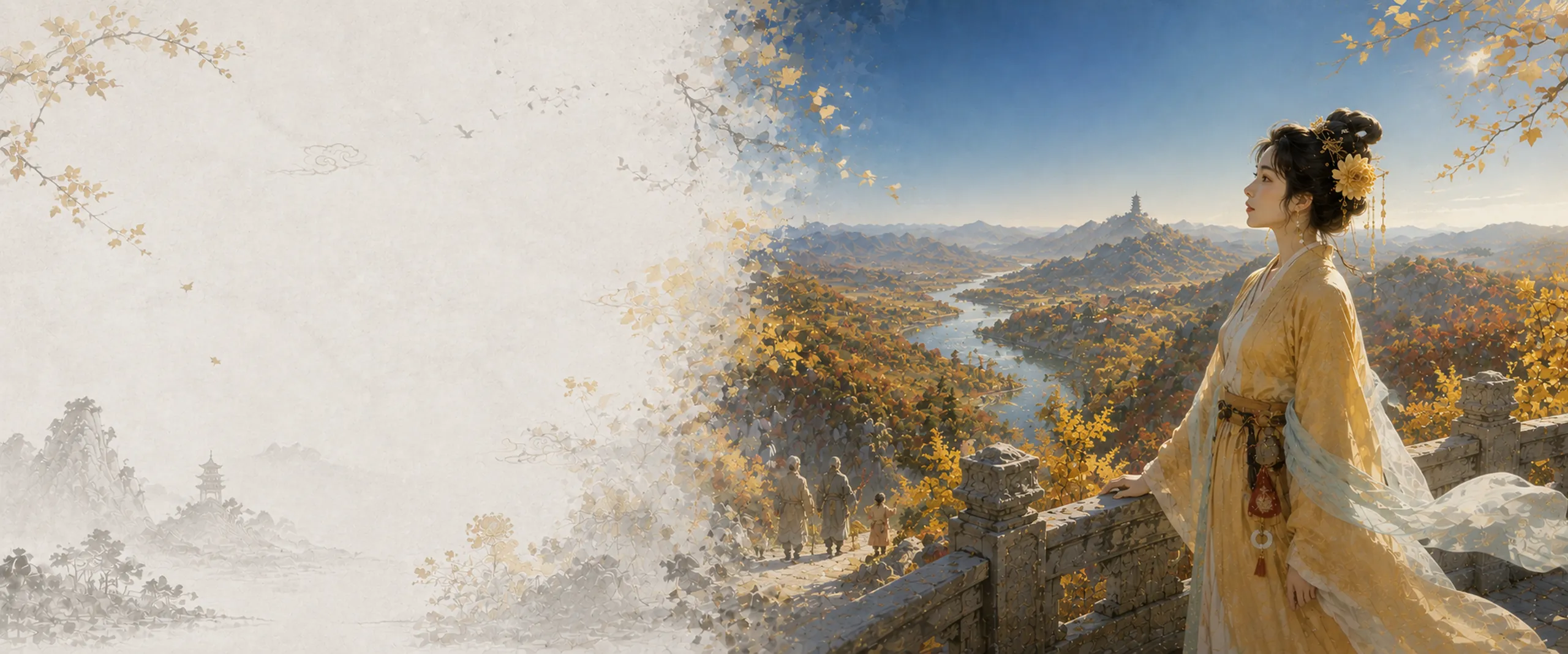
Ascending to high places is the most important traditional activity of the Double Ninth Festival, which is why the festival is also called the “Festival of Ascending Heights.” The custom is generally explained through three cultural origins: the belief that climbing to a high place could help people avoid disaster, ancient Chinese reverence for mountains, and the autumn tradition known as “bidding farewell to the green” (辞青). Admiring chrysanthemums and drinking chrysanthemum wine are equally important seasonal customs. Wearing zhuyu was believed to repel harmful influences and protect against misfortune, while eating Double Ninth cake (重阳糕) draws on the homophony between 糕 (gāo, cake) and 高 (gāo, high), symbolizing continual advancement and rising fortune.
The Double Ninth Festival is also one of China’s traditional occasions for honoring ancestors, and many families visit ancestral graves on this day. In 1989, the festival was officially designated a Festival for Respecting the Elderly, encouraging society to honor, respect, care for, and support older people.
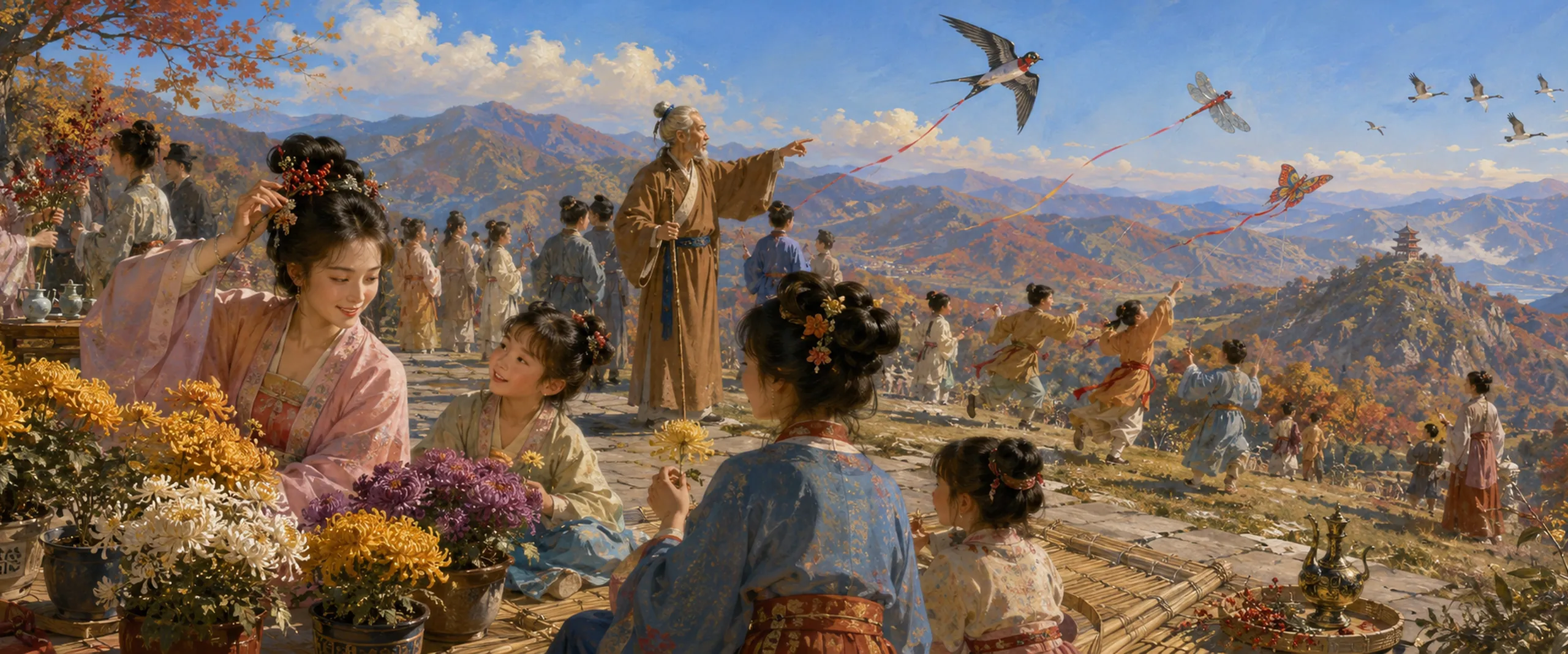
Main Customs
Ascending to High Places
Historical Origins
The custom of climbing during the Double Ninth Festival can be traced at least to the Han dynasty. According to Wu Jun (吴均) of the Liang dynasty in Xu Qi Xie Ji (《续齐谐记》, Continuation of Records of Harmonious Wonders), a man named Huan Jing (桓景) from Runan in the Eastern Han studied Daoist arts under the immortal Fei Changfang (费长房). Fei warned him:
“On the ninth day of the ninth month, disaster will befall your household. Leave at once. Have each member of your family make a crimson pouch, fill it with zhuyu, tie it to the arm, climb to a high place, and drink chrysanthemum wine. In this way the disaster may be avoided.”
Huan Jing followed his instructions and took his entire family uphill. When they returned that evening, they discovered that the chickens, dogs, cattle, and sheep at home had all died suddenly. From then on, the story says, the custom of climbing to high ground on the ninth day of the ninth lunar month to avoid misfortune spread among the people.
Climbing was also connected with ancient Chinese mountain worship. Mountains were believed to possess protective spiritual power, and because Double Ninth represented the culmination of yang—a moment when “extreme yang must change”—people went into the hills to distance themselves from possible disaster. The harvest had usually finished by this time, making the festival a natural opportunity for rural communities to climb and enjoy distant autumn views.
By the Tang dynasty, climbing had become the most celebrated Double Ninth custom. Wang Wei’s famous line—
“遥知兄弟登高处,遍插茱萸少一人。” From afar I know my brothers are climbing to the heights; each wears zhuyu, yet one person is missing.
—offers one of the most vivid literary portraits of this custom. During the Sui and Tang periods, Double Ninth became an officially recognized festival, and its tradition of climbing has continued into the present.
The Activity
Ascending to a high place is the most representative custom of Double Ninth, and the festival is therefore also known as the Festival of Ascending Heights. In the clear air of the ninth lunar month, climbing provides broad views, emotional refreshment, exercise, and, in traditional understanding, protection from illness and misfortune.
The custom is generally associated with three different cultural explanations: the legend of climbing to escape disaster, ancient reverence for mountains, and the autumn custom of “bidding farewell to the green” (辞青). The latter contrasts with the springtime tradition of “treading the green” (踏青) at Qingming: whereas spring excursions welcome the return of vegetation, Double Ninth outings mark a symbolic farewell to the fading green of the year.
Methods of climbing vary widely. In cities, people ascend city walls, towers, pagodas, pavilions, and high buildings; in rural areas, they climb nearby hills and mountains. Where no mountain is available, raised earthen platforms or slopes can serve the same purpose. Wealthier families in earlier times might travel by sedan chair, carrying wine and food for an outdoor feast on the summit. Zhuyu, chrysanthemum wine, appreciation of the autumn landscape, and poetry were frequently combined with the outing.
Cultural Meaning
For ancient people, climbing was more than physical exercise; it could also serve as a form of spiritual renewal. Standing on a mountaintop in autumn, overlooking the land below and experiencing the vastness of Heaven and Earth and the changing season, allowed people to bid farewell to autumn’s greenery and reflect on time itself.
Climbing was also closely related to ancestral observance and expresses the traditional ideal of “the unity of humanity and nature” (天人合一).
How to Participate
On Double Ninth, visitors can climb a nearby hill, mountain, tower, or other elevated place. City residents can walk on park hills or ascend observation towers and high buildings where access is permitted. Many scenic areas organize special climbing events during the festival.
Comfortable shoes, drinking water, and light food are recommended. Older participants should choose routes suited to their physical condition, and all climbers should prioritize safety.
Admiring Chrysanthemums and Drinking Chrysanthemum Wine
Historical Origins
The customs of admiring chrysanthemums and drinking chrysanthemum wine can be traced to the Han dynasty. The Xijing Zaji (《西京杂记》, Miscellaneous Records of the Western Capital) states:
“On the ninth day of the ninth month, people wear zhuyu, eat peng’er, and drink chrysanthemum wine, saying that these things enable one to live long.”
This shows that chrysanthemum wine was already associated with the ninth day of the ninth lunar month during the Han period. During the Wei and Jin dynasties, chrysanthemum appreciation became even more fashionable. The poet Tao Yuanming (陶渊明) became famous for his love of chrysanthemums, and his celebrated line—
“采菊东篱下,悠然见南山。” Picking chrysanthemums beneath the eastern fence, I leisurely see the southern mountains.
—helped establish chrysanthemum appreciation as a refined pursuit of scholars and literati.
Over time, the practice expanded from elite literary gatherings into popular culture and became a festival custom shared across society. Traditional chrysanthemum wine required considerable patience: it could be prepared during one Double Ninth Festival and not opened until the following year. This year-long period of waiting was itself part of the ritual meaning of the drink.
The Activity
Admiring chrysanthemums and drinking chrysanthemum wine are two closely connected Double Ninth customs. The festival occurs precisely when chrysanthemums are in full bloom, and the ninth lunar month has therefore been called the “Month of Chrysanthemums” (菊月). Because chrysanthemums bloom proudly in late autumn when many other flowers have withered, they came to symbolize purity, resilience, and moral integrity.
During chrysanthemum exhibitions, people not only admire the flowers themselves but also compare cultivars, shapes, and colors. Chrysanthemums may be yellow, white, red, purple, pink, and many other shades, while flower forms include flat petals, spoon-shaped petals, tubular petals, and numerous cultivated variations. In earlier literary culture, viewing chrysanthemums was often combined with drinking and composing poetry, forming a refined seasonal gathering.
Drinking chrysanthemum wine is one of the festival’s most characteristic food and drink customs. In traditional belief, it was regarded as an auspicious drink capable of warding off misfortune and bringing blessing. One method of preparation involved gathering chrysanthemums together with their stems and leaves when the flowers were in bloom and brewing them with millet, then sealing the wine until the following Double Ninth.
Traditional Chinese materia medica associated chrysanthemum with cooling and clarifying qualities, and popular culture attributed to chrysanthemum wine benefits such as nourishing the liver, improving the eyes, refreshing the mind, and supporting longevity.
Cultural Meaning
The chrysanthemum blooms proudly in late autumn and therefore symbolizes purity, endurance, and strength of character. Chrysanthemum wine expresses wishes to avert disaster and obtain blessings. Taken together, appreciating the flower and drinking the wine combine aesthetic appreciation of nature with hopes for health and a fortunate life.
How to Participate
During Double Ninth, visitors can attend chrysanthemum exhibitions in parks and botanical gardens. Displays in Beijing, Kaifeng, Hangzhou, and other cities are particularly well known. Chrysanthemum wine may also be sampled where available, while chrysanthemum tea offers an alcohol-free alternative.
Those interested in traditional brewing can prepare chrysanthemum wine in advance, using an appropriate recipe and safe fermentation methods. Photography, sketching, or simply spending time among the flowers are also natural ways to experience the tradition.
Wearing Zhuyu
Historical Origins
The belief that zhuyu (茱萸) could repel harmful influences was already recorded in the Han dynasty. The Xijing Zaji states:
“On the ninth day of the ninth month, people wear zhuyu, eat peng’er, and drink chrysanthemum wine, saying that these things enable one to live long.”
Thus, wearing zhuyu on the ninth day of the ninth lunar month was already established by Han times. The plant was believed to possess protective qualities capable of driving away harmful influences, preventing epidemic illness, and supporting longevity.
The custom is closely connected with the legend of Huan Jing. When his family climbed to safety, each person was instructed to “make a crimson pouch, fill it with zhuyu, and tie it to the arm.” Although wearing zhuyu is no longer common in everyday practice, the plant remains one of the most recognizable cultural symbols of the Double Ninth Festival.
The Activity
Wearing zhuyu is one of the festival’s most distinctive customs, so Double Ninth was historically also called the “Zhuyu Festival” (茱萸节). Zhuyu is an aromatic plant traditionally associated with repelling insects, dispelling cold, and protecting against harmful influences. Because the ninth day of the ninth month was once regarded as a potentially dangerous date, people wore zhuyu in hopes of turning away misfortune. For this reason, the plant was sometimes called the “Old Man Who Repels Evil” (辟邪翁).
There were many ways of wearing it. People inserted sprigs into their hair, tied them to the arm, ground the plant and placed it in fragrant sachets, or carried it in crimson pouches. In later descriptions, the widespread custom was sometimes called a “Zhuyu Gathering” (茱萸会).
Wang Wei’s poem Thinking of My Brothers East of the Mountains on the Ninth Day of the Ninth Month (《九月九日忆山东兄弟》) preserves the most famous literary image of the custom:
“遥知兄弟登高处,遍插茱萸少一人。” From afar I know my brothers are climbing to the heights; each wears zhuyu, yet one person is missing.
By the Tang dynasty, wearing zhuyu in the hair had become one of the festival’s most widespread customs.
Cultural Meaning
Zhuyu symbolizes the wish to repel misfortune, avoid epidemic disease, preserve health, and prolong life. Wearing it at Double Ninth expresses both a desire for bodily well-being and an appreciation of life itself. As a festival symbol, zhuyu carries hopes for peace, health, and longevity.
How to Participate
Zhuyu can be worn as a sprig or placed inside a small fragrant pouch. Where fresh material is unavailable, dried zhuyu may be purchased from traditional Chinese medicine shops.
A traditional crimson zhuyu pouch (茱萸绛囊) can also be made by hand. In Shangcai County, Henan, associated in local tradition with the origins of the Double Ninth Festival, the making of such pouches has been included in Henan’s provincial intangible cultural heritage. Visitors can learn about the symbolism of the plant and experience wearing or making the traditional pouch.
Eating Double Ninth Cake
Historical Origins
The custom of eating Double Ninth cake (重阳糕) can be traced to the Han dynasty, when a festival food known as peng’er (蓬饵) was eaten. It was a kind of cake made with plant material and rice flour and was used both for offerings and for ordinary consumption.
After the Tang and Song dynasties, Double Ninth cakes became increasingly varied. The Song-dynasty work Dongjing Meng Hua Lu (《东京梦华录》, Dreams of Splendor of the Eastern Capital) records methods of preparing the cakes and describes their widespread sale.
By the Ming and Qing periods, eating such cakes had become an indispensable Double Ninth custom. One explanation connects them directly with climbing: when people were unable to ascend a mountain, they could symbolically “ascend” by eating cake, because 糕 (gāo, cake) and 高 (gāo, high) are homophones in Chinese. The food therefore came to express wishes for “rising step by step” (步步高升).
The Activity
Double Ninth cake is one of the festival’s most representative foods. It is also called flower cake (花糕), chrysanthemum cake (菊糕), or five-colored cake (五色糕). The homophony between “cake” and “high” gives the food auspicious meanings such as “rising step by step” and “everything moving upward.”
Recipes vary widely by region but generally use rice flour or wheat flour as a base, with ingredients such as red dates, chestnuts, nuts, candied fruit, or other seasonal additions.
Traditional varieties include coarse flower cakes, decorated with coriander leaves and filled with dried fruits such as green plums, dates, and walnuts; fine flower cakes, made in two or three layers with finely chopped candied fruits between them; and coin flower cakes, similar in composition but smaller, like coins. Small colored flags are often inserted into the top, visually reproducing the idea of climbing to a height.
In Henan, chestnut flour and glutinous-rice flour may be mixed with honey and steamed, sometimes with red-date paste, and decorated with colored flags before being given to relatives and friends. In Wuxi, people eat Double Ninth cake and jiupin geng. In Shaoxing, families make and exchange Double Ninth zongzi.
Cultural Meaning
The homophony between 糕 (cake) and 高 (high) makes eating Double Ninth cake an expression of wishes for advancement. When climbing is impossible, eating cake symbolically replaces ascending to a height, illustrating the Chinese folk tendency to express abstract hopes through concrete objects and wordplay.
As a festival food, the cake provides both culinary enjoyment and a vehicle for expressing hopes for a better life. Exchanging cakes with family and friends transforms the food into a medium of blessing and affection.
How to Participate
Double Ninth cakes can be purchased or prepared at home. Northern varieties include coarse and fine flower cakes, while southern versions may include osmanthus or chestnut cakes.
A simple homemade version can be made by mixing glutinous-rice flour and rice flour with water and sugar, adding red dates and nuts, and steaming the mixture. Sharing the finished cake with relatives and friends is part of the tradition.
Honoring Ancestors
Historical Origins
The Double Ninth custom of ancestral worship can be traced to pre-Qin traditions. Autumn ancestral rites continued the ancient Chinese “autumn tasting” (秋尝) ceremony, in which newly harvested grain was offered to ancestors after the harvest as an expression of gratitude and remembrance.
From the Han dynasty onward, ancestral worship at Double Ninth gradually combined with customs such as climbing and chrysanthemum viewing. By the Ming and Qing periods, the festival included not only recreational activities such as climbing, drinking, and flower viewing but also sacrifices to local deities, the City God, the Kitchen God, and ritual theatrical performances offered in gratitude to the gods.
The Activity
Honoring ancestors remains an important Double Ninth custom. Together with Lunar New Year’s Eve, Qingming Festival, and the Ghost Festival (中元节), Double Ninth is often counted among China’s four major traditional occasions for ancestor worship.
The association between 九九 (“nine-nine”) and 久久 (“long-lasting”) gives the date an additional sense of enduring continuity, making it especially suitable for remembering ancestors and promoting filial respect. Families visit ancestral graves, clear and repair the burial sites, place offerings, and conduct ceremonies expressing gratitude for the accomplishments of previous generations and asking for ancestral protection.
Regional practices vary. In Tonglu, Zhejiang, pigs and sheep are prepared for the ninth day of the ninth month in an autumn ancestral sacrifice. In Shaoxing, families visit one another during the festival unless a relative has recently died, in which case mourning visits may be made before the spirit tablet. In Fujian and Taiwan, Double Ninth remains one of the important seasonal occasions for ancestral rites alongside Qingming and the Ghost Festival.
Family members may gather in ancestral halls or at graves, arrange offerings, burn incense, light candles, and bow in solemn remembrance.
Cultural Meaning
Double Ninth ancestor worship reflects the traditional virtue of “carefully attending to the end and remembering those who came before” (慎终追远), as well as the importance of family solidarity. Honoring ancestors on a day associated with “long duration” expresses both gratitude to the dead and the wish that their blessings will continue to protect later generations.
Such rites reinforce family cohesion and allow family memory and values to be transmitted from one generation to the next.
How to Participate
Families may visit ancestral graves or ancestral halls, clean and repair burial sites, prepare offerings, burn incense, and bow in respect. Where visiting in person is impossible, a memorial offering can be made at home.
Some historic villages permit visitors to observe communal ancestral rites from a respectful distance. Because these ceremonies are solemn, visitors should avoid interrupting or photographing participants without permission.
Respecting the Elderly
Historical Origins
The Double Ninth theme of respecting older people has extremely deep roots and can be traced to pre-Qin traditions of elder care. The Book of Rites: Monthly Ordinances (《礼记·月令》) records that during the eighth lunar month, older people were to be cared for and provided with tables, walking staffs, and nourishing gruel.
This autumn tradition of supporting elders is one of the earliest cultural roots of Double Ninth’s later theme of “honoring the elderly and praying for longevity.”
The Three Kingdoms ruler and writer Cao Pi (曹丕), in his Letter to Zhong Yao on the Ninth Day (《九日与钟繇书》), drew on the homophony of 九 (jiǔ, nine) and 久 (jiǔ, long-lasting) to interpret Double Ninth as a day “suited to long duration.” This helped establish longevity as one of the festival’s central cultural meanings.
In 1989, the ninth day of the ninth lunar month was designated in China as an Elders’ Day / Festival for Respecting the Elderly. In 2012, it was formally established in national law as Senior Citizens’ Day (老年节).
The Activity
Respecting and caring for older people is the most prominent contemporary theme of Double Ninth. Because 九九 sounds like 久久, the festival has long carried wishes for enduring life and longevity.
At the family level, adult children may return home to accompany their parents, prepare a favorite meal, talk with them, take a walk together, or offer small gifts and good wishes. At the social level, volunteers and community organizations may visit nursing homes, organize autumn outings, health activities, or recreational events for older people. Neighborhoods may hold banquets, cultural performances, and health lectures.
For the Zhuang, this date is also associated in some areas with a “Longevity Celebration Festival.”
Cultural Meaning
Respecting the elderly at Double Ninth goes beyond material care. It also provides emotional companionship, allowing older people to feel the warmth of family, the concern of society, and the continuing value of their lives.
From pre-Qin autumn elder care to the modern national observance of Senior Citizens’ Day, the festival’s ideals of filial respect and care for older people have endured for thousands of years and remain culturally significant today.
How to Participate
Spend time with parents, grandparents, or other older relatives. Preparing a meal, talking, walking together, or simply being present can all express the spirit of the festival.
Community events may include visits to elder-care institutions, performances for senior citizens, and public-service activities. If relatives live far away, a phone or video call is a meaningful alternative. Small gifts such as Double Ninth cake, warm clothing, flowers, or other thoughtful items can also express care.
Flying Kites
Historical Origins
Flying kites at Double Ninth has a long history and resembles the springtime Qingming tradition of kite flying. Spring kites were associated with “releasing bad fortune,” while autumn kite flying was linked to “bidding farewell to the green” (辞青)—marking the final major excursion of the autumn season.
Double Ninth itself was therefore sometimes called the “Festival of Farewell to the Green,” standing in contrast to Qingming’s “treading the green.” People climbed and flew kites both to say farewell to autumn and to express hopes for a favorable life. In some parts of southern China, kite flying at Double Ninth became even more prominent than at Qingming.
The Activity
Kite flying is an important southern Double Ninth custom. The clear autumn skies and moderate winds of the season are especially suitable for the activity. In southern dialects and traditions, it may be called “flying paper kites” (放纸鸢) or “flying yaozi” (放鹞子).
People send kites high into the blue autumn sky, symbolically “sending away bad fortune and welcoming good luck.” Families may fly kites together in open countryside, while communities sometimes organize competitions.
Traditional kite forms include butterflies, swallows, centipedes, human figures, and numerous other designs. People may write wishes on the kite before launching it, believing that the higher it flies, the more likely the wish is to be fulfilled.
Some areas also preserve a custom called “cutting loose the kite” (放断鹞): once the kite has risen high, the string is cut and the kite is allowed to drift away, symbolically carrying the year’s misfortune with it.
Cultural Meaning
Double Ninth kite flying expresses closeness to nature and aspirations for a good life. Against the open autumn sky, the soaring kite symbolizes freedom, height, and ambition.
The custom of cutting the kite loose expresses the wish to send away misfortune and move toward something new.
How to Participate
Kites can be flown in open parks or countryside during the festival. Ready-made kites can be purchased, or visitors can make their own.
Choose a broad, level area away from power lines, roads, airports, and dense trees. Traditional “cutting loose” practices should only be attempted where they are legal and environmentally responsible; in many modern settings it is better to retain control of the kite and avoid creating litter or hazards.
Other Folk Activities
Horseback Archery
From the Northern and Southern Dynasties through the Tang and Song periods, horseback archery was also associated with the Double Ninth Festival. Originating in military training among northern peoples, it later developed into a seasonal sport. Riders demonstrated archery and equestrian skill while also engaging in vigorous physical exercise. The custom was particularly widespread in northern China.
Drying the Autumn Harvest
Double Ninth is also an ideal time for “drying the autumn” (晒秋). In mountainous parts of Hunan, Jiangxi, and elsewhere, villagers spread newly harvested chilies, corn, pumpkins, and other crops across rooftops, windowsills, and drying trays. The brightly colored produce against traditional houses creates the distinctive visual landscape known as a “picture of autumn drying.”
The practice serves a practical need—drying and preserving food—but also becomes a celebration of harvest abundance.
Eating Mutton Noodles
In some northern regions, people eat mutton noodles at Double Ninth. The word 羊 (yáng, sheep) sounds like 阳 (yáng, yang), giving the dish an association with flourishing yang energy. Mutton is also traditionally regarded as warming and suitable for the transition from autumn to winter.
Brewing Chrysanthemum Wine
In addition to drinking chrysanthemum wine, some regions preserve the custom of brewing it. Chrysanthemums may be gathered at one Double Ninth Festival and brewed into wine, then sealed for a year and opened at the next festival.
The year-long wait itself becomes part of the ritual—a patient anticipation of the next annual cycle.
Climbing and Composing Poetry
Climbing and composing verse formed a traditional literary gathering for scholars. During the Tang and Song dynasties, poets ascended mountains, drank wine, admired chrysanthemums, and exchanged poems, leaving behind a large body of celebrated Double Ninth poetry.
Modern poetry associations and cultural groups continue to recreate this tradition.
Double Ninth Temple Fairs
Some regions hold temple fairs during Double Ninth. These may include traditional opera, acrobatics, games, food stalls, and ritual performances. The temple fair is simultaneously a place of worship and a space for community entertainment.
Regional Variations
North China
Beijing:Climbing to high places and admiring chrysanthemums are the principal activities, and Jingshan is a popular destination for seasonal outings. Traditionally, chrysanthemums were stacked on four sides into tower-like displays known as “Nine-Flower Towers” (九花塔). Today, parks and folk museums may recreate these towers and organize activities honoring older people.
Tianjin:Major customs include climbing, viewing chrysanthemums, eating Double Ninth cake, and drinking chrysanthemum wine.
Hebei:In Xianghe County, families related by marriage traditionally exchange festival gifts in a custom called “following the festival” (追节).
Shanxi:In the Lüliang region, the intangible-heritage custom of steaming “longevity cakes” (寿糕) survives. Dough is shaped into peaches of longevity, pine and cypress motifs, cranes, and other forms symbolizing enduring blessing and long life.
Inner Mongolia:In pastoral areas such as Ordos, people may wear ethnic dress while morin khuur music is played, and younger people learn intangible-heritage skills such as the making of traditional Mongolian headdresses from their elders.
Northeast China
Liaoning / Jilin / Heilongjiang:Customs resemble those found elsewhere in China, especially climbing, admiring chrysanthemums, and eating Double Ninth cake. Manchu, Korean, and other ethnic communities also preserve their own seasonal traditions.
East China
Shanghai:Common festival foods include Double Ninth cake and jiupin geng (九品羹), a traditional “nine-variety” soup.
Jiangsu:In Nanjing, five-colored paper is cut into flag shapes and placed in courtyards. In Wuxi, people eat Double Ninth cake and jiupin geng. In Changzhou, a flour-based food called “camel hoof” (骆驼蹄) is eaten. Suzhou preserves traditions of eating Double Ninth cake and climbing. In Yancheng, people ascend city gate towers, temple pagodas, or flood-refuge mounds; eating crab is another seasonal custom.
Zhejiang:In Hangzhou, chrysanthemum exhibitions are held beside West Lake, and intangible-heritage inheritors may demonstrate traditional chrysanthemum-wine brewing. In Shaoxing, people visit relatives and friends. In Tonglu, pigs and sheep are prepared for ancestral offerings in an “autumn sacrifice” (秋祭); families also make and exchange “Double Ninth zongzi” (重阳粽).
Anhui:In Huaibei, people eat fa gao (发糕) as a form of Double Ninth cake. Xiuning holds the Linxi Double Ninth Temple Fair, with lion dances, Shengli drums, Zhong Kui performances, and folk processions. Huoqiu has an autumn-drying tradition. Wuhu organizes activities explaining the traditional uses of zhuyu, mugwort, and other herbs used in sachets and distributes fragrant pouches. In Huizhou, ritual processions known as “carrying Lord Wang” (抬汪公) are held.
Fujian:In Fuzhou, people ascend Yushan or Wushan and carry sugarcane, whose joints symbolize “rising section by section.” A layered nine-tier cake (九重糕 / 粿) is an essential food. In Putian, ancestral worship at Double Ninth can be even more prominent than at Qingming, inspiring the saying, “The third month is the little Qingming; the Double Ninth is the great Qingming.” Because the ninth day of the ninth lunar month is traditionally associated with Mazu’s ascension, many worshippers visit the Mazu Temple on Meizhou Island. Putian also preserves an intangible-heritage custom of “filial flower pinning” (孝亲簪花), in which chrysanthemum and zhuyu are woven into garlands for elders. In Minnan, people traditionally take nourishing foods on Double Ninth in a practice called “supplementing at Double Ninth” (补重阳). In western Fujian Hakka communities, temple fairs may include rites such as “crossing a sea of fire.”
Jiangxi:Wuyuan is famous for “drying the autumn” (晒秋), with drying trays filled with red chilies, yellow chrysanthemums, corn, pumpkins, and other produce. Guangfeng in Shangrao makes ciba. Ganzhou eats fried yam cakes known as shubao. Yichun has a custom of steaming and brewing seasonal liquor.
Shandong:In Tai’an, climbing Mount Tai is a major Double Ninth activity, traditionally beginning at Dai Temple and proceeding toward the summit. In northern Shandong, people drink spicy radish soup, accompanied by the saying: “Drink radish soup, and the whole family will escape misfortune.”
Central China
Henan:Kaifeng’s Longting Park holds a major chrysanthemum exhibition.
Hubei:Brewing wine is a Double Ninth custom; tradition holds that wine made on this day is especially clear and can be stored for a long time without spoiling. Dayuwan in Huangpi practices autumn drying, arranging crops into auspicious characters such as 福 (fortune) and 寿 (longevity). In Gong’an County, elderly villagers may be invited to eat dumplings as part of community respect-for-the-elderly activities.
Hunan:At Mount Heng in Nanyue, large-scale gatherings feature “ten thousand people eating longevity noodles together.” In Fenghuang, Miao families traditionally eat duck at Double Ninth, and married daughters may give their parents a large duck. Yongxing County in Chenzhou holds the Han Three Marquis Shrine Double Ninth Temple Fair, a provincial intangible cultural heritage tradition.
South China
Guangdong:In Guangzhou, climbing is the most important custom and has been included in the municipal intangible cultural heritage list. People may carry pinwheels uphill in hopes of “turning their luck while climbing.” Kite flying is also popular, reflected in the saying: “Climb high and fly a kite at Double Ninth, and a thousand calamities will disappear.” In Foshan, autumn ancestral rites are held at the Ancestral Temple, with ceremonial processions, offerings, and the cutting of roast pig. In Huizhou, people fly kites. In Chaozhou, families make and exchange sesame balls (油麻团); the sound of tuan (“round”) is associated with forming auspicious social ties. In Taishan, Shuibu Town has a custom of eating beef. Lianzhou preserves ritual Nuo performances known as “carrying the Great Deity” (抬大神).
Guangxi:Among the Zhuang, one of the most distinctive customs is “adding grain to replenish longevity” (添粮补寿): younger family members fill a longevity jar with newly harvested rice for their elders. Yangshuo, Huanjiang, and other areas make and drink sweet rice wine. Miao communities in Rongshui brew Double Ninth wine. Some parts of Guangxi also observe grave-sweeping on this day.
Hainan:Customs include climbing, inserting zhuyu, giving Double Ninth cakes, and a local practice known as “chasing the mountain cat” (赶山猫). In Qionghai, Wenchang, and Wanning, people traditionally wash their hair or bathe in water infused with mugwort leaves.
Hong Kong and Macao:In Hong Kong, Double Ninth is an important autumn ancestral-worship day, and people visit graves to honor their forebears. In Macao, Double Ninth is a statutory holiday. Families visit graves and make offerings such as roast pig and fresh flowers; some also climb Guia Hill for blessings. Certain communities retain the custom of eating ji shi teng cakes (鸡矢藤饼).
Southwest China
Sichuan:In Nanxi County, scholars in former times gathered at Censhan Tower on Longteng Mountain during Double Ninth, calling the gathering the “Lord Cen Assembly” (岑公会). A traditional folk custom was to brew glutinous-rice wine known as Double Ninth wine.
Chongqing:Major customs include climbing, eating Double Ninth cake, and wearing zhuyu. Shizhu County also has customs such as making ciba and dumplings.
Guizhou:Maotai Town holds an annual water-sacrifice ceremony at Double Ninth. In Dong villages of Liping County, Qiandongnan, the festival is a traditional occasion for concentrated matchmaking and marriage proposals. Tujia communities make glutinous-rice cakes, accompanied by the old saying: “If you don’t make cakes at Double Ninth, the tiger will bite mother.” In the Anshun Tunpu region, a “grain-adding festival” (添粮节) passes on ideals of filial piety through ceremonial additions of grain.
Yunnan:Kunming has distinctive chrysanthemum cakes decorated with five-colored miniature flags, symbolizing continual advancement. Historically, parts of Yunnan held a “Nine Emperors Assembly” (九皇会) from the first to the ninth day of the ninth lunar month.
Tibet:Major activities include climbing and admiring chrysanthemums. In Lhasa, older residents may exercise in Zongjiao Lukang Park below the Potala Palace, celebrating the festival through health and physical activity.
Northwest China
Shaanxi:In Guanzhong, families give persimmons to daughters and nephews, and some areas call Double Ninth the “Persimmon Festival.” Xianyang preserves the custom of “following the festival and giving flower cakes”, now included in Shaanxi’s intangible cultural heritage. In Long County, relatives exchange flower cakes to symbolize abundant harvests. In rural Xi’an, a married daughter may receive flower cakes or qulian steamed buns from her natal family.
Gansu:In central Gansu, traditions include “following the festival” to honor elders and “climbing to look toward the ancestors.” In Ganzhou, people climb, drink chrysanthemum wine, and women wear zhuyu.
Qinghai:Old customs around Xining included climbing and releasing symbolic “deer-horse” papers (鹿马). People also purchased medicinal chrysanthemums from pharmacies to infuse in liquor.
Ningxia:Major activities include climbing, eating Double Ninth cake, wearing zhuyu, and wearing chrysanthemums in the hair.
Xinjiang:People from different ethnic communities celebrate together with activities such as eating pilaf and Double Ninth cake and watching horse races. Zhuyu sachets are also made.
Taiwan:Customs are broadly similar to those on the mainland, including climbing, wearing zhuyu, eating rice cakes as Double Ninth cake, admiring chrysanthemums, drinking chrysanthemum wine, and flying kites. Because 九 (jiǔ, nine) sounds like 久 (jiǔ, long-lasting), the festival is also called an Elders’ Festival, with customs such as giving money to older relatives or preparing pork-trotter vermicelli for parents.
Closing Note
The folk traditions of the Double Ninth Festival form a long cultural narrative about warding off misfortune and praying for longevity. From the vigorous image of people climbing to distant heights to the cultivated pleasure of admiring chrysanthemums and drinking wine, from the ancient belief in wearing zhuyu for protection to the auspicious symbolism of Double Ninth cake, from solemn ancestral rites to the modern practice of honoring and caring for older people, the festival brings together reverence for life, concern for health, hopes for longevity, and gratitude toward both ancestors and elders.
Double Ninth is historically a festival of protective ritual. Ancient people regarded the ninth day of the ninth month as a moment when “extreme yang must change” (阳极必变) and therefore as a date potentially associated with danger. Customs such as climbing to avoid calamity, wearing zhuyu to repel harmful influences, and drinking chrysanthemum wine to guard against illness gradually formed an entire symbolic system for responding to such perceived risks. From a modern perspective, these customs may appear superstitious, yet culturally they reveal something deeper: the concern of earlier societies for human safety and their attempts to face uncertainty through ritual action.
At the same time, Double Ninth is a festival of praying for longevity. Because 九九 (jiǔjiǔ, nine-nine) sounds like 久久 (jiǔjiǔ, long-lasting), the festival naturally acquired auspicious associations with endurance and long life. From Cao Pi’s interpretation of the day as one “suited to long duration,” to Han-dynasty references claiming that festival practices could “make one live long,” and finally to the modern legal establishment of Senior Citizens’ Day, the themes of longevity and respect for older people have passed through more than two millennia of Chinese history and remain strongly relevant today.
The customs of Double Ninth ultimately unite warding off misfortune and praying for longevity. The first protects the safety of life; the second expresses hope for its duration. Protective ritual focuses on health and security in the present, while longevity rituals turn toward the future. The image of a person climbing to a high place captures both dimensions: one may be climbing to escape danger, but also climbing in order to look toward what lies ahead. A cup of chrysanthemum wine carries the same double meaning: it is at once a symbolic defense against illness and a blessing for long life. This cultural habit of caring for the present while also looking toward the future is one of the reasons the Double Ninth Festival has remained vibrant across the centuries.
In 2006, the Double Ninth Festival was included in China’s first national list of intangible cultural heritage. In 2012, the ninth day of the ninth lunar month was legally designated Senior Citizens’ Day (老年节). From ancient celestial and seasonal beliefs to national-level heritage protection, from old rituals intended to avert disaster to the modern emphasis on respecting and caring for older people, the Double Ninth Festival has crossed more than two thousand years while retaining its distinctive cultural vitality.
Its customs are at once a vivid expression of the Chinese ideal of “the unity of humanity and nature” (天人合一) and an everyday embodiment of the virtue of “filial respect and honoring the elderly” (孝亲敬老). Between protection and longevity, the Double Ninth Festival continues to sustain a profound cultural conversation about life, health, aging, remembrance, and filial responsibility.
—
Readers’ Comments
Calendar and traditional culture enthusiasts from around the world, sharing the same moon.
Sign in or register to join the conversation. Your comment account is created automatically the first time you use a connected account.
No comments yet
Share your thoughts with readers around the world.