
Shoton Festival

Shoton FestivalCuisine of the Shoton Festival

「 酸奶飘香迎雪顿。 」

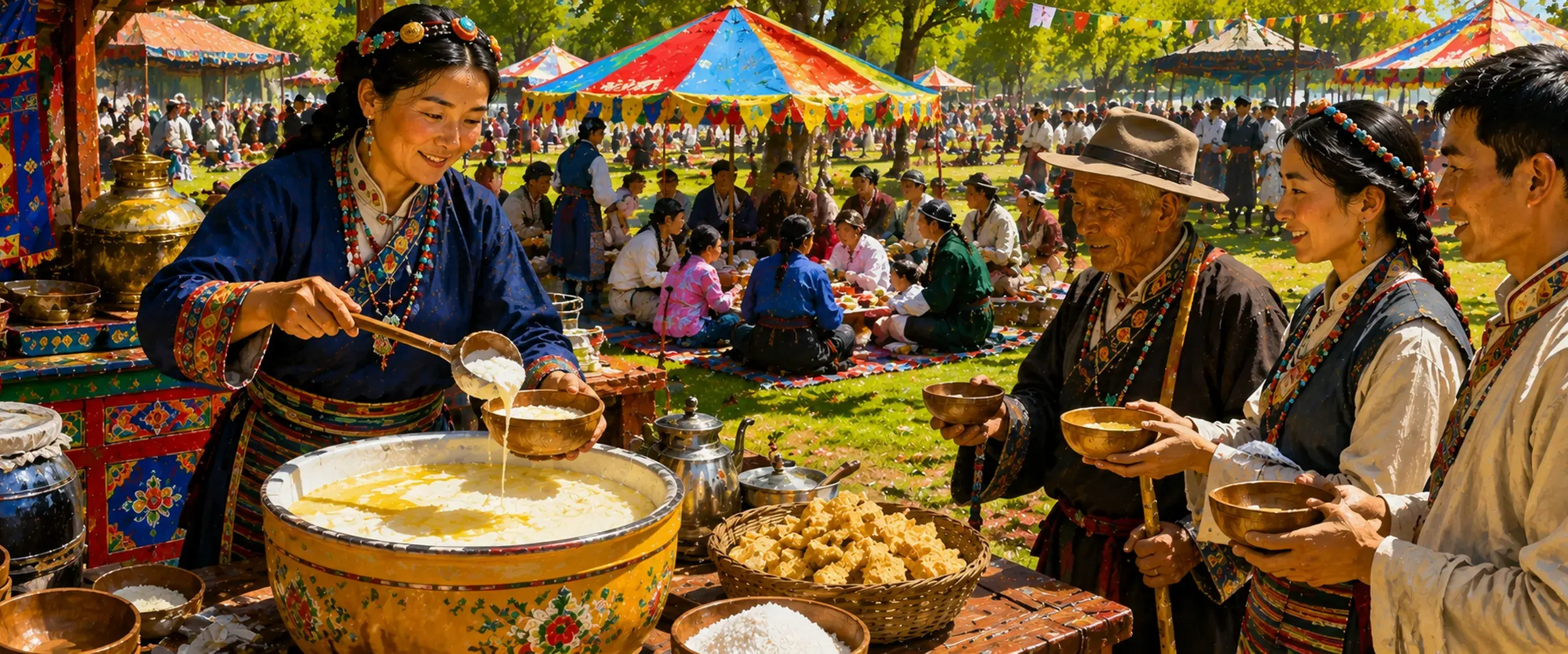
The Shoton Festival is held in the sixth month of the Tibetan calendar and is one of the grandest traditional festivals in Tibet. “Sho” means “yogurt” and “ton” means “banquet,” hence the name “Yogurt Festival.” It originates from the Gelug school…

The Shoton Festival is an important traditional festival of the Tibetan people. “Shoton” means “Yogurt Banquet” in Tibetan: “sho” means yogurt, while “ton” means “to eat” or “banquet.” Yogurt is the festival’s most iconic food—yak yogurt has been an indispensable food and offering in Tibetan regions for more than a thousand years. Tsampa is a traditional Tibetan staple made by grinding barley into flour, mixing it evenly with butter tea, milk curds, sugar, and other ingredients, and kneading it by hand into small lumps for eating. During the festival, people also enjoy Tibetan specialties such as barley wine, butter tea, yak meat, or mutton. Modern Shoton celebrations also feature areas devoted to Tibetan-style snacks such as Tibetan noodles, steamed buns, curry rice, and beef patties. The Shoton Festival originated in the 11th century. It was originally a purely religious observance: monks entered summer retreat, and when the restrictions were lifted and they emerged, ordinary people offered them yogurt. From an early religious offering, yogurt gradually evolved into the central culinary symbol of the Shoton Festival.

Shoton Festival / Cuisine of the Shoton Festival

Festival Food Gallery

Seasonal Menu

Food in Detail

Seeking the True Flavor

Yak Yogurt

Drinks & Fine Wines

Basic Information

  • Category: Dairy product / fermented drink
  • Popular regions: Throughout Tibet, especially Lhasa
  • Main ingredient: Yak milk
  • Other names: Daxue, Exue, Tibetan yogurt, plateau yogurt

Historical Origins

Yogurt is unquestionably the “protagonist” of the Shoton Festival. In Tibetan, “Shoton” means “eating yogurt”; literally, the Shoton Festival is a festival for eating yogurt. A fondness for yogurt has been one of the ancient living customs of the Tibetan people who have inhabited the snowy plateau for generations. As an indispensable food and offering in Tibetan regions, yak yogurt has a history of more than a thousand years.

The yogurt tradition of the Shoton Festival is closely connected with the Tibetan Buddhist system of “summer retreat.” Every year, from the fifteenth to the thirtieth day of the sixth month of the Tibetan calendar, a period of restriction was observed. Lamas in monasteries large and small were not permitted to go outside, so as to avoid accidentally stepping on and killing small insects. Only after the restrictions were lifted on the thirtieth day of the sixth month could they descend from the mountains. As the lamas came down, ordinary people brought out yogurt and offered it to them. This custom of sustaining monks with yogurt is among the oldest cultural genes of the Shoton Festival.

Another folk legend is also associated with the festival’s yogurt tradition. In the mid-11th century, Atiśa, a master of the Later Dissemination of Tibetan Buddhism, traveled from India to Tibet to spread Buddhism. In his later years, he settled on the plains of Nyethang, twenty kilometers southwest of Lhasa. He was very fond of yogurt. During the summer retreat, local people brought yogurt to him, which delighted him greatly. Out of reverence, people began to imitate this practice, and the custom of bringing yogurt to monks during summer continued thereafter. Regardless of which account is followed, “yogurt” has always remained the central cultural symbol of the Shoton Festival.

Cultural Meaning

Tibetan yogurt is divided into two types. One is called “Daxue,” made from milk after the butter has been extracted. The other is made from milk from which the butter has not been extracted and is called “Exue” in Tibetan. Because Daxue is produced from the buttermilk remaining after butter extraction, its flavor is relatively light. Exue, made from full-fat yak milk, has a richer and more mellow taste.

The traditional method of making yogurt involves pouring yak milk into a smooth-walled wooden bucket, blending it, and allowing it to ferment. The fermentation culture comes from the wooden bucket itself—the bucket should not be scrubbed too clean, so that the culture remains for the next batch. This method of “natural inoculation,” passed down from generation to generation, is the source of the distinctive flavor of Tibetan yogurt. Unlike many yogurts from other parts of China, Tibetan yogurt is made extremely thick and must be eaten with a spoon. A little white sugar is sprinkled on top. Because the yogurt is cold and dense, the sugar does not dissolve immediately, so every mouthful has a slight crunchy sound. This is a distinctive part of the experience of eating plateau yogurt.

Anyone who has tasted local Tibetan yak yogurt is likely to remember its flavor. Served in a refined porcelain bowl or wooden bowl, it is as white as snow. Gently stirred with a spoon, it reveals a dense, creamy texture. A yellow, firm layer of milk skin containing cream forms on the surface. Once the skin is lifted away, the yogurt beneath is soft, sticky, and thick—similar in consistency to jelly—and as white as snow, almost like doufunao. It is intensely fragrant, rich, sweet and sour, cool and refreshing. It may be served with fruit pieces, honey, ginseng fruit, roasted barley puffs, and some people even pair it with chili sauce, creating yet another distinctive flavor. In each mouthful, sourness and sweetness accompany one another, the texture is delicate and silky, and the sensation is cool and refreshing.

Yak yogurt carries multiple layers of cultural meaning. First, “honoring the sacred through purity.” The “whiteness” of yogurt corresponds with the noble symbolism of white in Tibetan culture. Offering yogurt to monks means presenting the purest food to the most honored practitioners. Second, “gratitude toward nature.” Every cup of yogurt is a generous return from nature for people’s hard work within a healthy ecological system. Third, “festival symbol.” The Shoton Festival itself is named after yogurt, making yogurt its most recognizable cultural symbol. Fourth, “a gift of the plateau.” During the festival, people offer rich yak yogurt whose sweetness carries within it the gifts of the high plateau.

During the Shoton Festival, fresh yogurt is sold in Tibetan restaurants throughout Lhasa, and some restaurants even create special yogurt banquets. Yogurt shops on Jokhang’s nearby Ramoche Temple Street are particularly popular with local residents, while yogurt shops at the foot of the Potala Palace enjoy an excellent reputation among tourists because of their immense online popularity. Yogurt-eating competitions have also become one of the distinctive festival activities during Shoton.

Tsampa

Grains & Staples

Basic Information

  • Category: Grain staple
  • Popular regions: Throughout Tibet
  • Main ingredients: Barley—roasted and ground into flour—, butter, tea
  • Other names: Tibetan roasted flour, roasted barley flour

Historical Origins

Tsampa is the staple food of the Tibetan people and an indispensable seasonal food during the Shoton Festival. It is a roasted flour made by roasting barley or peas and grinding them. Barley is a staple crop in Tibetan regions, and snacks made from it are also deeply appealing. The history of tsampa is as long as the agricultural civilization of the Tibetan people. Barley is a crop distinctive to the Qinghai-Tibet Plateau. Resistant to cold and drought, it has been fundamental to Tibetan survival in the harsh natural environment. Roasting barley and grinding it into flour to make tsampa not only makes it easier to preserve but also easier to carry, making it one of the most ingenious food creations of Tibetan society, where nomadic and agricultural ways of life coexist.

During the Shoton Festival, tsampa is one of the indispensable foods for “going lingka.” Tibetans carry butter churns, teapots, thermos flasks, and food to scenic places where they drink tea and wine, and tsampa is an essential staple among these provisions. On the morning of the Buddha Thangka Unveiling Ceremony at Drepung Monastery during Shoton, pilgrims also commonly carry tsampa with them as food to satisfy hunger.

Cultural Meaning

The method of making tsampa is extremely simple: barley is washed, dried, roasted, and then ground into fine flour. To eat tsampa, some butter is first placed in a bowl, tea is poured in, and finely ground roasted barley flour is added. The flour and tea are then mixed together by hand. While mixing, one first gently presses the roasted flour toward the bottom of the bowl with the middle finger to prevent the tea from spilling over the rim, while gently rotating the bowl in the hand. When Tibetans travel, they often mix tsampa with butter and carry it in a specially made bag. When they need to eat, it can be consumed as long as water is available; even without water, it can be eaten dry. It is convenient and highly nutritious.

Tsampa is aromatic, pure in flavor, nutritious, and convenient. Tibetan people often enjoy it with ginseng fruit or butter tea, and once accustomed to it, it is extremely delicious. Tsampa holds the position of “foremost staple” in everyday Tibetan life and is one of the simplest yet most indispensable flavors on the Tibetan table.

Tsampa carries the profound meaning of “the roots of the plateau.” Barley symbolizes the Qinghai-Tibet Plateau, while tsampa represents the Tibetan people’s deepest connection with this land. Its simplicity embodies the Tibetan wisdom of “turning the ordinary into the extraordinary” under harsh natural conditions. During Shoton, a festival of gratitude toward nature and reverence for monks, tsampa, yogurt, and butter tea together form the “iron triangle” of Tibetan food culture—yogurt provides protein, tsampa provides carbohydrates, and butter tea provides energy and warmth.

Butter Tea

Drinks & Fine Wines

Basic Information

  • Category: Beverage
  • Popular regions: Throughout Tibet
  • Main ingredients: Brick tea, butter, salt
  • Other names: Tibetan milk tea, butter milk tea

Historical Origins

Butter tea is an indispensable drink in the everyday life of Tibetan people and is also essential when “going lingka” during the Shoton Festival. Butter tea is a distinctive beverage of Tibet in China. During the festival, it has an unquestionably indispensable place in every lingka feast, large or small.

The origins of butter tea are closely connected with the Tibetan people’s need to survive in cold high-altitude environments. Butter is the concentrated essence extracted from yak milk. Rich in fat and calories, it serves as an important energy source for resisting the plateau cold. Brick tea supplies abundant vitamins and trace elements, supplementing the nutritional deficiency caused by the scarcity of vegetables in high-altitude regions. The combination of butter and tea is a “1 + 1 > 2” nutritional formula created by Tibetan ancestors through long experience.

Cultural Meaning

Butter tea has a highly distinctive preparation method. Brick tea is placed inside a wooden cylindrical churn about one meter long, after which butter and salt are added and repeatedly pounded and churned with a wooden pestle. Through repeated churning, butter and tea become thoroughly emulsified, creating golden butter tea with an intense aroma. During the Shoton Festival, Tibetans also carry butter churns, teapots, and thermos flasks filled with butter tea when they go outdoors for lingka.

Butter tea carries the profound meaning of “plateau warmth.” In the cold climate of the plateau, a steaming bowl of butter tea offers some of the greatest comfort to the body. The union of “butter” and “tea” reflects the Tibetan dietary wisdom of “balancing yin and yang”—the warmth of butter and the refreshing clarity of tea achieve a perfect balance on the tongue. During the Shoton Festival, a cup of butter tea in hand while sitting on the grass with several close friends is one of the most comfortable scenes of everyday life on the plateau.

Barley Wine

Drinks & Fine Wines

Basic Information

  • Category: Fermented alcoholic drink
  • Popular regions: Throughout Tibet
  • Main ingredients: Barley, fermentation starter
  • Other names: Qiang (in Tibetan), Tibetan beer

Historical Origins

Barley wine is one of the favorite alcoholic drinks of the people of the Qinghai-Tibet Plateau. During the Shoton Festival, it holds an unquestionably indispensable place in lingka feasts large and small. Barley wine is a low-alcohol beverage brewed from barley. It is pale yellow, sour with a hint of sweetness, and is sometimes known as “Tibetan beer.” During the festival, residents of Lhasa and surrounding areas dress in festive clothing, carry barley wine, butter tea, and various Tibetan pastries, and invite relatives and friends to spend lingka together beside the Lhasa River or in parks.

The history of barley wine is as long as that of barley cultivation itself. Within Tibetan society, it is indispensable during festivals, weddings, childbirth celebrations, and the welcoming or seeing off of relatives and friends. As the Shoton Festival is one of the most important festivals after the Tibetan New Year, barley wine naturally occupies an indispensable place on the festival table.

Cultural Meaning

The brewing method for barley wine is simple yet ingenious. First, the barley is washed and boiled. Once the temperature has fallen slightly, fermentation starter is mixed in while the grain is still warm, after which it is placed in a jar or wooden barrel and sealed. After a period of fermentation, the starches in the barley transform into alcohol and sugars, creating pale-yellow barley wine with a flavor that is sour yet sweet. The renowned poet Wang Guozhen once wrote: “喝一杯青稞酒,便记住了雪域高原” — a single cup of barley wine is enough to remember the snowy plateau. Its rich fragrance and long aftertaste make barley wine one of the most distinctive flavor memories of the snowy highlands.

Barley wine carries the meaning of “a brew for joyful gatherings.” Its alcohol content is low, making it difficult to become drunk quickly and suitable for leisurely drinking over long periods. During lingka feasts at Shoton, people sip barley wine while watching Tibetan opera and chatting about family life; the fragrance of wine intertwines with laughter. The gentle “tipsiness” created by barley wine is precisely one of the festival’s most beautiful atmospheres—half drunk and half awake, mountains remain mountains, waters remain waters, Tibetan opera remains Tibetan opera, and everything appears in its most authentic form.

Yogurt Banquet (Yogurt Rice, Yogurt Buns, Yogurt with Ginseng Fruit)

Others

Basic Information

  • Category: Composite banquet / dairy-based staple
  • Popular regions: Lhasa and major towns throughout Tibet
  • Main ingredients: Yak yogurt, rice, flour, ginseng fruit, etc.
  • Other names: Yogurt rice, yogurt buns, yogurt with ginseng fruit

Historical Origins

The yogurt banquet is one of the most distinctive forms of Shoton Festival dining. As the festival approaches, restaurants throughout Lhasa not only sell fresh yogurt but also specially introduce yogurt banquets: yogurt rice, yogurt buns, yogurt with ginseng fruit, and a seemingly endless variety of dishes made with yogurt. The emergence of the yogurt banquet marks the culinary development of yogurt from something “eaten directly” into an ingredient incorporated into cooked dishes.

Cultural Meaning

Yogurt rice is made by pouring yak yogurt over steaming rice and sprinkling it with white sugar or honey. The sweet-sour yogurt blends with the soft rice in the mouth, creating one of the simplest festival staples of Shoton. Yogurt buns use yogurt as a filling wrapped inside dough and steamed. The tangy fragrance of yogurt permeates the wheat aroma of the wrapper, making it one of the more inventive creations of the yogurt banquet. Yogurt with ginseng fruit is prepared by sprinkling cooked ginseng fruit—juema—over yak yogurt. The soft sweetness of ginseng fruit forms a perfect contrast with the tangy richness of yogurt.

The yogurt banquet carries the plateau wisdom of “eating sour foods for nourishment.” Yogurt is a food produced by fermenting milk, making it richer in nutrition and easier to digest. Every dish in the yogurt banquet reflects the Tibetan people’s deep understanding of yogurt’s nutritional value and their creative use of it. The banquet is also the most concentrated expression of Shoton as the “festival of eating yogurt”—a bowl of yogurt rice, a steamer of yogurt buns, a bowl of yogurt with ginseng fruit: every taste of the Shoton Festival is closely connected with yogurt.

Air-Dried Yak Meat

Meat & Seafood

Basic Information

  • Category: Meat product
  • Popular regions: Throughout Tibet, especially northern Tibet
  • Main ingredient: Yak meat
  • Other names: Air-dried meat, dried yak meat

Historical Origins

Air-dried yak meat is a traditional food of the Tibetan people. In Tibet’s cold high-altitude environment, food is less prone to mold and spoilage; removing moisture while preserving freshness is therefore particularly suitable, and the custom of eating air-dried beef remains highly popular to this day. During the Shoton Festival, air-dried yak meat is an important source of meat when people “go lingka.”

Its production is closely connected with the plateau’s distinctive climatic conditions. Tibet is cold and dry, and winter temperatures are extremely low, allowing fresh meat to dry slowly in natural conditions without spoiling. This climatic advantage, acting as a kind of “natural refrigerator,” enabled Tibetan ancestors to develop the distinctive preservation method of air-drying meat. In northern Tibet, beef is simply air-dried, while in eastern Tibet it first needs to be cured.

Cultural Meaning

Air-dried yak meat is generally prepared beginning in December each year. Yak hind-leg meat and shank meat are the preferred cuts. Carefully selected raw yak meat is first cut along the grain into strips of suitable size. Depending on personal preference, different flavors can then be prepared: the meat may simply be hung to dry in its original form, or first marinated with seasonings before being hung in a well-ventilated hay barn or under the eaves to air-dry. Once dried, yak meat becomes firm with clearly defined fibers, has a crisp texture, and fills the mouth with a mellow fragrance.

Air-dried yak meat carries the meaning of “the resilience of the plateau.” The yak is known as the vessel of the plateau and is the most important livestock animal of the Tibetan people. Making air-dried yak meat extends and honors the life of the yak—preserving its gift in the simplest possible way so that it can be slowly enjoyed throughout the long winter and during festive gatherings. The “toughness” of air-dried yak meat is both a physical quality and a culinary metaphor for the indomitable character of the Tibetan people.

Tibetan Buns (Momo)

Grains & Staples

Basic Information

  • Category: Grain staple
  • Popular regions: Throughout Tibet
  • Main ingredients: Flour, yak meat or mutton, scallion, salt
  • Other names: Momo, Tibetan steamed buns, beef buns

Historical Origins

Tibetan buns are a traditional Tibetan wheat-based food and an important item taken along for lingka during the Shoton Festival. Filled with yak meat or mutton, they have thin wrappers, generous fillings, and plentiful juices, making them one of the finest foods for receiving guests. During Shoton, Tibetan buns, yogurt, butter tea, and barley wine together form the “four-piece set” of the lingka feast.

Cultural Meaning

The method of making Tibetan buns resembles that of Han Chinese steamed buns, but the filling is primarily yak meat. Seasoning is kept simple in order to emphasize the meat’s natural flavor. After the dough has fermented, it is wrapped around the meat filling and steamed. Finished Tibetan buns have thin wrappers and tender fillings. Bite into one and savory meat juices burst into the mouth, offering one of the warmest comforts of the plateau.

Tibetan buns carry the meaning of “the taste of home.” On Shoton, a day when the entire family heads outdoors together, Tibetan buns are a food shared by family members sitting together and one of the most direct culinary expressions of familial affection.

Tibetan Pastries

Pastries & Snacks

Basic Information

  • Category: Pastries / fried dough
  • Popular regions: Throughout Tibet
  • Main ingredients: Flour, butter, sugar
  • Other names: Khapse, fried pastries

Historical Origins

Tibetan pastries are indispensable when “going lingka” during the Shoton Festival. During the festival, residents of Lhasa and surrounding areas dress in festive clothing, carry barley wine, butter tea, and various Tibetan pastries, and invite relatives and friends to go lingka together. Tibetan pastries come in many varieties, of which the fried dough pastry known as “khapse” is among the most common.

In traditional Tibetan festivals, khapse, or fried pastries, are an important festive food. During Shoton, people bring various Tibetan pastries from home and sit together on the grass to share them.

Cultural Meaning

Tibetan pastries carry the meaning of “festival sweetness.” Shoton is a sweet festival—the sweet-sour yogurt, the crisp sweetness of pastries, and the gentle sweetness of barley wine together form the festival’s overarching flavor of “sweetness.” The golden, crisp appearance of Tibetan pastries also symbolizes festivity and abundance.

Ginseng Fruit (Juema)

Seasonal Vegetables

Basic Information

  • Category: Root / dessert accompaniment
  • Popular regions: Throughout Tibet
  • Main ingredient: Juema (ginseng fruit)
  • Other names: Ginseng-fruit rice, juema rice

Historical Origins

Ginseng fruit, or juema, is an important supplementary ingredient in Tibetan cuisine and is widely eaten during the Shoton Festival. At traditional Tibetan banquets, the first food served is zhuma rice—ginseng-fruit rice. As the opening dish of Tibetan banquets, ginseng-fruit rice demonstrates the special position that juema holds in Tibetan culinary culture.

During Shoton, throughout streets and lanes, people offer rich yak yogurt served with tsampa and ginseng fruit. Yogurt with ginseng fruit is one of the festival’s most distinctive desserts: cooked ginseng fruit is sprinkled over yogurt, allowing its soft sweetness to mingle with the yogurt’s tangy richness on the tongue.

Cultural Meaning

Ginseng fruit carries the meaning of “a treasure of the plateau.” Ginseng fruit is the root of a wild plant distinctive to the Qinghai-Tibet Plateau. Rich in starch and various nutrients, it is a kind of “natural energy bar” discovered by Tibetan people amid harsh natural conditions. During Shoton, a festival of gratitude toward nature, ginseng fruit appears on the table as “a gift of the plateau,” offering one of the clearest responses to nature’s generosity.

Food Culture

Foodways

Looking across the culinary system of the Tibetan Shoton Festival, several cultural principles run consistently throughout:

I. “Purity” as beauty. The Shoton Festival takes its name from “sho,” meaning yogurt, and yogurt itself is synonymous with whiteness and purity. In Tibetan culture, white is the noblest color—the pure white khata, snow-white yogurt, and white tsampa together establish the festival’s aesthetic foundation of “whiteness.” Yogurt is as white as snow. The “sho” in “Shoton” is the Tibetan term for yogurt, while its whiteness also resonates with cultural meanings of “purity” and “cleanness.” The foods of the Shoton Festival use the “taste of whiteness” to express a pursuit of spiritual purity.

II. “Reverence” as the source. The origins of the Shoton Festival are closely connected with ordinary people offering yogurt to monks. Under the monastic rules of the Gelug school of Tibetan Buddhism, from the fourth to the sixth month of the Tibetan calendar, monks were permitted only to chant scriptures and practice within the monasteries, and the restriction was not lifted until the end of the sixth month. When the period ended, the monks left the monasteries and descended the mountains. To reward them, laypeople prepared yogurt and organized outdoor banquets and excursions. Yogurt thus rose from an everyday food to a sacred medium for “honoring monks.” Every bite of Shoton Festival food expresses reverence for practitioners and celebrates the spirit of compassion.

III. “Enjoyment” as joy. The Shoton Festival is not only a religious festival but also a secular celebration. After the Buddha Thangka Unveiling Ceremony, people move from solemn religious ritual into the worldly pleasures of “lingka”—outdoor picnicking and leisure. On the green lawns of Norbulingka, people set up tents, spread out picnic mats, and lay out barley wine, butter tea, Tibetan pastries, yogurt, and other foods brought from home. They eat, talk, sing, and dance. The “enjoyment” embodied in Shoton cuisine expresses a philosophy of life based on “the unity of heaven and humanity”—in the most beautiful gardens, together with the people one loves most, enjoying nature’s most generous gifts.

IV. “Purity” as flavor. Traditional Tibetan food is characterized by the idea of “purity.” No additives whatsoever are used during the production and processing of yak yogurt; the most original yogurt is used as the fermentation starter to produce probiotics. Tsampa is finely milled roasted barley flour, which is eaten simply by adding butter and tea and kneading it by hand into lumps. Butter tea is made by repeatedly churning brick tea and butter together inside a wooden cylinder. Every flavor of Shoton Festival cuisine is an expression of the plateau in its most authentic form—without complicated seasoning, only the purest expression of the ingredients themselves.

Regional Distribution

Foodways
Region Distinctive Shoton Festival Foods
Lhasa Yak yogurt (the core festival food, with flavors varying from place to place); yogurt banquet (yogurt rice, yogurt buns, yogurt with ginseng fruit, etc.); Tibetan noodles, sweet tea, liangfen, potato slices
Shigatse Yak yogurt, air-dried yak meat, butter tea (traditional festival foods of the Tsang region)
Shannan Yak yogurt, milk curds, butter-and-cheese cakes (traditional festival foods from one of the cradles of Tibetan culture)
Nyingchi Yak yogurt, roasted Tibetan fragrant pig, matsutake (festival foods incorporating local Nyingchi products)
Chamdo Yak yogurt, butter tea, tsampa (traditional festival foods of Kham)
Nagqu Yak yogurt, hand-held meat (Nagqu is rich in yaks, making yogurt and meat the central festival foods)
Ngari Yak yogurt, air-dried meat, barley wine (distinctive plateau festival foods)
Garzê / Ngawa, Sichuan Yak yogurt, tsampa, butter tea, hand-held yak meat (traditional festival foods of the Amdo and Kham regions)
Diqing, Yunnan Yak yogurt, butter tea, barley cakes (Shoton Festival flavors of Tibetan areas in Yunnan)
Gannan, Gansu Yak yogurt, tsampa, Tibetan buns (festival foods of the Amdo Tibetan region)

The Shoton Festival is about much more than yogurt. During the festival, whole families head outdoors with tents, carpets, and plentiful foods to “go lingka”—to picnic and enjoy the countryside. The grasslands are spread with hand-held meat, yak meat, barley wine, butter tea, and a variety of Tibetan pastries, forming a vast outdoor feast in which everyone participates.

Additional Note: During the Shoton Festival, in addition to enjoying food, people also watch the grand Buddha Thangka Unveiling Ceremony and spectacular Tibetan opera performances. Bringing together faith, art, and cuisine, the festival is one of the most vivid windows into Tibetan culture.

Closing Reflections

Foodways

The Shoton Festival is the direct rendering of the Tibetan expression meaning “Yogurt Banquet.” In Tibet, it has been remembered for more than a thousand years precisely as a festival of “eating yogurt.” The festival originated in the mid-11th century. During the summer retreat, monks remained secluded in religious practice, and on the day when the restrictions were lifted and they emerged, ordinary people offered them yogurt. This custom continued for a millennium and gradually evolved into a festival combining the Buddha Thangka Unveiling Ceremony, Tibetan opera, and outdoor excursions. In 2006, it was included in the first batch of China’s national intangible cultural heritage list. Yet the soul of the festival has always remained that bowl of yogurt—it tells everyone in the most direct possible way: today is a day specifically for eating yogurt.

Tibetan yak yogurt is entirely different from the sweet industrial products found on urban supermarket shelves. It resembles doufunao in appearance and has a cold, dense texture. Take a spoonful and its sourness arrives directly and openly. Even more remarkable is the white sugar sprinkled over the surface. Because the yogurt is so thick, the sugar does not dissolve, and every mouthful carries the crisp sound of sugar crystals mingling with yogurt. There is a saying in Tibetan regions: the sourness of yogurt is yak milk’s most honest expression of the plateau. That sourness slides from the tip of the tongue into the throat, awakening every memory the taste buds possess of the word “purity.”

Yet the Shoton Festival is far more than a single bowl of yogurt. During the celebration, whole families in Lhasa head outdoors with tents, picnic mats, and foods made by their own hands, going to Norbulingka or the banks of the Lhasa River to “go lingka”—to picnic and enjoy the countryside. Tibetan rugs are spread across the grass, and barley wine, butter tea, sweet tea, tsampa, hand-held mutton, and all kinds of Tibetan pastries are laid out upon them. The melodies of Tibetan opera drift from afar as relatives and friends sit together, raise their cups, and exchange blessings. Ancient yogurt once served in wooden and porcelain bowls has evolved into the finely packaged products of today; likewise, the meaning of the festival has expanded from a single religious offering into an open and inclusive cultural feast.

A single bowl of yogurt carries more than a thousand years of Tibetan faith and everyday life. To eat the foods of the Shoton Festival is to taste the purity of the plateau and to experience the simplest covenant between humanity, heaven and earth, and the sacred. When the sourness of yogurt meets the sweetness of sugar in the mouth, and when the melodies of Tibetan opera mingle with the laughter of friends and family in the wind, one begins to understand why the Shoton Festival is a celebration for all the people, second only to the Tibetan New Year.

—-

Continue exploring Shoton Festival culture

Readers’ Comments

Calendar and traditional culture enthusiasts from around the world, sharing the same moon.

Sign in or register to join the conversation. Your comment account is created automatically the first time you use a connected account.