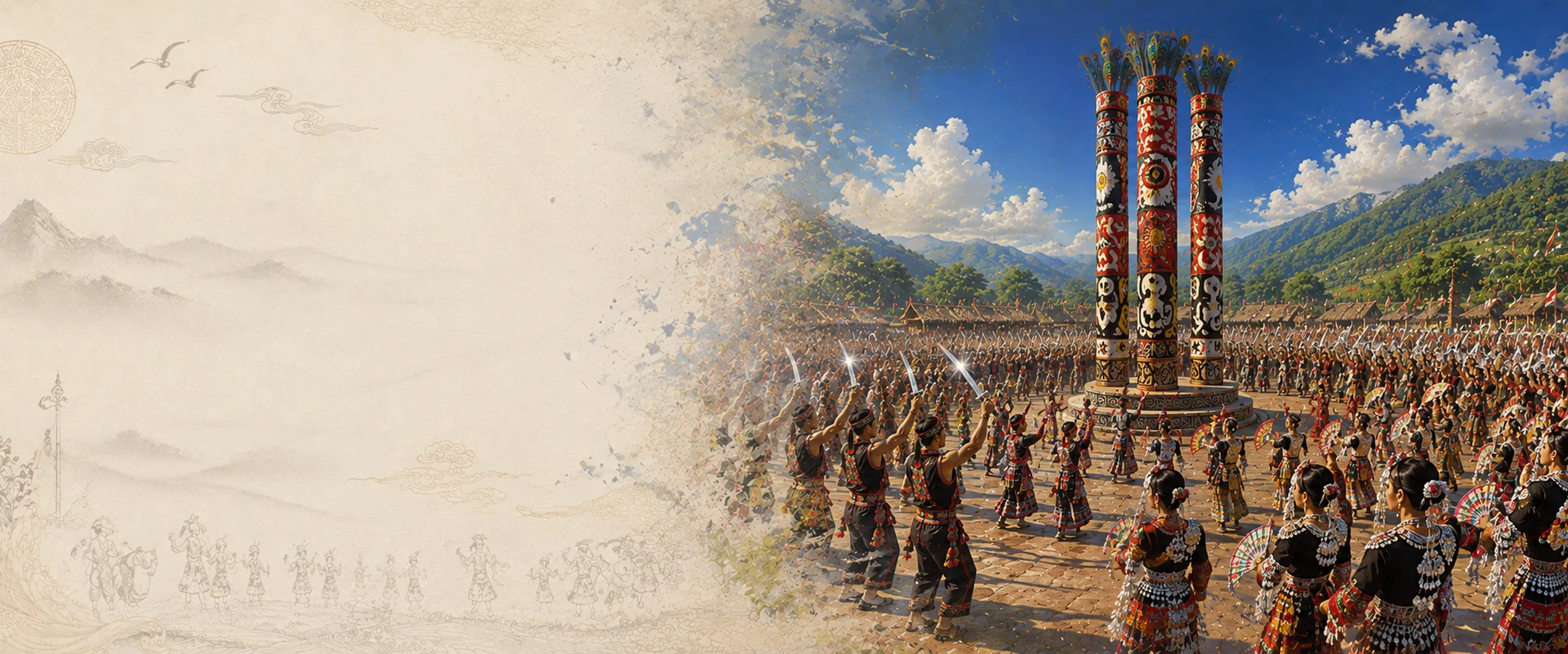

The Manau Zongge Festival is a traditional festival of the Jingpo people, generally held in the first month of the lunar calendar. “Manau Zongge” is a Jingpo term meaning “everyone dance together,” and it is the most important festival celebration of the Jingpo people. During the festival, tens of thousands of Jingpo people, dressed in their finest attire, gather at the Manau square. Led by the “Naushuang” (chief dance leader), they move to the same drumbeat and rhythm, performing grand and well‑ordered dance formations. The dance movements originate from the migration history and daily life of the Jingpo ancestors, with each step carrying the memory and spirit of the people. The Manau Zongge Festival is not only a carnival for the Jingpo people but also a powerful expression of ethnic cultural identity. In 2006, Manau Zongge was inscribed on China’s first list of National Intangible Cultural Heritage.
Festival Journey
Origins & Legends
History · Evolution · Legend
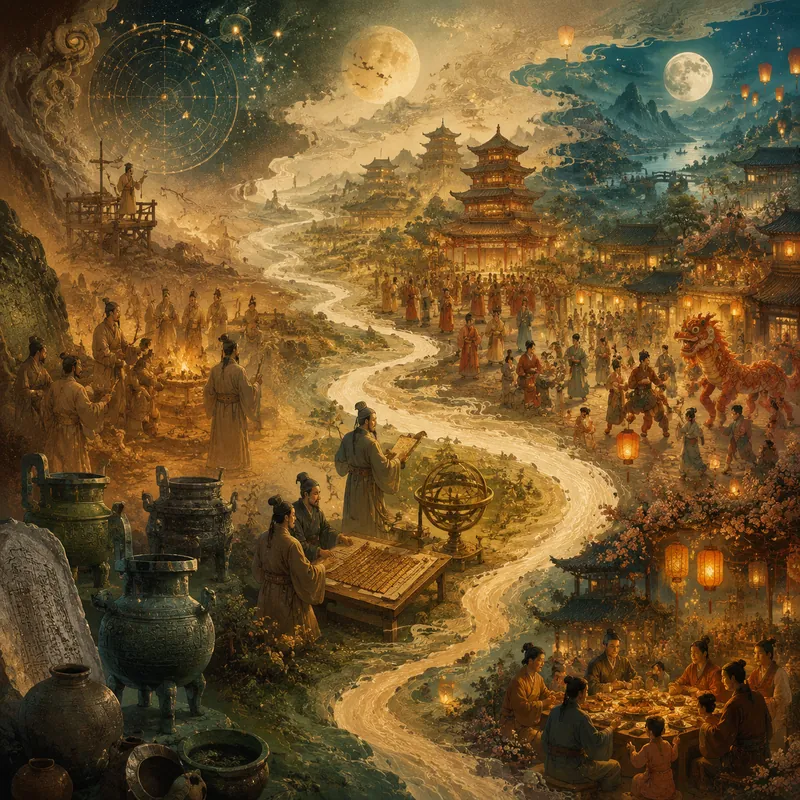
Tracing the Source · Historical Evolution
- Primitive Society Period The Munao Zongge can be traced back to primitive society
- Tang to Ming Dynasties According to historical legends and Chinese historical records, the Jingpo people began their long journey from the Qinghai‑Tibet Plateau southward along the Hengduan Mountains around the Tang dynasty
- Qing Dynasty to the Republic of China The Qing dynasty to the Republic of China period was the heyday and monopolisation period of Munao Zongge under the hill chief system
- 1950s to 1970s In the 1950s, with the founding of the People’s Republic of China and the social system reforms in Jingpo areas, the hill chief system was abolished
- Revival after Reform and Opening‑up After reform and opening‑up, through the continuous efforts of the Jingpo people and the restoration and implementation of ethnic policies, Munao Zongge activities were approved by the government for restoration
- 21st Century: Intangible Heritage Protection and Cultural‑Tourism Integration On 20 May 2006, with approval from the State Council, “Jingpo Munao Zongge” (No
Festival Customs
Customs · Local Traditions · Everyday Life
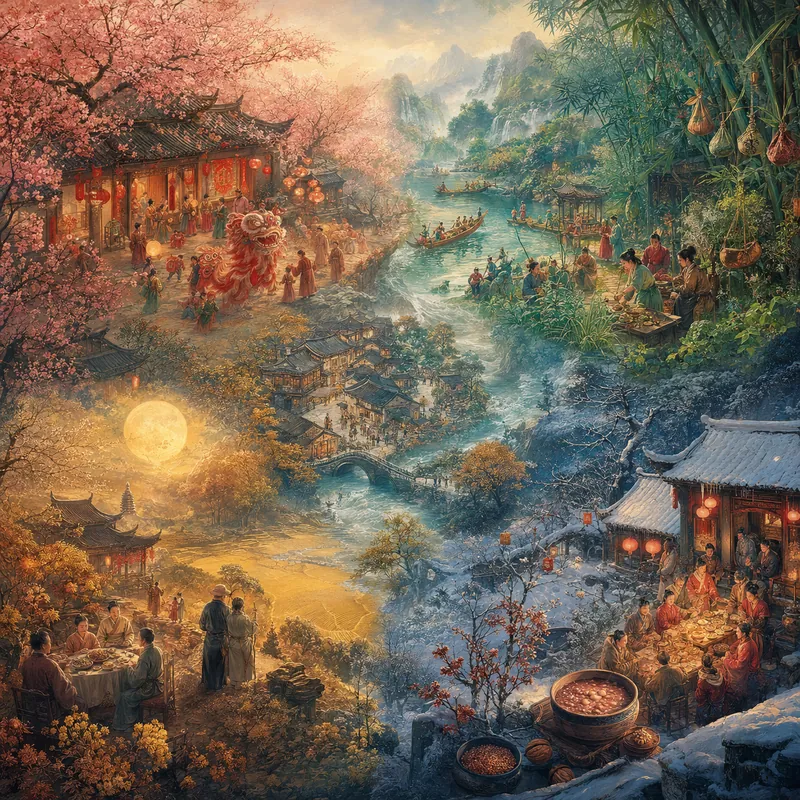
Seasonal Snapshots · Customs & Local Life
Festival Foods
Food Traditions · Local Flavors · Taste
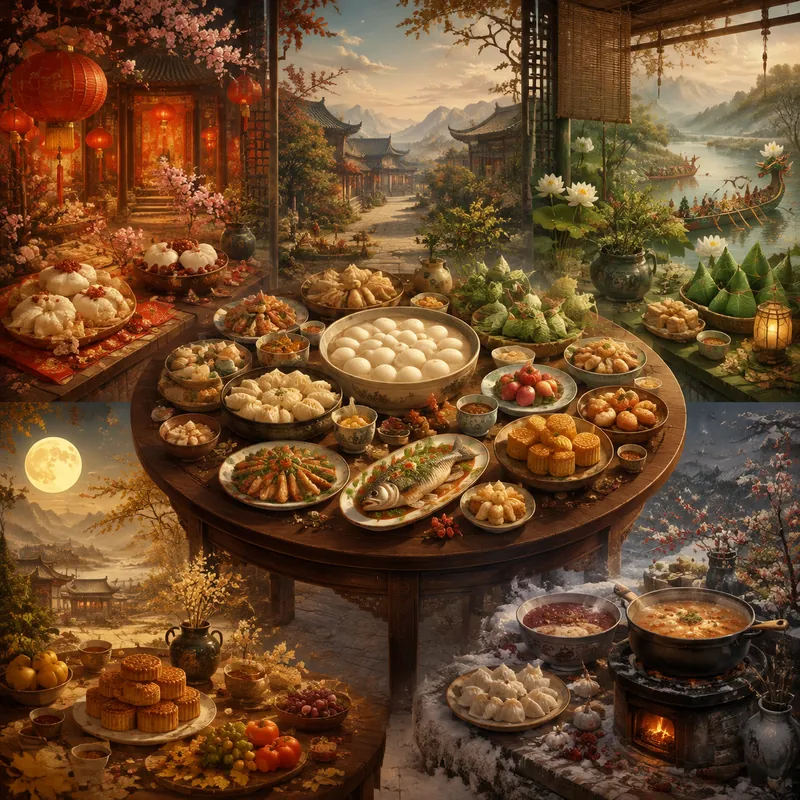
Seasonal Flavours · Seasonal Menu
Folk Arts
Song & Dance · Living Tradition · Heritage
Living Folk Arts · Of Song and Dance
Through Song and Dance · A Living Tradition
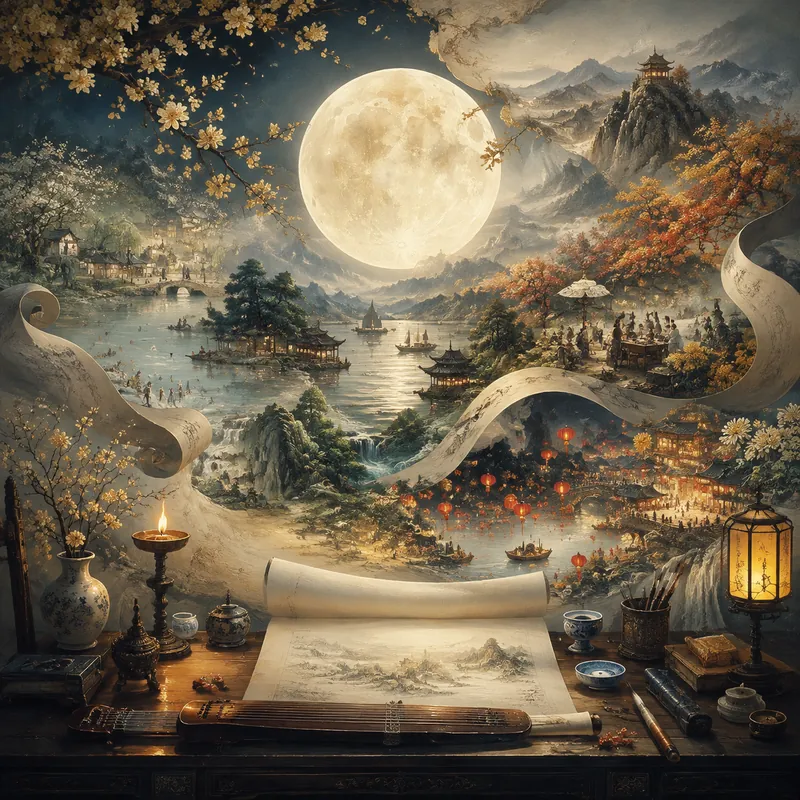
Opening Verse: 目瑙纵歌,万人同舞。 Introduction: Poetry associated with the Munao Zongge Festival centers on the spectacle of thousands dancing together and on the worship of the Sun God. “目瑙纵歌,万人同舞” captures the festival’s most magnificent scene. These poems often record the vast spectacle of tens of thousands of people dancing beneath the wooden “Munao Shidong” pillars, all moving to the same drumbeat and the same rhythm. The Munao Zongge Festival is the grandest traditional festival of the Jingpo people. The Jingpo saying “目瑙纵歌,万人同舞” precisely captures its defining image. The poetry and songs of Munao Zongge are closely connected with the Jingpo creation epic 《目瑙斋瓦》. According to the epic, Munao Zongge was first danced by the children of the Sun in the Palace of the Sun and was later brought to the human world by birds. During the festival, wooden pillars known as “Munao Shidong” are erected at the center of the dance ground for the worship of the Sun God. Tens of thousands of people step to the same drumbeat and the same rhythm, forming vast yet orderly lines of dancers. With sweeping strokes, the poetry of Munao Zongge records this spectacular scene of “万人同舞,” carrying within it the Jingpo people’s reverence for the Sun God and their pride in the cohesion of their community.
Global Features
Overseas · Chinese Communities · Celebrations
Overseas Celebrations · Lights of Chinese Communities
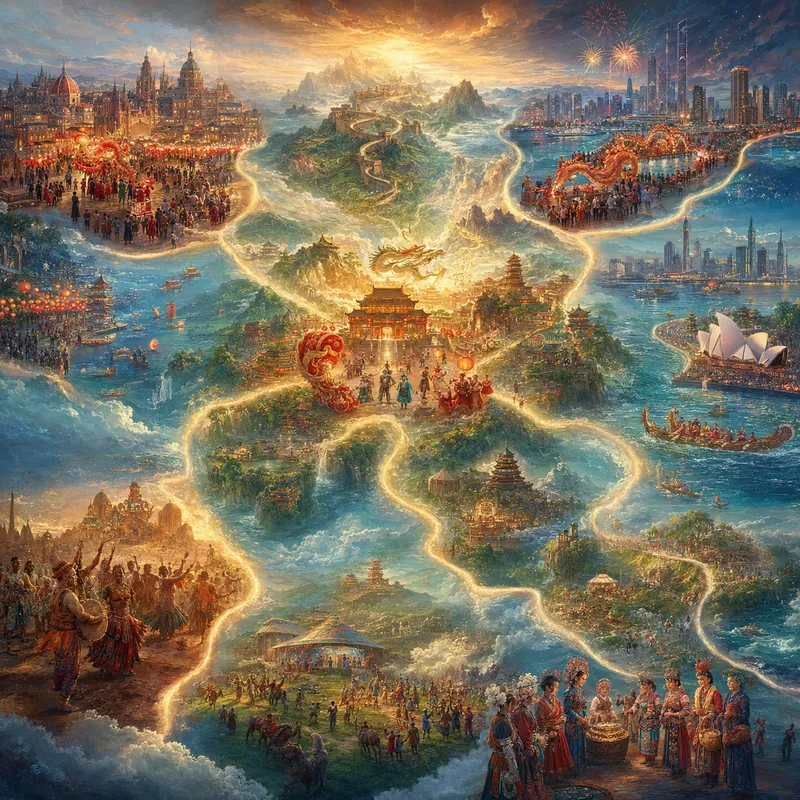
The global spread of the Munao Zongge Festival begins with a distinctive geographical and ethnic reality—the Jingpo are a cross-border people. In China, the Jingpo are concentrated primarily in the Dehong Dai and Jingpo Autonomous Prefecture of Yunnan. In Myanmar, the Jingpo are known as the Kachin, and live mainly in Kachin State and Shan State. The two countries are connected by the same mountains and rivers; the people share common origins and closely related cultures. Munao Zongge, known in Kachin as Manau, is the grandest traditional song-and-dance festival of the Kachin people. Both the government of Dehong Prefecture in China and the government of Kachin State in Myanmar have designated the Munao Zongge Festival as an official public holiday. This natural cross-border distribution has given the Munao Zongge Festival an intercultural character from the very beginning. Its cross-border transmission is reflected not only in the simultaneous celebration of the festival, but also in everyday cultural exchange. Academic research has noted that Munao Zongge is a traditional festival shared by Jingpo communities along the China–Myanmar border and is highly representative of cross-border ethnic communication practices. The pathways through which Munao Zongge has developed across the border include cross-border conferences, festival activities, think-tank forums, marriages, study, training, and other forms of exchange. The melodies of Munao Zongge had already spread from Dehong into Jingpo/Kachin communities in Myanmar at an early stage. Cross-border celebration in Ruili. Ruili, situated directly on the China–Myanmar border, is a representative setting for the cross-border dissemination of the Munao Zongge Festival. In 2025, Ruili held a grand celebration of the festival. Among the participants were special guests from Myanmar, who wore traditional attire and joined the lead dancers, together creating a spectacular cross-border cultural celebration. As one observer remarked, the Munao Zongge Festival is “not only a festival within the Jingpo community, but increasingly an international event, because more and more tourists are taking part.” What remains unchanged is the Jingpo people’s aspiration for a happy life. Border trade in Manghai. In Manghai Township, Dehong, the Munao Zongge gathering ingeniously combines the presentation of ethnic culture with rural tourism and border trade. Around the festival grounds, a distinctive “China–Myanmar Border Specialty Street” brings together characteristic goods from both countries. Traditional Jingpo foods such as “ghost chicken” (鬼鸡), a distinctive Jingpo-style chicken dish, attract border residents and travelers from both sides. Here, Munao Zongge is not only a cultural feast but also an important platform for economic and cultural exchange between border communities in China and Myanmar.
In June 2026, the first South and Southeast Asia Influencer Creators Conference was held in Kunming, Yunnan. Around 200 guests gathered in the “Spring City,” including leading influencers from 11 countries, well-known domestic creators, platform representatives, and media journalists. During the performance showcase, Yingjiang County represented Dehong with a presentation of Munao Zongge. This national-level intangible cultural heritage performance, deeply rooted in Jingpo culture, became one of the most closely watched cultural highlights of the conference through its distinctive folk appeal. At the performance venue, Jingpo dancers dressed in exquisite traditional clothing entered in formation under the leadership of the Naoshuang Naoba (瑙双瑙巴), the festival’s lead dancers, their silver ornaments swaying as their steps remained perfectly synchronized, fully displaying both the power and agility of Munao Zongge. Influencer creators from countries across South and Southeast Asia watched attentively throughout, immersing themselves in the distinctive character of Yunnan’s ethnic minority culture. By drawing on the platforms of the South and Southeast Asia Expo and the first South and Southeast Asia Influencer Creators Conference, Munao Zongge was presented comprehensively and disseminated from multiple perspectives, allowing friends from South and Southeast Asia to experience directly the appeal of China’s ethnic minority cultures and effectively helping ethnic culture move beyond the borderlands and onto the international stage. With song and dance as a bond and culture as a bridge, this cultural performance further narrowed the distance between China and the countries of South and Southeast Asia and deepened regional cultural exchange and emotional connection.
One of the most striking chapters in the Munao Zongge Festival’s journey into the world has unfolded on the African continent. According to China News Service, the Nigeria Huaxing Arts Troupe has obtained performance authorization for “Munao Zongge.” This African arts group has brought Jingpo music from Dehong in Yunnan, China, onto African stages. Performance authorization means that Munao Zongge is no longer simply a cultural tradition belonging only to the Jingpo people, but has become a cultural resource actively embraced, learned, and transmitted by people of other countries and ethnic groups. Mainstream global media have also witnessed the spread of Munao Zongge in Africa. The Global Times reported that the music of Munao Zongge had “crossed continents, captivating audiences in African countries including Nigeria and Rwanda, where local performers are developing their own interpretations of it.” The phrase “local performers are developing their own interpretations of it” is particularly significant. In Africa, Munao Zongge is no longer merely “being displayed”; it is being “re-created.” When African performers interpret Munao Zongge in their own way, this ethnic culture from China’s southwestern frontier has already undergone its first process of localization on the African continent. As local media in Dehong observed: “When the powerful melody of ‘O Ran, O Ran’ crosses mountains and seas and sparks a wave of public imitation across the African continent, and when the Jingpo intangible cultural heritage music ‘Munao Zongge,’ originating in Dehong, Yunnan, China, sweeps global social-media platforms with more than 3.7 billion plays across the internet, a miracle of traditional ethnic culture breaking out of its original circle in the digital age is unfolding.” This hit song, rearranged and empowered by AI, has “moved from the firesides of the southwestern frontier to the center of the world stage, demonstrating through the most vivid practice the profound truth that ‘what is ethnic belongs to the world.’”
The Munao Zongge Festival attracts tens of thousands of participants every year, including not only local residents but also visitors from around the world. On March 3, 2026, coinciding with the Lantern Festival on the fifteenth day of the first lunar month, the opening ceremony of the 2026 Mangshi Munao Zongge Festival was held at the Dehong Jingpo International Munao Zongge Cultural Park. People of different ethnic groups from within and beyond the prefecture, together with visitors from China and overseas, gathered to celebrate amid powerful drumbeats and flowing dance steps. On the morning of February 24, 2024 alone, around 40,000 people took part in the Munao Zongge gathering. Participants included not only residents of surrounding counties, cities, townships, and villages, but also visitors who had traveled from Jilin, Sichuan, Chongqing, and other parts of Yunnan. Foreign visitors are likewise important participants in the Munao Zongge Festival. At the 2024 celebration, a tour group of overseas visitors with an average age of over 65 joined in the festivities. Israeli tour guide Glaubman Yonatan, who has maintained ties with China for nearly 30 years, said: “After coming to Yunnan, I was drawn to its original ethnic traditions and landscapes.” Liu Li, a visitor from Chongqing, said after experiencing Munao Zongge: “This is my first time in Dehong experiencing Munao Zongge. The atmosphere is wonderful. I became completely immersed in it and was deeply affected by the energy. I’m very happy.” For visitors from afar, Munao Zongge offers a distinctive cultural experience. Its dance steps are simple and easy to learn, requiring no dance background whatsoever—this is precisely one of the major reasons it can attract so many visitors to participate personally. As one observer noted, the dance steps “have to be simple,” because this is a gathering of strangers—“whether or not one has learned the dance is not a barrier to participation; once the body enters the space, it naturally merges into the collective rhythm.” This open and inclusive mode of participation gives the Munao Zongge Festival a natural accessibility and warmth for international visitors.
Visitor Guide
Preparation · Etiquette · Take Part with Confidence
Readers’ Comments
Calendar and traditional culture enthusiasts from around the world, sharing the same moon.
Sign in or register to join the conversation. Your comment account is created automatically the first time you use a connected account.
No comments yet
Share your thoughts with readers around the world.