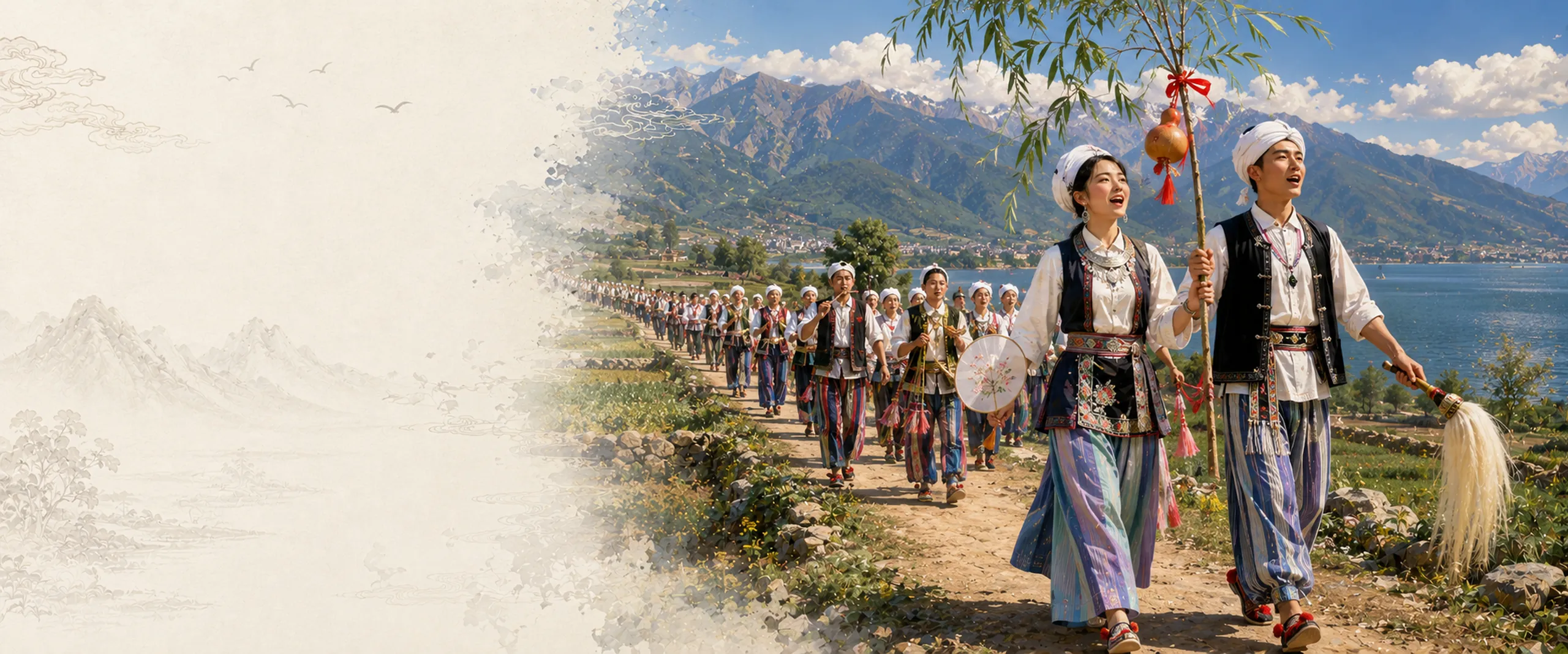

Rao San Ling is a traditional festival of the Bai people, celebrated in the Bai‑populated areas of Dali, Yunnan, generally held in the latter half of the fourth lunar month. The “Three Spirits” (San Ling) refer to three important temples in the Dali plain — the Buddhist Chong Sheng Temple, the Divine Sheng Yuan Temple, and the Immortal Jin Gui Temple. During the festival, Bai people in festive attire gather from all directions, circumambulating the three temples to pray for favourable weather and abundant harvests. The most striking feature of Rao San Ling is the pair of “Flower‑and‑Willow Elders” — an elderly man and woman holding willow branches and fans, leading the procession with song and dance. Rao San Ling integrates religious worship, song and dance entertainment, and social interaction — the Bai people pray during the circumambulation, celebrate through music and dance, and connect with one another through these encounters. In 2006, Rao San Ling was inscribed on China’s first list of National Intangible Cultural Heritage.
Festival Journey
Origins & Legends
History · Evolution · Legend
Tracing the Source · Historical Evolution
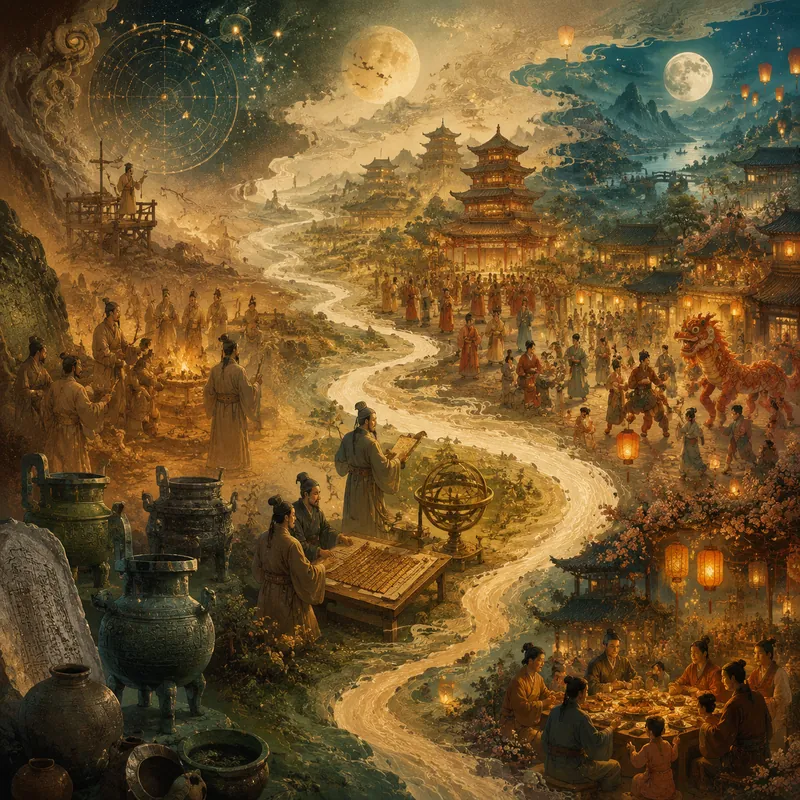
- Nanzhao Period According to records, Raosanling originated in the Nanzhao period
- Dali Kingdom Period During the Dali Kingdom (937–1253), Bai culture flourished further, and Buddhism reached its peak in the Dali region
- Yuan, Ming, and Qing Dynasties After the Yuan dynasty, the Dali region was formally incorporated into the central imperial domain, and Bai culture continued to develop through further exchanges with Han culture
- Modern and Contemporary Periods In modern and contemporary times, Raosanling has maintained its vitality in Bai society
Festival Customs
Customs · Local Traditions · Everyday Life
Seasonal Snapshots · Customs & Local Life
Festival Foods
Food Traditions · Local Flavors · Taste
Seasonal Flavours · Seasonal Menu
Folk Arts
Song & Dance · Living Tradition · Heritage

Living Folk Arts · Of Song and Dance
Through Song and Dance · A Living Tradition
Opening Verse: 绕三灵,绕三灵,绕出白族好年景。 Introduction: Poetry associated with Raosanling centers on song-and-dance prayers for the year ahead and on circling sacred sites to seek blessings. “绕出白族好年景” expresses the people’s hope that Raosanling will bring a year of abundant harvests. These poems often record the festive scenes of Bai communities circling three temples, exchanging songs through the night, and using music and dance both to entertain the deities and to delight the people. Raosanling is one of the grand traditional festivals of the Bai people, and Bai folk songs frequently contain descriptions of its celebrations. The line “绕三灵,绕三灵,绕出白族好年景” captures the festival’s central wish: favorable weather and abundant harvests. Qing-dynasty Bai scholar Yang Qiong recorded in 《滇中琐记》: “大理有绕三灵会,每年季春下浣,男妇坌集,始千万人,十百各为群”. Bai Dabenqu also contains many descriptions of Raosanling—people dress in festive finery, singing and dancing as they set out from Chongsheng Temple and follow the foot of Cangshan toward Shengyuan Temple; by day they pray for a prosperous year, and by night they camp in the fields and exchange songs until dawn. The poetry and folk songs of Raosanling preserve the ancient Bai tradition of entertaining the gods through song and dance and conveying affection through antiphonal singing.
Global Features
Overseas · Chinese Communities · Celebrations
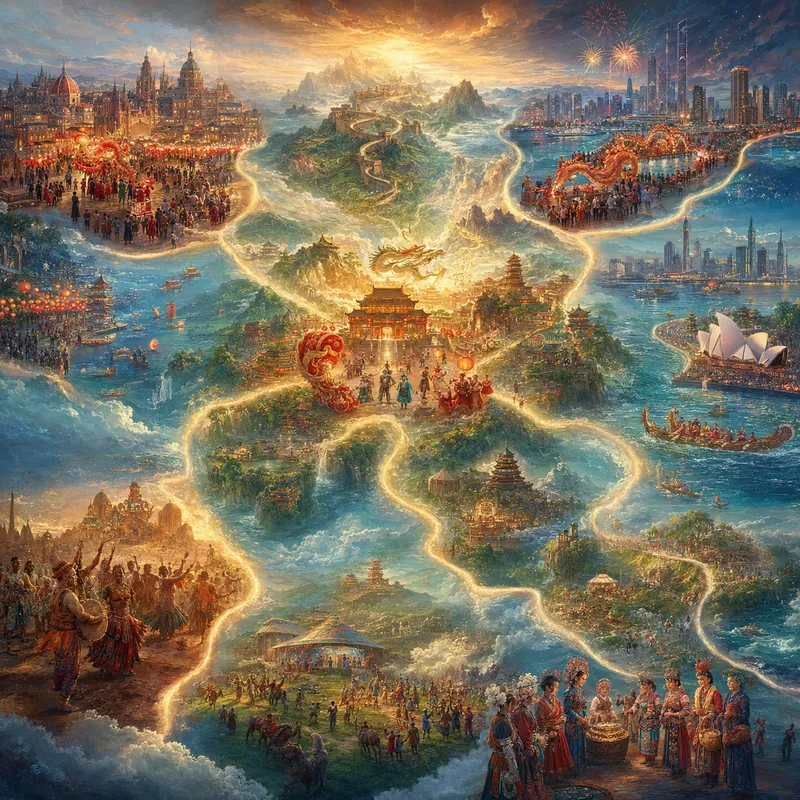
Overseas Celebrations · Lights of Chinese Communities
The most important channel through which Raosanling has entered the international stage has been the intangible cultural heritage system of the United Nations Educational, Scientific and Cultural Organization. In 2009, “Bai Raosanling” was listed among the projects recommended by China for nomination to UNESCO’s Representative List of the Intangible Cultural Heritage of Humanity. In 2011, the nomination materials for Raosanling were formally submitted to UNESCO’s Intergovernmental Committee for the Safeguarding of the Intangible Cultural Heritage. UNESCO’s official nomination file described Raosanling as “an annual three-day festival of the Bai people whose name refers to a syncretic system of religion and belief combining Buddhism, Taoism, and the local Benzhu faith.” During the evaluation process, UNESCO gave strong recognition to the value of Raosanling. The assessment concluded that Raosanling satisfied a number of criteria from R.1 to R.4: it is a ritual and festive event transmitted from generation to generation, integrating multiple forms of cultural expression and bringing together Bai communities; inscription on the List would help raise awareness of intangible cultural heritage and promote intercultural dialogue; communities and government authorities had jointly adopted effective safeguarding measures; and the nomination had received the full participation and consent of the communities concerned. Although Raosanling was ultimately not inscribed because of issues relating to criterion R.5—concerning supplementary information on the inventorying of intangible cultural heritage—the nomination process itself produced far-reaching effects. UNESCO’s website still retains the nomination record for Raosanling. Owing also to its cultural relationship with the Cangshan Mountains and Erhai Lake, Raosanling has become one of the cultural calling cards of Dali Cangshan UNESCO Global Geopark, where it is likewise introduced as an important form of intangible cultural heritage. UNESCO’s attention brought Raosanling from the status of a local ethnic festival into the global field of intangible cultural heritage safeguarding. As some scholars have noted, the fact that Raosanling attained national intangible cultural heritage status and was nominated to UNESCO for recognition as world intangible cultural heritage was made possible by strong support and active organization from the local government, and even more fundamentally by the profound and distinctive cultural value of the festival itself.
The most direct form of Raosanling’s global dissemination is to “invite” the world into the landscape between Cangshan and Erhai in Dali, allowing international visitors to participate personally in this thousand-year-old carnival. Every year from the twenty-third to the twenty-fifth day of the fourth lunar month, the Dali plain erupts into the exuberance of Raosanling—tens of thousands of Bai people dress in ceremonial attire, strike the bawangbian (霸王鞭), a traditional rhythmic bamboo-clapper prop used in Bai song-and-dance performance, and sing and dance all the way from Chongsheng Temple to Heyi City Village beside Erhai Lake. Visitors from around the world immerse themselves in the celebration and witness this extraordinary cultural spectacle firsthand. The scene is more authentic than any staged performance at a scenic attraction, and far wilder and livelier than one might imagine. Dali has long been a popular destination for foreign travelers. The old “Foreigner Street” in the ancient city was itself one of the clearest signs of this. During Raosanling, large numbers of visitors become part of the festival itself. The performers show no shyness before cameras; instead, they often sing with even greater enthusiasm. Yunnan Nationalities Village serves as a concentrated showcase of Raosanling culture and holds Bai Raosanling folk activities every year during the May Day holiday, allowing visitors from China and abroad to experience authentic Bai customs within the park. Visitors can not only enjoy performances involving the bawangbian, Dabenqu (大本曲), a traditional Bai narrative song form accompanied by instrumental performance, and suona music, but can also join interactive activities under the guidance of “Jinhua” and “Apeng,” traditional Bai terms used for young women and men, fully immersing themselves in the authentic atmosphere of Bai culture. International travel guides have also taken note of Raosanling. Frommer’s travel guide lists it among Dali’s important festival events. A report on the Mekong Tourism website describes Raosanling as “an occasion when local Bai people walk through rural areas to worship at three temples one after another, and an opportunity for travelers to witness firsthand both the region’s religious diversity and its uninhibited secular celebration.” Travel platforms such as Trip.com also recommend Raosanling dancing to international visitors as an important experience at bonfire evenings in Dali Ancient City. After participating personally in Raosanling, these international visitors and travelers spread its cultural appeal around the world through travel writing, photographs, and videos. They are not merely spectators, but voluntary transmitters of Raosanling culture.
Raosanling has also attracted attention from the international academic community. A number of overseas scholars have conducted fieldwork and academic research on the festival. A research team from the University of Oregon once carried out field investigations in Beijing, Kunming, and Dali, with particular attention to the Raosanling festival and the Bai people. They visited Lijiang Ancient City and several villages around the Erhai Lake basin, documenting ritual activities held during Raosanling at Shengyuan Temple, the Erhe Shrine, and Huguo Temple. Their research showed that Raosanling is not merely a festival celebration, but also a ritual closely connected with the reproduction and continuation of life. Some studies have pointed out that the bawangbian dance is “deeply embedded in the spiritual practices of the Bai people” and, in rituals such as Raosanling, “invokes the presence of ancestors and sacred powers.” Other research has focused on the “liminal” qualities of the Raosanling pilgrimage—the pilgrimage process displays the characteristics of the liminal stage found in rites of passage, temporarily breaking through the hierarchical boundaries between humans and deities and the norms governing marriage and romantic relationships established in everyday Bai society. Through these academic findings, Raosanling has been introduced to the international scholarly community as a representative case of Bai culture. In addition, the Chinese Festival Image Chronicle Project has produced audiovisual documentation of Raosanling. The project “Dali Bai ‘Raosanling’” was undertaken by researcher Bao Bo of Dali University, and the resulting film documented the contemporary condition of this traditional Bai festival in Dali. This form of audiovisual documentation has allowed Raosanling to enter broader channels of international communication.
Media coverage is an important channel through which Raosanling has reached the world. International Online and other media directed toward overseas audiences have reported on the festival. China Youth Network, China News Service, and other outlets have used photojournalism to communicate the grandeur of Raosanling to international audiences. Hong Kong China News Agency has also reported on the festival. These reports have been translated into multiple languages and disseminated around the world. Raosanling is also beginning to attract attention on overseas social media. Ma Xiaoyu of Egypt has previously experienced intangible cultural heritage in China. As Dali is a popular destination among international travelers, folk activities such as Raosanling are becoming known to growing numbers of people through visitors’ social-media sharing. As Dali becomes increasingly internationalized, transport hubs such as airports and railway stations have been equipped with English signage, while tools such as WeChat translation have made travel more convenient for foreign visitors. Improvements in this infrastructure have also created better conditions for the international dissemination of Raosanling.
Visitor Guide
Preparation · Etiquette · Take Part with Confidence
Readers’ Comments
Calendar and traditional culture enthusiasts from around the world, sharing the same moon.
Sign in or register to join the conversation. Your comment account is created automatically the first time you use a connected account.
No comments yet
Share your thoughts with readers around the world.