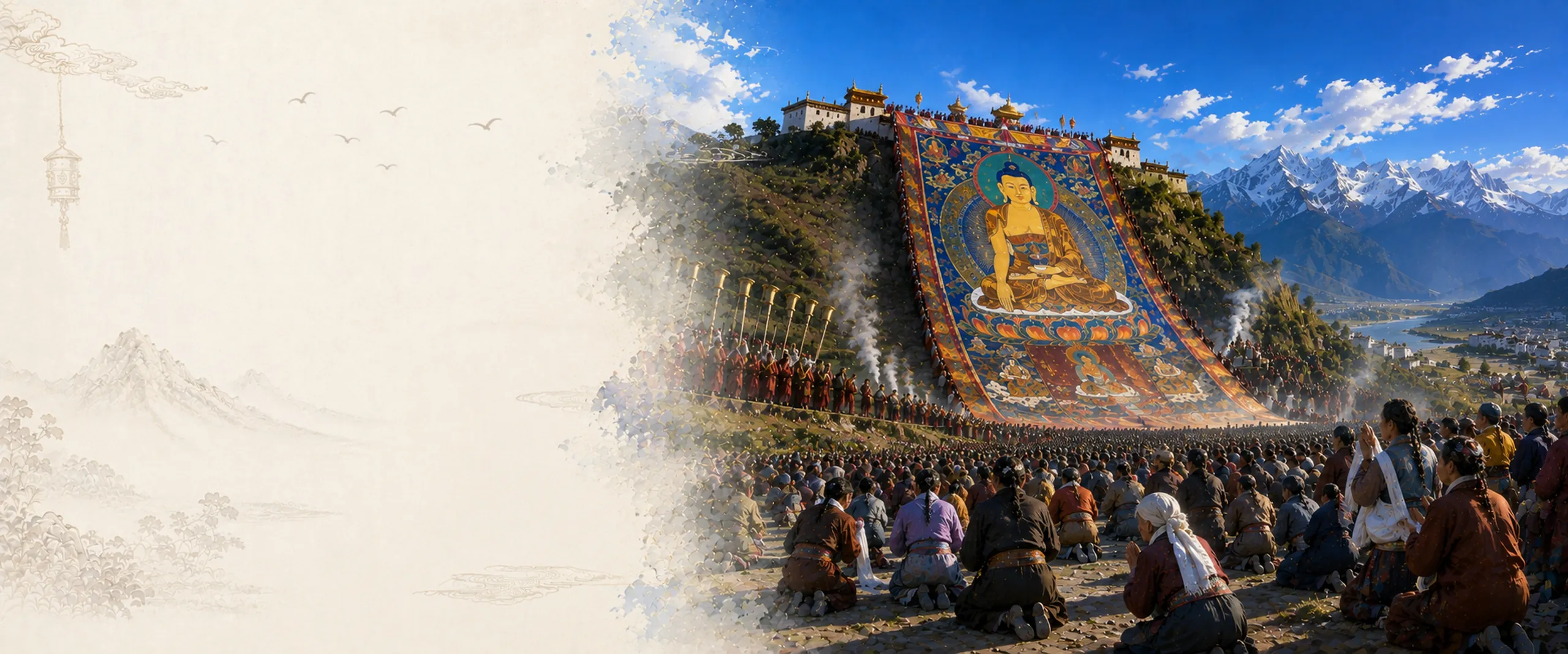
The Shoton Festival is one of Tibet’s most important traditional festivals. In Tibetan, its name means “Yogurt Banquet”: *sho* means yogurt, while *ton* means banquet, making Shoton literally a festival of eating yogurt.
In 2006, the Shoton Festival was included in the first national list of intangible cultural heritage of China.
Each year, on the thirtieth day of the sixth month in the Tibetan calendar, usually around mid-August in the Gregorian calendar, Drepung Monastery in Lhasa holds a monumental thangka unveiling ceremony. At Norbulingka, several days of Tibetan opera performances follow, while lively horse-racing competitions take place in the northern suburbs.
As Tibetan Buddhism and Tibetan culture have spread around the world, the Shoton Festival has become a cultural festival observed by Tibetan communities and Buddhist followers across many countries. From large celebrations in the Belgian seaside city of Ostend to performances by French Tibetan opera groups, from Buddhist ceremonies in Kathmandu, Nepal, to cultural programs in Dharamsala, India, Tibetan communities abroad and Buddhist believers celebrate the festival through traditional song and dance, Tibetan opera, folk activities, and other cultural practices.
Event Schedule and Venues
### Core Shoton Festival Dates
The Shoton Festival begins on the thirtieth day of the sixth month in the Tibetan calendar, corresponding to approximately mid-August each year in the Gregorian calendar, and lasts for four to seven days.
During the festival, the entire city of Lhasa becomes immersed in celebration. Major events follow one another across the city, including the Buddha unveiling at Drepung Monastery, Tibetan opera at Norbulingka, intangible cultural heritage exhibitions and sales at Zongjiao Lukang Park, and competitions at the northern suburban racecourse.
The core schedule is as follows:
| Time | Activity | Description |
|---|---|---|
| Thirtieth day of the sixth Tibetan month | Opening of Shoton — Drepung Monastery Buddha Unveiling Ceremony, the principal highlight, Sera Monastery Buddha unveiling, Tibetan opera performances begin | Festival climax; the Buddha unveiling takes place early in the morning |
| Second Day | Tibetan opera continues, intangible heritage exhibitions and sales, handicraft experiences | Norbulingka and Zongjiao Lukang Park are especially lively |
| Third to Fourth Day | Shoton Horse-Racing Festival — horseback archery, picking up khatas while riding, speed racing, and other events | Lhasa northern suburban racecourse; 120 riders participate |
| Fifth to Sixth Day | Tibetan opera performances conclude; intangible heritage exhibitions continue | Activities gradually end across different venues |
### Traditional Shoton Festival Customs
The Shoton Festival originated in the mid-11th century as a religious activity in which lay believers offered yogurt to monks after the lifting of their summer retreat restrictions.
Its main customs include:
| Custom | Description |
|---|---|
| Buddha Unveiling — “Sun-Drying the Buddha” | The opening highlight of Shoton. Drepung Monastery displays a 500-square-meter monumental thangka of Shakyamuni Buddha, slowly unfurled in the morning light |
| Tibetan Opera Performances | Norbulingka, Longwangtan Park, and Zongjiao Lukang Park jointly host five consecutive days of Tibetan opera, with classic plays performed in rotation |
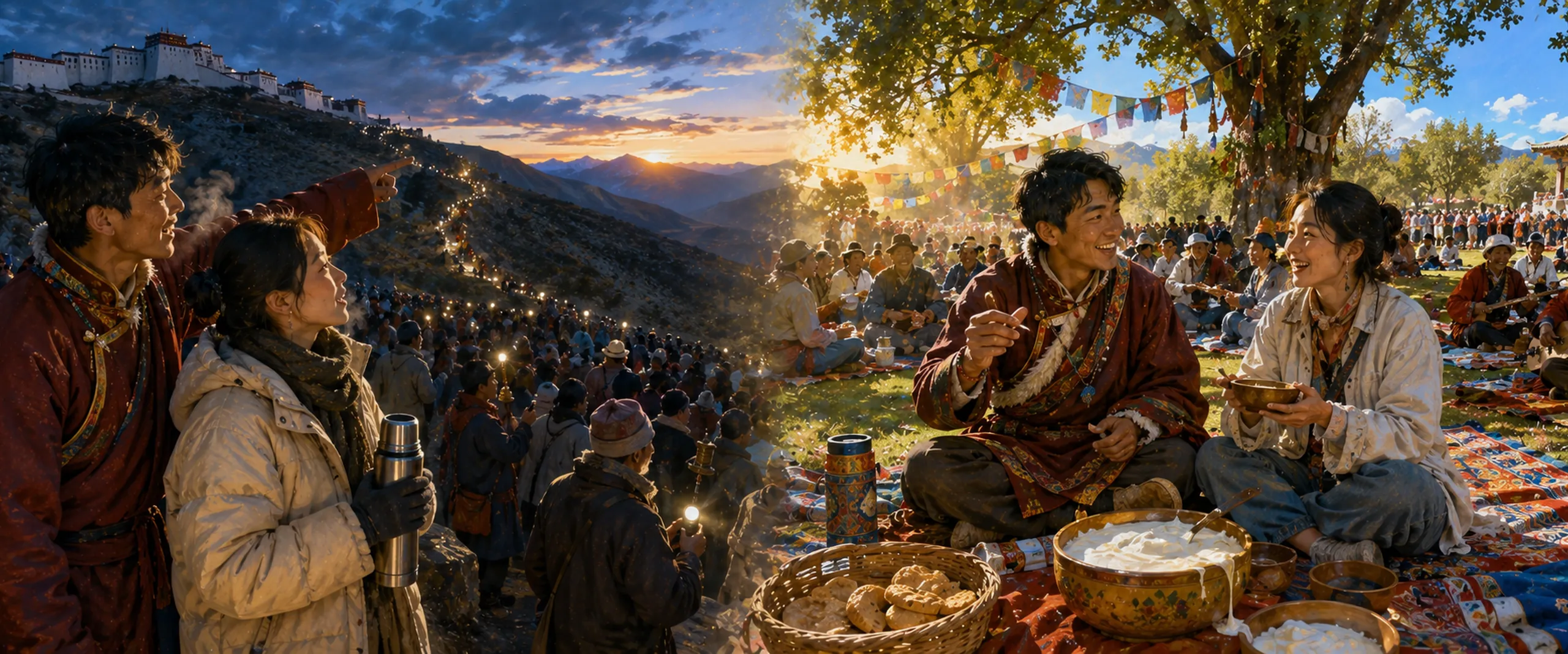
| Guo Linka — Park Outings and Picnics | Tibetan families pitch tents in parks such as Norbulingka, eat yogurt, share food, and watch Tibetan opera |
| Horse-Racing Festival | Traditional horsemanship and speed-racing competitions featuring riders from across the autonomous region |
| Eating Yogurt | The festival’s oldest custom and its defining culinary tradition |
| Intangible Cultural Heritage Market | Tibetan incense, thangka painting, Tibetan opera costumes, and other intangible cultural heritage items are displayed and sold together |
### Major Recommended Activities
Lhasa — Core Main Venue of the Shoton Festival:
During the Shoton Festival, the whole city celebrates together, with a rich range of activities at different venues:
* Drepung Monastery Buddha Unveiling Ceremony: The principal opening highlight. A monumental Shakyamuni Buddha thangka is slowly unfurled in the morning light, while thousands of khatas flutter before the image. Leaving before dawn is recommended.
* Sera Monastery Buddha Unveiling Ceremony: A Buddha-display ceremony is held on the same day.
* Tibetan Opera at Norbulingka: A World Heritage Site and the summer palace of successive Dalai Lamas, Norbulingka is one of the main venues for Tibetan opera, with five consecutive days of performances.
* Zongjiao Lukang Park — Longwangtan Park: A major venue for Tibetan opera and intangible cultural heritage exhibitions.
* Lhasa Northern Suburban Racecourse: Venue of the Shoton Horse-Racing Festival, featuring horseback archery, picking up khatas from horseback, speed racing, and other traditional contests.
* Lhasa City Library: Hosts a variety of hands-on craft activities.
* Lhalu Wetland: Hosts family-oriented outdoor Shoton linka classes.
Pre-Trip Preparation
### Visas and Entry
Lhasa, Tibet, is subject to China’s unified visa policies:
* 240-Hour Visa-Free Transit for Citizens of 54 Countries: Travelers may enjoy visa-free transit for up to 240 hours, with permitted stay areas covering Tibet and other administrative regions.
* Tour Groups from ASEAN Countries: Organized groups may enter visa-free through designated ports.
* Other Nationalities: Apply in advance for a tourist visa, or L visa, through the relevant Chinese embassy or consulate and ensure that your passport remains valid for more than six months.
* Latest Policies: Before departure, consult the official website of China’s National Immigration Administration or the relevant embassy or consulate.
* Special Reminder: Foreign visitors traveling to some parts of Tibet, such as Everest Base Camp, may need to obtain a border permit. Consult a travel agency in advance. Security checks in Lhasa are strengthened during the Shoton Festival, so carry your ID card or passport with you.
### High-Altitude Acclimatization — Highest Priority
Lhasa lies at an elevation of approximately 3,650 meters and is a high-altitude destination. Altitude sickness is something every traveler entering Tibet needs to take seriously:
* Acclimatization Time: Arrive in Lhasa 1–2 days in advance to allow sufficient time for your body to adjust. Avoid strenuous activity immediately after flying in.
* First 24 Hours: During the first 24 hours after arrival, avoid bathing, drinking alcohol, and vigorous exercise. Rest frequently and drink plenty of warm water.
* Recommended Medicines and Supplies: Bring Rhodiola rosea, beginning one week in advance, Gaoyu’an, ibuprofen for headaches, and portable oxygen cylinders, which can also be purchased locally.
* Recognizing Symptoms: If severe headache, nausea, breathing difficulties, or other serious symptoms appear, seek medical attention immediately or descend to a lower altitude.
* Accommodation: Prioritize hotels with oxygen-supply facilities, as nighttime oxygen deficiency may worsen altitude sickness.
### Adapting to the Climate
The Shoton Festival takes place on the thirtieth day of the sixth Tibetan month, corresponding to around mid-August. Lhasa’s climate at this time has the following characteristics:
* Temperature: Around 20°C–25°C during the day, falling below 10°C at night. The difference between daytime and nighttime temperatures is very large.
* Sunlight: Ultraviolet radiation is extremely strong, making daily sun protection essential.
* Rainfall: August is the rainy season, with frequent showers. Carry rain gear.
* Clothing: Use layered clothing — a short-sleeved T-shirt as the base layer, a light sweater in the middle, and a shell jacket or heavier outer layer. Warm clothing is needed in the morning, evening, and rainy weather, while layers can be removed at midday on sunny days.
### Travel Insurance
It is strongly recommended to purchase travel insurance covering:
* Accidental injury and acute illness treatment, including emergency care for altitude sickness
* Loss of or damage to personal belongings
* Travel delays or cancellations, including weather-related flight delays
### Currency and Payment
* Currency: Renminbi (CNY).
* Cash: Carry a reasonable amount of cash. Network coverage may be poor at some remote temples and markets, making cash more reliable.
* Cards: Visa and MasterCard are accepted at major hotels and shopping centers.
* Mobile Payment: Alipay and WeChat Pay are widely used in central Lhasa.
### Communications and Internet
* Important: Visitor numbers are extremely high during Shoton, and 4G/5G networks may become congested. It is strongly recommended to download offline maps in advance. Baidu Maps or AutoNavi are recommended; download the Lhasa map to your phone while connected to Wi-Fi.
How to Get There
### Core Venue: Lhasa
| Transportation | Details |
|---|---|
| Air | Lhasa Gonggar Airport is Tibet’s principal aviation gateway, with direct flights from Chengdu — the most popular route — Chongqing, Beijing, Shanghai, Guangzhou, Xining, Kunming, and other cities. Fares may rise sharply during Shoton, so booking 1–2 months in advance is recommended |
| Train | The Qinghai–Tibet Railway runs directly to Lhasa Station. Temporary passenger trains toward Nyingchi and Shigatse are added during the festival |
| Driving | Both the Sichuan–Tibet and Qinghai–Tibet routes provide access, but high-altitude driving carries substantial risks; traveling with companions is recommended |
Airport Transfer: After arriving at Lhasa Gonggar Airport, you can use DiDi or AutoNavi ride-hailing, or take an airport shuttle bus into the city.
### Urban Transportation During the Festival
Strict traffic controls are implemented in Lhasa during Shoton.
Traffic Controls on Buddha-Unveiling Day:
* Control Period: From midnight on the day of the Buddha unveiling until the activity ends.
* Vehicles Affected: Motor vehicles and non-motorized vehicles.
* Restricted Roads: Controlled areas around Drepung Monastery.
* Travel Recommendation: The unveiling takes place in the early morning, so leaving before dawn is recommended. Prioritize public transportation, walking, or cycling for short connections.
Core Park Areas — Norbulingka and Longwangtan: Visitor numbers reach capacity each day during the festival. Roads nearby are crowded with both vehicles and pedestrians. Illegal parking on major roads and fire-access routes is strictly prohibited.
During the Horse-Racing Festival: Traffic increases significantly on suburban roads leading to the northern racecourse. Vehicles must park in designated areas in an orderly manner.
Accommodation Reservations
| Key Point | Recommendation |
|---|---|
| When to Book | Shoton is one of Tibet’s peak tourism periods. Book 1–2 months in advance |
| Recommended Areas | Around Potala Palace / Barkhor Street — close to major attractions; around Norbulingka — near Tibetan opera venues; along major roads in central Lhasa |
| Accommodation Type | Options range from high-end oxygen-supplied hotels to budget guesthouses. Prioritize hotels with oxygen facilities and humidifiers |
| Price Reference | Prices rise during peak season: budget around RMB 300–600 per night, mid-range RMB 600–1,200, high-end above RMB 1,200 |
| Booking Platforms | Major platforms such as Ctrip, Qunar, and Meituan; rooms with free cancellation are preferable |
Pre-Trip Packing Checklist
| Category | Essential Items | Special Notes |
|---|---|---|
| Clothing | Shell jacket / heavy coat, light sweater, long-sleeved T-shirt, thermal underwear | Very large day–night temperature difference; dress in layers. August is rainy season, so a waterproof outer layer is recommended |
| Shoes | Non-slip athletic shoes / hiking shoes | Reaching the Drepung Buddha unveiling involves climbing; visiting Norbulingka requires walking |
| Sun Protection | SPF50+ sunscreen, sun hat, sunglasses, scarf / face covering | Ultraviolet radiation is extremely strong and sunlight in Lhasa is intense |
| Medicine | Rhodiola rosea one week in advance, Gaoyu’an, ibuprofen, portable oxygen cylinder | For prevention and management of altitude sickness |
| Electronics | Power bank, phone, camera | The Buddha unveiling is visually spectacular and worth documenting |
| Storage | Small bag / waist pouch for documents and cash | Crowds are dense, so protect personal belongings |
| Other | Rain gear, insulated bottle for drinking warm water, tissues / wet wipes | Showers are frequent in August |
Cultural Respect
### Ceremony-Viewing Guidelines
Guidelines for the Buddha-Unveiling Ceremony:
* Best Viewing Time: Arrive at Drepung Monastery before 6:30 a.m. on the first festival day. The Buddha unveiling begins at around 7:00 a.m.
* Respect the Religious Ceremony: Remain solemn during the unveiling. Do not shout, crowd, or push. Visitors may throw khatas toward the monumental thangka as an expression of prayer — khatas can be purchased outside the monastery.
* Photography Etiquette: Before photographing monks, worshippers, or religious rituals, smile and ask permission.
* Dress Appropriately: Wear respectful clothing when entering temple areas, with shoulders and knees covered.
Guidelines for Watching Tibetan Opera:
* Tibetan opera at Norbulingka begins at around 11:00 a.m.
* Arrive early and, like local Tibetan families, pitch a tent and spread out mats to experience the tradition of guo linka.
Guidelines for the Horse-Racing Festival:
* Admission is free.
* Take sun protection seriously, as the racecourse is outdoors.
* Plan your transportation route in advance.
### Safety Guidelines
* Altitude Safety: Avoid strenuous exercise, rest frequently, and drink plenty of water. Seek medical help immediately if severe altitude-sickness symptoms occur.
* Fire Safety: Smoking is prohibited in temple areas.
* Crowd Safety: The Buddha unveiling and Tibetan opera performances attract dense crowds. Stay alert and supervise elderly family members and children carefully.
* Property Safety: Store valuables in the hotel safe and carry only essential items at event sites.
* Traffic Safety: Follow the directions of traffic police and security personnel.
### Cultural Etiquette
* Respect Belief: Shoton originated in Tibetan Buddhist culture. Participate in religious activities with respect and sincerity.
* Guo Linka Culture: Guo linka refers to Tibetan outdoor excursions and communal picnics. If invited to join a Tibetan family’s linka gathering, it is an excellent opportunity to experience local culture.
* Photography Etiquette: Before photographing local people in ethnic clothing or monks, smile and ask permission.
* Environmental Awareness: Do not litter. Keep festival venues and natural surroundings clean.
Emergency Information
| Item | Contact / Notes |
|---|---|
| Emergency Numbers | Police 110, Fire 119, Ambulance 120 |
| Major Hospitals | Tibet Autonomous Region People’s Hospital; Lhasa People’s Hospital |
| Tourist Police / Lost Property | Permanent police posts are located at all major venues. If valuables are lost, report immediately to the nearest police office |
| Tourist Information | Official platforms of the Lhasa Culture and Tourism Bureau |
| Altitude-Sickness Emergency | If severe altitude sickness occurs, seek medical attention immediately or descend to a lower altitude |
| Time Zone | UTC+8, China Standard Time |
| Voltage / Plugs | 220V; plug types A / C / I |
Special Reminders
* Shoton Festival Dates: The festival begins each year on the thirtieth day of the sixth Tibetan month, corresponding approximately to mid-August. Confirm the exact dates before departure.
* Altitude Comes First: Lhasa sits at an elevation of 3,650 meters, and altitude sickness is the greatest risk. Allow sufficient acclimatization time, prepare necessary medicines, and avoid overexertion.
* Wake Early for the Buddha Unveiling: The Drepung Monastery Buddha-unveiling ceremony begins at around 7:00 a.m.. Leaving before dawn is recommended, and traffic controls begin at midnight.
* Potala Palace Reservations: The Potala Palace requires real-name reservations seven days in advance through the official mini-program, with no on-site tickets available.
* Daily Sun Protection Is Essential: Ultraviolet radiation in Lhasa is extremely strong. Sunscreen, sunglasses, and a sun hat are daily necessities.
* Traffic Controls: Strict traffic controls are implemented around all major venues. Plan routes in advance and prioritize public transportation.
* Weather Awareness: August is the rainy season. Check weather changes before departure and carry rain gear.
* Enhanced Security Checks: Security checks in Lhasa are strengthened during Shoton. Carry your ID card or passport with you.
*May you experience the distinctive charm of Tibetan culture on the snowy plateau and carry home an unforgettable journey filled with the fragrance of yogurt and the resonant melodies of Tibetan opera.*
——-
Cultural Background:
The Shoton Festival originated in the mid-11th century. The Gelug school established strict monastic rules requiring monks and nuns to remain indoors from the fourth through the sixth month of the Tibetan calendar, devoting themselves to scripture recitation and religious practice without going outside.
On the day these restrictions were lifted, local people offered yogurt to the monastics. In return, monks organized religious and cultural activities for the community, including Buddha-display ceremonies and Tibetan opera performances. From this practice, the tradition of the Shoton Festival gradually took shape.
Before the 17th century, Shoton was originally a religious festival. The traditional celebration begins with the unveiling of a giant Buddha thangka, followed by Tibetan opera performances, public opera viewing, and communal park outings. It also includes lively yak races and equestrian displays.
Shoton customs are rich and varied:
* Buddha Unveiling — “Sun-Drying the Buddha”: The opening highlight of Shoton. Drepung Monastery displays a monumental thangka of Shakyamuni Buddha, gradually unfurled in the morning light.
* Tibetan Opera Performances: Traditional Tibetan opera is staged for several consecutive days at Norbulingka and Longwangtan Park, with classic works performed in rotation.
* Guo Linka (过林卡) — Park Outings and Picnics: Tibetan families pitch tents in parks, share yogurt, tsampa, and barley wine, and watch Tibetan opera.
* Horse-Racing Festival: Traditional equestrian displays and speed races showcase the exceptional skills of Tibetan riders.
* Eating Yogurt: The oldest custom of the Shoton Festival. Yogurt remains the festival’s defining taste.
As Tibetan Buddhism and Tibetan culture have reached a wider global audience, Shoton has become a cultural festival shared by Tibetan communities around the world. It is also celebrated by Bhutanese, Nepalese, Monpa, and other communities. Tibetan Buddhist monasteries and Tibetan communities in India, Nepal, and other places likewise hold related activities.
During the 2026 Shoton Festival, Lhasa attracted visitors from Russia, France, Portugal, and other countries.
The core date of the 2026 Shoton Festival is August 12, when the Buddha-unveiling ceremony is held at Drepung Monastery.
Overview of Major Activities:
Overseas Shoton celebrations are concentrated mainly in countries and regions with Tibetan communities and Tibetan Buddhist monasteries:
| Country / Region | Core City | Featured Activities |
|---|---|---|
| Belgium | Ostend | Two-day Shoton celebration organized by the Belgium Regional U-Tsang Association — traditional Tashi Shoelpa dance, traditional U-Tsang costume display, Tibetan opera performance by a French Lhamo group, Tibetan traditional games, circle dancing |
| France | Paris | French Lhamo group performs the Tibetan opera *Khandro Drowa Zangmo* |
| Bhutan | Thimphu | Shoton celebrations among Bhutanese communities |
| Nepal | Kathmandu | Shoton celebrations among Nepalese communities |
Major Activities by Region:
### Ostend, Belgium
Belgium is one of the countries with the largest-scale Shoton celebrations outside China. The Belgium Regional U-Tsang Association organizes a two-day Shoton celebration each year in the Belgian coastal city of Ostend.
Activities:
* Tashi Shoelpa Dance: The celebration opens with the ancient traditional Tibetan dance Tashi Shoelpa.
* Traditional U-Tsang Costume Display: Young members of Belgium’s U-Tsang community appear on stage in traditional clothing from the U-Tsang region.
* Multicultural Performances: A range of artistic performances showcases Tibet’s rich cultural heritage.
* Tibetan Opera Performance: A French Lhamo group performs the traditional Tibetan opera *Khandro Drowa Zangmo*.
* Traditional Circle Dances and Games: Participants form circles to perform Tibetan dances and take part in various traditional Tibetan games.
* Talk on Cultural Heritage: The association’s president introduces the deep cultural significance of the Shoton Festival.
Significance: The celebration is not only a cultural feast but also an important platform through which the Tibetan community in Belgium strengthens its cultural identity. It emphasizes the importance of preserving Tibetan culture through language, history, and education, while encouraging younger generations to maintain their distinctive cultural heritage in an age of globalization.
Transportation: Ostend is a well-known seaside city in Belgium and can be reached from Brussels by train in about one hour.
### Bhutan
The Shoton Festival is not only a traditional festival of Tibetans in China; it is also celebrated by people in Bhutan.
The Kingdom of Bhutan is deeply influenced by Tibetan Buddhist culture, and Shoton is maintained as an important religious and cultural festival in local monasteries and communities. Celebrations in Bhutan generally integrate local Buddhist traditions and center on religious rituals, Dharma assemblies, and communal meals.
### Nepal
Nepal is an important point in the overseas spread of the Shoton Festival.
The country has a large Tibetan community and numerous Tibetan Buddhist monasteries. In Kathmandu and other places, Tibetan communities hold religious ceremonies and cultural activities during the festival.
Historically, media professionals and cultural representatives from countries such as India and Nepal have also been invited to Tibet to participate in Shoton celebrations, helping introduce this distinctive cultural festival to different parts of South Asia.
### Other Regions
India: Tibetan communities in places such as Dharamsala organize cultural activities during the Shoton Festival. Overseas journalists and cultural representatives from India, Nepal, and other countries have previously been invited to participate in major Shoton activities in Lhasa as part of programs designed to experience Tibetan culture.
France: The French Lhamo group performs the traditional Tibetan opera *Khandro Drowa Zangmo* at the Belgian Shoton Festival, demonstrating the transmission and continuation of Tibetan opera in Europe.
Pre-Trip Packing Checklist:
| Category | Recommended Items | Notes |
|---|---|---|
| Clothing | Prepare according to local weather — August in Belgium is cool, so bring a light jacket | Outdoor activities may last a long time |
| Shoes | Comfortable athletic shoes | Dance and park activities may require long periods of standing |
| Camera / Phone | For photographing traditional dances, Tibetan opera, and costume displays | Bring a power bank |
| Cash | Small amount of local currency | Food stalls may not accept cards |
| Translation App | Google Translate or similar | Useful for communicating with members of Tibetan communities |
Participation Etiquette:
### Etiquette for Shoton Cultural Experiences
* Respect Religious Culture: The Shoton Festival originated within Tibetan Buddhist culture. Participate with respect and an open mind.
* Join the Dancing: Traditional circle dances are an important part of Shoton, and visitors may join naturally and follow the rhythm.
* Performance Etiquette: Remain quiet while watching Tibetan opera and do not disturb performers.
* Dress Appropriately: When attending religious or cultural activities, dignified and respectful clothing is recommended.
### Photography Etiquette
* Ask Permission: Before photographing Tibetans in traditional clothing, performers, or elderly participants, smile and ask permission first.
* Respect Portrait Rights: Do not use photographs of other people commercially without consent.
Travel Tips:
| Item | Description |
|---|---|
| Best Time to Follow the Festival | Mid-August each year, around the thirtieth day of the sixth month in the Tibetan calendar, is the central Shoton period |
| Belgian Shoton Festival | Usually held in Ostend from late July to early August |
| Check in Advance | Event information can be obtained through the Belgium Regional U-Tsang Association and related channels |
| Transportation | Ostend is about one hour from Brussels by train |
| Weather | August in Europe is cool; check the local forecast before departure |
| Cultural Background | Shoton is celebrated by Bhutanese, Nepalese, and several other communities |
Special Reminders:
* Overseas Shoton Celebrations Are Mainly Community-Based: Unlike widely disseminated traditional festivals such as the Spring Festival and Mid-Autumn Festival, overseas Shoton celebrations are mainly concentrated in countries and regions with Tibetan communities and Tibetan Buddhist monasteries, and their scale remains relatively limited.
* Belgium Is a Major Overseas Experience Destination: The Shoton celebration in Ostend is one of Europe’s larger Shoton events and includes traditional dance, costume displays, Tibetan opera, and other forms.
* Cultural Transmission in South Asia: Bhutan and Nepal also celebrate Shoton. If traveling in South Asia, you can follow announcements from local Tibetan communities.
* Shoton Festival Dates: The festival generally begins on the thirtieth day of the sixth month of the Tibetan calendar, usually in mid-August.
* 2026 Highlights: The 2026 Shoton Festival attracted visitors from Russia, France, Portugal, and other countries.
* Cultural Diversity: Shoton is not only a Tibetan festival; it is also celebrated by Bhutanese, Nepalese, Monpa, and other communities.
*May you experience the distinctive charm of the Shoton Festival in different corners of the world, and amid the resonant melodies of Tibetan opera and the rich taste of yogurt, receive the beautiful blessing of “good fortune and Tashi Delek.”*
Readers’ Comments
Calendar and traditional culture enthusiasts from around the world, sharing the same moon.
Sign in or register to join the conversation. Your comment account is created automatically the first time you use a connected account.
No comments yet
Share your thoughts with readers around the world.