
Mooncakes
Pastries & SnacksBasic Information
- Category: Grain-based pastry
- Popular Regions: Nationwide
- Main Ingredients: Wheat flour, sugar, fats, and fillings such as lotus-seed paste, red bean paste, five-nut mixture, salted egg yolk, ham, and others
- Alternative Names: Hubing (胡饼), palace cakes, small cakes, moon rounds, reunion cakes
Historical Origins
Mooncakes are the most representative folk food and festive gift of the Mid-Autumn Festival. Their history is a thousand-year evolution from the “hubing” to the “reunion cake.”
Cultural Meaning
The predecessor of the mooncake can be traced to the Han-dynasty hubing (胡饼). When Zhang Qian traveled to the Western Regions, he introduced sesame and walnuts, adding new ingredients to the production of cakes. Round cakes filled with walnut kernels subsequently appeared and were known as hubing. Hubing were round baked wheat cakes sprinkled with sesame on the surface, products of cultural exchange along the Silk Road.
By the Tang dynasty, early records of mooncakes began to appear. A beautiful legend surrounds the origin of the name. According to tradition, the Tang court prepared a pastry known as hubing and presented it during Mid-Autumn. Emperor Xuanzong disliked the name hubing. Looking up at the moon, Yang Guifei casually suggested “mooncake,” and the name supposedly spread from then on. A surviving Tang-style mooncake decorated with baoxianghua patterns, paired pearl-round motifs, a ring of lotus-petal designs, and pine-needle ornamentation is described as a physical example of mooncake-like pastries from that period. The Tang text Luozhong Jiwen (《洛中记闻》) records that Emperor Xizong ate mooncakes during Mid-Autumn, found them extremely delicious, and ordered the imperial kitchen to wrap them in red silk and bestow them upon newly successful imperial examination candidates.
Records of mooncakes became more numerous during the Song dynasty. The earliest written record of the term “mooncake” appears in the Southern Song work Mengliang Lu (《梦粱录》) by Wu Zimu. At that time, however, the mooncake was made in a rhomboid flower shape and belonged to the category of “market pastries”; it was not yet an indispensable Mid-Autumn food. Mengliang Lu, which specifically records Song customs, states: “Market pastries are available throughout the seasons… hibiscus cakes, chrysanthemum cakes, plum-blossom cakes, mooncakes… sold directly at people’s doors.” Su Dongpo wrote: “A little cake, like chewing the moon, with crispness and sweetness within,” already bringing together the ideas of “moon” and “cake.” The term “mooncake” also appears in the Southern Song writer Zhou Mi’s Wulin Jiushi (《武林旧事》).
It was not until the Ming dynasty that mooncakes truly became an established seasonal food of the Mid-Autumn Festival and gradually spread widely among the people. During the Jiajing reign, mooncakes increasingly became a special food associated with the festival. A copy of Tian Rucheng’s Xihu Youlan Zhiyu preserved in the Zhejiang Library, printed in the twenty-sixth year of Jiajing, describes how the mooncake became a “reunion cake”: “The fifteenth day of the eighth month is called Mid-Autumn. Among the people, mooncakes are given to one another, taking the meaning of reunion.” Wanshu Zaji (《宛署杂记》) records that every Mid-Autumn, people made flour cakes and exchanged them as gifts, calling them “mooncakes.”
From the Ming dynasty onward, numerous records of mooncakes survive. By then, mooncakes were round and eaten specifically at Mid-Autumn, becoming the principal offering used in popular moon-worship rituals. Wanshu Zaji records that mooncakes of the period had “ingenious names and unusual forms, with some single cakes worth several hundred coins.” Skilled pastry makers even impressed myths such as Chang’e Flying to the Moon onto mooncakes as decorative food art.
During the Qing dynasty, mooncake-making techniques improved greatly. Mooncakes became not only more refined but also increasingly diverse. Qing imperial food archives record that every fifteenth day of the eighth lunar month, the palace made “fanmao mooncakes”, whose skins were thin and finely layered; with the slightest pressure, flakes of pastry would fall like drifting snow.
Qing palace fillings also incorporated cream and other ingredients, producing varieties such as A’erbuha mooncakes and milk mooncakes. A’erbuha is a Manchu term whose Chinese meaning is milk cake. In size, Qing imperial mooncakes ranged from roughly an inch across to more than a foot, while their weight ranged from just over one liang to more than twenty jin. Yuan Mei described flaky mooncakes in Suiyuan Shidan (《随园食单》), filled with pine nuts, walnuts, melon seeds, rock sugar, and lard—an early prototype of the modern five-nut mooncake. By the Qing dynasty, many regional styles had already formed, including Cantonese, Beijing, and Suzhou varieties.
A popular uprising legend also became associated with mooncakes. In the late Yuan dynasty, Han Chinese people wanted to rise up against Mongol rule but had difficulty transmitting messages. Liu Bowen devised a plan to hide slips of paper inside mooncakes bearing the call “On the fifteenth day of the eighth month, every household act together.” Mooncakes were thus used as a communication signal for a national uprising that, according to the legend, overthrew the Yuan dynasty in a single stroke. Mooncakes thereafter became a required Mid-Autumn food. Although this story may not accord with historical fact, it adds a legendary dimension to the mooncake.
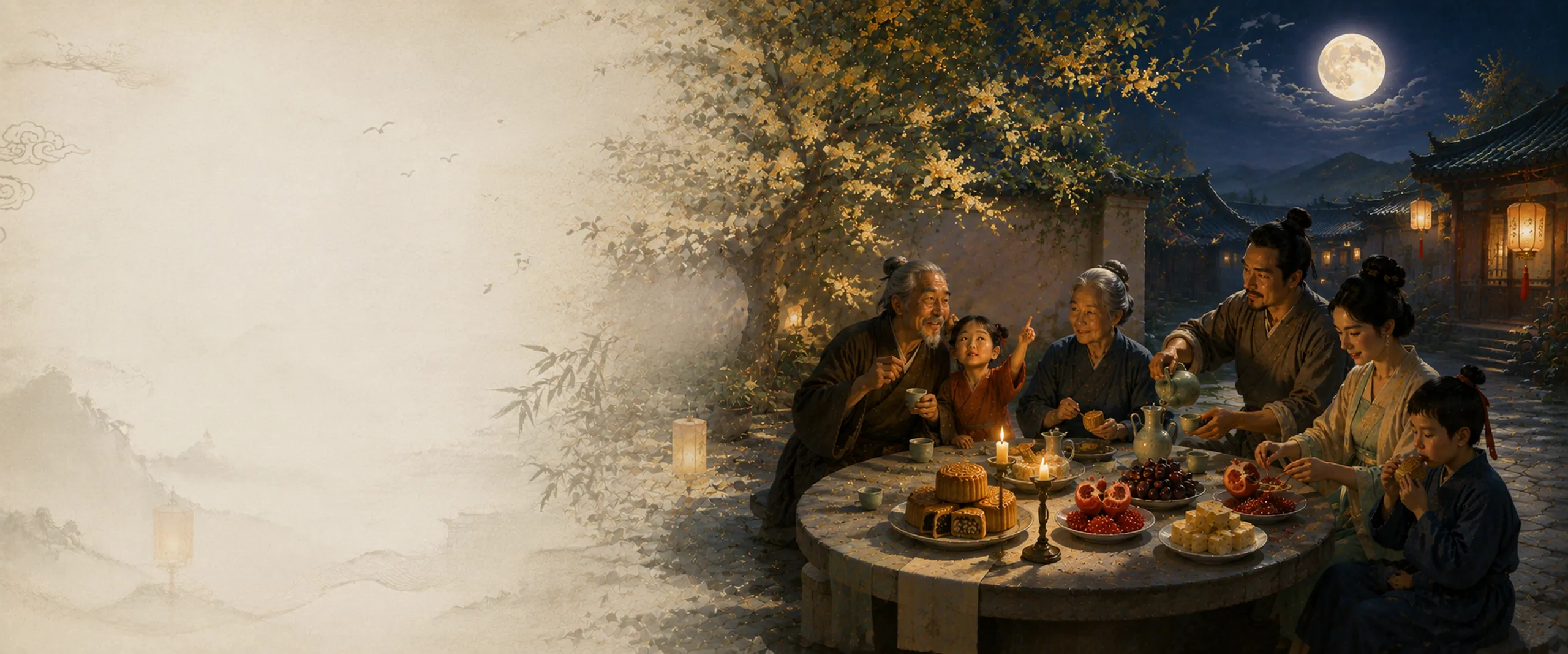
The mooncake carries multiple layers of cultural meaning. First, “symbolizing reunion.” Its round shape represents reunion and harmony. When a family shares one mooncake, it symbolizes sharing happiness and remaining closely connected. Second, “an offering to the moon.” Mooncakes originally served as offerings in moon worship and, from the Ming dynasty onward, became closely associated with Mid-Autumn reunion. Third, “a gift of affection.” Mooncakes are also important gifts exchanged among friends at Mid-Autumn to maintain emotional bonds. Fourth, “an artistic medium.” Mooncake surfaces may feature legendary designs or inscriptions associated with Chang’e Flying to the Moon: Chang’e in celestial-maiden form, the osmanthus paradise of Guanghan Palace, the Jade Rabbit pounding medicine, or auspicious motifs and characters for fortune, emolument, longevity, happiness, and wealth.
Regional Evolution
China has a great many mooncake varieties. By region of origin, major styles include Suzhou, Cantonese, Beijing, Ningbo, Chaoshan, and Yunnan. Their appearances may be similar, but their flavors differ greatly.
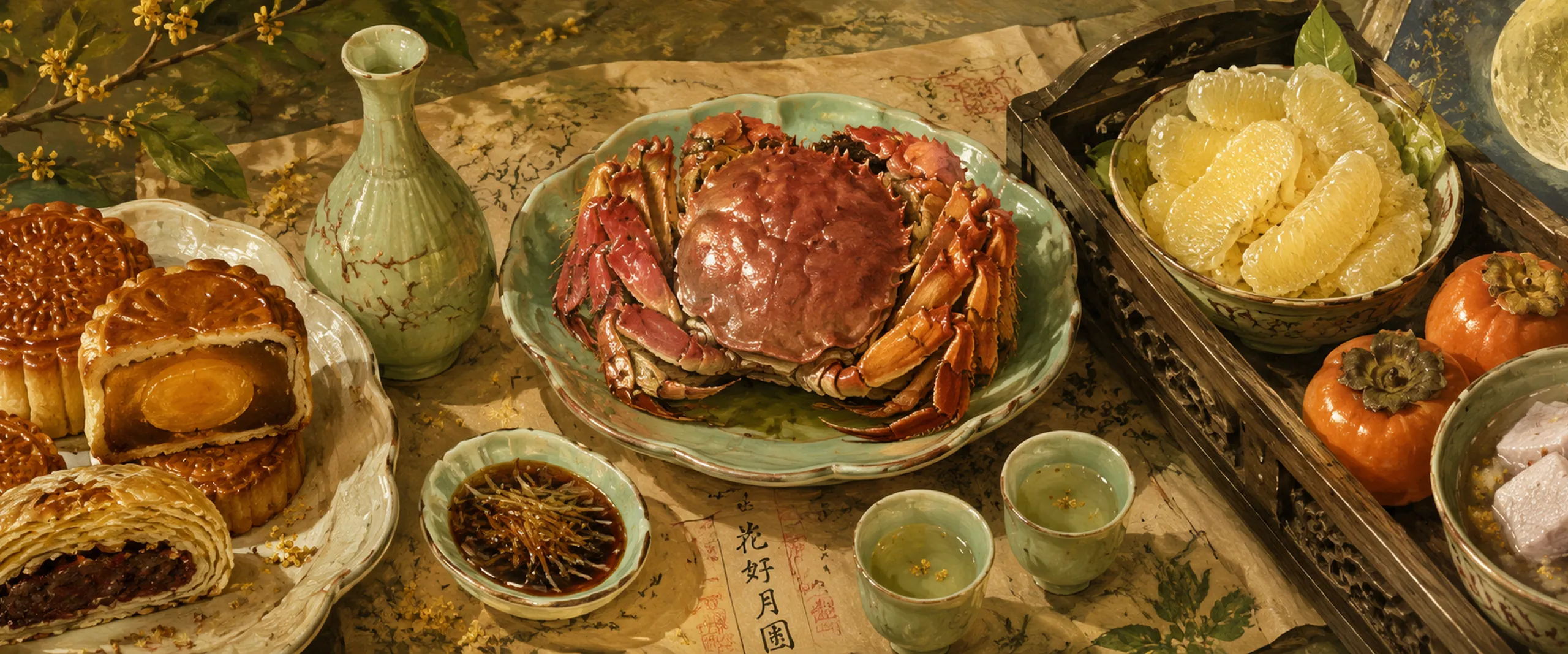
- Cantonese-style mooncakes: Originating in Guangdong and surrounding areas, they are currently one of the most popular types. They feature thin skins, generous fillings, and a higher fat content in both crust and filling than other styles. Their texture is soft. Lotus-seed paste, red bean paste, and five-nut mooncakes are representative varieties. Cantonese mooncakes use relatively little oil but are comparatively heavy on sugar.
- Suzhou-style mooncakes: A form of Suzhou pastry, characterized by loose, flaky layers, attractive color, rich but not greasy fillings, and a crisp, crumbly texture. Both oil and sugar are emphasized, with a particular preference for flakiness. Their name is associated with su (酥, “flaky”), and they are best eaten freshly made.
- Beijing-style mooncakes: Made somewhat like shaobing, with fragrant, crisp outer crusts. They are known for vegetarian ingredients: both oils and fillings are traditionally plant-based. Classic Beijing varieties are especially known for wisteria-flower and hawthorn fillings, extensive use of sesame oil, crisp texture, and a light, sweet fragrance.
- Chaoshan-style mooncakes: Flatter in shape, with pale white pastry skins and crisp sugary fillings. Originating in Chaoshan, Guangdong, they use abundant oil and sugar. Their fillings resemble Cantonese ones, while candied winter melon is a major supplementary ingredient.
- Yunnan-style mooncakes: Their main feature is the use of Yunnan-style ham in the filling. The pastry is loose, the filling balances savory and sweet flavors, and it has a distinctive Yunnan ham aroma. In Yunnan dialect they are called “tuo” (酡). Representative varieties include fresh-flower, white-glutinous-rice, sesame-kernel, fine-bean-paste, and ham mooncakes.
- Ningbo-style mooncakes, Shanghai-style mooncakes, and other regional varieties likewise have their own distinctive characteristics.
In recent years, new mooncake styles have appeared continuously. Snow-skin mooncakes require no baking and are eaten chilled, with translucent milky-white skins; fruit-and-vegetable mooncakes use fillings such as Hami melon, pineapple, lychee, and strawberry; seafood mooncakes may contain abalone, shark fin, seaweed, and other fillings; tea mooncakes use fresh green tea as a principal filling.
Simple Preparation
- Ingredients: 75 g invert syrup, 25 g peanut oil, 2 g alkaline water, 100 g low-gluten flour, 250 g lotus-seed paste, 5 salted egg yolks, beaten egg as needed
- Steps:
- Mix the invert syrup, peanut oil, and alkaline water thoroughly. Sift in the low-gluten flour, knead into a smooth dough, cover with plastic wrap, and rest for 2 hours.
- Soak the salted egg yolks in baijiu to remove odors, then bake at 180°C for 5 minutes.
- Divide the lotus-seed paste into portions. Wrap one salted egg yolk in each portion and roll into balls.
- Take a small piece of pastry dough, about 15 g, flatten it, wrap it around the filling, and slowly close the dough around it using the web between thumb and forefinger.
- Dust lightly with dry flour and press in a mooncake mold to create the pattern.
- Spray the surface lightly with water and bake at 200°C for 5 minutes to set the shape. Remove, brush with beaten egg, lower the temperature to 180°C, and bake for another 15 minutes.
- Allow to cool, seal, and leave for 2–3 days for the oils to redistribute and soften the pastry.
Tip: The ratio of pastry skin to filling is approximately 3:7. A thin crust and generous filling are hallmarks of Cantonese mooncakes. The oil-returning process is a key step: freshly baked mooncake skins are firm, but after resting for 2–3 days, the oils redistribute and the crust becomes softer and glossier.
Readers’ Comments
Calendar and traditional culture enthusiasts from around the world, sharing the same moon.
Sign in or register to join the conversation. Your comment account is created automatically the first time you use a connected account.
No comments yet
Share your thoughts with readers around the world.