“火树银花” describes lanterns and fireworks in dazzling brilliance, like trees blooming with silver flowers. The phrase later became a classic idiom for radiant illumination. The character “合” suggests that lights from every direction have merged into a boundless sea. “星桥” refers to bridges outside Chang’an, while “铁锁开” indicates that the curfew had been lifted: iron locks on gates and bridges were opened, and traffic restrictions removed. From the two broad perspectives of illumination and the opening of the city, the couplet sketches the spectacle of a brilliantly lit Lantern Festival night shared by the entire populace.
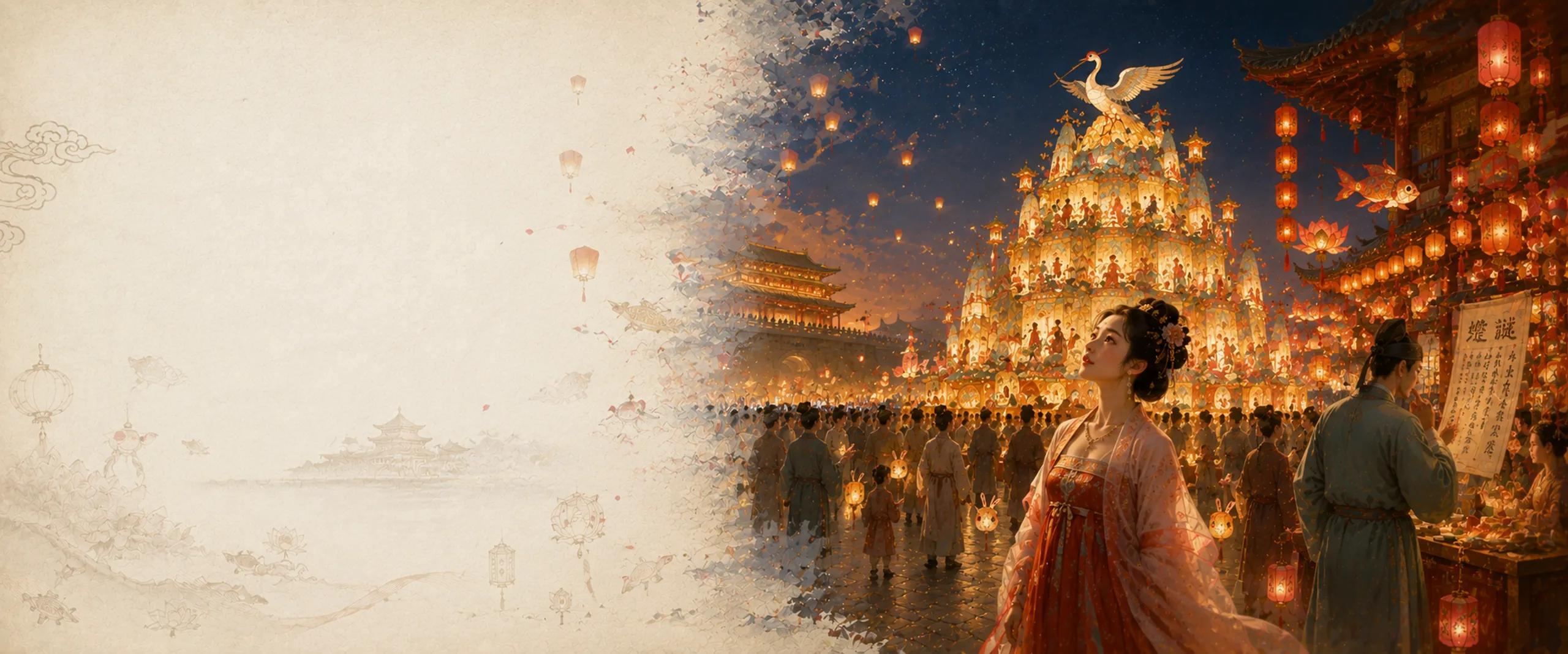
The Lantern Festival is one of the most visually evocative festivals in classical Chinese poetry. In his Tang-dynasty poem The Night of the Fifteenth Day of the First Lunar Month (《正月十五夜》), Su Weidao wrote, “火树银花合,星桥铁锁开。暗尘随马去,明月逐人来,” depicting the magnificent spectacle of the capital on the night of Shangyuan, when lanterns blazed throughout the city and the gates remained unlocked. Xin Qiji’s The Green Jade Table · Lantern Festival (《青玉案·元夕》), with “东风夜放花千树,更吹落、星如雨。宝马雕车香满路。凤箫声动,玉壶光转,一夜鱼龙舞,” renders the lantern-lit city, music, and dancing with tremendous sweep. Ouyang Xiu’s Shengchazi · Lantern Festival (《生查子·元夕》) takes a strikingly different path: “去年元夜时,花市灯如昼。月到柳梢头,人约黄昏后,” recounting a Lantern Festival romance in the voice of a young woman. Tang Yin’s Lantern Festival (《元宵》), with its line “春宵一刻值千金,” speaks to the preciousness of a night when lanterns and moonlight illuminate one another and human joy fills the world.
Historical Development
From the Han Dynasty to the Sui and Tang
The origins of the Lantern Festival can be traced back to the Han dynasty. Emperor Wen of Han designated the fifteenth day of the first lunar month as the Lantern Festival, while under Emperor Wu the worship of the deity “Taiyi” was likewise conducted on this date. By the Sui and Tang dynasties, the Lantern Festival had developed into a grand cultural celebration. Its duration expanded from a single day in the Han period to three days, while its scale grew and its forms and activities became increasingly varied. Liu Su’s Tang-dynasty collection of anecdotal writings, New Tales of the Great Tang (《大唐新语》), records: “京城正月望日盛饰灯影之会,金吾弛禁,特许夜行。贵族戚属及下隶工贾,无不夜游。车马喧阗,人不得顾”, offering a vivid glimpse of the extraordinary bustle.
The Tang dynasty marked the first great flowering of Lantern Festival poetry. The magnificence of the lantern fairs provided Tang poets with exceptional material. Through images such as “火树银花” and “星桥铁锁,” poets transformed the brilliance of Chang’an’s Lantern Festival night and the famed “端门灯火” into enduring verse. Su Weidao’s The Night of the Fifteenth Day of the First Lunar Month became a representative work of the period. It won distinction in a “poetry competition on the night of the fifteenth day of the first lunar month” and has been praised as one of the most beautiful poetic pictures of the Tang Lantern Festival. Cui Ye’s six poems titled Shangyuan Night (《上元夜》), Lu Zhaolin’s Watching Lanterns on the Fifteenth Night (《十五夜观灯》), and Zhang Hu’s Lanterns on the Night of the Fifteenth Day of the First Lunar Month (《正月十五夜灯》) are among the other celebrated Lantern Festival poems of the Tang.
The Two Song Dynasties
By the Song dynasty, the scale and momentum of the Lantern Festival had grown greater still, to the point that “游人已集御街,两廊下奇术异能,歌舞百戏,鳞鳞相切,乐声喧杂十余里” (The Eastern Capital: A Dream of Splendor 《东京梦华录》, by Meng Yuanlao of the Song dynasty). The rise of the ci lyric introduced a new artistic form for the subject, and Lantern Festival lyrics reached their height during the Song.
Xin Qiji’s The Green Jade Table · Lantern Festival (《青玉案·元夕》) has been acclaimed as the “finest Lantern Festival lyric through the ages.” With a vigorous hand, it writes in the refined mode of wanyue, finding the deepest solitude within the height of prosperity. Ouyang Xiu’s Shengchazi · Lantern Festival (《生查子·元夕》) unites the festival with the theme of love, and “月上柳梢头,人约黄昏后” became an immortal line. Li Qingzhao’s Yongyule · The Setting Sun Melts Like Gold (《永遇乐·落日熔金》), set against the Lantern Festival, expresses profound reflections on flourishing and decline, together with sorrow over the poet’s own fate. Su Shi’s Butterflies in Love with Flowers · Shangyuan in Mizhou (《蝶恋花·密州上元》) contrasts the Shangyuan scenes of Hangzhou and Mizhou, revealing nostalgia for the past and loneliness in the present.
Yuan, Ming, and Qing
Lantern Festival poetry of the Yuan, Ming, and Qing both inherited earlier traditions and opened new paths. During the Ming dynasty, the Lantern Festival brought a ten-day holiday, with officials and commoners celebrating together throughout the realm. Tang Yin’s Lantern Festival (《元宵》), written in an accessible and lucid style, depicts the joy of the festival. “有灯无月不娱人,有月无灯不算春” expresses the essential importance of lantern light and moonlight shining together on this night. Qing-dynasty works such as Fu Zeng’s Shangyuan Bamboo-Branch Song (《上元竹枝词》) continued the creative tradition of Lantern Festival poetry.
Core Imagery
Images that recur throughout Lantern Festival poetry form a distinctive “Lantern Festival image system.” They are both literary expressions of Yuanxiao customs and vessels for the poets’ emotions.
Lantern Light
Lantern light is the most central image in Lantern Festival poetry. “火树银花,” “星如雨,” “万灯明” — the lights of Yuanxiao are not merely sources of illumination, but a visual wonder that seems to surpass nature itself. Su Weidao’s “火树银花合” uses the four characters “火树银花” to define the aesthetic ideal of Lantern Festival brilliance. Xin Qiji’s “东风夜放花千树,更吹落、星如雨” imagines the spring wind opening flowers on a thousand trees in order to describe the abundance of light. Zhang Hu’s “千门开锁万灯明” depicts universal participation through the vast spectacle of thousands of households lighting lamps at once. Lantern light is the soul of Lantern Festival poetry—the “火树银花不夜天” of later imagination is precisely the festival’s unique carnival of light.
The Bright Moon
The Lantern Festival is the first full-moon night of the new year, making the moon indispensable to its poetry. Su Weidao’s “明月逐人来” describes moonlight following the crowd; Ouyang Xiu’s “月上柳梢头” combines the rising moon with the emotion of a lovers’ meeting; Cui Ye’s “谁家见月能闲坐” writes the moon as a summons no one can resist; Tang Yin’s “有月无灯不算春” emphasizes the complementarity of lantern and moon. The Lantern Festival moon has been a focal point for generations of writers. The round moon in the sky and the round yuanxiao or tangyuan on earth together form a cultural image of roundness—reunion, completeness, perfection.
Fish-and-Dragon Dances
“一夜鱼龙舞” is Xin Qiji’s classic image for the variety performances of Lantern Festival night. Fish-and-dragon dances involve lanterns shaped as fish and dragons moving as though the creatures were stirring the sea. The “百戏” performances of the Tang Lantern Festival were an important part of the collective revelry. Zhang Hu’s “三百内人连袖舞” and Xin Qiji’s “一夜鱼龙舞” together reveal an evening of music, dancing, and flourishing celebration.
Willow Branches and Dusk
“月上柳梢头,人约黄昏后” forms perhaps the most romantic combination of images in Lantern Festival poetry. The willow branch defines space: the willow is a messenger of spring, and its first green tips announce the season’s arrival. Dusk defines time: the sky is neither fully bright nor fully dark, everything softened and indistinct, the perfect hour for lovers to meet. This combination of images was repeatedly quoted in later generations and helped shape the Lantern Festival’s cultural identity as a “Chinese Valentine’s Day.”
Thematic Categories
Songs of a Flourishing Age
The Lantern Festival was one of the rare occasions in ancient China for true collective revelry, and the largest body of Lantern Festival poetry directly depicts the grandeur of the celebration. Su Weidao’s The Night of the Fifteenth Day of the First Lunar Month presents head-on the brilliant lights and shared joy of Chang’an; Cui Ye’s Shangyuan Night conveys universal participation through “谁家见月能闲坐,何处闻灯不看来”; Zhang Hu’s Lanterns on the Night of the Fifteenth Day of the First Lunar Month uses “千门开锁万灯明” to show thousands of households pouring into the streets; Lu Zhaolin’s Watching Lanterns on the Fifteenth Night describes the spectacular reach of illumination through “缛彩遥分地,繁光远缀天.” Set against the Lantern Festival, these poems reveal both the imposing grandeur of flourishing Tang civilization and the prosperity of Song urban life.
Love and Longing
Ouyang Xiu’s Shengchazi · Lantern Festival unites the Lantern Festival and romantic love with remarkable completeness, helping establish the festival as a cultural source for the idea of a “Chinese Valentine’s Day.” On the fifteenth day of the first lunar month, young men and women were able to go out together more freely to view lanterns, creating the possibility of “人约黄昏后.” Against the festival background, the lyric contrasts last year and this year, writing the sorrow of “不见去年人” while moon and lanterns remain unchanged. From that point onward, Lantern Festival light and moonlight became witnesses to love stories. Xin Qiji’s The Green Jade Table · Lantern Festival similarly uses the festival as its setting, finding amid the bustle of “众里寻他千百度” the sudden joy of “蓦然回首,那人却在灯火阑珊处.”
Reflections on Life, Rise, and Decline
Li Qingzhao’s Yongyule · The Setting Sun Melts Like Gold uses the Lantern Festival as a setting for profound reflections on flourishing and decline and the sorrow of her own life. The splendor of Bianjing and the desolation of Lin’an, the radiance of the young woman and the weariness of the older self—“中州盛日” and “如今憔悴” create an immense emotional distance. Su Shi’s Butterflies in Love with Flowers · Shangyuan in Mizhou similarly relies on contrast, setting Hangzhou’s prosperity against Mizhou’s loneliness. Bai Juyi’s The Fifteenth Day of the First Lunar Month in Chang’an (《长安正月十五日》) writes “明月春风三五夜,万人行乐一人愁,” finding individual sorrow amid universal celebration. Li Shangyin’s Hearing That There Are Lanterns in the Capital on the Fifteenth Day of the First Lunar Month and Regretting That I Cannot Go See Them (《正月十五闻京师有灯恨不得观》) expresses regret at being unable, because of illness—or another circumstance—to travel to the capital to view the lanterns. Against the bright backdrop of the Lantern Festival, these works write deeper reflections on human life.
Literary Gatherings and Chan Reflection
Su Shi’s Visiting the Monk Kejiu’s Room at Xiangfu on Shangyuan Night, Quietly Without Lanterns (《上元过祥符僧可久房萧然无灯火》) is an unusual Lantern Festival poem. It depicts the cold and quiet atmosphere of a monk’s room on Lantern Festival night, contrasting the singing and dancing outside with the stillness and absence of light within in order to express Chan reflection. “门前歌舞斗分朋” describes the lively lantern celebrations beyond the door; “一室清风冷欲冰” evokes the austere quiet of the monk’s room. “不把琉璃闲照佛,始知无尽本无灯” adapts the allusion of the “inexhaustible lamp” from the Vimalakirti Sutra (《维摩诘经》). Beginning with Su Shi’s experience of visiting a monk on Shangyuan night, the poem uses spatial contrast and Buddhist allusion to transform noisy festival experience into contemplation of Chan principles. At a festival given over to collective celebration, Su Shi enters a monk’s room without lanterns and writes a poem still as unmoving water—the revelry belongs to others; the serenity belongs to oneself.
Lantern Festival Folk Songs
The Lantern Festival is not only a Han Chinese festival but also an important celebration among many ethnic minority communities. In regions of Yunnan, Guizhou, and elsewhere where minority peoples live in concentrated communities, the festival has also absorbed distinctive local traditions. Miao, Dong, and other peoples perform activities such as lusheng dances and antiphonal singing during the Lantern Festival. The songs associated with these customs have been transmitted orally for centuries and, together with the written poetry of Han literati, form a fuller picture of Lantern Festival culture within the Chinese nation. Although many of these orally transmitted songs were never recorded in writing, they have passed from generation to generation in minority festival life, carrying forms of emotional expression and aesthetic sensibility distinct from those of Han classical poetry.
Closing Reflections
Lantern Festival poetry is a singular and brilliant landscape within the treasury of Chinese verse. From Su Weidao’s “火树银花合” and the grandeur of the flourishing Tang, to Xin Qiji’s “东风夜放花千树” and the subtle depths of Song ci; from Ouyang Xiu’s “月上柳梢头” and the romance of an unexpected encounter, to Li Qingzhao’s “落日熔金” and the sorrow of personal fate amid the rise and fall of dynasties—Lantern Festival poetry has recorded, across a thousand years, the Chinese longing for light, reunion, and a beautiful life.
Within these poems is the bustle of collective revelry—“千门开锁万灯明,正月中旬动帝京”; the romance of moonlight above willow branches—“月上柳梢头,人约黄昏后”; the devotion of searching through the crowd—“蓦然回首,那人却在,灯火阑珊处”; reflections on flourishing and decline—“中州盛日,闺门多暇,记得偏重三五”; and the completeness of lanterns and moonlight shining together—“有灯无月不娱人,有月无灯不算春”. The meaning of Lantern Festival poetry lies precisely in its ability to carry the lantern light and moonlight of a thousand years ago into every succeeding age of Chinese life.
Lanterns at the Lantern Festival are themselves poetic. In the lights of these poems, we see the grandeur of the Tang, the refinement of the Song, the urban vitality of the Ming, and the continuity of the Qing. Lantern Festival poetry is among the deepest and most enduring declarations Chinese people have made to light—a vast scroll of lanterns and moonlight written in ink by generation after generation. Within that scroll, light is more than light: it is the Chinese people’s undying longing for brightness itself.
—
[Language: es]
Selected Poems
Selected Poems
正月十五夜
Tang Dynasty · Su Weidao
火树银花合,星桥铁锁开。
暗尘随马去,明月逐人来。
游伎皆秾李,行歌尽落梅。
金吾不禁夜,玉漏莫相催。
Background
Su Weidao (c. 648–705), a Tang-dynasty statesman and poet from Luancheng in Zhaozhou, present-day Luancheng in Hebei, rose to the office of chancellor. Together with Du Shenyan, Cui Rong, and Li Jiao, he was known as one of the “Four Literary Friends.” The poem was written on a Lantern Festival night during the Shenlong era of Empress Wu Zetian, in 705. According to Liu Su’s New Tales of the Great Tang (《大唐新语》), Chang’an held a magnificent lantern celebration at the time, and the court organized a “poetry competition on the night of the fifteenth day of the first lunar month,” in which more than two hundred poets composed simultaneously. Su Weidao’s poem, together with two others, emerged among the winning works.
By the Shenlong era, the Tang dynasty had been established for nearly sixty years and stood at the height of its national strength. There was no National Day in the modern sense, and the Lantern Festival functioned almost like one. To celebrate and enjoy the occasion, the entire populace rejoiced on an unprecedented scale. Every conceivable form of celebration was brought into play, including spectacular displays of light and the relaxation of the capital’s nighttime restrictions. It was against precisely this background that Su Weidao wrote this celebrated poem.
Line-by-Line Reading
With crowds surging through the streets, dust rises in the darkness beneath horses’ hooves; moonlight follows the human tide, illuminating wave after wave of people. “暗尘随马去” evokes the profusion of carriages and horses, while “明月逐人来” emphasizes the brightness of the moon. People look at lanterns, lanterns illuminate people, and the moon follows them all—the three shine upon one another. This is one of the poem’s finest couplets, filled with extraordinary movement.
The strolling performers—singing girls and dancers—are all as radiant as blossoming plum trees. 《秾李》 and 《落梅》 were both names of melodies at the time. “秾李” derives from “何彼秾矣,华如桃李” in The Book of Songs · Zhaonan · Hebinongyi (《诗经·召南·何彼秾矣》), describing the beauty of women. The performers walk while singing the elegant melody 《梅花落》. Here the poem turns to people: the beauty of the performers and the grace of song unite human charm with musical beauty on Lantern Festival night.
The Jinwu guards were officials responsible for maintaining security in the capital, and on this night the curfew was suspended. “玉漏” was an ancient timekeeping device. The poet hears the water clock sounding as time passes and implores it to slow down, not to hasten the end of this beautiful night. The couplet carries the festival revelry to its height: everyone sings, dances, and gives themselves fully to the pleasure of the night.
Overall Appreciation
Among Tang poems on the Lantern Festival, Su Weidao’s The Night of the Fifteenth Day of the First Lunar Month may not be the most individual in voice, but it is perhaps the most comprehensive and direct portrayal of the festival at its height. Many Lantern Festival poems write the occasion “indirectly,” using it as a point of departure for the poet’s personal emotions. Su Weidao’s poem, by contrast, is both early and entirely frontal in its depiction from beginning to end. One of its great values is that it preserves one of the most beautiful poetic images of the Tang Lantern Festival.
The opening phrase “火树银花合” hardly requires explanation. One need only recall later expressions inspired by it, such as “火树银花不夜天,” to understand how powerfully it must have seized the reader’s eye and imagination from the moment it appeared. For writing illumination, “火树银花” is an unsurpassed four-character combination. The diction throughout is precise, the parallelism disciplined, the conception ingenious, the progression clear, and the imagery vivid. The poem recreates the brilliance of the ancient Luoyang Lantern Festival and its “端门灯火” as though in an enchanting festival painting. Not a single line offers direct personal lyricism, yet the final “玉漏莫相催” releases the poet’s entire reluctance to part with such a beautiful night—an ease and confidence distinctive of poets in the flourishing Tang.
青玉案·元夕
Song Dynasty · Xin Qiji
东风夜放花千树,更吹落、星如雨。
宝马雕车香满路。
凤箫声动,玉壶光转,一夜鱼龙舞。
蛾儿雪柳黄金缕,笑语盈盈暗香去。
众里寻他千百度,蓦然回首,那人却在,灯火阑珊处。
Background
Xin Qiji (1140–1207), courtesy name You’an and literary name Jiaxuan, was one of the greatest ci poets of the Southern Song. Throughout his life he strongly advocated resistance against the Jin, yet his ambitions remained unrealized, and he withdrew from public life in his later years. The Green Jade Table · Lantern Festival is one of his representative works and has been praised as the “finest Lantern Festival lyric through the ages.” Among all classical poems and lyrics on the Lantern Festival, this work is often regarded as unsurpassed. The renowned scholar Zhou Ruchang praised it highly: “写上元灯节的词,不计其数,稼轩的这一首,却谁也不能视为可有可无,即此亦可谓豪杰了。”
The exact date of composition cannot be established. It is generally believed to have been written after Xin Qiji crossed south. The Southern Song’s reduced territory stood in painful contrast to the prosperity of the Northern Song, and amid the bustle of the Lantern Festival the poet felt not only festive joy, but also profound longing for the lost homeland and reflections on his own life. Liang Qichao described the lyric as “自怜幽独,伤心人别有怀抱,” understanding it as a work of deeper personal and political implication.
Overall Appreciation
Upper Stanza — Unfolding the Splendor of the Lantern Festival
The opening three lines, “东风夜放花千树,更吹落、星如雨,” use a vigorous brush to paint the lights of the Lantern Festival. The chill spring wind seems, in a single night, to force open dazzling lanterns and fireworks; amid shifting light and shadow, fireworks burst as though stars were falling from the heavens in a shower. The passage echoes the imaginative world of Cen Shen’s “忽如一夜春风来,千树万树梨花开.” “花千树” refers to countless lanterns blooming like flowers upon a thousand trees, while “星如雨” describes fireworks filling the sky. Meng Man once praised this in The Chinese Poetry Competition as the most beautiful line ever written about Lantern Festival lights.
“宝马雕车香满路” — Fine horses and carved carriages emphasize the luxury of the vehicles, while fragrance filling the road suggests both the density of the crowds and the richness of perfume. The lyric now shifts its gaze toward the lantern market, where the entire city seems to have emptied into the streets.
“凤箫声动,玉壶光转,一夜鱼龙舞” — “凤箫” is an elegant name for the panpipe, while “玉壶” refers to the moon. Music, turning moonlight, and dancing fish-and-dragon lanterns interweave. Carriages, instruments, fireworks, lanterns, and moonlight combine into a richly colored scroll of festival viewing. The phrase “一夜” conveys the duration of the revelry: it continues through the entire night, without weariness.
Lower Stanza — The Deep Feeling of Searching Through the Crowd
“蛾儿雪柳黄金缕,笑语盈盈暗香去” — “蛾儿,” “雪柳,” and “黄金缕” all refer to ornaments worn in women’s hair. With delicate strokes, the poet sketches a scene filled with women out enjoying the festival. “笑语” conveys their happiness and delight, “盈盈” suggests graceful and light movement, while “暗香” refers both to feminine fragrance and the scent that lingers as they pass. In only a few words, their glances and flowing movement are rendered with remarkable vividness.
“众里寻他千百度,蓦然回首,那人却在,灯火阑珊处” — This is the lyric’s finishing stroke. After richly unfolding the magnificence of the Lantern Festival, the poet suddenly turns, revealing why he has been wandering and searching through the lantern market. He has not lingered because he is intoxicated by festive splendor or drifting fragrance; he has been seeking, again and again, the unforgettable “那人” in his heart. Where is she? When he suddenly turns his head, he discovers with astonished joy that she is standing where the lanterns are fading and nearly gone. In Renjian Cihua (《人间词话》), Wang Guowei placed “众里寻他千百度,蓦然回首,那人却在,灯火阑珊处” in the third of the three realms that “古今之成大事业、大学问者” must pass through. The lyric’s exceptional artistry lies chiefly in three dimensions.
First, it writes a refined and graceful lyric with a vigorous hand. Its tone is clear, pure, subtle, and enduring, greatly enriching the aesthetic range of ci. Second, it uses the language of prosperity to write inward grief. The dazzling noise of the outer world throws the pain and desolation within into sharper relief. Its superb depiction of the Lantern Festival is, in a sense, a screen: beneath it lies nothing other than “自怜幽独,伤心人别有怀抱.” Third, against a background of revelry, it creates the most profound solitude. The figure sought is not where the lights burn brightest, but where they are growing dim. This is not merely a physical position; it is an attitude toward life. From the brilliance of “东风夜放花千树” at the beginning to the cool quiet of “灯火阑珊处” at the end, the lyric completes an emotional arc from noise to stillness. The revelry belongs to others; the quiet belongs to oneself.
生查子·元夕
Song Dynasty · Ouyang Xiu — alternatively attributed to Zhu Shuzhen
去年元夜时,花市灯如昼。
月上柳梢头,人约黄昏后。
今年元夜时,月与灯依旧。
不见去年人,泪湿春衫袖。
Background
Shengchazi · Lantern Festival is one of the most graceful and moving works in the entire corpus of Lantern Festival poetry. Its authorship has long been debated. Traditionally attributed to Ouyang Xiu, it has also been ascribed by some scholars to the Southern Song woman poet Zhu Shuzhen. Qing scholar Wang Shizhen noted in Chibei Outan (《池北偶谈》) that the lyric appears in The Collected Works of Ouyang Wenzhonggong (《欧阳文忠公集》). Whoever its author may be, the work uses language of extraordinary simplicity to express profound sorrow over the transformation of human circumstances while the world itself remains unchanged.
The lyric was written in the third year of the Jingyou era, 1036, when Ouyang Xiu was mourning his second wife, Lady Yang. The upper stanza recalls the Lantern Festival of the previous year; the lower stanza expresses the pain of longing during the festival in the present year.
Overall Appreciation
The artistic conception of the lyric resembles Cui Hu’s Tang poem Written at a Village South of the Capital (《题都城南庄》): “人面不知何处去,桃花依旧笑春风.” Yet the language of Ouyang Xiu—or Zhu Shuzhen—possesses an even more circling and interwoven beauty, with a stronger flavor of folk song.
The upper stanza recalls the happy meeting of the previous Lantern Festival. “花市灯如昼” fully evokes the festival’s dazzling brilliance. The lower stanza returns to the same place a year later and expresses grief at the beloved’s absence. The author does not directly describe the anticipation before the meeting, their laughter after they met, or the turmoil of parting. A single line—“人约黄昏后”—is enough to suggest it all, displaying profound artistic restraint.
The lyric’s greatest power lies in the tension between what does not change and what does. The moon and lanterns remain “依旧,” suggesting that before nature, time appears almost still; yet “不见去年人” reveals the instability of human affairs. Countless Lantern Festival poems describe bustling markets or crowds at play. This lyric takes another path entirely, using the monologue of a woman—or perhaps a man—to write with delicate intimacy about love during the festival. It brings the Lantern Festival back from a collective revelry to individual joy and sorrow, allowing lantern light and moonlight to become the setting and witness of a love story.
永遇乐·落日熔金
Song Dynasty · Li Qingzhao
落日熔金,暮云合璧,人在何处?
染柳烟浓,吹梅笛怨,春意知几许?
元宵佳节,融和天气,次第岂无风雨?
来相召、香车宝马,谢他酒朋诗侣。
中州盛日,闺门多暇,记得偏重三五。
铺翠冠儿,捻金雪柳,簇带争济楚。
如今憔悴,风鬟霜鬓,怕见夜间出去。
不如向、帘儿底下,听人笑语。
Background
Li Qingzhao (1084–c. 1155), literary name Yi’an Jushi, was the most distinguished woman ci poet of the Southern Song. She wrote this lyric late in life while living as a refugee in Lin’an, present-day Hangzhou. After the Jingkang catastrophe and the fall of the Northern Song, Li Qingzhao endured the loss of her country, her home, and her husband, followed by repeated hardship after fleeing south. Encountering the Lantern Festival again only deepened her sorrow and anxiety, prompting this celebrated lyric. Although the poem is set during Yuanxiao, it overturns conventional festive expectations. By contrasting Lantern Festivals of past and present, it expresses profound awareness of rise and decline, together with grief over the course of her own life.
Overall Appreciation
Upper Stanza — Present Scenery and a Desolate State of Mind
The opening three lines, “落日熔金,暮云合璧,人在何处” — The setting sun is like molten gold; evening clouds gather like joined discs of jade. The parallelism is elegant and the language brilliant. Yet immediately afterward comes “人在何处,” breaking away into a long sigh filled with bewilderment and pain.
“染柳烟浓,吹梅笛怨,春意知几许” — Newly sprouting willow leaves are veiled in dense mist, while the flute melody 《梅花落》 carries a plaintive tone. Rather than saying directly that plum blossoms have fallen, the poet writes “吹梅笛怨,” using the music to express grief and longing for the former capital.
“元宵佳节,融和天气,次第岂无风雨” — On this Lantern Festival, the weather is mild and harmonious, yet who can be certain that wind and rain will not suddenly come? This is the vigilance of someone who has endured drastic reversals in life: beautiful things are always brief, and storms may arrive at any moment.
“来相召、香车宝马,谢他酒朋诗侣” — Friends of wine and poetry arrive in splendid carriages and on fine horses to invite her out, but she can only decline with courteous words because grief and agitation fill her heart. It is not that she no longer loves festivity; rather, festivity now causes her greater pain.
Lower Stanza — Former Prosperity and Present Decline
“中州盛日,闺门多暇,记得偏重三五” — She recalls the flourishing days of Bianjing, when as a young woman with ample leisure she especially treasured the fifteenth day of the first lunar month. “中州” refers to Bianjing of the Northern Song, while “偏重三五” emphasizes how dearly she once valued the Lantern Festival.
“铺翠冠儿,捻金雪柳,簇带争济楚” — During Lantern Festivals in Bianjing, she wore caps set with kingfisher-feather ornaments and golden silk xueliu hair decorations, dressing carefully and beautifully. This is a concrete re-creation of former splendor: the youthful years of elaborate adornment and graceful display.
“如今憔悴,风鬟霜鬓,怕见夜间出去” — Now her face is worn, her hair disheveled and touched with frost, and she fears even going out at night. The brilliance of the past has become an irretrievable dream.
“不如向、帘儿底下,听人笑语” — Better simply to remain behind the curtain and listen to other people’s laughter. On one level, this is a sigh over the rise and decline of past and present, stirred by the festival scene. On another, she still longs for the Lantern Festivals of former days and tries to revisit old dreams through the bustle outside. To warm oneself with memories while hearing laughter through a curtain—how desolate that is. The lyric employs contrast, writing the Lantern Festivals of Bianjing, capital of the Northern Song, and Lin’an, capital of the Southern Song, in order to express longing for the lost homeland. The upper stanza depicts the sorrow of living far from home during the Lantern Festival, setting the outward happiness of reality against the desolation of her inner state. In the lower stanza, “中州盛日” turns from the present toward memory. The lyric’s genius lies in its ending, “帘儿底下,听人笑语.” She has not truly rejected festivity; she simply cannot enter into it. Her heart is not truly still; she is afraid to touch the memories of the past. Listening to laughter from behind a curtain, she is separated by that single curtain from two worlds, two lives. By placing her private grief against the background of a festival celebrated by all, Li Qingzhao writes sorrow through joy and decline through splendor, multiplying the emotional force.
蝶恋花·密州上元
Song Dynasty · Su Shi
灯火钱塘三五夜,明月如霜,照见人如画。
帐底吹笙香吐麝,更无一点尘随马。
寂寞山城人老也!击鼓吹箫,却入农桑社。
火冷灯稀霜露下,昏昏雪意云垂野。
Background
This lyric was written in the eighth year of the Xining era, 1075, when Su Shi was serving as prefect of Mizhou, present-day Zhucheng in Shandong. Although its title identifies the subject as “Shangyuan in Mizhou,” the lyric begins with the Lantern Festival night in Qiantang, that is, Hangzhou. Su Shi had previously spent three Lantern Festivals there. Lantern light is the defining feature of the festival, and the opening “灯火钱塘三五夜” immediately establishes the grandeur of the scene. Soon after taking office in Mizhou, Su Shi encountered the Lantern Festival. As he walked the streets looking at lanterns and the moon, memories of Hangzhou’s bustling celebration came back to him. The entire lyric contrasts the Shangyuan scenes of Hangzhou and Mizhou, revealing longing for Hangzhou and the loneliness he felt upon first arriving in Mizhou.
Overall Appreciation
The lyric uses broad strokes to capture differences in climate, geography, and custom between Hangzhou and Mizhou, presenting two contrasting visions of the Lantern Festival. Su Shi had spent three Lantern Festivals in Hangzhou and held its local customs in deep regard. The language is plain and unadorned, yet emotionally powerful. The upper stanza gives us the festival beauty of “明月如霜,照见人如画”; the lower falls into the sorrow of “寂寞山城人老也.” From brilliant lights to cold and sparse flames, from people “like paintings” to people grown old, from swelling music to clouds heavy with snow—prosperity and decline, warmth and coldness confront each other, and the poet’s loneliness and unease become palpable. The line “却入农桑社” is especially subtle: the joy of Mizhou’s residents on Lantern Festival night does not take the form of the urban splendor familiar to Su Shi, but of rural worship alien to him, deepening his sense of distance as an “outsider.”
正月十五夜灯
Tang Dynasty · Zhang Hu
千门开锁万灯明,正月中旬动帝京。
三百内人连袖舞,一时天上著词声。
Background
Zhang Hu (c. 785–c. 852), a Tang poet especially known for palace verse, wrote this celebrated Lantern Festival poem with particular attention to court women singing and dancing during the festivities. According to Tang custom, during the Lantern Festival both palace and common neighborhoods throughout Chang’an were hung with lanterns and decorations. The poem combines a sweeping view of the capital’s lights with a close-up of palace music and dance, recreating a festive world in which heaven and earth alike seem filled with song.
Line-by-Line Reading
“千门开锁” means that countless locked doors are opened and people from thousands of households pour out to see the lanterns. “万灯明” conveys the sheer number and brightness of the lights. The image of doors opening everywhere and ten thousand lamps igniting at once creates an immediate sense of grandeur.
On the Lantern Festival, the fifteenth day of the first lunar month, the entire imperial capital is stirred. The word “动” is forceful: it describes not only the movement of crowds, but the sense that the whole city itself is trembling with festival energy.
Three hundred palace women dance with sleeves joined together. It is a close-up of court celebration, magnificent in scale.
Singing and music rise into the heavens, as though even the sky were echoing with the sounds of the human world. Exaggeration conveys both the volume of the sound and the intensity of the festive mood.
Overall Appreciation
This seven-character quatrain reveals the grand through the small. It first establishes the brilliance of the lantern festival: there are “万灯,” three hundred “内人,” and a dance of linked sleeves. The poem alternates between panoramic overview and close-up detail, creating a magnificent scene with imposing scale. Its language is lucid and its images vivid. By focusing on both popular lantern revelry and palace dancing, it uses remarkably concise strokes to evoke the grandeur and joy of the Tang Lantern Festival, making it a representative work of court and populace celebrating together.
上元夜
Tang Dynasty · Cui Ye
玉漏银壶且莫催,铁关金锁彻明开。
谁家见月能闲坐,何处闻灯不看来。
Background
Cui Ye was a Tang poet active during the reign of Emperor Zhongzong; his dates are unknown. His sequence Shangyuan Night consists of six seven-character quatrains depicting the prosperous lantern-viewing scenes of Chang’an. Liu Su’s New Tales of the Great Tang records: “神龙(唐中宗年号,公元705—707年)之际,京城正月望日(即十五),盛饰灯影之会,金吾弛禁,特许夜行。贵族戚属及下隶工贾,无不夜游。”
Line-by-Line Reading
Both “玉漏” and “银壶” are ancient timekeeping devices. The poet asks the dripping clock not to hurry. The three words “且莫催” express reluctance to part with such a beautiful moment and a wish that time might stop.
The iron locks of the city gates remain open all night. The capital’s curfew has been lifted, and people are free to enjoy themselves until dawn.
What family could see the moon and remain idly seated at home? Who could hear of the lantern fair and not come to look? “谁家” and “何处” really mean every family and everyone, conveying streets emptied by universal participation. Princes and ministers as well as ordinary commoners all join the celebration.
Overall Appreciation
This seven-character quatrain does not describe lantern viewing itself in detail, but rather the conditions and irresistible impulse behind it. Through two rhetorical questions—“谁家见月能闲坐” and “何处闻灯不看来”—the poet captures the collective revelry of Lantern Festival night: no one can resist the attraction of moonlight and lanterns shining together. With apt and characteristic imagery and concise, moving language, the poem depicts the festive joy and prosperous streets of Yuanxiao. Through its lines, one can almost see the crowds, traffic, noise, and restless energy of the celebration.
十五夜观灯
Tang Dynasty · Lu Zhaolin
锦里开芳宴,兰红艳早年。
缛彩遥分地,繁光远缀天。
接汉疑星落,依楼似月悬。
别有千金笑,来映九枝前。
Background
Lu Zhaolin (c. 636–c. 695), courtesy name Shengzhi and literary name Youyouzi, was one of the Four Great Poets of the Early Tang. This poem describes Lantern Festival decorations from both distant and close perspectives. Seen from afar they resemble stars fallen to earth; seen nearby they look like the moon suspended beside towers. The parallelism is meticulously balanced, giving distinctive expression to the festival’s colorful brilliance. At a deeper level, the poem reveals a particular ethics of seeing that belongs to Lu Zhaolin: even when standing at the margins of his age and repeatedly frustrated in official life, the poet continues to use the brush as his eye—to gaze upon beauty and give names to splendor.
Line-by-Line Reading
Amid brilliantly colored lights, people hold fragrant banquets in celebration; beneath exquisite lanterns, the young appear even more radiant and beautiful.
Rich and varied Lantern Festival colors seem to divide the earth in the distance, while countless lights adorn the far horizon. This is the panoramic view from afar.
Lanterns and fireworks reaching toward the Milky Way seem like falling stars, while lights close to the towers resemble a suspended moon. Falling and hanging, far and near, low and high—the parallelism is exceptionally precise.
And there are the smiling faces of young women, radiant before the lanterns. The poem reaches its climax here: the lanterns are beautiful, and so are the people.
Overall Appreciation
The poem describes Lantern Festival decorations from both distant and close perspectives. “缛彩遥分地,繁光远缀天” is a wide-angle view, showing the number, brightness, and beauty of the lanterns. The characters “遥” and “远” suggest a celebration spread across the realm, with lamps lit everywhere. “接汉疑星落,依楼似月悬” compares lanterns with stars and the moon, merging heaven and the human world. The final “别有千金笑,来映九枝前” sets human faces against lantern light, giving the festival’s beauty a warmth of human feeling. The poem is meticulously parallel and richly colored, one of the finest Lantern Festival works of the Early Tang.
元宵
Ming Dynasty · Tang Yin
有灯无月不娱人,有月无灯不算春。
春到人间人似玉,灯烧月下月如银。
满街珠翠游村女,沸地笙歌赛社神。
不展芳尊开口笑,如何消得此良辰。
Background
Tang Yin (1470–1524), courtesy name Bohu and literary name Liuru Jushi, was a celebrated Ming painter and poet. In accessible and lucid language, this poem depicts the joy of Lantern Festival night: lanterns and moonlight shining together, village girls filling the streets, and music surging everywhere. There is painting within the poem, presenting both a nocturnal Lantern Festival scene and a vivid picture of lantern-viewing customs.
Line-by-Line Reading
If there are brilliant lanterns but no clear moon, the night cannot be enjoyed to the full; if there is a bright moon but no brilliant lanterns, it can hardly count as spring. Lanterns and moon are the two essential elements of the Lantern Festival, and neither can be absent.
Spring arrives in the human world, and people seem as beautiful as jade; lanterns burn beneath the moon, whose light appears silver-white. People like jade, moon like silver—human beings and moonlight, spring and lanterns all merge in the poet’s vision.
The streets are filled with village girls wearing pearls and jade, while pipes and songs boil across the ground as though competing with the local deity. The couplet captures universal participation in the Lantern Festival: girls roam the streets and music fills every corner.
If one does not raise the wine cup and laugh freely, how could one do justice to such a beautiful hour? The poem carries the festival’s joy to its highest point: such a perfect night must not be wasted; wholehearted laughter is the finest response.
Overall Appreciation
Unlike the cool melancholy that often appears in literati poems on festivals, this poem is filled with the warmth and exuberance of ordinary life, taking both the fullness of spring and human delight to their utmost. What a line: “有灯无月不娱人.” On Lantern Festival night, lanterns and moonlight are both indispensable. With the eye of a painter and calligrapher, Tang Yin captures the festival’s play of light: lanterns and moon illuminate one another, while human beings and spring seem to merge. The poem is easy to understand, yet every line is finely judged, overflowing with love of life and gratitude for a beautiful moment. “春到人间人似玉” — spring is not merely a season but a state of life; the Lantern Festival is not merely a festival but an attitude toward living.
Readers’ Comments
Calendar and traditional culture enthusiasts from around the world, sharing the same moon.
Sign in or register to join the conversation. Your comment account is created automatically the first time you use a connected account.
No comments yet
Share your thoughts with readers around the world.