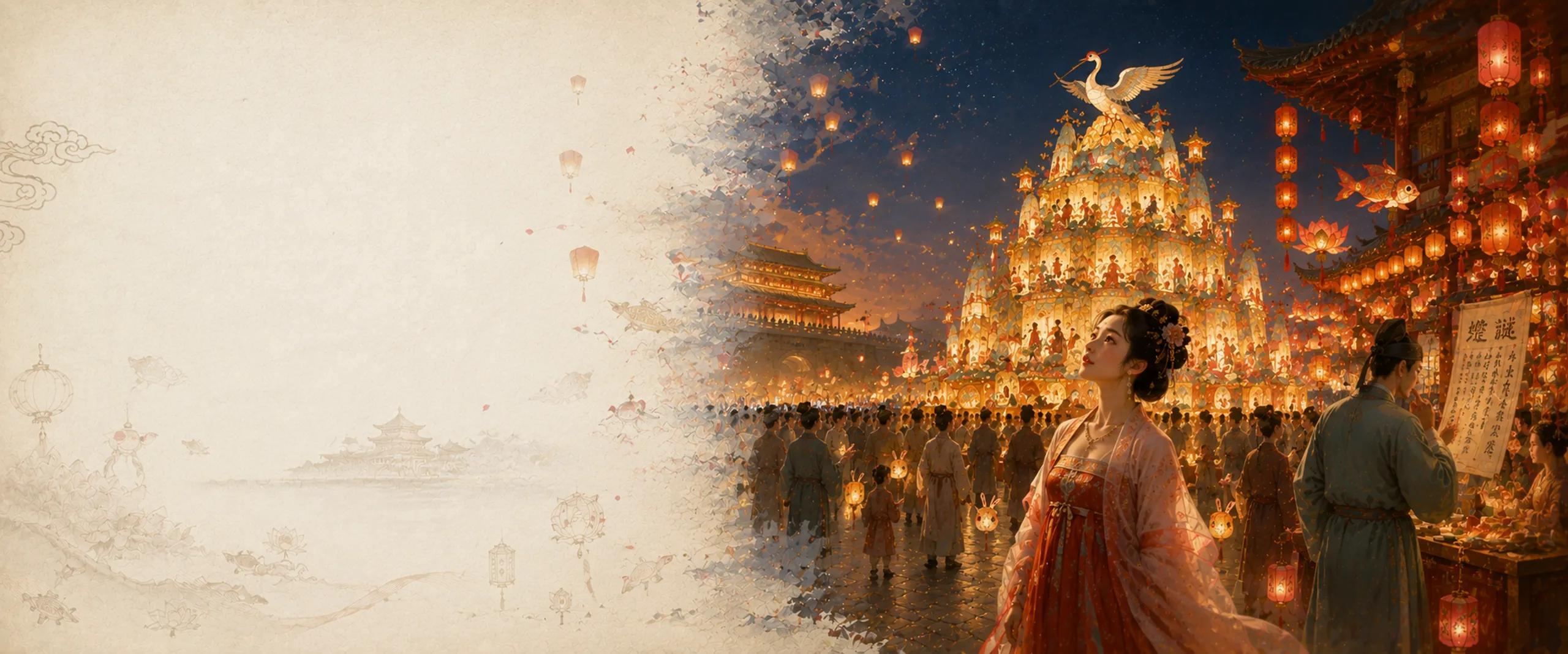
The Lantern Festival, also known as Shangyuan Festival (上元节) or the Festival of Lanterns, is the final major observance in the cycle of Spring Festival customs. The first lunar month is the opening month of the lunar calendar; yuan (元) means “beginning,” while xiao (宵) means “night.” The ancients therefore called the first full-moon night of the lunar new year the Lantern Festival. Customs such as admiring lanterns, solving lantern riddles, eating yuanxiao (元宵) or tangyuan (汤圆), and watching dragon and lion dances have been passed down for more than a thousand years. In 2008, the Lantern Festival folk customs were included in the second batch of China’s national intangible cultural heritage list. As Chinese culture has reached a wider global audience, the Lantern Festival has become a cultural celebration shared by many cities around the world—from the Lantern Festival at Canopy Market near London’s King’s Cross Station to the Lantern Festival parade in Manhattan Chinatown, from the Lantern Festival street fair in San Francisco Chinatown to Spring Festival concerts at the Sydney Opera House. In 2026, the Lantern Festival falls on March 3, the fifteenth day of the first lunar month, with celebrations held around the world from late February to early March. There is no need to travel all the way to China to experience the magnificent festive scene evoked by “火树银花合,星桥铁锁开.”
Event Schedule and Venues:
### Core Lantern Festival Dates
The Lantern Festival falls on the fifteenth day of the first lunar month, generally corresponding to mid-February through early March in the Gregorian calendar. Lantern displays often begin earlier, reaching a festive peak from the thirteenth day of the first lunar month and culminating on the evening of the fifteenth. Some lantern festivals continue through the sixteenth. The core schedule is as follows:
| Time | Activity | Description |
|---|---|---|
| From the twenty-third day of the twelfth lunar month | Lantern festivals across the country begin lighting up between Little New Year and Lunar New Year’s Eve | Events such as the Shanghai Yuyuan Lantern Festival and Xi’an City Wall Lantern Festival usually begin before the Spring Festival |
| Thirteenth day of the first lunar month | Lantern festivals and intangible cultural heritage performances begin opening nationwide | Known as the “day of lighting the lanterns”; some regions begin trial illuminations |
| Fourteenth day of the first lunar month | Warm-up programs for Lantern Festival gala branch venues and dragon-dance gatherings begin | Activities enter full swing nationwide |
| Fifteenth day of the first lunar month | Lantern Festival Day — admire lanterns, eat yuanxiao, solve lantern riddles | Festivities reach their peak across the country |
| Sixteenth day of the first lunar month | Some lantern festivals continue illuminating and temple fairs continue | In Xun County, Henan, the Shanhui celebration reaches its height on the sixteenth day |
### Traditional Lantern Festival Customs
The heart of the Lantern Festival lies in the word “nao (闹),” lively communal celebration—a single word that captures the festival’s boundless joy. Principal customs include:
| Custom | Description |
|---|---|
| Admiring Lanterns | The Lantern Festival is also known as the Festival of Lanterns. The custom of viewing lanterns began in the Western Han dynasty and flourished during the Sui and Tang. Large-scale lantern festivals are held nationwide, with thousands of lights shining brilliantly |
| Eating Yuanxiao / Tangyuan | The most representative food custom of the festival. In northern China, yuanxiao are traditionally “rolled,” while in southern China tangyuan are “wrapped”; both symbolize reunion and fulfillment |
| Solving Lantern Riddles | Riddles are hung from lanterns for visitors to solve, making this one of the festival’s most intellectually playful activities |
| Dragon and Lion Dances | Watching dragon dances forms a distinctly Chinese sense of Lantern Festival ritual. Records of dragon dances performed to pray for rain date back as early as the Han dynasty |
| Floating River Lanterns | In some areas, people release lanterns on rivers while making wishes |
| Walking Away Illnesses | On Lantern Festival night, women go out together and walk about in hopes of dispelling illness and misfortune |
### Major Recommended Events by Region
Lu County, Sichuan — National Dragon Dance Lantern Festival Celebration:
Lu County is known as the “Home of Chinese Dragon Culture.” Every year on the fifteenth day of the first lunar month, national-level intangible cultural heritage dragon-dance troupes from across China gather together with teams from Sichuan to perform on the same stage. Distinctive dragon-dance traditions from north and south—including the Fenghua Cloth Dragon of Zhejiang, Umbrella Dragon of western Hunan, Drunken Dragon of Zhongshan in Guangdong, Firecracker Dragon of Binyang in Guangxi, and Fire Dragon of Tongliang in Chongqing—join local teams in forming an extra-long parade formation. They perform along the city’s principal roads, creating the spectacular scene of “a thousand people dancing dragons and streets emptied by tens of thousands of spectators.”
Jingzhou, Hubei — Intangible Cultural Heritage Gathering of China’s Nine Famous Historic Cities:
The event “Lanterns Aglow in Jinan · Lantern Festival Celebration — Intangible Cultural Heritage Gathering of China’s Nine Famous Historic Cities” opens grandly at Jiuge Square in Jingzhou Garden Expo Park, located at the site of the ancient Chu capital of Jinan. Nine historic and culturally renowned cities—Jingzhou in Hubei, Xi’an in Shaanxi, Yuncheng in Shanxi, Shantou in Guangdong, Dezhou in Shandong, Guangzhou in Guangdong, Hangzhou in Zhejiang, Kaifeng in Henan, and Jiuquan in Gansu—bring together representative intangible cultural heritage traditions. Cultural and tourism ambassadors from all nine cities take turns appearing on stage, promoting their destinations in two-way exchanges across cities.
Ji’an, Jiangxi — Jiangxi Lantern Festival Dragon Dance Gathering:
The “Luling New Year, Most Auspicious Ji’an” Jiangxi Lantern Festival Dragon Dance Gathering opens at Luling Culture Square in Ji’an County and the Jizhou Kiln Scenic Area. Dozens of outstanding dragon-dance, lantern, and folk-performance troupes from all 11 prefecture-level cities in Jiangxi as well as neighboring provinces appear together. A 1.6-kilometer-long intangible cultural heritage parade moves along the main roads, while an intangible cultural heritage market with dozens of distinctive stalls brings together national-, provincial-, and municipal-level traditional crafts, foods, and cultural creative products.
CMG Lantern Festival Gala:
China Media Group’s Lantern Festival Gala follows the theme “Celebrating the Lantern Festival with Joy” and is broadcast live worldwide every year at 8:00 p.m. on the fifteenth day of the first lunar month. The gala features a main venue in Beijing and several branch venues; in previous years, these have included Harbin, Yiwu, Hefei, Yibin, Shenyang, Xi’an, Changsha, and other cities. Sixteen hosts appear together, presenting a rich program of song and dance, traditional opera, sketches, xiangsheng, magic, and more. Lantern viewing, lantern-riddle guessing, tangyuan making, and other Lantern Festival customs are woven throughout the program. Multi-platform simultaneous broadcast includes CCTV-1, CCTV-3, CCTV-4, CCTV-11, CCTV-15, 4K/8K ultra-high-definition channels, CCTV News, Yangshipin, and other platforms.
Shanghai — Multiple Lantern Festivals Across the City:
* Yuyuan Lantern Festival (late January to early March each year): set against the backdrop of Jiangnan gardens, combining Shanghai-style culture with zodiac themes
* Jinchao 8 Lane Shanghai-style Lantern Festival (late January to early March each year): free admission
* Luodian Warm Spring Lantern Festival (mid-February to early March each year): on Lantern Festival night, lights remain on until the early hours of the following morning
* Nanxiang Ancient Town Lantern Display (late January to early March each year): lively fish lanterns and zodiac-themed lanterns line the streets
* Intangible Cultural Heritage Fish-Lantern Parades: held in multiple commercial districts and cultural landmarks on Lantern Festival Day
* Lantern Riddles: museums and parks across the city establish interactive lantern-riddle areas
Other Recommended Destinations:
* Xun County, Henan: Xun County First Lunar Month Ancient Temple Fair — one of the largest traditional temple fairs in North China. The sixteenth day of the first lunar month is livelier than the fifteenth. Must-try foods include Xun County zimo and fenjiang fan
* Nanjing: Qinhuai Lantern Festival, held every first lunar month and included in the first batch of national intangible cultural heritage
* Zigong, Sichuan: Zigong International Dinosaur Lantern Festival, one of China’s largest lantern festivals
* Chengdu: Wuhou Shrine Grand Temple Fair lantern displays and Huanglongxi Ancient Town’s national intangible cultural heritage Fire Dragon Lantern Dance
* Xi’an: Grand Tang Mall Spring Festival Lantern Festival and City Wall Lantern Festival
* Datong: Datong Ancient Capital Lantern Festival
* Guangzhou: Guangdong–Hong Kong–Macao Greater Bay Area Lantern Festival and Guangfu Temple Fair
* Fuzhou: “Two Ma Together in Spring · Celebrating the Lantern Festival” Lantern Festival
Pre-Trip Preparation:
### Visas and Entry
Lantern Festival destinations across China are subject to the country’s unified visa policies:
* 240-hour visa-free transit for citizens of 54 countries: travelers may enjoy visa-free transit for up to 240 hours, with permitted stay areas covering most administrative regions of China.
* Tour groups from ASEAN countries: organized groups may enter visa-free through designated ports.
* Other nationalities: apply in advance for a tourist visa, or L visa, through the relevant Chinese embassy or consulate and ensure the passport remains valid for more than six months.
* Latest policies: before departure, consult the official website of China’s National Immigration Administration or the relevant local Chinese embassy or consulate.
### Adapting to the Climate
The Lantern Festival falls on the fifteenth day of the first lunar month, corresponding to mid-February through early March. China is then in the transition from winter to spring, with the following regional climate patterns:
| Region | Temperature Range | Climate Characteristics | Clothing Recommendations |
|---|---|---|---|
| North China (Beijing, Henan) | 0°C–12°C | Cold and dry, with large differences between morning and evening temperatures | Down jacket, thermal underwear, scarf, gloves |
| East China (Shanghai, Hangzhou) | 5°C–15°C | Damp cold, with lower perceived temperatures | Down jacket, thermal underwear, waterproof outerwear |
| South China (Guangzhou, Shenzhen) | 12°C–22°C | Mild and comfortable, with occasional rain | Light jacket, long-sleeved T-shirt, rain gear |
| Southwest China (Chengdu, Chongqing) | 8°C–16°C | Chilly and humid | Thick coat, thermal underwear, rain gear |
| Northeast China (Harbin) | -10°C–0°C | Severe cold | Extreme-cold-weather down jacket, snow boots, and full heavy thermal clothing |
| Northwest China (Xi’an, Lanzhou) | 0°C–12°C | Dry, with large day-night temperature differences | Down jacket, thermal underwear, scarf |
General Advice: During the Lantern Festival, most parts of China are still in late winter, so keeping warm is the highest priority. Northern regions are dry and cold and require wind protection, while southern regions are damp and chilly and require moisture protection. Temperatures drop further at night when visiting lantern festivals and temple fairs, so layered clothing—lighter layers inside and heavier layers outside—is recommended for easy adjustment between indoor and outdoor environments. Because evening outdoor activities can last for long periods, scarves, gloves, and warm hats are essential.
### Travel Insurance
It is strongly recommended to purchase travel insurance covering the following:
* Accidental injury and medical treatment for acute illness, including outpatient care
* Loss of or damage to personal belongings
* Travel delays or cancellations
### Currency and Payment
* Currency: Renminbi (CNY).
* Cash: Cash is often more reliable at lantern festivals, temple fairs, night markets, and similar venues. Carrying RMB 200–400 is recommended.
* Cards: Visa and MasterCard are accepted at major hotels and shopping centers.
* Mobile payment: Alipay and WeChat Pay are widely used throughout China.
### Communications and Internet
* Important: Popular lantern festivals and temple fairs can attract enormous crowds, and 4G/5G networks may become congested. It is strongly recommended to download offline maps in advance. Baidu Maps and AutoNavi are recommended; download maps for your destination cities while connected to Wi-Fi.
How to Get There:
### Major Event Destinations
The Lantern Festival is celebrated nationwide, and lantern fairs, temple fairs, and dragon-dance activities vary by region. Key recommended destinations include:
| Destination | Featured Activities | Transportation |
|---|---|---|
| Lu County, Sichuan | National Dragon Dance Lantern Festival Celebration — multiple national-level dragon-dance troupes performing together | Fly first to Chengdu / Chongqing, then take high-speed rail to Lu County |
| Jingzhou, Hubei | Intangible Cultural Heritage Gathering of China’s Nine Famous Historic Cities — traditions from nine cities presented together | Fly first to Yichang / Wuhan, then transfer by high-speed rail / road to Jingzhou |
| Ji’an, Jiangxi | Jiangxi Lantern Festival Dragon Dance Gathering — dozens of dragon-dance and lantern troupes | Fly first to Nanchang / Jinggangshan, then take high-speed rail to Ji’an |
| Shanghai | Yuyuan Lantern Festival, Jinchao 8 Lane Shanghai-style Lantern Festival, Luodian Warm Spring Lantern Festival | Pudong / Hongqiao airports; Hongqiao Railway Station |
| Nanjing | Qinhuai Lantern Festival — included in the first batch of national intangible cultural heritage | Nanjing Lukou Airport; Nanjing South Railway Station |
| Zigong, Sichuan | Zigong International Dinosaur Lantern Festival | Zigong Fengming Airport |
| Xi’an | Grand Tang Mall Spring Festival Lantern Festival and City Wall Lantern Festival | Xi’an Xianyang Airport; Xi’an North Railway Station |
| Chengdu | Wuhou Shrine Grand Temple Fair lantern displays and Huanglongxi Ancient Town Fire Dragon Lantern Dance | Shuangliu / Tianfu airports; Chengdu East Railway Station |
| Guangzhou | Guangdong–Hong Kong–Macao Greater Bay Area Lantern Festival and Guangfu Temple Fair | Guangzhou Baiyun Airport; Guangzhou South Railway Station |
| Fuzhou | “Two Ma Together in Spring · Celebrating the Lantern Festival” Lantern Festival | Fuzhou Changle Airport; Fuzhou Railway Station |
| Datong | Datong Ancient Capital Lantern Festival | Datong Yungang Airport; Datong South Railway Station |
| Xun County, Henan | Xun County First Lunar Month Ancient Temple Fair — one of the largest traditional temple fairs in North China | Fly first to Zhengzhou / Anyang, then transfer by high-speed rail to Hebi / Xun County |
### Special Transportation Reminders
The Lantern Festival falls near the end of Chunyun, just after the Spring Festival holiday, and in most years it is a working day rather than a statutory public holiday.
Flights / High-Speed Rail:
* Tickets to popular destinations such as Lu County, Jingzhou, Ji’an, Shanghai, Nanjing, and Zigong can be in high demand. Purchase in advance through the 12306 App or the Railway 12306 mini program.
* Cities hosting branch venues of the Lantern Festival Gala may experience heavier traffic pressure.
Driving:
* Important: Expressways are not toll-free during the Lantern Festival. Free expressway travel applies only during the four statutory holidays of the Spring Festival, Qingming Festival, Labor Day, and National Day.
* Roads leading to lantern festivals, temple fairs, and scenic areas may be congested, so depart early.
Urban Transportation Tips:
* During the Lantern Festival, traffic controls are implemented around major lantern festivals and temple fairs. Public transportation is recommended.
* Popular lantern-festival venues attract extremely large crowds, so arrive early.
* In Xun County, Henan, the sixteenth day of the first lunar month is livelier than the fifteenth. Buses, taxis, or bicycles are preferable.
Accommodation Reservations:
| Key Point | Recommendation |
|---|---|
| When to book | Accommodation is in high demand in popular destinations during the Lantern Festival. Book hotels two to three weeks in advance |
| Lu County, Sichuan | Lu County urban area |
| Jingzhou, Hubei | Central Jingzhou and areas around the Garden Expo Park |
| Ji’an, Jiangxi | Ji’an County urban area and areas around the Jizhou Kiln Scenic Area |
| Xun County, Henan | Guesthouses in Xun Ancient Town for walking access to the temple fair, or hotels in Qibin District for more balanced transport access |
| Shanghai | Around Yuyuan for the core lantern festival area, or Hongqiao / People’s Square for convenient transport |
| Nanjing | Around Confucius Temple / Qinhuai River for the core lantern festival area |
| Price Reference | Prices generally rise during peak season: budget hotels around RMB 200–500 per night, mid-range RMB 500–1,000, and high-end above RMB 1,000 |
| Booking Platforms | Major platforms such as Ctrip, Qunar, and Meituan; rooms with free cancellation are preferable |
| Distinctive Experience | Choose guesthouses in ancient towns or historic districts such as Xun Ancient Town or Huanglongxi Ancient Town, where lanterns can be seen from the window and temple fairs begin just outside the door |
Pre-Trip Packing Checklist:
| Category | Essential Items | Special Notes |
|---|---|---|
| Upper-body clothing | Down jacket, thermal underwear, sweater / fleece | Most of China remains cold during the Lantern Festival; northern regions are dry and cold, while southern regions are damp and chilly |
| Lower-body clothing | Thermal trousers, thick long pants | Evening lantern viewing involves long periods outdoors |
| Shoes | Non-slip insulated boots / athletic shoes | Lantern festivals and temple fairs require extensive walking; icy northern roads require non-slip soles |
| Accessories | Scarf, gloves, warm hat — essential | Evening outdoor lantern viewing can be very cold |
| Sun Protection | SPF30+ sunscreen | Snow in northern China strongly reflects ultraviolet radiation |
| Rain Gear | Folding umbrella — essential in southern China | Late winter in the south is often rainy |
| Medication | Cold medicine, gastrointestinal medicine, adhesive bandages | Useful for coping with climate changes and dietary differences |
| Electronics | Power bank, phone, camera | Night photography at lantern festivals consumes battery quickly |
| Storage | Small bag / waist pouch for documents and cash | Keep personal belongings secure in crowded areas |
| Other | Thermos, tissues / wet wipes | Outdoor activities may last for long periods |
Participation Rules:
### Lantern Festival Viewing Etiquette
Admiring lanterns is the central activity of the Lantern Festival. The following guidelines are recommended:
* Do not touch the lanterns: Lanterns are flammable objects. Do not touch or pull them.
* Maintain order: Lantern festivals can be extremely crowded. Follow on-site staff instructions, do not push, and do not create disturbances.
* Photography etiquette: Turn off the flash when photographing lanterns so as not to disturb other visitors. Before photographing local people in traditional clothing, smile and ask permission first.
* Child safety: Lantern festivals are high-risk places for children becoming separated from their families. Keep accompanying children under close supervision.
* Arrive early for a good viewing position: For free performances, arrive about one hour in advance to secure a place.
### Temple Fair and Folk Parade Etiquette
* Maintain order: Temple fairs and parades are crowded. Follow instructions from on-site staff.
* Performance etiquette: Watch dragon dances and intangible cultural heritage performances from designated areas and do not interfere with the program.
* Special reminder for the Xun County temple fair: The sixteenth day of the first lunar month is livelier than the fifteenth but also more crowded. Drivers must check traffic restrictions in advance.
### Lantern Riddles and Folk-Culture Experience Etiquette
* Lantern riddles: Feel free to participate. Correct answers often receive small prizes.
* Tangyuan-making experiences: Many places organize tangyuan-making activities where visitors can learn the traditional technique under guidance.
* River lantern safety: Release river lanterns only in designated areas. Watch your footing and keep away from the water’s edge.
### Photography Etiquette
* Ask permission: Before photographing local people in traditional clothing, intangible cultural heritage practitioners, elderly people, or children, smile and ask politely first.
* Respect portrait rights: Do not use photographs of others for commercial purposes without consent.
* Drone regulations: Flying drones over lantern festivals, temple fairs, and other crowded areas requires advance notification to local public security authorities.
### General Responsible Participation
* Protect the environment: Do not litter; keep scenic areas and natural surroundings clean.
* Maintain order: Queue patiently, do not cut in line, and avoid crowding.
* Waste sorting: Major Chinese cities have implemented waste-sorting systems. Dispose of rubbish according to local regulations.
Practical Emergency Information:
| Item | Contact / Notes |
|---|---|
| Emergency Numbers | Police 110, Fire 119, Ambulance 120 |
| Major Hospitals | Municipal and People’s Hospitals in major cities; emergency departments remain open 24 hours during the Lantern Festival |
| Tourist Police / Lost Property | Lantern festivals and temple fairs generally have permanent police posts. If valuables are lost, report immediately to the nearest police office |
| Tourist Information | Official platforms of local culture and tourism authorities |
| Time Zone | UTC+8, China Standard Time |
| Voltage / Plugs | 220V; plug types A / C / I |
Special Reminders:
* Lantern Festival date: The festival falls on the fifteenth day of the first lunar month each year, corresponding to mid-February through early March in the Gregorian calendar. Check the exact date for the year in advance.
* Expressways are not free: Expressways are not toll-free during the Lantern Festival. Toll-free travel applies only during the Spring Festival, Qingming Festival, Labor Day, and National Day statutory holidays.
* Lu County’s “Thousand-Person Dragon Dance”: The national dragon-dance Lantern Festival celebration is held in Lu County, Sichuan, where multiple national-level dragon-dance troupes and local teams form an extra-long parade formation. More than 60% of the participating traditions are national-level intangible cultural heritage, making it a must-visit destination for dragon-dance enthusiasts.
* Jingzhou Nine-City Intangible Cultural Heritage Gathering: Jingzhou, Hubei, brings together representative intangible cultural heritage traditions from nine historic and culturally renowned cities, creating a concentrated showcase of some of China’s most prominent living heritage.
* Xun County Temple Fair, Henan: One of North China’s largest traditional temple fairs. The sixteenth day of the first lunar month is livelier than the fifteenth but also more crowded. Accommodation should be booked in advance, and public transportation is preferable.
* North–south climate differences: Temperatures differ greatly across China during the Lantern Festival. The north is cold and dry, while the south is damp, chilly, and often rainy. Check destination-specific weather before departure and bring sufficient warm clothing.
* Lantern festival hours: Most lantern festivals reach their peak on Lantern Festival night, and some remain illuminated until the early hours of the following morning. Check exact lighting times and closing dates in advance.
* Health protection: Late winter and early spring are peak seasons for respiratory illnesses. Wearing masks in crowded places and washing hands frequently are recommended.
* Lantern Festival Gala broadcast: China Media Group’s Lantern Festival Gala is broadcast worldwide at 8:00 p.m. on the fifteenth day of the first lunar month, with simultaneous transmission across multiple platforms. Even those unable to attend in person can watch on television or online.
*May you experience the distinctive charm of Chinese culture amid brilliant lanterns and the full moon’s radiant light, and in the sweet softness of tangyuan and the playful ingenuity of lantern riddles, receive the heartfelt blessings of “family reunion and may all your wishes come true”!*
—-
Cultural Background:
The Lantern Festival originated during the Western Han dynasty and has a history of more than two thousand years. During the reign of Emperor Wu of Han, the fifteenth day of the first lunar month was designated as a day for worshipping the deity Taiyi (太一神). By the Eastern Han dynasty, after Buddhism had entered China, the custom of lighting lamps in worship of the Buddha on the fifteenth day of the first lunar month gradually merged with indigenous sacrificial practices. By the Sui and Tang dynasties, the Lantern Festival had become a grand celebration for the entire population, with lanterns filling the cities and song and dance continuing throughout the night.
The essence of the Lantern Festival lies in “nao yuanxiao (闹元宵),” celebrating the festival with lively communal festivities. Unlike the family-centered reunions of the Spring Festival, the Lantern Festival places greater emphasis on going out into public spaces and celebrating together. People admire lanterns, solve riddles, perform dragon and lion dances, walk on stilts, and dance yangge, bringing the Spring Festival season to a joyful and complete conclusion.
As Chinese communities spread across the world, Lantern Festival culture traveled with them. Today, the festival has become an important part of multicultural life in many countries:
* Europe: Canopy Market near King’s Cross Station in London hosts a Year of the Horse Lantern Festival, attracting large numbers of local residents and visitors.
* North America: Manhattan Chinatown in New York holds Lunar New Year firecracker festivities and Lantern Festival parades, while San Francisco Chinatown hosts a Lantern Festival street fair.
* Oceania: Sydney presents a series of “Happy Chinese New Year” events spanning major festive milestones including the Spring Festival and Lantern Festival.
* Asia: Chinese communities in Singapore, Malaysia, and elsewhere hold distinctive Lantern Festival activities such as lion dances, tossing mandarins, and lo hei / yusheng gatherings.
The year 2026 is the lunar Bingwu Year of the Horse (丙午马年), and horse motifs feature prominently in decorations and festivities around the world.
Major Celebration Cities:
| Continent | Country / Region | Core City | Featured Activities |
|---|---|---|---|
| Europe | United Kingdom | London | Year of the Horse Lantern Festival at Canopy Market near King’s Cross — more than 200 Chinese lanterns, hanfu parade, and contemporary Chinese-style Lantern Festival market |
| Switzerland | Zurich | Lantern Festival celebrations organized by local overseas Chinese communities and Chinese students | |
| France | Paris, Lyon | Belleville Lantern Festival and the “Family Affection Across China · Cultures of China, Festival of Spring” performances for overseas Chinese communities | |
| North America | United States | New York | Lantern Festival parade in Manhattan Chinatown and float parade in Brooklyn |
| United States | San Francisco | Chinatown Lantern Festival street fair on Grant Avenue and grand float parade | |
| United States | Seattle | Lantern Festival celebrations organized by local overseas Chinese communities | |
| Canada | Vancouver, Toronto | Lantern Festival galas and Buddhist temples distributing tangyuan | |
| Oceania | Australia | Sydney | “Happy Chinese New Year” series and Spring Festival concerts |
| Australia | Melbourne | Riverside Lantern Festival cultural market and Chinese community Lantern Festival gatherings | |
| New Zealand | Hamilton | Lantern Festival featuring lion dances, Kunqu opera, face-changing, magic, song, and dance | |
| Asia | Singapore | Singapore | Lion dances, flag performances at shopping centers, and lo hei |
| Malaysia | Kuala Lumpur | Petaling Street “Grand Lantern Festival Celebration” — more than 20 lion-dance teams, a hundred-person lo hei, and a Lantern Festival gala at Thean Hou Temple |
Recommended Activities by Destination:
### 3.1 London, United Kingdom
London’s Year of the Horse Lantern Festival is held from February 27 to March 1 at Canopy Market, near King’s Cross Station. The event combines pop-up performances, processions in traditional Chinese dress, and interactive cultural and artistic experiences, allowing visitors to immerse themselves in the atmosphere of the Chinese New Year. More than 200 Chinese lanterns of different forms are suspended throughout the venue, alongside displays of the character 福, paper-cut decorations, and other festive works. Folk singing, hanfu processions, traditional dance, and kung fu performances appear in succession, while hands-on experiences in calligraphy and seal carving, Yunnan woodblock printing, tea culture, and other traditional arts draw large crowds. A contemporary Chinese-style Lantern Festival market is also held, with more than 20 stalls offering food, tea and beverages, clothing, accessories, and other goods. Yunnan flower cakes, floral pastries, and similar specialties are especially popular.
As one of the events in the “Nihao! China” Spring Festival themed series, the Lantern Festival is jointly organized by Canopy Market and the UK Yunnan Culture Festival Organizing Committee, with special support from the China National Tourist Office in London.
Transport Tip: King’s Cross Station is one of London’s major transport hubs and is directly served by the Victoria, Piccadilly, Northern, Hammersmith & City, Metropolitan, and Circle Underground lines, as well as multiple rail services.
### 3.2 New York, United States
New York’s Lantern Festival celebrations are rich and varied, spanning the city’s two major Chinese communities in Manhattan and Brooklyn.
The Brooklyn Lunar New Year and Lantern Festival Float Parade takes place on February 28 in the Eighth Avenue Chinese community. Six floats lead the festive procession, departing from 60th Street on Eighth Avenue, continuing via Ninth Avenue, 50th Street, and Seventh Avenue before returning to Eighth Avenue. The main stage is located at Eighth Avenue and 60th Street.
Manhattan Chinatown holds its Lunar New Year parade and celebration on March 1, featuring dragon and lion dances and a large-scale float procession. On Lantern Festival Day itself, local Chinese community organizations hold a seniors’ celebration banquet at the Golden Unicorn restaurant in Chinatown.
In addition, the 300-foot Ferris wheel known as the “Eye of New York” is illuminated in festive Chinese red and remains lit through the Lantern Festival.
Transport Tip: Manhattan Chinatown is accessible from Canal St Station on the N/Q/R/W/J/Z/6 lines. Brooklyn’s Eighth Avenue Chinatown can be reached from 8th Ave Station on the N line.
### 3.3 San Francisco, United States
The San Francisco Chinatown Lantern Festival Street Fair is an important part of the city’s Lunar New Year celebrations. In 2026, the fair is held on March 7–8 along Chinatown’s principal commercial streets, including Grant Avenue and Clay Street.
During the street fair, dozens of stalls line several streets of Chinatown, selling traditional New Year decorations, handicrafts, auspicious ornaments, seasonal goods, and a wide range of snacks. Displays of paper-cutting, Spring Festival couplets, and festive handicrafts showcase elements of traditional Chinese culture. Many Chinatown shops and restaurants also offer seasonal merchandise and specialty foods.
In the evening, the largest Lunar New Year float parade outside Asia unfolds through the city center, drawing hundreds of thousands of spectators along the route. Fo Guang Shan’s San Bao Temple and the San Francisco Association set up booths for the third consecutive year, including a “Lighting Lamps for Blessings” area where visitors can light lamps and pray for peace and good fortune for themselves and their families. Local schools also hold Lantern Festival celebrations, with performers in traditional Chinese qipao appearing on stage.
Transport Tip: San Francisco Chinatown is located downtown and can be reached by multiple bus routes.
### 3.4 Sydney, Australia
Sydney’s 2026 “Happy Chinese New Year” series runs from January 20 to February 27, covering major festive milestones including the Spring Festival and Lantern Festival. Through exhibitions, performances, folk-culture experiences, and public cultural events, the program is presented at landmark venues including Sydney Town Hall, the Sydney Opera House, and the Australian National Maritime Museum.
As a major part of the series, the “2026 Happy Chinese New Year · Spring Festival Concert” is held on February 21 at the Sydney Opera House, featuring artists from both China and Australia.
Around the Lantern Festival, ensembles such as Sydney Ru Ge Chamber Group present large-scale song-and-dance celebrations under themes such as “Celebrating Reunion · Spring Festival and Lantern Festival Gala,” creating a dialogue between Chinese and Western arts with reunion as its spirit, spring as its brush, and harmony as its resonance.
Transport Tip: The Sydney Opera House is directly accessible from Circular Quay by train, ferry, or light rail.
### 3.5 Kuala Lumpur, Malaysia
Malaysia has a large Chinese community, and its Lantern Festival celebrations possess distinctive local characteristics.
The Petaling Street “Grand Lantern Festival Celebration” takes place on March 3. More than 20 lion-dance teams gather for the festivities, and for the first time the event includes a “Hundred-Person Lo Hei” session. Lo hei, a distinctive Spring Festival tradition among Malaysian Chinese, symbolizes “rising prosperity and ever-greater success with every toss.” The celebration has now entered its 40th year.
The Kuala Lumpur Thean Hou Temple Lantern Festival Gala, themed “Celebrating Together, Joy Filling the Lantern Festival,” is held on the evening of March 3. The program includes high-pole lion dance performances, 24 Festive Drums, diabolo, singers, acrobatics by the Beijing Acrobatic Art Troupe, xiangsheng, violin performances, and more. A spectacular fireworks finale fills the night sky with color. The venue also presents lantern displays, a lantern-riddle evening, and activities such as “Find a Good Match in the Year of the Horse.” The Astronomical Society provides stargazing equipment, allowing visitors to admire the moon while exploring astronomical wonders.
Serdang, Kajang, and other areas hold Lantern Festival cultural celebrations and activities such as tossing mandarins in hopes of finding romance during the same period.
Transport Tip: Petaling Street is located in central Kuala Lumpur and is within walking distance of Pasar Seni LRT Station. Thean Hou Temple can be reached by bus or taxi.
### 3.6 Singapore
During the Lantern Festival, Singapore holds dragon dances, lion dances, and other celebrations, allowing local residents and overseas Chinese communities to share in the festive atmosphere. On March 3, Lantern Festival Day, celebrations are held outside a shopping center, where performers present lion dances and large-flag routines.
Singapore’s Parliament also joins the festive atmosphere. During Committee of Supply debates on departmental budgets, Members of Parliament take time to participate together in lo hei. In keeping with the Year of the Horse, the yusheng is arranged in the shape of a horse.
### 3.7 Other Regions
Toronto, Canada: On the fifteenth day of the first lunar month, Cham Shan Temple of the Buddhist Association of Canada holds a warm-hearted yuanxiao distribution, serving bowls of steaming tangyuan to Chinese residents from Toronto and surrounding areas. Mississauga also hosts a “Happy Chinese New Year” Lantern Festival gala.
Vancouver, Canada: The “Auspicious Horse Returns Through the Clouds · Reunion Night” 2026 Lantern Festival Gala opens on March 8 at River Rock Theatre in Richmond. Fo Guang Shan Vancouver also organizes a series of celebrations, including a lively market and multicultural experiences.
Hamilton, New Zealand: A Lantern Festival is held on February 28. The atmosphere is festive and lively, with an auspicious red horse becoming a popular photo spot. Lion dances, Kunqu opera, magic, face-changing, song, dance, and other performances fill the program.
Paris, France: Belleville hosts a Lantern Festival from February 21 to 22. The Jardin d’Acclimatation in western Paris presents its third Lantern Festival, illuminating 2,000 lanterns across three hectares after dark. Lyon hosts the “Family Affection Across China · Cultures of China, Festival of Spring” performance for overseas Chinese communities on Lantern Festival night.
Pre-Trip Packing Checklist:
| Category | Recommended Items | Notes |
|---|---|---|
| Clothing | Dress for the local climate — late February and early March remain cold in the Northern Hemisphere, so bring a down jacket; late summer in the Southern Hemisphere calls for lightweight clothing | Outdoor activities may last for long periods; prepare for warmth or sun protection |
| Shoes | Comfortable, non-slip athletic shoes | Lantern festivals and parades often involve long periods of standing and walking |
| Camera / Phone | For photographing lanterns, float parades, dragon and lion dances, and fireworks | Prepare suitable equipment for night photography |
| Cash | Small amounts in local currency | Some temple-fair stalls and food markets may not accept cards |
| Power Bank | Portable charger | Outdoor activities may last for many hours |
| Translation App | Google Translate and similar apps | Useful for communicating with local Chinese residents or stallholders |
Participation Etiquette and Cultural Respect:
### 5.1 General Lantern Festival Etiquette
* Festival greetings: Say “元宵节快乐” (Happy Lantern Festival) when greeting others.
* Eating tangyuan / yuanxiao: Tangyuan symbolize reunion and fulfillment. If invited to celebrate with a Chinese family, feel free to enjoy them.
* What to wear: Red is an auspicious festive color, and wearing red clothing can help you blend into the celebratory atmosphere.
### 5.2 Etiquette at Lantern Festivals and Temple Fairs
* Do not touch the lanterns: Lanterns are flammable objects. Do not touch or pull them.
* Maintain order: Lantern festivals and temple fairs can be crowded. Follow the instructions of on-site staff.
* Photography etiquette: Turn off the flash when photographing lanterns. Before photographing Chinese participants in traditional clothing, first smile and gesture politely to ask permission.
* Lantern riddles: Feel free to participate. Correct answers often receive small prizes.
### 5.3 Parade Etiquette
* Watch from designated areas: Stay within officially marked viewing zones and do not enter the parade route.
* Child safety: Parades and lantern festivals are high-risk places for children becoming separated from their families. Keep accompanying children under close supervision.
* Protect your belongings: Dense crowds require extra attention to personal items.
Travel Tips:
| Item | Notes |
|---|---|
| Best time to participate | The peak period is generally one to two weeks before and after Lantern Festival Day, March 3 |
| Plan ahead | Popular cities such as London, New York, and Sydney attract large crowds during events, so plan itineraries in advance |
| Transport | Traffic restrictions are often imposed around event venues, so public transportation is recommended |
| Weather | Late February and early March remain cold in the Northern Hemisphere, while it is late summer in the Southern Hemisphere; check local weather before traveling |
| Local culture | Lantern Festival celebrations in different countries incorporate local cultural traditions, offering distinctive experiences — Malaysia’s lo hei and Singapore’s yusheng tossing are notable examples |
Special Reminders:
* The Lantern Festival is a global celebration: You do not need to travel to China to experience its atmosphere. London, New York, San Francisco, Sydney, Kuala Lumpur, Singapore, and many other cities hold large-scale celebrations.
* 2026 is the Year of the Horse: Horse motifs appear prominently in decorations and activities.
* Dates vary by location: Some cities begin their activities several weeks before Lantern Festival Day, such as Sydney’s “Happy Chinese New Year” series, which begins on January 20. Check official local schedules in advance.
* Do not miss London’s Lantern Festival: The Year of the Horse Lantern Festival at Canopy Market near King’s Cross combines more than 200 Chinese lanterns, a hanfu parade, and a contemporary Chinese-style market, making it one of Europe’s largest Lantern Festival celebrations.
* Distinctive Malaysian experience: The Hundred-Person Lo Hei at Petaling Street’s “Grand Lantern Festival Celebration” in Kuala Lumpur is a distinctive Lantern Festival tradition among Malaysian Chinese.
* San Francisco Grand Parade: San Francisco’s Lunar New Year Grand Parade is the largest event of its kind outside Asia and is held after the Lantern Festival.
* Sydney Opera House Spring Festival Concert: The Sydney Opera House hosts a Spring Festival concert before the Lantern Festival, featuring artists from China and Australia.
*May you experience the distinctive charm of the Lantern Festival in different corners of the world, and amid brilliant lanterns and joyful parades, receive the heartfelt blessings of “family reunion and may all your wishes come true”!*
Readers’ Comments
Calendar and traditional culture enthusiasts from around the world, sharing the same moon.
Sign in or register to join the conversation. Your comment account is created automatically the first time you use a connected account.
No comments yet
Share your thoughts with readers around the world.