Lantern Festival

Lantern FestivalGlobal Spread

「 火树银花合,星桥铁锁开。 」

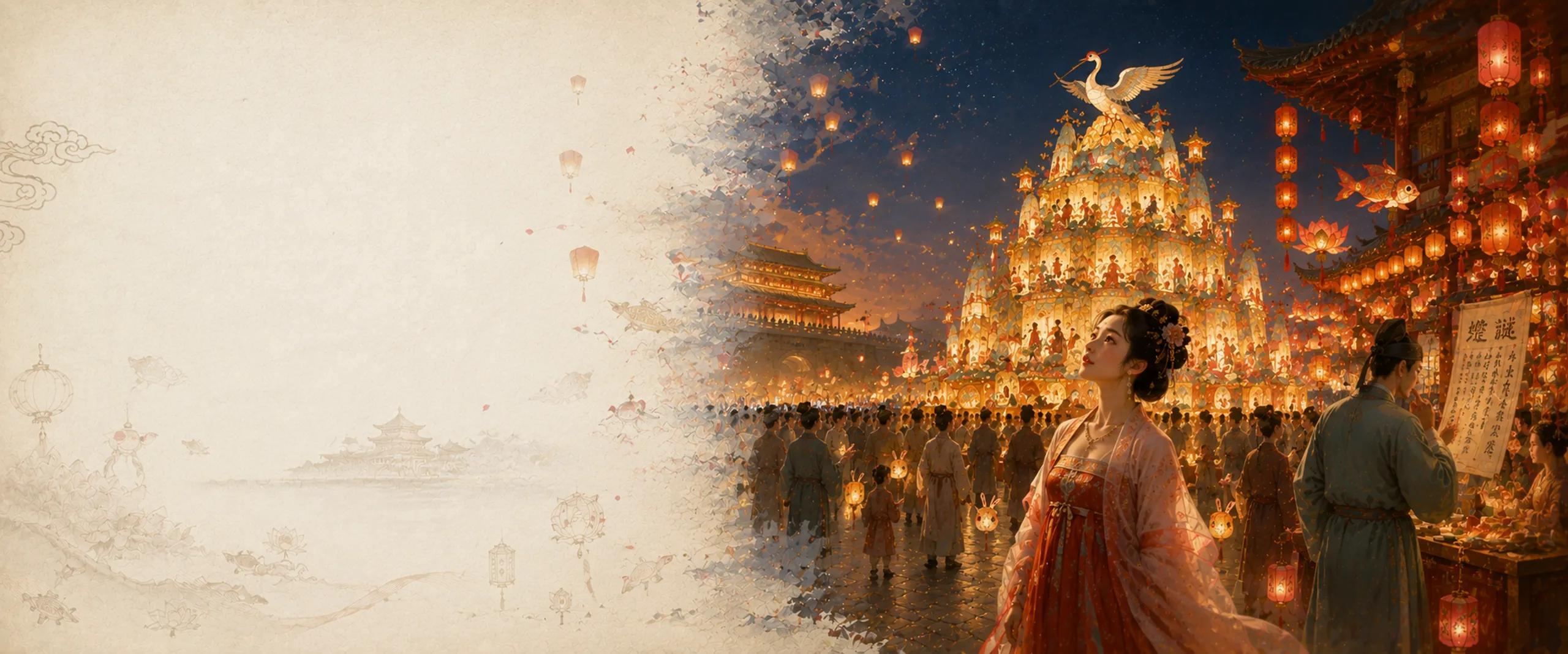
The Lantern Festival originated in the Han dynasty and had become a grand carnival for all by the Tang dynasty. Su Weidao, in his poem “The Night of the 15th of the First Month” (《正月十五夜》), wrote: “火树银花合,星桥铁锁开。” (*The fiery trees…

The Lantern Festival centers on the customs of viewing lanterns, guessing lantern riddles, and eating yuanxiao, and its overseas spread is equally vibrant. During the 2026 Lantern Festival, Milan’s Chinatown held a grand dragon-and-lion dance celebration at the Arco della Pace square, attracting more than 20,000 residents and visitors. More than 30 overseas Chinese associations in the Florence consular district jointly organized Lantern Festival celebrations, while Confucius Institutes set up cultural workshops and photo spots, drawing large numbers of tourists and local residents. London held a Year of the Horse Lantern Festival, with more than 200 Chinese lanterns of various forms suspended throughout the venue; folk singing, hanfu parades, traditional dances, and kung fu performances followed one another, while hands-on activities in calligraphy, seal carving, tea arts, and other traditions attracted large crowds. Seattle in the United States, Zurich in Switzerland, and other places likewise held festive activities—the dragon and lion dances leapt through the streets, while ensembles of traditional Chinese instruments filled the air with lingering melodies. The All-China Federation of Returned Overseas Chinese also organized the global online Lantern Festival gala for Chinese youth, “亲情中华·童心欢畅”, using the Lantern Festival as a bond to deepen overseas Chinese young people’s identification with Chinese culture. With lantern light and reunion as its theme, the Lantern Festival is illuminating the “Chinese red” across the five continents and the four seas.

Lantern Festival / Global Spread
120 days until Lantern Festival February 20, 2027 · Lunar 正月十五

Celebrated Worldwide

Regional Highlights
01

Asia

Asia is the region where Lantern Festival culture has spread most deeply and extensively. Southeast Asia is home to the largest concentration of overseas Chinese communities; here, the Lantern Festival has not only preserved Chinese traditions in their full form, but has also developed distinctive expressions through its integration with local cultures.

Cambodia

Cambodia is one of the countries where the overseas Lantern Festival retains the strongest sense of ritual. Chinese ancestors who migrated to Cambodia hundreds and thousands of years ago deeply rooted the traditions of ancestor worship and deity processions from their homelands in the local society. Ancestor worship is the central Lantern Festival ritual among Cambodian Chinese families: households prepare elaborate offerings in advance; roast suckling pig gleams with a glossy sheen, roast chicken gives off a rich aroma, and locally abundant fruits and traditional pastries are carefully arranged on the offering table. Khmer traditional foods and fresh flowers are also often placed on both sides of the table; this seemingly casual combination is precisely a warm portrait of generations of coexistence between Cambodian and Chinese cultures.

The most imposing Lantern Festival activity is the “deity procession”. In Phnom Penh’s Orussey commercial district, banners fill the sky and gongs and drums thunder. Wherever the procession passes, lion dancers leap with joy and the public lines the streets to welcome it. The deities respectfully invited by the “乩童” include Tianhou Shengmu, Baosheng Dadi, Nezha the Third Prince, and the Great Sage Equal to Heaven. Following long-standing custom, householders along the route bow devoutly as the divine procession passes, while the 乩童 use traditional movements to bestow blessings and ward off misfortune for merchants and residents. Today, many young Chinese Cambodians have also joined the procession—some carry lanterns, while others beat gongs and drums. The active participation of Khmer residents has further transformed this Chinese tradition into a vehicle for cultural integration between Cambodia and China. The Lantern Festival deity procession is not merely a religious ritual, but also an important bond through which overseas Chinese communities transmit their traditional beliefs and strengthen communal ties.

Malaysia

In Malaysia, the Lantern Festival is a distinctive “grand matchmaking occasion”. Unmarried men and women take part in the activity of “throwing mandarins”: women write their names and contact information on citrus fruits and throw them into rivers or lakes, while men compete to retrieve them with long poles. This matchmaking method, somewhat like “opening a mystery box”, adds an element of fun and is popular among young people. Today, with changing times, variations involving bananas, apples, and even durians have also appeared. Lin Suhui, a Malaysian student from a Chinese family, said that her grandparents came from Chaozhou, Guangdong, and that her family still preserves Spring Festival customs from southern China; for her entire family, the Lantern Festival is one of the most important festivals. In Malaysia, in addition to dragon and lion dances, the custom of “抛柑接蕉” is also highly distinctive: young Chinese men and women write their names and contact information on bananas or citrus fruits. This combination of the Lantern Festival’s “romantic gene” with the local culture of Nanyang has created a distinctive “localized” matchmaking tradition.

Indonesia

Indonesian Chinese Li Fuyuan showed through video the local Lantern Festival deity procession in Tegal: seven deity sedan chairs were carried by the procession from the temple all the way to Tegal Port, with solemnity and devotion permeating the thunder of gongs and drums. He said that people from Minnan regard deity processions as a form of spiritual sustenance; even after “putting down roots and spreading their branches” in Nanyang, the customs of celebrating the Lantern Festival and staging votive operas for the gods have never ceased, and remain the bond that connects them closely to their homeland. Today, he has taken the baton from his father and continues to pass on Minnan customs.

On March 2, 2026, the “亲情中华·四海同春” touring performance, jointly organized by the All-China Federation of Returned Overseas Chinese and the Chinese Embassy in Indonesia, was held in Bandung. Artistic groups from China presented wonderful performances to local audiences, while more than a thousand representatives from different sectors of Indonesian society and members of the overseas Chinese community celebrated the Lantern Festival together. Zhuang Junqin, chairman of the West Java branch of the Indonesian Chinese Chamber of Commerce, said: “I thought it was wonderful. I hope a program like this can come to Bandung again next time. It is a source of pride for us Chinese.”

Thailand

Chen Yaohua, a member of the Chinese community in Thailand, took part in a Lantern Festival activity organized by the Chinese community in Bangkok and was captivated by the Teochew opera performed there. Teochew opera contains many classic scenes depicting Lantern Festival lantern viewing—the audience watches the play, but what it savors is the full range of human life. In addition to listening to opera, older members of the overseas Chinese community shared Lantern Festival customs from their ancestral hometowns; community members gathered to steam “寿桃包” and paint lanterns, kneading their hopes for the coming year into the dough and painting them onto the lantern surfaces.

Zeng Yuanjian, a member of the Chinese community in Vietnam, told reporters that the Lantern Festival atmosphere in Vietnam is strong. In addition to dragon and lion dances and lantern viewing, many Chinese chambers of commerce also organize Qiong opera and Teochew opera performances, bringing to those far from home the sounds and sentiments of their ancestral homeland. The Lantern Festival in Hoi An Ancient Town is renowned far and wide—lanterns are among the most popular decorations in Vietnam, and people believe that red lanterns are not merely decorative, but can also bring good luck and happiness.

Singapore

Most Chinese Singaporeans trace their ancestry to southern China, and therefore eat tangyuan during the Lantern Festival. The filled tangyuan “鸭母捻”, originating in the Chaoshan region of Guangdong, is a common everyday snack in Singapore; once cooked, this kind of tangyuan floats on sweet soup. Whenever the Lantern Festival arrives, Chinatown is the place where the festive atmosphere is strongest; all kinds of lanterns fill the area, with some even suspended in the air.

Japan

The evolution of the Lantern Festival in Japan is the most distinctive branch in the entire East Asian tradition. Japan’s traditional festivals also include a “Lantern Festival,” called Koshōgatsu in Japanese, in contrast to Ōshōgatsu on January 1. During the Meiji period, Japan replaced the lunar calendar with the Gregorian calendar; the first month shifted from the first lunar month to January in the Gregorian calendar, and the Koshōgatsu corresponding to the Lantern Festival was likewise fixed on January 15.

Unlike in China, Japanese people do not have the custom of eating yuanxiao or tangyuan on Koshōgatsu, but do traditionally eat red-bean porridge. According to tradition, the red color of the beans possesses a supernatural power to drive away evil influences. In addition, people in Japan pray on Koshōgatsu for good harvests in sericulture and agriculture. Japan’s Lantern Festival is called Koshōgatsu, and its customs include welcoming the deity of the year and ancestral spirits, as well as praying for abundant harvests.

Although Japan’s own Lantern Festival has already become detached from the lunar-calendar date, Chinatowns in different regions still hold grand lantern festivals on the fifteenth day of the first lunar month. Yokohama Chinatown organizes Lantern Festival lantern-viewing activities every year, and local Chinese residents and overseas Chinese often go there to join in the festivities. Lantern viewing begins around dusk, and the entire street is decorated in brilliant colors. Nagasaki Shinchi Chinatown also holds the “Nagasaki Lantern Festival”, a grand celebration whose festive atmosphere even draws in many Japanese visitors. The Nagasaki festival centers on lanterns and originated in Shinchi Chinatown, where the Chinese population was concentrated.

South Korea

The Lantern Festival also corresponds to a major traditional festival in South Korea, where it is known as Daeboreum. Koreans do not celebrate the day by eating yuanxiao, but instead eat five-grain rice, nuts, and other seasonal foods. The representative food of the Korean Lantern Festival is five-grain rice, symbolizing an abundant harvest, accompanied by various healthy wild vegetables, walnuts, peanuts, chestnuts, and other foods. Koreans believe that eating nuts during the Lantern Festival can strengthen the teeth. According to Korean folk custom, the fifteenth day of the first lunar month is marked by eating five-grain rice and nine kinds of vegetables: on the night before the Lantern Festival, rice made with five kinds of grain is prepared; nine kinds of dried vegetables harvested and dried the previous year are soaked in water and then mixed with seasonings to make cold dishes; the dried vegetables and five-grain rice are wrapped in vegetable leaves and seaweed before being eaten, symbolizing the taking in of the new year’s blessings. According to legend, five-grain rice should first be placed in the cattle trough so that the cattle can eat their fill, thereby ensuring a great harvest in the new year. It is also said that one should eat five-grain rice from more than three families with different surnames in order to have good luck throughout the year, and for this reason there is a Korean custom of sharing five-grain rice. After getting up on the day of the Lantern Festival, Koreans also eat hard-shelled nuts and drink “清耳酒”, also known as “耳明酒”. On the fifteenth day of the first lunar month, various activities are held in Korea to drive away evil spirits, dispel misfortune, and pray for health.

Vietnam

Vietnam has likewise been deeply influenced by Chinese culture, and the Lantern Festival atmosphere there is strong. Members of the Chinese community in Vietnam explain that, in addition to dragon and lion dances and lantern viewing, many Chinese chambers of commerce organize Qiong opera and Teochew opera performances, bringing to those far from home the sounds and sentiments of their ancestral homeland. The Lantern Festival of Hoi An Ancient Town is renowned far and wide—lanterns are among the most popular decorations in Vietnam, and people believe that red lanterns are not merely decorative, but can also bring good luck and happiness. Lantern markets and fairs are held in many places during the Festival.

02

Europe

Europe is the region where “cultural encounter” is most clearly visible in the overseas spread of the Lantern Festival. In Italy, the United Kingdom, Switzerland, Serbia, Germany, and other countries, the Lantern Festival shows a tendency to shift from “an internal activity of the Chinese community” to “a cultural event of mainstream society”.

Italy

During the 2026 Lantern Festival, celebrations in Italy were especially grand. On March 1, Milan Chinatown’s grand dragon-and-lion dance celebration was held at the Arco della Pace square and attracted more than 20,000 residents and visitors. The Winter Paralympic mascot also appeared and interacted with performers and spectators. On the same day, Florence held the grand “迎新春·闹元宵” celebration. Chinese Consul General in Florence Yin Qi, Italian Deputy Prime Minister Salvini, and others attended, while the event attracted more than 10,000 local residents and international visitors.

Local resident Francesca Rione said: “It is a brilliant and colorful festival, like a Chinese version of Carnival, and it allows everyone to gain a deeper understanding of Chinese culture.” Italian Deputy Prime Minister and Minister of Infrastructure and Sustainable Transport Matteo Salvini said: “I think the more deeply one studies Chinese culture, the more fascinating it becomes.” The attendance and personal remarks of the Italian deputy prime minister marked the Lantern Festival’s transformation in Italy from an internal Chinese community activity into a cultural event attracting broad participation from mainstream society.

United Kingdom

In London, the Lantern Festival is likewise an important festival for the Chinese community. During the Lantern Festival, Chinatown is decorated with lanterns and festive ornaments, while dragon and lion dances leap through the streets. In London, Birmingham, and other cities, Chinese associations celebrate the Lantern Festival every year in a wide variety of ways—eating tangyuan, viewing lanterns, and staging dragon and lion dances. In Chinatown in particular, the festive atmosphere is especially strong.

Switzerland — Eastern Rhythms in Zurich

Zurich, Switzerland, also held festive activities during the 2026 Lantern Festival. Traditional Chinese instrumental ensembles filled the air with lingering melodies, while the flowing garments of hanfu fluttered in the wind, presenting a spirited and vibrant scene. Although Switzerland’s Chinese community is smaller than those of the United Kingdom and France, the lights of the Lantern Festival still shine in the heart of Europe.

Serbia

In Serbia, the Lantern Festival is celebrated in a distinctive way. On March 1, 2026, a special Lantern Festival screening under “欢乐春节” — “Chinese Film Week” was held in the northern Serbian city of Zrenjanin. Through watching Chinese films and taking part in interactive experiences, local residents were able to experience the appeal of Chinese culture at close range. Lalić, director of Belgrade’s Belt and Road Institute, said: “We have noticed that many people who have watched Chinese films later look for opportunities to travel to China, because they are deeply attracted by Chinese culture and history.” The event also featured a Chinese traditional-culture experience area, where many children showed strong interest in Chinese culture. Local child Stella said: “I tried Chinese calligraphy. It looks simple, but it is actually very difficult. I am very excited, and I like it very much.”

Germany

In Germany, Lantern Festival celebrations are likewise rich and varied. Lu Xin, head of a Chinese arts troupe in North Rhine-Westphalia, said that although festival customs and cultural atmospheres overseas differ from those in China, the functions of the Lantern Festival in transmitting culture, bringing communities together, carrying homesickness, and promoting exchange remain the same. For overseas Chinese, the Lantern Festival is an important time to remember their homeland and miss their loved ones, and is also an expression of identity and cultural confidence. Lu Xin also told reporters that in Germany, growing numbers of second- and third-generation Chinese young people are joining the celebrations dressed in traditional clothing such as hanfu and qipao. “Overseas Chinese communities make careful preparations and continue the festival traditions. The joyful Lantern Festival atmosphere also encourages young people of Chinese descent to take an interest in Chinese culture.” In Antwerp in Belgium, Madrid in Spain, and other places, Lantern Festival temple fairs are often held, with stalls displaying food, handicrafts, calligraphy, and more. Some cultural centers and Chinese associations also organize cultural exhibitions and lectures.

03

The Americas

The United States has a large Chinese community, and during the Lantern Festival, Chinatowns in major cities present exceptionally lively scenes.

San Francisco

San Francisco’s Chinatown is the oldest Chinatown in North America and also the largest Chinese community in the world outside Asia. Every Lantern Festival, a parade is held from around five in the afternoon until evening. In New York, Chicago, Los Angeles, and other cities, Chinese associations celebrate the Lantern Festival every year in rich and varied ways—eating tangyuan, viewing lanterns, and staging dragon and lion dances—bringing the festive atmosphere to its height. Many Chinese also choose to visit temple fairs to make wishes, hoping that in the new year they will be full of vigor and that their wishes will come true.

New York

The Lantern Festival float parade in New York’s Chinatown is particularly distinctive. In the 2024 parade, not only did Tang Sanzang and Sun Wukong join the festivities, but each float had its own characteristics: the Moutai float had the strongest New Year atmosphere, the Red Bull float was the most DJ-like—mixing music while handing out Red Bull drinks—and the Salesforce float was so high-energy that the whole vehicle kept shaking. This combination of a traditional Chinese festival with the creativity of modern commercial brands is precisely a vivid reflection of the localized evolution of Lantern Festival culture in the United States. In Chinatown, the festive atmosphere is especially intense: gongs and drums thunder, firecrackers erupt, and lion-dance troupes take to the streets, performing blessings in front of shops and wishing people flourishing lives and ever-better fortune. Chuang Yen Monastery, New York’s largest Buddhist monastery, is also a good place to visit during the Lantern Festival.

Seattle

During the 2026 Lantern Festival, Seattle in the United States also held festive activities. Dragon and lion dances leapt through the streets, while the flowing garments of hanfu fluttered in the wind. The Lantern Festival celebration organized by the Seattle Emerald City Chinese Parents Association has become an important local cultural event.

Canada

Chinese communities in Canada also organize rich and varied activities during the Lantern Festival. Overseas Chinese in Canada celebrate by eating yuanxiao, watching lion dances, and guessing lantern riddles, offering blessings for the new year amid reunion and joyful gatherings. Lantern Festival celebrations among Chinese communities in Canada include Vancouver’s LunarFest and celebrations in Toronto’s Chinatown. Art exhibitions and other activities also add cultural depth to the Lantern Festival. In Vancouver, overseas Chinese of Chaoshan origin still organize the traditional coming-of-age ceremony “出花园” for young people. These customs have crossed mountains and seas: some come from the ancestral homeland, while others have taken root overseas and gradually evolved into new cultural traditions.

04

Oceania

Auckland’s Lantern Festival in New Zealand is one of the largest Spring Festival celebrations in the Southern Hemisphere. During the 2026 Lantern Festival, the four-day Year of the Horse lantern festival attracted many visitors. More than 500 lanterns illuminated the night sky, among which the “Auspicious Horse” lantern was especially eye-catching: it was inspired by the Eastern Han “Horse Treading on a Flying Swallow” and drew on the mane style of the Tang-dynasty “five-flowered horse”; the main form was supplemented with auspicious-cloud and ruyi motifs, creating an energetic upward-reaching silhouette symbolizing good fortune and progress. The lantern installations also included the twelve zodiac animals and birds returning to their nests; fish lanterns and bird lanterns of various forms complemented one another among the tree shadows. Chinese student Zeng Tianyi, who went to view the lanterns, said that people of different ethnic groups had gathered there, and that she also took the opportunity to explain to foreign friends the positive meanings of the horse, dragon, and tiger in Chinese culture. In Sydney, Australia, Chinese communities also organize lantern displays, cultural performances, and food markets during the Lantern Festival, blending with the sea breeze of the Southern Hemisphere’s early summer to create a distinctive festive landscape.

05

Africa

Africa is a new frontier in the spread of the Lantern Festival. During the 2026 Lantern Festival, celebrations in Ghana, West Africa, attracted particular attention.

In Accra, the capital of Ghana, the Chinese community and Ghanaian friends jointly held a grand Lantern Festival gala in the forecourt of the Parliament House. The event showcased Chinese folk arts and culture, including dance and musical performances by cultural groups such as the Anhui Performing Arts Group. Dragon and lion dances leapt and turned through the air, while the deity procession and blessing rituals were both solemn and lively. According to overseas Chinese resident Zhang Siqi, the year coincided with the China-Africa Year of People-to-People Exchanges; in addition to song and dance performances, the gala featured lacquer fans, rubbing prints, hoop rolling, Chinese chess, and other hands-on activities, allowing local residents to experience the appeal of Chinese culture at close range. In the nearby food area, the aroma of famous snacks from major hometowns of overseas Chinese filled the air, while community members gathered to taste the flavors of home and talk about homesickness.

Li Yang, Chargé d’Affaires of the Chinese Embassy in Ghana, said that the full moon of the Lantern Festival connects the hearts of all Chinese people with the homeland and reflects the Chinese nation’s longing for reunion, prosperity, and peace for the country and its people. That year marked the 66th anniversary of diplomatic relations between China and Ghana, the 70th anniversary of diplomatic relations between China and African countries, and the China-Africa Year of People-to-People Exchanges. Ghanaian Minister for Food and Agriculture Eric Opoku said that Ghana welcomed Chinese investors to establish partnerships in its large-scale agricultural transformation agenda. Ghanaian Deputy Minister of Defence Ernest Brogya Genfi conveyed President Mahama’s Lantern Festival greetings to the Chinese community and praised the enormous contributions the Chinese community has made to Ghana’s economic development through investment in manufacturing, commerce, hospitality, and other sectors. The Lantern Festival gala’s entry into Ghana’s Parliament House marked the festival’s attainment of official-level cultural recognition in Africa.

Mutual Learning Among Civilizations

In-Depth Feature

The Lantern Festival has gradually moved from being a traditional festival of the Chinese nation toward the wider world. This process has followed a distinctive path different from that of the Spring Festival: if the global spread of the Spring Festival takes “family reunion” as its emotional core, then the global spread of the Lantern Festival takes “lantern light” as its visual symbol and diverse forms such as “deity processions,” “throwing mandarins,” and “lantern festivals” as cultural vehicles, taking root and growing in different parts of the world.

The overseas spread of the Lantern Festival presents several clear characteristics: the preservation of ritual, localized innovation, cross-cultural dialogue, and intergenerational transmission.

The Preservation of Ritual

In Cambodia, Lantern Festival deity processions have been passed down for decades, led by the Federation of Khmer Chinese in Cambodia and temple committees, with assistance from local governments. In the processions, lion-dance troupes leap and roll, while large gong-and-drum ensembles beat out powerful rhythms. This ancient ritual continues to retain vigorous vitality amid the noise of the modern city. In Germany, increasing numbers of second- and third-generation Chinese young people join the celebrations wearing traditional clothing such as hanfu and qipao. This preservation of ritual is the foundation of cultural identity among overseas Chinese communities—no matter where in the world they have migrated, Chinese people reaffirm through the lantern lights of the Lantern Festival their spiritual connection with their homeland.

Localized Innovation

Malaysia’s “throwing mandarins” combines the Lantern Festival’s “romantic gene” with local culture, creating a distinctive matchmaking activity similar to “opening a mystery box.” In Cambodia’s deity processions, locally distinctive motorbike trailers are converted into parade floats. At New Zealand’s Lantern Festival, the “Auspicious Horse” lantern is inspired by the Eastern Han “Horse Treading on a Flying Swallow” and draws on the mane style of the Tang-dynasty “five-flowered horse”—a new interpretation of Chinese cultural symbols in the Southern Hemisphere. In Italy, local residents have called the Lantern Festival “the Chinese version of Carnival.” These localized innovations prevent the Lantern Festival from becoming a closed cultural “enclave”; instead, it becomes an open cultural “site”—preserving the genes of Chinese tradition while growing new branches and leaves in new cultural soil.

Cross-Cultural Dialogue

In Ghana, the Lantern Festival gala has become an important platform for China-Africa people-to-people exchange. In Serbia, the special Lantern Festival screening under “Chinese Film Week” allowed local residents to experience Chinese culture through film. In Indonesia, Lantern Festival deity processions attract large numbers of local residents who watch and cheer, and some even imitate Chinese participants by joining their palms together to pray for blessings. In Italy, Deputy Prime Minister Salvini personally attended a Lantern Festival event and offered wishes for “great fortune in the Year of the Horse.” The Lantern Festival is not only a festival of Chinese communities; it is gradually becoming a window through which local people can understand Chinese culture. As one young South African woman participating in an event said, the Spring Festival is “not only China’s Spring Festival, but also the world’s Spring Festival”—and the same is true of the Lantern Festival.

Intergenerational Transmission

Overseas, the transmission of the Lantern Festival is facing both the challenges and opportunities of second- and third-generation Chinese communities. In Germany, more and more young people participate in celebrations wearing traditional clothing. In Cambodia, many young Chinese Cambodians have joined deity processions and, through direct participation, come to understand the cultural meanings behind Lantern Festival customs. In Indonesia, Li Fuyuan has taken the baton from his father and continues to pass down Minnan customs. The 2026 global online Lantern Festival gala for Chinese youth was also an intergenerational cultural relay spanning the five continents. These young faces are the future of the Lantern Festival’s overseas transmission.

A Relay in the Cloud

In-Depth Feature

On March 3, 2026, the fifteenth day of the first lunar month, a cultural celebration crossing mountains and seas and bringing together young people of Chinese descent from five continents—the 2026 global online Lantern Festival gala “亲情中华·童心欢畅”—was successfully broadcast worldwide through platforms including Haiwainet and Chinese Headlines. The event was organized by the All-China Federation of Returned Overseas Chinese under the theme “共同的根 共同的魂 共同的梦”, using the traditional Lantern Festival as a bond to deepen overseas Chinese young people’s identification with Chinese culture.

The gala opened with remarks by Wang Linggui, chairman of the All-China Federation of Returned Overseas Chinese. Wang extended festive greetings to young people of Chinese descent and their families around the world, expressing the hope that they would consciously take up the mission of cultural transmission, gain knowledge, build friendships through the event, and share China’s long and enduring civilization with friends in countries around the world. The online Lantern Festival gala was divided into five chapters: “灯溯上元·启幕”, “灯舞鱼龙·民俗”, “灯赋华章·诗词”, “灯暖万家·团圆”, and “灯耀未来·馀响”. From the origins of the festival to displays of folk customs, from poetry games of 飞花令 to stories of tracing one’s roots, the program used digital means to present the complete cultural lineage of the Lantern Festival to young people of Chinese descent around the world.

The event successfully attracted the active participation of more than 70 Chinese-language schools and overseas Chinese associations from 31 countries across five continents, including the United States, Canada, Australia, New Zealand, the United Kingdom, the Netherlands, the Philippines, Japan, South Africa, and Brazil. Organizers received nearly 400 works, with close to 2,000 participants, and a total running time of more than 1,100 minutes, covering martial arts, dance, vocal music, traditional instrumental music, opera, recitation, and other artistic forms.

The online Lantern Festival gala is not an isolated case. In recent years, the “Lantern Festival in the Cloud” has become an important way for young people of Chinese descent overseas to take part in festival celebrations. From guessing lantern riddles to 飞花令, from poetry recitation to traditional instrumental ensembles, digital technology has broken through geographical barriers, allowing young people of Chinese descent on five continents to share the same “Lantern Festival moon” at the same moment. This new model of “celebrating the festival in the cloud” was not only a product of the pandemic era, but after the pandemic has also evolved into a normalized form of cultural connection—allowing young people of Chinese descent scattered around the world to no longer become distant from traditional festivals simply because of geographical separation.

Closing Note

Lingering Notes

The global spread of the Lantern Festival is a road of lantern light stretching from ancient Chang’an in China to the five continents of the world. Its inclusion in 2006 on China’s national list of intangible cultural heritage marked the Lantern Festival’s movement from a folk festival into national protection; its widespread transmission across dozens of countries and regions around the world, meanwhile, demonstrates that “lantern light” and “reunion” can cross languages and national borders.

Unlike the Spring Festival’s “bidding farewell to the old and welcoming the new,” the overseas spread of the Lantern Festival takes “lantern light” as its warmest cultural symbol and “completeness” as its most universal emotional bond—lantern light needs no translation; reunion is a longing shared by humanity. Tangyuan needs no explanation; completeness is a pursuit shared by all. No matter where one may be, a lantern can illuminate the heart; no matter the culture, the desire for family reunion and a fulfilled life is universal.

In Asia, Cambodia’s deity processions move through the streets and lanes of Phnom Penh; young Malaysians “throw mandarins” beside rivers and lakes in search of a good match; Chinese families in Indonesia stage votive operas on Lantern Festival night; and the Lantern Festival traditions of Japan and South Korea have developed distinctive local characteristics over the long course of time. In Europe, 20,000 residents and visitors gather at Milan’s Arco della Pace square to witness the brilliance of Chinese lantern light; the lanterns of London’s Chinatown illuminate the night sky of a foreign land; and cinema screens in Serbia carry the stories of the Lantern Festival. In the Americas, float parades in the Chinatowns of San Francisco and New York draw people of different skin colors to stop and watch. In Oceania, more than 500 lanterns in Auckland, New Zealand, illuminate the summer night of the Southern Hemisphere. In Africa, the Lantern Festival gala before Ghana’s Parliament House sounds a new movement in China-Africa people-to-people exchange.

More moving still is that, even as the Lantern Festival’s lights illuminate the world, the festival has never forgotten its roots—at its core, the Lantern Festival has always been about “reunion” and “completeness.” Like the lanterns blooming in the night sky, they cross mountains and seas yet remain as bright as ever; they cross cultures yet remain as warm as before. When Chinese communities around the world look up together at the same full moon on Lantern Festival night, and when people of different skin colors share in the beauty of Chinese lantern light, that is the Chinese nation, in its own way, offering its deepest and most enduring declaration of “reunion” and “completeness.” The lights of the Lantern Festival are illuminating every corner of the world.

—

[Language: es]

Continue exploring Lantern Festival culture

Readers’ Comments

Calendar and traditional culture enthusiasts from around the world, sharing the same moon.

Sign in or register to join the conversation. Your comment account is created automatically the first time you use a connected account.