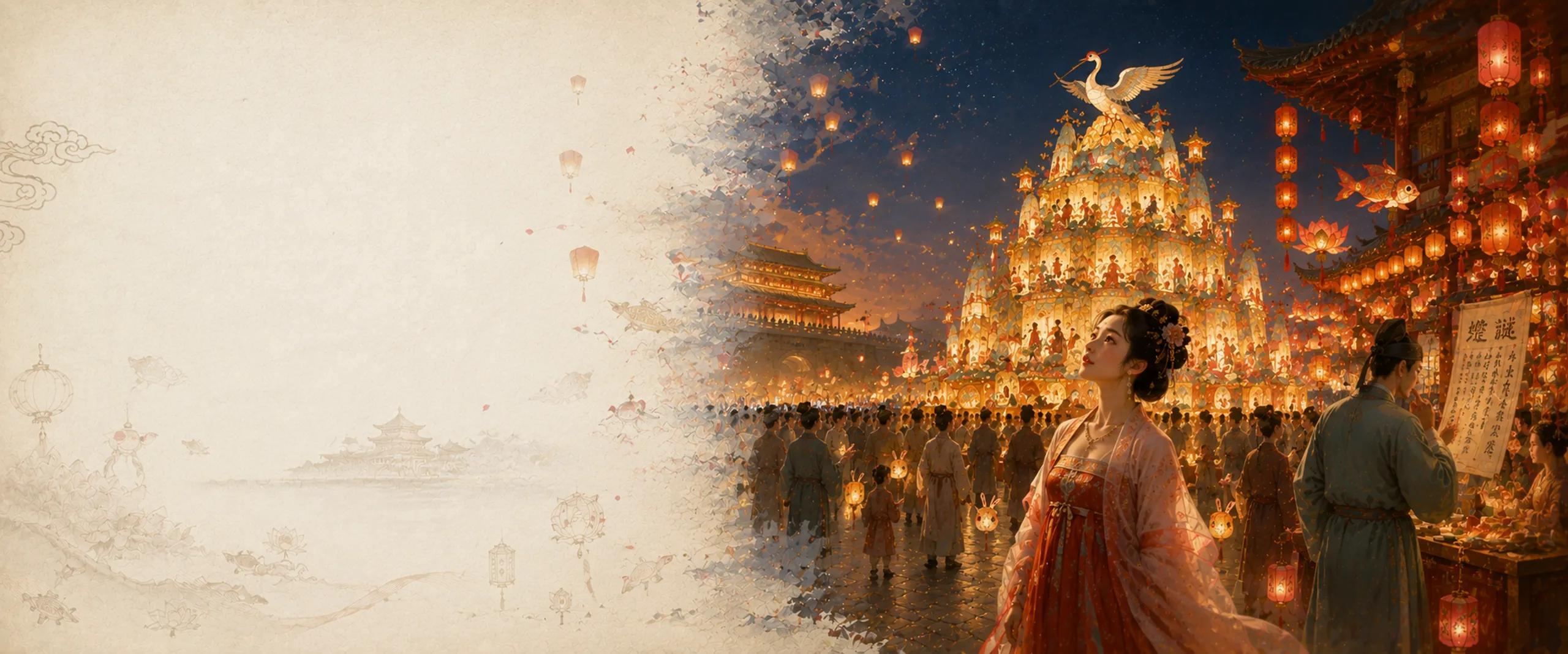
The origins of the Lantern Festival are not singular but the result of the gradual fusion of multiple cultural sources over a long historical period. These sources include the ancient star‑worshipping and liaoji (torch‑burning) traditions, the Taiyi deity worship of the pre‑Qin Chu people, Emperor Wu of Han’s all‑night ritual at Ganquan Palace, the Daoist “Three Yuan” belief system, Emperor Ming of Eastern Han’s decree to “light lanterns to honour the Buddha,” and folk legends such as the “Pacification of the Lü Clan” and the “Maiden Yuanxiao.” Converging from different directions, they jointly formed the foundation of the Lantern Festival.
Ancient Star Worship and Liaoji Traditions
Before the Taiyi deity worship, the Daoist “Three Yuan” doctrine, and the Buddhist lantern‑lighting tradition, the origins of the Lantern Festival can be traced even further back—to the ancient star‑worshipping and liaoji (torch‑burning) traditions.
The festival’s origins are likely related to the star worship of ancient peoples, who lit lanterns to pray for the protection of the stars, particularly the North Star (Taiyi). Their prayers centred on two things: human reproduction (fertility) and material production (agriculture and sericulture). These two concerns were the most essential survival concerns of agrarian society.
Some scholars believe that the Lantern Festival lantern customs originated from ancient sky‑worshipping rituals. Sky worship was a form of deity worship, and the veneration of celestial gods emerged as early as ancient times. Other scholars suggest that the festival originated from the pre‑Qin “court torch worship of heaven” ritual, with lanterns evolving from the bonfires used in that ritual. Court torch worship (庭燎) was an ancient ceremony in which torches were lit in courtyards to illuminate and worship celestial deities—its core elements, firelight and sacrifice, were carried forward in the festival’s lanterns. Another view holds that the festival originated from the “liaoji” (燎祭)—a ritual of burning fields to drive away insects and animals and pray for a bountiful harvest.
The Lantern Festival can be traced back to the customs of the Chu people in the pre‑Qin period. The Chu people would worship the “Taiyi deity”—the god who presided over all creation in their cosmology—on the 15th of the first month. Emperor Wen of Han, as a descendant of the Chu people, officially named the 15th of the first month, on which the Taiyi deity was worshipped, the Lantern Festival. This lineage traces the festival’s origins from the Han dynasty back to pre‑Qin Chu culture.
The Lantern Festival originated from the ancient folk custom of lighting lanterns for blessings; its festive forms evolved gradually over a long historical process. The “15th of the first month” symbolises the day when winter ends and spring arrives—on this day, farmers would first offer sacrifices to the sky and moon, praying for favourable weather and a bountiful harvest. This gratitude toward the deities of heaven and earth and this hope for the coming harvest constitute the festival’s most ancient cultural genes.
The Taiyi Deity Worship
Among the various theories of the Lantern Festival’s origin, the “Taiyi deity worship origin theory” is the most influential.
Taiyi, also known as Taiyi or Taibin, was the most honoured among the celestial deities, ranking above the Five Emperors. Qu Yuan, in his “Nine Songs · The Eastern Sovereign Taiyi” (《九歌·东皇泰一》), already recorded the folk custom of worshipping Taiyi. Taiyi commanded nine dragons and possessed the power to control human fortunes, including droughts, floods, famines, and plagues. As a great agricultural nation, ancient China naturally revered Taiyi for the sake of national peace and prosperity. It is said that from the time of Qin Shi Huang, grand ceremonies were held each year to pray to Taiyi for favourable weather and health and longevity.
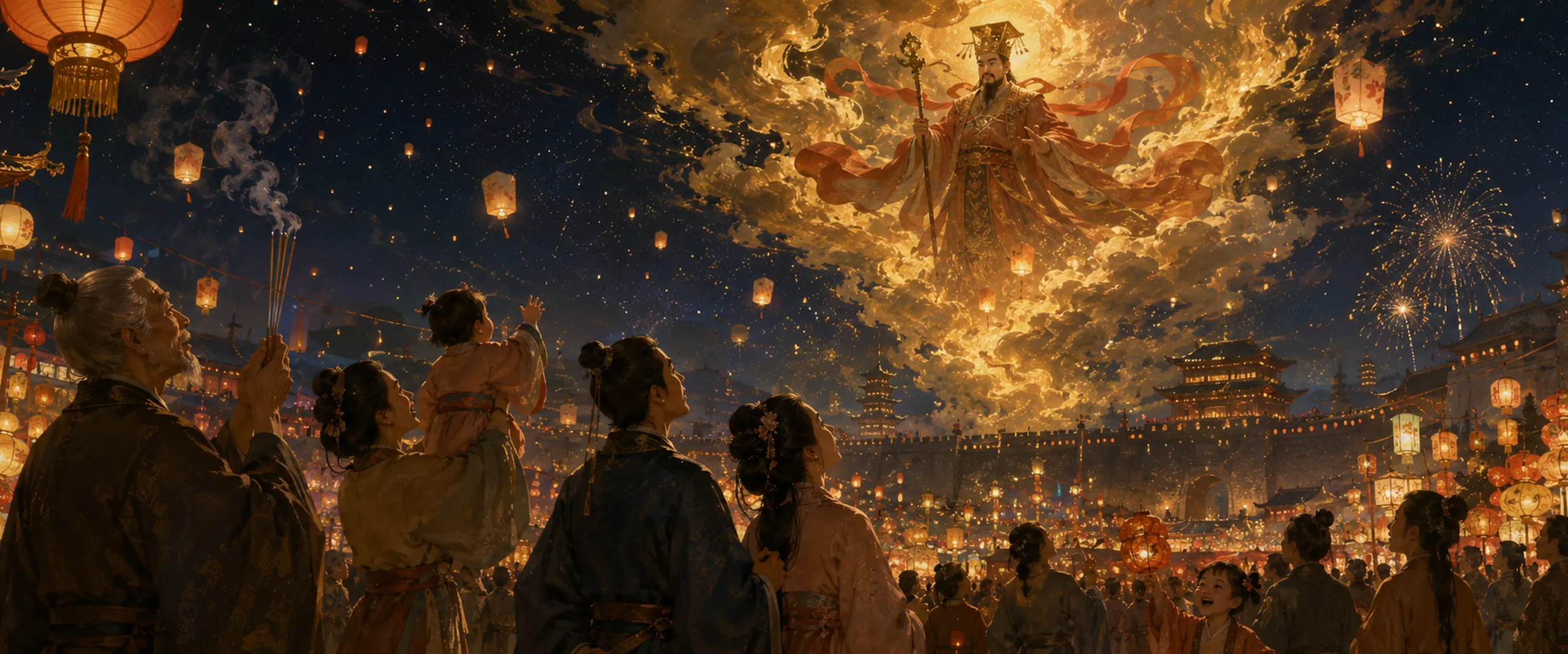
Emperor Wu of Han “particularly revered the spirits in worship.” According to the “Book of Han · Treatise on Suburban Sacrifices,” a man of Bo named Miao Ji petitioned to offer sacrifices to Taiyi, saying, “The most honoured among celestial deities is Taiyi, whose assistants are the Five Emperors. In ancient times, the Son of Heaven sacrificed to Taiyi in the southeastern suburbs in spring and autumn.” Emperor Wu then ordered the Grand Minister of Sacrifices to establish a shrine for Taiyi in the southeastern suburbs of Chang’an for year‑round worship. Later, in the third year of Yuanshou, “he also built the Ganquan Palace, with an altar chamber in the centre, where images of heaven, earth, Taiyi, and various spirits were painted, and sacrificial vessels were placed to invoke the celestial gods.” Emperor Wu’s worship of Taiyi was extremely solemn, timed precisely on Shangyuan, beginning at dusk and continuing until dawn the next day.
According to the “Records of the Grand Historian · Treatise on Music”: “The Han court customarily sacrificed to Taiyi at Ganquan on the first xin day of the first month, performing the ceremony at night from dusk until dawn.” The “Book of Han · Treatise on Rites and Music” also records: “When Emperor Wu established the suburban sacrifice rituals, he worshipped Taiyi at Ganquan, in the position of Qian”; “on the first xin day of the first month, he performed the rites at the Circular Mound of Ganquan, with seventy boys and girls singing together, from dusk until dawn.” Sima Qian also recorded the same in the “Records of the Grand Historian · Treatise on Music.”
Ouyang Xun of the Tang dynasty, in his “Art and Literature Collection · Seasons” (《艺文类聚·岁时》), records: “The ‘Records of the Grand Historian’ says: ‘The Han court sacrificed to Taiyi on the wangri, from dusk until dawn.’ Today’s night tours and lantern‑viewing are a vestige of this.” Tang Xu Jian’s “Beginner’s Notes” and Northern Song Li Fang’s “Imperial Readings of the Taiping Era” contain similar records, tracing the night tours and lantern‑viewing of later times back to the Han dynasty’s all‑night sacrifices to Taiyi on the 15th of the first month. Song Hong Mai, in his essay “Lantern Lighting on Shangyuan,” also said: “The Han court customarily sacrificed to Taiyi at Ganquan on the first xin day of the first month, from dusk until dawn; today’s night tours and lantern‑viewing on the wangri of the first month are a vestige of that.”
The Lantern Festival originated from the Taiyi deity worship at Ganquan Palace in the Han dynasty. Chunhua, as the site of Ganquan Palace, is considered the birthplace of the festival. In terms of timing, the sacrifice to Taiyi was held on the first xin day of the first month—an auspicious day in the first ten days of the month, falling between the 1st and 10th depending on the year. Although the day of the sacrifice was not necessarily the 15th, its all‑night lantern‑burning ritual provided a direct model for the later lantern tradition.
The Daoist “Three Yuan” Doctrine
Daoism provided the Lantern Festival with another complete system of meaning—the “Three Yuan” belief.
Daoism established the doctrine of the “Three Officials” of Heaven, Earth, and Water (or Man). Daoism designated the 15th of the first month as Shangyuan, the 15th of the seventh month as Zhongyuan, and the 15th of the tenth month as Xiayuan—collectively called the “Three Yuan.” Daoism reveres the Heavenly Official, the Earthly Official, and the Water Official, believing that the Heavenly Official bestows blessings, the Earthly Official pardons sins, and the Water Official relieves calamities. The Three Yuan are paired with the Three Officials—the Heavenly Official was born on the 15th of the first month, the Earthly Official on the 15th of the seventh month, and the Water Official on the 15th of the tenth month. The Heavenly Official delights in joy, hence lanterns are lit on Shangyuan.
The origin of Shangyuan is recorded in the “Miscellaneous Records of the Seasons” as following Daoist tradition. The “Encyclopedia of the Seasons,” volume 10, quoting Lü Yuanming’s “Miscellaneous Records of the Seasons,” states: “Daoists customarily take the 15th of the first month as Shangyuan.” According to the “Essentials of Emperor Yuan of Liang”: “Shangyuan is the day when the Heavenly Official bestows blessings.” The Heavenly Official is a messenger sent by the celestial court to descend to the human world to inspect and bestow blessings.
To welcome the Heavenly Official, every household would light lanterns on that day to guide the celestial messenger—a practice that became a custom. The custom of lighting lanterns on the festival derives precisely from the Daoist “Three Yuan” doctrine; Shangyuan contains the meaning of “the first full moon night of the new year.” The name Shangyuan was established through Daoist belief, while the name Yuanxiao evolved from the festival’s core activities—nighttime lanterns and food. Daoists explained the festival’s origin as “the Heavenly Official bestows blessings on Shangyuan,” making the Lantern Festival a festival centred on Daoist activities.
The Buddhist Lantern‑Lighting Tradition
The introduction of Buddhism injected another important cultural element into the Lantern Festival—the religious tradition of lighting lanterns to honour the Buddha.
During the reign of Emperor Ming of the Eastern Han, Buddhism was introduced to China. Emperor Ming, who promoted Buddhism, heard that Buddhists observed the practice of monks viewing Buddha relics and lighting lanterns to honour the Buddha on the 15th of the first month. He ordered that lanterns be lit in the palace and temples on that night, and that both officials and common people should hang lanterns, thus establishing the tradition of lantern‑viewing. The “Records of the Western Regions” states that in Magadha, India, monks gathered on the 15th of the first month to “view the Buddha relics as they emitted light and rained flowers.” Emperor Ming, to honour the Buddha’s teachings, ordered that on the night of the 15th of the first month, lanterns be lit in the palace and temples to “illuminate and honour the Buddha.” The “Encyclopedia of the Seasons,” volume 10, citing the “Brief History of Monasticism · Han Dharma Tradition,” states: “The 30th day of the twelfth month in the Western Regions corresponds to the wangri of the first month in China, called the Great Shennong Transformation Month. Emperor Ming of Han ordered lanterns to be lit to signify the great illumination of the Buddha’s teachings.”
In Buddhist doctrine, the lamp symbolises wisdom and light. The ritual of lighting lanterns as offerings to the Buddha entered China with the eastward transmission of Buddhism, coinciding with the 15th of the first month, infusing the festival’s lanterns with new religious significance. Although the religious aspect of lighting lanterns to honour the Buddha gradually faded, the custom of “lighting lanterns to honour the Buddha” left behind the tradition of hanging lanterns, enriching the festival’s meaning.
The influence of Buddhist and Daoist cultures gradually spread the custom of lighting lanterns on the night of the 15th of the first month throughout China. During the Six Dynasties, Sui, and Tang periods, the lantern fires on the wangri of the first month burned ever brighter. Thereafter, the Lantern Festival underwent a process of diffusion from the court to the people, and from the Central Plains to the whole country.
Folk Legends
In addition to the above origin theories with clear documentary evidence, several folk legends about the Lantern Festival’s origins circulate among the people. Though not necessarily historically accurate, they interpret the festival’s cultural connotations through vivid stories.
#### The “Pacification of the Lü Clan” Legend
One widely circulated account holds that the Lantern Festival was established by Emperor Wen of Han to commemorate the “Pacification of the Lü Clan.” After the death of Han Gaozu (Liu Bang), his son Liu Ying ascended the throne as Emperor Hui of Han. The young emperor was weak‑willed, and power fell into the hands of Empress Dowager Lü. The empress dowager monopolised the court, turning the Liu clan’s realm into the Lü clan’s realm, arousing great indignation among veteran ministers and Liu clan members. After the empress dowager’s death, the Lü clan members grew fearful of being harmed and marginalised. They secretly gathered at General Lü Lu’s residence to plot a rebellion. Prince Liu Xiang of Qi, together with founding ministers Zhou Bo, Chen Ping, and others, devised a plan to strip Lü Lu of his military command, and the “Lü Clan Rebellion” was completely suppressed. Emperor Wen of Han then declared the 15th of the first month, when the rebellion was put down, as a day of celebration with the people, with every household in the capital hanging lanterns. Although the suppression of the Lü Clan is historical fact, the claim that Emperor Wen established the Lantern Festival on that day lacks documentary evidence and remains merely a legend.
#### The “Maiden Yuanxiao” Legend
Another widely told legend concerns the custom of eating yuanxiao (tangyuan). It is said that Emperor Wu of Han had a favoured minister named Dongfang Shuo, who was kind and witty. One winter, after several days of heavy snow, Dongfang Shuo went to the imperial garden to pluck plum blossoms for the emperor. Entering the garden, he found a palace maid weeping profusely and preparing to throw herself into a well. Dongfang Shuo saved her and asked what was wrong. The maid, named Yuanxiao, had been separated from her family for a long time after entering the palace; as winter ended and spring approached, she missed her family even more deeply, feeling that she could not fulfil her filial duty to her parents and would rather die. Dongfang Shuo promised to find a way for her to reunite with her family. He then set up a fortune‑telling stall on the streets of Chang’an, where many people drew slips reading “On the 16th of the first month, you will be consumed by fire.” The news soon reached Emperor Wu.
Dongfang Shuo falsely told the emperor that the Fire God, by order of the Jade Emperor, would burn Chang’an on the 15th of the first month. The only way to escape this calamity was to have the palace maid “Yuanxiao” make many tangyuan—which the Fire God loved—on that day, and to have all subjects hang lanterns as offerings. The emperor agreed, and thus Yuanxiao was able to leave the palace to make tangyuan, while the whole city of Chang’an was decorated with lanterns and fireworks. When Yuanxiao’s family came into the city to view the lanterns, they finally saw their beloved relative. From then on, the customs of eating tangyuan and viewing lanterns on the 15th of the first month were established.
Readers’ Comments
Calendar and traditional culture enthusiasts from around the world, sharing the same moon.
Sign in or register to join the conversation. Your comment account is created automatically the first time you use a connected account.
No comments yet
Share your thoughts with readers around the world.