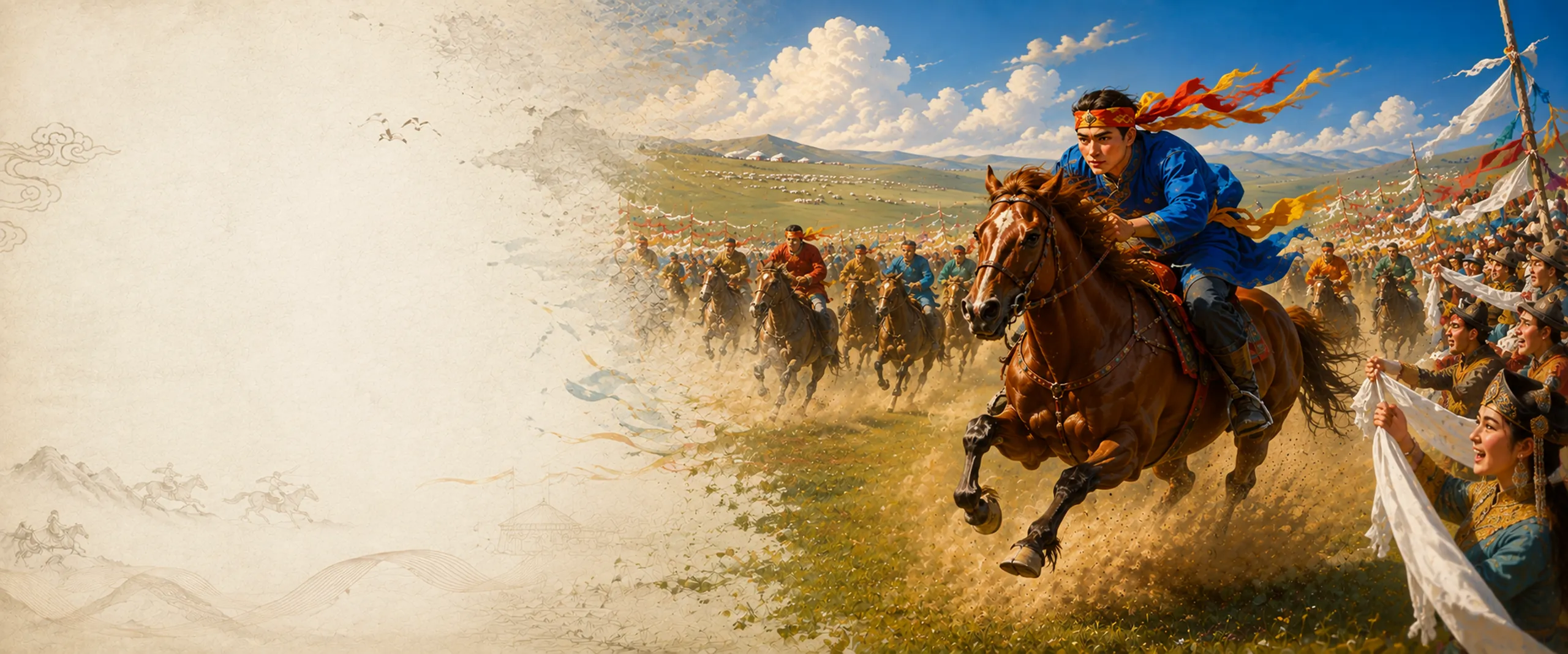

Naadam is a traditional festival with a long history among the Mongolian people. “Naadam” is a Mongolian transliteration meaning “entertainment” or “games,” generally held in summer and autumn when the grass and water are plentiful. The most essential elements are the “Three Manly Arts” — horse racing, wrestling (Bokh), and archery. On the racetrack, riders gallop at full speed — as the verse goes, “草原赛马马蹄轻” (*On the grassland racetrack, the horses’ hooves are light*) — capturing the speed and excitement; wrestlers, clad in traditional attire, grapple on the grassland, displaying strength and wisdom; archers draw their bows, taking aim at the targets, demonstrating focus and precision. Naadam is not only a sporting event but also a platform for socialising — people set up tents, raise their cups in toast, and dance around bonfires. “执策扬鞭追赶集,毡房举酒畅心倾” (*Wielding whips and racing to the gathering, raising cups in the felt tents, hearts pour out freely.*) Naadam, in the most authentic way of the grassland, embodies the spirit and magnanimity of the Mongolian people.
Festival Journey
Origins & Legends
History · Evolution · Legend
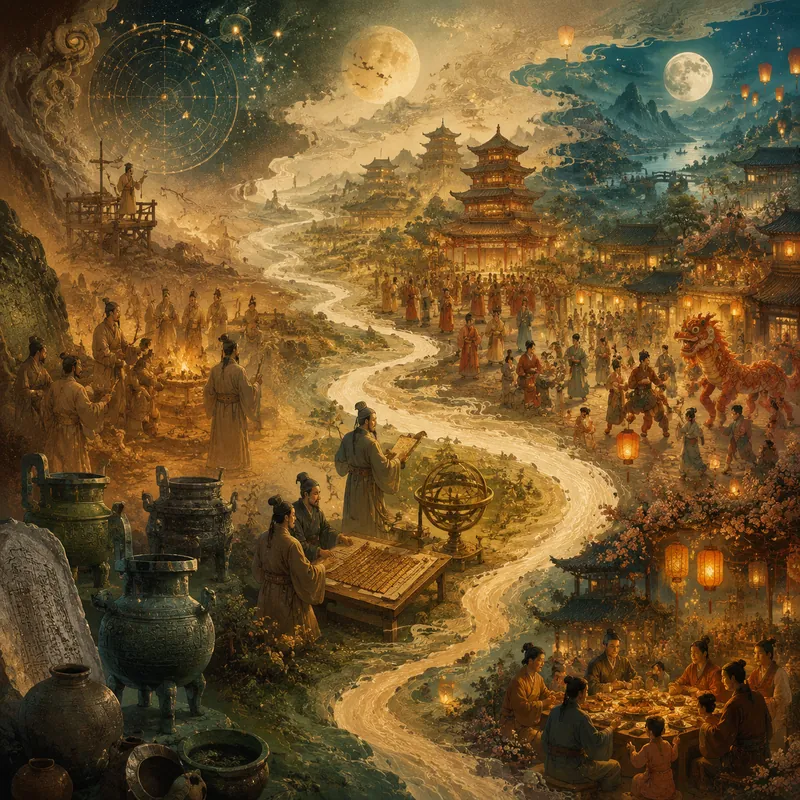
Tracing the Source · Historical Evolution
- Mongol Empire Period The predecessor of Nadam can be traced back to the Ovoo sacrifice and shamanist beliefs of the Mongolian ancestors
- Yuan Dynasty In 1271, Kublai Khan established the Yuan dynasty, with its capital at Dadu (modern‑day Beijing)
- Ming Dynasty After the fall of the Yuan dynasty, the Mongol ruling group retreated to the northern grasslands, a period known in history as the “Northern Yuan.” During this period, although they had lost their political centre in the Central Plains, the Mongols still maintained their traditional nomadic lifestyle and social organisation on the grasslands
- Qing Dynasty The Qing dynasty was an important period for the development of Nadam
- Contemporary Era In the 20th century, Nadam entered a new period of development
Festival Customs
Customs · Local Traditions · Everyday Life
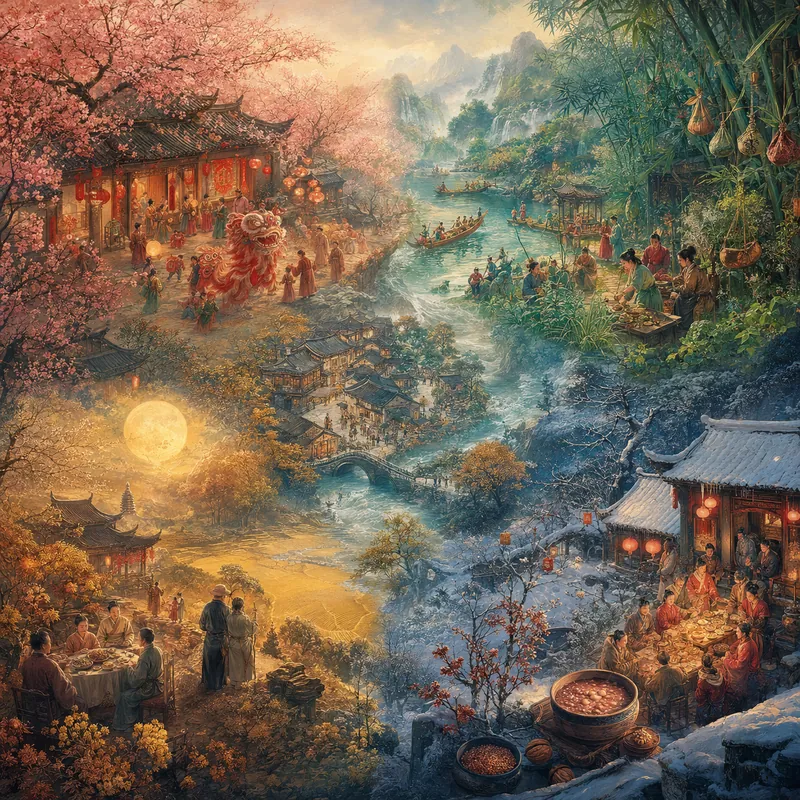
Seasonal Snapshots · Customs & Local Life
Festival Foods
Food Traditions · Local Flavors · Taste
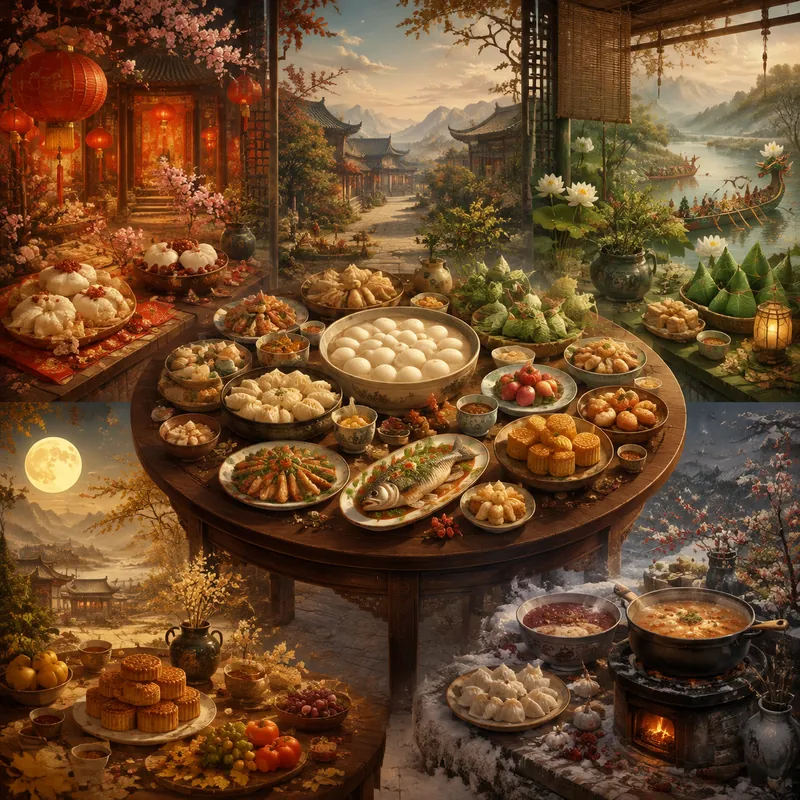
Seasonal Flavours · Seasonal Menu
Folk Arts
Song & Dance · Living Tradition · Heritage

Living Folk Arts · Of Song and Dance
Through Song and Dance · A Living Tradition
Opening Verse: 且看男儿三艺,赛马弯弓射箭,搏克气凝金。 Introduction: Poetry associated with Naadam centers on the “Three Manly Skills”—horse racing, archery, and wrestling. “且看男儿三艺” encapsulates the core competitions of Naadam; “执策扬鞭追赶集,毡房举酒畅心倾” evokes the bold spirit of the grassland gathering, with people raising their cups freely inside felt yurts after the races; and “彩旗猎猎舞金风,万箭齐飞惊远鸿” depicts the spectacle of the archery field. Naadam is a traditional Mongolian festival with a long history, and poetry about it frequently portrays the “Three Manly Skills.” 《水调歌头·那达慕》 reads: “八方宾客云集,欢语动慕心。且看男儿三艺,赛马弯弓射箭,搏克气凝金。长调绕穹帐,马头伴清音”. The line “搏克气凝金” captures the tense concentration of wrestlers locked in competition. Another poem contains the lines “执策扬鞭追赶集,毡房举酒畅心倾”, depicting the bold scene of people raising their cups and drinking freely in felt yurts after the horse races. “彩旗猎猎舞金风,万箭齐飞惊远鸿” portrays the intensity of the archery competition. With a vigorous and powerful poetic voice, Naadam poetry records the courage and heroic spirit displayed by the sons and daughters of the grasslands through speed, strength, and precision.
Global Features
Overseas · Chinese Communities · Celebrations
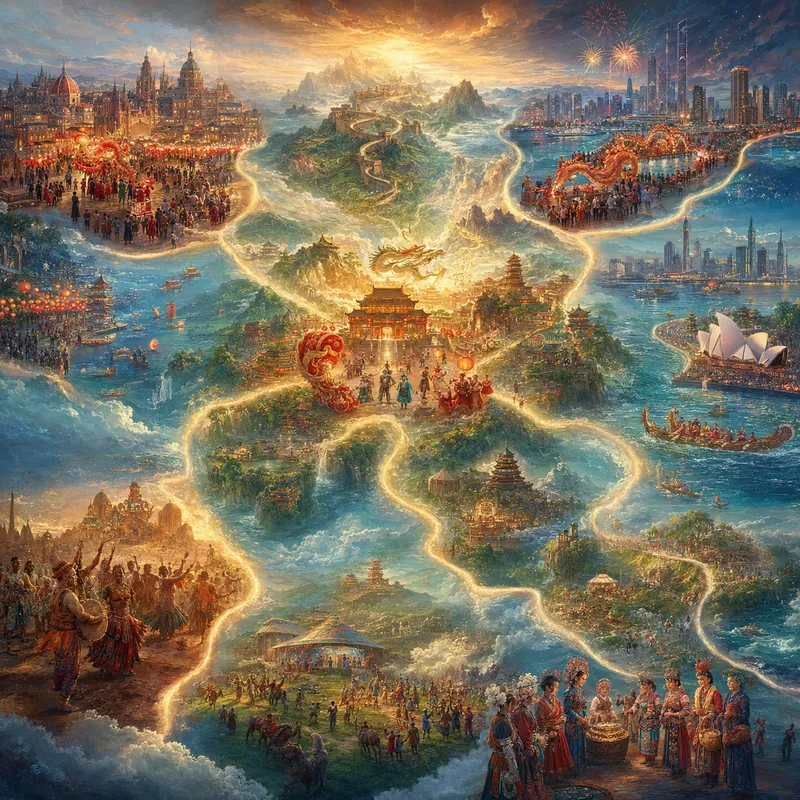
Overseas Celebrations · Lights of Chinese Communities
Mongolia is the most central stage in Naadam’s global presence. Every year from July 11 to 13, people across the country celebrate Naadam together—it is both a traditional festival and Mongolia’s national holiday. “Eternal Mongolia” — Naadam’s International Upgrade in 2026 On July 11, 2026, the opening ceremony of Naadam, themed “Eternal Mongolia,” was held in grand fashion at the Central Stadium in Ulaanbaatar. Mongolian President Ukhnaagiin Khürelsükh delivered the opening address. In the distinguished guests’ section, alongside Mongolia’s three highest-ranking state leaders, were South Korean President Lee Jae-myung and his wife, who were then on a state visit to Mongolia. This year’s opening ceremony marked a historic international upgrade for Naadam—for the first time, real-time commentary was simultaneously provided in five foreign languages: English, Japanese, Korean, Chinese, and Russian. The event was broadcast globally through MNB World, YouTube, FM radio, and other media platforms. To make viewing more convenient for international audiences, the YouTube livestream also offered simultaneous translation in English, Russian, Chinese, Korean, and Japanese. At the same time, large electronic screens in Ulaanbaatar’s nine districts and in the central squares of all 21 provincial capitals broadcast the opening ceremony live. For the first time, the National Naadam Organizing Committee also installed a large outdoor screen in Sükhbaatar Square and created an artificial-turf leisure area, providing residents and visitors with a public space from which to watch the festivities. To implement the principle of “making it convenient and comfortable for every citizen to participate in the National Naadam,” the organizing committee also introduced a series of accessibility services. Service tents were set up outside the Central Stadium for people with disabilities, pregnant women, and breastfeeding mothers, while a rest area capable of accommodating 100 people was built outside the stadium. This year’s opening ceremony also distributed 104 free admission tickets to people with disabilities. These measures made Naadam not only a traditional celebration, but also a public cultural event shaped by modern human-centered care. 8,500 Foreign Visitors — Naadam’s Global Appeal According to Mongolian media, during Naadam in 2025 alone, approximately 8,500 foreign visitors traveled specifically to Mongolia to experience the festival. In recent years, growing numbers of travelers from around the world have journeyed vast distances to Mongolia for the opportunity to witness this unique ethnic celebration firsthand. At the Naadam opening ceremony, visitors from around the world shared their impressions. American visitor Anna Rebecca, an English teacher working in Mongolia as a volunteer teacher, said: “Seeing smiles on everyone’s faces and watching people immerse themselves in the joyful atmosphere of the festival left me with a wonderful impression.” American visitors Marco Benagas and Nat Ratboun, from Maine, were attending the National Naadam opening ceremony for the first time: “It is definitely one of the most spectacular performances I have ever seen. Watching thousands upon thousands of people work together to create something so powerful was genuinely moving.” Australian visitor Dennis Pipich was visiting Mongolia for the first time, mainly to see his wife’s family. The Mongolian robe he wore that day had been given to him by his mother-in-law. He said: “The entire performance fully expressed the pride and vibrant energy of the Mongolian people. I especially enjoyed the horseback performances, the music, and the dancing.” American visitor Lucy Tennett came to Mongolia for the first time with five family members to visit her younger brother, who was working there as an English teacher: “Mongolian culture is astonishing. Every performance fully expressed the traditions and national pride of the Mongolian people.” South Korean visitor Ryu Ju-yoon said: “South Korea does not have a nationwide traditional celebration on the same grand scale as Mongolia’s Naadam, so watching the Naadam opening ceremony felt very fresh and distinctive to me.”
In China, the global dissemination of Naadam centers on the Inner Mongolia Autonomous Region. Through the innovative model of “Tourism Naadam,” the traditional festival has been transformed into a major cultural-tourism IP capable of attracting international visitors. The 36th Tourism Naadam — 100,000 Visitors and 30 Million Livestream Viewers From July 18 to 20, 2026, the 36th Inner Mongolia Tourism Naadam, themed “Travel through Inner Mongolia · Encounter Naadam,” opened in grand fashion in Xilinhot, Xilingol League. More than 100,000 visitors from across China and local residents attended on the opening day. According to statistics, around 100,000 Chinese and international visitors entered the opening ceremony venue, while nearly 30 million people watched the ceremony via livestream. Naadam has become a major cultural-tourism IP for Inner Mongolia. He Mingjian, deputy commander of this year’s Naadam, stated that “visitor numbers are expected to surpass 600,000 this year.” The three-day festival brought together the charm of folk customs, the spirit of competition, and the energy of consumption, while a broader series of activities continued through the end of August. One of the most striking international initiatives at this year’s festival was organized by China Youth Daily, which invited nearly 100 online influencers and 100 international visitors to form a joint parade contingent. Using their cameras to document sporting competitions and folk traditions, they extended to the world an invitation to “meet at Naadam.” A contingent of international visitors also appeared in the opening ceremony. Representatives of China’s 56 ethnic groups entered in festive dress, followed successively by contingents from Inner Mongolia’s 12 leagues and cities. A Tunisian Woman’s Naadam Encounter At the 2026 Inner Mongolia Naadam, one of the most eye-catching international figures was Asma, a reporter and presenter with China Arab TV in Dubai, originally from Tunisia. Wearing a red Mongolian robe, she sang the Chinese song Great China in fluent Mandarin and became one of the most striking figures in the media group. Walking across the green grasslands, Asma recorded the sweeping scenery with her camera while enthusiastically responding to greetings from those around her, completely immersed in the lively and harmonious atmosphere. She said that Naadam is a long-established cultural and sporting gathering of the grasslands with deep roots among ordinary people. This Tunisian woman’s Naadam encounter reached audiences around the world through international media coverage. A “Two-Way Journey” of China–Mongolia Intangible Cultural Heritage Naadam is not only a platform for presenting the culture of China’s Mongolian people; it is also becoming a bridge for cultural exchange between China and Mongolia. In July 2026, at Naadam in Ulaanbaatar, Mongolia, an intangible cultural heritage performance team from Otog Front Banner in Inner Mongolia was invited to present the traditional Ordos Wedding. During the performance, inheritors dressed in traditional Ordos ceremonial attire recreated in a realistic setting the solemn rites of the nationally listed intangible cultural heritage item “Ordos Wedding.” The team won first prize in the costume presentation category and also received two special honors for “wedding sister-in-law attire” and “marriage audience attire.” Through intangible cultural heritage as a bridge and clothing as a medium, this transnational performance wrote a vivid chapter of ethnic unity and cultural integration through mutual learning between the grassland civilizations of China and Mongolia. Naadam’s Many Contemporary Forms Contemporary Naadam has evolved beyond the traditional “Three Manly Skills” into multiple forms. Alongside official Naadam celebrations, there are now folk Naadam, tourism Naadam, international Naadam, school Naadam, symbolic Naadam, and other varieties. This year’s Inner Mongolia Naadam introduced more than 20 participatory experiences, including intangible cultural heritage workshops, folk games, and costume-change travel photography. The traditional “Three Manly Skills”—bökh wrestling, horse racing, and archery—were held simultaneously, while interactive events such as a four-event visitor competition, family Naadam, and youth Naadam allowed visitors themselves to enter the competitive arena. Nearly 20 experience-oriented activities were arranged at the main venue. In the evening, Beizimiao Square hosted a special intangible cultural heritage performance and a bonfire celebration for tens of thousands of people. The local area also launched 13 distinctive tourism routes, linking grassland landscapes with folk-cultural experiences. The festival also launched the “Fine Intangible Heritage Goods · Craftsmanship in Transmission” Inner Mongolia Intangible Cultural Heritage Shopping Month, bringing together intangible cultural heritage practitioners from all 12 leagues and cities of the autonomous region. Inside the heritage workshops, visitors could personally make leather carvings and felt embroidery, experiencing distinctive cultural traditions at close range under the careful guidance of heritage inheritors. Naadam has thus developed from a regional ethnic festival into a cultural-tourism brand open to the world.
Naadam’s global spread is visible not only in its principal settings in Mongolia and Inner Mongolia, China, but also in the spontaneous transmission of tradition among Mongolian communities overseas. On July 11, 2026, Mongolian nationals studying, working, and living in the Washington, D.C. area held a traditional Mongolian Naadam celebration in Arlington, Virginia. Mongolian Ambassador to the United States Ö. Battbayar declared the event open. Maria Sand, acting deputy director of the U.S. State Department’s Office of Japanese, Korean, and Mongolian Affairs, attended by invitation and delivered remarks. During the Naadam gathering, 32 outstanding wrestlers holding national-, provincial-, and county-level titles took part in Mongolian wrestling competitions. Other sporting and cultural activities combining Mongolian tradition with modern elements included shagai shooting, archery, children’s races, and shagai horse racing. With support from Mongolia’s Ministry of Foreign Affairs, this year’s Naadam was jointly organized by the Embassy of Mongolia in the United States, the Mongolian Association of the Washington, D.C. area, and other nongovernmental organizations. According to the Mongolian Embassy, the celebration attracted more than 2,000 participants from Mongolia and other countries. Mongolian Americans in communities such as Chicago also regularly hold Naadam celebrations. The President of Mongolia has previously stated that Naadam, as part of the nation’s cultural heritage, was held abroad for the first time under presidential patronage. Such Naadam gatherings spontaneously organized by overseas Mongolian communities vividly embody a culture “carried with them”—wherever Mongolian people migrate in the world, they gather each July and use wrestling, horse racing, and archery to reaffirm their cultural identity.
Visitor Guide
Preparation · Etiquette · Take Part with Confidence
Readers’ Comments
Calendar and traditional culture enthusiasts from around the world, sharing the same moon.
Sign in or register to join the conversation. Your comment account is created automatically the first time you use a connected account.
No comments yet
Share your thoughts with readers around the world.