Han, Wei, Jin, and Northern and Southern Dynasties
Although moon sacrifice and Autumn Reward customs had long existed, the Mid‑Autumn Festival as an independent festival had not yet formed during the Han, Wei, Jin, and Northern and Southern Dynasties period.
The Han dynasty inherited the pre‑Qin tradition of moon sacrifice. According to Sima Qian’s Records of the Grand Historian · Treatise on the Feng and Shan Sacrifices, Han emperors regularly worshipped the sun deity and moon spirit, with the practice of “worshipping the sun in the morning and the moon in the evening, with bows.” The Han dynasty not only had the custom of “autumn moon sacrifice” but also stipulated the direction of the sacrifice: according to the Rites of Ritual · Sacrificial Meaning, “sacrifice to the moon in the west,” or “sacrifice to the moon in a pit.” At the same time, the Han dynasty also had the custom of respecting and caring for the elderly on Mid‑Autumn or the Beginning of Autumn, presenting them with coarse cakes. Although at this time “Mid‑Autumn” was still just a time node rather than an independent festival, the coexistence of moon sacrifice tradition and respect for the elderly infused two important cultural elements into the later Mid‑Autumn Festival—worship of the moon and emphasis on family ethics.
During the Wei‑Jin and Northern and Southern Dynasties period, although the Mid‑Autumn Festival had not yet formed, literati began to compose more poems eulogising the moon. With the prevalence of Neo‑Daoism, poems expressing feelings about the moon gradually increased. Tao Yuanming wrote: “I rise in the morning to clear the weeds, and return home carrying my hoe under the moon”; the Southern dynasty writer Shen Xiuyou wrote “A Moon Poem in Response to the Censor Wang Siyuan”; the Southern dynasty Yuefu Midnight Songs of the Four Seasons contains eighteen Autumn Songs, seven of which are directly related to “moon‑gazing.” These poems indicate that the concept of “moon‑gazing” had already emerged during this period, and people’s attention to the moon gradually shifted from religious “moon sacrifice” to aesthetic “moon‑gazing.”
According to documentary records, by the Wei‑Jin period, there was a record of “an official travelling incognito on the river with his attendants on the Mid‑Autumn Eve.” This shows that during the Wei‑Jin period, some people were already boating on the river to enjoy the moon on the night of the 15th of the eighth month. However, this moon‑gazing was still the personal activity of a few literati, not a nationwide festival. Zong Lin’s Jingchu Suishiji of the Southern Liang dynasty also contains no record of the 15th of the eighth month as the Mid‑Autumn Festival, indicating that during this period, the Mid‑Autumn Festival did not yet exist as an independent festival.
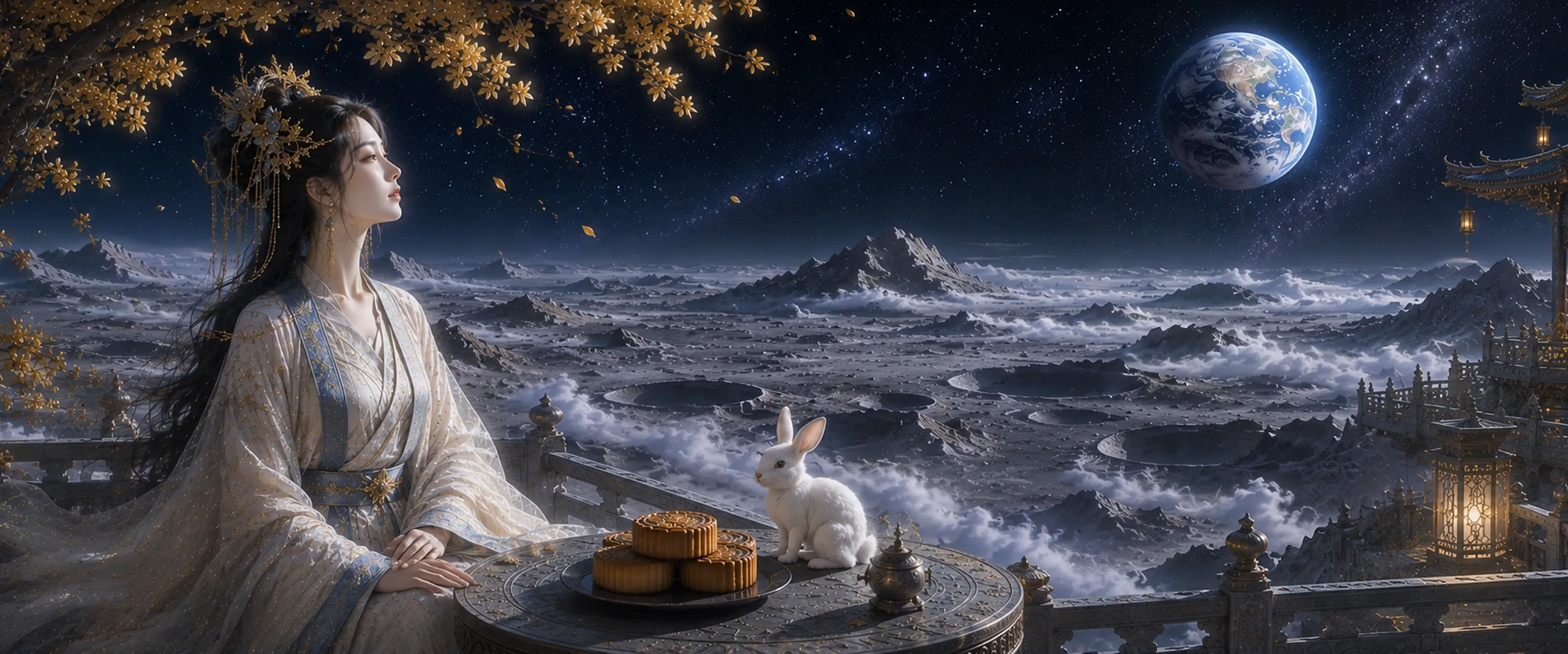
During this period, moon‑related myths and legends also grew increasingly rich. Stories such as Chang’e flying to the moon, Wu Gang chopping the osmanthus tree, and the Jade Rabbit pounding medicine gradually took shape. The legend of Chang’e had already appeared during the Warring States period and was widely disseminated in the Han dynasty; the myth of the Jade Rabbit pounding medicine also became popular during this period; the story of Wu Gang chopping the osmanthus tree only appeared in the Tang dynasty. Although these myths were not the direct cause of the festival’s formation, they greatly enriched the Chinese imagination of the moon and provided a profound cultural background for the moon‑gazing activities of later Mid‑Autumn Festivals.
Tang Dynasty
The Tang dynasty was the decisive period for the development of the Mid‑Autumn Festival. It was in the Tang dynasty that the 15th of the eighth month evolved from an ordinary day into a nationwide festival. “Mid‑Autumn” as a festival name was formally established in the Tang dynasty.
The direct source of the festival’s formation was the moon‑gazing fashion of the early Tang. The reason for this fashion lay first in the moon’s natural appearance—large and round—on the 15th of the eighth lunar month. The Tang dynasty was the golden age of poetry, and literati’s eulogies of the moon reached unprecedented heights. According to scholars’ statistics, among extant Tang poems, there are over ninety poems celebrating the Mid‑Autumn moon. The term “Mid‑Autumn” frequently appeared in Tang literati’s poems. Poets would gather on the night of the 15th of the eighth month to gaze at the moon, drink wine, and compose poems, gradually forming a fixed social custom. This custom spread from the literati circle to upper‑ and middle‑class families, eventually affecting ordinary people in the mid‑to‑late Tang.
During Emperor Xuanzong’s reign, moon‑gazing became even more popular. According to the Records of the Kaiyuan and Tianbao Eras, on a Mid‑Autumn night, Emperor Xuanzong and Consort Yang were enjoying the moon by the Taiye Pool. Unaware that the Jade Rabbit had already set in the west, the emperor felt deeply melancholy and ordered the construction of a hundred‑foot‑high “Moon‑Gazing Platform” by the pool for the following year. It is also said that Emperor Xuanzong once visited the Moon Palace on the night of the 15th of the eighth month, leading the people to regard this day as the Mid‑Autumn Festival. Although these records carry legendary colour, they reflect the Tang court’s emphasis on Mid‑Autumn moon‑gazing.
The Mid‑Autumn Festival in the Tang dynasty already had the rudiments of a festival. The Tang Shu · Records of Emperor Taizong explicitly records “the Mid‑Autumn Festival on the 15th of the eighth month.” The 15th of the eighth month in the Tang dynasty had already formed patterned folk activities—moon‑gazing, banqueting, and poetry composition. According to the Records of Luozhong, Emperor Xizong of Tang ate mooncakes on the Mid‑Autumn Festival, found them extremely delicious, and even wrapped mooncakes in silk to reward newly appointed imperial scholars. This is one of the earliest records linking mooncakes with the Mid‑Autumn Festival.
However, the Tang dynasty Mid‑Autumn Festival still had notable differences from later periods. First, Tang dynasty activities were mainly at night, centred on moon‑gazing and banqueting; second, the main participants were literati and upper‑ and middle‑class families—although ordinary people also began to participate, they were not yet enthusiastic or fully engaged. The Tang dynasty Mid‑Autumn Festival lacked the lively atmosphere of a nationwide carnival that appeared later. It was not yet an official public holiday in the Tang dynasty. But this did not affect its formation as a folk festival—the formation of festivals does not depend on official recognition.
Some scholars believe that the formal establishment of the Mid‑Autumn Festival was related to Emperor Xuanzong’s birthday, the “Qianqiu Festival.” In the 17th year of the Kaiyuan era (729 CE), Emperor Xuanzong designated his birthday, the 5th of the eighth month, as the “Qianqiu Festival,” with a three‑day national holiday and grand celebrations. Although the Qianqiu Festival fell on the 5th of the eighth month rather than the 15th, the establishment of this official festival provided a reference for the 15th of the eighth month to become a festival. Emperor Xuanzong’s admiration for Daoist concepts of immortality also brought more attention to moon‑related myths. After the Qianqiu Festival, the 15th of the eighth month gradually developed from a private literati moon‑gazing activity into a nationwide festival.
Song Dynasty
If the Tang dynasty was the formative period of the Mid‑Autumn Festival, then the Song dynasty was its flourishing period. It was in the Song dynasty that the festival developed from an elite moon‑gathering into a nationwide carnival.
During Emperor Taizong’s reign, the Spring Festival, Dragon Boat Festival, and Mid‑Autumn Festival were designated as the three major festivals, and the Mid‑Autumn Festival received official recognition. The court granted public officials a one‑day holiday for Mid‑Autumn. From the Song dynasty onwards, the Mid‑Autumn Festival became an official festival.
The Song dynasty Mid‑Autumn Festival had two significant differences from the Tang. First, the Tang mainly involved evening banquets and moon‑gazing, while the Song celebrated throughout the day, with drinking starting at noon. Second, the Tang festival’s main participants were literati and upper‑ and middle‑class families, while in the Song it was a nationwide celebration—both the nobility and common people shared the joy.
Meng Yuanlao’s Dreams of the Eastern Capital vividly records the Mid‑Autumn Festival in Bianjing: “Before the Mid‑Autumn Festival, all shops sell new wine, redecorating their shopfronts with colourful arches and banners. People compete to buy wine; by mid‑afternoon, every household is out of wine. At this time, newly caught crabs, pomegranates, and fresh fruits are all on the market. On the Mid‑Autumn night, wealthy families decorate their pavilions, while ordinary people vie for spots in wine shops to enjoy the moon. Music fills the air; residents near the palace hear the sound of pipes from afar, as if from beyond the clouds. Children in the neighbourhood play all night. The night market is bustling until dawn.” This passage vividly depicts the Mid‑Autumn Festival scene in the Northern Song: merchants began preparations before the festival, new wine and abundant fruits appeared; on the night itself, wealthy families decorated their pavilions to enjoy the moon, while ordinary people rushed to wine shops; music was in full swing, children played all night, and the night market was crowded until dawn. The festival atmosphere was lively and widely participated in.
Wu Zimu’s Dreams of the Painted Land in the Southern Song records similar customs, equally lively, but adds one important detail: “Even modest households set up small moon platforms, arrange family banquets, and gather their children to mark the festival.” This indicates that during the Southern Song, the festival began to emphasise family reunion. The “reunion” theme of the Mid‑Autumn Festival began to sprout in the Song dynasty.
The Southern Song Mid‑Autumn Festival also had the custom of lantern appreciation. According to Zhou Mi’s Old Affairs of Wulin, on Mid‑Autumn night in Hangzhou, “lanterns and candles shone brilliantly all night long.” Along Su Causeway, people linked arms and danced, as if in daylight, and released thousands of “small red dots” (small sheepskin lanterns) on the river, shining like stars. In addition, watching the Qiantang River tidal bore in Hangzhou also became one of the festival’s customs.
The Song dynasty produced a large number of poems celebrating the Mid‑Autumn moon. The Complete Song Ci contains 210 Mid‑Autumn poems, of which 178 are specifically labelled “Mid‑Autumn.” The content of these poems mostly describes the moonlight, homesickness, and longing for family, frequently mentioning Chang’e, the Jade Rabbit, the toad, the osmanthus tree, the moon palace, and jade towers. Su Shi’s Water Melody · When Will the Bright Moon Appear is the most famous. The lines “People experience joy and sorrow, parting and reunion; the moon waxes and wanes, bright and dim—nothing has ever been perfect since ancient times. May we all be blessed with longevity; though miles apart, we share the same beautiful moonlight” compare human joys and sorrows with the moon’s waxing and waning, embodying the theme of connecting the full moon with family reunion.
Although the Song dynasty focused mainly on moon‑gazing, moon‑worshipping had also appeared. However, moon‑worshipping at that time was not widespread, and the rituals were not as solemn as in later periods. Jin Yingzhi’s New Compilation of the Drunkard’s Talks records: “On Mid‑Autumn, the moon‑gazing gatherings in the capital differ from other places. All young people, rich or poor, from about twelve or thirteen years of age, wear adult attire and worship the moon on towers or in courtyards, each with their own aspirations: boys wish to step into the Moon Palace early and climb the immortal osmanthus; girls wish to be as beautiful as Chang’e, with faces like the bright moon.” It is clear that moon‑worshipping in the Song was mainly young people making wishes and prayers to the moon.
Yuan, Ming, and Qing Dynasties
Although the Yuan dynasty was ruled by the Mongols, they were deeply sinicised, and festival customs largely followed Han traditions. The Mid‑Autumn Festival customs of the Yuan period basically continued Song traditions.
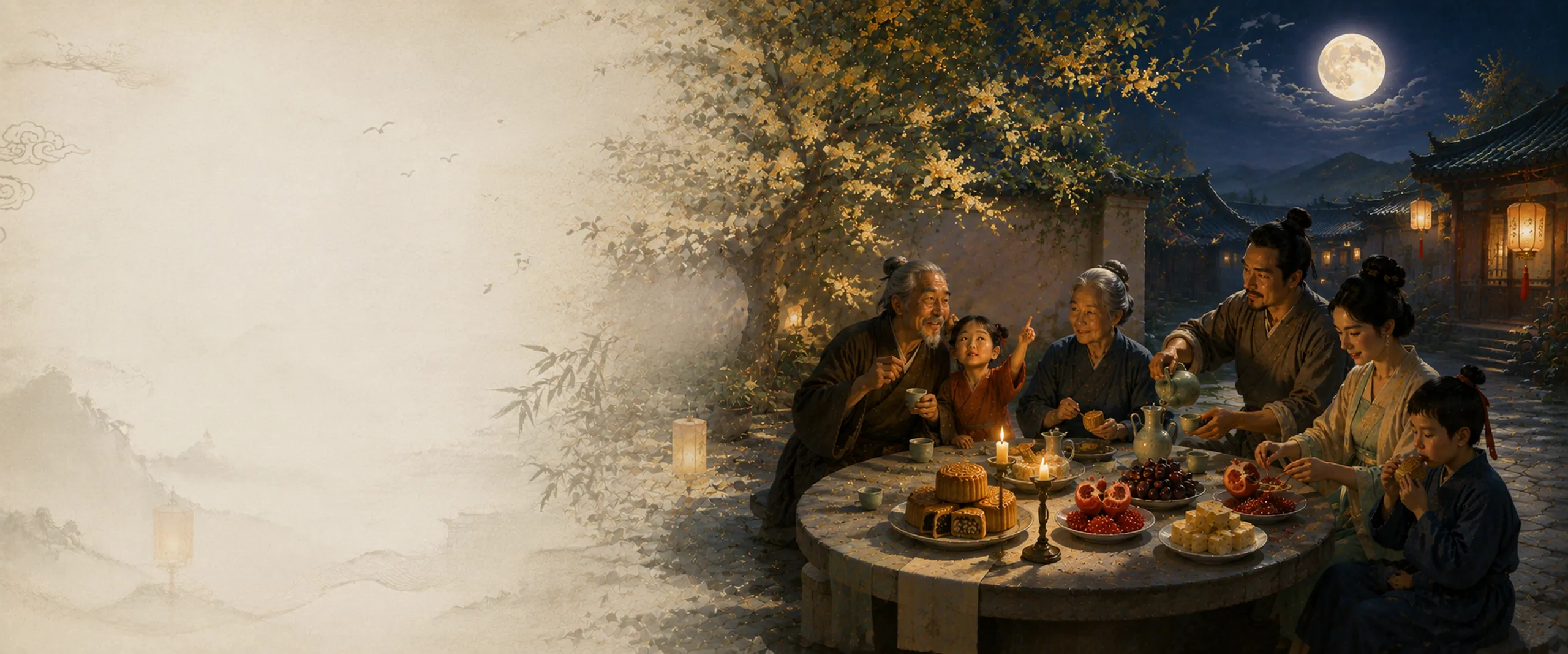
The Ming dynasty was another important turning point in the festival’s development. Ming dynasty Mid‑Autumn activities gradually shifted from moon‑gazing as the core to moon‑worshipping, and mooncakes appeared as a seasonal food. Tian Rucheng’s Records of Excursions in West Lake records: “The 15th of the eighth month is called Mid‑Autumn; the people exchange mooncakes, taking the meaning of reunion.” The Scenes of the Imperial Capital also records: “If a married daughter has returned to her parents’ home, she must return to her husband’s house on this day, called the Reunion Festival.” These historical sources show that in the Ming dynasty, people began to value family reunion on this day. The themes of human relationships and family affection gradually became prominent, hence the 15th of the eighth month was also called “Reunion Festival.” On the night of the festival, ordinary Ming people would set up tables in open spaces, placing mooncakes, pomegranates, dates, and other fruits on the table. After worshipping the moon, the whole family would sit around the table, eating, talking, and enjoying the moonlight. This custom continues to this day.
By the Qing dynasty, the Mid‑Autumn Festival had risen further in status, becoming one of China’s traditional festivals on par with the Spring Festival. Although the Qing court no longer held large‑scale lantern festivals like those in the Song, folk lantern festivals remained spectacular. Emperor Qianlong would summon vassal states and ministers to the Garden of Perfect Brightness on the 15th of the first month to view lanterns, fireworks, and performances of song, dance, and acrobatics. The Qing dynasty, inheriting the Ming tradition of lantern craftsmanship, added ice lanterns, and also inherited a series of folk traditions including lion dances, dragon dances, and community parades. During the Ming‑Qing transition, the Mid‑Autumn Festival, which in the Tang and Song had been somewhat intellectually oriented, gradually transformed into one focused on secular human relationships. Mooncakes became popular and an indispensable seasonal food of the festival.
Readers’ Comments
Calendar and traditional culture enthusiasts from around the world, sharing the same moon.
Sign in or register to join the conversation. Your comment account is created automatically the first time you use a connected account.
No comments yet
Share your thoughts with readers around the world.