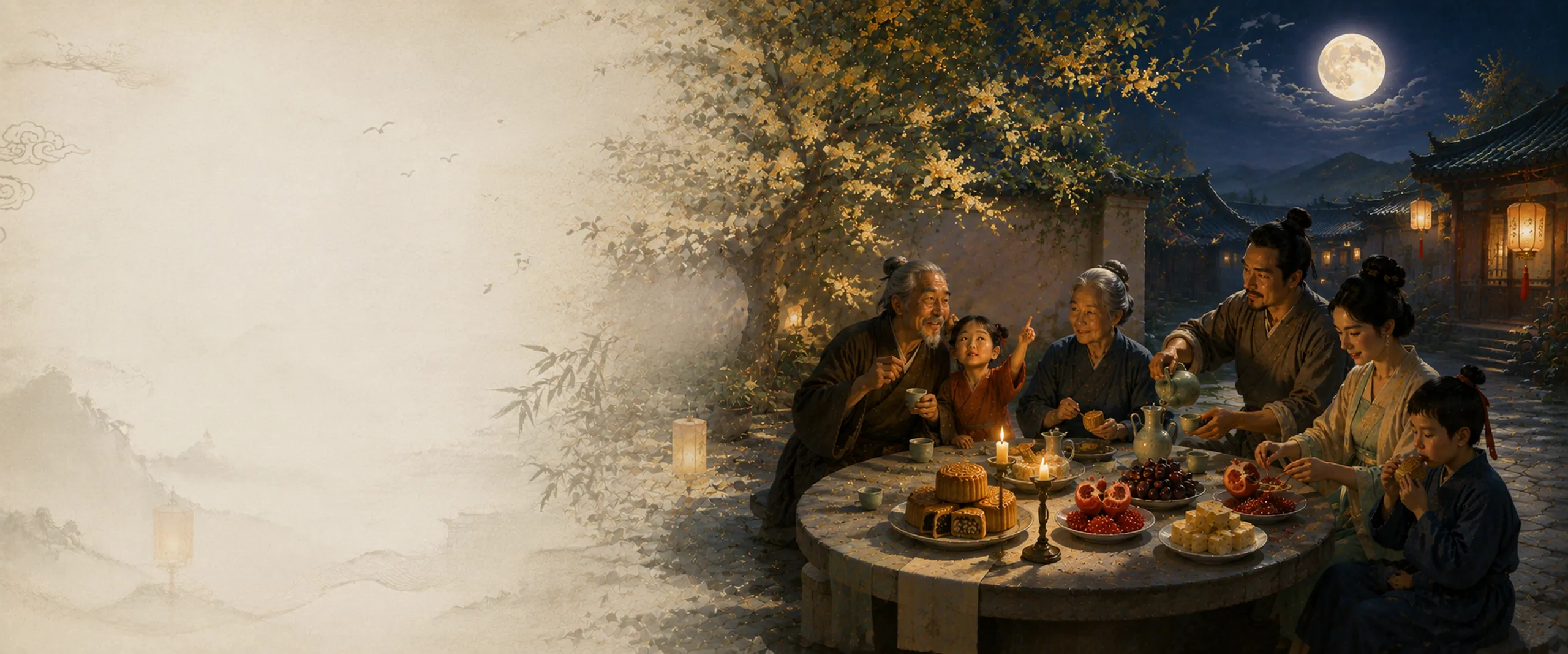
The principal customs of the Mid-Autumn Festival include offering sacrifices to the moon (祭月), moon-viewing (赏月), moon worship (拜月), eating mooncakes, appreciating osmanthus flowers, and drinking osmanthus wine. Mooncakes were originally offerings made to the moon deity; over time, the practices of moon-viewing and eating mooncakes gradually became closely linked, and the round pastry came to symbolize reunion. The festival is also associated with a rich body of lunar mythology, including stories of Chang’e (嫦娥), the Jade Rabbit (玉兔), and Wu Gang (吴刚). In some areas, traditional amusements such as cricket fighting and keeping singing katydids were also popular. Together with the Spring Festival, Qingming Festival, and Dragon Boat Festival, Mid-Autumn is regarded as one of China’s four major traditional festivals.
Main Customs
Offering Sacrifices to the Moon
Historical Origins
The custom of offering sacrifices to the moon (祭月) is extremely ancient. Moon worship, lunar mythology, and autumn moon rituals had already emerged before the Zhou dynasty. The Book of Rites (《礼记》, Lǐjì) records:
“The Son of Heaven greets the sun in spring and offers to the moon in autumn.”
The phrase “offering to the moon in autumn” (秋夕月) refers specifically to ritual worship of the moon. Zhou rulers performed lunar sacrifices around the autumn equinox to thank the moon deity for the harvest. This tradition of autumnal moon worship became the direct ritual ancestor of the Mid-Autumn moon sacrifice.
At first, moon sacrifice belonged to the royal ritual system and had little connection with ordinary households. As society changed, however, the practice gradually moved from court to popular society, shifted from the autumn equinox to the fifteenth day of the eighth lunar month, and eventually became a festival custom practiced by the wider population. Traditional sayings also prescribed gender roles in worship, most famously “men do not worship the moon; women do not worship the Kitchen God” (男不拜月,女不祭灶). Because the moon was associated with yin and women were likewise traditionally classified as yin, women often presided over Mid-Autumn moon worship. This reflects the traditional Chinese philosophical concept of balancing yin and yang (阴阳调和).
The Ritual
Moon sacrifice is one of the oldest and most central customs of the Mid-Autumn Festival and developed from ancient worship of the natural moon. By the Zhou period, ceremonies of welcoming the autumn chill and worshipping the moon were already associated with this season. The Book of Rites records the phrase “at the end of autumn, offer to the moon” (秋暮夕月). As a major festival rite, moon sacrifice uses the moon as a vehicle for remembrance and expresses wishes for blessings and fulfillment.
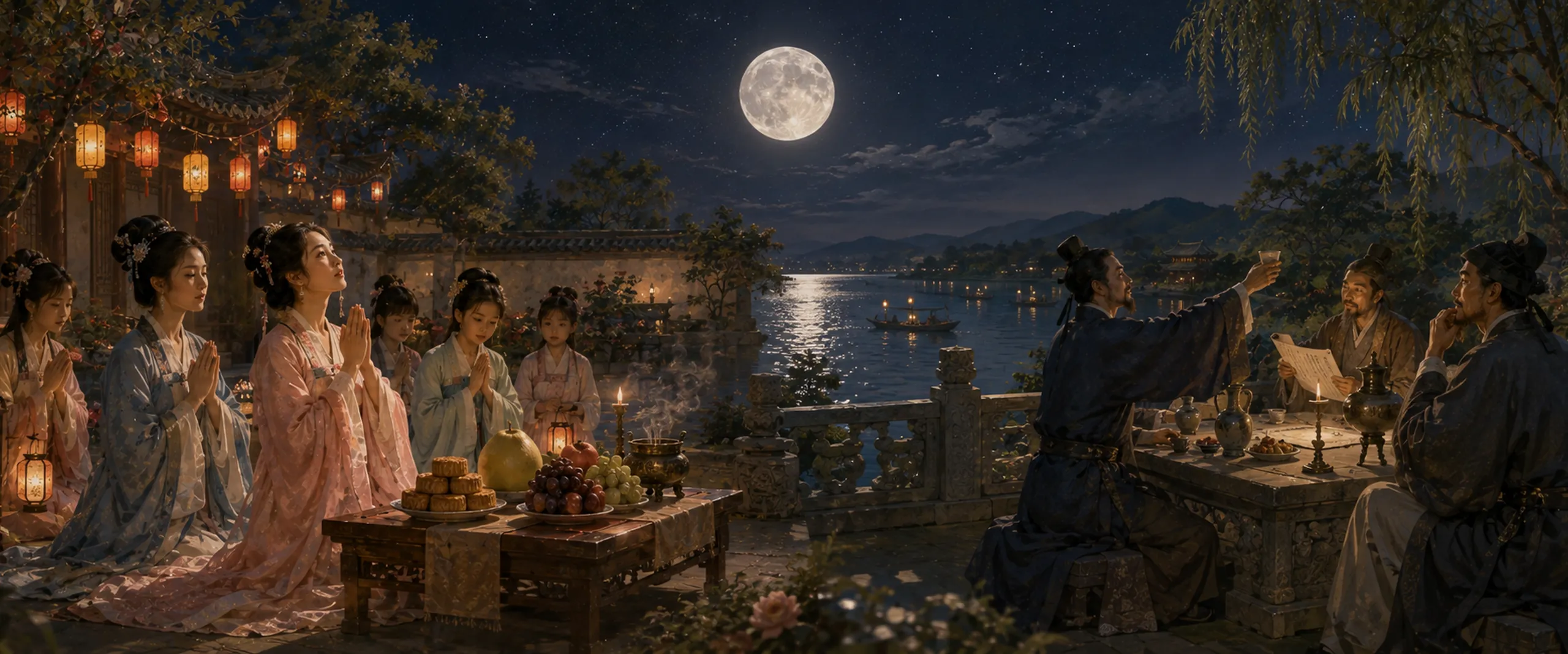
The ceremony was traditionally solemn and carefully arranged. A large incense table was set out with offerings such as mooncakes, watermelon, apples, red dates, plums, and grapes. Mooncakes and watermelon were considered especially indispensable, and the watermelon was often carved into the shape of a lotus. Beneath the moon, a tablet representing the Moon Deity (月神) was positioned to face the moon, red candles were lit, and members of the household worshipped in sequence to pray for blessings. In parts of Guangdong, worshipping the Moon Lady (拜月娘) or moonlight (拜月光) remains a recognizable Mid-Autumn tradition.
Cultural Meaning
Moon sacrifice embodies both reverence for and gratitude toward nature. The moon carries multiple layers of symbolism in Chinese culture—completeness, brightness, femininity, gentleness, and eternity. Through lunar worship, people express respect for the moon deity while also praying for family reunion and a harmonious, fulfilled life.
How to Participate
On Mid-Autumn night, a family can set up a small table on a balcony, in a courtyard, or in another open area, placing mooncakes, watermelon, apples, grapes, and other round foods upon it. Candles or other culturally appropriate offerings may be arranged facing the moon, after which family members can offer wishes together. Although the ritual is often simplified in modern cities, many households still preserve the custom of “making an offering to the moon”, setting out fruit and mooncakes beneath the night sky.
Moon-Viewing
Historical Origins
The custom of moon-viewing (赏月) can be traced back to the Wei and Jin periods. The Book of Jin (《晋书》) records people boating on rivers to appreciate the moon. From the Tang dynasty onward, moon-viewing became particularly fashionable among scholars and cultivated elites and can be regarded as one of the immediate sources from which the Mid-Autumn Festival developed. Tang culture was marked by a broad, romantic imagination, and the period produced many famous poems on the Mid-Autumn moon. By the middle and late Tang, Mid-Autumn had already become a festival celebrated widely across society. During the Song dynasty, it developed into a major festival centered on moon-viewing, drinking, and family gatherings.
Mid-Autumn lore also includes the famous story of Emperor Xuanzong of Tang visiting the Moon Palace. According to legend, Xuanzong dreamed that he traveled to the lunar palace and there encountered the music that became the celebrated “Rainbow Skirt and Feathered Robe” (《霓裳羽衣曲》). The story was later associated with the growing popularity of Mid-Autumn celebration. The Southern Song writer Wu Zimu (吴自牧) wrote in Mengliang Lu (《梦粱录》) that on Mid-Autumn people would “approach the window to enjoy the moon … arrange a family banquet and gather their children together in celebration of the festival.” The Tang poet Liu Yuxi (刘禹锡) also wrote in Playing with the Moon on the Fifteenth Night of the Eighth Month (《八月十五夜玩月》):
“Tonight Heaven will wash the whole world with the moon.”
The Activity
Moon-viewing is one of the most representative Mid-Autumn customs. Although its roots can be traced to the Wei and Jin dynasties, it flourished particularly during the Tang and Song. The fullness of the moon symbolizes reunion and completeness. When the Mid-Autumn moon rises, families traditionally make offerings outdoors and, once the ritual is complete, sit together around a table to share food, admire the moon, and exchange good wishes.
Ways of enjoying the moon varied according to historical period and social class. In the Tang dynasty, scholars and poets invited one another to drink, compose poetry, and exchange verses beneath the moon. According to the Kaiyuan Tianbao Yishi (《开元天宝遗事》), Emperor Xuanzong and Yang Guifei went to the banks of the Taiye Pool on Mid-Autumn night to admire the moon reflected in the water, and the outing became an annual custom. Among ordinary families, moon-viewing was more intimate: relatives sat together, ate mooncakes and fruit, talked, and enjoyed one another’s company.
Cultural Meaning
The full moon is the central image of the Mid-Autumn Festival. In Chinese culture, roundness (圆) represents completeness, harmony, and fulfillment. On Mid-Autumn night, the full moon in the sky and the reunited family on earth mirror one another, giving form to one of the most enduring Chinese ideals of “completeness” (圆满). No matter how far apart people may be, looking up at the same moon has long served as one of the most poetic ways of imagining reunion.
How to Participate
Mid-Autumn night can be enjoyed in any open place with a clear view of the sky. City residents may visit parks, riverbanks, lakesides, or hilltops, while families can simply place chairs and a table on a balcony or in a courtyard, prepare mooncakes and fruit, and spend the evening together. It is one of the simplest and most accessible ways to take part in Mid-Autumn tradition.
Eating Mooncakes
Historical Origins
Mooncakes were originally offerings made to the moon deity. The earliest surviving written references to a food called “mooncake” (月饼) appear in the Song dynasty. Wu Zimu’s Mengliang Lu already uses the term, although at that time mooncakes were not yet exclusively associated with Mid-Autumn. They appear to have become established festival foods around the Ming dynasty, when sources such as Dijing Jingwu Lüe (《帝京景物略》) record their growing popularity. Around the Ming-Qing transition, Mid-Autumn increasingly shifted from the Tang-Song emphasis on aesthetic moon-viewing toward family ethics and everyday social relationships, and mooncakes became correspondingly more important.
Many folk legends explain their origin. One claims that mooncakes date to the Tang dynasty, when Emperor Xizong ate them at Mid-Autumn and found them so delicious that he wrapped them in silk and bestowed them upon newly successful examination candidates. Another famous story connects mooncakes with Zhu Yuanzhang’s rebellion against the Yuan, claiming that messages reading “Rise in revolt on the night of the fifteenth day of the eighth month” were hidden inside cakes and secretly distributed. Although this tale is not necessarily supported by historical evidence, it has added a legendary dimension to the mooncake tradition.
The Activity
Eating mooncakes is the most representative food custom of Mid-Autumn. Because of their round shape, mooncakes symbolize great reunion (大团圆) and are used both as offerings and as gifts for relatives and friends. Today, eating mooncakes is considered an indispensable part of Mid-Autumn throughout northern and southern China.
Traditional mooncake-making is highly sophisticated. Basic ingredients include flour, sugar, and oil, with a wide range of fillings. Beijing-style mooncakes tend to be large and flaky, sweet without being overly rich; Suzhou-style mooncakes are known for crisp layered pastry and varied fillings; Cantonese mooncakes have thin crusts, abundant fillings, and a golden surface; and Chaoshan-style mooncakes are particularly associated with flaky pastry and sweet fillings. Their surfaces are commonly stamped with auspicious designs and phrases such as “flowers bloom beneath the full moon” (花好月圆), “Chang’e Flies to the Moon” (嫦娥奔月), “fortune” (福), or “longevity” (寿).
Traditional etiquette emphasizes sharing one mooncake among the entire family. The cake, representing the full moon, is cut into portions according to the total number of family members. Traditionally, even relatives away from home were symbolically included when calculating the portions; the cake was not supposed to be divided into too many or too few pieces, and each portion should be roughly equal. Beneath the Mid-Autumn moon, everyone receives a share—even if the family is physically separated, their hearts are imagined as remaining together. The act reinforces both family cohesion and the central festival theme of reunion.
Cultural Meaning
The mooncake is a symbol of auspiciousness and reunion. Its roundness echoes the full moon and the ideal of a complete family, together forming the festival’s most recognizable visual and cultural image. Wherever a person may be, eating even a single piece of mooncake can immediately evoke the feeling of Mid-Autumn.
How to Participate
During the festival, visitors can sample many kinds of mooncakes or try making them by hand. Northern China is known for Beijing-, Shanxi-, and Shaanxi-style varieties, while southern China offers Cantonese, Suzhou, and Chaoshan styles. Mooncakes are also the most common Mid-Autumn gifts and are widely presented to relatives, friends, colleagues, and elders.
Playing with Lanterns
Historical Origins
The Mid-Autumn custom of playing with lanterns belongs to the wider Chinese tradition of decorative lantern culture (灯彩文化), also seen at the Lantern Festival. Mid-Autumn lantern traditions can be traced at least to the Song dynasty. Zhou Mi’s Wulin Jiushi (《武林旧事》) records that on Mid-Autumn night “lamps and candles shone brilliantly until the night was over.” By the Ming and Qing periods, lantern play had become an important Mid-Autumn custom in southern China.
Unlike the grand government- or merchant-sponsored lantern displays associated with the Lantern Festival, Mid-Autumn lanterns were more often small lanterns made by families and children, giving them a more domestic and popular character.
The Activity
Playing with lanterns is one of Mid-Autumn’s major forms of festive entertainment. Traditional celebrations could include viewing lanterns, guessing riddles, drumming, music, and crowds filling the streets. Lanterns came in many ingenious forms, including sesame lanterns, eggshell lanterns, wood-shaving lanterns, straw lanterns, fish-scale lanterns, rice-husk lanterns, melon-seed lanterns, and lanterns shaped like birds, animals, flowers, and trees.
In Guangzhou and Hong Kong, Mid-Autumn night traditionally features “raising Mid-Autumn” (树中秋 / 竖中秋). Here, shu means “to raise upright.” With help from adults, children make rabbit lanterns, star-fruit lanterns, or square lanterns from bamboo strips and paper, hang them from short rods, and then raise them high on long poles. When countless colored lights appear across the city at night, the scene has traditionally been compared to a world made of crystal.
Releasing sky lanterns (天灯) has also been associated with Mid-Autumn in some places. The burning lantern rises slowly into the night sky like a moving star, carrying wishes for family safety, success, or enduring love.
Cultural Meaning
Light symbolizes brightness and hope in Chinese culture. On Mid-Autumn night, the moon above and lanterns below reflect one another, forming the idealized image of “reunion in Heaven and on Earth.” Lantern play is therefore not merely entertainment but also an expression of hopes for a beautiful and prosperous life.
How to Participate
Families can make or purchase lanterns and light them safely in courtyards, on balconies, or in parks. Visitors may also attend local Mid-Autumn lantern fairs. Lantern traditions are especially lively in southern cities such as Guangzhou, Hong Kong, and Foshan. For modern safety and environmental reasons, open-flame or airborne lanterns should only be used where legally permitted and properly supervised.
Appreciating Osmanthus and Drinking Osmanthus Wine
Historical Origins
The connection between osmanthus (桂花) and Mid-Autumn is extremely old. According to lunar mythology, an enormous osmanthus tree grows in the Moon Palace. Wu Gang (吴刚) was condemned to cut it down as punishment, but each wound in the tree immediately healed, forcing him to continue chopping forever. The myth created an enduring symbolic connection between osmanthus, the moon, and Mid-Autumn.
The customs of appreciating osmanthus and drinking osmanthus wine can therefore be understood as earthly extensions of this lunar mythology. Ancient writers sometimes called osmanthus an “immortal guest” (仙客) and osmanthus wine an “immortal brew” (仙酿), so drinking it beneath the Mid-Autumn moon could be imagined as sharing wine with immortals in the Moon Palace.
The Activity
Mid-Autumn coincides with the season when osmanthus blossoms fill the air with fragrance. Moon-viewing is therefore often accompanied naturally by their scent. Osmanthus is one of China’s most celebrated traditional flowers and has long been admired for its refined form and far-reaching fragrance. Appreciating osmanthus at Mid-Autumn became a cultivated pleasure particularly associated with scholars.
Drinking osmanthus wine is another important seasonal custom. Fresh blossoms may be infused in clear grain liquor or yellow rice wine and allowed to mature until Mid-Autumn. The resulting drink carries a rich floral fragrance and has long been associated with autumn elegance. In some places, families drink osmanthus honey wine while admiring the flowers. Osmanthus wine also carries auspicious meaning because 桂 (gui, osmanthus) sounds similar to 贵 (gui, noble or precious); it may therefore be associated with fortune, status, and good luck.
Cultural Meaning
Osmanthus symbolizes purity, refinement, elegance, and auspiciousness. The legend of the osmanthus tree in the Moon Palace permanently linked the flower with the moon and the Mid-Autumn Festival. Appreciating its blossoms and drinking osmanthus wine combine appreciation of nature with prayers for a beautiful life.
How to Participate
Around Mid-Autumn, visitors can enjoy osmanthus in parks and gardens and use small amounts of edible blossoms in foods such as osmanthus cakes or lotus root sweetened with osmanthus syrup. Osmanthus wine is also widely available. Where appropriate, adults may prepare homemade infused wine in advance and share it with family on Mid-Autumn night.
Walking the Moon
Historical Origins
The custom known as “walking the moon” (走月亮) is closely related to traditional moon worship. In older belief systems, moonlight was sometimes regarded as possessing the power to remove illness and misfortune. Because the Mid-Autumn moon is traditionally regarded as the roundest and brightest of the year, its beneficial power was likewise thought to be strongest on that night. People therefore left their homes and walked beneath the moon in order to “receive moonlight and gain the moon’s blessing.”
This tradition has been passed down in areas such as Shiyan in Hubei, where it forms a distinctive element of the Mid-Autumn night.
The Activity
“Walking the moon” means leaving the house on Mid-Autumn night to stroll and enjoy the moonlight. It resembles Qingming spring outings (踏青) and the Lantern Festival custom of “walking away the hundred illnesses” (走百病): all involve leaving home on a particular festival night or day and spending time outdoors in nature.
People may walk in small groups along rivers, field paths, bridges, or streets. Under a clear moon and cool autumn air, they talk while appreciating the night scenery. Children may carry lanterns and play beneath the moon. In traditional belief, the walk also had a protective function: exposure to the moonlight was thought to absorb lunar essence, drive away illness, and bring good fortune.
Cultural Meaning
Walking the moon reflects the Chinese ideal of “the unity of humanity and nature” (天人合一). On the night of the full moon, people step outside and move through the moonlit landscape, combining closeness to nature with hopes for health and well-being. Because the moon is traditionally associated with yin, the practice was also interpreted within older ideas of absorbing the moon’s vital essence.
How to Participate
On Mid-Autumn night, friends or family can simply take a moonlit walk together. Urban residents may choose a park path, riverside promenade, lakefront, or bridge. Comfortable shoes and appropriate clothing for the cooler autumn evening are sufficient.
“Stealing Moon Vegetables”
Historical Origins
The custom of “stealing moon vegetables” (偷月亮菜) comes from ancient Dong beliefs concerning the moon deity. According to legend, on Mid-Autumn night celestial maidens from the Moon Palace scatter sweet dew upon the human world. Vegetables and melons touched by this dew acquire a special spiritual blessing, and those who “steal” them symbolically receive the favor of the lunar immortals.
The tradition has been preserved for generations in Xinhuang Dong Autonomous County, Hunan, where it has become one of the most distinctive local Mid-Autumn customs.
The Activity
According to Dong tradition, unmarried young women may carry flowered umbrellas under the moon and quietly enter the vegetable plot belonging to a young man they admire. After taking vegetables, they deliberately call out something like:
“Hey! I’ve taken your vegetables!”
The playful “theft” serves as a way of expressing affection. Young men also participate in forms of “stealing moon vegetables” in hopes of receiving blessings from the celestial maidens, but traditionally they were expected to cook and eat what they took outdoors rather than bring it home. Curiously, if the owner of the vegetable plot loudly scolded the “thief,” the event could be interpreted as even more auspicious.
Cultural Meaning
“Stealing moon vegetables” ingeniously combines moon worship with Dong courtship culture. It expresses reverence toward the moon deity while creating a socially recognized space in which unmarried young people can communicate affection. In traditional society, the reversal whereby “stealing” becomes fortunate reveals the humor, playfulness, and romantic imagination characteristic of many folk traditions.
How to Participate
Visitors can observe the custom in Xinhuang Dong Autonomous County during Mid-Autumn. It is best to watch from an appropriate distance and avoid interrupting local participants. If invited to join, visitors should follow local guidance and respect community etiquette.
Burning Fantowers and Dancing Fire Dragons
Historical Origins
Customs such as burning fantowers (烧番塔) and fire-dragon dancing (舞火龙) are often connected with older traditions of fire worship. Fire was believed to possess the power to repel harmful forces, dispel calamity, and bring light. Lighting great fires on Mid-Autumn night could therefore serve as both an act of protection and a prayer for future good fortune.
These traditions have been transmitted for centuries in places such as Foshan in Guangdong and parts of Hunan. The “playing with pagodas” (耍宝塔) tradition of Xinshi Ancient Town in Miluo is said to date from the late Yuan and early Ming period and to share cultural roots with the local dragon-boat traditions honoring Qu Yuan. A rite once connected with prayers for safe water transport gradually developed into a Mid-Autumn celebration symbolizing peace in the country, family reunion, and abundant harvests.
The Activity
In the Foshan region, burning a fantower involves building a tower-shaped structure from bricks or tiles, filling the interior with firewood or straw, and setting it alight on Mid-Autumn night. People interpret the blazing flames as a wish that life will become increasingly prosperous—“red and flourishing” (红红火火). The custom has been included on intangible cultural heritage lists.
The fire-dragon dance is another major Mid-Autumn tradition in parts of Guangdong. Handmade dragons are carried through villages in processions, often with burning incense inserted into the body. Similar grass-dragon dances have been performed for centuries in places such as Leiyang in Hunan. Against the bright Mid-Autumn moon, the glowing dragon becomes a striking meeting point between fire imagery and lunar celebration.
Cultural Meaning
Burning towers and dancing fire dragons reflect popular reverence for fire. Fire represents light, warmth, vitality, and hope. When flames are raised beneath the Mid-Autumn moon, they create a symbolic dialogue between moonlight and earthly fire. The brighter and stronger the flames, the more prosperous the coming year is believed to be.
How to Participate
Visitors can watch these traditions in places such as Foshan or Miluo where organized performances are held. Because both activities involve large fires, they should only be observed from designated viewing areas and under local safety arrangements.
Mid-Autumn Bobing
Historical Origins
The origin of Mid-Autumn Bobing (中秋博饼) is commonly associated with the late Ming and early Qing periods. According to popular tradition, when the national hero Zheng Chenggong (郑成功, Koxinga) was training naval forces in Xiamen, he ordered one of his commanders to devise a dice game to ease soldiers’ homesickness during Mid-Autumn. The men cast dice and competed for festival cakes, allowing them to forget their longing for home for a time.
The custom was subsequently passed down throughout southern Fujian and became an indispensable part of Mid-Autumn. Today, bobing has been recognized as an intangible cultural heritage tradition in Fujian.
The Activity
Bobing is especially associated with Xiamen and the Minnan region. Participants sit around a table and take turns throwing six dice into a large porcelain bowl. Different combinations correspond to ranks derived from the traditional imperial examination system, such as Zhuangyuan (状元, top graduate), Bangyan (榜眼, second place), and Tanhua (探花, third place), with prizes awarded according to the result. Traditionally, the prizes were mooncakes, and the “Zhuangyuan” winner received the largest one.
The sound of dice rattling in the bowl is central to the festive atmosphere. People cheer at favorable throws and groan at poor ones, making bobing a lively social activity. More than a contest, it provides relatives and friends with a way to gather, laugh, and share the festival together. After centuries of practice, it has become one of Minnan’s defining Mid-Autumn traditions.
Cultural Meaning
Bobing combines the Mid-Autumn theme of reunion with the Minnan cultural spirit often summarized by the phrase “only those who dare to strive can win” (爱拼才会赢). Winning matters less than the shared experience: around the bowl of dice, people strengthen relationships and enjoy the warmth of gathering together.
How to Participate
During Mid-Autumn, visitors to Xiamen and other parts of southern Fujian can often join bobing events held by hotels, shopping centers, communities, or cultural institutions. The rules are relatively easy to learn, and the emphasis is on participation and experiencing the lively Minnan atmosphere.
Regional Variations
North China
Beijing:Old Beijing traditionally called Mid-Autumn the “Fruit Festival” (果子节) because it coincided with the season when many fruits ripened and entered the market. Traditional Beijing mooncakes included zilaihong (自来红), zilaibai (自来白), and syrup-crust mooncakes. One of the city’s most distinctive customs is worshipping Tu’er Ye (兔儿爷, “Lord Rabbit”), a clay figure with a rabbit’s head and human body, often dressed in armor and carrying banners, shown sitting, standing, or riding an animal. The Ming-dynasty Huawangge Shenggao (《花王阁剩稿》) already recorded that people in Beijing made rabbit-shaped clay figures dressed like human beings for children to worship during Mid-Autumn. Other customs include worshipping the Moon Goddess (月神娘娘) and drinking osmanthus wine.
Tianjin:Moon-viewing and eating mooncakes are common, while places such as Ancient Culture Street hold lantern fairs and folk performances.
Hebei:Wan’an County called Mid-Autumn “Little New Year’s Day” (小元旦). Ritual moon papers depicted the Taiyin Xingjun (太阴星君, Lord of the Moon) and Guan Yu reading the Spring and Autumn Annals at night. In Hejian, rain on Mid-Autumn was regarded as “bitter rain,” and people believed it would cause vegetables to taste poor that year.
Shanxi:In the Lu’an region, families traditionally invited married daughters and sons-in-law, together with their children, to celebrate. In Yongning, households worshipped the Lord of the Lunar Star (太阴星主). Datong mooncakes were called “reunion cakes” (团圆饼) and could reach two or three chi in diameter; people also stayed awake late on Mid-Autumn night. In Shilou, the City God was worshipped. In southern Shanxi, families made especially large mooncakes as offerings to the moon, while watermelons were carved into lotus shapes for the altar.
Inner Mongolia:Pastoral regions preserve traditions such as moon sacrifices and bonfire gatherings. Some areas practice “chasing the moon” (追月), in which riders gallop across the grasslands under the Mid-Autumn moon.
Northeast China
Liaoning / Jilin / Heilongjiang:Manchu Mid-Autumn traditions include ancestor worship and shamanic rites. Among the Korean ethnic community, the festival is known as Chuseok / Qiuxi (秋夕节) or Jiabei (嘉排) and is recognized as a national-level intangible cultural heritage tradition. Customs include visiting and clearing ancestral graves, making songpyeon and pounded rice cakes, performing tea rites, and folk games such as the ox game and “burning the moon house.” Women join hands beneath the moon and dance Ganggangsullae (江江水月来). Traditionally, some businesses closed for three days.
East China
Shanghai:Mid-Autumn banquets traditionally feature food accompanied by osmanthus honey wine. Taro and fresh soybeans are eaten, and older customs included burning douxiang (斗香), elaborate incense structures.
Jiangsu:In Nanjing, Mid-Autumn traditionally includes osmanthus duck, a famous local dish associated with the season when osmanthus blossoms. After drinking, people eat sweet taro in osmanthus syrup. Family moon-viewing is called “celebrating reunion” (庆团圆), sitting together to drink is called “rounding the moon” (圆月), and strolling through the streets is called “walking the moon” (走月). In Wuxi, people burned douxiang incense towers decorated with scenes of the lunar palace. In historical Suzhou, women went out together on Mid-Autumn night and crossed at least three bridges in the custom known as “walking three bridges” (走三桥). In Yangzhou, married daughters returned to their natal homes on the sixteenth day of the eighth lunar month to eat the remaining “reunion mooncakes.”
Zhejiang:Hangzhou has a long Mid-Autumn tradition. By the Tang dynasty, customs already included gathering fallen osmanthus seeds at Tianzhu Temple and watching the Qiantang tidal bore. During the Southern Song, four refined pleasures became famous—moon-viewing at West Lake, viewing the moon at Three Pools Mirroring the Moon, viewing the moon from Moon Rock, and discussing the moon at Sansheng Stone—alongside four popular customs: watching the Qiantang tide, gathering osmanthus at Tianzhu, floating lanterns for blessings, and burning incense towers in lunar worship. “West Lake Mid-Autumn Moon-Viewing” is now a provincial-level intangible cultural heritage tradition. Wenzhou merchants had a custom called “small displays” (小摆设), while sons-in-law traditionally presented their fathers-in-law with a pair of ducks together with fish, meat, and bean cakes. Shaoxing has a custom of worshipping “Grandmother Moon” (月亮婆婆), and Daishan preserves moon-sacrifice traditions.
Anhui:In Wuyuan—now part of Jiangxi—children built hollow pagodas from bricks and tiles, decorated them with curtains and plaques, and lit candles inside and outside at night. In Jixi, children made a “Mid-Autumn cannon” (中秋炮) by braiding wet straw and striking it against stone to create a loud report. In Xiuning, children fashioned straw into dragons, inserted incense sticks, paraded them through villages, and finally sent them into the river.
Fujian:Minnan Mid-Autumn Bobing (闽南中秋博饼) is one of the region’s most distinctive traditions and has been included in the second batch of national intangible cultural heritage items. Legend says it was devised by one of Zheng Chenggong’s commanders to ease soldiers’ homesickness. Six dice are cast in a large porcelain bowl, with ranks such as Zhuangyuan, Duitang, Sanhong, Sijin, Erju, and Yixiu determining the prizes. Minnan has a saying: “Spring Festival is small; Mid-Autumn is grand” (小春节,大中秋). Fuzhou has the custom of “displaying pagodas” (摆塔), said to have flourished during the Jiajing reign of the Ming and to commemorate Qi Jiguang’s victory over Japanese pirates; because Fuzhou was famous for its pagodas, miniature pagoda models became common displays. Old Fuzhou also ate carp-shaped cakes, symbolizing many descendants and the auspicious phrase “the carp leaps over the Dragon Gate.” In Pucheng, women crossed Nanpu Bridge at Mid-Autumn to pray for longevity; in Jianning, hanging lanterns was regarded as an auspicious prayer to the lunar palace for children; in Shanghang, children worshipping the moon invited the “Moon Maiden” (月姑) using a bamboo basket as her ritual substitute; in Longyan, parents cut out the center of a mooncake for elders to eat, symbolically keeping family secrets from younger generations; and Xiapu preserves customs of dragging stones and attaching decorative Mid-Autumn cake flowers.
Jiangxi:The Ji’an Mid-Autumn Pagoda Burning tradition (吉安中秋烧塔)—also called burning tile lamps, pagodas, tile towers, or Buddhist towers—is a widespread blessing ritual across Fujian, Guangdong, and Jiangxi. At dusk, villages construct structures from tiles and burn straw inside them; once the tiles glow red, vinegar may be poured over them, filling the village with fragrance. Towers may be round, symbolizing reunion; square; or hexagonal, symbolizing smooth fortune. Wuyuan children build pagodas; in Xincheng, pith-paper lanterns were hung from the eleventh to the seventeenth nights of the eighth lunar month; and Jixi children played with Mid-Autumn “cannons.”
Shandong:Weifang, Yantai, and nearby regions make “moon drums” and “moon cakes”, constructed from two layers of flour cake: the upper layer features models of the Jade Rabbit and Moon Palace, while the lower layer contains twelve “moon petals,” symbolizing completeness. Farmers in Qingyun worshipped the gods of soil and grain on the fifteenth day of the eighth month in a rite called the Qingmiao Society (青苗社). In Zhucheng, Linyi, and Jimo, people both worshipped the moon and visited ancestral graves. Jimo also ate a food called maijian (麦箭). In Guanxian and Laiyang, landlords traditionally hosted tenant farmers at Mid-Autumn. Influenced by Confucian ideals of filial piety, Shandong families also visit parents and elders before the festival and gather for reunion meals.
Central China
Henan:Lighting lamps at Kaifeng’s Iron Pagoda is an important Mid-Autumn activity said to have ancient roots. In Tangyin, families once steamed round white-flour “mooncakes” sweetened with sugar and impressed patterns on them with combs and thimbles before offering them to the moon when it rose above the trees. In Gongyi, mooncakes were exchanged before the festival, families slaughtered chickens for reunion meals, and offerings were placed before the moon in an act called “making wishes to the moon” (愿月). Zhumadian also has the custom of eating ciba glutinous rice cakes.
Hubei:In Qizhou, people traditionally caught and fought crickets. Wuhan, Jingzhou, and other places preserve the standard customs of moon-viewing and eating mooncakes.
Hunan:In Ningxiang, children built pagodas and burned material inside them, regarding a tower glowing red as an auspicious sign. Moon-viewing, mooncakes, and moon worship are widely practiced throughout the province.
South China
Guangdong:Guangdong preserves one of the richest bodies of Mid-Autumn tradition. Cantonese speakers call the festival the “Birthday of the Moonlight” (月光诞) and set up incense tables with offerings to worship the moon in a ritual called “worshipping the moonlight” (拜月光). In Chaoshan, the rite is known as “worshipping the Moon Lady” (拜月娘), and a traditional saying states, “Men do not worship the moon; women do not worship the Kitchen God.” Guangzhou’s “raising Mid-Autumn” (树中秋 / 竖中秋) consists of tying lanterns to bamboo poles and erecting them on rooftops or tall trees so that the city glows with lights after dark. Fire-dragon dances are practiced in places such as Baiyun District in Guangzhou and Nanzhuang in Foshan; dragon bodies are made from rice straw and studded with burning incense, then danced by bare-chested performers to pray for favorable weather. Burning the fantower (烧番塔) in Foshan and Zhaoqing is listed as provincial intangible cultural heritage, and higher flames are considered more auspicious. Donghai Island in Zhanjiang is famous for the Human Dragon Dance (人龙舞), in which performers use their bodies to form a dragon; the centuries-old tradition is a national intangible heritage item. Hakka communities in Meizhou sing and compete in mountain songs. Tower burning is also common in parts of Guangdong, where towers are made from broken tiles and rosin powder is thrown into the flames to intensify the fire. Foods include river snails and taro; in Cantonese, the pronunciation of taro is associated with auspicious expressions such as “protecting the head” and “having surplus.” In Chaoshan, peeling taro is called “peeling the ghost’s skin”, symbolically dispelling misfortune. Yangjiang has sugar chickens, while Maoming and Zhanjiang have pig-cage cakes and other seasonal foods.
Guangxi:Among the Zhuang, there is a ritual of “offering to the moon and inviting the deity” (祭月请神). On Mid-Autumn night, an offering table and incense burner are placed at the village entrance, while tree branches or bamboo form a symbolic ladder by which the moon deity descends. Rice cakes may also be offered on bamboo-raft houses, and girls release flower lanterns onto the water. The Dong practice “walking the moon” (行月): lusheng music and dance groups travel to neighboring villages for singing contests under the moon, and young men may use the occasion to “sing for a bride.” Other Guangxi customs include raised-platform performances, horse shows, lion and dragon dances, and inserting incense into pomelos for blessings.
Hainan:Moon-viewing and eating mooncakes are widespread. Coastal areas preserve rituals of offering to and worshipping the moon.
Hong Kong and Macao:Hong Kong is famous for Mid-Autumn fire-dragon dances. Macao holds moon-viewing events, lantern fairs, and other traditional celebrations.
Southwest China
Sichuan:The Lushan “Eighth-Month Colorful Pavilion Festival” (八月彩楼会) has a history said to exceed 1,800 years and combines processions, performances, drumming competitions, and other folk arts. In old Jiading, people worshipped the Earth God and staged dramatic performances known as “watching the gathering” (看会). Southern Sichuan, including Luzhou, preserves the custom of lighting orange lanterns—hollowing out oranges, placing candles inside, and hanging them at doorways. Children also insert incense sticks into pomelos and parade them through the streets in an activity called “dancing the meteor incense ball” (舞流星香球). Besides mooncakes, Sichuan families may make pounded rice cakes, slaughter ducks, and eat sesame or honey cakes.
Chongqing:Moon-viewing and mooncakes remain common; Tongliang is known for dragon dances, while mountain communities preserve moon-sacrifice and moon-worship customs.
Guizhou:Miao, Dong, and other ethnic communities celebrate with moon sacrifices, lusheng dancing, mountain songs, and related traditions.
Yunnan:Among the Dai, Mid-Autumn moon worship includes pounding glutinous rice to make food, placing round glutinous-rice cakes with incense on a table, and worshipping as a family when the moon rises. The Naxi make large handmade mooncakes called bantao (班涛) and conduct solemn rituals with incense and fruit offerings. The Lahu celebrate an Eighth-Month Full Moon Festival by offering pumpkins, cucumbers, corn, and other crops to the moon and dancing the lusheng in celebration of the harvest. Other ethnic customs include forms known as “making merry with the moon,” “dancing to the moon,” and “visiting under the moon.”
Tibet:Some Tibetan communities have customs described as “seeking the moon”, alongside incense-smoke offerings, guozhuang dancing, and hanging prayer flags.
Northwest China
Shaanxi:In Xixiang, men once boated and climbed cliffs on Mid-Autumn night while women prepared festive meals. Regardless of wealth, families ate watermelon carved into lotus shapes. In some areas, wind and percussion musicians went door to door performing in return for money, as they also did at the Dragon Boat Festival and Lunar New Year. In Luochuan, parents accompanied students with gifts to pay festival respects to their teachers, and lunch was often shared at the school.
Gansu:Moon-viewing and mooncakes are common; some regions also preserve moon-sacrifice and moon-worship rituals.
Ningxia:Hui families prepare fried foods such as youxiang and sanzi, and shehuo performances may be held. Some localities also retain moon-sacrifice customs.
Qinghai:Tibetan communities perform guozhuang dances and shehuo, and Kumbum Monastery may hold religious observances around Mid-Autumn.
Xinjiang:Han families view the moon and eat mooncakes, while members of different ethnic groups exchange festival greetings. Uyghur, Kazakh, and other families prepare foods such as sanzi to entertain guests.
Taiwan:Taiwan is often said to have “Four Treasures of Mid-Autumn”: viewing the moon, peeling pomelos, eating mooncakes, and barbecuing. Barbecues have become one of the island’s most distinctive modern Mid-Autumn customs and are frequently combined with family moon-viewing gatherings. Eating Wendan pomelos is another hallmark. Minnan bobing also spread to Taiwan. In Keelung, the fifteenth day of the eighth month was historically called “Contract Day” (契约日). In earlier periods, examination candidates played bobing games, and Mid-Autumn gambling traditions developed into customs known as “winning Mid-Autumn cakes” and “competing for the top scholar.” Ancestor worship, worship of the Earth God, and worship of the Moon Lady are also practiced.
Closing Note
The folk traditions of the Mid-Autumn Festival form a vast cultural tapestry woven around two enduring ideas: reunion and gratitude. From the solemn devotion of moon sacrifice to the quiet poetry of moon-viewing, from sharing sweet mooncakes to the childlike delight of lanterns, from the fragrance of osmanthus and osmanthus wine to regional customs such as walking beneath the moon or “stealing moon vegetables,” Mid-Autumn brings together reverence for nature, attachment to family, longing for reunion, and hopes for a beautiful life.
Mid-Autumn is above all a festival of reunion. The roundness of the moon represents the wholeness of the family. Wherever people may find themselves, those far from home traditionally look up at the same full moon and think of relatives separated by distance. Su Shi (苏轼) gave perhaps the most famous expression to this feeling in the line:
“但愿人长久,千里共婵娟。” May we both be blessed with long life, and though a thousand miles apart, share the beauty of the same moon.
The verse has endured for centuries because it captures the emotional heart of Mid-Autumn: physical distance does not erase the possibility of spiritual reunion.
Mid-Autumn is also a festival of gratitude. Offering to the moon expresses thanks for the gifts of nature; eating mooncakes celebrates harvest and abundance; admiring the moon is an affirmation of the beauty of life itself. Through these customs, the festival connects the relationships between humanity and Heaven, between individuals and their families, and between one person and another. The moon hangs high in the distant sky, yet its light reaches the human world, turning a celestial body into a symbol of warmth, memory, and belonging.
The traditions of Mid-Autumn ultimately unite reunion and gratitude. Reunion expresses how deeply people cherish their families; gratitude expresses respect for life and its gifts. Reunion gathers emotion together, while gratitude elevates it into a broader spiritual awareness. The full moon embodies both: it is at once a symbol of family wholeness and a witness to the blessings for which people give thanks. This cultural ideal of “the full moon, reunited people, and harmony between humanity and nature” (月圆人圆、天人合一) is one of the reasons the Mid-Autumn Festival has remained vibrant across the centuries.
In 2006, the Mid-Autumn Festival was included in the first national list of China’s intangible cultural heritage, and in 2008 it became an official national public holiday. Through the historical influence of Chinese culture, Mid-Autumn is also an important traditional festival in parts of East and Southeast Asia, particularly among overseas Chinese communities.
Its customs embody both the Chinese ideal of deep commitment to family and community (家国情怀) and the philosophy of harmony between humanity and nature (天人合一) in everyday life. Between reunion and gratitude, the Mid-Autumn Festival continues, year after year, to create a profound cultural conversation about family, life, memory, and the human longing for goodness and completeness.
—
Readers’ Comments
Calendar and traditional culture enthusiasts from around the world, sharing the same moon.
Sign in or register to join the conversation. Your comment account is created automatically the first time you use a connected account.
No comments yet
Share your thoughts with readers around the world.