Thangka‑Unfurling Ceremony (晒佛, also known as “Displaying the Buddha”)
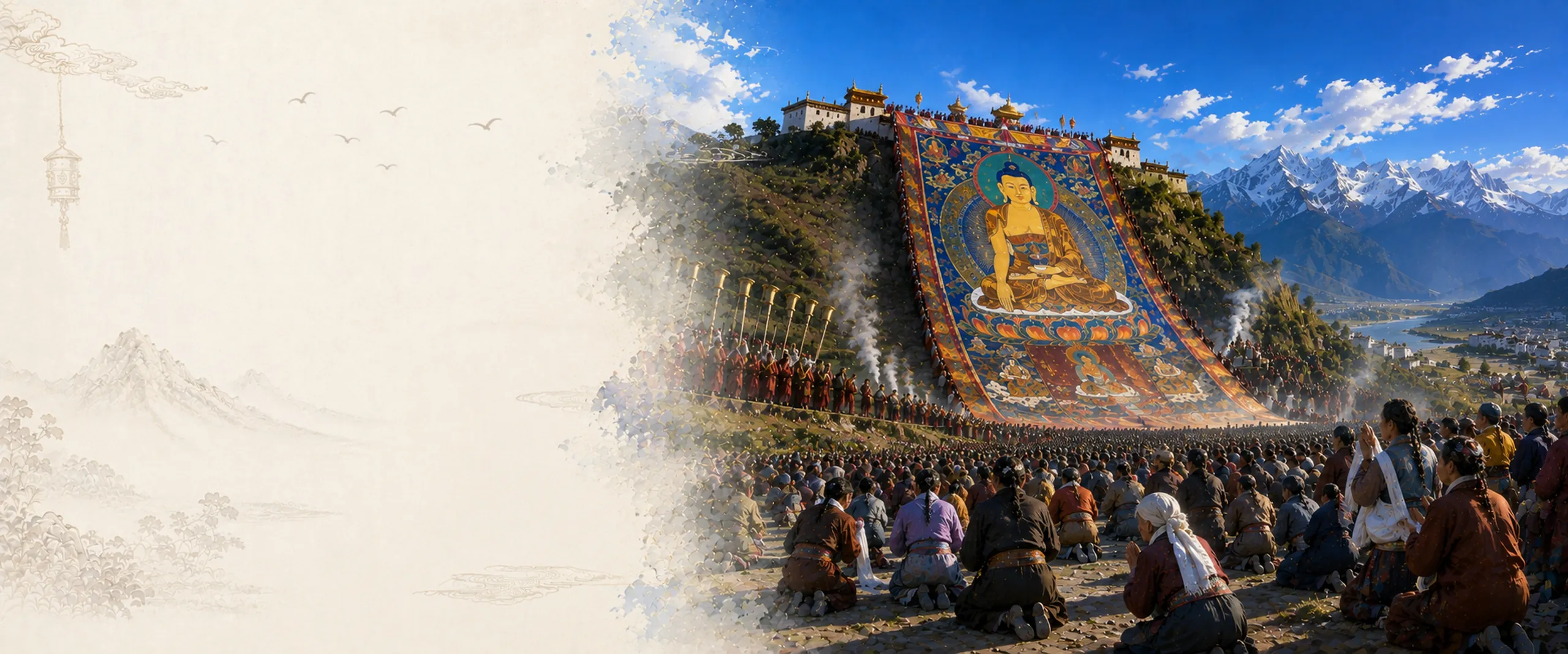
The thangka‑unfurling ceremony is the most awe‑inspiring religious event of the Shoton Festival and the true beginning of the festival. This ceremony, which has a history of three hundred years, generally begins around 8 a.m. on the 30th day of the sixth month in the Tibetan calendar. On this day each year, a gigantic thangka of the Buddha is slowly revealed to the world, heralding the start of a great festival of celebration.
The prelude to the Shoton Festival is the thangka‑unfurling at Drepung Monastery. On that day, before dawn, people gather from all directions at the foot of Gephel Uise (更乌培孜) hill, where Drepung Monastery is located, for the grand ceremony. Long before daybreak, streams of pilgrims climb the hill in the dark; the area around Drepung is packed with the faithful, and the incense‑burning stoves (煨桑炉) are thronged with people. As the time for the unfurling approaches, accompanied by the sound of ceremonial horns echoing through the valley, nearly a hundred monks slowly carry the huge silk thangka, rolled like a dragon, out of the Great Assembly Hall (Tsokchen, 措钦大殿) of Drepung and up to the special platform on the west side of the monastery. Soon the enormous thangka is gradually unfurled from top to bottom; white scarves (khata, 哈达) fly toward the image, creating a spectacular scene. Normally, the giant thangka is stored deep within the monastery; from a preservation standpoint, periodic airing is beneficial, so the ceremony is also called “sun‑bathing the Buddha” (晒佛). Within less than an hour, the thangka is rolled up again and carried back to the Great Assembly Hall.
The thangka‑unfurling is not only a visual feast but also a powerful expression of faith. For followers of Tibetan Buddhism, gazing upon the giant Buddha image is an extremely auspicious religious experience. The unfurling of the image symbolises the illumination of the world by the Buddha’s Dharma; the faithful pray before the image, offer scarves, and prostrate themselves, seeking the Buddha’s blessings and protection. The giant thangka usually depicts Shakyamuni Buddha or Maitreya (the future Buddha), is exquisitely embroidered with fine silk brocade, and is normally kept hidden in the monastery; it is shown to the public only during the Shoton Festival. Regular airing serves both to preserve the artefact (preventing damp, insect damage, and mildew) and to symbolically let the Buddha’s light shine upon the world and allow the faithful to behold his countenance. The thangka‑unfurling ceremony attracts hundreds of thousands of pilgrims and tourists to Drepung Monastery. People come from every corner of Lhasa, from every region of Tibet, and even from Tibetan areas in Qinghai, Sichuan, and Yunnan, converging on the slopes of Drepung. The smoke of burning juniper (煨桑) fills the valley, the long‑sounding horns echo across the sky, and khata scarves fly like snowflakes before the Buddha image. The thangka‑unfurling is not only the prelude to the Shoton Festival but also the most sacred moment of the Lhasa summer. Only after this ceremony do the other activities—Tibetan opera, garden gatherings, yak races, equestrian shows—unfold. The thangka‑unfurling establishes the religious tone of the festival, ensuring that this carnival‑like celebration retains a degree of holiness and solemnity.
Tibetan Opera Performances (藏戏, Ache Lhamo)
If the thangka‑unfurling is the prelude, then Tibetan opera is the soul of the Shoton Festival. Because the festival features opera performances as its main attraction, it is also called the “Tibetan Opera Festival.” The integration of Tibetan opera with the Shoton Festival elevated the festival from a purely religious observance to a comprehensive celebration combining religion, art, and entertainment.
Tibetan opera is an ancient theatrical form; its origins can be traced back about 1,200 years, to the mid‑Tang dynasty, and it took initial shape in the 14th‑15th centuries, during the time of the legendary figure Thangtong Gyalpo (唐东杰布, 1385–1464). Thangtong Gyalpo is considered the father of Tibetan opera. He was a Kagyu monk and a famous bridge‑builder in Tibet. According to legend, in order to raise funds for bridge construction, Thangtong Gyalpo adapted Buddhist stories into dramatic performances and organised local people to perform them, thereby spreading the Dharma and raising funds. This combination of Buddhist narratives with theatrical performance established the tradition of Tibetan opera. Tibetan opera integrates Buddhist stories, Tibetan history, folk tales, and other elements; its performance style is robust and passionate, its singing high‑pitched and resonant, its masks colourful, and its costumes elaborate and splendid. The repertoire mainly consists of Buddhist birth stories (Jataka tales) and historical legends, such as *Princess Wencheng*, *Prince Norsang*, *Drigum Choegyal*, and others, which serve both to teach Buddhist morality and to provide aesthetic entertainment.
When Tibetan opera first became part of the Shoton Festival, its scope was limited to the monastery, initially centring on Drepung Monastery, and thus it was called the “Drepung Shoton Festival.” According to records, the twelve opera troupes participating in the Shoton Festival performances were: Tashishölpa, Jiongpa, Jianggar, Shangpa, Juelong, Tazhong, Lhündrubgang, Langzewa, Bindunba, Ruonieg’a, Xirong Zhongzi, and Gongbu Zhuo’ba. These twelve troupes came from various parts of Tibet and represented the opera arts of different regions and schools. They gathered in Lhasa every year during the Shoton Festival, competing and exchanging with one another, making the festival the highest showcase for Tibetan opera. After the Fifth Dalai Lama moved from Drepung to the Potala Palace, the Shoton Festival on the 30th day of the sixth month each year would always feature opera performances first at Drepung, and on the following day at the Potala for the Dalai Lama. In the early 18th century, after Norbulingka was built, the activities moved again to Norbulingka, and citizens were allowed to enter the park to watch the operas.
The integration of Tibetan opera and the Shoton Festival has been mutually beneficial. Tibetan opera provides the festival with its most essential cultural content—without opera, the festival would be only a yoghurt‑eating ritual and could hardly become a grand celebration lasting several days; the festival provides opera with its most important performance platform—without the gathering at Shoton, Tibetan opera would have struggled to remain vibrant and pass from generation to generation over the centuries. The festival is made splendid by the opera, and the opera is transmitted through the festival. Even today, Tibetan opera performances remain the core of the Shoton Festival. During the festival each year, opera performances are staged continuously in Norbulingka Park, drawing huge audiences. Actors wear gorgeous costumes and exquisite masks, sing in high, resonant voices, and enact ancient Buddhist stories. In 2009, Tibetan opera was inscribed on UNESCO’s Representative List of the Intangible Cultural Heritage of Humanity. The Shoton Festival and Tibetan opera, as two intangible cultural heritage items—one a festival and the other an art form—together form the most brilliant cultural landscape of Tibet.
Going to the Garden (过林卡, Lingka)
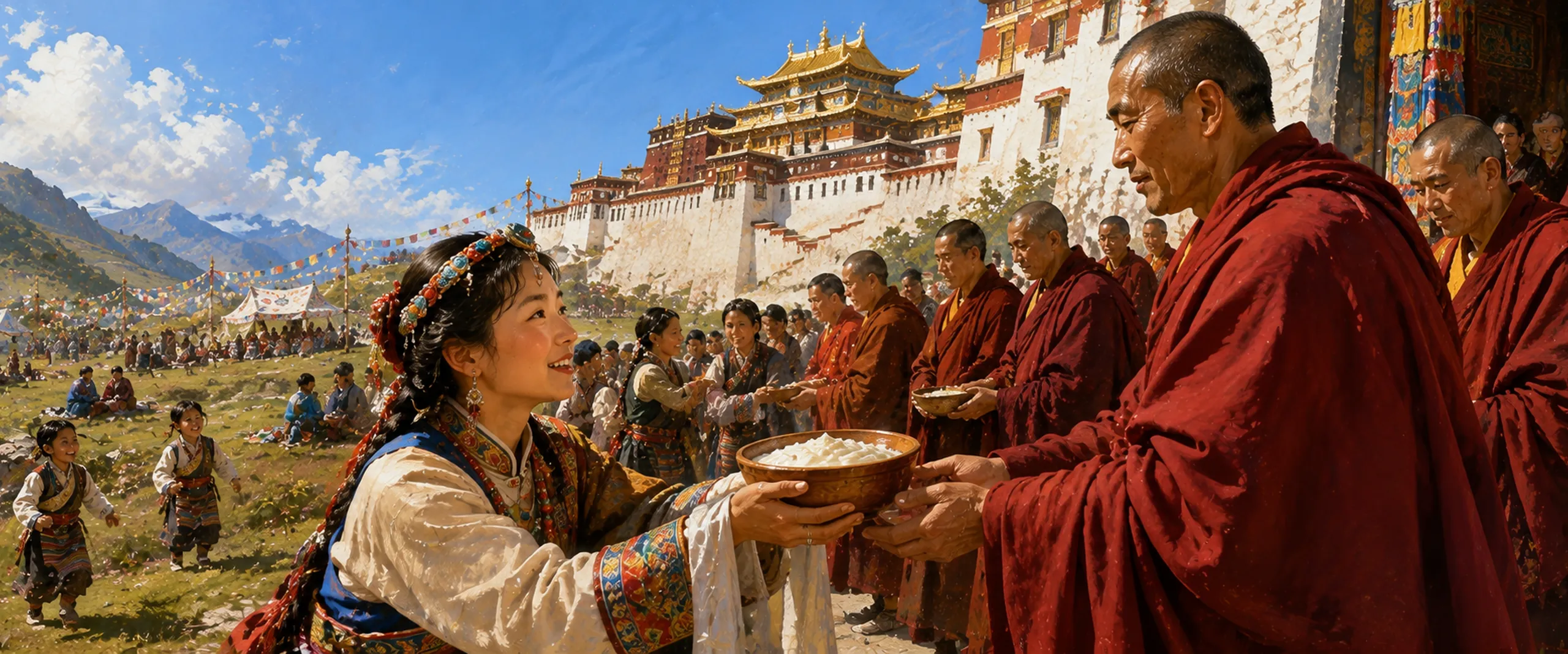
“Going to the garden” is the most life‑affirming part of the Shoton Festival. In Tibetan, “lingka” means “garden” or “park,” and “going to the garden” means picnicking, playing, and relaxing in a garden setting. During the Shoton Festival, Tibetan people dress in their finest festive clothes, bring yoghurt, barley wine (chang), butter tea, dried meat, and other foods, and go to Norbulingka or other gardens. There they set up tents, spread out cushions, and gather with family or friends to enjoy the most pleasant time of the year.
Norbulingka is the central venue for “going to the garden” during the Shoton Festival. This 360,000‑square‑metre garden is shaded by trees, filled with blooming flowers, and dotted with pavilions and halls, making it the most beautiful public space in Lhasa. During the festival, Norbulingka becomes an ocean of joy. People pour in from all directions, setting up colourful tents on the lawns, spreading brightly coloured carpets, and laying out abundant food. Children chase and play on the grass; young men and women sing and dance under the shade of trees; the elderly sit in their tents, tasting yoghurt and chatting about everyday life.
As the “festival of eating yoghurt,” yoghurt holds an irreplaceable place in the Shoton Festival. During the festival, yoghurt is not only daily food but also a symbol of the celebration. People offer yoghurt to monks, serve it to guests, and enjoy it to mark the festival. Tibetan yoghurt is made with a unique technique—yak milk is boiled, cooled, mixed with a starter culture, and fermented in a warm environment for several hours, resulting in a thick, rich yoghurt. For the Shoton Festival, the yoghurt is often made with extra care; some add sugar, some honey, some the fruit of the Tibetan ginseng (人参果), creating various flavours. In Tibetan culture, yoghurt is not just food but also a carrier of blessings. From Atiśa’s tradition of blessing those who offered him yoghurt, to the custom of laypeople offering yoghurt to monks emerging from retreat, yoghurt has always carried the meanings of gratitude, blessing, and good fortune. Tasting a bowl of yoghurt during the Shoton Festival is not only a sensory pleasure but also a cultural experience.
Yak Races and Equestrian Shows
During the Shoton Festival, there are also thrilling yak races and equestrian performances. Yak racing is a traditional Tibetan sport: riders mount yaks and race across the grasslands, a rough and passionate spectacle. Equestrian shows are even more spectacular—riders perform difficult manoeuvres on horseback, such as standing upside down, picking up objects, and shooting arrows while galloping, demonstrating the Tibetans’ superb horsemanship and their special bond with horses. These sporting events add vigour and passion to the festival, making it not only religiously solemn and artistically beautiful but also athletically exciting.
Readers’ Comments
Calendar and traditional culture enthusiasts from around the world, sharing the same moon.
Sign in or register to join the conversation. Your comment account is created automatically the first time you use a connected account.
No comments yet
Share your thoughts with readers around the world.