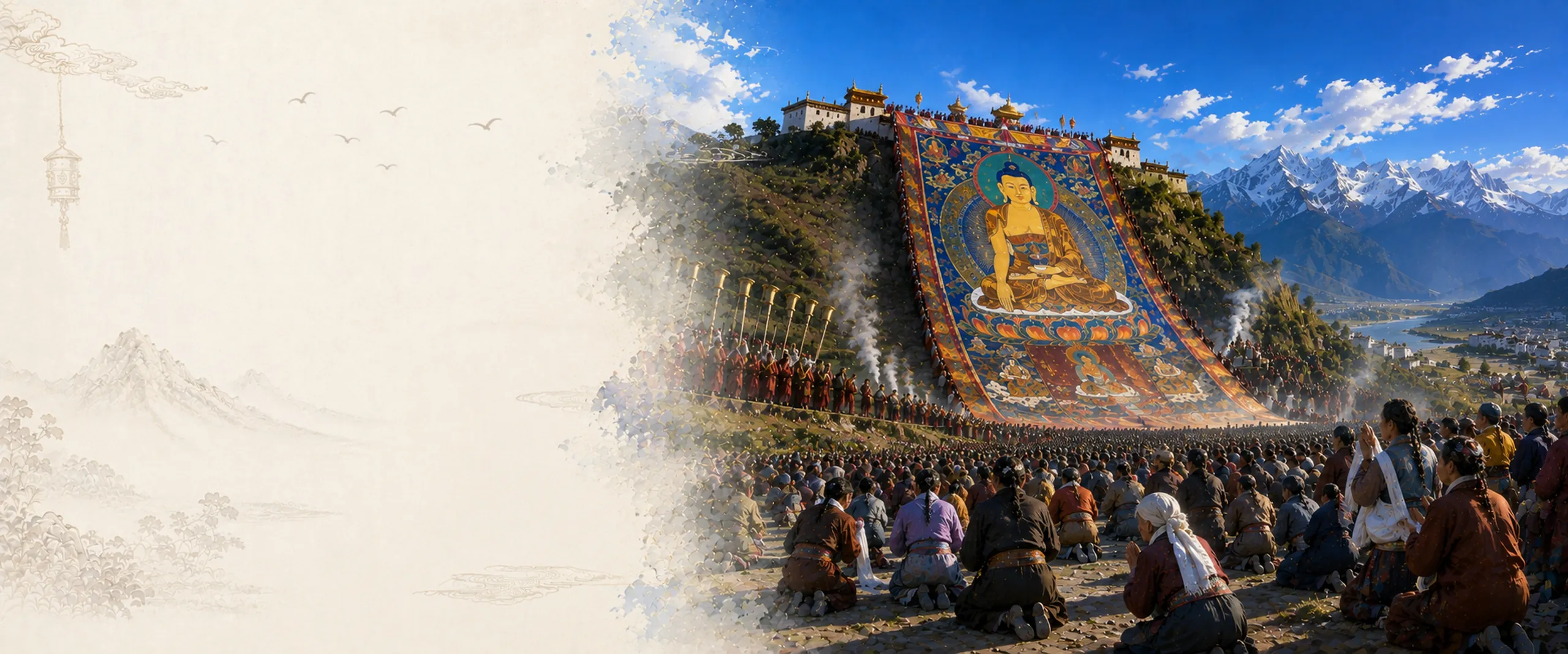
The Shoton Festival begins each year on the first day of the seventh month of the Tibetan calendar and lasts between five and seven days. Traditionally, the festival opens with the Buddha Unveiling Ceremony, during which enormous thangkas are displayed outdoors at monasteries such as Drepung. Tibetan opera is one of the principal highlights of the festival; historically, twelve Tibetan opera troupes took part in its performances. People dress in festive clothing, bring food and drink, and travel to Norbulingka to watch Tibetan opera. The Shoton Festival was originally a religious observance. According to the rules of the Gelug school of Tibetan Buddhism, the period from the fifteenth day of the sixth Tibetan month to the thirtieth day of the seventh month was a period of retreat during which monks and nuns were not permitted to go outside, in order to avoid accidentally killing living creatures underfoot. When the restriction was lifted on the first day of the seventh Tibetan month, laypeople offered yogurt to the monks and nuns. This custom gave the Shoton Festival, literally the “Yogurt Banquet,” its name.
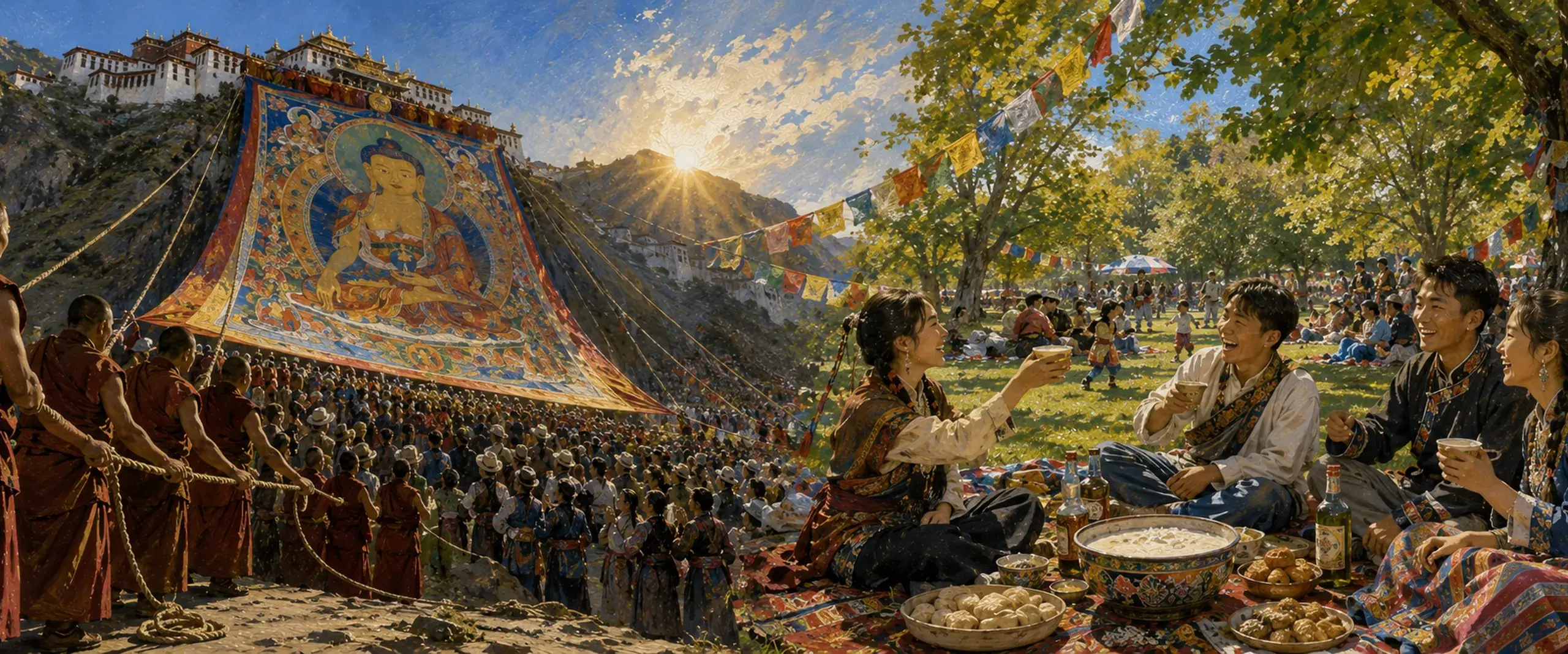
Main Customs
Preparations Before the Festival
Preparations for the Shoton Festival begin several days in advance, and the entire city of Lhasa becomes immersed in an atmosphere of anticipation.
Preparations at the Monasteries
For monasteries such as Drepung Monastery and Sera Monastery, where giant thangkas are ceremonially displayed, preparations before the festival are especially demanding. The enormous thangkas used in the ceremony are normally kept carefully stored inside the monasteries and are brought out for public viewing only during the Shoton Festival. Before the celebration, monks remove them from storage, inspect them for damage, and carry out any necessary repairs and cleaning. The construction of the display platform, preparation of ritual horns and drums, and rehearsals for scripture-recitation ceremonies all require careful organization. The giant thangka used for the unveiling ceremony is made using silk appliqué and embroidery and measures approximately 37 meters wide and 40 meters high.
Preparations Among the Public
For ordinary Tibetan families, preparations are equally busy. People ready their finest festival clothing—Tibetan robes, pulu (氆氇, traditional Tibetan woolen cloth) garments, belts, and jewelry—and carefully clean and arrange every item. More importantly, they prepare the foods to be eaten during the festival. Yogurt is unquestionably the centerpiece, while families also prepare highland-barley wine, butter tea, sweet tea, and a variety of snacks. Tents, sitting mats, utensils, and other items needed for lingka outings must also be packed in advance. When spending the day at Norbulingka, families bring thermos flasks filled with sweet tea, ground mats, woven cloth or Tibetan carpets, and bamboo containers filled with yogurt and snacks.
Preparations of Pilgrims
For devotees traveling from different parts of Tibet to attend the Buddha Unveiling Ceremony, preparations can be even more demanding. Before dawn on the thirtieth day of the sixth Tibetan month, roughly in late August on the Gregorian calendar, people travel on foot from every direction and gather beneath Drepung Monastery, the largest monastery in Tibet. Some leave home in the early hours of the morning or even the previous night, carrying khatas, offerings, and sincere devotion as they make their way toward the monastery to await the unveiling. During the 2025 Shoton Festival, beginning on the night of August 22, visitors and pilgrims traveling toward Drepung could frequently be seen asking local residents where to enter for the unveiling ceremony. Residents not only gave directions but also warmly reminded them, “It gets cold at night, wear more clothes,” and “Did you bring an umbrella? It might rain.” According to reports from 2024, some visitors arrived as early as 4:00 a.m. specifically to witness the event.
Preparing Norbulingka
After Norbulingka was constructed in the early eighteenth century, the principal center of Shoton Festival activities gradually shifted from Drepung Monastery and the Potala Palace to Norbulingka. Before the festival, tents and performance stages are set up throughout the grounds in preparation for tens of thousands of visitors and residents. During the celebration, Tibetan-style tents rich in traditional cultural character fill nearly every corner of Norbulingka.
Buddha Unveiling
The Buddha Unveiling Ceremony, also often described as the airing or displaying of the giant thangka, is the most sacred and visually overwhelming ritual of the Shoton Festival and marks the formal opening of the celebration. Because Drepung Monastery displays an enormous thangka on the first day of the festival, Shoton is also sometimes known as the “Buddha Unveiling Festival.”
Origins and Meaning of the Buddha Unveiling
In Tibetan usage, the ceremony refers to bringing out a giant Buddhist thangka that has been stored away for an entire year and displaying it outdoors. From the practical perspective of preservation, periodically airing such enormous thangkas helps protect them against dampness, insects, and mildew. Religiously, however, the purpose is to allow large numbers of devotees to behold the image of the Buddha, experience his compassion, and receive his blessing. The ceremony symbolizes the light of the Dharma illuminating the world, and believers hold that seeing and venerating the enormous sacred image can generate exceptional religious merit.
The Drepung Monastery Buddha Unveiling: The Largest Ceremony
Drepung Monastery is the largest monastery in Tibet and the central site of the Shoton Festival’s Buddha Unveiling Ceremony. Founded in 1416 by Jamyang Chöjé Tashi Palden, a disciple of Tsongkhapa, it has a history of more than six centuries. The giant thangka is displayed on a dedicated platform on the slopes west of the monastery, on Genpei Utsé Mountain.
The scene on the day of the ceremony is exceptionally spectacular. Before dawn on the thirtieth day of the sixth Tibetan month, usually around late August, people travel under the stars from every direction and gather below Drepung Monastery. Pilgrims form an immense human sea at the foot of the mountain. In the darkness, no one can clearly see the faces around them, yet everyone is moving in the same direction—toward Drepung.
The ceremony begins in the early hours. At around 6:00 a.m., monks from Drepung begin making their way toward the Tsogchen Assembly Hall to prepare for the unveiling. Approximately one hundred monks carry the enormous rolled thangka on their shoulders and proceed along the winding mountain path toward the display platform on Genpei Utsé. At the same time, other lamas dressed in purple robes and high golden ceremonial hats sit on the ground with lowered heads, praying devoutly for favorable weather, peace, happiness, and well-being for the people.
At approximately 7:00 a.m., as the first light of dawn appears, ritual horns sound and ceremonial gongs ring out. Deep, resonant horns fill the air as dozens of lamas shoulder the enormous thangka roll, described as roughly 20 meters long, and carry it toward the western slope. When the appointed moment arrives, the monks rapidly unfurl the silk image across the mountainside amid the sound of ritual instruments and the intense expectation of the assembled crowd.
As the yellow covering cloth is gradually lifted away, the giant thangka appears before the multitude. When the entire sacred image is fully revealed, rays of dawn seem to wash across it. A popular saying holds that even if heavy rain is falling on the day of the Buddha Unveiling, the moment the image is fully opened may still be accompanied by a sudden burst of radiant light. At this moment, worshippers are said to feel spiritually transformed. Facing the solemn Buddha image in the morning light, the crowd does not erupt into pushing or noise but instead prays quietly. Devotees throw auspicious khatas toward the giant thangka, press their palms together, bow in reverence, and recite prayers for favorable weather, happiness, health, and peace.
Drepung Monastery possesses two giant thangkas used for the Buddha Unveiling. During the 2025 Shoton Festival, the monastery displayed a monumental thangka of Maitreya Buddha, or Jampa. One description gives its dimensions as approximately 60 meters high and nearly 40 meters wide—comparable to a building almost twenty stories tall if each story is calculated at three meters. The same source also describes the appliqué thangka as measuring 37 meters wide and 40 meters high and states that it was made in 2014 in preparation for the monastery’s 600th anniversary in 2016. On the same day, Sera Monastery displayed a giant thangka of Śākyamuni Buddha.
Religious Meaning of the Buddha Unveiling
The Buddha Unveiling is not merely a visual spectacle but a profound act of faith. For Tibetan Buddhist devotees, beholding the giant Buddha image constitutes an especially meaningful religious experience. The unfurling of the image symbolizes the radiance of the Dharma spreading throughout the world, while devotees pray, offer khatas, and perform full-body prostrations before it in the hope of receiving blessings and protection. Large-scale Buddhist rituals, including scripture recitation and the sounding of ritual horns, are also performed at the same time. The unveiling formally opens the Shoton Festival. Afterward, the sounds of Tibetan opera drums and cymbals can be heard within nearby Drepung Monastery, where the first performance is traditionally offered to the revered Buddha with a spirit of devotion.
Tibetan Opera Performances
If the Buddha Unveiling is the opening of the Shoton Festival, Tibetan opera is its cultural soul. Because Tibetan opera performances became one of the principal elements of the celebration, Shoton has also been known as the “Tibetan Opera Festival.” Tibetan opera is an indispensable part of the festival and one of the art forms most deeply loved by Tibetan audiences.
The Integration of Tibetan Opera and the Shoton Festival
Tibetan opera began to become incorporated into the Shoton Festival in the mid-seventeenth century. After the Gelug school of Tibetan Buddhism came to political power in 1642, the Ganden Phodrang Palace at Drepung Monastery, residence of the Fifth Dalai Lama, temporarily became a major political, religious, and cultural center of Tibet. Every year on the thirtieth day of the sixth Tibetan month, thousands of people entered Drepung to present yogurt to the Fifth Dalai Lama and the monastery’s monks and to request blessings by the laying on of hands. As the contents of the festival expanded, Tibetan opera performances began to be included. Records identify twelve Tibetan opera troupes or performance traditions that took part in Shoton activities: Tashi Sholpa, Jomba, Janggar, Shangba, Jomolung, Tazhong, Lhundrubgang, Langzewa, Bindunba, Ronyega, Shirong Zhongzi, and Kongpo Zhaba. For this reason, the festival, which has more than three centuries of history in this form, may in one sense be regarded as a Tibetan opera festival.
From Drepung Shoton to Norbulingka Shoton
In the early stages of Tibetan opera’s integration into the festival, activities remained largely confined to monasteries, with Drepung serving as the center; this period was therefore known as “Drepung Shoton.” After the Fifth Dalai Lama moved from Drepung Monastery to the Potala Palace, Tibetan opera performances on the thirtieth day of the sixth month continued to be held first at Drepung, followed by performances the next day at the Potala Palace for the Dalai Lama.
After Norbulingka was constructed in the early eighteenth century, the center of Shoton Festival activities shifted again, this time from the Potala Palace to Norbulingka, and ordinary residents were gradually permitted to enter the gardens to watch Tibetan opera. From that point onward, the festival acquired a more complete and stable ceremonial structure. Over roughly two centuries, three forms—Drepung Shoton, Potala Shoton, and Norbulingka Shoton—coexisted, with Norbulingka eventually becoming the principal center.
Contemporary Tibetan Opera Performances
Today, Tibetan opera during the Shoton Festival is one of Lhasa’s largest cultural events. During the 2025 festival, major Tibetan opera performances were held simultaneously at Norbulingka and Zongjiao Lukang Park, attracting large numbers of residents and visitors. At Norbulingka, dedicated opera enthusiasts arrived early and set benches in front of the stage, some bringing yak meat and sweet tea so they could comfortably enjoy the holiday. Folk opera troupes performed classic works whose dramatic plots, vivid characters, humor, and emotional intensity repeatedly drew laughter and applause from the audience.
The 2025 program was particularly extensive. From August 23 to 27, outstanding Tibetan opera performances were staged at Zongjiao Lukang Park: the Dazi Deqing Tibetan Opera Troupe performed Pema Wenba; the Duilong Gadong Tibetan Opera Troupe performed Sugyi Nyima; the Duilong Dingga Tibetan Opera Troupe performed Drowa Sangmo; the Duilong Shexing Tibetan Opera Troupe performed Nangsa Öbum; and the Mozhugongka Qimaka Tibetan Opera Troupe performed Pema Wenba. During the same period at Norbulingka, the Jomolung Tibetan Opera Troupe, Shö Folk Tibetan Opera Troupe, and Nyare Folk Tibetan Opera Troupe performed Pema Wenba, Nangsa Öbum, and Sugyi Nyima, respectively.
Tibetan opera remains a living transmission of Tibet’s major traditional opera traditions. Each work integrates mythology, history, religion, and reflections on human nature. With its powerful and expressive vocal style, vigorous and joyful dance, and vividly colored character masks, Tibetan opera has become one of the best-known and most widely loved art forms among Tibetan people.
Cultural Value of Tibetan Opera
In 2009, Tibetan opera was inscribed on UNESCO’s Representative List of the Intangible Cultural Heritage of Humanity. It is one of the most important artistic forms of Tibetan culture, combining religious stories, historical legends, folk song and dance, and mask traditions. It represents a crystallization of collective Tibetan cultural wisdom. Tibetan opera performances during the Shoton Festival are therefore more than festival entertainment; they are an important vehicle of cultural transmission through which Tibetan historical memory, values, and aesthetic traditions are passed from generation to generation.
Lingka Outings
Lingka outings (过林卡) are the most everyday and leisurely part of the Shoton Festival and one of the forms of recreation most loved by Tibetan communities. If the Buddha Unveiling may be understood as “honoring the sacred” and Tibetan opera as “entertaining through sacred art,” then spending time in the lingka is about “enjoying life.” After the solemnity of religious ritual, people return to ordinary pleasures, enjoying food, nature, family, and friendship.
What Is a Lingka Outing?
Lingka means “garden” or “parkland” in Tibetan. To “spend time in the lingka” means to picnic, relax, and enjoy leisure outdoors in such a setting, roughly comparable to a picnic excursion. Every summer, Tibetans enjoy gathering in small groups at places with water and trees, setting up tents, laying down sitting mats, serving highland-barley wine and butter tea, and spending the day singing, dancing, and relaxing together. Among all such outings, those held in Norbulingka during the Shoton Festival are especially large and lively.
Norbulingka: The Premier Place for Lingka Outings
Located in the western suburbs of Lhasa, Norbulingka means “Treasure Garden” in Tibetan. Construction began in the 1740s during the period of the Seventh Dalai Lama. It later served as the summer palace of successive Dalai Lamas and is the largest and one of the most beautiful garden complexes in Tibet. During the Shoton Festival, brightly colored tents appear across its shaded lawns, and families bring food and drink to enjoy their favorite form of leisure—spending the day in the lingka.
During the festival, Tibetan-style tents rich in traditional cultural character fill nearly every corner of Norbulingka. Families arrive early, erect colorful tents, spread sitting mats and carpets across the ground, and arrange wine, drinks, dishes, and festival foods. Tibetan residents wear brilliant clothing and come with entire families, while relatives and friends gather together beneath the tents.
Activities During Lingka Outings
The activities are extremely varied. Families neatly spread sitting mats on the grass, sit together, and bring out yogurt, sweet tea, highland-barley wine, cooked beef, and other foods. They drink, eat meat, drink tea, talk, and enjoy the relaxed atmosphere of the festival. Some sing and dance and remain in the lingka for the entire day or even continue such outings throughout the seven-day festival period.
A guest who happens to enter one of the tents may be warmly welcomed whether personally acquainted with the hosts or not. Visitors can be treated as honored guests and greeted with toasting songs and blessing songs, such as: “Raise high the shining wine cup; this wine is filled with affection and friendship. May our friends enjoy good fortune and may all things go smoothly. Though the moment of gathering is brief, the flowers of friendship bloom in our hearts, and beautiful memories remain with us.” Traditionally, accepting one bowl of wine is not considered sufficient; a guest may be offered three bowls in succession—to honor Heaven, Earth, and the divine.
Cultural Meaning of Lingka Outings
Lingka outings express a Tibetan philosophy of living in harmony between humanity and nature. Within traditional Tibetan thought, human beings should live harmoniously with the natural world, and enjoying life in a beautiful garden is one way of responding to nature’s gifts. During the Shoton Festival, the lingka outing creates a particularly complete combination of religious solemnity and secular enjoyment: one may experience the solemn Buddha Unveiling at Drepung in the morning and then spend the afternoon relaxing in Norbulingka. Within a single day, spiritual life is purified, the body is allowed to rest, and the mind is refreshed.
The Yogurt Banquet
The Tibetan word “Shoton” means “Yogurt Banquet.” Yogurt is the festival’s most important traditional food and the origin of its name. The festival itself grew out of the custom in which laypeople offered yogurt to monks as they emerged from the period of monastic retreat.
Yogurt: From Everyday Food to Cultural Symbol
A fondness for yogurt has long been part of Tibetan life on the high plateau. The distinctive natural environment of the Qinghai-Tibet Plateau—high elevation, intense sunlight, and large temperature differences between day and night—gave rise to a distinctive pastoral culture. The yak is one of the most important animals for plateau herders, and its milk is rich and full-bodied. Fermenting yak milk into yogurt not only made it easier to preserve but also created a food with a distinctive flavor.
Within Tibetan food culture, yogurt occupies a special position. It is at once an everyday food, a ritual offering, and a delicacy used in hospitality. During the Shoton Festival, yogurt is not merely something to eat but also a bearer of blessing. From the historical practice of laypeople offering yogurt to monks emerging from retreat to customs in which monasteries share yogurt with devotees, it has continually carried meanings of gratitude, blessing, and auspiciousness. Eating a bowl of yogurt during Shoton is therefore not only a sensory pleasure but also a cultural experience.
The Yogurt Banquet During Shoton
During the Shoton Festival, households prepare and ferment yogurt in advance. In old Tibet, the Kashag government observed a holiday during Shoton, and officials gathered at Norbulingka to accompany the Dalai Lama in watching performances; yogurt was an indispensable food on the occasion. Shoton was, quite literally, a festival for eating yogurt. People brought drinks and foods from home, including butter tea, beer, dough-based foods, and, of course, yogurt, to share with others.
Preparation begins before the festival. Yak milk or cow’s milk is fermented into yogurt, and both timing and temperature are carefully controlled. Yogurt prepared for Shoton is often especially thick and rich; some varieties contain sugar, others honey, and still others ginseng fruit, producing different flavors. Yogurt is indispensable during lingka outings and is eaten while people relax and enjoy the festivities. During the 2025 Shoton Festival, intangible-cultural-heritage experience areas also offered demonstrations and participatory activities related to traditional yogurt-making techniques.
Religious Meaning of Yogurt Offerings
Yogurt is not only food during Shoton but also an expression of faith. Under the monastic discipline of Tibetan Buddhism, monks and novices traditionally observe a period of summer retreat, during which they refrain from going outside. When they complete several months of retreat and leave the monastery, laypeople offer yogurt to them both as an expression of respect for the merit gained through religious practice and as a response to their compassion and diligence. Yogurt therefore becomes more than food: it is transformed into a cultural symbol carrying faith, gratitude, and blessing.
Horse Racing and Equestrian Performances
Horse racing and equestrian performances are among the most exciting outdoor activities during the Shoton Festival. In addition to the Buddha Unveiling, Tibetan opera, and lingka outings, traditional celebrations also include activities such as yak racing and equestrian displays.
Horse-Racing Festival
Horse racing is one of the traditional sports most loved by Tibetan communities. During Shoton, horse races attract skilled riders and excellent horses from different parts of Tibet. In 2025, the Lhasa Shoton Horse-Racing Festival and Equestrian Performance was held on August 24 at the racecourse in Lhasa’s northern suburbs, from 10:00 a.m. to 4:20 p.m.
Events include traditional forms such as speed racing and gaited-horse competitions. Speed racing tests both the horse’s speed and the rider’s control, generally over courses of several kilometers, with horses galloping across the open ground while riders lean low over their backs. Gaited-horse competitions emphasize the steadiness, rhythm, and elegance of the horse’s movement.
Equestrian Performances
Equestrian performance is one of the highlights of Shoton’s horse-racing activities. Riders perform a range of technically demanding maneuvers on horseback. The 2025 Shoton Festival program included lying sideways or flat on the horse, sword-cutting displays, mounted archery competitions, presenting or collecting bowls while riding, picking up khatas from the ground at speed, and forming human pyramids on horseback.
Mounted archery is among the most difficult events. Riders draw their bows and shoot at targets while their horses gallop at speed, requiring both exceptional riding ability and accuracy. In picking up khatas on horseback, riders lean down from a galloping horse to collect scarves from the ground, creating a display that is both dangerous and visually graceful. Human pyramids on horseback require multiple performers to cooperate while stacked into formations on moving horses, demonstrating remarkable balance and teamwork.
Cultural Meaning of Equestrian Performance
These performances are more than athletic competitions; they constitute a living transmission of Tibetan pastoral culture. In traditional Tibetan society, horses were among the herders’ most important companions, and riding was an essential skill for men. Horse races and equestrian performances during Shoton therefore both display traditional techniques and pay tribute to a culture deeply shaped by life on horseback.
Regional Variations
Lhasa
Drepung Buddha Unveiling, Tibetan opera at Norbulingka, lingka outings, horse-racing festival
Shigatse
Smaller-scale Buddha Unveiling and Tibetan opera activities
Shannan
Combination of religious ceremonies and popular entertainment
Contemporary Transmission
### Recognition as National Intangible Cultural Heritage
On May 20, 2006, the Shoton Festival was approved by the State Council for inclusion in the first batch of China’s National Intangible Cultural Heritage, under heritage number Ⅹ—31. It is an important Tibetan festival and a concrete manifestation of the continued transmission of Tibetan culture.
### Establishment as a Statutory Festival
The Shoton Festival is a statutory holiday in the Tibet Autonomous Region. During the festival, a wide variety of celebrations take place throughout Tibet. Since the festival began to be organized by the Lhasa municipal government in 1994, it has gradually developed into a comprehensive celebration combining traditional Buddha Unveiling ceremonies, Tibetan opera, economic and trade activities, and tourism.
### The Contemporary Scale of the Shoton Festival
Far from declining in contemporary society, the Shoton Festival has become increasingly diverse. The 2025 Lhasa Shoton Festival, held from August 23 to 29, included major activities such as Buddha Unveiling ceremonies at Drepung and Sera monasteries, Tibetan opera performances at Norbulingka and Zongjiao Lukang Park, traditional equestrian performances at the racecourse in Lhasa’s northern suburbs, public lingka outings, and yogurt tasting. It remains one of Tibet’s grandest traditional festivals.
Alongside traditional events, contemporary celebrations have incorporated modern elements such as firework waterfalls, decorative lantern displays, lively evening markets, and special foods. The festival has become an important platform for displaying Tibetan cultural vitality, promoting economic development, and strengthening interethnic solidarity.
Closing Note
The folk traditions of the Shoton Festival form a long cultural narrative about “reverence” and “joy.” From the solemn majesty of the Buddha Unveiling to the exuberance of Tibetan opera, from the rich sweetness of the yogurt banquet to the leisurely pleasure of lingka outings, from the excitement of horse racing to the careful transmission of intangible cultural heritage craftsmanship, the customs of the Shoton Festival bring together the Tibetan people’s… [the source text ends this sentence here]
At the heart of the Shoton Festival is the integration of “reverence” and “joy.” The Buddha Unveiling expresses reverence for the Buddha: through the most solemn ritual, the sacred image is displayed so that devotees may behold it, pray before it, and receive blessings. Yogurt expresses reverence for monks: the richest food is offered to religious practitioners in gratitude for their compassion and diligence. Tibetan opera expresses reverence for art: ancient cultural traditions are transmitted through energetic performance so that the old dramas continue to live on stage.
The Shoton Festival is also a festival of joy. Lingka outings represent the joy of nature—enjoying life and drawing close to the natural world in beautiful gardens. Horse racing represents the joy of strength—galloping across open ground and displaying exceptional riding skills. Song and dance represent the joy of human relationships—friendship is transmitted through song and happiness is expressed through dance.
The Shoton Festival originated in the mid-eleventh century and was originally a purely religious observance. Before the seventeenth century, it remained primarily religious in character. After the Gelug school of Tibetan Buddhism came to political power in 1642, the festival gradually evolved and stabilized into an important celebration combining Tibetan opera performances and the Buddha Unveiling with both religious and recreational activities. After Norbulingka was built in the early eighteenth century, ordinary residents were allowed to enter the gardens to watch Tibetan opera, completing the festival’s transformation from a purely religious observance into a public celebration.
In 2006, the Shoton Festival was included in the first batch of China’s National Intangible Cultural Heritage. From the religious rites of the eleventh century to contemporary national heritage protection, and from the lifting of the monks’ summer retreat to a celebration enjoyed by the wider public, the festival has crossed nearly a thousand years while continuing to flourish on the Tibetan Plateau. Its customs are both a concentrated expression of the Tibetan religious tradition of revering the Buddha and respecting the monastic community and an everyday expression of a cultural wisdom that embraces life with acceptance and joy. Between reverence and celebration, the Shoton Festival continually renews a profound cultural dialogue about faith, life, and culture. Like the giant thangka slowly unfurled across the mountainside at Drepung Monastery, the traditions of the Shoton Festival have passed through centuries of history and continue, with their distinctive cultural radiance, to illuminate every summer on the Tibetan Plateau.
———-
Readers’ Comments
Calendar and traditional culture enthusiasts from around the world, sharing the same moon.
Sign in or register to join the conversation. Your comment account is created automatically the first time you use a connected account.
No comments yet
Share your thoughts with readers around the world.