Tibetan Opera
Other 藏族Why Shoton Is Also Called the “Tibetan Opera Festival”
Because performances of Tibetan opera form one of the central events of the Shoton Festival, the festival is also known as the “Tibetan Opera Festival.”
Tibetan opera is called “Lhamo” in Tibetan, meaning “fairy.” According to tradition, Tibetan opera was first performed by seven sisters, and many of its stories were drawn from mythic narratives in Buddhist scriptures, hence the name.
Tibetan opera originated in the folk songs and dances, narrative singing traditions, religious rites, and ritual arts that developed during the formative period of Tibetan culture. Its history can be traced back as early as the eighth century. By the fifteenth century, the Tibetan architect and cultural figure Thangtong Gyalpo adapted folk singing and dancing, acrobatics, and various popular arts into Tibetan opera, marking the gradual maturation of this ancient theatrical form.
As a highly distinctive genre within China’s ethnic theatrical traditions, Tibetan opera occupies a unique place not only in China but also in the wider world of drama.
In 2009, Tibetan opera, together with the Gesar epic tradition as representatives of Tibet’s intangible cultural heritage, was inscribed on UNESCO’s Representative List of the Intangible Cultural Heritage of Humanity.
Tibetan opera brings together myth, legend, folk song, narrative singing, dance, acrobatics, and various forms of Tibetan folk literature and art with religious ritual, music, and dance. It has therefore been described as a “living fossil” of Tibetan culture.
During the period of the Fifth Dalai Lama, Tibetan opera gradually separated from monastic religious ritual and developed into a theatrical form centered on singing, integrating singing, chanting, dancing, acting, spoken dialogue, and performance skills within a set of basic conventions.
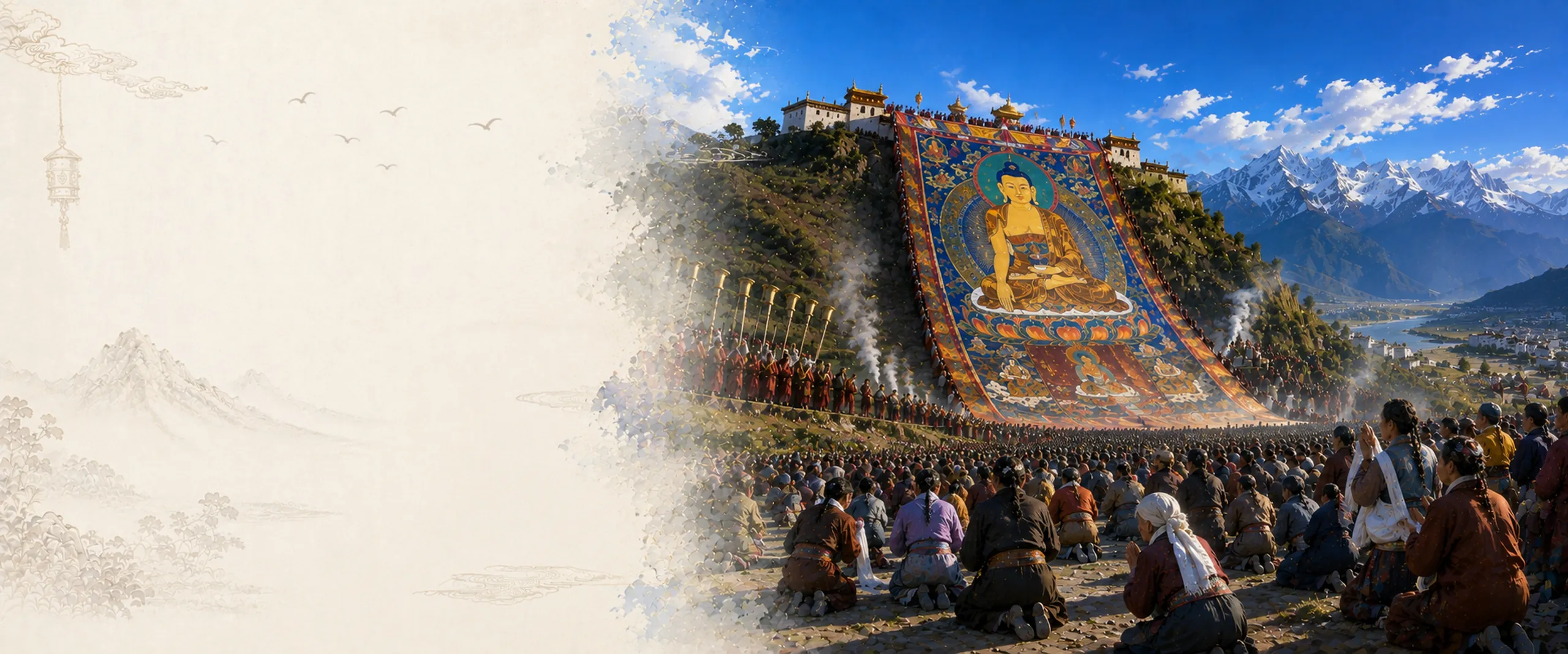
According to historical records, in the mid-seventeenth century the Fifth Dalai Lama established the custom of holding the Shoton Festival in Lhasa each year from the end of the sixth lunar month to the beginning of the seventh, with Tibetan opera troupes from different regions gathering in Lhasa to perform.
From that time onward, Tibetan opera became the cultural heart of the Shoton Festival, and the festival accordingly acquired the alternative name “Tibetan Opera Festival.”
Today, during the annual Shoton Festival, Tibetan opera performances at Norbulingka and Dzongyab Lukhang Park are among the liveliest events. Folk Tibetan opera troupes take turns presenting their finest repertoire at these two venues.
Three Major Traditions and the Eight Great Operas
Tibetan opera encompasses an exceptionally broad theatrical system. Because the regions of the Qinghai-Tibet Plateau differ in natural conditions, ways of life, cultural traditions, dialects, and pronunciation, Tibetan opera developed numerous artistic genres and schools.
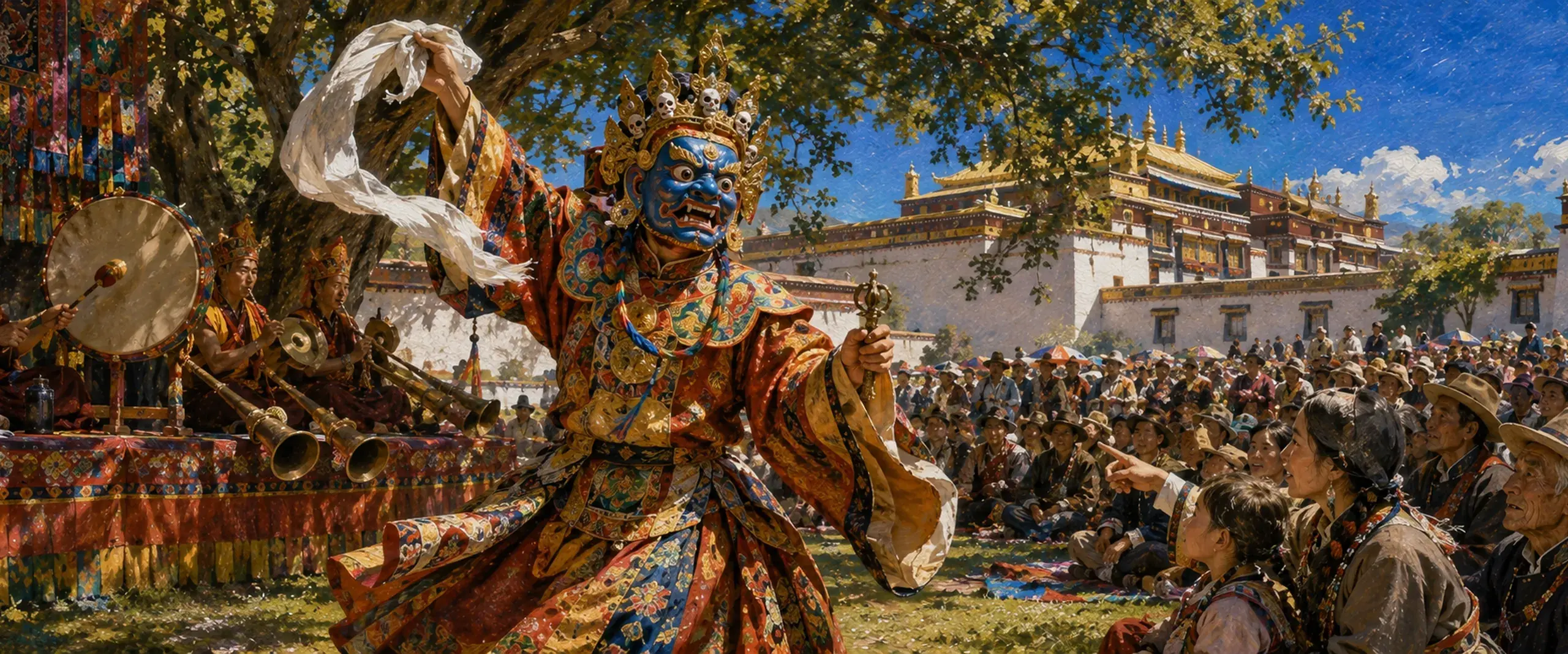
In Tibet, the best-known forms are White Mask Tibetan Opera and Blue Mask Tibetan Opera.
White Mask Tibetan Opera is the oldest form of Tibetan opera, with its embryonic beginnings traceable to the Tubo period. It is distinguished by its unique dance rhythms, graceful singing, archaic costumes, and mysterious plots.
Many later schools of Tibetan opera developed from this tradition, and White Mask Tibetan Opera was included in the second national list of intangible cultural heritage in 2011.
One of its most distinctive features is that many melodies begin with introductory sounds resembling the cries or roars of animals. This arose from the way its vocal melodies were designed according to the fundamental requirements of the seven categories of Tibetan vocal sound.
The classic White Mask Tibetan Opera 《扎西雪巴》 is an indispensable opening performance at the Shoton Festival each year. It is often said that if 《扎西雪巴》 is not performed, no other Tibetan opera can begin.
The work in fact serves as a ceremonial prologue to Tibetan opera performances. At the beginning, performers purify the performance ground, conduct ritual offerings, invoke divine protection, and drive away evil influences. Its origins lie in “Wenbadun,” regarded as one of the earliest forms of Tibetan opera.
White Mask Tibetan Opera was included in the second national list of intangible cultural heritage in 2011.
Blue Mask Tibetan Opera began to take shape in the fourteenth and fifteenth centuries and flourished in the seventeenth century.
From it developed four major schools: Jomulung, Jungpa, Shangpa, and Jianggar. Among them, the Jomulung school is the most representative Tibetan opera tradition of the Lhasa region, with repertoire including 《卓娃桑姆》, 《苏吉尼玛》, and 《白玛文巴》.
Tradition holds that Tibetan opera once possessed “thirteen great plays.” The works most frequently performed are 《文成公主》, 《曲杰诺桑》, 《朗萨雯蚌》, 《卓娃桑姆》, 《苏吉尼玛》, 《白玛文巴》, 《顿月顿珠》, and 《智美更登》, collectively known as the “Eight Great Tibetan Operas.”
During the Shoton Festival, folk Tibetan opera troupes take turns presenting these classics.
During the 2025 Shoton Festival, Dzongyab Lukhang Park and Norbulingka Park hosted performances by folk Tibetan opera troupes of classic works including 《白玛雯巴》, 《卓娃桑姆》, 《苏吉尼玛》, and 《朗萨雯蚌》.
Onstage, performers dressed in magnificent costumes may stand firmly in place as male and female voices alternate in soaring song, or move and leap across the performance area with the hems of their robes flying through the air.
Below the stage, hundreds of spectators sit directly on the ground, at times deeply absorbed in the unfolding drama and at others applauding and cheering the performers’ remarkable skill.
Artistic Characteristics
A Tibetan opera performance is generally divided into three sections.
The first is “Dun,” consisting mainly of opening songs and dances offered to the deities. The second is “Xiong,” the principal dramatic narrative. The third is known as “Tashi,” meaning the offering of blessings and auspicious wishes.
Tibetan opera was originally an open-air theatrical form. Its accompaniment consisted only of a drum and a cymbal, with no other musical instruments.
Its singing style is high-pitched, powerful, and resonant. Melodies are generally tailored to individual performers, and every sung line is accompanied by supporting voices.
Actors usually do not wear theatrical makeup; instead, masks form the primary means of character presentation.
Tibetan opera integrates mythology, legend, folk songs, narrative singing, dance, acrobatics, and many other forms of Tibetan folk literature and art with religious ritual, music, and dance.
The scripts of Tibetan opera also represent one of the high points of Tibetan literature. They place equal emphasis on musical rhythm and poetic atmosphere, make extensive use of maxims, proverbs, and popular sayings, and even insert fables into dramatic plots, preserving much of the finest language of ancient Tibetan literature.
Throughout its development, Tibetan opera was relatively little affected by outside cultures. Both its content and its performance forms therefore retain many features of their original character, giving the tradition exceptional scholarly value in fields such as the study of theatrical origins and development.
Performance Tradition
Every year, the Shoton Festival brings renowned Tibetan opera troupes from across Tibet together in Lhasa to perform.
These performances are deeply loved by Lhasa residents. Many people travel to the venues specifically to watch traditional Tibetan opera.
Since Tibetan opera performance events were launched in 2012, they have been held successfully for thirteen years, attracting more than ten thousand spectators annually and becoming one of Lhasa’s most influential public cultural programs and cultural calling cards.
Shoton Festival Tibetan opera performances have become a cultural bridge linking tradition with modernity, monastic communities with lay society, and local residents with visitors.
The Jomulung Tibetan Opera Troupe is an important force in Shoton Festival performances.
Losang Tashi, an autonomous-region-level representative inheritor of the nationally recognized intangible cultural heritage tradition of Lhasa Jomulung Tibetan Opera, was invited in 2008 by the Lhasa Doilung Jomulung Tibetan Opera Troupe to oversee rehearsals for its Shoton Festival performance.
The formal production was widely praised by scholars, specialists, and the general public.
Readers’ Comments
Calendar and traditional culture enthusiasts from around the world, sharing the same moon.
Sign in or register to join the conversation. Your comment account is created automatically the first time you use a connected account.
No comments yet
Share your thoughts with readers around the world.