Ancient Miao Songs
Other 苗族Oral Literature
The Miao people possess an exceptionally rich tradition of oral folk literature, including a large body of legends, stories, and songs concerning the origins of the “Miao New Year.” In southeastern Guizhou, traditions concerning the festival’s origin can broadly be divided into three categories: 《苗族古歌》, the Miao 《季节歌》, and Miao legends and folk tales. In the cycle 《打杀蜈蚣》 from 《苗族古歌》, the Miao ancestral figure Jiang Yang fights countless battles against the centipede, a representative of evil forces. Finally, with the help of his mother “妹榜妹留(蝴蝶妈妈)” and other deities, he defeats the vicious centipede in the tenth month, when cold and warmth alternate. Through this form of oral literary transmission, memories of the festival’s origins have continued across generations in the songs of the Miao people.
Ancient Miao songs encompass the history of migration and labor among Miao ancestors, and their melodies are solemn, distant, and lingering. In Baibei Miao Village in Rongjiang, Guizhou, there is a saying about the local ancient songs: “千年唱一曲、一曲唱千年”. These songs are repeatedly sung during the Miao New Year, merging the historical memory of the Miao people with the joy of festival celebration.
Folk Legends
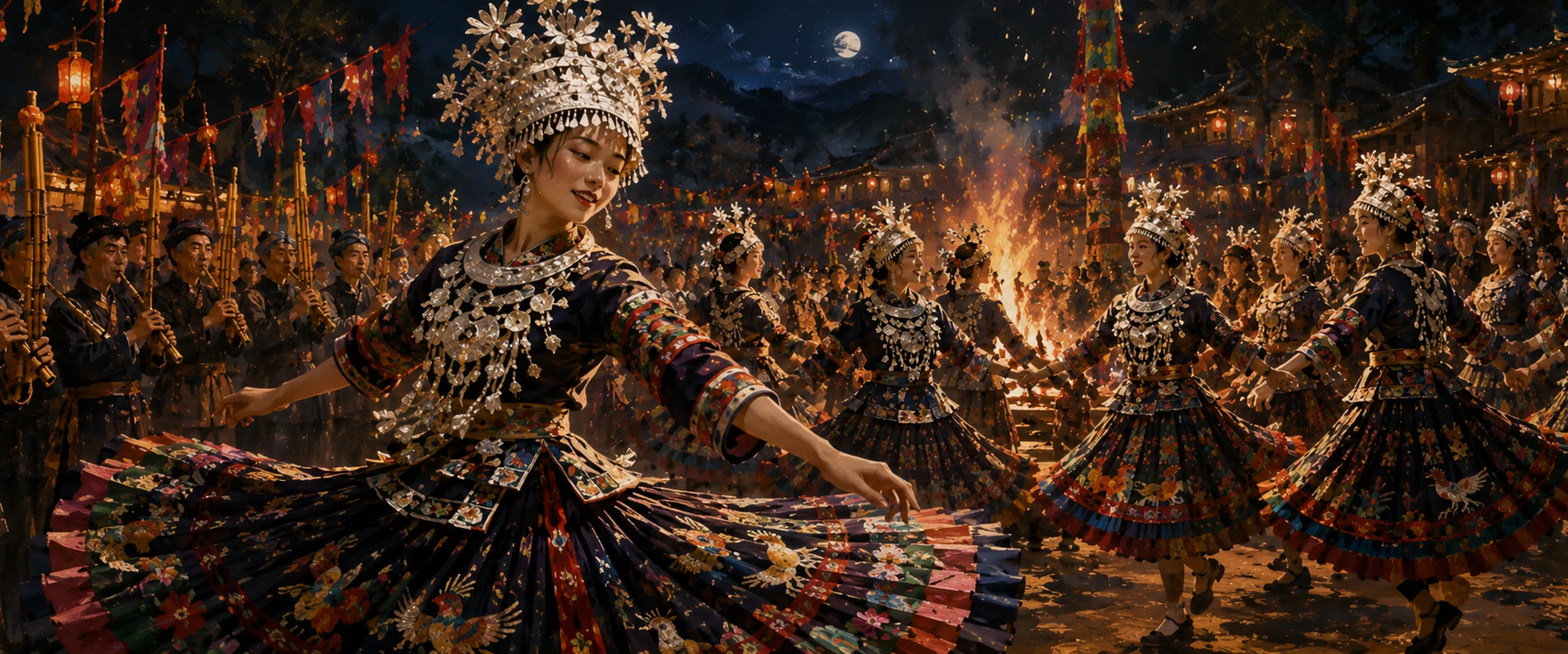
A widely circulated legend in Miao areas of southeastern Guizhou explains the origin of the Miao New Year as follows. It is said that there once lived a Miao girl named Wodudui, who was beautiful, intelligent, and capable. Both Heaven and Earth wished to marry her, but Wodudui had made up her mind to become the wife of Earth. When the god in Heaven learned of this, he abducted her. Wodudui refused to submit even at the cost of her life and hanged herself in the celestial palace in the eleventh lunar month. Admiring her steadfastness, people prepared fine food every year on the first Tiger Market Day of the eleventh lunar month and invited her spirit to return for reunion. Young men and women dressed in ceremonial finery, traveled from village to village, played the lusheng, and danced beneath the moon. Repeated year after year and passed down from generation to generation, this custom gradually became the grand traditional Miao festival known as the Miao New Year.
Another widely circulated legend tells of “the struggle between Heaven and the human world for the New Year festival.” According to the story, the Miao New Year was originally celebrated only by those in Heaven, while the human world remained cold and desolate. When the people below asked Heaven to grant them the festival and were refused, they declared war upon the celestial realm. After a fierce struggle, the people of Heaven yielded, allowing the New Year festival to descend to the human world once its celebration in Heaven had ended. Through simple oral narratives, such legends closely connect the origins of the Miao New Year with the Miao people’s longing for a better life.
The Miao people also maintain a custom of transmitting songs from generation to generation. Around the twelfth lunar month each year, young women and men in Miao villages collectively invite elderly singers in the village to teach them songs. The learning sequence begins with youfang songs, followed by other forms such as ancient songs, drinking songs, and narrative songs. Learning to sing is also regarded as a way to dispel sorrow and relieve boredom. This custom of “transmitting songs” enables the oral literary tradition of the Miao New Year to continue from one generation to the next.
Readers’ Comments
Calendar and traditional culture enthusiasts from around the world, sharing the same moon.
Sign in or register to join the conversation. Your comment account is created automatically the first time you use a connected account.
No comments yet
Share your thoughts with readers around the world.