Miao New Year

Miao New YearGlobal Spread

「 芦笙吹奏丰收曲,银饰闪亮贺苗年。 」

The Miao New Year is the most solemn festival of the year for the Miao people. The dates vary across regions, but it is generally held after the autumn harvest, around the tenth month of the lunar calendar. During the festival, Miao people dress in…

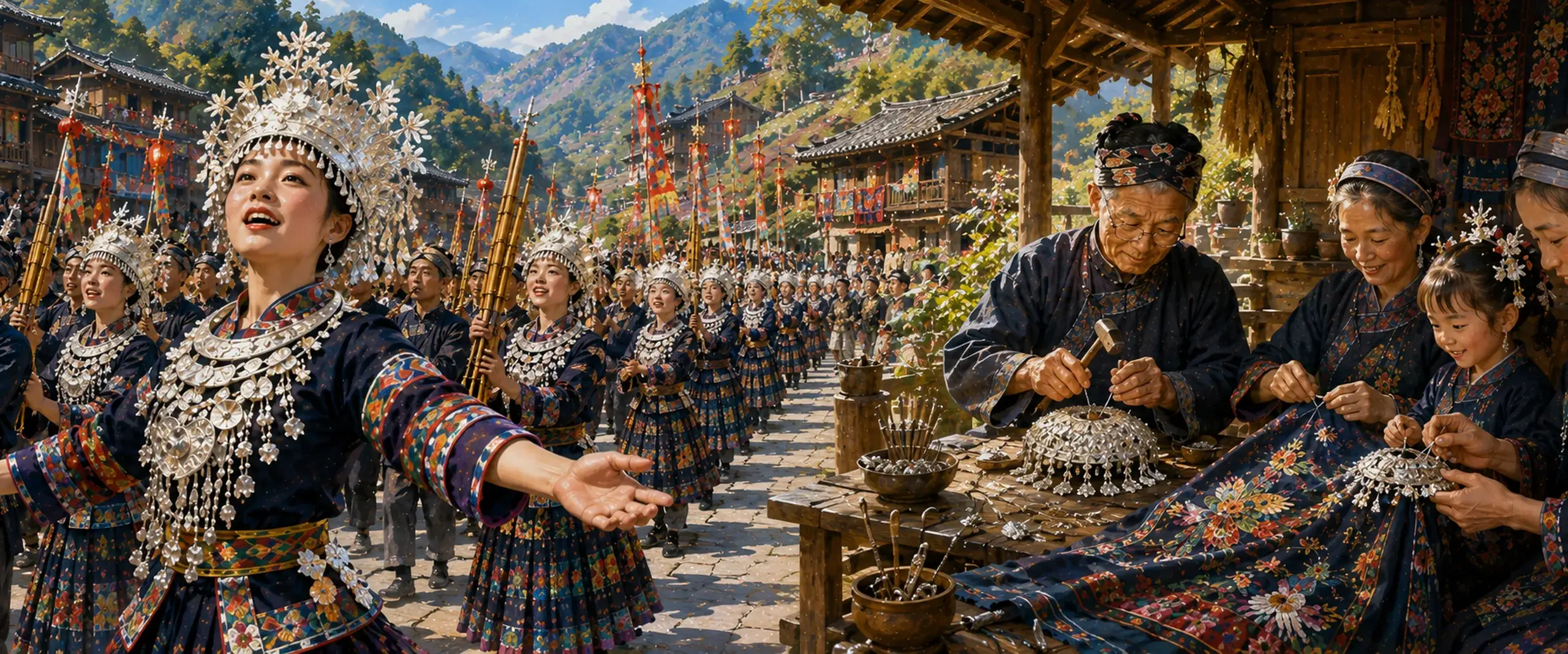
Miao New Year is the most important festival of the year for the Miao people and is widely celebrated in Miao communities across Guizhou, Hunan, Yunnan, and other regions. In 2008, Miao New Year was included in the second batch of China’s national representative list of intangible cultural heritage. During the festival, Miao people dress in splendid garments adorned with silver ornaments, play the lusheng (芦笙), a traditional reed-pipe wind instrument, perform lusheng dances, and lay out long-table banquets, creating a grand and exuberant scene. In recent years, Miao New Year has become an important cultural-tourism brand in Guizhou and elsewhere—during the festival each year, large numbers of Chinese and overseas visitors travel to Leishan, Taijiang, and other places to experience Miao New Year customs, taste Miao cuisine, admire elaborate silver-adorned dress, and encounter the distinctive charm of Miao culture. With the joy of harvest and the warmth of reunion, Miao New Year has become an important window through which the world can understand Miao culture.

Miao New Year / Global Spread

Celebrated Worldwide

Regional Highlights
01

The Americas — United States

The United States has the largest overseas Miao population in the world, and the scale of Miao New Year celebrations there, both in size and participation, is unmatched among overseas Miao communities.

Sacramento: a Miao New Year gathering of 50,000 people. Sacramento has the third-largest Miao population in the United States, with around 30,000 residents of Miao ancestry. In November 2025, the California Exposition grounds, or Cal Expo, hosted its annual Miao New Year celebration, with an estimated 40,000 visits over the course of the weekend. Participants came from across the United States and even included some overseas travelers. The gathering has become one of the largest Miao cultural celebrations in the country, while also commemorating the important milestone of the Miao community’s 50 years of resettlement in the United States.

The most eye-catching feature of the event was the dazzling variety of Miao clothing. Women wore silver headdresses and embroidered chest pieces, while men wore traditional embroidered vests and belts; each garment carried symbols of family, region, and history. The grounds also featured handicraft areas, food markets, and cultural performances, where visitors could taste fragrant sticky rice, bamboo-tube chicken, hand-shaken milk tea, and candied fruit on skewers. In addition to music and dance, the program included traditional ball-tossing games, cultural lectures, and singing competitions. Organizers also created a special “Fifty Years of Stories Gallery”, presenting the history of Miao migration to the United States after the Vietnam War in 1975, including images documenting life in refugee camps and the community’s early settlement in California.

For many Miao families, this was not merely a festival celebration, but also a symbol of cultural homecoming and intergenerational connection. Zaven Wang, a local high school student whose parents came from Laos, attended specifically to experience the cultural celebration. He said, “This is a very important part of my life. I still cannot speak Miao very well, but I want to learn because it is part of our family heritage.” He admitted that he rarely had opportunities at school to interact with other Miao students, so the New Year celebration allowed him to meet more people with the same cultural background. “I’m really happy to be able to find a sense of belonging here.”

Wisconsin: a winter gathering of nearly 30,000 people. On December 14 and 15, 2024, nearly 30,000 members of Wisconsin’s Miao community gathered at the State Fair to celebrate Miao New Year in grand style. Over the two-day celebration, nearly 30,000 people filled the hall. Looking across the venue, crowds surged everywhere, and amid the brightly colored gathering it was almost impossible not to be swept up in the joyful atmosphere. Miao people of all ages are skilled in song and dance, and men and women in festive dress sang and danced as expressions of joy, harmony, and celebration filled their faces.

Miao clothing carries strong ethnic characteristics and has been described as “history draped over the body, culture worn upon the body.” Women’s attire is often ornamented with silver and decorated with intricate, brilliantly colored patterns of considerable artistic value. Traditional Miao foods include well-known dishes such as Miao-style fermented fish, cured pork, beef with pickled vegetables, and fish in sour soup; in recent years, bubble tea has also become especially popular among younger people. Notably, the Wisconsin Chinese Chamber of Commerce participated in the Miao New Year celebration for the first time as a sponsor, expressing support for the Miao Asian minority community.

Minnesota: the Miao cultural center of the Twin Cities. Minnesota is home to the second-largest Miao population in the United States after California, with most residents concentrated in Minneapolis and St. Paul, collectively known as the Twin Cities. Miao New Year celebrations in Minnesota are large in scale and include ball tossing, Miao song and dance, Miao beauty pageants, and large marketplaces selling Miao goods.

Minnesota hosts an annual Miss Hmong pageant. Ball tossing is a traditional social activity for young men and women during Miao New Year—young men and women stand in two facing rows and toss balls back and forth. Traditionally, one would throw the ball to someone one favored, though today the activity is more recreational and its courtship element has been greatly reduced. During the festival, both traditional and modern performances are indispensable. At Miao marketplaces, goods include Miao films or music discs, Miao clothing and ornaments, Miao books and newspapers, traditional Miao snacks, and even Chinese herbal medicines.

Colorado: Miao New Year on Thanksgiving weekend. In Colorado, Miao New Year is held each year over the two days of Thanksgiving weekend and is organized primarily by the Colorado Hmong Association. Colorado’s Miao population is relatively small, so the festival is more modest in scale, but the Colorado Hmong Student Association also uses the occasion to raise scholarship funds. This combination of a traditional festival with public-benefit activities reveals a new function that Miao New Year has taken on in contemporary American society.

The changing timing of Miao New Year in the United States. The customs of Miao people in the United States and those in Laos are fundamentally the same, because most migrated from Laos to the United States within the past 40 years. Broadly similar to Miao communities in China, they enter the Miao New Year season from the first day of the tenth lunar month, with each community or family choosing a different date on which to celebrate. Yet under the impact of urbanization, the timing of Miao New Year in the United States has changed considerably—many communities no longer choose the date according to the lunar calendar, but instead allow well-organized and influential associations to discuss and decide it. Generally speaking, Minnesota, Colorado, and some parts of California celebrate in late November, while Miao New Year in Fresno, California, is usually held in late December around Christmas. Weekends and public holidays are increasingly preferred so that more Miao people can participate.

Activities at Miao New Year generally include song-and-dance performances, traditional Miao songs and dances, and the traditional ball-tossing game. There are also performances of popular songs in the Miao language, and even Chinese popular songs sung in Miao. Another major activity is football, with small stalls arranged around the playing area. Miao New Year also includes a traditional soul-calling ritual, intended to call back ancestral spirits and pass cultural traditions on to the next generation.
02

Asia

Asia is the region where the culture of Miao New Year has spread most deeply and extensively. Miao communities are widely distributed across Thailand, Laos, Vietnam, Myanmar, and other Southeast Asian countries, where Miao New Year has been transmitted from generation to generation.

Laos

Laos is one of the countries with the largest concentrations of Miao people outside China. Miao New Year, also known as Hmong Xyoo Tshiab, is one of the most important festivals in the Miao calendar. As the capital of Laos, Vientiane hosts one of the grandest Miao New Year celebrations, renowned for its lively atmosphere, cultural displays, and large-scale gatherings of the Miao community.

One of the most striking features of Miao New Year in Vientiane is the display of brilliantly colored traditional clothing. The Miao are renowned for their finely embroidered garments; different Miao branches have their own distinctive styles, and during New Year celebrations people wear their most magnificent dress, displaying vivid colors, intricate patterns, silver ornaments, headdresses, and other traditional accessories. Rituals form a central part of the festival, including offerings to ancestors and deities—families prepare traditional foods and arrange carefully decorated altars to pray for blessings in the coming year and express gratitude for the harvest of the year just passed.

Traditional games and activities provide enjoyable ways for community members to celebrate together. Among the most popular are ball-tossing games, in which small bean-filled bags are thrown toward a series of hoops or targets; traditional Miao music and dance performances are indispensable to the celebrations; and traditional wrestling, known as “Miao wrestling,” is another festival highlight. Food plays a central role in Miao New Year festivities, with traditional dishes prepared and shared among relatives and friends, including Miao sausages, sticky rice, and Miao-style soups and stews. The communal character of the festival is reinforced through shared meals and social gatherings—relatives and friends come together for feasts, exchange gifts, and celebrate the New Year.

Thailand

Thailand has a large Miao community, mainly distributed across the mountainous regions of the north, with Chiang Mai and Chiang Rai among the principal centers. The history of Thailand’s Miao population can be traced to migration from southwest China from the late nineteenth to the early twentieth century, giving the community a history of more than a century.

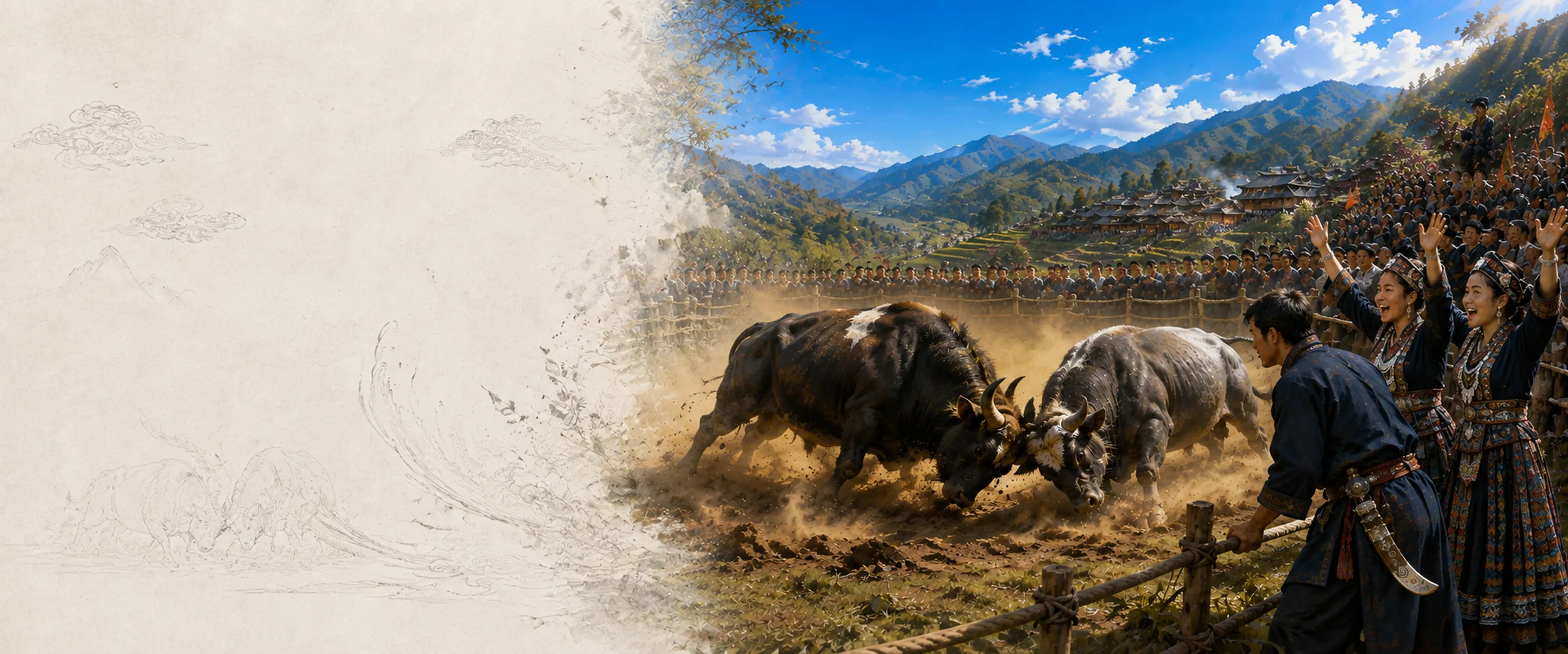
Miao New Year is the grandest festival of the Miao people in Thailand and is held on the fifteenth day of the twelfth lunar month. Celebrations last for more than five days and include ancestral rites, banquets for guests, and numerous forms of entertainment, with the entire village taking part in ceremonial dress. Festival activities include striking gongs, tossing embroidered balls, playing the lusheng, bullfighting, cockfighting, and more. In the culture of Thailand’s Miao people, lusheng dance lies at the heart of both funerals and festivals, and lusheng melodies are an important vehicle of cultural transmission.

Thailand’s Miao communities have also attracted Miao people from around the world through gatherings promoted as “Miao people from across the world reunite in Thailand for Miao New Year.” According to records, from January 7 to 13, 2021, Miao people from around the world gathered in Thailand to celebrate Miao New Year. Such transnational gatherings have made Thailand an important node in global Miao cultural exchange.

Vietnam

In Vietnam, an important Miao festival corresponds to China’s Huashan Festival (花山节) and is generally held from the third to the tenth day of the first lunar month. Vietnamese Miao communities also celebrate the Shicheng Festival (十成节), a traditional harvest festival observed in parts of southern China and Vietnam by several ethnic groups, including Han communities in some areas as well as Zhuang, Yi, Hani, Jing, Miao, and others. Among the Miao, the Shicheng Festival is the most important festival and is known as Bagu Festival (罢谷节) or Jiyang Festival (祭仰节).

China

In China, Miao New Year is the grandest festival in places such as the Qiandongnan Miao and Dong Autonomous Prefecture of Guizhou and Rongshui Miao Autonomous County in Guangxi.

Leishan Miao New Year: an intangible-heritage parade of tens of thousands. Leishan County was one of the main gathering points of the fifth great migration of the Miao people in China. Miao residents account for 84% of the county’s total population, and the area has long been known as a “sacred land of the Miao frontier.” On November 4, 2025, Leishan County was immersed in the bustle and anticipation preceding the festival, as it prepared to formally launch a Miao New Year celebration lasting more than a month. Tens of thousands of people gathered there, rehearsing intensively in preparation for a spectacular “intangible-heritage parade of tens of thousands.”

In 2017, the Leishan Miao New Year Intangible Cultural Heritage Showcase opened on a grand scale. Miao celebration groups from more than 20 countries and regions, including the United States, Canada, Australia, Thailand, France, and Laos, gathered in Leishan to celebrate Miao New Year together with 160,000 Miao people of Leishan. The parade, stretching for several kilometers and involving tens of thousands of participants, incorporated displays of Leishan County’s 13 national-level intangible cultural heritage items—including a five-starred red flag embroidered using multiple Miao embroidery techniques, a gigantic silver headdress 1.5 meters in diameter, and an enormous Miao wooden drum so heavy that more than a dozen strong Miao men were needed to carry it. The lusheng sounded melodiously, bronze drums rang with force, silver bells rustled, embroidered skirts swirled through the air—at that moment, Leishan truly lived up to its reputation as a global showcase center for Miao culture.

During Miao New Year, traditional entertainment also includes bullfighting, horse racing, bird fighting, lusheng dancing, and drum dancing. The festival is an important window for the concentrated display of intangible cultural heritage such as Miao clothing, silverwork, and embroidery.

Rongshui Miao New Year: “Da Tongnian” and the experience of French artists. Rongshui Miao Autonomous County in Liuzhou, Guangxi, is another important center of Miao New Year celebrations. In December 2025, a group of French artists traveled to Mengwu Miao Village in Rongshui to experience the Miao celebration of “Miao New Year · Da Tongnian (打同年)”, encountering the essence of original local culture and art. On January 20, 2026, during the Great Cold solar term, Dangjiu Village in Gandong Township, Rongshui County, held its traditional Miao New Year celebration. Local residents and visitors played the lusheng, sang Miao songs, performed Miao dances, and shared a hundred-family banquet amid cold winds and light rain.

Mengwu Miao Village in Shuanglonggou, Rongshui, is a new village established through relocation for poverty alleviation. There, around one hundred local Miao people and visitors gathered joyfully to “Da Tongnian,” welcoming the New Year in the traditional Miao way. At a Da Tongnian event held in Baiyun Township in 2024, more than 40 media organizations broadcast the celebration live to global audiences, attracting more than five million viewers in a single broadcast. The custom has already moved beyond the boundaries of Miao villages, with Dong, Yao, Zhuang, and other ethnic groups joining the celebrations.

Myanmar

Myanmar also has a Miao population. As an important component of cross-border ethnic communities in Myanmar, the Miao regard Miao New Year as their most important festival. Myanmar’s Miao communities maintain close cultural ties with Miao communities in Thailand and Laos, and their New Year celebrations are broadly similar—honoring ancestors, entertaining guests, playing the lusheng, and taking part in festivities in ceremonial dress.

03

Europe

Europe was one of the important destinations for the resettlement of Miao refugees. During the 1960s and 1970s, under the impact of the Vietnam War, some Miao people from Laos and Vietnam fled to Thailand. Through coordination by the United Nations High Commissioner for Refugees, some of these refugees were resettled in France and Germany. Over more than 40 years, they faced challenges involving language, employment, education, housing, and many other aspects of life, gradually adapting to local society.

France and Germany: transmission and adaptation of Miao New Year in Europe. France and Germany have different immigration policies and social environments, which have also influenced cultural transmission within their Miao communities. Miao groups have actively absorbed elements of local culture and combined them with their own traditions in innovative ways. As their most important traditional festival, Miao New Year centers on rites honoring ancestral spirits and rituals intended to avert misfortune and secure peace. It contains the emotional belonging and identity of its participants and has continued to be transmitted in foreign lands, providing comfort and cohesion for Miao refugees dispersed across different places. At the same time, the festival has assumed a flexible and open form among them, strengthening ethnic identity.

For Miao communities in Europe, Miao New Year is a time of reunion. Because resettlement, employment, marriage, and other circumstances have placed people in different cities, festivals provide rare opportunities for them to gather. Celebrations emphasize “participation by all,” regardless of age or gender—children join their parents, taste Miao dishes, and learn to “toss the bag”, gaining an intuitive understanding of Miao culture through participation. For young men and women, public activities such as festivals also provide valuable opportunities to meet other Miao people.

New Year’s Eve: a new tradition among European Miao communities. Celebrating New Year’s Eve is a European tradition, and among Europe’s Miao population these celebrations take place within families and communities, with participants mainly consisting of Miao relatives and family members. On December 31, 2016, preparations for a New Year’s Eve gathering in Germany’s Miao community began early in the morning. The activity was organized and attended by community members and held in a shared public hall, with each household bringing its own dishes. From the morning onward, women in each family moved busily between kitchen and living room, while men and women, young and old, all actively joined in preparing the food.

Festival activities among Europe’s Miao communities demonstrate how traditional culture adjusts within new social contexts—certain elements must change, yet Miao New Year celebrations continue, allowing traditional culture to be passed on. New Year’s Eve, absorbed from local culture, likewise helps shape community solidarity, strengthen ethnic identity, and provide a place for emotional belonging.

04

Oceania

Australia and New Zealand: gatherings of Miao people from around the world. Australia and New Zealand also have Miao immigrant communities. During the 2017 Leishan Miao New Year Intangible Cultural Heritage Showcase, celebration groups of Miao people from Australia gathered in Leishan and celebrated the festival together with 160,000 Miao residents of the county. This model of “returning to China to celebrate Miao New Year” has become an important way for overseas Miao communities to maintain cultural connections with their ancestral homeland.

Lunar New Year celebrations in Australia nearly fill the entire 15-day festive period in the three cities with the country’s largest Asian populations—Sydney, Melbourne, and Brisbane. Within these multicultural celebrations, Miao culture is presented through dance, music, and other forms.

05

Africa

The spread of Miao New Year in Africa is still in its early stages. As an international ethnic community, the Miao have established a presence across the world’s continents. With increasingly close China-Africa exchanges and the continued development of the Belt and Road Initiative, Miao New Year culture is expected gradually to spread across the African continent through cultural exhibitions, Confucius Institutes, and other channels.

Miao New Year in the Cloud

In-Depth Feature

With the development of digital technology, Miao New Year has generated entirely new forms of celebration and dissemination among Miao communities worldwide.

Global livestreaming: more than five million viewers in a single broadcast. At the Da Tongnian event held in Baiyun Township in 2024, more than 40 media organizations livestreamed the celebration to audiences around the world, with a single broadcast attracting more than five million viewers. This large-scale livestreaming enabled Miao people scattered across the globe to experience the festive atmosphere of Miao New Year simultaneously.

Miao New Year on social media. An international promotional video released by the Guizhou International Communication Center for the Tiaohua Festival (跳花节) at Sanhe Miao Village in the Anshun Economic and Technological Development Zone recently drew widespread attention on the overseas social-media platform Facebook and was even liked and recommended by the official account of a spokesperson for China’s Ministry of Foreign Affairs. Social media is becoming an important channel for the international dissemination of Miao New Year culture.

Rongshui Miao New Year dominates CCTV coverage. Miao New Year activities in Rongshui Miao Autonomous County have appeared on CCTV many times, reaching global audiences through television and the internet. The headline “Global livestream! Rongshui once again dominates CCTV, connecting directly to the Spring Festival Gala” vividly reflects the power of mainstream media in carrying Miao New Year toward the world.

French artists share their experiences through social media. In December 2025, a group of French artists traveled to Mengwu Miao Village in Rongshui to experience Miao New Year and shared their impressions with European audiences through their own social-media accounts. This “inviting people in” approach to cultural dissemination turns foreign visitors into voluntary communicators of Miao New Year culture.

Mutual Learning Among Civilizations

In-Depth Feature

The global spread of Miao New Year follows perhaps the most distinctive path of all ethnic minority festivals—it was not simply “spread” abroad, but “carried” abroad through the forced migration of the Miao people themselves. Miao New Year is not a festival that merely “went out into the world”; it is a festival carried wherever its people went.

Diaspora and cohesion: the most fundamental cultural function of Miao New Year. For Miao people living across the world, Miao New Year is the most important ritual through which they affirm identity, transmit culture, and bring communities together in foreign lands. At the Sacramento Miao New Year celebration, Bee Moua said, “This festival means a great deal to me. Our entire community waits for this day, and being able to come together and celebrate is very special.” He added that New Year celebrations provide an excellent opportunity to meet new friends and reunite with old ones: “It is like one enormous reunion.”

From Lao refugees to American citizens, Miao communities completed, in only a few decades, a profound transition from an agrarian people into modern society. Miao New Year has played an essential role throughout this process—it is not merely a festival, but a cultural anchor, enabling a dispersed people to find a sense of belonging on unfamiliar soil.

“History draped over the body”: clothing as a vessel of cultural memory. Miao clothing has been described as “history draped over the body, culture worn upon the body.” At overseas Miao New Year celebrations, women wear silver headdresses and embroidered chest ornaments, and every garment symbolizes family, region, and history. For younger generations of Miao people born and raised in the United States, these garments provide one of their most direct connections with the culture of their ancestors. As Zaven Wang said, although he cannot yet speak Miao very well, “I want to learn because it is part of our family heritage.”

From an agrarian festival to a cross-cultural platform: the overseas evolution of Miao New Year. Miao New Year was originally an agricultural festival celebrating the harvest, symbolizing the end of a year of hard work and the beginning of a new cycle. Today in the United States, this tradition has evolved into a platform for cross-cultural exchange. Miao New Year celebrations in Wisconsin are attended not only by Miao people, but also by organizations representing other ethnic groups, which take the opportunity to participate and introduce their own products. Miao festival culture has become an important part of America’s multicultural society.

Dialogue between Miao New Year and New Year traditions around the world. Miao New Year forms an intriguing dialogue with New Year cultures in different countries. The Niiname-sai ceremony held at Japan’s Imperial Palace bears similarities to the Miao custom of “cleansing the village in the winter month.” Miao New Year, the Zhuang New Year, and the Tujia Gannian are all celebrated at times different from the Spring Festival. New Year in North Korea, South Korea, and Vietnam falls on the same day as the Spring Festival, while Bhutanese New Year coincides with Tibetan New Year. This diversity of New Year traditions around the world constitutes a rich expression of humanity’s shared theme of “bidding farewell to the old and welcoming the new.”

Miao New Year as a cultural bridge connecting China and the world. During the 2017 Leishan Miao New Year activities, Miao people from more than 20 countries and regions gathered in Leishan. This model of a “homecoming journey to Leishan for Miao people around the world” has made Miao New Year an important cultural bridge connecting Miao communities in China with those overseas. Through cultural exchange activities, Leishan County has brought the splendid culture of Miao clothing to international stages such as fashion events in New York, United States, demonstrating the vigorous vitality of ethnic culture as it advances with the times.

Closing Note

Lingering Notes

The global spread of Miao New Year traces a distinctive path toward the world’s five continents alongside the five great migrations of the Miao ancestors. Its inclusion on the national intangible cultural heritage list in 2008 marked the transition of Miao New Year from a folk festival into the sphere of state protection; its widespread presence across dozens of countries, meanwhile, demonstrates that the theme of “diaspora and cohesion” can transcend language and national borders.

Unlike the carnival of “water” in the Water-Splashing Festival, the passion of “fire” in the Torch Festival, or the “plateau” as the root of the Shoton Festival, the overseas spread of Miao New Year takes “migration and steadfast preservation” as its deepest historical background and “diaspora and cohesion” as its most essential cultural function. Miao New Year is the most important ritual through which Miao people living in foreign lands affirm identity, transmit culture, and unite their communities. Wherever they may live, Miao New Year remains the most important spiritual bond connecting Miao people with their homeland; whatever the culture, the desire to “bid farewell to the old and welcome the new, give thanks to ancestors, and celebrate the harvest” is shared.

In the Americas, Miao New Year in Sacramento attracts around 50,000 participants, nearly 30,000 people gather together in Wisconsin, and Minnesota’s Miao beauty pageants and ball-tossing traditions continue from generation to generation. In Asia, Vientiane in Laos hosts one of the grandest Miao New Year celebrations, Miao communities in Thailand celebrate on the fifteenth day of the twelfth lunar month, and Leishan’s intangible-heritage parade of tens of thousands astonishes the world. In Europe, Miao communities in France and Germany continue to celebrate Miao New Year in foreign lands, providing comfort and cohesion for Miao refugees dispersed across different places. In Oceania, Miao people from Australia cross the ocean to return to China for Miao New Year celebrations. In the digital realm, a single Miao New Year livestream attracts more than five million viewers, carrying the festival’s lively atmosphere across the globe through screens.

More moving still is the moment when Sacramento high school student Zaven Wang says at a Miao New Year celebration, “I want to learn Miao because it is part of our family heritage”; when Miao people in Wisconsin put on traditional clothing described as “history draped over the body”; and when French artists immerse themselves in the “living culture” of Miao New Year at Mengwu Miao Village in Rongshui—at such moments, Miao New Year is no longer merely “the New Year of the Miao people,” but is becoming a living example through which humanity can witness how a people preserve their cultural roots amid diaspora. Like the sound of the lusheng that has traveled across a thousand years—it has crossed war and mountains and seas, yet remains as melodious as ever; it has crossed borders and generations, yet remains as warm as before. The lights of Miao New Year are illuminating every corner of the world.

—

Continue exploring Miao New Year culture

Readers’ Comments

Calendar and traditional culture enthusiasts from around the world, sharing the same moon.

Sign in or register to join the conversation. Your comment account is created automatically the first time you use a connected account.