The Period of Early Society
The Sisters’ Festival can be traced back to the era of primitive matrilineal clans and matriarchal social organisation. In matrilineal society, women played leading roles in social life, and marriage often took forms such as visiting relationships or pair marriage, allowing relatively free interaction between the sexes. The Sisters’ Festival preserves elements of this ancient social structure within festive culture.
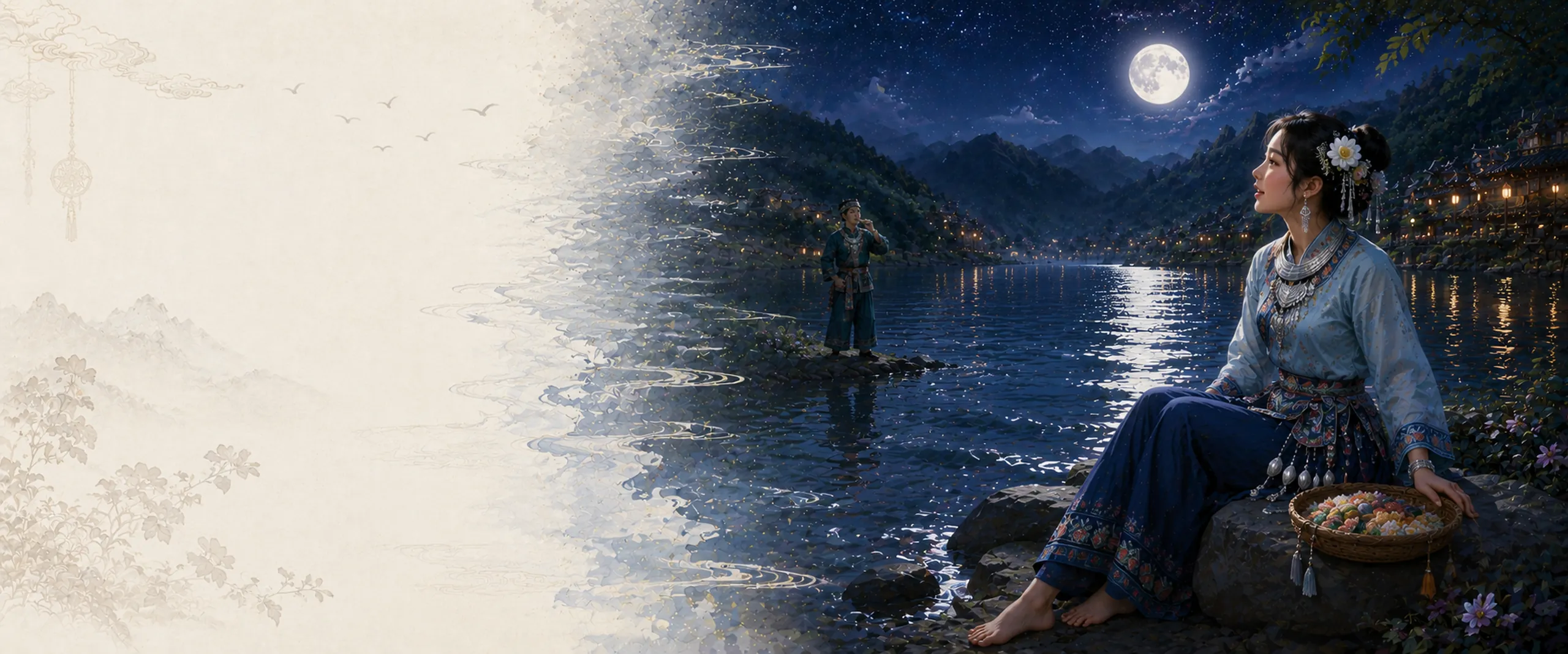
Its predecessor, the ancient Miao Slope Gathering, was a traditional occasion for young men and women to meet on hillsides, sing antiphonally, converse, and establish relationships. According to Miao ancient songs and migration epics, such female-centred social traditions already existed when Miao ancestors still lived in the eastern homeland described as “where water and sky joined as one.” The line “girls gathered in great numbers, and every year we ate Sisters’ Rice” suggests that the customs of sharing Sisters’ Rice and gathering among sisters were already imagined as part of a very ancient social world.
The Migration Period
The Miao people experienced a long and often painful history of migration. Their ancestors are traditionally associated with regions around the lower Yellow River and the middle and lower Yangtze, from which various groups gradually moved southwestward due to warfare and other pressures. During this process, sisters became dispersed across different places and reunion became increasingly difficult. In this historical context, the Sisters’ Festival acquired a deeper meaning: “married sisters moved farther and farther away, so every spring they were invited back to their natal homes to reunite, share Sisters’ Rice, and speak of their endless longing.”
> “We once lived in the East, where water and sky stretched into one… > To survive, we journeyed westward, leaving our married sisters far behind, not knowing when we might return.”
This old folk song closely connects the festival’s origin with Miao migration history. What may have begun as a remnant of matrilineal social life gradually became an important means by which a migrating people maintained family bonds and remembered their homeland.
From the Ming and Qing Dynasties to the Republican Period
During the Ming and Qing dynasties, intensified state administration and development in southwest China brought profound changes to Miao society. Han Chinese cultural influence became increasingly visible, but Miao communities continued to preserve a relatively independent traditional cultural system. The Sisters’ Festival remained one of the most important traditional celebrations and continued to develop during this period.
Marriage customs among the Miao were also affected by broader social changes. The Ming and Qing governments implemented the policy known as “gaitu guiliu” (改土归流)—the replacement of hereditary native chieftains with centrally appointed officials—which significantly altered political and social structures in southwest China. Within this context, the festival’s ideal of freely chosen love remained in tension with arranged marriage. The legend of Jindan and Ajiao, with its emphasis on resistance to imposed marriage and pursuit of romantic freedom, gained particular relevance against the background of such social pressures.
During the same period, Shidong gradually developed into an important commercial town in eastern Guizhou because of its location along the Qingshui River (清水江) transportation route. Improved mobility allowed the local Sisters’ Festival to attract communities from an increasingly wide area. Miao people from surrounding villages gathered there during the celebration, and Shidong gradually became the festival’s most representative centre. Its rituals and activities also became increasingly elaborate and standardised.
After the Founding of the People’s Republic of China
After the founding of the People’s Republic of China, the social system in Miao regions underwent fundamental change. Arranged marriage, marriage by purchase, and other remnants of older systems were abolished, and freedom of marriage received legal protection. The Sisters’ Festival’s traditional ideal of free love thus gained institutional support in the new society. It no longer needed to appear primarily as an act of resistance but could continue as a form of celebration.
During the Cultural Revolution (文化大革命), however, traditional festivals including the Sisters’ Festival were condemned as “feudal superstition” (封建迷信) and were prohibited, temporarily interrupting transmission. After the beginning of Reform and Opening (改革开放), the restoration and implementation of ethnic cultural policies allowed the festival to revive and once again be transmitted publicly.
The Contemporary Era
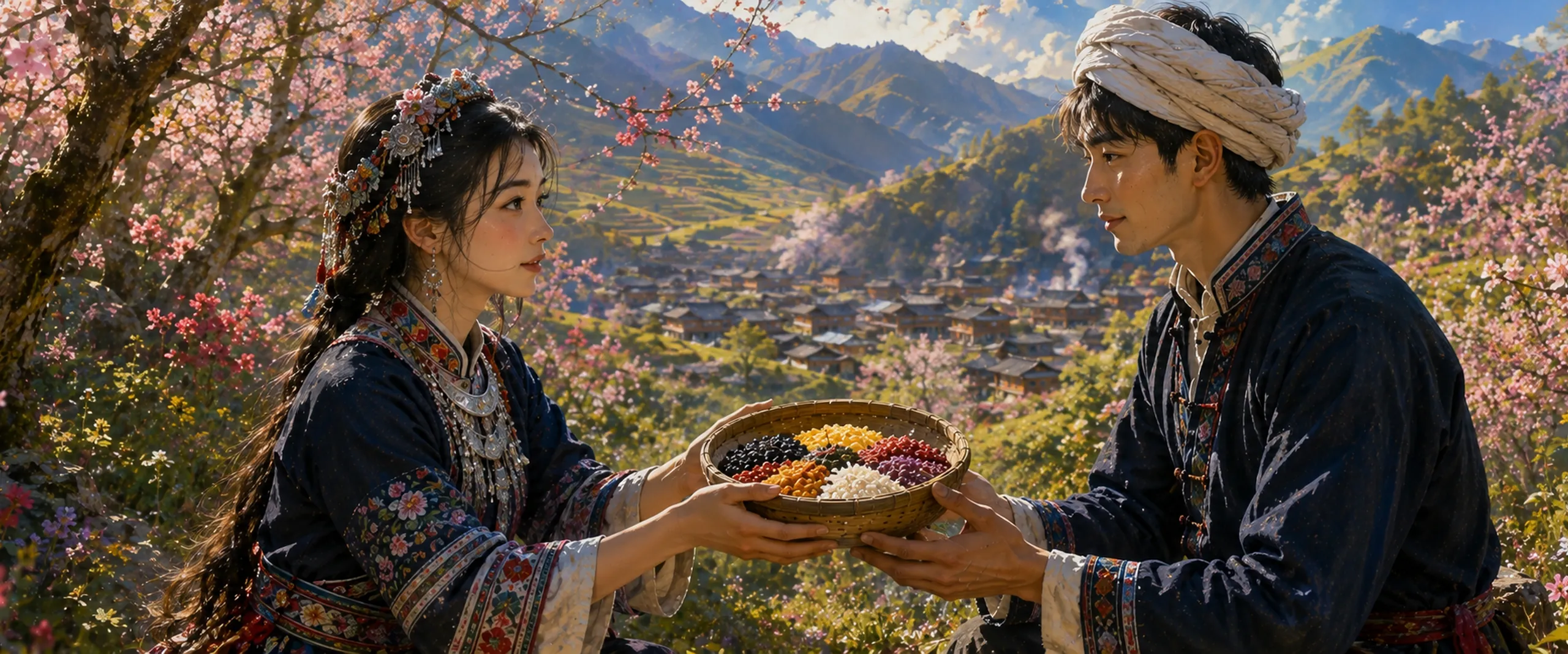
On 20 May 2006, the Miao Sisters’ Festival was approved by the State Council for inclusion in the first national list of intangible cultural heritage, under project number Ⅹ-22. The festival is traditionally practised among Miao communities in areas such as Laotun (老屯) and Shidong (施洞) in Taijiang County, Guizhou Province, and is now recognised as a national-level intangible cultural heritage tradition. Young women stand at the centre of the celebration, whose principal activities include song and dance, traditional dress, youfang courtship, eating Sisters’ Rice, and the exchange of love tokens between young men and women. The festival is large in scale and rich in distinctive cultural content.
Far from declining in contemporary society, the festival has continued to grow in visibility and scale. Each year, from the 15th to the 17th days of the third lunar month, large celebrations are held in the Shidong area of Taijiang County. Young women dress in elaborate costumes and silver ornaments, prepare colourful Sisters’ Rice, exchange songs with young men arriving from distant places, perform drum-stamping dances (踩鼓舞), and exchange symbolic gifts. The festival has become an important cultural event showcasing Miao song, dance, clothing, silverwork, and broader ethnic traditions. Scholars in China and abroad have described the Taijiang Sisters’ Festival as “the world’s oldest Eastern Valentine’s Day” and “a festival hidden within the heart of a flower.”
As society changes, the festival continues to adapt to modern needs. Traditional core customs—eating Sisters’ Rice, youfang courtship songs, drum-stamping dances, and the exchange of tokens—have been carefully preserved, while modern stage performances, tourism, and commercial exchange have also been incorporated. The Sisters’ Festival has become an important platform for presenting Miao culture, strengthening community and interethnic ties, and promoting the integration of culture and tourism. Every year, visitors from across China and around the world travel to Taijiang to experience the distinctive charm of this ancient celebration.
Readers’ Comments
Calendar and traditional culture enthusiasts from around the world, sharing the same moon.
Sign in or register to join the conversation. Your comment account is created automatically the first time you use a connected account.
No comments yet
Share your thoughts with readers around the world.