Songs of the Sisters’ Festival
Other 苗族The Legend of Jindan and Ajiao
The Miao are a people with a highly developed oral literature, and the legend of the origins of the Sisters’ Festival comes primarily from the more than five-hundred-line 《姊妹节歌》. The Miao Sisters’ Festival is a “festival with a story”—and the soul of the festival lies hidden within this orally transmitted epic.
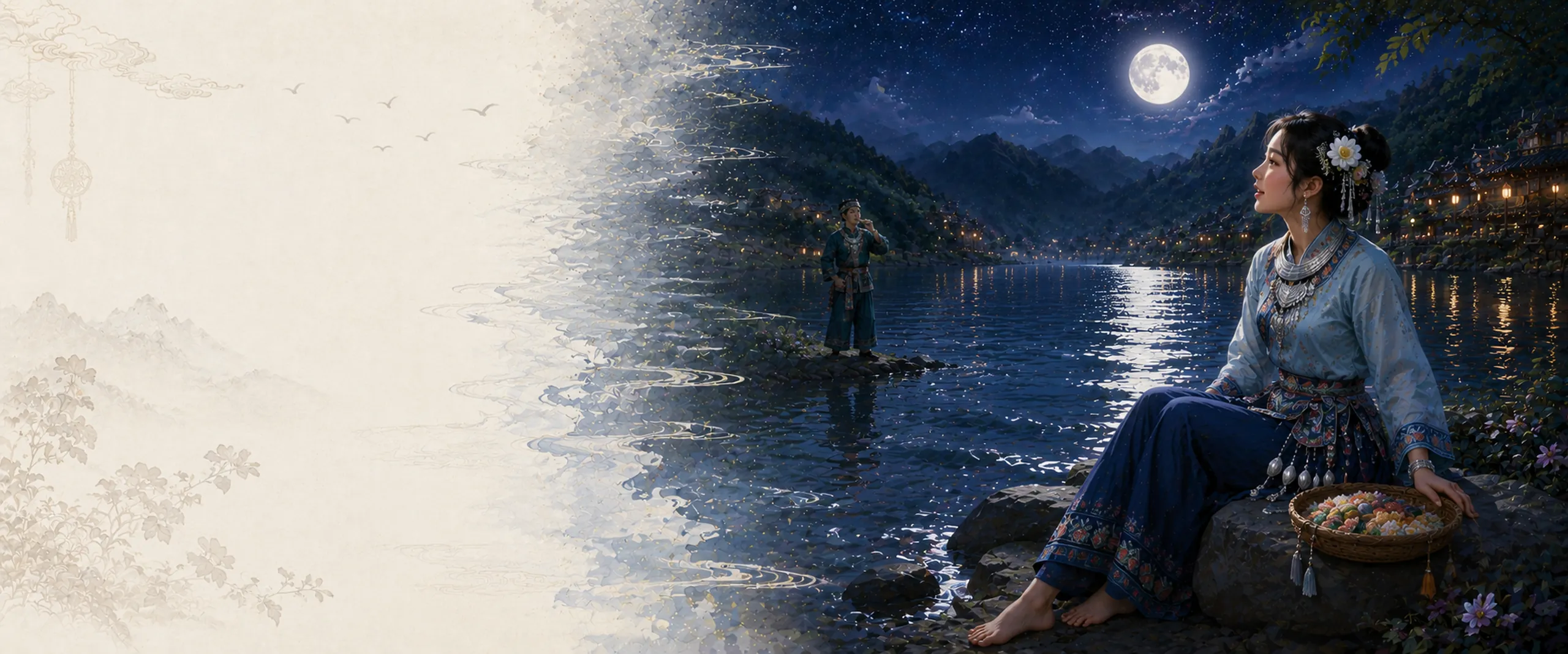
According to legend, two children born to maternal aunts grew up together: the boy was named Jindan and the girl Ajiao. They had been childhood companions from an early age, innocent and close, and as they grew older they fell in love. Jindan was determined to marry Ajiao, and Ajiao was equally determined to marry no one but Jindan, yet their parents and clanspeople opposed them. Ajiao’s parents wanted her to marry back into her maternal uncle’s family—among the Miao in earlier times there was a custom known as “还娘头”, under which a maternal uncle enjoyed priority in arranging a marriage for his niece. Ajiao refused to marry back into her uncle’s family and insisted on marrying Jindan; Jindan likewise refused to marry anyone else and continued waiting for Ajiao.
For the sake of their faithful love, they secretly met every day. Fearing discovery by their parents and village elders, they arranged to meet outdoors to speak of love. Each time, Ajiao hid rice in the bamboo basket she used for sewing supplies and secretly brought it for Jindan to eat. Year after year, after hardship and unyielding resistance, the two finally became husband and wife. Thus arose the allusion of “Sisters’ Rice”—in the Miao language, food brought to one’s lover is called “藏饭”, which is translated into Chinese as “姊妹”.
Another version, even more widely circulated locally, tells that Jindan and Ejiao lived in villages facing one another across a river. They met by chance while attending a market and fell in love. Ejiao’s parents forbade them from seeing each other and forced her to marry back into her maternal uncle’s family. To keep her beloved from going hungry, Ejiao hid glutinous rice in the bamboo basket that held her sewing materials and brought it to Jindan. The freshly cooked glutinous rice was dyed into five colors by Ejiao’s sewing threads. Eventually, their faithful love moved their families, and the two were allowed to marry and remain together for life.
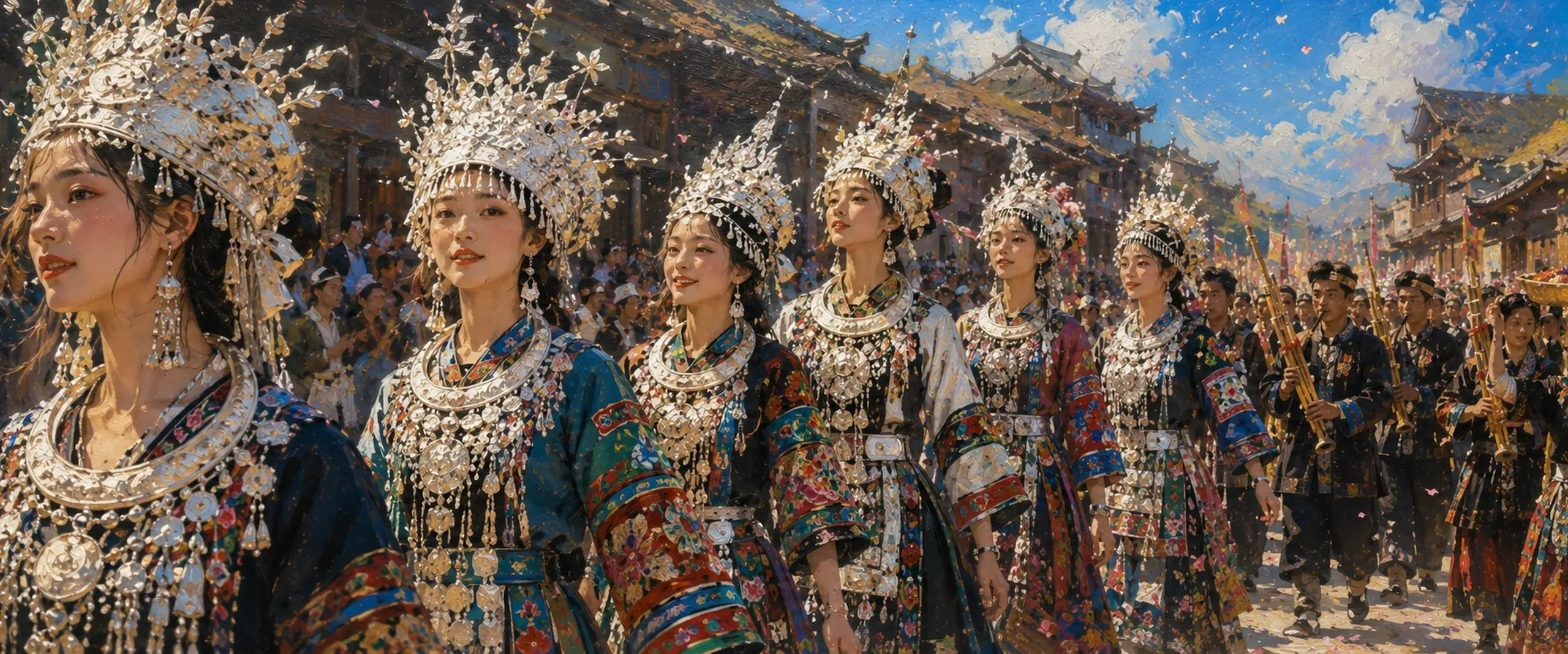
Young Miao men and women admired Ajiao and Jindan’s steadfast devotion to love and began imitating them by meeting on the slopes and choosing their partners freely. Over time, the elders found themselves unable to stop them and were also afraid that the young men and women might get into trouble, so they designated specific times and places to facilitate youfang courtship and free choice of partners. In this way, the Sisters’ Festival was handed down.
Legend and Formation
Another folk legend is also told about the formation of the Sisters’ Festival. According to tradition, in ancient times there were eight hundred young women in Shidong who could not marry because they could not find boyfriends, while at Sanbing Datang there were eight hundred young men who remained single because they could not find wives. The elders remembered the story of Ejiao and Jindan and their “Sisters’ Rice”, and taught the young women to follow their example by inviting the eight hundred young men of Sanbing Datang to eat “Sisters’ Rice”. In this way, everyone found the person they wished to marry, and pair after pair became couples. From then on, eating “Sisters’ Rice” gradually evolved into a festival activity centered on young Miao men and women selecting romantic partners.
Memories of Migration and the Reunion of Sisters
There is also an old folk song circulating along the Qingshui River about the origins of the Sisters’ Festival: “我们原来住东方,那里水天连成片,姑娘多得起堆堆,年年都吃姊妹饭。为了逃生向西迁,长别出嫁的姊妹,不知哪年才复还。我们来到新地方,我们还要邀起来,年年来吃姊妹饭,不忘我们姊妹情。”
According to local folk tradition, the Miao originally lived in an eastern land where water and sky seemed joined together. Later, as the population increased and life became difficult, some of the people had to migrate westward. Married daughters could not return, so people brought them back to join their sisters in catching fish and shrimp and sharing a meal. After several days of reunion, the married women returned to their husbands’ homes, the unmarried women also married, and those who were to migrate departed. This legend links the Sisters’ Festival with the solemn and tragic history of Miao migration, making it not merely a festival of love, but also a festival of sisters reuniting and expressing their longing for one another.
A Legacy of Matrilineal Clan Society
The Sisters’ Festival has a long history, with origins traceable to primitive matrilineal clans and matriarchal society. The Miao Sisters’ Festival is collectively planned, presided over, participated in, and transmitted by women. Mothers pass it orally and directly to their daughters, and through gatherings held at fixed times, it has been transmitted from generation to generation down to the present. Judging from the various rites and customs of the Sisters’ Festival, sisters stand at its center: they are the planners and organizers of the festival, while men must act according to the young women’s wishes. This female-centered festival structure is precisely a living transmission of the cultural genes of matrilineal clan society. According to 《苗族古歌》, almost all regions inhabited by Miao people once celebrated the Sisters’ Festival. Today, however, the custom has disappeared from most areas, and only Taijiang County still preserves this ancient tradition in complete form.
Readers’ Comments
Calendar and traditional culture enthusiasts from around the world, sharing the same moon.
Sign in or register to join the conversation. Your comment account is created automatically the first time you use a connected account.
No comments yet
Share your thoughts with readers around the world.