
The Miao Sisters’ Meal Festival is the grandest traditional festival of the Miao people of Taijiang County, Guizhou Province. It is celebrated as the “festival hidden within a flower’s heart” and the “world’s oldest Valentine’s Day.”
The festival originated from an ancient Miao tradition in which young men and women gathered during the agricultural season and conveyed their feelings through song.
In 2006, it was included in the first batch of China’s National Intangible Cultural Heritage List. The year 2026 marks the 20th anniversary of the Sisters’ Meal Festival’s inclusion on the national intangible cultural heritage list.
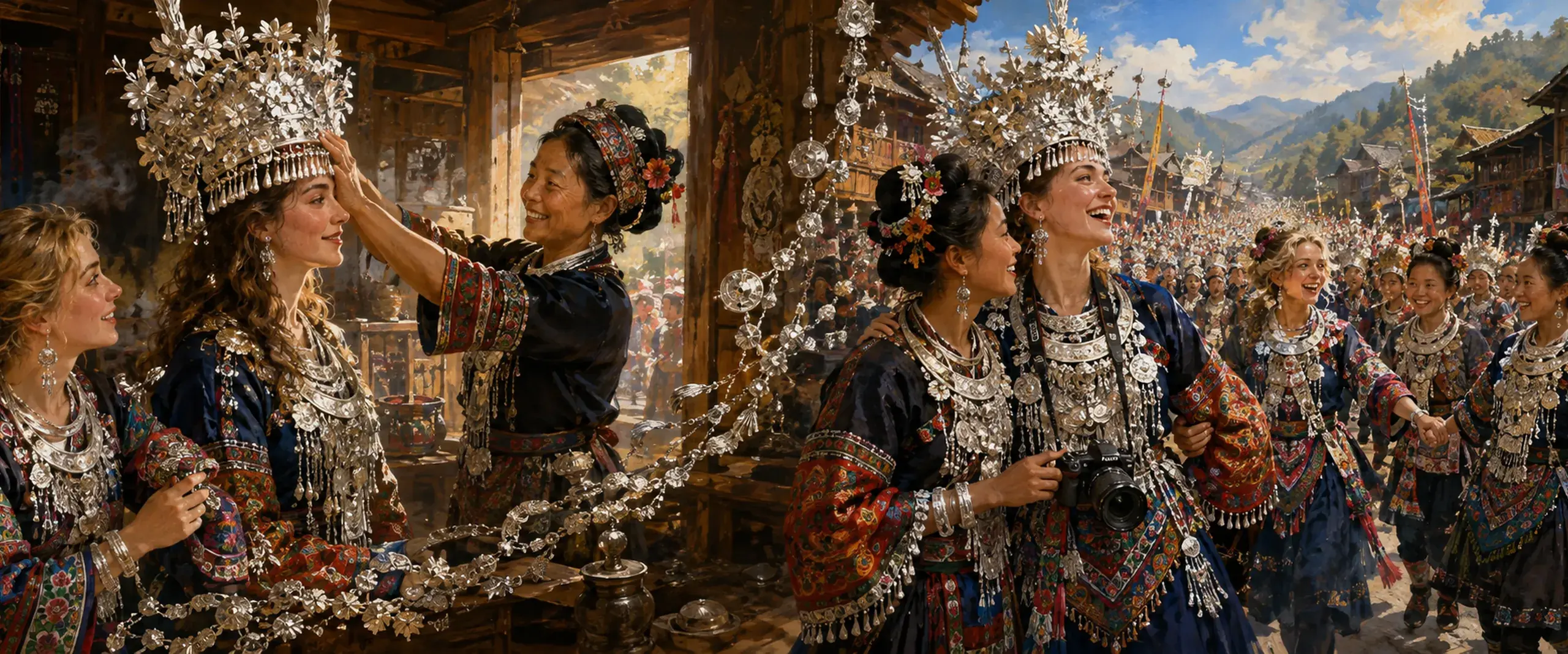
Each year around the fifteenth day of the third lunar month, Miao communities across Taijiang gather in magnificent festive dress. A succession of major events unfolds, including a mass costume parade with thousands of participants, “Village BA” basketball games, the mass singing event along the Wengni River, and long-table banquets.
Miao silverwork, batik, flying songs, lusheng dance, and numerous other forms of intangible cultural heritage are presented throughout the festival.
Amid the shimmering sea of silver created by thousands of people in ceremonial dress and the antiphonal flying songs along the Wengni River, visitors can experience the distinctive charm of Miao culture.
Event Schedule and Venues
### Core Dates of the Sisters’ Meal Festival
The Sisters’ Meal Festival is held each year around the fifteenth day of the third lunar month, corresponding to late April or early May in the Gregorian calendar.
In 2026, the festival marks the 20th anniversary of its inclusion on the National Intangible Cultural Heritage List. The Taijiang Miao Sisters’ Meal Festival series runs from April 30 to May 10, with the main celebrations concentrated from May 1 to May 5, during China’s May Day holiday.
The core schedule is as follows:
| Date | Core Activities | Venue |
|---|---|---|
| April 30 | Ethnic song and dance performances; “Deep Bonds of Sisterhood” Laotun series — ceremonial welcome at the village gate, wedding-custom performances, Laogeng fish-catching, ceremonial drum dancing, bonfire evening | Xiumei Square; Changtan Village, Laotun Township |
| May 1 | Miao Market featuring Miao handicrafts and local foods; “Sisters United · Long-Table Banquet”, the highest form of Miao hospitality; “Deep Bonds of Sisterhood” Laotun activities including wedding-custom performances and bonfire evening; Opening Ceremony of the Miao Sisters’ Meal Festival, with four major chapters and 14 selected cultural performances | Sisters Street; Ethnic Unity Square; Laotun Village, Laotun Township; Miaojiang Sisters Square |
| May 2 | Mass Costume Parade — the festival’s climax — more than 20 groups and 10,000 Miao participants in ceremonial dress; Miao Banquet, featuring the “Six Sour Dishes” as the main courses; Sisters’ Youfang and Ancient Miao Song Performances, with antiphonal love songs and lusheng dancing; “Village BA” Champion Bull Cup National Basketball Invitational | Administrative Center Gate → Miaojiang Avenue → Sisters Square; Xiumei Square; Taipan Village BA Court; Gangdanglüe Village, Shidong Town |
| May 3 | Mass Singing along the Wengni River, with more than 10,000 people singing Miao songs across the river; Miao Market; continuation of “Village BA” basketball games; Miao Sisters Show | Banks of the Wengni River; Sisters Street; Taipan Village; Xiumei Square |
| May 4–5 | Miao Market; continuation of “Village BA” basketball games | Sisters Street; Taipan Village |
### Traditional Customs and Cultural Background
The Miao Sisters’ Meal Festival originated in the ancient tradition of young Miao men and women gathering during the agricultural season and expressing affection through song.
Centered on courtship among young men and women, the festival is celebrated as the “world’s oldest Valentine’s Day.”
| Custom | Description |
|---|---|
| Five-Colored Sisters’ Rice | The festival’s most distinctive token of affection — five-colored glutinous rice. Miao girls dye the rice in five colors using plant juices and give it to young men they favor. Different colors convey different emotions, creating a distinctive tradition of “expressing affection through rice” |
| Mass Costume Parade | More than 20 groups and 10,000 Miao participants parade in magnificent clothing and silver ornaments, presenting the distinctive dress traditions of different Miao branches |
| Mass Singing along the Wengni River | More than 10,000 people sing Miao songs to one another from opposite sides of the river, with flying songs and love songs intertwining |
| Youfang | A traditional social activity in which young Miao men and women express affection and choose partners through song; one of the central traditions of the Sisters’ Meal Festival |
| Long-Table Banquet / Miao Banquet | The highest form of Miao hospitality, with guests seated along extended communal tables to share Miao cuisine |
### Major Recommended Activities
Taijiang County Town — Core Main Venue of the Sisters’ Meal Festival:
Taijiang County town is where the festival’s activities are most concentrated.
Major venues include:
* Miaojiang Sisters Square — main venue for the opening ceremony
* Xiumei Square — main venue for ethnic song and dance performances and the Sisters Show
* Ethnic Unity Square — main venue for the long-table banquet
* Banks of the Wengni River — venue for the mass singing event
* Sisters Street — venue for the Miao Market
Taipan Village — Birthplace of “Village BA”:
The “Village BA” Champion Bull Cup National Basketball Invitational is held at the Taipan Village BA Court during the May Day holiday.
This is a distinctive event linking “Village BA” with the Sisters’ Meal Festival. Crowds are large, so arriving early is recommended.
Laotun Township — “Deep Bonds of Sisterhood” Series:
Changtan Village and Laotun Village in Laotun Township host a range of folk activities, including:
* Ceremonial welcome at the village gate
* Wedding-custom performances
* Laogeng fish-catching
* Ceremonial drum dancing
* Bonfire evenings
Shidong Town — Traditional Sisters’ Meal Festival Activities:
Gangdanglüe Village in Shidong Town hosts traditional activities including ceremonial drum dancing, bonfire evenings, fish-catching, and shrimp-catching.
Pre-Trip Preparation
### Visas and Entry
Taijiang County in Guizhou Province, where the Sisters’ Meal Festival is held, follows China’s unified visa policies:
* 240-Hour Visa-Free Transit for Citizens of 54 Countries: Travelers may enjoy up to 240 hours of visa-free transit, with the permitted stay area covering Guizhou Province.
* Tour Groups from ASEAN Countries: Groups organized through travel agencies may enter visa-free through designated ports.
* Other Nationalities: Apply in advance for a tourist visa, or L visa, through the relevant Chinese embassy or consulate and ensure that your passport remains valid for more than six months.
* Latest Policies: Before departure, consult the official website of China’s National Immigration Administration or the relevant embassy or consulate.
### Adapting to the Climate
The Sisters’ Meal Festival falls around the fifteenth day of the third lunar month, corresponding to late April or early May.
At this time, Taijiang County has the following climate characteristics:
* Temperature: Average daily temperatures of around 15°C–25°C. Days are warm and comfortable, while mornings and evenings can be cooler.
* Rainfall: This is the rainy spring season, with frequent showers. Carrying rain gear is recommended.
* Clothing: Use a layered system — short sleeves or a light long-sleeved top during the day, with a light jacket or sun-protective outer layer for mornings and evenings.
Shoes should be comfortable, non-slip athletic or hiking shoes. Taijiang is mountainous, with many slopes and stone-paved paths, so good footwear is essential.
### Travel Insurance
It is strongly recommended to purchase travel insurance covering:
* Accidental injury and acute illness treatment, including outpatient care
* Loss of or damage to personal belongings
* Travel delays or cancellations
### Currency and Payment
* Currency: Renminbi (CNY).
* Cash: Carry a reasonable amount of cash. Outdoor Miao markets and rural areas may have unreliable network signals, making cash more dependable.
* Cards: Visa and MasterCard may be accepted at larger hotels and supermarkets in Taijiang County town; they are generally not accepted in rural villages.
* Mobile Payment: Alipay and WeChat Pay are widely used in Taijiang County town.
### Communications and Internet
* Important: Visitor numbers are extremely high during the Sisters’ Meal Festival, and 4G/5G networks may become congested.
* Taijiang is mountainous, and mobile signals can be weak in some areas.
* It is strongly recommended to download offline maps in advance. Use Baidu Maps or AutoNavi and download maps of Qiandongnan Prefecture while connected to Wi-Fi.
How to Get There
### Core Venue: Taijiang County, Qiandongnan Prefecture, Guizhou Province
| Transportation | Details |
|---|---|
| Air | Guiyang Longdongbao International Airport, Guizhou’s largest aviation hub, serves major domestic and international cities. Continue to Taijiang by high-speed rail or road |
| High-Speed Rail | The Shanghai–Kunming High-Speed Railway serves Kaili South Station, the most convenient high-speed rail station for Taijiang. The journey from Guiyang North Station to Kaili South takes about 40 minutes |
| Bus | After arriving at Kaili South Station, transfer at Kaili Bus Station to a bus for Taijiang, with a journey of about 1 hour |
| Driving | The Shanghai–Kunming Expressway and Yu’an Expressway provide direct access to Taijiang. Traffic controls apply around the county town and activity venues during the festival; use designated parking areas |
High-Speed Rail Ticket Tip:
From April 30 to May 5, the May Day holiday coincides with the peak of the Sisters’ Meal Festival, making tickets extremely difficult to obtain.
Advance purchase through the Railway 12306 App is recommended.
### Transportation Tips During the Festival
* Taijiang County Town: Major streets are subject to traffic controls during the festival. In particular, during the mass costume parade on May 2, vehicles are prohibited along Miaojiang Avenue.
* Taipan Village: The “Village BA” venue is approximately 25 kilometers north of Taijiang County town. Traffic is heavy during the festival, so leave early.
* Laotun Township and Shidong Town: Rural roads are narrow and passing oncoming vehicles can be difficult. Drive carefully.
* Travel Recommendation: The core Sisters’ Meal Festival experience is concentrated in the county town and nearby villages. Leave vehicles in designated areas and travel primarily on foot within the county town.
Accommodation Reservations
| Key Point | Recommendation |
|---|---|
| When to Book | Late April and early May combine the May Day holiday with the Sisters’ Meal Festival. Book accommodation more than one month in advance |
| Taijiang | Taijiang County town — most convenient and closest to activities; around Miaojiang Sisters Square; near Xiumei Square |
| Kaili | If accommodation in Taijiang is fully booked, stay in Kaili and take a daily bus to Taijiang, about 1 hour each way |
| Special Experience | Choose a local Miao-style guesthouse to experience traditional Miao hospitality |
| Price Reference | Prices generally rise during the festival: budget around RMB 200–400 per night, mid-range RMB 400–800, high-end above RMB 800 |
| Booking Platforms | Major platforms such as Ctrip, Qunar, and Meituan; rooms with free cancellation are preferable |
Pre-Trip Packing Checklist
| Category | Essential Items | Special Notes |
|---|---|---|
| Clothing | Short-sleeved T-shirts, light long-sleeved tops, light jacket / sun-protective outerwear, long trousers | Mornings and evenings are cooler in late April and early May. Comfortable, well-worn clothing is recommended for extended outdoor activities |
| Shoes | Comfortable, non-slip athletic / hiking shoes | Essential — Taijiang has many slopes and stone-paved paths, and good shoes make a major difference to the experience |
| Sun Protection | SPF30+ sunscreen, sun hat, sunglasses | Spring UV exposure should not be overlooked |
| Rain Gear | Folding umbrella or lightweight raincoat | Spring is rainy, with frequent showers |
| Medicine | Cold medicine, gastrointestinal medicine, adhesive bandages | Useful for changes in weather and diet |
| Electronics | Power bank, phone, camera | Charging facilities at event sites may be limited |
| Storage | Small bag / waist pouch for documents and cash | Protect belongings in crowded areas |
| Other | Tissues / wet wipes, insulated bottle | Facilities may be limited in rural areas |
Cultural Respect
### Respect for Religious Beliefs and Folk Etiquette
The Sisters’ Meal Festival originated from the ancient Miao tradition of young men and women expressing affection through song and carries deep historical and cultural meaning.
* Remain Solemn During Rituals: If you encounter a ritual ceremony, remain quiet and respectful. Do not shout, joke, or play around.
* Do Not Interfere: Do not obstruct or disturb the normal conduct of rituals without reason.
* Photography Restrictions: Some ritual segments may prohibit photography. Confirm with on-site personnel in advance.
### Etiquette When Participating in Activities
* Watching the Costume Parade: During the mass costume parade, remain in designated viewing areas and do not enter the parade route.
* Joining a Long-Table Banquet: The long-table banquet represents the highest form of Miao hospitality. After taking your seat, respect local dining etiquette and avoid wasting food. If offered a toast, receive the cup with both hands as a sign of respect. Those who do not drink much may take a small sip and explain with a smile.
* Visiting the Miao Market: Miao handicrafts and local foods can be purchased at the market. If bargaining, maintain a friendly attitude.
* Mass Singing along the Wengni River: If you wish to participate in the antiphonal singing, follow the rhythm of local participants. If you prefer only to watch, remain in designated areas along the two banks.
### Photography Etiquette
* Ask Permission: Before photographing Miao people in ceremonial dress, elderly participants, or children, smile and ask first.
* Respect Portrait Rights: Do not use photographs of others for commercial purposes without permission.
* Drone Regulations: Drone flights over festival venues require advance registration with local public-security authorities.
### Safety Guidelines
* Crowd Safety: The mass costume parade and opening ceremony attract dense crowds. Stay alert and supervise elderly family members and children.
* Property Safety: Store valuables in the hotel safe and carry only essentials.
* Traffic Safety: Traffic controls apply around festival venues. Follow the instructions of traffic police.
* Sun Protection and Hydration: Spring sunlight is growing stronger, so use sun protection and drink enough water.
* Food Hygiene: Long-table banquets and Miao banquets involve outdoor communal dining. Choose thoroughly cooked food.
Emergency Information
| Item | Contact / Description |
|---|---|
| Emergency Numbers | Police 110, Fire 119, Ambulance 120 |
| Major Hospital | Taijiang County People’s Hospital; serious cases may require transfer to Kaili |
| Tourist Police / Lost Property | Permanent police posts are located at major venues. Report lost valuables immediately to the nearest police office |
| Tourist Information | Official platform of the Taijiang County Bureau of Culture, Sports, Radio, Television and Tourism |
| Time Zone | UTC+8, China Standard Time |
| Voltage / Plugs | 220V; plug types A / C / I |
Special Reminders
* May Day Peak: The core period of the Sisters’ Meal Festival coincides with China’s May Day holiday. Visitor numbers, traffic, and accommodation demand all reach their annual peak, so comprehensive advance planning is essential.
* Traffic Controls: During the mass costume parade on May 2, the entire Miaojiang Avenue is subject to traffic controls. Plan your route in advance.
* Watching “Village BA”: Taipan Village’s “Village BA” court attracts large crowds. Arriving early is recommended.
* Weather Awareness: Late April and early May fall within the rainy spring season. Check forecasts before departure and carry rain gear.
* Offline Maps: Taijiang is mountainous and mobile signals can be weak in some areas. Download offline maps before departure.
* Long-Table Banquet Reservations: Seating is limited. Check local reservation arrangements in advance.
* 20th Anniversary of Intangible Cultural Heritage Recognition in 2026: The year 2026 marks the 20th anniversary of the Miao Sisters’ Meal Festival’s inclusion in the first batch of the National Intangible Cultural Heritage List, with celebrations on a larger scale and a richer program.
*May you experience the distinctive charm of a thousand years of intangible cultural heritage in the “First County of the Miao People under Heaven,” and, amid a shimmering sea of silver created by thousands in ceremonial dress and the antiphonal flying songs along the Wengni River, receive the beautiful blessing of “deep sisterly bonds, happiness, and fulfillment.”*
—-
Readers’ Comments
Calendar and traditional culture enthusiasts from around the world, sharing the same moon.
Sign in or register to join the conversation. Your comment account is created automatically the first time you use a connected account.
No comments yet
Share your thoughts with readers around the world.