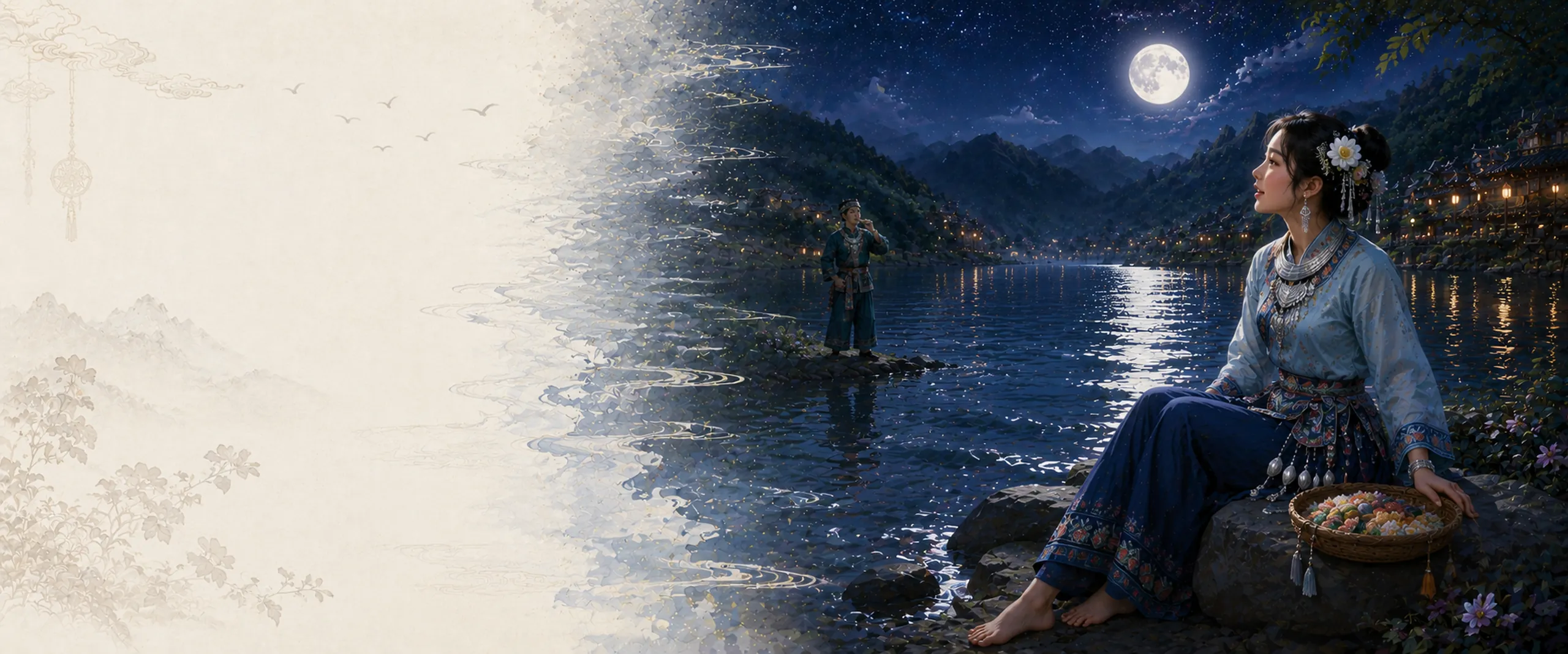
The Sisters’ Festival is a traditional celebration of the Miao people in places such as Taijiang County, Qiandongnan Miao and Dong Autonomous Prefecture, Guizhou, and is held each year around the fifteenth day of the third lunar month. During the festival, young women prepare five-colored Sisters’ Rice (姊妹饭) and use its different colors, together with objects wrapped inside the rice, to convey their feelings to young men they admire. The Sisters’ Festival was included in the first group of China’s national intangible cultural heritage list in 2006 and has been praised as “a festival hidden in a flower’s heart” and “the world’s oldest Eastern Valentine’s Day.” In recent years, the Sisters’ Festival has become an important cultural tourism brand in Guizhou, attracting large numbers of domestic and international visitors each year to Taijiang and other places to experience the romantic Miao tradition in which young men and women express affection through song and convey meaning through rice. In a restrained yet romantic way, the Sisters’ Festival presents to the world the Miao people’s distinctive culture of courtship and marriage, together with their unique aesthetic sensibility.
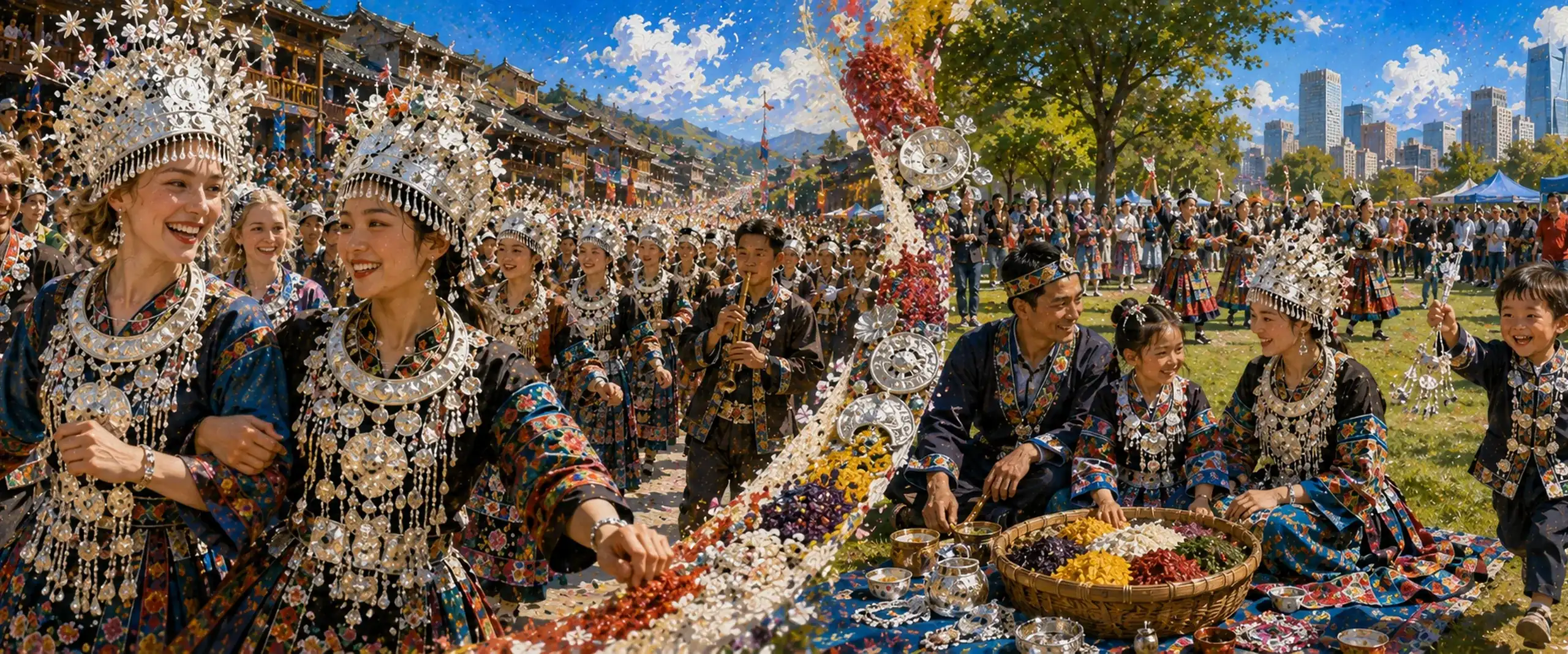
Celebrated Worldwide
Japan
Japan was the earliest and most systematic arena for the overseas dissemination of the Miao Sisters’ Festival.
Translation and research by Japanese scholars. Since the twentieth century, Japanese scholars have conducted sustained research on ethnic minorities in southwestern China. In the course of studying the Miao people of Guizhou, Japanese researchers took notice of the distinctive festival culture of the Miao Sisters’ Festival. They introduced translations of the festival’s legends, rituals, and cultural meanings into Japanese academic circles, bringing the Miao Sisters’ Festival into international scholarly view for the first time. These research成果 helped deepen understanding and awareness of the festival within Japanese academia. Documentary materials indicate that the dissemination of Miao Sisters’ Festival culture in Japan has mainly followed three paths: academic publications, promotion by Chinese and Japanese travel agencies, and online travel writing by Japanese visitors.
Firsthand experiences of Japanese visitors. As ethnic minority cultural tourism in Guizhou developed, increasing numbers of Japanese tourists traveled to Qiandongnan to experience the Miao Sisters’ Festival for themselves. They recorded what they saw and felt in online travel journals, which then circulated through the internet in Japan. These firsthand accounts by travelers proved more communicative than academic works, allowing more ordinary members of the Japanese public to learn about this “oldest Eastern Valentine’s Day.”
Promotion by Chinese and Japanese travel agencies. Travel agencies in China and Japan have promoted the Miao Sisters’ Festival as a distinctive product of ethnic minority cultural tourism in Guizhou. Through travel brochures, promotional videos, itinerary recommendations, and other formats, the festival has been introduced to a wider pool of potential Japanese visitors. This model of “culture + tourism” has given the Sisters’ Festival sustained visibility in Japan.
International Visitors
The most direct form of global dissemination for the Miao Sisters’ Festival is to “invite” the world into the Miao villages of Taijiang, Guizhou, allowing international visitors to participate personally in this “festival hidden in a flower’s heart.”
One hundred thousand visitors from China and abroad gather in Taijiang. According to China Daily, the Miao Sisters’ Festival once attracted 100,000 visitors from Hong Kong, Macao, Taiwan, Russia, the United States, France, and other countries and regions. The Miao Sisters’ Festival is a grand traditional celebration of the Miao people of Taijiang, presenting a rich array of Miao songs, dances, and costume arts, with magnificent scenes of ethnic custom and community life. Visitors from China and abroad not only witnessed one of the most concentrated displays of Miao culture in Taijiang, but also experienced firsthand the warmth and hospitality of the Miao people.
A family from Chicago visits Taijiang. During the 2026 Miao Sisters’ Festival, a family of friends from Chicago in the United States came to participate at the invitation of friends in Taijiang. Having just watched the grand costume parade involving ten thousand participants, they eagerly sampled Kaili sour soup on the street. While tasting the sour soup, the family marveled at the exquisite splendor of Miao clothing. The young girl in the family was even more captivated by the continuous green mountains, saying that she had “never seen so many mountains before.” Their journey from the American Midwest into the depths of the Miao Mountains of southwestern China offers a vivid example of the festival’s “inviting the world in” mode of dissemination.
A “journey to the roots” for overseas Miao guests. In 2018, Miao residents of Taijiang County and overseas Miao guests gathered together to celebrate the Miao Sisters’ Festival. The Miao are a cross-border people: beyond China, Miao communities are also found in Vietnam, Laos, Thailand, Myanmar, the United States, France, Canada, Australia, and other countries. For Miao communities overseas, returning to China to take part in the Sisters’ Festival is a cultural “journey to the roots.” Together with compatriots in their ancestral homeland, they dance the lusheng (芦笙) dance, eat Sisters’ Rice, affirm cultural identity through a shared festival, and transmit collective ethnic memory.
International Communication
A spokesperson for China’s Ministry of Foreign Affairs introduces the festival to the world. In May 2023, Chinese Foreign Ministry spokesperson Wang Wenbin introduced the Miao Sisters’ Festival of Taijiang, Guizhou, to a global audience. Promotion by a Foreign Ministry spokesperson gave the festival national-level support in external communication and brought it into the view of the global public.
Coverage by international-facing media such as CRI. International-facing media including CRI have continuously reported on the Miao Sisters’ Festival. In 2024, CRI published a report titled “Taijiang, Guizhou: Ten Thousand Miao People Parade in Festive Dress, Displaying Confidence in Folk Culture.” In 2026, CRI again published an in-depth report titled “Ten-Thousand-Person Costume Parade Staged at Guizhou Taijiang Miao Sisters’ Festival, More Than 20 Teams Paint a ‘Moving Feast of Intangible Heritage.’” These reports were translated into multiple languages and disseminated around the world through CRI’s multilingual platforms.
Attention from global media. Mainstream media such as China News Service and China Daily have also maintained continuous coverage of the Miao Sisters’ Festival. China Daily once published a report under the headline “One Hundred Thousand Guests from China and Abroad ‘Enchanted’ by Guizhou Sisters’ Festival.” Through international media networks, such reporting has carried the cultural appeal of the Miao Sisters’ Festival to readers around the world.
Internationalization of Tourism
The Miao Sisters’ Festival is evolving from a traditional ethnic festival into a cultural tourism brand oriented toward the world.
Brand positioning as “the world’s oldest Valentine’s Day.” The Miao Sisters’ Festival has been described as “the oldest Eastern Valentine’s Day.” This positioning precisely captures the festival’s most distinctive and universally appealing cultural core: love. Valentine’s Day is a globally familiar festival concept. Positioning the Sisters’ Festival as “the oldest Eastern Valentine’s Day” enables international audiences to understand its central meaning quickly. As one report put it, the Miao Sisters’ Festival is “a festival centered on courtship and romance among young men and women.”
The “Sisters’ Festival + May Day” model of cultural-tourism integration. In recent years, activities associated with the Miao Sisters’ Festival have extended throughout the entire May Day mini-holiday, using the combined appeal of the two celebrations to attract visitors. This model of integrating a traditional festival with a national statutory holiday has further driven sales in local hotels, restaurants, cultural and creative products, and specialty agricultural goods. The Sisters’ Festival is not only a platform for cultural presentation, but also an important engine of local economic development.
From “hidden in a flower’s heart” to entering the world. The Miao Sisters’ Festival has been praised as “a festival hidden in a flower’s heart.” This poetic metaphor describes both its beauty and romance and the way it once remained “hidden deep in the mountains, unknown to the outside world.” Today, with advances in intangible heritage safeguarding, cultural-tourism integration, and international communication, this “festival hidden in a flower’s heart” is being seen and appreciated by more and more people.
Mutual Learning Among Civilizations
Dialogue with Global “Valentine’s Days”
The Miao Sisters’ Festival has been called “the world’s oldest Valentine’s Day.” This description itself creates a dialogue with Valentine’s Day cultures around the world.
Globally, Valentine’s Day takes many forms. In the West, Valentine’s Day on February 14 is named after Saint Valentine and is commonly marked by giving roses, chocolates, and cards. In Japan, Valentine’s Day on February 14 is characterized by women giving chocolates to men, while one month later, on White Day, men return the gesture. South Korea has a “Valentine’s calendar” built around the fourteenth day of every month. China’s Qixi Festival centers on the legend of the Cowherd and the Weaver Girl and emphasizes steadfast and enduring love.
The Miao Sisters’ Festival stands apart among these celebrations. Its distinctiveness lies in three aspects. First, it is centered on women—unlike most forms of social courtship traditionally led by men, the Sisters’ Festival is led by women. Young women are the protagonists of the festival: they plan it, preside over it, participate in it, and transmit it. Second, it uses “Sisters’ Rice” as an emotional code—the objects inserted into or served with Sisters’ Rice determine the young woman’s attitude. This understated and romantic way of communicating affection through food is a uniquely Miao expression. Third, it has continued for thousands of years—its origins can be traced back to early matrilineal clan society and matriarchal social structures, giving its antiquity a distinctive cultural value in its own right.
As one observer put it, the Miao Sisters’ Festival “reveals the passionate and uninhibited love lives of young men and women during the transition of human society from matrilineal clans to patrilineal clans.” It is not merely a Valentine’s Day, but also a living witness to the evolution of human cultures of love.
Dialogue with Global “Women-Centered Festivals”
Among the festivals of the world, those centered on women are relatively uncommon. The existence of the Miao Sisters’ Festival therefore allows it to enter into dialogue with the small number of women-centered festivals found globally.
India’s Karwa Chauth is a festival in which married women pray for their husbands. Nepal’s Teej is a festival in which women fast and pray for marital happiness. Japan’s Hinamatsuri, or Girls’ Day, is a festival wishing for the healthy growth of girls. Although all of these are centered on women, most revolve around marriage and family. The distinctive feature of the Miao Sisters’ Festival is its stronger emphasis on young women’s autonomous choice and emotional expression before marriage—through Sisters’ Rice and youfang (游方) antiphonal courtship singing, young women actively choose those they admire.
The Miao Sisters’ Festival is “a festival centered on courtship and romance among young men and women.” Within societies shaped by traditionally arranged marriage, the Sisters’ Festival offered young Miao women a rare space in which to express their emotions freely. This respect for women’s autonomy possesses a progressive significance that transcends its historical era even when viewed from the present day.
Dialogue with “Intangible Cultural Heritage Safeguarding”
From its inclusion in China’s national intangible cultural heritage in 2006, to the launch of work toward UNESCO inscription in 2017, and then to the formal start of the application in 2023, the path of the Miao Sisters’ Festival itself constitutes a deep dialogue with the global system for safeguarding intangible cultural heritage.
UNESCO’s Convention for the Safeguarding of the Intangible Cultural Heritage emphasizes that intangible cultural heritage “contains the cultural genes, spiritual characteristics, values, psychological structures, temperaments, emotions, and other core elements of the world’s peoples, and is a precious common wealth of all humanity.” The Miao Sisters’ Festival is precisely this kind of intangible cultural heritage “containing cultural genes”—it carries the Miao ancestors’ pursuit of freedom in love, respect for women’s autonomy, and aspiration toward a beautiful life. These values transcend ethnicity and national borders and possess universal human significance.
Qiandongnan Miao and Dong Autonomous Prefecture is one of the world’s ten leading destinations recommended by UNESCO for “returning to simplicity and returning to nature.” As one of the region’s most representative cultural calling cards, the Miao Sisters’ Festival’s own application process for world heritage recognition serves as an important window through which the world can see the achievements of safeguarding China’s ethnic minority cultures.
Cultural Sharing
The Miao are a cross-border people—besides China, Miao communities are also found in Vietnam, Laos, Thailand, Myanmar, the United States, France, Canada, Australia, and other countries. Although the Sisters’ Festival is mainly practiced in Miao-inhabited areas of Guizhou, China, as an important part of Miao culture it also generates cultural resonance among cross-border Miao communities.
In 2018, Miao residents of Taijiang County and overseas Miao guests gathered together to celebrate the Miao Sisters’ Festival. For overseas Miao guests, returning to China to take part in the Sisters’ Festival was not only a cultural experience, but also a cultural journey back to their roots. Together with compatriots in the homeland, they danced to the lusheng, ate Sisters’ Rice, and reaffirmed cultural identity through shared festival rituals. This demonstrates that the Sisters’ Festival is not only part of China’s intangible cultural heritage, but also a shared cultural treasure of Miao people everywhere.
Contemporary Value
The Miao Sisters’ Festival has been called “a festival hidden in a flower’s heart.” This metaphor describes its beauty while also suggesting how it was once “hidden deep in the mountains and unknown to the outside world.”
Today, with the advancement of intangible heritage safeguarding, the development of cultural-tourism integration, and the expansion of international communication, the Sisters’ Festival is moving from “hidden in a flower’s heart” toward “blossoming across the world.” As demonstrated at the opening ceremony of the 2026 Sisters’ Festival, it “perfectly integrates Miao historical legends, song and dance arts, intangible cultural heritage, and the vitality of the times, revealing both the profound foundations of Miao culture and a fresh face of innovative development.”
The contemporary value of the Sisters’ Festival lies in several dimensions: it provides young Miao women with a cultural space for presenting themselves and expressing emotion; it provides a living vehicle for the transmission and innovation of Miao culture; and it provides a distinctive case for the international communication of China’s ethnic minority cultures. As scholars have noted, the Miao Sisters’ Festival, “through the accumulation of time and cultural transmission, has gradually developed into an important festival carrying ethnic symbols and regional culture.”
Closing Note
The global dissemination of the Miao Sisters’ Festival follows a distinctive path from the depths of the Miao Mountains in Taijiang, Guizhou, to the world cultural stage. Its inclusion in the national intangible cultural heritage list in 2006, the launch of work toward UNESCO inscription in 2017, and the formal start of the application in 2023—these three milestones clearly outline the trajectory of the Miao Sisters’ Festival from an ethnic celebration in southwestern China into international view.
Unlike the exuberance of “water” in the Water-Splashing Festival, the passion of “fire” in the Torch Festival, or the spirit of “competition” in Naadam, the global dissemination of the Miao Sisters’ Festival takes “women’s leadership” as its most distinctive cultural gene and “love” as its most universal emotional connection. This is a festival planned, presided over, participated in, and transmitted by women—and among the world’s festivals, such celebrations are rare. Its use of Sisters’ Rice as an emotional code is an expression unique to Miao culture.
In Japanese academic writings and travel accounts, the Miao Sisters’ Festival received its earliest overseas dissemination. Among the Miao villages of Taijiang, each year from the fifteenth to the seventeenth days of the third lunar month, tens of thousands of Miao people and visitors from the United States, Russia, France, and other countries witness together the romance of this thousand-year-old festival. Through promotion by a spokesperson for China’s Ministry of Foreign Affairs, the Miao Sisters’ Festival has received national-level support in external communication. Through international media coverage, it has been introduced to readers around the world. Through the UNESCO application process, the Miao Sisters’ Festival is advancing toward world-level cultural recognition.
More moving still is the fact that, throughout its journey toward the world, the Miao Sisters’ Festival has always maintained a profound connection with the mountains and waters of the Miao region. Young women still gather Sisters’ flowers and purple-tree leaves in the third lunar month to dye glutinous rice and steam it into five-colored Sisters’ Rice. Young men and women still dance the lusheng and wooden-drum dance on the lusheng-and-drum grounds and sing antiphonal love songs in the youfang courtship grounds. The grand parade of ten thousand people in festive dress still winds through the streets of Taijiang. The Miao Sisters’ Festival has not diluted the richness of its culture in order to “go out into the world”—through “inviting people in,” it allows the world to enter Miao villages; through “going out,” it allows the story of the Sisters’ Festival to travel across the globe.
Like the five-colored Sisters’ Rice itself—after crossing a thousand years, it remains radiant with color; after crossing mountains and seas, it continues to carry the deepest affection. The Miao Sisters’ Festival, this “festival hidden in a flower’s heart,” is now blossoming in the world’s field of vision with its most moving brilliance.
—-
Readers’ Comments
Calendar and traditional culture enthusiasts from around the world, sharing the same moon.
Sign in or register to join the conversation. Your comment account is created automatically the first time you use a connected account.
No comments yet
Share your thoughts with readers around the world.