Sisters’ Festival

Sisters’ FestivalFolk Arts of the Sisters’ Festival

「 姊妹节里姊妹饭,五彩斑斓寄深情。 」

The Sisters' Festival is a traditional festival of the Miao people, celebrated in the Qiandongnan Miao and Dong Autonomous Prefecture of Guizhou, generally held around the 15th day of the third lunar month. The most distinctive custom of the…

Opening Verse:

姊妹节里姊妹饭,五彩斑斓寄深情。

Introduction:

Poetry associated with the Sisters’ Festival centers on five-colored Sisters’ Rice and antiphonal singing as a means of expressing affection. Sisters’ Rice is dyed in five colors using natural plants. The poetry often records romantic scenes in which young women convey their feelings through Sisters’ Rice, while young men and women meet and come to know one another through antiphonal singing on the youfang slopes.

The Sisters’ Festival is a festival of young Miao women. The Miao folk saying “姊妹节里姊妹饭,五彩斑斓寄深情” precisely captures its central image—five-colored Sisters’ Rice. Sisters’ Rice uses glutinous rice in five colors—red, blue, yellow, black, and purple—as its medium. Young women give it to the young men they admire, with different colors or different objects wrapped inside the rice conveying different meanings. Ancient Miao songs record the origins of the Sisters’ Festival through the story of Ajiao and Jindan, who resisted an arranged marriage, secretly met with rice hidden in a bamboo basket, and ultimately became husband and wife. The poetry and songs of the Sisters’ Festival take five-colored Sisters’ Rice as a central image, recording the romantic tradition through which young Miao men and women convey affection through song and entrust their feelings to rice.

Sisters’ Festival / Folk Arts of the Sisters’ Festival

Art Forms

Forms of Expression

Songs of the Sisters’ Festival

Other 苗族

The Legend of Jindan and Ajiao

The Miao are a people with a highly developed oral literature, and the legend of the origins of the Sisters’ Festival comes primarily from the more than five-hundred-line 《姊妹节歌》. The Miao Sisters’ Festival is a “festival with a story”—and the soul of the festival lies hidden within this orally transmitted epic.

According to legend, two children born to maternal aunts grew up together: the boy was named Jindan and the girl Ajiao. They had been childhood companions from an early age, innocent and close, and as they grew older they fell in love. Jindan was determined to marry Ajiao, and Ajiao was equally determined to marry no one but Jindan, yet their parents and clanspeople opposed them. Ajiao’s parents wanted her to marry back into her maternal uncle’s family—among the Miao in earlier times there was a custom known as “还娘头”, under which a maternal uncle enjoyed priority in arranging a marriage for his niece. Ajiao refused to marry back into her uncle’s family and insisted on marrying Jindan; Jindan likewise refused to marry anyone else and continued waiting for Ajiao.

For the sake of their faithful love, they secretly met every day. Fearing discovery by their parents and village elders, they arranged to meet outdoors to speak of love. Each time, Ajiao hid rice in the bamboo basket she used for sewing supplies and secretly brought it for Jindan to eat. Year after year, after hardship and unyielding resistance, the two finally became husband and wife. Thus arose the allusion of “Sisters’ Rice”—in the Miao language, food brought to one’s lover is called “藏饭”, which is translated into Chinese as “姊妹”.

Another version, even more widely circulated locally, tells that Jindan and Ejiao lived in villages facing one another across a river. They met by chance while attending a market and fell in love. Ejiao’s parents forbade them from seeing each other and forced her to marry back into her maternal uncle’s family. To keep her beloved from going hungry, Ejiao hid glutinous rice in the bamboo basket that held her sewing materials and brought it to Jindan. The freshly cooked glutinous rice was dyed into five colors by Ejiao’s sewing threads. Eventually, their faithful love moved their families, and the two were allowed to marry and remain together for life.

Young Miao men and women admired Ajiao and Jindan’s steadfast devotion to love and began imitating them by meeting on the slopes and choosing their partners freely. Over time, the elders found themselves unable to stop them and were also afraid that the young men and women might get into trouble, so they designated specific times and places to facilitate youfang courtship and free choice of partners. In this way, the Sisters’ Festival was handed down.

Legend and Formation

Another folk legend is also told about the formation of the Sisters’ Festival. According to tradition, in ancient times there were eight hundred young women in Shidong who could not marry because they could not find boyfriends, while at Sanbing Datang there were eight hundred young men who remained single because they could not find wives. The elders remembered the story of Ejiao and Jindan and their “Sisters’ Rice”, and taught the young women to follow their example by inviting the eight hundred young men of Sanbing Datang to eat “Sisters’ Rice”. In this way, everyone found the person they wished to marry, and pair after pair became couples. From then on, eating “Sisters’ Rice” gradually evolved into a festival activity centered on young Miao men and women selecting romantic partners.

Memories of Migration and the Reunion of Sisters

There is also an old folk song circulating along the Qingshui River about the origins of the Sisters’ Festival: “我们原来住东方,那里水天连成片,姑娘多得起堆堆,年年都吃姊妹饭。为了逃生向西迁,长别出嫁的姊妹,不知哪年才复还。我们来到新地方,我们还要邀起来,年年来吃姊妹饭,不忘我们姊妹情。”

According to local folk tradition, the Miao originally lived in an eastern land where water and sky seemed joined together. Later, as the population increased and life became difficult, some of the people had to migrate westward. Married daughters could not return, so people brought them back to join their sisters in catching fish and shrimp and sharing a meal. After several days of reunion, the married women returned to their husbands’ homes, the unmarried women also married, and those who were to migrate departed. This legend links the Sisters’ Festival with the solemn and tragic history of Miao migration, making it not merely a festival of love, but also a festival of sisters reuniting and expressing their longing for one another.

A Legacy of Matrilineal Clan Society

The Sisters’ Festival has a long history, with origins traceable to primitive matrilineal clans and matriarchal society. The Miao Sisters’ Festival is collectively planned, presided over, participated in, and transmitted by women. Mothers pass it orally and directly to their daughters, and through gatherings held at fixed times, it has been transmitted from generation to generation down to the present. Judging from the various rites and customs of the Sisters’ Festival, sisters stand at its center: they are the planners and organizers of the festival, while men must act according to the young women’s wishes. This female-centered festival structure is precisely a living transmission of the cultural genes of matrilineal clan society. According to 《苗族古歌》, almost all regions inhabited by Miao people once celebrated the Sisters’ Festival. Today, however, the custom has disappeared from most areas, and only Taijiang County still preserves this ancient tradition in complete form.

Miao Folk Songs

Folk Song 苗族

Flying Songs

Flying Songs are among the most representative forms of Miao folk song and are called “Hxak Yeet” in the Miao language. Their tones are high, resonant, and ringing; true to the name, the songs seem to “fly”—soaring, unrestrained, and bright. Their lyrics are mainly concerned with praise, gratitude, and encouragement, and Flying Songs are generally sung during festive celebrations such as the Sisters’ Festival. Flying Songs have been called the “gems” of Miao song. Their freedom to respond emotionally to whatever is seen and improvise on the spot reflects the natural inclination of the Miao people to sing freely among mountains and fields.

Every year during the Sisters’ Festival, the “万人唱响翁你河” Miao antiphonal singing event is held along the Wengni River in Taijiang County. Ten thousand Miao male and female singers from Taijiang County’s nine Miao branches gather beside the Wengni River and present audiences with ancient Miao songs, Miao polyphonic love songs, Miao drinking songs, Flying Song antiphonal singing, and other performances. The singing of Flying Songs during the Sisters’ Festival is the most direct expression of the cultural charm embodied in the Miao saying that “会走路就会跳舞、会说话就会唱歌”.

Youfang Songs and Love Songs

“Youfang” is the principal way in which young Miao men and women establish marriages through free courtship. Youfang generally takes place during major festivals such as the Sisters’ Festival, Miao New Year, and the New Rice Festival, or during agricultural slack seasons. Miao youfang songs—called “霞哟” or “霞游方” in the Miao language—are their primary means of communication. For young Miao men and women, the journey from first acquaintance to love is inseparable from “youfang”.

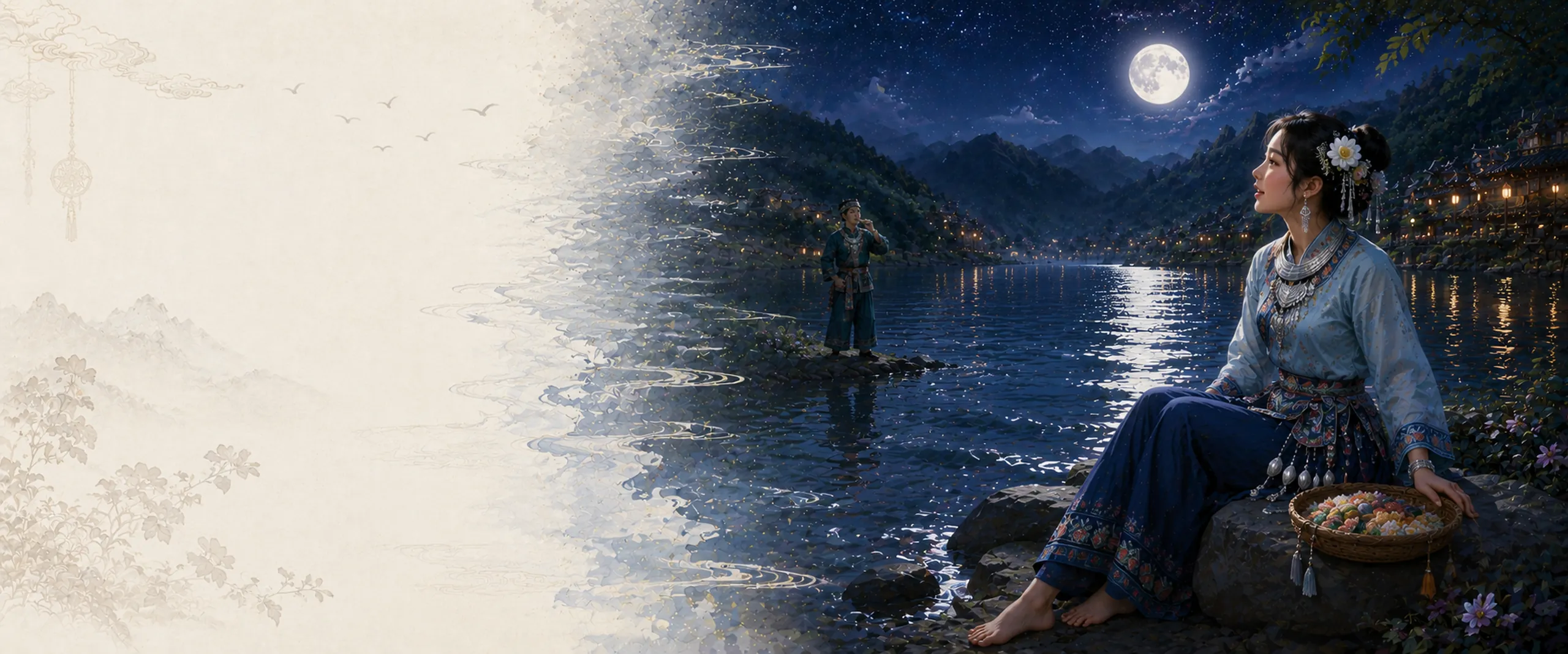
During the Sisters’ Festival, whenever night falls, young men who have come from afar go to the fixed “youfang” grounds of the young women’s village and use blown leaves, whistles, and other means to signal and invite the young women to gather. The two sides communicate through love songs, singing back and forth in response to one another. If they are mutually attracted, they may continue their antiphonal singing until the moon sinks behind the slope. Young women take part in collective activities with distinctive dress and adornment, skillfully composed and beautiful lyrics, affectionate symbolic tokens, and graceful dance movements, attracting members of the opposite sex in pursuit of a satisfying love and thereby establishing their own marriages.

Drinking Songs

Drinking songs are an indispensable form of singing at the long-table banquets of the Sisters’ Festival. Miao drinking songs have a long history and are generally sung at formal wedding banquets or at banquets held for guests during New Year celebrations. There are two forms of drinking songs. In one form, the singer carries a cup of wine to the seat beside the person being toasted and sings, with each section generally consisting of around ten lines.

The lyrics of Miao drinking songs are direct and passionate: “金打酒壶银打杯,打对凤凰壶上飞。金壶银杯装满酒,敬奉姑妈不用推。” During the gate-blocking wine ritual and long-table banquets of the Sisters’ Festival, Miao young women sing melodious toasting songs and offer guests wine in horn cups. During the Sisters’ Festival, the soaring sounds of Flying Songs, the rich and ancient voices of grand songs, and the voices of love songs intertwine and can travel very far through the quiet night.

Ancient Miao Songs

Ancient Miao songs are the oldest oral tradition of the Miao people. Their content encompasses the history of migration and labor among Miao ancestors, and their melodies are desolate, spacious, and far-reaching. In Baibei Miao Village in Rongjiang, Guizhou, the local tradition includes the saying “千年唱一曲、一曲唱千年” in reference to ancient Miao songs. Each of the nine Miao branches in Taijiang County has its own distinctive way of singing ancient songs, and these songs form an important part of the “万人唱响翁你河” event.

《姊妹节歌》 itself is a narrative long poem of more than five hundred lines. Passed down from generation to generation through oral transmission, it fuses the origin legend of the Sisters’ Festival with the historical memory of the Miao people. One old Miao love song associated with the Sisters’ Festival sings: “飞歌献予远方客,米饭暗送心上人;白天共享姊妹饭,夜晚相携游方场。” These lyrics essentially summarize the main activities of the Miao Sisters’ Festival.

Folk Dance

Other 苗族

Drum-Stepping Dance

The Drum-Stepping Dance is the most emblematic folk dance of the Sisters’ Festival. Performing the Drum-Stepping Dance during the Sisters’ Festival is itself one of the sacrificial rites, through which collective dancing expresses worship of the ancestors. Miao ancestors believed that the souls of their forebears had not died but dwelled within maple-wood drums. They beat the wooden drums and danced “四方舞”, “六方舞”, “八方舞”, and other dances to delight their ancestors and thereby obtain protection for later generations.

Drum-stepping is an important way for the entire community to participate in festival activities. Carefully dressed by their parents, the young women wear festive attire: silver crowns on their heads, silver rings at their ears, silver collars around their necks, flowered garments decorated with silver plaques, silver bracelets at their wrists, and embroidered shoes on their feet. They travel from dozens of li away to gather at the drum grounds, using the occasion to display Miao dress culture. Miao women travel from dozens of li away to Laotun Village for drum-stepping on the first day, then to Yangjia Village in Shidong on the second day, and gather at Pianzhai on the third day.

Drum-stepping is also an activity through which young Miao men and women display their talent and intelligence before the public. In the center of the square, people happily gather together and begin the Drum-Stepping Dance. The lusheng sounds gently, drums resound in waves, and the people immerse themselves in rich ethnic culture, filled with joy and delight. The Miao folk recreational dance known as “Drum-Stepping Dance” is an indispensable women’s “鼓舞” at New Year celebrations and festive gatherings, especially during the lunar third-month “Sisters’ Festival”.

Lusheng Dance

The lusheng is a symbol of Miao culture. In Miao lusheng performance, words, melody, and dance are integrated into one, preserving the original and ancient qualities of Miao history, culture, and art. In ancient Miao legend, the ancestors of the Miao survived in remote antiquity by hunting birds and animals. To overcome the difficulty of capturing them, they fashioned instruments from wood and bamboo that could produce sounds similar to bird and animal calls, and then imitated the movements of those creatures.

During the Sisters’ Festival, young men play the lusheng while asking the young women they admire for “decorative flower ribbons”. If a young woman returns his affection, she ties a flower ribbon she has carefully woven onto his lusheng. In addition to large-scale village group dances involving lusheng and drum-stepping, every household prepares five-colored rice, and at the village entrance welcomes relatives and friends with a cup of gate-blocking wine and a mouthful of five-colored rice.

During the Sisters’ Festival, young women and men dressed in festive and ethnic clothing joyfully gather along the Qingshui River to take part in recreational and sporting activities: youfang mountain singing, lusheng playing, beach drum-stepping, gong and drum playing, lusheng dance, boating, bullfighting, and more. The lusheng dance is one of the most participatory dance forms of the Sisters’ Festival—as soon as the lusheng sounds, people rise and dance.

Ten-Thousand-Person Grand Costume Parade

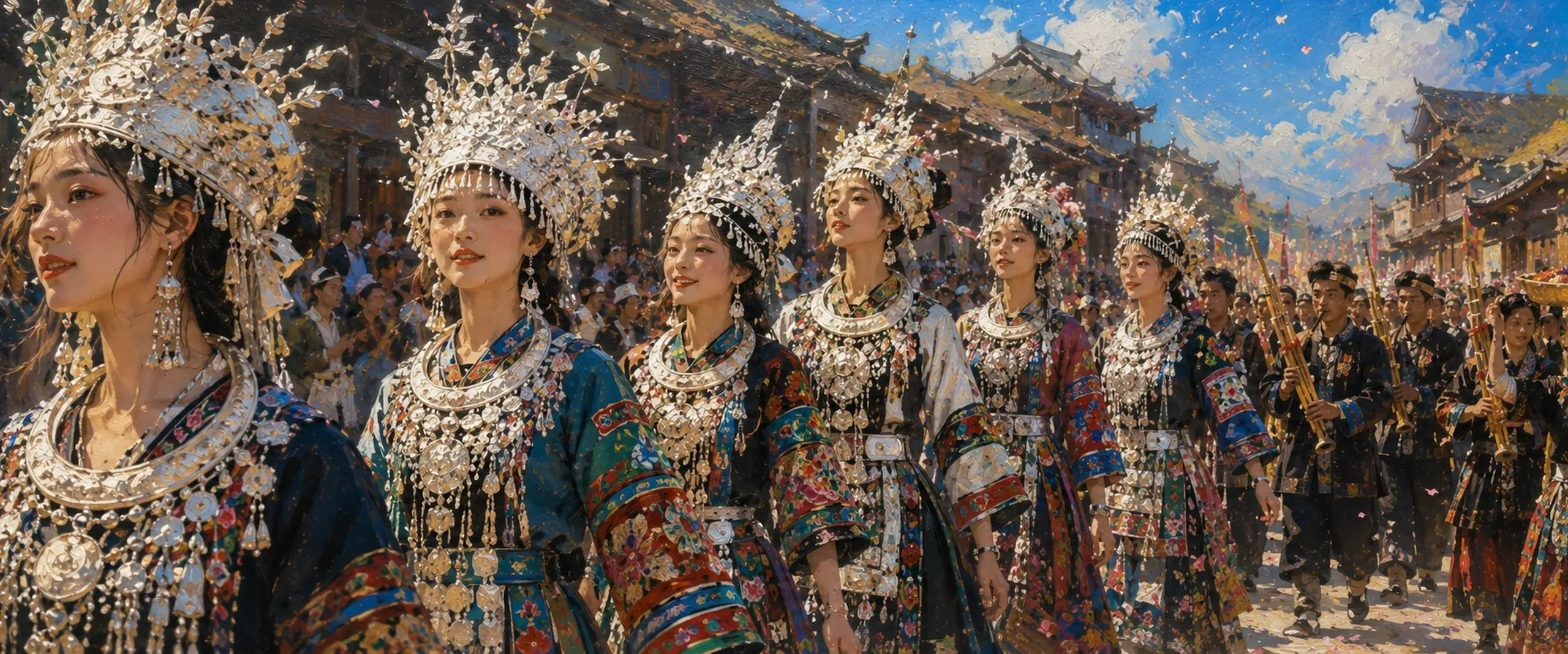
The ten-thousand-person grand costume parade is the most visually striking form of folk art in the contemporary Sisters’ Festival and a concentrated display of Miao dress culture, silversmithing, and embroidery. The grand costume performance is one of the festival’s central events. Its varied formations, Miao dance performances, displays of production and everyday life, dragon-lantern and flower-lantern performances, and other elements comprehensively present the diverse Miao costumes of Taijiang and the atmosphere of daily Miao life, fully displaying the brilliant indigenous ethnic cultures of different Miao branches.

Young Miao women from the nine branches of Taijiang County wear distinctive ceremonial dress and glittering silver ornaments, forming a parade several kilometers long. Miao participants move to the beat of drums and dance into the wind, while layer upon layer of silver ornaments ring brightly with every movement of the body, creating a breathtaking spectacle. The parade can truly be called a “walking museum”—every piece of silver jewelry, every embroidered pattern, and every motif silently tells the history and culture of the Miao people.

Folk Music

Other 苗族

Blown Leaves

Blowing on leaves is one of the most distinctive musical forms of “youfang” during the Sisters’ Festival. Whenever night falls, young men who have come from afar go to the fixed “youfang” grounds of the young women’s village and use blown leaves, whistles, and other means to send signals inviting the young women to gather. The sound of a leaf is crisp and pleasing and can travel far through the quiet mountain night. In the mouth of a young Miao man, an ordinary tree leaf becomes a “love letter in sound”—a single note blown from the leaf is an invitation to love.

Lusheng

The lusheng is the most important instrument in the folk music of the Sisters’ Festival. It is not merely a musical instrument, but also a symbol of Miao culture. During the Sisters’ Festival, the sound of the lusheng runs through the entire celebration—from daytime drum-stepping to nighttime youfang, from village gatherings to riverside festivities, the lusheng can be heard everywhere. Lusheng melodies include fixed traditional tunes as well as improvised passages, but every lusheng piece carries the emotions and memories of the Miao people.

Polyphonic Folk Songs

Miao polyphonic folk songs are among the most distinctive forms of Miao folk music, and the beauty of their unaccompanied harmonies is extremely rare even in world music. Each of Taijiang County’s nine Miao branches has its own distinctive singing tradition, and during the Sisters’ Festival “万人唱响翁你河” event, ancient Miao songs, polyphonic love songs, drinking songs, Flying Song antiphonal performances, and many other forms are brought together.

Fang Shaobao, a national-level representative inheritor of Miao polyphonic folk songs, teaches young women to sing each year before the Sisters’ Festival. Miao polyphonic love songs are among the most representative musical forms of Taijiang. Singers sit on the ground and engage in lively antiphonal singing, their voices lingering as if around the rafters for three days, continuing from daylight deep into the night.

Sisters’ Rice

Other 苗族

Preparation

Five-colored Sisters’ Rice is the most emblematic folk-cultural symbol of the Sisters’ Festival and a concentrated expression of Miao food culture, aesthetic culture, and emotional culture. Sisters’ Rice is made by dyeing and steaming glutinous rice, producing a dish of many brilliant colors that is fragrant and delicious. Young women go into the mountains to gather the flowers and leaves of wild plants, use them to dye the glutinous rice in many colors, and then steam it until cooked.

The Miao call the flowers of Buddleja officinalis “Sisters’ Flowers” and use them to dye glutinous rice yellow. These flowers bloom every year in the third and fourth lunar months and are associated with the traditional effects of clearing heat and nourishing the liver, draining fire, and brightening the eyes. The black, red, yellow, white, purple, blue, green, and other colors of five-colored Sisters’ Rice all come from natural plant dyes—black from maple leaves, red from sappanwood or Sisters’ Flowers, yellow from Buddleja officinalis, purple from indigo, while white is the natural color of the glutinous rice.

Color Symbolism

The different colors of five-colored Sisters’ Rice carry different symbolic meanings. Green represents one’s beautiful homeland—or the Qingshui River; red symbolizes prosperity and flourishing; yellow symbolizes abundant harvests; purple symbolizes auspicious energy arriving from the east; and white symbolizes pure love. Sisters’ Rice expresses the Miao people’s yearning for a beautiful life—every color is a prayer for happiness, and every hue embodies hope for the future.

A Code of Love

Sisters’ Rice is also a token that young women give to romantic partners in order to express their feelings. Young women hide different objects inside the rice to communicate different emotions toward a young man. When a young man receives Sisters’ Rice and opens it, he can understand the young woman’s intentions:

Pine needles imply a request for embroidery needles, indicating that the young man should repay the young woman with embroidery needles and silk thread. A bamboo hook means that he should buy an umbrella as a return gift. Chinese toon shoots indicate that marriage is possible. Chili peppers or garlic convey a message of breaking off the relationship—telling the young man that the two are not suited to one another. * A single forked twig, scallions and garlic, leaves, and other objects also each carry their own specific meanings.

As an old Miao love song sings: “飞歌献予远方客,米饭暗送心上人”. Everything is conveyed without words, and yet everything remains wrapped in mystery. Sisters’ Rice is like a wordless love letter and has brought together countless happy marriages.

Folk Arts and Crafts

Other 苗族

Miao Silverwork

Miao silverwork is the most visually striking form of folk arts and crafts at the Sisters’ Festival. Miao women enjoy relatively high status within the family, and a girl’s dress generally reflects the economic circumstances of her household. The three most fundamental artistic characteristics of Miao silverwork are that larger, heavier, and more numerous pieces are regarded as more beautiful. A complete ceremonial silver ensemble includes dozens of ornaments such as silver crowns, silver horns, silver collars, silver bracelets, silver belts, and silver earrings, and may weigh several kilograms.

The Sisters’ Festival is the most important stage on which Miao women display their grand silver adornments. A beautiful Miao young woman from the Shidong region perfectly embodies the artistic principle that Miao silverwork values “以大以重以多为美”. During the grand costume parade, the layered silver ornaments worn by the young women ring brightly with every movement, creating a breathtaking sight.

Miao Ceremonial Dress

Among the Miao of Taijiang there is a saying: “文化藏在身上,史书从头读起”. The Miao have no traditional writing system, so they embroider their culture onto Miao clothing, sing it into Miao songs, and embed it in silver ornaments. A Miao woman’s ceremonial dress is a work of art combining family wealth, craft transmission, and aesthetic expression, and every embroidered motif carries a specific cultural symbol.

During the Sisters’ Festival, young women wear silver crowns, silver earrings, silver neck rings, flowered garments decorated with silver plaques, silver bracelets, and embroidered shoes. The Miao Sisters’ Festival centers on young women, with the display of song and dance and of traditional dress as major activities.

Embroidery and Brocade Weaving

Miao embroidery and Miao brocade weaving are important folk craft displays during the Sisters’ Festival. During the festival, members of Taijiang’s nine Miao branches comprehensively present the brilliant indigenous ethnic culture of their clothing, silver ornaments, embroidery, and other traditions. From childhood, Miao girls learn embroidery and brocade weaving from their mothers through oral and direct instruction, and the ceremonial dress worn at the Sisters’ Festival is the crystallization of many years of painstaking work. Every motif and every stitch in Miao embroidery embodies Miao women’s pursuit of beauty and their commitment to preserving their culture.

Contemporary Transmission

Heritage & Transmission 苗族

Intangible Cultural Heritage Recognition

On May 20, 2006, with the approval of the State Council, the Miao Sisters’ Festival was included in the first batch of China’s national intangible cultural heritage list (category: folk custom; number: Ⅹ-22). The Miao Sisters’ Festival is a core vehicle of Miao culture in Taijiang, as well as an important platform for presenting the image of Taijiang, transmitting the cultural lineage of the people, witnessing beautiful relationships, and promoting ethnic unity.

Contemporary Folk Celebration

Far from declining in contemporary society, the Sisters’ Festival has instead shown an increasingly expanding tendency. The 2025 Taijiang Miao Sisters’ Festival took “姊妹花开·情定台江” as its theme. Its opening ceremony centered on the Miao legend of “Jindan and Ajiao” and focused on the integration of Miao culture and fashion, presenting Taijiang’s local character and contemporary spirit while creating a cultural celebration that crossed ethnic boundaries.

Ten-thousand-person grand costume parade: centered on the ceremonial dress of Taijiang County’s nine Miao branches, this event brought together 10,000 people in collective grand costume performances, highlighting local ethnic culture and distinctive clothing while presenting the human and cultural character of the Taijiang Miao.

Ten thousand voices along the Wengni River: more than 10,000 male and female singers and dancers from Taijiang County’s nine Miao branches gathered beside the Wengni River, engaging expressively in antiphonal performances of Miao Flying Songs and love songs, and singing red songs together.

Xiong Jinjiang, Party Secretary of Taijiang County Secondary Vocational School, believes that over the years the Sisters’ Festival has not only stimulated investment and tourism development in Taijiang, but has also become an important vehicle for transmitting Miao culture. As transportation and infrastructure have improved, enthusiasm for participating in the activities has grown even stronger.

Inheritors

Fang Shaobao, a national-level representative inheritor of Miao polyphonic folk songs, frequently teaches young women to sing before the Sisters’ Festival. His teaching is not merely the transmission of technique, but the continuation of the cultural lifeblood of the Miao people. Through oral and direct instruction, the song traditions of the Sisters’ Festival continue from one generation to the next. Whenever the Sisters’ Festival draws near, cicadas sing like music outside the window while enthusiasm fills the room—this is one of the most vivid portraits of the living transmission of Miao folk arts.

Closing Reflections

Overview 苗族

The folk artistic expression of the Miao Sisters’ Festival differs fundamentally from the “literati poetry” associated with Han festivals. It is not “written” in words, but “sung,” “danced,” “worn,” and “eaten” at the festival itself. It does not arise from an external perspective of “watching” and “reflection,” but from an internal perspective of “speaking” and “revelry.”

From the age-old legend in 《姊妹节歌》 of Ajiao and Jindan “藏饭定情”, to the ethnic memory in migration songs of “年年来吃姊妹饭,不忘我们姊妹情”; from the mountain voice of Flying Songs with their “见物即情即兴编唱”, to the heartfelt declarations of youfang songs in which lovers “对歌对到月落坡”; from the ringing rhythm of silver ornaments in the Drum-Stepping Dance, to the visual impact of the ten-thousand-person grand costume parade as a “行走的博物馆”; from the “色香味情合一” love code of five-colored Sisters’ Rice, to the Miao silverwork aesthetic of “以大以重以多为美”—the folk artistic expression of the Miao Sisters’ Festival takes “song” and “dance” as its twin wings, and “feeling” and “beauty” as its core, forming a complete, living, and continuously flourishing system of cultural expression.

The Miao Sisters’ Festival has been called a “藏在花蕊里的节日”—a festival hidden within the heart of a flower. This metaphor refers not only to the festival’s romance and subtlety, but also to the cultural depth that must be savored carefully and unfolded layer by layer before it can be fully discovered. Just as Miao girls “hide” their feelings within Sisters’ Rice, the Miao people have also “hidden” a thousand years of culture within every song, every dance step, and every piece of silverwork.

The Sisters’ Festival is a festival of affection and love, and at the same time a grand gathering that displays the richly varied arts of Miao song, dance, and clothing, as well as the profound cultural heritage of the Miao people. Taijiang is “歌与舞的海洋,是情与爱的世界”. When Flying Songs ring out high above the Wengni River, when the drumbeats of the Drum-Stepping Dance resound powerfully beside the Qingshui River, when love songs flow beneath the moonlight on the youfang grounds, and when the ten-thousand-person grand costume parade winds through the streets of the county town—that is the Miao people using their own voices, their own bodies, their own dances, and their own clothing to offer their deepest and most enduring declaration of love to “feeling” and “beauty.” The Sisters’ Festival is like the five-colored Sisters’ Rice itself—every color is a memory, and every grain of rice carries affection. It is not a performance to be watched, but a revelry to be joined; it is not writing inscribed on paper, but emotion sung into song, rhythm danced beneath the feet, history worn upon the body, and a love letter hidden inside rice.

—

Continue exploring Sisters’ Festival culture

Readers’ Comments

Calendar and traditional culture enthusiasts from around the world, sharing the same moon.

Sign in or register to join the conversation. Your comment account is created automatically the first time you use a connected account.